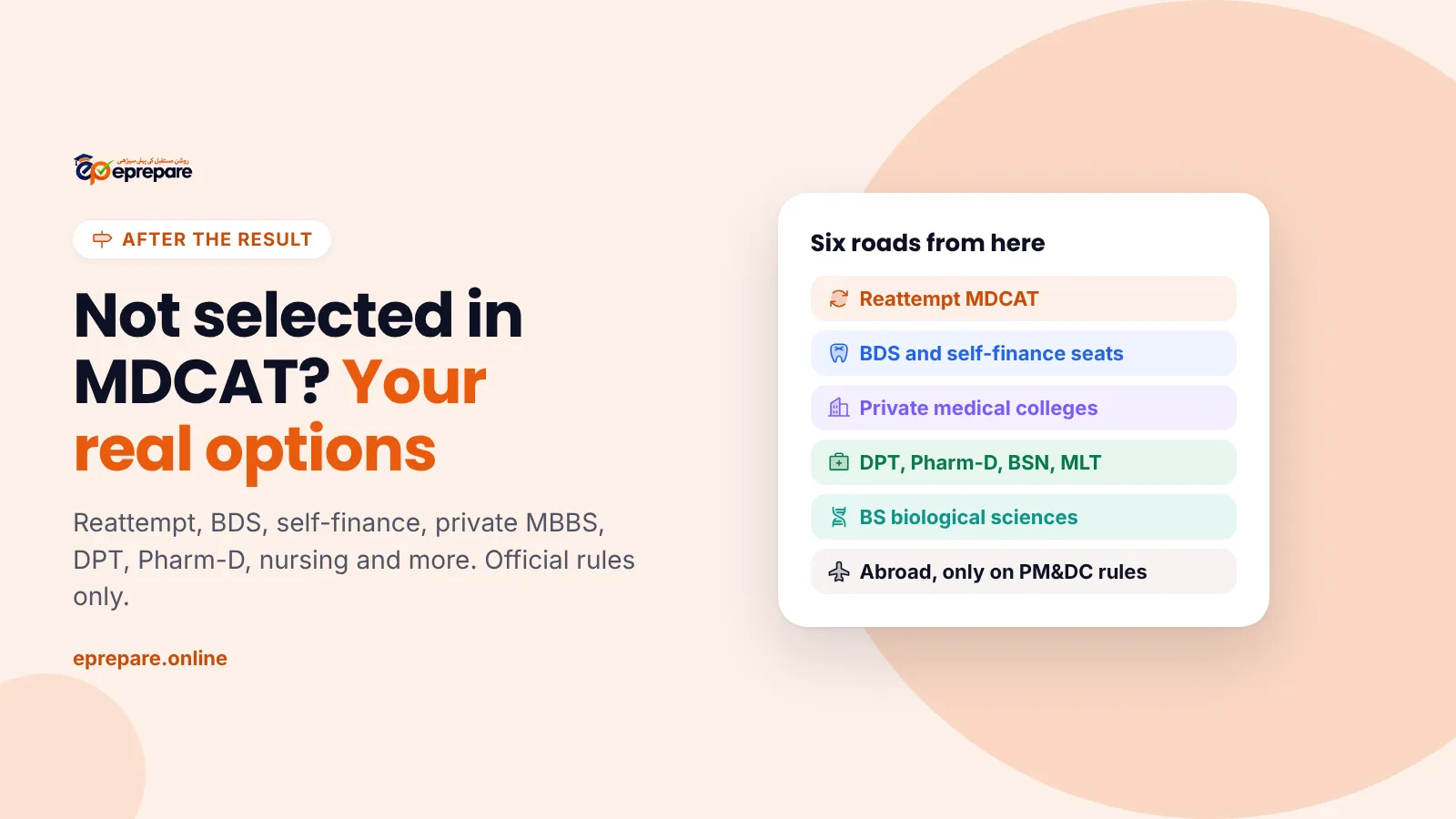
If your name is not on the merit list you were hoping for, this page is for you. Take a breath before you read the rest. A missed seat feels like the end of the road at 18. It is not. Every year, students in exactly your position go on to become doctors, dentists, pharmacists, physiotherapists and nurses. Some take MDCAT again. Some choose a different health degree and never look back.
We work with repeaters and their families every year at ePrepare, so we will be honest with you. There is no shortcut and no secret seat. But there are more real options than most students know about, and the rules for each one are written down by official bodies. This guide puts them in one place: reattempting MDCAT, BDS and self-finance seats, private medical colleges, allied health degrees such as DPT, Pharm-D, nursing, lab technology and radiology, BS biological sciences, and MBBS abroad under the rules of the Pakistan Medical and Dental Council (PM&DC).
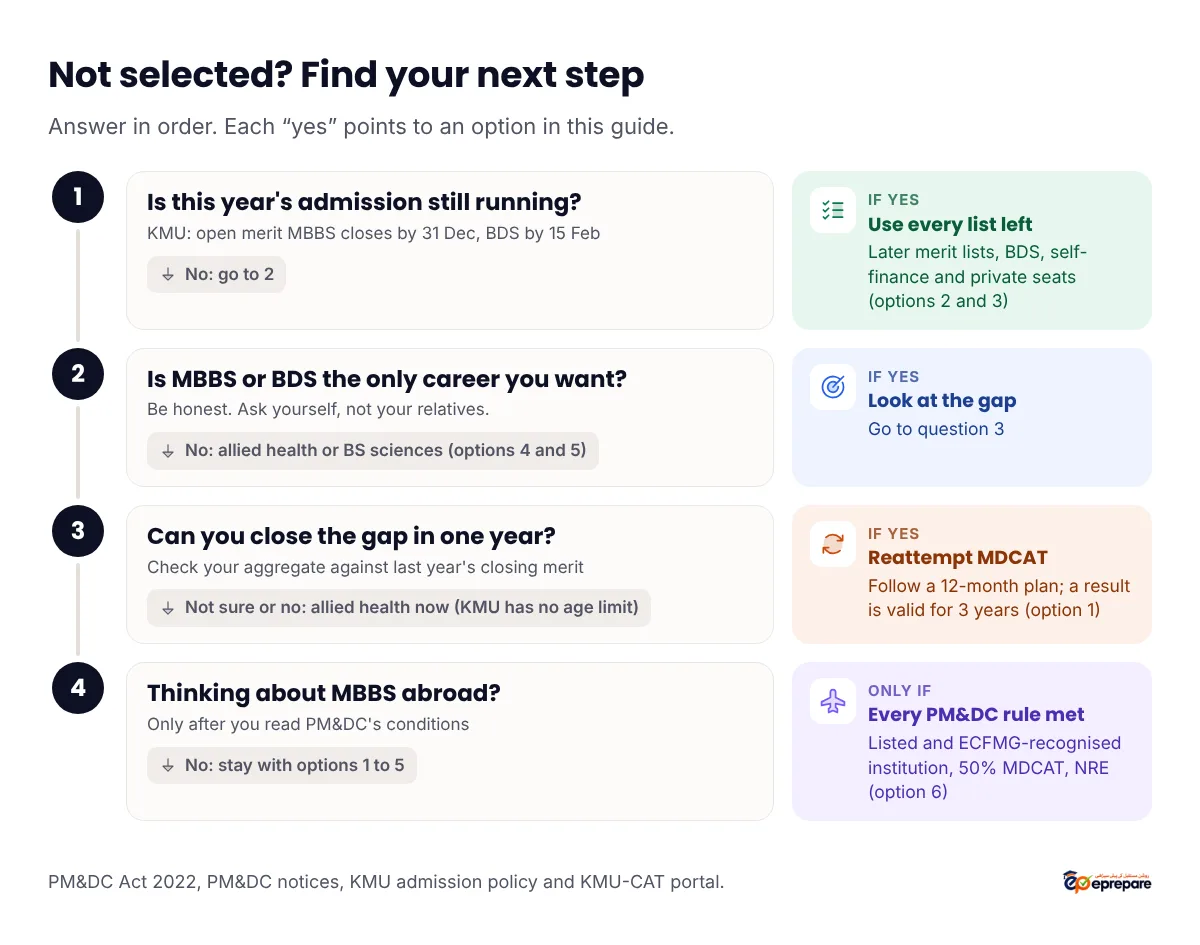
The short answer: first check whether this year's admission is still running, because later merit lists, BDS (which needs its own application), self-finance and private seats can still come through. If not, you have two main roads. You can reattempt MDCAT: under the PM&DC Act a result is valid for three years, and KMU has no age limit. Or you can take a different health degree, such as Pharm-D (5 years), Doctor of Physical Therapy (5 years), BS Nursing (4 years) or a 4-year BS in medical lab technology or radiology, through tests such as KMU-CAT or UHS UGAT. MBBS abroad is only safe if you meet every PM&DC condition, including 50% in MDCAT, an institution on PM&DC's list that is recognised by ECFMG, and passing PM&DC's National Registration Examination when you come back.
First, give yourself a week
Do not decide your whole future on the night of the result. Feelings are loudest in the first two days, and that is exactly when relatives, group chats and social media are loudest too. Here is the week we suggest to our own students:
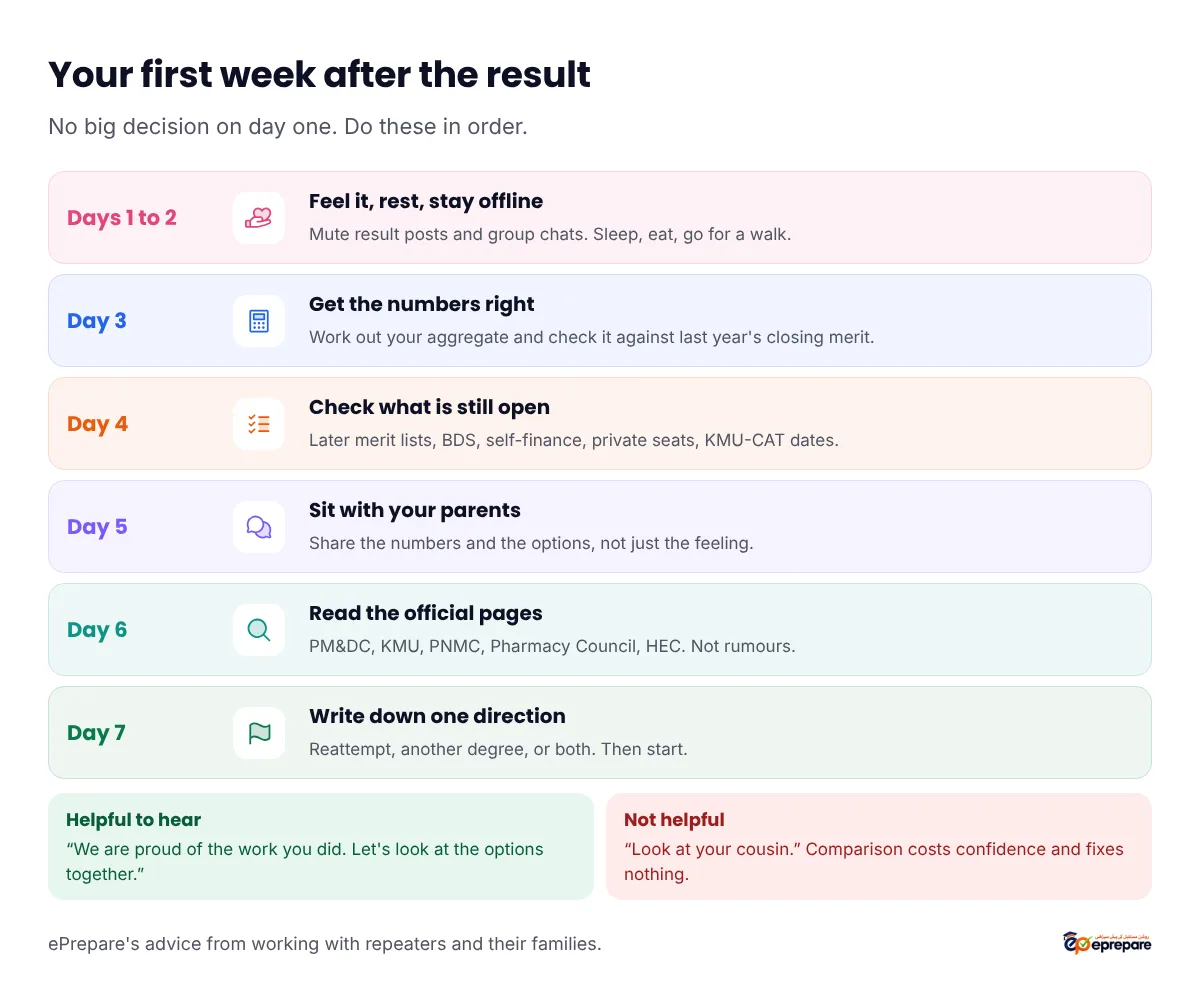
The most useful day is day 3. Put your marks into the aggregate calculator: for public MBBS and BDS seats, merit is 10% Matric, 40% FSc and 50% MDCAT, and one MDCAT mark out of 180 is worth about 0.28 aggregate. Then compare your figure with last year's cut-offs on the KMU closing merit page. A real number makes every conversation after that calmer.
Is this year really over? Check before you decide
"Not selected" on the first merit list does not always mean not selected this year. In Khyber Pakhtunkhwa (KP), Khyber Medical University (KMU) runs at least three merit lists, and seats left empty because selected students did not pay go to the next candidates on merit. KMU's policy also fixes when admissions must close:
| Programme | Open merit seats | Special category seats |
|---|---|---|
| MBBS (public colleges) | By 31 December | By 10 January |
| BDS (public dental colleges) | Before 15 February | By 28 February |
So until those dates, keep checking every list, keep your documents and the fee ready, and answer every call from KMU. Our guide to KMU merit lists, upgrades and the waiting list explains how the later lists work, and the KMU admission schedule shows every step. Students in other provinces should follow their own admitting university's notices; see our guides for Punjab (UHS), Sindh, Balochistan and Islamabad.
Option 1: Reattempt MDCAT
For many students this is the right choice, especially if the gap to a seat is small. Before you commit, know the rules that protect a repeater.
The rules that matter for repeaters
- Your result stays valid for three years. Section 17 of the PM&DC Act says: "The MDCAT result of one province shall be valid for the entire country and shall be valid for a period of three years." KMU's admission policy repeats the same rule.
- There is no age limit for KP's public medical and dental colleges. KMU's policy says: "There is no lower or upper age limit for admission in public sector Medical/Dental colleges of Khyber Pakhtunkhwa."
- The pass mark is the same on every attempt: 55% for MBBS and 50% for BDS. See MDCAT passing marks.
- Improved FSc marks can count, but only if your board declares the result and issues the certificate before KMU's closing date. KMU's policy does not mention any deduction for improvers. What you upload on the portal is final.
- If you hold two valid MDCAT results, KMU's policy does not say which one it uses. Follow the instructions on the form for your session, and ask KMU's admission office before the closing date if they are unclear.
All the details, with the policy quoted word for word, are in our guide to KMU rules for improvers and repeaters.
Is a repeat year worth it for you?
Be honest with three questions. How far is my aggregate from the seat I want? Do I know exactly where my marks went? Do I still want medicine, or am I repeating because of pressure from others? Remember that MDCAT moves your aggregate fastest: each MDCAT mark is worth nearly eight FSc marks out of 1,100. If you were a few MCQs short and you know why, a repeat year is a real chance. If you are not sure you want medicine at all, read the other options first. Our MDCAT repeaters guide walks you through this decision.
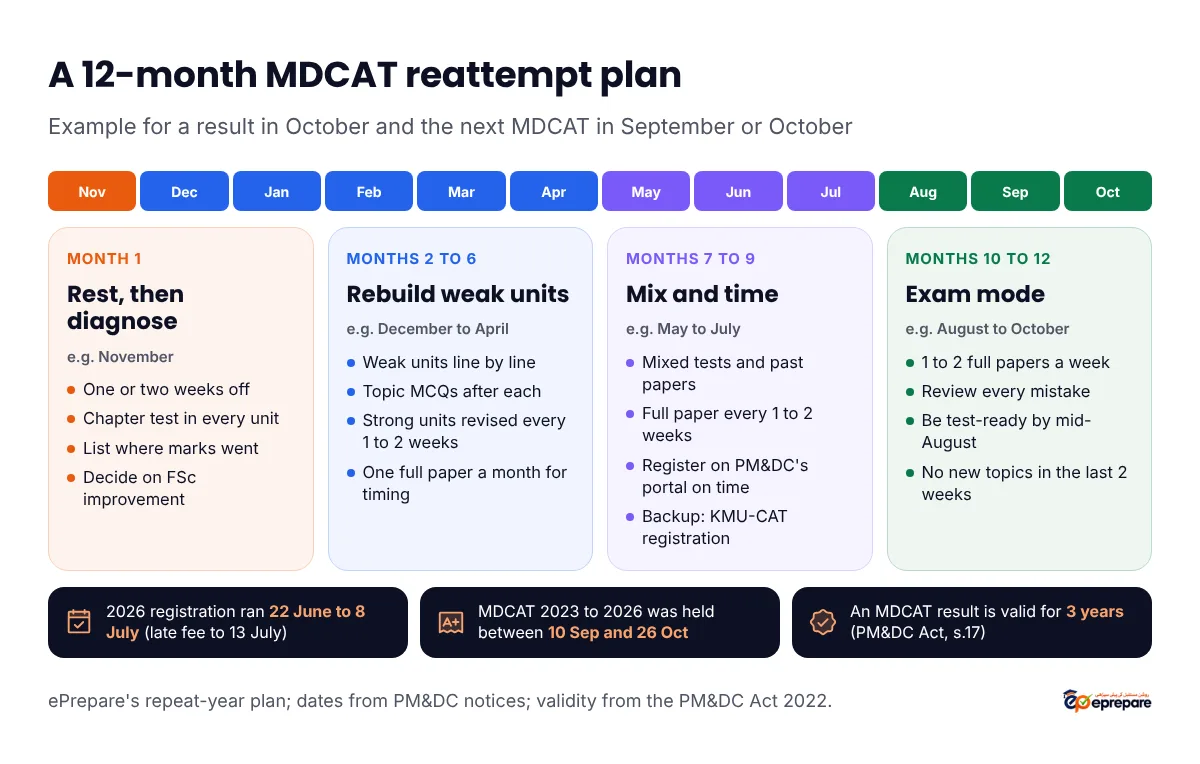
A 12-month reattempt plan
| When | Stage | What to do |
|---|---|---|
| Month 1 (e.g. November) | Rest, then diagnose | One or two weeks off. Then a chapter test in every unit, and a written list of where your marks went: knowledge gaps, forgetting, time pressure or careless mistakes. |
| Months 2 to 6 (December to April) | Rebuild | Study weak units fully with topic MCQs. Keep strong units fresh with short revision sets. One full-length paper a month for timing. |
| Months 7 to 9 (May to July) | Mix and time | Mixed chapter tests, past papers and a full paper every one to two weeks. Register for MDCAT on PM&DC's portal as soon as the window opens. |
| Months 10 to 12 (August to October) | Exam mode | One or two full papers a week with a proper review of each. No new material in the last two weeks. |
Two dates to plan around. For MDCAT 2026, registration ran from 22 June to 8 July, with a late fee until 13 July, and the test, first set for 16 August, was held on 20 September. Every MDCAT from 2023 to 2026 was held between 10 September and 26 October. So aim to be ready by mid-August and treat any extra weeks as a bonus. Our MDCAT date and registration guide is updated when PM&DC announces the next test.
Do not restart from page one. Test each unit first; study fully only where you score poorly. Start full-length papers much earlier than last year, and review each one for at least as long as you spent solving it. Our guide to mock tests and FLPs shows how.
Make a backup in the same year. Allied health tests such as KMU-CAT and UHS UGAT are held in summer, before the MDCAT result (more below). Sitting one keeps a second door open, so a second disappointment does not cost you another full year.
Option 2: BDS and self-finance seats
If you are close to the merit line, these two can turn "not selected" into a seat, as long as you applied for them.
BDS is a separate application
KMU's policy says medical and dental admissions are conducted separately, and "a student having not applied to a given program shall not be entitled to admission to such program." The minimum MDCAT score for BDS is 50% (90 out of 180). BDS is a four-year degree, and KP's four public dental colleges have 260 sanctioned seats. It is competitive: in KMU's latest final merit list, the highest BDS open merit closing (Khyber College of Dentistry, 93.0232) was only about one or two MDCAT marks below the lowest MBBS open merit closing (93.4020). BDS is a full professional degree, not a consolation prize. Read our guide to KMU BDS admission before you decide.
Self-finance: same college, higher fee
A general self-finance (GSF) seat is a seat inside a public college, with the same classes, teachers, hostel and house job as open merit. The difference is the fee: under KMU's latest policy, self-finance MBBS costs Rs 11.62 lakh to Rs 12.62 lakh in the first year, against Rs 87,000 to Rs 102,000 on open merit. In KMU's latest final merit list, self-finance MBBS closed 0.7 to 1.5 aggregate below open merit in the same college, which is about 3 to 5 MDCAT marks. If your family can afford it without strain, it is the same education. If it would be a heavy burden, a repeat year or another degree may be wiser. Our comparison of self-finance vs open merit and the KMU fee structure have every figure.
Option 3: Private medical colleges
Private MBBS and BDS still need an MDCAT pass. The PM&DC Act says no student can be awarded a medical or dental degree in Pakistan without passing MDCAT before admission, and that MDCAT must make up at least 50% of the weightage for admission in both public and private colleges. Private colleges "may take any additional entrance test" set by their affiliating university. In KP, you apply to private colleges through KMU's separate private portal, caspr.kmu.edu.pk, not the public one.
Fees are much higher than in public colleges and differ by college. See every college's figures in our guide to private medical colleges in KPK and their fee structure, and sit down with your parents and the full five-year total before you accept anything. Check that any college you consider is recognised by PM&DC on pmdc.pk.
Option 4: Allied health degrees (DPT, Pharm-D, nursing, lab and radiology)
These are not "lesser" choices. They are separate professions with their own degrees, councils and careers in hospitals, labs, clinics and industry. Many need the same FSc pre-medical background you already have, and the entry tests cover the same Biology, Chemistry and Physics you studied for MDCAT.
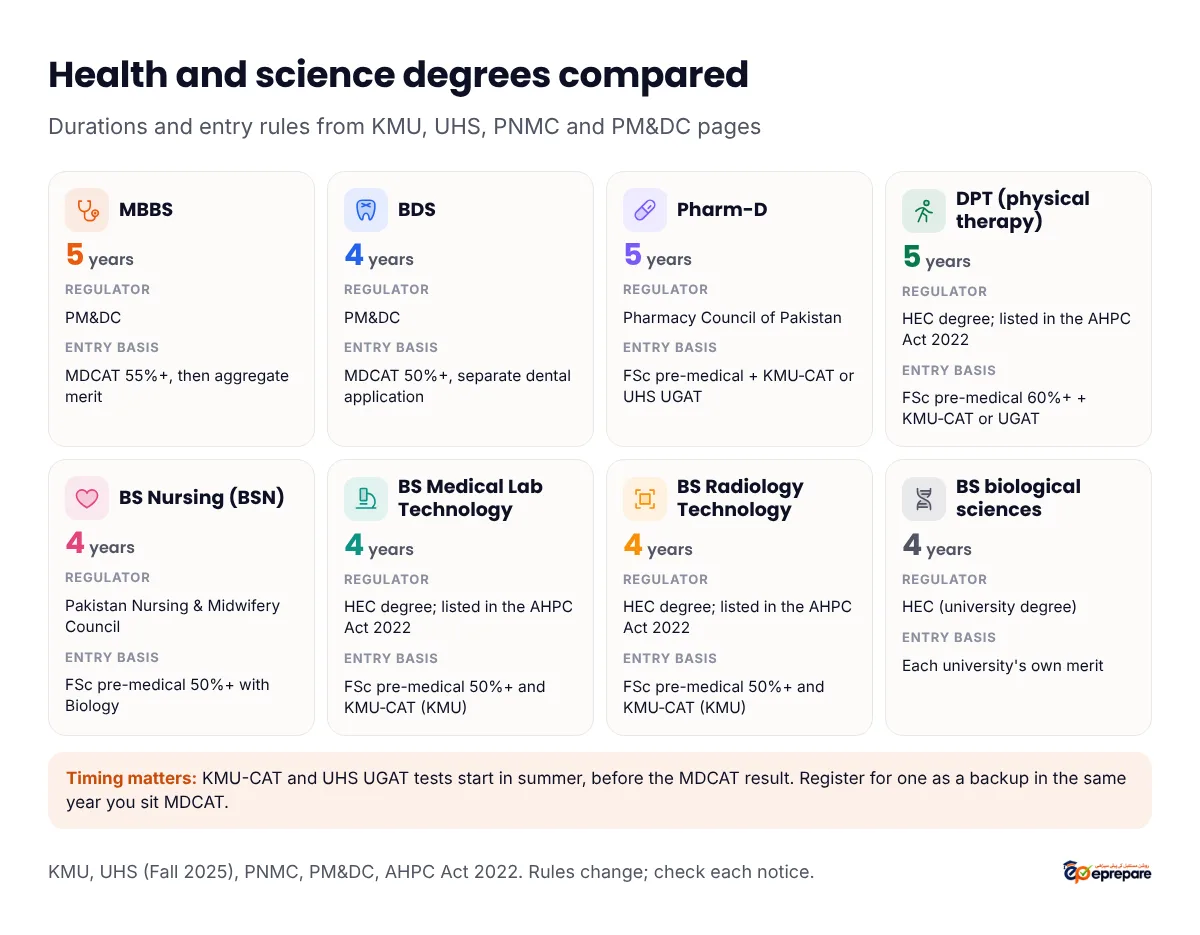
| Programme | Years | Regulator | Entry basis |
|---|---|---|---|
| Doctor of Pharmacy (Pharm-D) | 5 | Pharmacy Council of Pakistan (registers pharmacists) | FSc pre-medical; KMU uses KMU-CAT (SSC 10%, FSc 40%, test 50%); UHS asked for 60% and UGAT |
| Doctor of Physical Therapy (DPT) | 5 | University degree under HEC; physiotherapy is listed in the Allied Health Professionals Council Act, 2022 | FSc pre-medical with at least 60% (KMU and UHS), plus KMU-CAT or UGAT |
| BS Nursing (Generic BSN) | 4 | Pakistan Nursing & Midwifery Council (PNMC) | FSc pre-medical with at least 50%, having studied Biology; age 14 to 35 |
| BS Medical Lab Technology (MLT) | 4 | University degree under HEC; listed in the AHPC Act | FSc pre-medical with at least 50% and KMU-CAT at KMU; UHS asked for 60% and UGAT |
| BS Radiology Technology (imaging) | 4 | University degree under HEC; "Radiography & Imaging Technology" is listed in the AHPC Act | FSc pre-medical with at least 50% and KMU-CAT at KMU |
| Other KMU BS programmes (anesthesia, cardiology, dental, surgical, emergency, optometry, public health and more) | 4 | University degree under HEC; most are listed in the AHPC Act | FSc pre-medical with at least 50% and KMU-CAT |
Durations come from KMU's Pharm-D page, KMU's DPT page, PNMC's degree page, KMU's paramedical institute ("BS eight semesters (4 years)") and UHS's Fall 2025 admission notice. Entry rules change from year to year, so read each university's notice for your session.
Pharm-D (Doctor of Pharmacy)
A five-year degree that leads to registration as a pharmacist with the Pharmacy Council of Pakistan, which works under the Pharmacy Act, 1967 and publishes the list of institutions whose pharmacy degrees it recognises. Check that list before you join any college. At KMU, Pharm-D is taught at the KMU Institute of Pharmaceutical Sciences; its page says a valid KMU-CAT score is needed and lists merit as SSC 10%, FSc 40% and KMU-CAT 50%, with 71 open merit seats. UHS's Fall 2025 on-campus notice listed Pharm-D as "05 years / 10 semesters", with at least 60% in HSSC pre-medical and at least 50% in its Undergraduate Admission Test (UGAT).
DPT (Doctor of Physical Therapy)
A five-year clinical degree in physiotherapy. KMU teaches it at its Institute of Physical Medicine and Rehabilitation in Peshawar and at several Institutes of Health Sciences. KMU's BS admission portal asks for at least 60% in FSc pre-medical for DPT, compared with 50% for its other BS programmes. Physiotherapy appears in Schedule I of the Allied Health Professionals Council (AHPC) Act, 2022, which set up a national council to register and license allied health professionals through licensing exams.
BS Nursing (BSN)
The Pakistan Nursing & Midwifery Council lists the Generic BSN as a "04 years Degree Program" for students with "FSc (Pre-Medical) or equivalent with 50% marks minimum having studied Biology", aged 14 to 35. Only study at an institution on PNMC's list of recognised institutes. KMU offers BSN through its Faculty of Nursing Sciences and several campuses, with admission through KMU-CAT.
BS Medical Lab Technology, Radiology Technology and other BS programmes
KMU's Institute of Paramedical Sciences runs four-year, eight-semester BS programmes in medical lab technology, radiology, anesthesia, cardiology, dental, surgical, emergency, renal dialysis and more, and other KMU campuses offer optometry, public health, speech and language pathology, audiology and occupational therapy. KMU's BS portal for its own institutes uses SSC 10%, HSSC 50% and the entrance test 40% to calculate merit, and admits on "merit-cum-quota basis". The AHPC Act lists Medical Laboratory Technology and Radiography & Imaging Technology among allied health disciplines.
How KMU-CAT works
The KMU Centralized Admission Test (KMU-CAT) is the entry test for KMU's allied health, nursing, DPT and Pharm-D programmes in its own and affiliated institutes. From the official portal, cat.kmu.edu.pk:
- Who can sit it: FSc pre-medical or equivalent with at least 50%, or awaiting the result.
- Paper: 100 MCQs in 90 minutes: Biology 35, Chemistry 30, Physics 20, and English, Islamiyat and Pakistan Studies 15. No negative marking.
- Validity: "KMU-CAT shall be valid for one year only."
- How often: registration opens in June, and the test is usually held three times a year. For the 2026-27 session, the portal listed tests on 26 July, 4 October and 8 November 2026, with registration for the third test closing on 2 November.
- Retakes: allowed in a later session, with a new registration and fee each time.
One caution for this season: applications to KMU's own constituent institutes for 2026-27 closed on 9 October 2026, according to KMU's BS admission portal. Before you pay for a later KMU-CAT, check which affiliated institutes are still advertising admissions.
Outside KP: UHS and other universities
In Punjab, the University of Health Sciences (UHS), Lahore runs its own Undergraduate Admission Test (UGAT). For its Fall 2025 on-campus programmes, UGAT was 100 MCQs (English, Biology, Chemistry and Physics, 25 each) in two hours, held on 3 August 2025, and merit was SSC 10%, HSSC Part I 40% and UGAT 50%. Check uhs.edu.pk for the current notice, including admissions to its affiliated colleges. Other universities in every province offer these degrees too; check that the university is on HEC's list of recognised universities.
Option 5: BS biological sciences
If you enjoyed Biology and Chemistry most, a four-year BS in a subject such as biotechnology, microbiology, biochemistry, zoology, botany, human genetics or human nutrition is a serious route into research, teaching, laboratories and industry. HEC's BS overview lists 120 to 135 credits for a BS degree. Admission is on each university's own merit, usually FSc marks with or without its own test, so read the prospectus of each university you like and confirm it is on HEC's recognised list.
These degrees can lead further. For example, KMU's Institute of Basic Medical Sciences accepts graduates with a four-year BS, BS MLT or BS Nursing into some of its MPhil programmes. Some students also sit MDCAT again during or after a BS; KMU's policy sets no age limit for admission to its public colleges.
Option 6: MBBS abroad, only on PM&DC's rules
This is the option where a wrong step costs a family the most. Do not trust anyone who says a foreign degree can be "sorted out" after you graduate. If you want to practise in Pakistan, PM&DC's rules decide whether your foreign degree counts, and they apply before you take admission, not after.
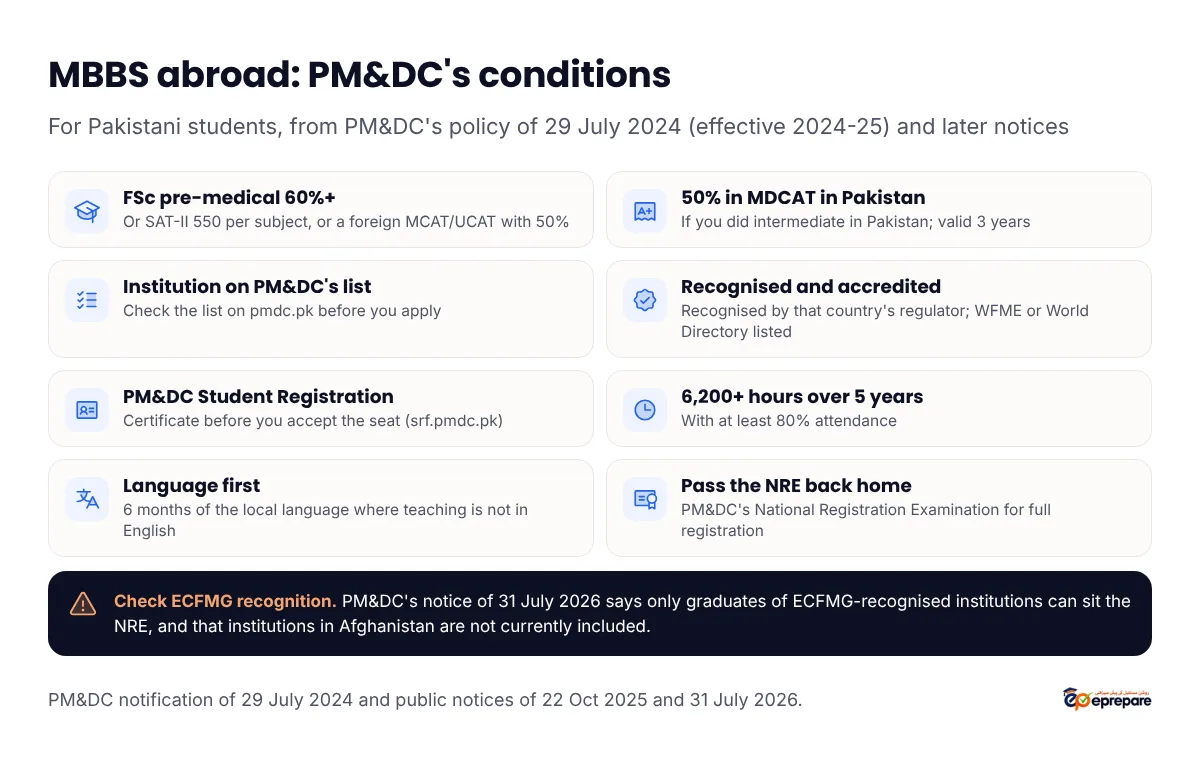
PM&DC's notification of 29 July 2024, effective from session 2024-25, lists these "mandatory conditions" for Pakistani students seeking undergraduate medical or dental admission abroad:
- FSc pre-medical with at least 60% (for students who did intermediate in Pakistan), or SAT-II with at least 550 in each subject, or a foreign MCAT or UCAT with 50%.
- At least 50% in MDCAT conducted in Pakistan, valid for three years, for students who did intermediate in Pakistan.
- The institution must be on the list available from PM&DC.
- The qualification must be in allopathic medicine from an institution recognised by that country's regulator for full registration, accredited by the World Federation for Medical Education (WFME) or listed in the World Directory of Medical Schools.
- A PM&DC Student Registration Certificate before you accept the seat. PM&DC's student alert gives the online link as srf.pmdc.pk.
- At least 6,200 hours of study, with at least 80% attendance, over five years.
- At least six months learning the local language first, where teaching is not in English.
- Passing PM&DC's National Registration Examination (NRE) for full registration after you qualify.
- Your residence details and contact numbers in that country, and a multiple-entry visa for the whole course, before you leave.
Two later notices make the rules stricter. On 22 October 2025, PM&DC said graduates of foreign institutions it does not recognise will not get provisional registration, and that recognition by the foreign regulator plus accreditation by the Education Commission for Foreign Medical Graduates (ECFMG) is the standard for NRE eligibility. On 31 July 2026, it repeated that only graduates of ECFMG-recognised institutions can sit the NRE, said that medical and dental institutions in Afghanistan are not currently included, and warned that it "shall not entertain any request for exemption, relaxation, or special dispensation." Under the PM&DC Act, the NRE is held at least twice a year and there is no limit on attempts.
We do not recommend any country or university. If you are considering this road, check the institution on PM&DC's list and on ecfmg.org yourself, get your PM&DC student registration first, and read the latest notices on pmdc.pk. Never rely on an agent's word.
How to choose between these options
| If this sounds like you | Consider first |
|---|---|
| You were a few MCQs short and know exactly why | Reattempt MDCAT, with a KMU-CAT or UGAT backup in the same year |
| You are close to the line and admissions are still running | Later merit lists, BDS and self-finance seats |
| Your family can afford private fees without strain | Private colleges, after reading the five-year total |
| You want a health career but not necessarily MBBS | Pharm-D, DPT, BSN, MLT, radiology or another BS programme |
| You loved Biology and Chemistry, and like research | BS biological sciences at an HEC-recognised university |
| You are thinking of going abroad | Only after checking every PM&DC condition yourself |
You can also combine roads. Many students start an allied health degree and sit MDCAT once more; others repeat MDCAT with a KMU-CAT result in hand. Just be realistic about time. A full repeat year needs full attention.
The part nobody talks about: how you feel
It is normal to feel embarrassed, angry, numb or lost. It is also normal to feel relieved that the waiting is over. None of these feelings means you are not good enough.
- Talk to your parents early. Most parents are more worried about you than about the result. Show them the numbers and the options in this guide, then decide together. A plan you both understand is easier to follow.
- Stop comparing. Your cousin's score, a friend's college, a stranger's result post: none of it changes your next step. Compare yourself only with your own last attempt.
- Step away from social media for a while, especially result posts and rumours about "secret seats".
- Keep a routine. Wake up at a fixed time, go outside every day, and sleep at night. A shapeless week makes everything feel heavier.
- Ask for help. If the sadness does not lift after a couple of weeks, or you stop eating or sleeping properly, talk to a doctor or a counsellor. If you ever think about harming yourself, tell someone you trust today and go to the nearest hospital.
A word to parents: your child already knows the result. What they need from you now is calm, time and help thinking through the options, not a lecture or a comparison. Our parents' guide to MDCAT has more on how to help.
"My problem was i was not consistent in study. But sir daily task make me consistent … last time my bio mcqs and concepts was not good."
Fatih Khan, Google review (2025)
Frequently asked questions
What should I do if I am not selected in MDCAT?
Give yourself a few days, then check whether later merit lists, BDS, self-finance or private seats are still possible this year. If not, choose between reattempting MDCAT, with a 12-month plan, and another health or science degree such as Pharm-D, DPT, BSN, MLT or a BS in biological sciences.
How many years is an MDCAT result valid?
Three years. Section 17 of the PM&DC Act says the MDCAT result of one province is valid for the entire country for a period of three years.
Is there an age limit for MDCAT or MBBS admission?
KMU's policy says there is no lower or upper age limit for admission to KP's public medical and dental colleges. Check your own province's admission policy if you are applying elsewhere.
Can I get into DPT or Pharm-D without MDCAT?
Yes. These programmes have their own entry tests. KMU uses KMU-CAT for allied health, nursing, DPT and Pharm-D, and UHS uses its Undergraduate Admission Test (UGAT) for its on-campus programmes. You need FSc pre-medical; KMU asks for at least 60% for DPT and 50% for its other BS programmes.
Can I do MBBS abroad if I failed MDCAT?
Not if you did your intermediate in Pakistan. PM&DC's policy requires at least 50% in MDCAT conducted in Pakistan, at least 60% in FSc pre-medical, an institution on PM&DC's list, a PM&DC student registration certificate before you accept the seat, and passing the National Registration Examination later.
Is BDS a good option if I miss MBBS?
BDS is a four-year professional degree and is competitive: in KMU's latest final merit list, the top BDS open merit closing was only about one or two MDCAT marks below the lowest MBBS closing. You must apply for it separately; KMU does not consider you for BDS unless you applied for the dental programme.
Should I take a gap year or join another degree?
Take a gap year if you were close, know why you fell short and still want MBBS or BDS above everything else. Otherwise, start a degree you will be happy in. You can sit KMU-CAT or UGAT in the same summer as MDCAT, so one result does not decide everything.
Does KMU deduct marks for FSc improvers?
KMU's latest policy for public colleges does not mention any deduction. Improved marks count only if your board declares the result and issues the certificate before KMU's closing date. KMU-CAT's own FAQ also says no marks are deducted for FSc improvement.
Your next step, whichever road you choose
A missed seat is one result, not a verdict on you. If you decide to reattempt, register on ePrepare for chapter tests that show where your marks went, a study plan up to the next test, Wrong MCQs and smart revision, and full-length papers with your rank. The same Biology, Chemistry and Physics practice also prepares you for KMU-CAT and UGAT, so your backup is covered too.
Sources: PM&DC Act 2022, sections 17 and 18, on pmdc.pk; PM&DC notification on admission in foreign undergraduate medical and dental institutes (29 July 2024), PM&DC "Students Alert for Admission Abroad", and PM&DC public notices of 22 October 2025 and 31 July 2026; Khyber Medical University's latest admission policy for public sector medical and dental colleges (validity, age limit, improvers, BDS, merit lists, deadlines, fees) on cas.kmu.edu.pk and KMU's latest final merit list; KMU-CAT portal (cat.kmu.edu.pk: eligibility, pattern, schedule and FAQ), KMU BS admission portal (bsadmissions.kmu.edu.pk: eligibility and merit), KMU Pharm-D, DPT and IPMS pages on kmu.edu.pk, KMU-IBMS prospectus 2025-26; UHS Lahore Fall 2025 on-campus undergraduate admission notice; Pakistan Nursing & Midwifery Council degree programmes page; Pharmacy Council of Pakistan; Allied Health Professionals Council Act 2022 (Schedule I) on pakistancode.gov.pk; HEC BS overview and list of recognised universities on hec.gov.pk. Rules, dates and fees change every session; always check the latest official notice.