Ask students what went wrong in their MDCAT and a surprising number do not say "I didn't know the answers". They say "I ran out of time". Twenty minutes lost on a few hard Physics numericals, a rushed last section, and fifteen circles filled in a panic in the final two minutes. Those marks were within reach. The clock took them.
Time management is a skill, and like any skill you can train it. This guide starts with the official numbers from the Pakistan Medical and Dental Council (PM&DC), then gives you a time budget for each subject, a three-pass method, how to fill the answer sheet without losing time or marks, how to handle long Logical Reasoning and English items, a minute-by-minute plan for exam day, and practice drills you can start this week.
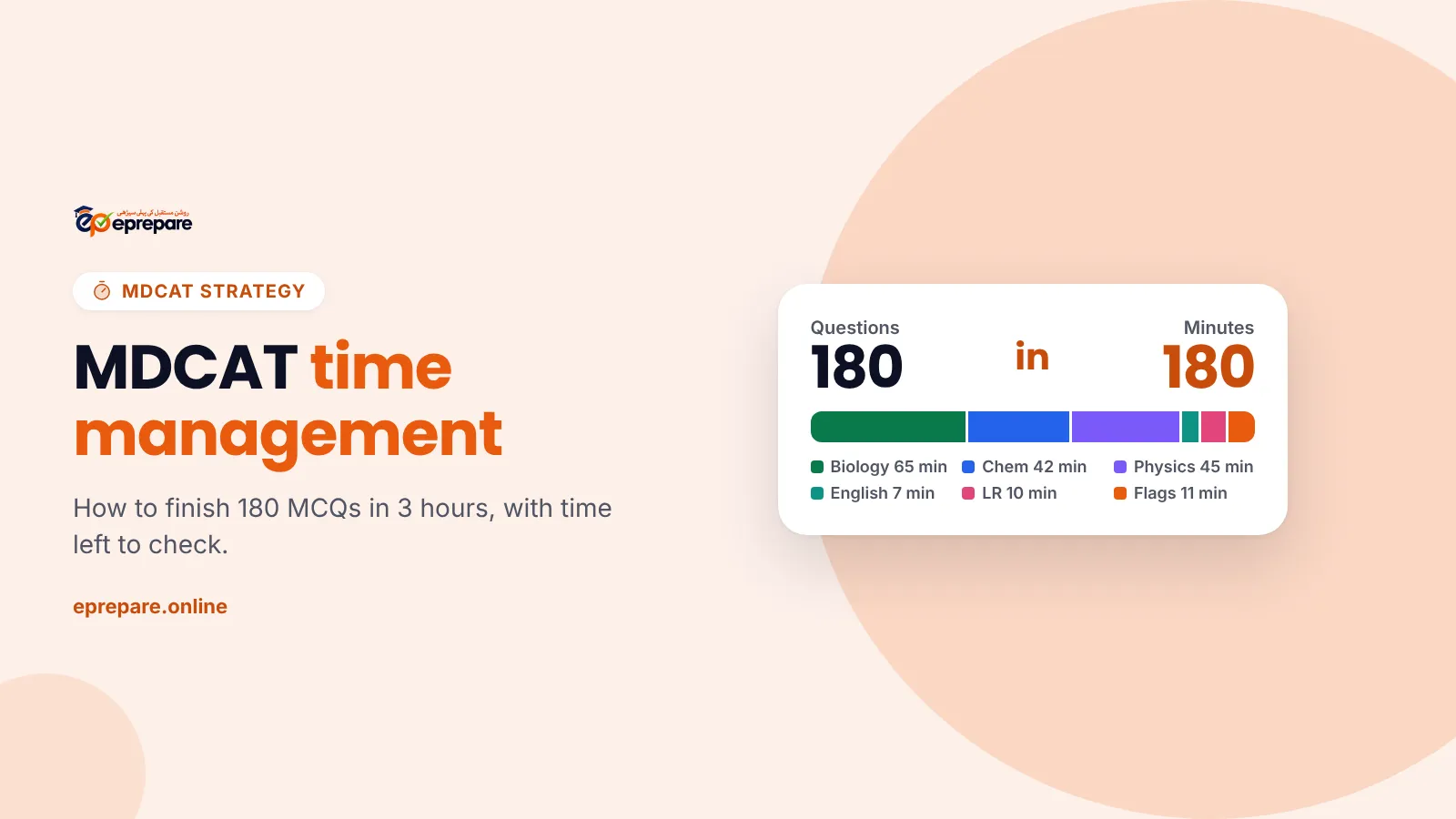
The short answer: MDCAT gives you 180 MCQs in 3 hours, an average of one minute per MCQ, on a paper-based test where you fill circles on an answer sheet. Spend about 65 minutes on Biology, 42 on Chemistry, 45 on Physics, 7 on English and 10 on Logical Reasoning, and keep about 11 minutes to return to flagged questions and check the sheet. Answer what you know first, note anything that takes more than about 90 seconds and come back to it, and make sure every circle is filled before time ends. There is no negative marking.
The official numbers
Everything in your time plan comes from these facts in PM&DC's MDCAT curriculum and its MDCAT-2026 notice:
| What | Official rule |
|---|---|
| Questions | 180 MCQs: Biology 81, Chemistry 45, Physics 36, English 9, Logical Reasoning 9 |
| Time | 3 hours |
| Format | Multiple-choice, paper-based, in English |
| Negative marking | No negative marking |
| Start time in 2026 | 10:00 PST, the same time across the country |
| Difficulty | 15% easy, 70% moderate, 15% difficult |
So MDCAT is not computer-based. You read a printed question paper and mark your answers on a response form (the OMR or bubble sheet) that a machine reads later. That matters for timing, because filling circles takes time too, and a mistake on the sheet cannot be undone. More on that below.
The conducting university runs the hall. In Khyber Pakhtunkhwa that was Khyber Medical University (KMU) in 2026, and in Punjab the University of Health Sciences (UHS). As one example of hall timings, UHS's MDCAT-2025 guide said gates opened at 8:00, closed at 9:00 sharp, question papers were handed out at 9:50, and the test ran from 10:00 to 1:00. Your own admit card and centre instructions are what count on the day.
Your time budget, subject by subject
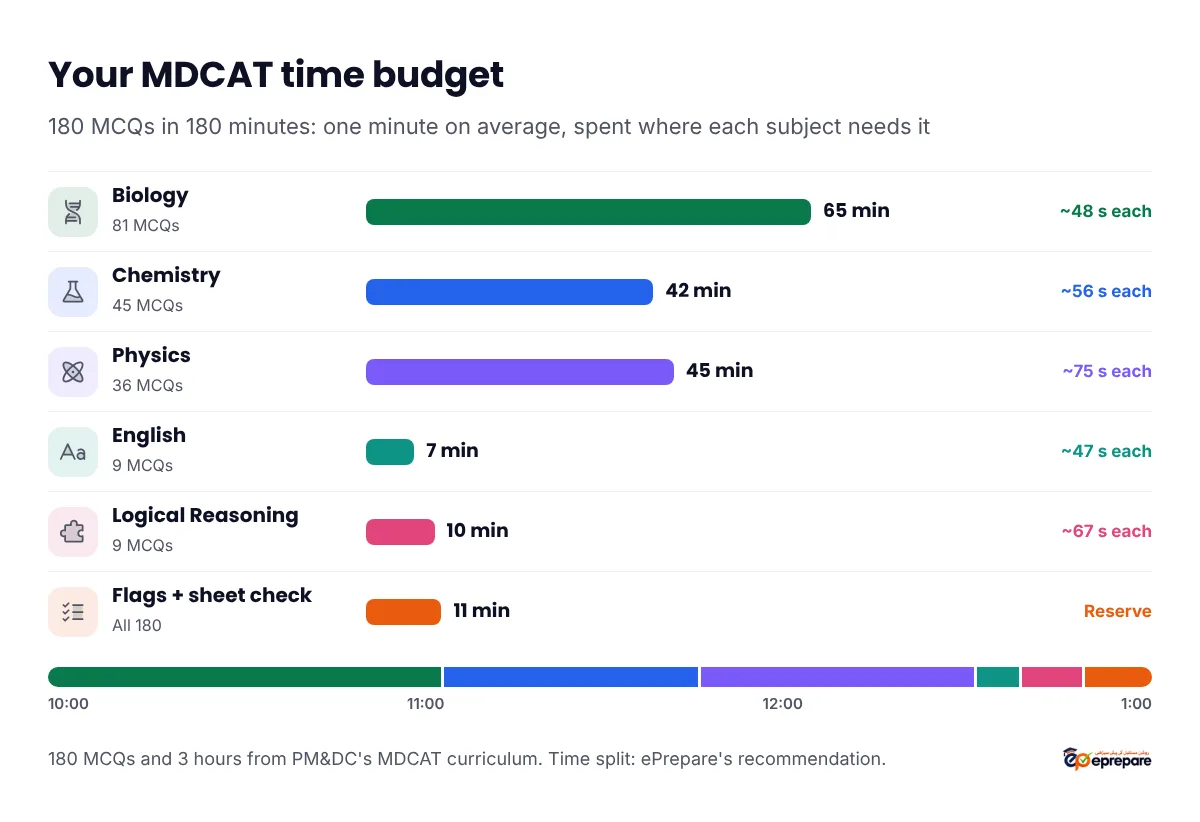
One minute per MCQ is the average, not the rule. Biology and English questions are mostly recall and usually take less. Physics numericals and Logical Reasoning puzzles take more. Here is the budget we suggest, and the pace it works out to:
| Subject | MCQs | Minutes | Pace per MCQ |
|---|---|---|---|
| Biology | 81 | 65 | About 48 seconds |
| Chemistry | 45 | 42 | About 56 seconds |
| Physics | 36 | 45 | About 75 seconds |
| English | 9 | 7 | About 47 seconds |
| Logical Reasoning | 9 | 10 | About 67 seconds |
| Flagged questions and sheet check | All | 11 | Reserve |
| Total | 180 | 180 | 1 minute average |
Treat this as a starting point. After three or four full-length papers you will know your own speed. If you are a fast Physics student and a slow reader, move a few minutes from Physics to Biology. The total never changes.
Which section should you attempt first?
There is no official order you must follow, and you should not assume Biology always comes first on your paper. UHS's 2025 guide explained that there are several paper codes (A, B, C, D) with the same questions in a different order. In the first two minutes, flip through and see where each subject starts. Then pick one of these orders and practise it in your mocks so it feels normal:
| Order | Why it works | Watch out for |
|---|---|---|
| Paper order, start to end | Lowest risk of filling the wrong line on the answer sheet | A hard section early can shake you; skip within it and keep moving |
| Strongest subject first | Quick early marks calm nerves and build a time cushion | Jumping around the sheet: check the question number every time you fill a circle |
| Biology first, Physics last | Biology is 81 marks and usually quickest; slow numericals come when the easy marks are safe | Do not let Physics shrink to 20 minutes; keep a checkpoint |
Whatever you choose, do not leave English and Logical Reasoning to the last five minutes. They are 18 marks, and a rushed Logical Reasoning puzzle is a coin toss.
The three-pass method
The single most useful habit in a timed MCQ test is to stop one question from stealing the time of five others. The three-pass method does that.
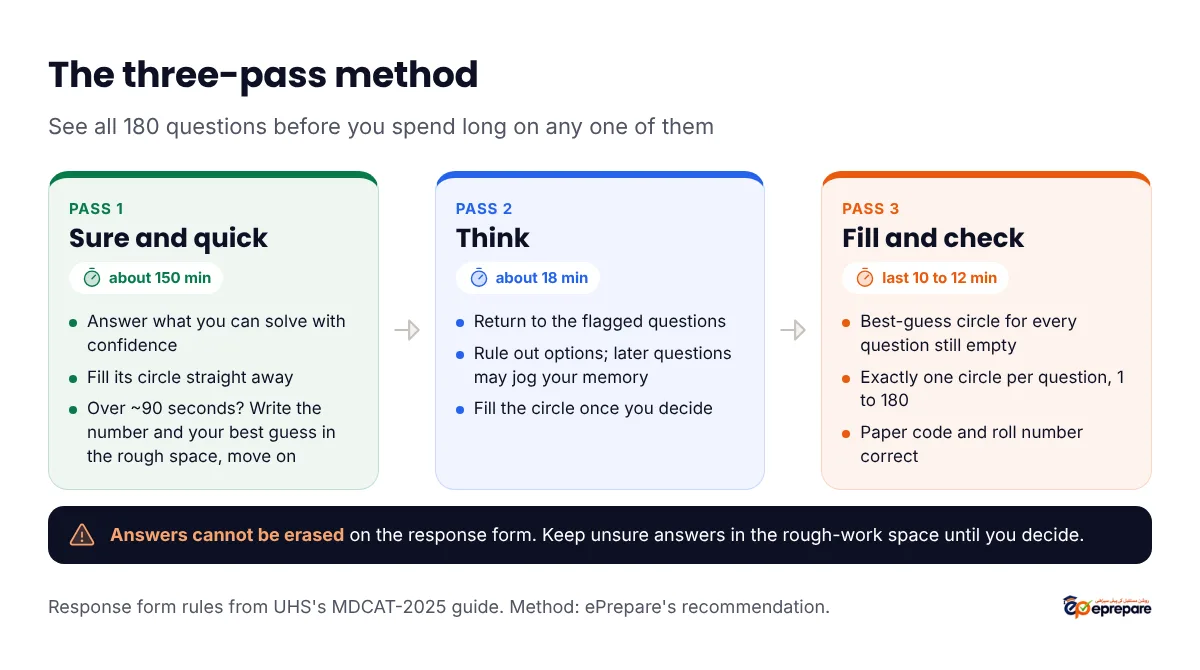
- Pass 1: sure and quick (about 150 minutes). Go through the whole paper. Answer every question you can solve with confidence and fill its circle at once. If a question needs more than about 90 seconds (two minutes at most for a long numerical), write its number and your best guess in the rough-work space and move on.
- Pass 2: think (about 18 minutes). Return to your flagged questions. You will often find them easier now; another question may even have reminded you of the fact you needed. Rule out options, decide, then fill the circle.
- Pass 3: fill and check (the last 10 to 12 minutes). Any flagged question still undecided gets your best-guess circle. Then check that every question from 1 to 180 has exactly one filled circle.
If you prefer two passes, merge passes 2 and 3. What matters is that you see all 180 questions before you spend long on any one of them. A question you never read is a mark you never had a chance at. Our exam-day tips use the same idea.
Marking the answer sheet without losing time or marks
Because MDCAT is paper-based, the answer sheet is part of time management. UHS's MDCAT-2025 guide set out rules like these (check your own admit card and the instructions on the sheet, as details can differ by university and year):
- Use a blue ballpoint and fill each circle completely. Light or half-filled circles are rejected by the machine and get no mark.
- One circle per question.
- Once marked, an answer cannot be changed. Erasers, correction fluid and overwriting are not allowed.
- No rough work on the answer sheet, and no marks or notes on the question paper except in the space given for rough work.
- Fill your roll number and paper code correctly. A wrong code can lead to a wrong or null result. UHS even advised practising the roll-number circles at home.
Those rules shape how you should bubble:
- Fill the circle only when you have decided. Since you cannot erase, a guess you might change later belongs in the rough-work space, not on the sheet.
- Fill as you go, not at the end. Leaving all your bubbling for the last 15 minutes is how students end up shading 60 circles in a panic.
- Check alignment every 10 questions. Look at the question number on the paper and the line on the sheet. One skipped line can shift a whole section.
- Be extra careful when you skip a question. The next answer goes on the next number's line, not the empty one you just left.
- Practise on paper. Do some of your timed sets with a printed or hand-drawn bubble sheet, so filling circles is part of your speed, not a surprise.
Handling long Logical Reasoning and English items
Logical Reasoning has six question types in PM&DC's curriculum: critical thinking, letter and symbol series, logical deductions, logical problems, course of action, and cause and effect. Some take 20 seconds. A seating-arrangement puzzle can take three minutes if you let it.
- Read the question line first, then the passage or the rules. You will know what you are looking for.
- Puzzles: draw a small table or line in the rough-work space. Writing the clues down is faster than holding them in your head.
- Letter series: write the alphabet positions (A=1 to Z=26) once in your rough space and reuse them.
- Course of action and cause and effect: pick the option that follows directly from the statement. Do not bring in outside assumptions.
- Cap each item at about two minutes. If it is not done, note your best guess and come back in pass 2.
English items are usually short: grammar, sentence errors, punctuation and vocabulary in context. Read the whole sentence before choosing, because the clue for a tense or a preposition is often at the other end. Most should take under a minute. Practise every type in our guides to MDCAT Logical Reasoning questions and English grammar topics.
Physics and Chemistry numericals without a calculator
Calculators are not allowed (UHS's 2025 guide listed them as prohibited, along with geometry boxes and log tables). Numericals are where most time is lost, so:
- Look at the options before you calculate. If they are far apart, a rough estimate is enough.
- Use powers of ten and cancel before you multiply.
- Check units. An option in the wrong unit can be crossed out without any working.
- Know your formulas cold. Hunting for a formula in your memory costs more time than the arithmetic. See MDCAT Physics high-yield chapters and formulas.
Exam day, minute by minute
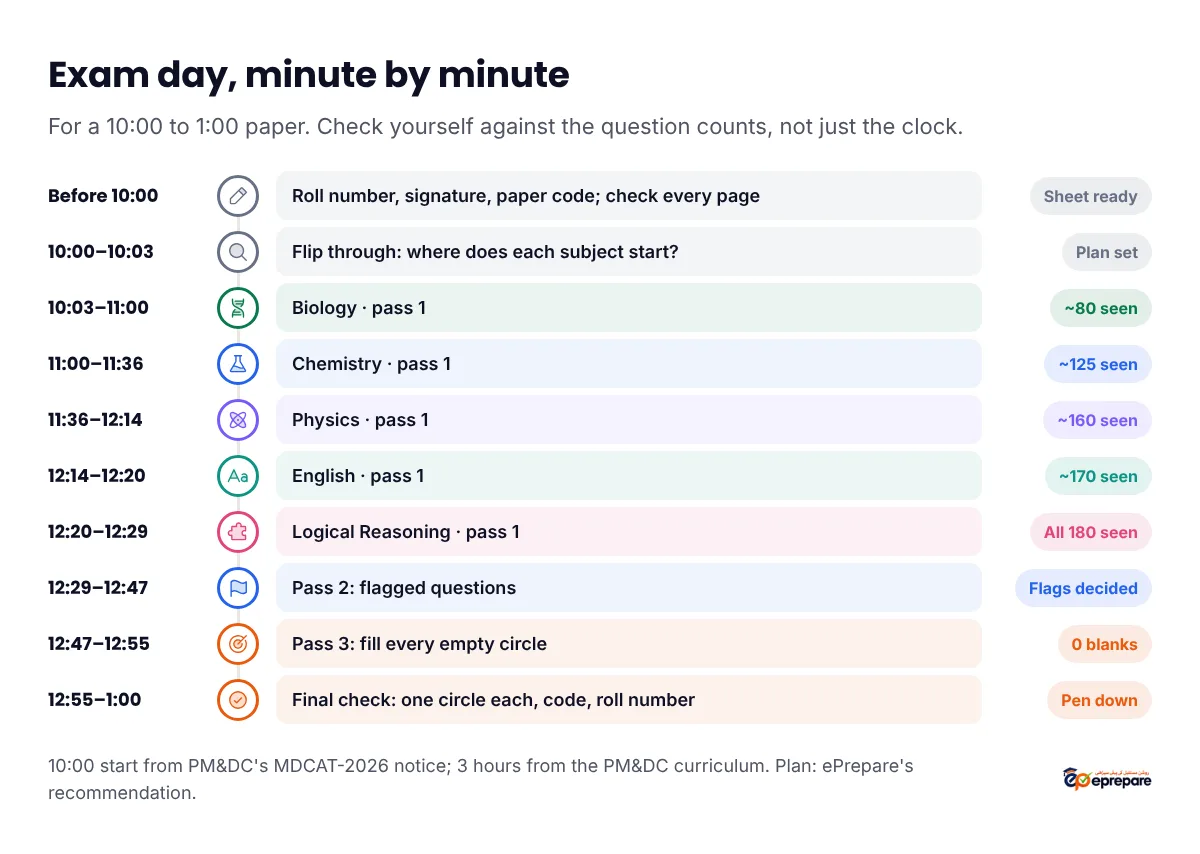
Here is a plan for a 10:00 to 1:00 paper. It uses question-count checkpoints, so it still works if the subjects on your paper come in a different order. Pass 1 targets are slightly tighter than the budget above, which is what gives you time for passes 2 and 3.
| Time | What you do | Checkpoint |
|---|---|---|
| Before 10:00 | Roll number, signature and paper code on the sheet; check that every page is printed | Sheet details done |
| 10:00 to 10:03 | Flip through and note where each subject starts | Plan for your paper code |
| 10:03 to 11:00 | Biology, pass 1 | About 80 questions seen |
| 11:00 to 11:36 | Chemistry, pass 1 | About 125 seen |
| 11:36 to 12:14 | Physics, pass 1 | About 160 seen |
| 12:14 to 12:20 | English, pass 1 | About 170 seen |
| 12:20 to 12:29 | Logical Reasoning, pass 1 | All 180 seen |
| 12:29 to 12:47 | Pass 2: flagged questions | Most flags decided |
| 12:47 to 12:55 | Pass 3: fill every empty circle with your best guess | 0 blanks |
| 12:55 to 1:00 | Final check: one circle per question, paper code, roll number | Pen down at "Stop" |
If you are behind at a checkpoint, do not panic and do not rush the next ten questions. Flag more freely for the rest of that section, and win the time back on quick recall questions.
A note on watches: UHS's 2025 list of items you could bring did not include any kind of watch, and smart watches were named as prohibited. Check your own admit card. If you may not be able to see the time often, train your internal clock in mocks: learn what 20 Biology questions in 16 minutes feels like.
Practice drills with a timer
You cannot learn pace on exam day. Build it in short, timed drills, then test it in full papers. Here is a weekly set:
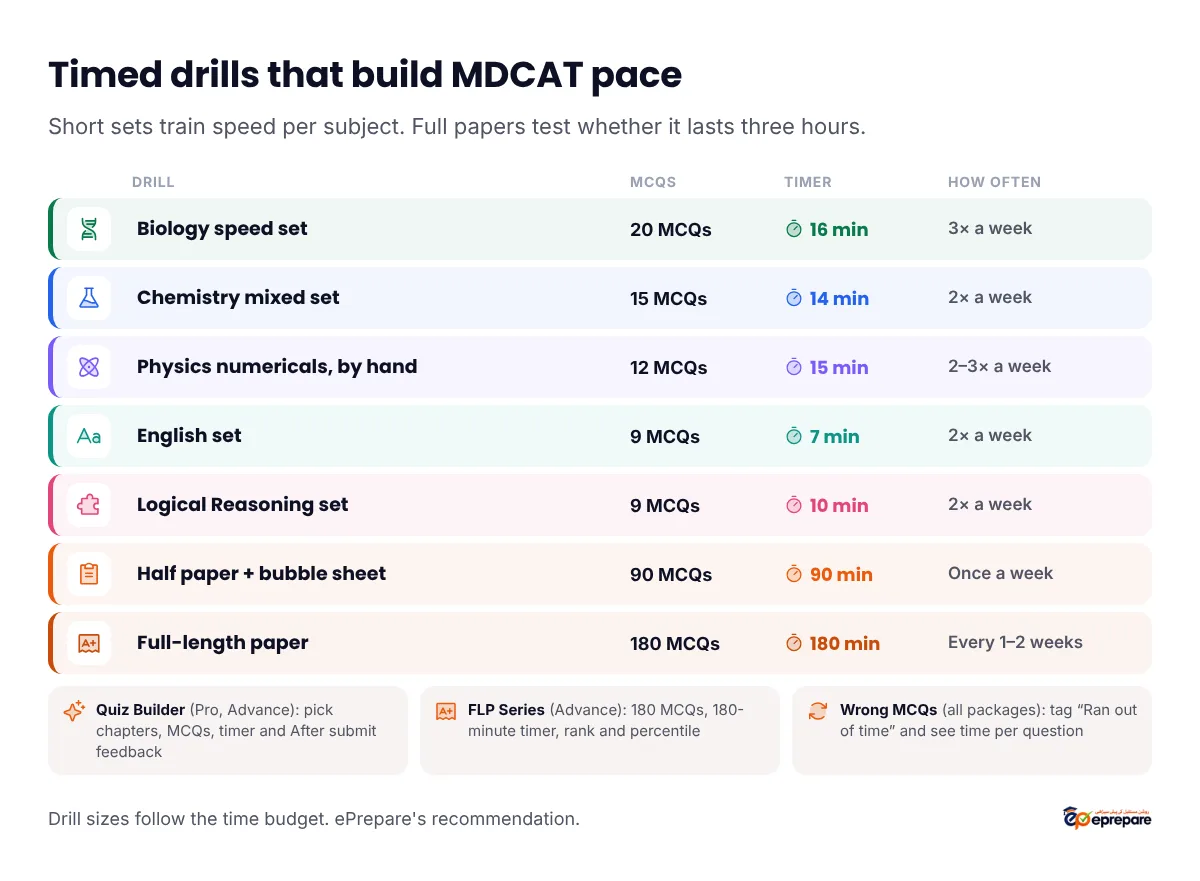
| Drill | MCQs and timer | How often |
|---|---|---|
| Biology speed set | 20 MCQs in 16 minutes | 3 times a week |
| Chemistry mixed set | 15 MCQs in 14 minutes | 2 times a week |
| Physics numericals, by hand | 12 MCQs in 15 minutes | 2 to 3 times a week |
| English and Logical Reasoning | 9 English in 7 minutes, 9 reasoning in 10 minutes | 2 times a week each |
| Half paper with a bubble sheet | 90 MCQs in 90 minutes, in the real subject ratio | Once a week |
| Full-length paper | 180 MCQs in 180 minutes, one sitting | Every 1 to 2 weeks; twice a week in the final month |
How to run these drills on ePrepare
- Quiz Builder (Pro and Advance): tick the chapters, set the number of MCQs, switch the timer on and set the minutes, and choose After submit feedback so it feels like the real test. Past Paper MCQs work well for speed sets. See 5 ways to use the Quiz Builder.
- FLP Series and the one-tap full-length paper (Advance): 180 MCQs in the real subject split with a 180-minute timer, and your rank and percentile afterwards. See the FLP Series.
- Any package: take a chapter test from Bookline, past papers or the question bank and time it with your phone. Try free MDCAT past papers.
- Wrong MCQs (every package): tag mistakes with "Ran out of time", and check how long you spent on each question. Seventy seconds on a simple recall question means you were unsure. Read how Wrong MCQs works.
"And there FLPs series is very much helpful for me to revise all the chapters and to practice with time for mdcat real test."
Ziaullah Rahim, Google review (2026)
Time mistakes to avoid
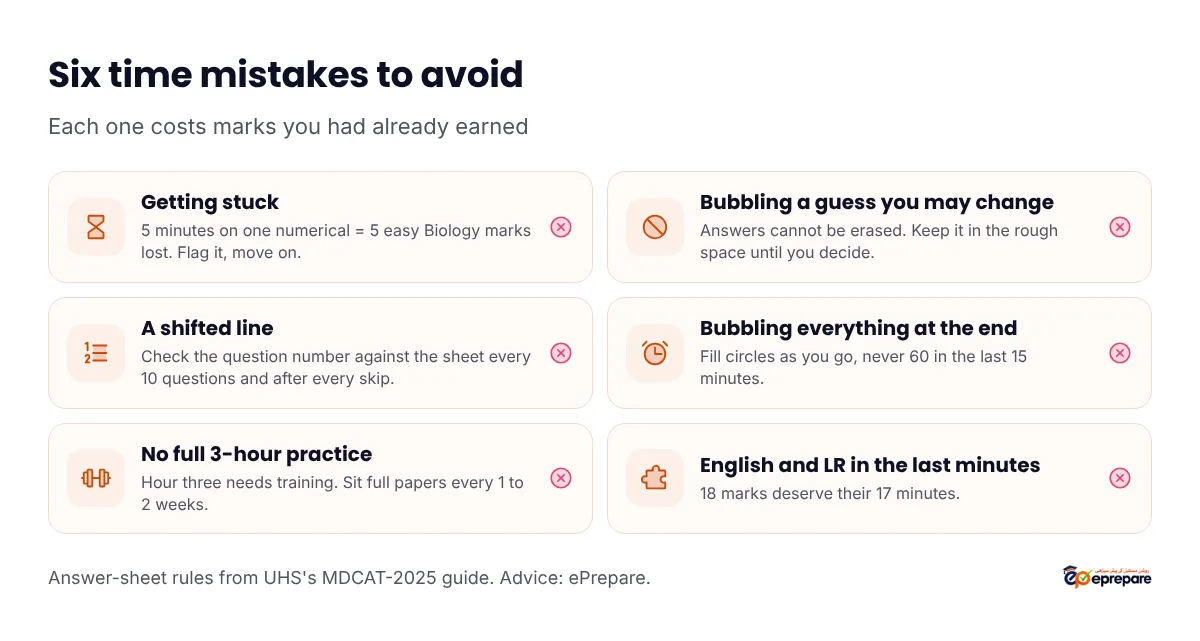
- Getting stuck. Five minutes on one numerical costs you five easy Biology marks. Flag it and move on.
- Bubbling a guess you might change. You cannot erase. Keep unsure answers in the rough space until you decide.
- A shifted line. Check the question number against the sheet every 10 questions, and after every skip.
- Bubbling everything at the end. Fill circles as you go.
- Never sitting a full 3-hour paper. Concentration fades in hour three unless you have trained it. See how many mock tests to take.
- Leaving English and Logical Reasoning to the last minutes. They are 18 marks; give them their 17 minutes.
How NUMS timing differs
If you are also sitting the National University of Medical Sciences (NUMS) test, practise its timing separately. NUMS's MDCAT-2026 advertisement set Part A at 150 MCQs in 2 hours 45 minutes, about 66 seconds per MCQ, with Biology 55, Chemistry 40, Physics 40 and English 15 and no Logical Reasoning. Part B is a psychological test of 50 MCQs in 15 minutes, about 18 seconds each. It is also paper-based with no negative marking. See PM&DC MDCAT vs NUMS MDCAT.
Frequently asked questions
How much time is given for MDCAT?
3 hours for 180 MCQs, according to PM&DC's MDCAT curriculum.
How many minutes per MCQ in MDCAT?
One minute on average. In practice, aim for about 48 seconds per Biology MCQ, 56 for Chemistry, 75 for Physics, 47 for English and 67 for Logical Reasoning.
Is MDCAT computer-based or paper-based?
Paper-based. PM&DC's MDCAT-2026 notice describes a multiple-choice, paper-based test in English, and you fill circles on an answer sheet.
How do I finish the MDCAT paper on time?
Use a subject time budget, answer quick questions first, flag anything over about 90 seconds, fill circles as you go, and practise full 3-hour papers regularly so the pace becomes habit.
Which subject should I attempt first in MDCAT?
There is no required order. Many students do Biology first because it is 81 marks and usually quickest. Whatever order you pick, practise it in mocks and check question numbers carefully if you jump between sections.
Can I change an answer on the MDCAT answer sheet?
Under UHS's 2025 rules, no: once a circle is filled it cannot be altered, and erasers and correction fluid were not allowed. Only fill a circle when you have decided.
Are calculators allowed in MDCAT?
No. Practise numericals by hand, estimate when the options are far apart, and check units.
What should I do in the last 10 minutes of MDCAT?
Fill a best-guess circle for every question still empty, then check that each question has exactly one filled circle and that your paper code and roll number are correct.
Train the clock before the clock trains you
Good time management on exam day is just your practice habits under pressure. Start with one timed drill today, and sit a full 3-hour paper this week. Register on ePrepare for timed past papers, full-length papers with ranks, and the Wrong MCQs report that shows exactly where your minutes go. Planning your remaining weeks? See MDCAT preparation in 2 months.
Sources: number of MCQs, 3-hour duration, paper-based format, difficulty mix and no negative marking from PM&DC's MDCAT curriculum 2025 (applied to MDCAT-2026 by PM&DC's notice of 19 May 2026); subject split, language, paper-based format, conducting universities and 10:00 PST start from PM&DC's public notice on MDCAT-2026; hall timings, paper codes, response form rules and prohibited items from UHS's MDCAT-2025 information guide; Logical Reasoning question types from the PM&DC curriculum; NUMS timing from NUMS's MDCAT-2026 advertisement and syllabus. The time budget, three-pass method, minute plan and drills are ePrepare's recommendations.