


Two months before MDCAT, most students we talk to feel the same thing: there is too much syllabus and too little time. Some panic and try to read every book again. Others give up on half the subjects. Neither works. Eight weeks is short, but it is enough time to cover the whole PM&DC syllabus once with proper MCQ practice, revise what you got wrong, and sit around nine full-length papers. You just need a plan that tells you what to do each week, and the discipline to stick to it.
This guide is that plan. It is built on the official paper pattern from the Pakistan Medical and Dental Council (PM&DC), and on how our own students use their last two months. You will find a week-by-week schedule, two daily timetables (one for students still in college, one for full-time students), how to split your hours by subject, when to take mock tests, what to prioritise and what to drop, and a separate plan for the last 10 days.
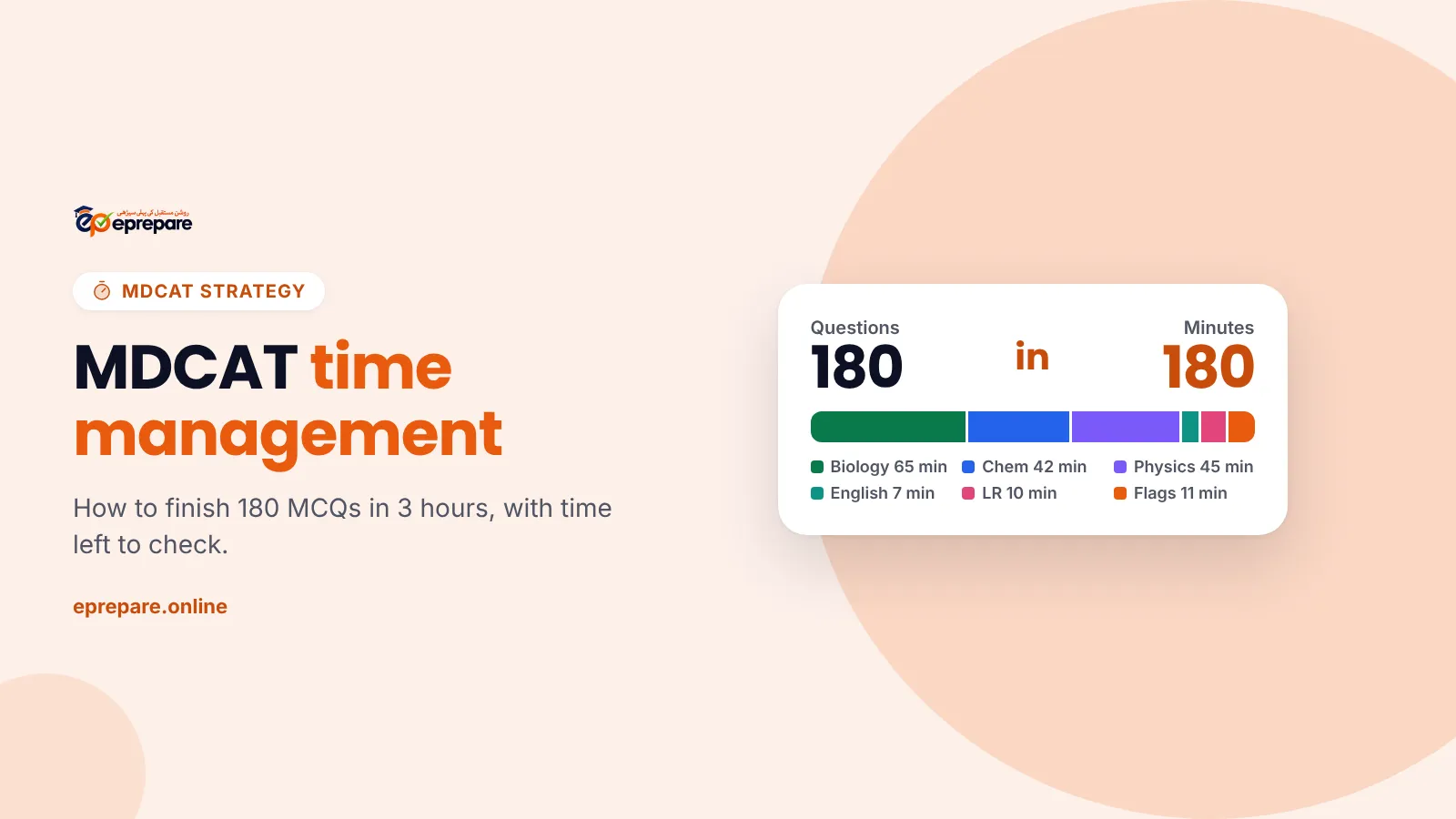
The short answer: yes, you can prepare for MDCAT in 2 months if you already studied FSc pre-medical. MDCAT is 180 MCQs in 3 hours (Biology 81, Chemistry 45, Physics 36, English 9, Logical Reasoning 9) with no negative marking. Spend weeks 1 to 5 on one fast pass of every unit with same-day MCQs, giving each subject time in line with its marks. Use weeks 6 and 7 for past papers, weak units and two full-length papers a week. Keep the last 10 days for mocks, your mistakes list and rest. Study 7 to 8 hours a day full-time, or 3 to 4 hours on college days.
Is 2 months enough for MDCAT?
For most students who have studied FSc pre-medical, yes. Two months is enough for a strong score if three things are true:
- You are not starting from zero. MDCAT tests the FSc syllabus. If you studied it in college, you are revising and practising, not learning everything for the first time.
- You study every day. Eight weeks at 7 to 8 hours a day is roughly 350 to 400 hours. That is a lot of preparation if you actually use it.
- You test more than you read. In two months there is no time for a slow first reading and a second slow reading. Every unit you finish gets its MCQs the same day.
If you never studied a subject properly in FSc, two months will feel tight for that subject. Do not drop it. Give it a few extra hours a week from the start, and lean on lectures to get through the hard concepts quickly.
A practical point before you start: count your eight weeks back from the official date, and check it again during the plan. Dates move. In 2026, PM&DC first announced MDCAT for 16 August, then rescheduled it to 20 September. Always take the date from pmdc.pk, not from social media.
What you are preparing for
PM&DC's MDCAT curriculum and its MDCAT-2026 notice set the paper that every province uses:
| Subject | MCQs | Share of marks |
|---|---|---|
| Biology | 81 | 45% |
| Chemistry | 45 | 25% |
| Physics | 36 | 20% |
| English | 9 | 5% |
| Logical Reasoning | 9 | 5% |
| Total | 180 in 3 hours | 100% |
The paper is paper-based, in English, with 15% easy, 70% moderate and 15% difficult questions, and no negative marking. You need at least 55% (99 out of 180) for MBBS and 50% (90 out of 180) for BDS to qualify, but a government seat usually needs far more. Read the MDCAT paper pattern and MDCAT passing marks if any of this is new to you.
Split your hours by what the paper rewards
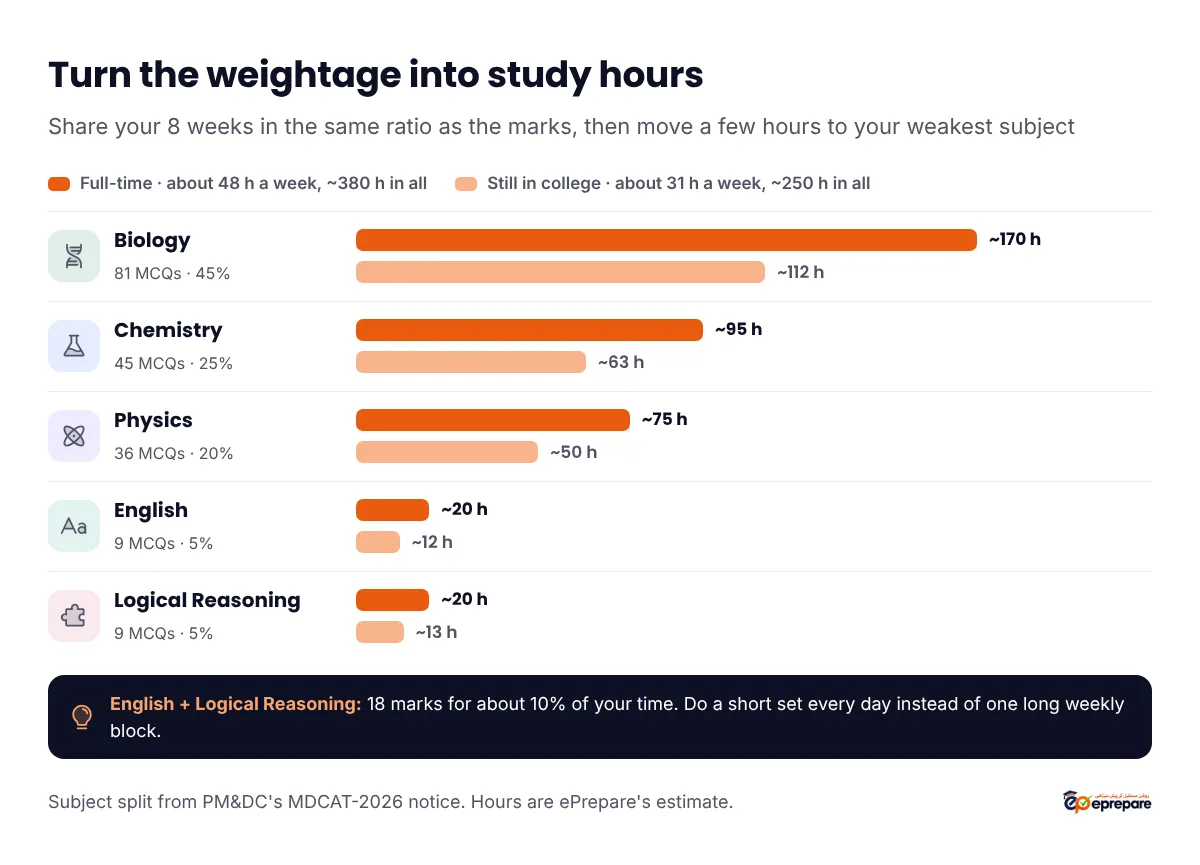
With only eight weeks, every hour has to go where the marks are. The simplest fair rule is to share your study time in the same ratio as the marks, then adjust a little for your weak subject.
| Subject | Share of time | Full-time, per week | In college, per week |
|---|---|---|---|
| Biology | About 45% | About 21 hours | About 14 hours |
| Chemistry | About 25% | About 12 hours | About 8 hours |
| Physics | About 20% | About 9 to 10 hours | About 6 hours |
| English and Logical Reasoning | About 10% | About 5 hours, 30 to 45 minutes a day | About 3 hours, 25 minutes a day |
These numbers assume about 48 hours a week full-time and about 31 hours a week for a student still in college or classes. If Physics is your weakest subject, take two or three hours a week from Chemistry or Biology practice and give them to Physics numericals. Do not cut English and Logical Reasoning: 18 marks for about 10% of your time is the best deal in the paper.
The 8-week MDCAT plan, week by week
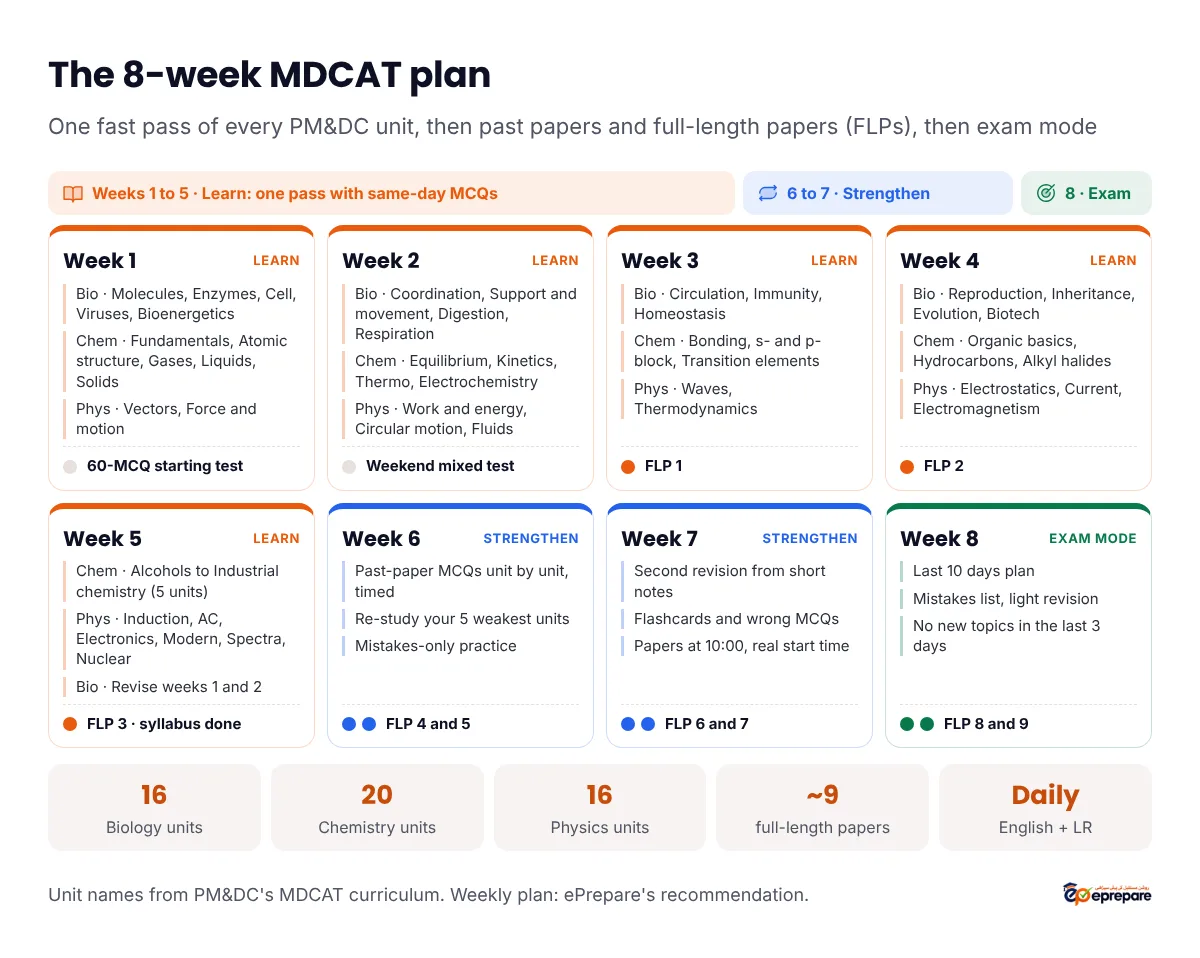
The plan has three phases. Weeks 1 to 5 are a single fast pass of every unit. Weeks 6 and 7 turn that knowledge into exam marks. Week 8 is exam mode. Biology runs every day; Chemistry and Physics take turns, so every subject moves forward each week. The unit names below are from PM&DC's curriculum, and the biggest units come early so they get the most revision.
Week 1: Foundations and a starting score
- Day 1: a 60-MCQ mixed test in 60 minutes. It is not for marks. It shows which subject is weakest, so you know where the extra hours go.
- Biology: Biological molecules, Enzymes, Cell structure and function, Acellular life, Bioenergetics.
- Chemistry: Fundamental concepts, Atomic structure, Gases, Liquids, Solids.
- Physics: Vectors and equilibrium, Force and motion.
- English and Logical Reasoning: tenses and subject-verb agreement; letter and symbol series.
Week 2: Big Biology units and physical chemistry
- Biology: Coordination and control, Support and movement, Digestion, Respiration.
- Chemistry: Chemical equilibrium, Reaction kinetics, Thermochemistry, Electrochemistry.
- Physics: Work and energy, Rotational and circular motion, Fluid dynamics.
- English and Logical Reasoning: prepositions and active and passive voice; logical deductions.
- Weekend: a mixed test on everything from weeks 1 and 2, then your first wrong-MCQ revision.
Week 3: Homeostasis, bonding and waves
- Biology: Circulation, Immunity, Homeostasis.
- Chemistry: Chemical bonding, s- and p-block elements, Transition elements.
- Physics: Waves, Thermodynamics.
- English and Logical Reasoning: direct and indirect speech; course of action.
- End of week: full-length paper 1 (180 MCQs, 3 hours), and a proper review the next morning.
Week 4: Inheritance, organic chemistry begins, electricity
- Biology: Reproduction, Inheritance, Evolution, Biotechnology. That completes one pass of Biology.
- Chemistry: Fundamentals of organic chemistry, Hydrocarbons, Alkyl halides.
- Physics: Electrostatics, Current electricity, Electromagnetism.
- English and Logical Reasoning: punctuation and sentence errors; cause and effect.
- End of week: full-length paper 2 and its review.
Week 5: Finish the syllabus
- Chemistry: Alcohols and phenols, Aldehydes and ketones, Carboxylic acids, Macromolecules, Industrial chemistry.
- Physics: Electromagnetic induction, Alternating current, Electronics, Dawn of modern physics, Atomic spectra, Nuclear physics. The last three are short units and can share one evening.
- Biology: no new units. Revise weeks 1 and 2 from your short notes and do their past-paper MCQs.
- English and Logical Reasoning: vocabulary in context; logical problems and critical thinking.
- End of week: full-length paper 3. By now every unit has been studied and tested once.
Week 6: Past papers and weak units
- Past-paper MCQs unit by unit, timed at about a minute per MCQ, for every unit in all three sciences.
- Use your three full-length papers to list your five weakest units. Re-study each one from the textbook, then test it again.
- Two full-length papers this week (for example, Tuesday and Saturday), each reviewed the next day.
Week 7: Second pass and exam rhythm
- A fast second revision of every unit from short notes and flashcards, Biology first.
- Mistakes-only practice twice: only the questions you got wrong before.
- Two full-length papers, at 10:00 in the morning if you can, the time the real test started in 2026.
Week 8: The last 10 days
The final ten days overlap the end of week 7 and run to exam day. They have their own plan below.
"Regular tests, MCQs, and a disciplined study plan have really improved my preparation and confidence."
Shereen Zaman, Google review (2025)
Daily timetable: still in college vs full-time
A plan only works if the days work. Pick the timetable that matches your life, keep the order of the blocks, and move the clock times to fit.
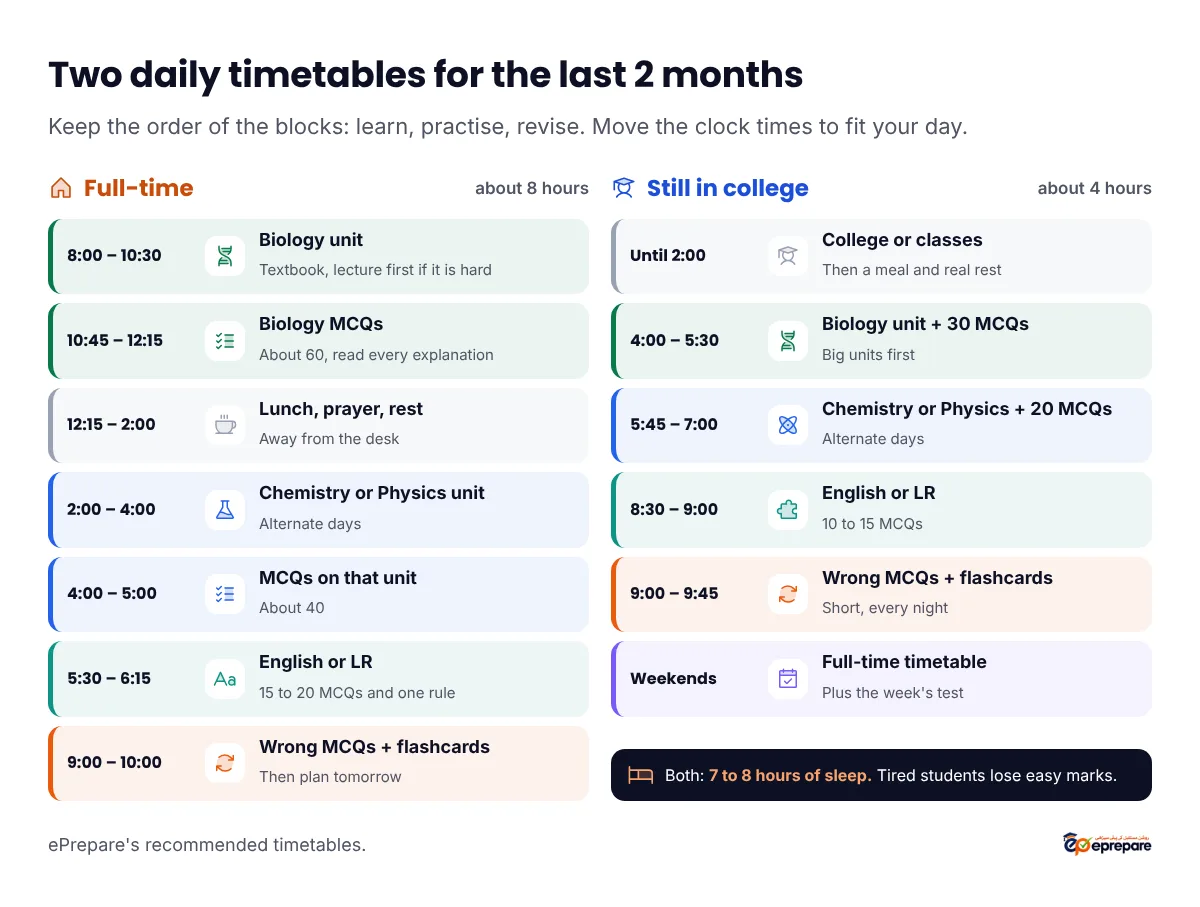
Full-time student (about 8 hours of real study)
| Time | Block |
|---|---|
| 8:00 to 10:30 | Biology: today's unit from the textbook, lecture first if the topic is hard |
| 10:45 to 12:15 | Biology MCQs on the same unit, about 60, with explanations |
| 12:15 to 2:00 | Lunch, prayer and rest |
| 2:00 to 4:00 | Chemistry or Physics (alternate days): today's unit |
| 4:00 to 5:00 | MCQs on that unit, about 40 |
| 5:30 to 6:15 | English or Logical Reasoning: 15 to 20 MCQs and one rule or method |
| 9:00 to 10:00 | Wrong MCQs, flashcards, and tomorrow's plan |
Student still in college (about 4 hours on weekdays)
| Time | Block |
|---|---|
| Until about 2:00 | College or classes, then a meal and real rest |
| 4:00 to 5:30 | Biology unit and 30 MCQs |
| 5:45 to 7:00 | Chemistry or Physics unit and 20 MCQs |
| 8:30 to 9:00 | English or Logical Reasoning, 10 to 15 MCQs |
| 9:00 to 9:45 | Wrong MCQs and flashcards |
| Weekends | The full-time timetable, plus the week's test |
If you are in college, you will cover fewer pages per day, so the big units matter even more. Learn them properly and move faster through the small ones, but still do every small unit's MCQs. Sleep seven to eight hours either way. Tired students lose easy marks to careless mistakes.
How many MCQs and mock tests in 2 months?
| Weeks | MCQs a day (full-time) | MCQs a day (in college) | Full-length papers |
|---|---|---|---|
| 1 to 2 | About 100 | About 50 to 60 | 0, one mixed test each weekend |
| 3 to 5 | 100 to 120 | 60 to 70 | 1 a week |
| 6 to 7 | About 150, mostly past papers | About 100 | 2 a week; the last one in week 7 falls 10 days before MDCAT |
| 8 | Mocks and mistakes only | Mocks and mistakes only | 2: seven days and four days before MDCAT |
That is about nine full-length papers in total. It is fewer than a six-month plan allows, so each one has to count: take it in one sitting with the phone in another room, and spend at least as long reviewing it as you spent solving it. Our guide to mock tests and FLPs shows how to review a paper in four steps.
Your weekly checklist
Every Sunday night, tick these off. If three or more are missing, the next week needs fixing before it starts.
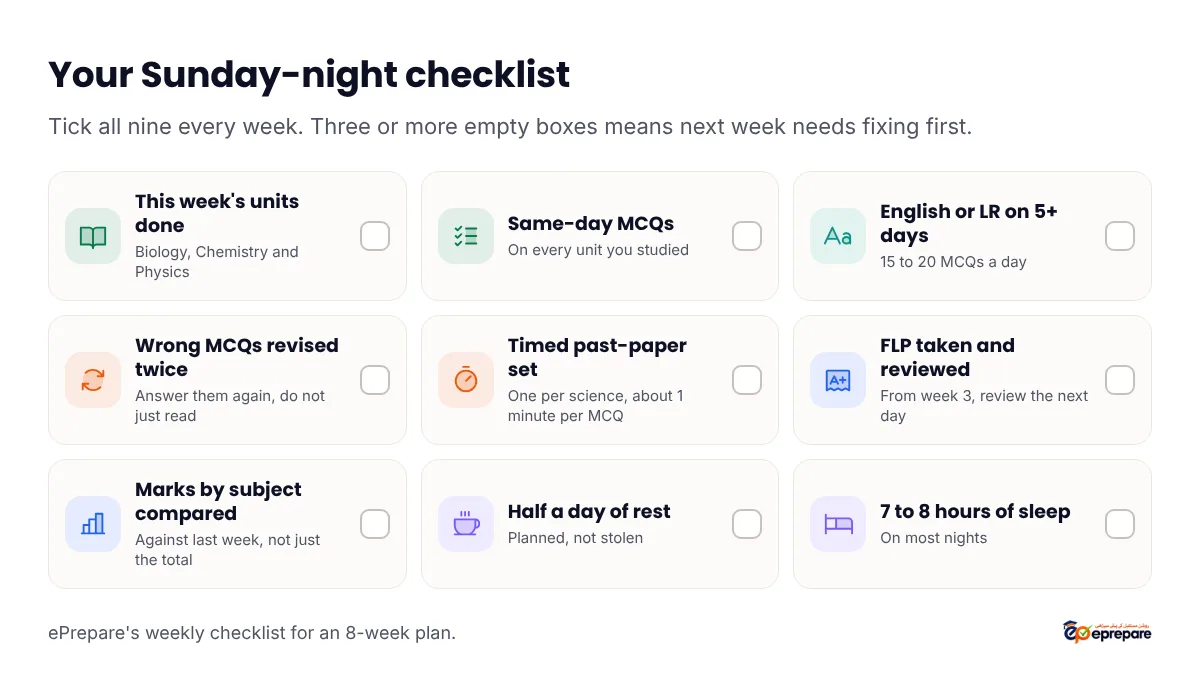
- Finished this week's units in Biology, Chemistry and Physics.
- Did MCQs on every unit the same day you studied it.
- Did English or Logical Reasoning on at least five days.
- Revised wrong MCQs at least twice.
- Did one timed past-paper set in each science.
- From week 3: took a full-length paper and reviewed it.
- Compared marks by subject with last week, not just the total.
- Took at least half a day off.
- Slept seven to eight hours on most nights.
What to prioritise, and what to drop
Prioritise
- The biggest units, early. By share of the PM&DC curriculum, Biological molecules, Homeostasis, Coordination and control, Support and movement and Inheritance make up more than half of Biology; Hydrocarbons is the largest Chemistry unit; Waves and Force and motion are over a third of Physics. See chapter-wise weightage.
- Textbook lines, diagrams and definitions. With 70% moderate questions, close textbook knowledge wins most marks.
- Physics numericals every Physics day. No calculators are allowed, so practise by hand.
- Your own mistakes. A wrong MCQ you fix now is a mark you keep in the hall.
Drop
- Collecting new books and PDFs. Textbooks, one good MCQ bank and past papers are enough.
- Long handwritten notes. In two months, write one-line notes from your mistakes only.
- Topics outside the PM&DC syllabus. For example, PM&DC's Bioenergetics unit covers respiration of proteins and fats only, not photosynthesis. Check the MDCAT syllabus before spending an hour on anything.
- Skipping small units completely. Do not drop them. A one-outcome unit can take a single evening and still give you a question. Move fast through them instead.
- Endless group chats about "expected questions". Nobody knows the paper.
The last 10 days before MDCAT
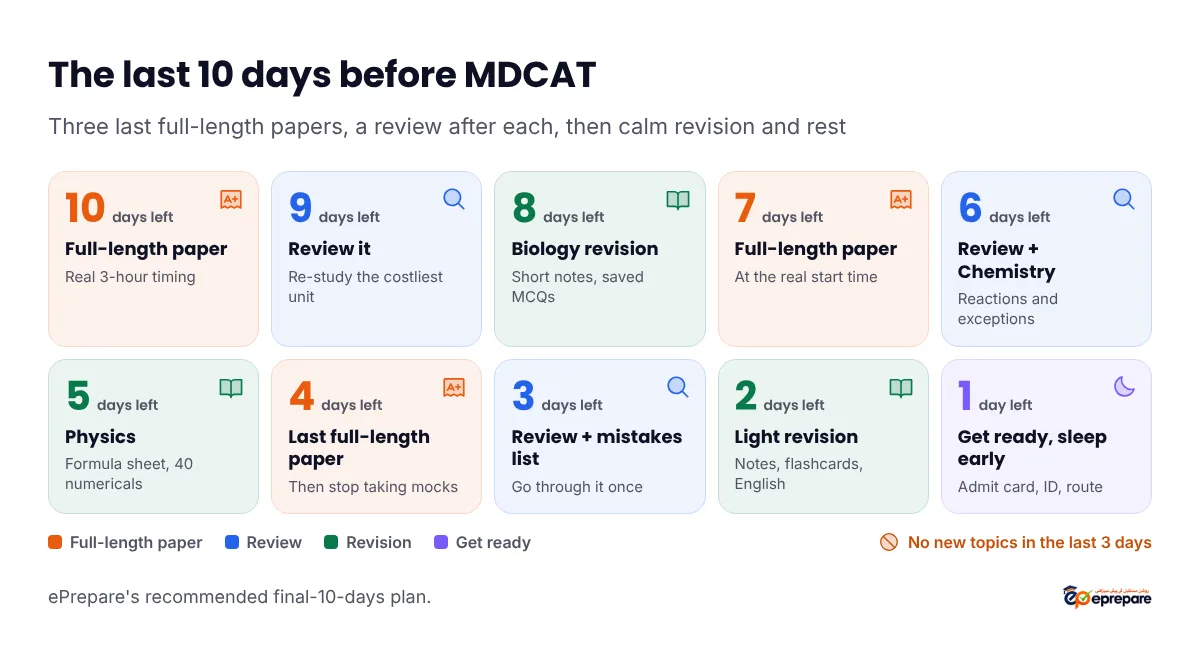
| Days left | What to do |
|---|---|
| 10 | Full-length paper under the real 3-hour timing |
| 9 | Review it; re-study the unit that cost the most marks |
| 8 | Biology revision from short notes and saved MCQs |
| 7 | Full-length paper at the real start time |
| 6 | Review it; Chemistry revision, reactions and exceptions |
| 5 | Physics formula sheet and 40 numericals by hand |
| 4 | Last full-length paper |
| 3 | Review it; go through your whole mistakes list once |
| 2 | Light revision: short notes, flashcards, English rules |
| 1 | Admit card and ID ready, route checked, early sleep |
No new topics in the last three days. Learning something new now adds stress, not marks. For the day itself, read MDCAT exam-day tips and how to manage your time in the paper.
How to use ePrepare in your 2 months
You can follow this plan with textbooks and past papers alone. ePrepare saves you the organising, so all of your hours go into study. Here is what helps most in a short plan, and which package has it:
- Study plan (every package): choose 60 days and your daily hours, and the app spreads every chapter, revision day, weekly test and full-length paper across them. If you miss a day, press Reschedule missed. See how to make your study plan.
- Bookline MCQs and past papers (every package): same-day MCQs for each unit, and real past-paper MCQs filed by province for weeks 6 and 7. Try MDCAT past papers.
- Wrong MCQs and smart revision (every package): every mistake is saved automatically and comes back 1, 3, 7 and 14 days later. Read how smart revision works.
- Lectures (Plus, Pro and Advance): for the units you never understood in FSc, so you are not stuck for days.
- Quiz Builder (Pro and Advance): timed past papers by unit, mistakes-only tests and weak-topic drills. See 5 ways to use the Quiz Builder.
- FLP Series (Advance only): full-length papers under real MDCAT timing with your rank and percentile, plus the one-tap 180-MCQ paper. See the FLP Series.
Tools do not raise a score on their own. Daily study does. Pick the package that covers what you will actually use; the packages page compares them.
Mistakes that waste the last two months
- Restarting the syllabus slowly. A slow first reading of everything can eat five weeks and leave no time to test.
- Reading without MCQs. You only know a unit once you have answered its questions.
- Avoiding full-length papers until you feel ready. Timing and stamina need practice too. Start in week 3.
- Studying 12 hours for a week, then burning out. Eight steady hours for 56 days beats that every time.
- Ignoring English and Logical Reasoning. They are 18 marks and need only a short daily set.
- Only checking the total in mocks. Look at marks by subject and why you lost each one.
Frequently asked questions
Can I prepare for MDCAT in 2 months?
Yes, if you studied FSc pre-medical and can study every day. Follow one fast pass of the syllabus with daily MCQs in weeks 1 to 5, past papers and full-length papers in weeks 6 and 7, and a calm last 10 days.
How many hours a day should I study in the last 2 months?
About 7 to 8 focused hours a day if you are preparing full-time, and 3 to 4 hours on college days with longer weekends. Steady days matter more than one very long day.
Can I score 170+ in MDCAT with 2 months of preparation?
It is possible for students with a strong FSc base who practise hard and fix their mistakes, but nobody can promise a score. Set a target, then watch your full-length paper average move towards it week by week.
Which subject should I start with in a 2-month plan?
Biology, because it carries 81 of the 180 marks. Study it every day, with Chemistry and Physics on alternate days so neither falls behind.
How many full-length papers should I take in 2 months?
About nine: one a week in weeks 3 to 5, two a week after that, with the last one 3 to 4 days before MDCAT. Review each one properly.
Should I skip any chapters with only 2 months left?
No. Go faster through small units, but do not skip them. PM&DC does not publish chapter-wise marks, and a small unit can take one evening and still give you a question.
Is the 2-month plan the same for NUMS MDCAT?
The method is the same, but NUMS has a different paper: 150 MCQs in 2 hours 45 minutes with no Logical Reasoning, plus a 50-MCQ psychological test in 15 minutes. If you are sitting both, see PM&DC MDCAT vs NUMS MDCAT.
Is there negative marking in MDCAT?
No. PM&DC's MDCAT-2026 notice says 180 MCQs with no negative marking, so answer every question. Read MDCAT negative marking explained.
Start week 1 today
Write your exam date at the top of a page, count back eight weeks, and copy this week's units under it. Then take the 60-MCQ starting test before you go to sleep tonight. If you want the plan built for you, register on ePrepare, choose a 60-day study plan, and follow the tasks under Today.
Sources: paper pattern, subject split, difficulty mix, pass marks and no negative marking from PM&DC's MDCAT curriculum 2025 (applied to MDCAT-2026 by PM&DC's notice of 19 May 2026) and PM&DC's public notice on MDCAT-2026; the 2026 date change from PM&DC's press release rescheduling MDCAT to 20 September 2026; NUMS paper pattern from NUMS's MDCAT-2026 advertisement. Unit names from the PM&DC curriculum. The week-by-week plan, hours, MCQ targets and timetables are ePrepare's recommendations.