

Most MDCAT students revise by reading: notes open, highlighter in hand, page after page. It feels productive because everything looks familiar. Then the paper asks "Which inhibitor's effect is reduced by adding more substrate?" and the familiar page will not come back. Active recall fixes exactly this gap between recognising a fact and producing it. This guide explains the method in plain terms and then walks through one complete revision session on a real Biology chapter, Enzymes, so you can copy it for any chapter.
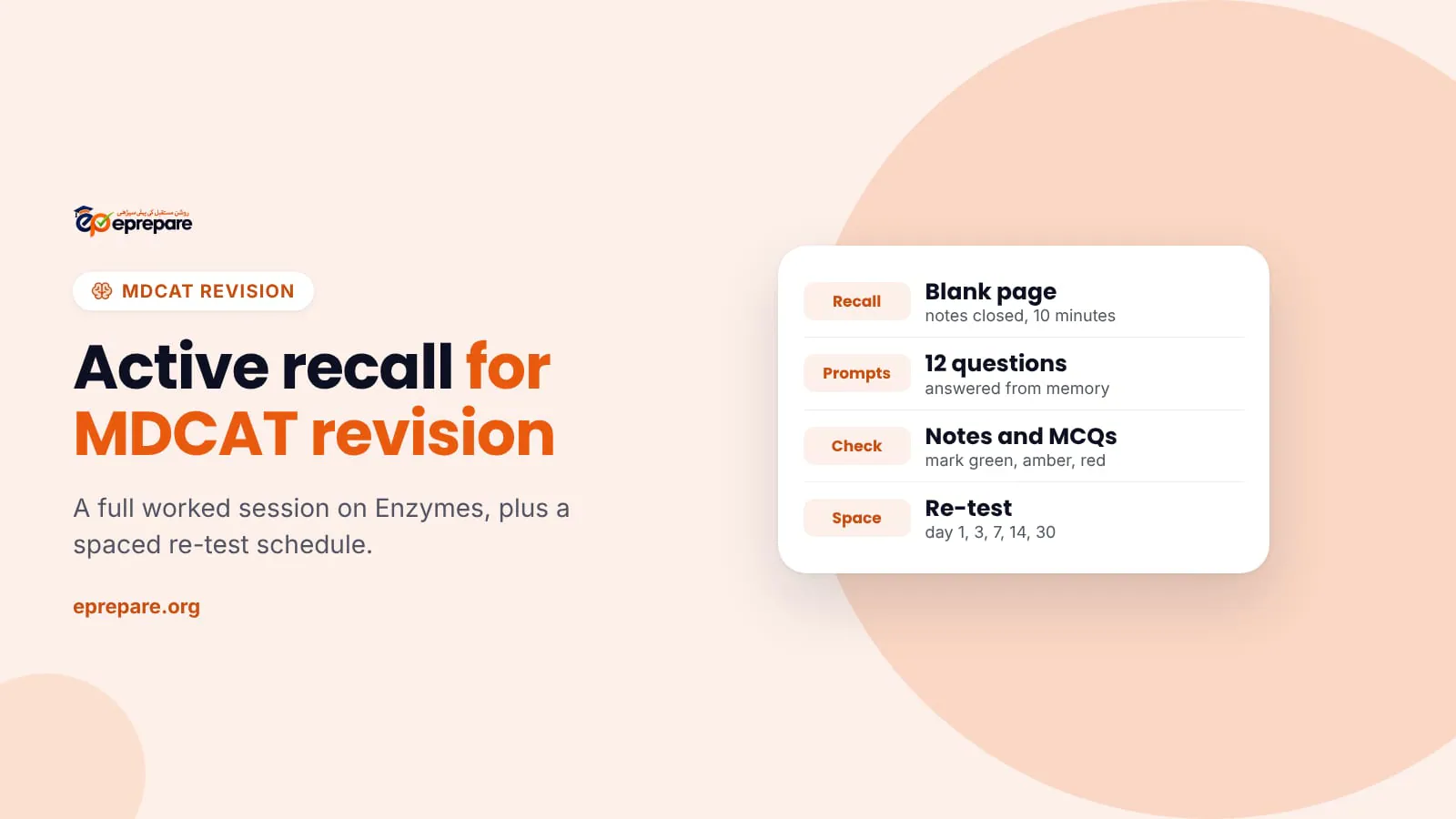
The short answer: Active recall means revising by pulling information out of your memory, with your notes closed, instead of reading it again. In practice: write everything you remember about a topic on a blank page, answer question prompts from memory, then open your notes to check and correct, solve MCQs, and re-test the weak points after one day, three days, a week and two weeks. Testing yourself and spacing the tests out is far more effective for long-term memory than re-reading.
What is active recall, in simple words?
Active recall is the act of answering from memory. Every time you close the book and try to say what a holoenzyme is, you are practising recall. Re-reading, highlighting and watching a lecture again are passive: the information is in front of you, so your brain only has to recognise it.
Memory research has found again and again that testing yourself helps you remember for longer than studying the same material again, and that spreading the tests out over days works better than cramming them into one sitting. These two ideas are often called the testing effect and the spacing effect. You do not need the research details to use them. You need a routine.
Two honest warnings before you start:
- It feels harder than reading. That difficulty is the point. A blank page that you struggle to fill teaches more than a page you breeze through.
- You must understand before you recall. Active recall strengthens what you have learnt. It does not replace learning the chapter the first time from a lecture or your notes.
Why it suits MDCAT so well
MDCAT is 180 MCQs in 3 hours, and 81 of them are Biology. Biology MCQs reward exact facts: names, numbers, exceptions and pairs that look alike. Those are precisely the things that feel familiar on re-reading and vanish in the exam. Recall practice also mirrors the exam itself: in both, you must produce an answer without the book.
A complete worked session: Biology, Enzymes
Here is a full session, about 50 minutes, on PM&DC's Biology unit 6, Enzymes. The facts used below come from ePrepare's Enzymes notes. You need a blank page, a pen, a timer and your notes kept closed until step 3.
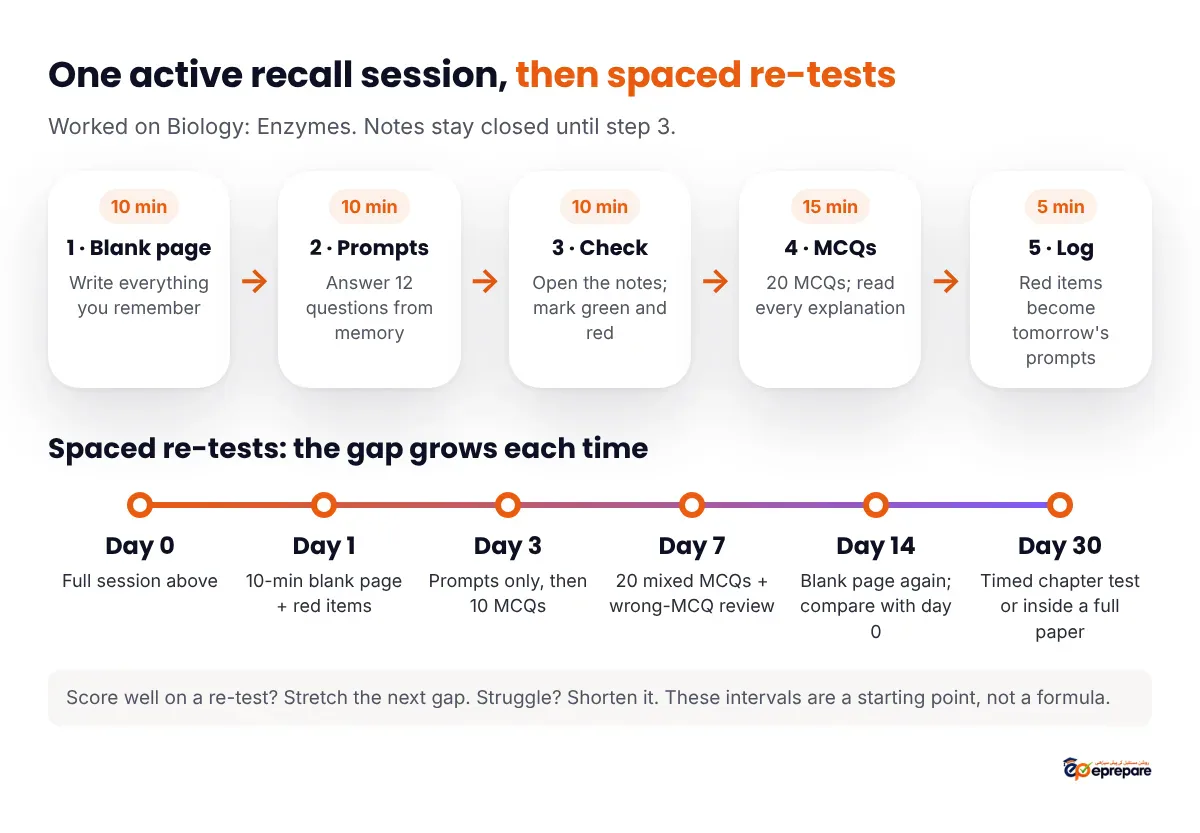
Step 1 · Blank-page recall (10 minutes)
Write "Enzymes" at the top and set a timer for 10 minutes. Write everything you can remember: definitions, diagrams, numbers, examples, anything. Do not peek. When you get stuck, move to another part of the chapter instead of stopping.
Here is what a typical first attempt might look like. It is a made-up example, but the mistakes are the ones students commonly make:
| What the student wrote | After checking the notes |
|---|---|
| Enzymes are proteins that speed up reactions | Mostly right. Most enzymes are proteins; a few catalytic RNAs are ribozymes (rRNA in the ribosome) |
| They lower activation energy and change ΔG | Half wrong. They lower activation energy but leave ΔG and the equilibrium unchanged |
| Lock and key model: Koshland | Wrong. Lock and key: Fischer, 1890. Induced fit: Koshland, 1959 |
| Optimum temperature 37 °C | Close. Human enzymes 37–40 °C; rate roughly doubles every 10 °C below the optimum (Q10 = 2) |
| Pepsin works at pH 8 | Wrong. Pepsin about 2; trypsin about 8 |
| Competitive inhibitor binds the active site | Right. And only competitive inhibition is reduced by adding more substrate |
| (nothing about cofactors, specificity, feedback or markers) | Missing: four whole areas of the chapter |
This is not a bad result. It is a precise map of what to revise. Reading the chapter again would have hidden every one of these gaps.
Step 2 · Question prompts (10 minutes)
The blank page shows what comes to mind freely. Prompts check the corners you did not think of. Answer each one from memory, in a word or a line. Try them yourself now, then open the answers.
- What is the difference between an apoenzyme and a holoenzyme?
- Coenzyme or prosthetic group: which is loosely bound, and which is firmly bound? Give an example of each.
- Name three metal ions that act as activators.
- About how many amino acids make up an active site?
- What are the two parts of the active site, and what does each do?
- Which model has a rigid active site, and which has a flexible one? Who proposed each, and when?
- What happens to the activation energy of 2H2O2 → 2H2O + O2 when catalase is present?
- Give an example of absolute specificity and of group specificity.
- A reaction is at saturation. What will raise its rate?
- Why does cold slow an enzyme while high heat stops it for good?
- Which inhibitor mimics succinate, and which enzyme does cyanide block?
- In feedback inhibition, which enzyme is inhibited, and what kind of inhibition is it?
Show answers to the 12 prompts
1. The apoenzyme is the protein part alone and is inactive; apoenzyme + cofactor = holoenzyme, the active form. 2. A coenzyme is organic and loosely bound (NAD+, FAD); a prosthetic group is firmly bound (heme). 3. Mg2+, Zn2+, Mn2+. 4. About 3 to 12. 5. The binding site recognises and holds the substrate; the catalytic site makes or breaks the bonds. 6. Lock and key: rigid, Fischer, 1890. Induced fit: flexible, Koshland, 1959, the more accepted model. 7. It falls from about 86 kJ mol−1 to about 1 kJ mol−1; ΔG stays the same. 8. Absolute: urease acts only on urea. Group: hexokinase acts on hexoses. 9. More enzyme, because every active site is already busy, so more substrate will not help. 10. Cold makes the enzyme inactive, and it recovers on warming; heat above the optimum breaks the bonds holding its shape and denatures it, usually permanently. 11. Malonate mimics succinate (a competitive inhibitor of succinate dehydrogenase); cyanide blocks cytochrome oxidase by binding its iron. 12. The first enzyme of the pathway; it is reversible, non-competitive and acts at an allosteric site (in the classic example, excess threonine inhibits enzyme 1 of the aspartate pathway).
Make your own prompts for other chapters from the headings and bold lines of your notes. Write them as questions, not as statements, and keep the answers short.
Step 3 · Check with your notes (10 minutes)
Now open the notes. Go through your blank page and your prompt answers. Mark each item green (right), amber (partly right) or red (wrong or missing). Correct every red item in a different colour on the same page. The correction you write yourself sticks far better than the one you only read.
A fast way to check is to look only at the high-yield lines. Every ePrepare notes lesson has an "Exam points only" switch that hides everything except the exam points, and a "High-yield MCQ points" box at the top.
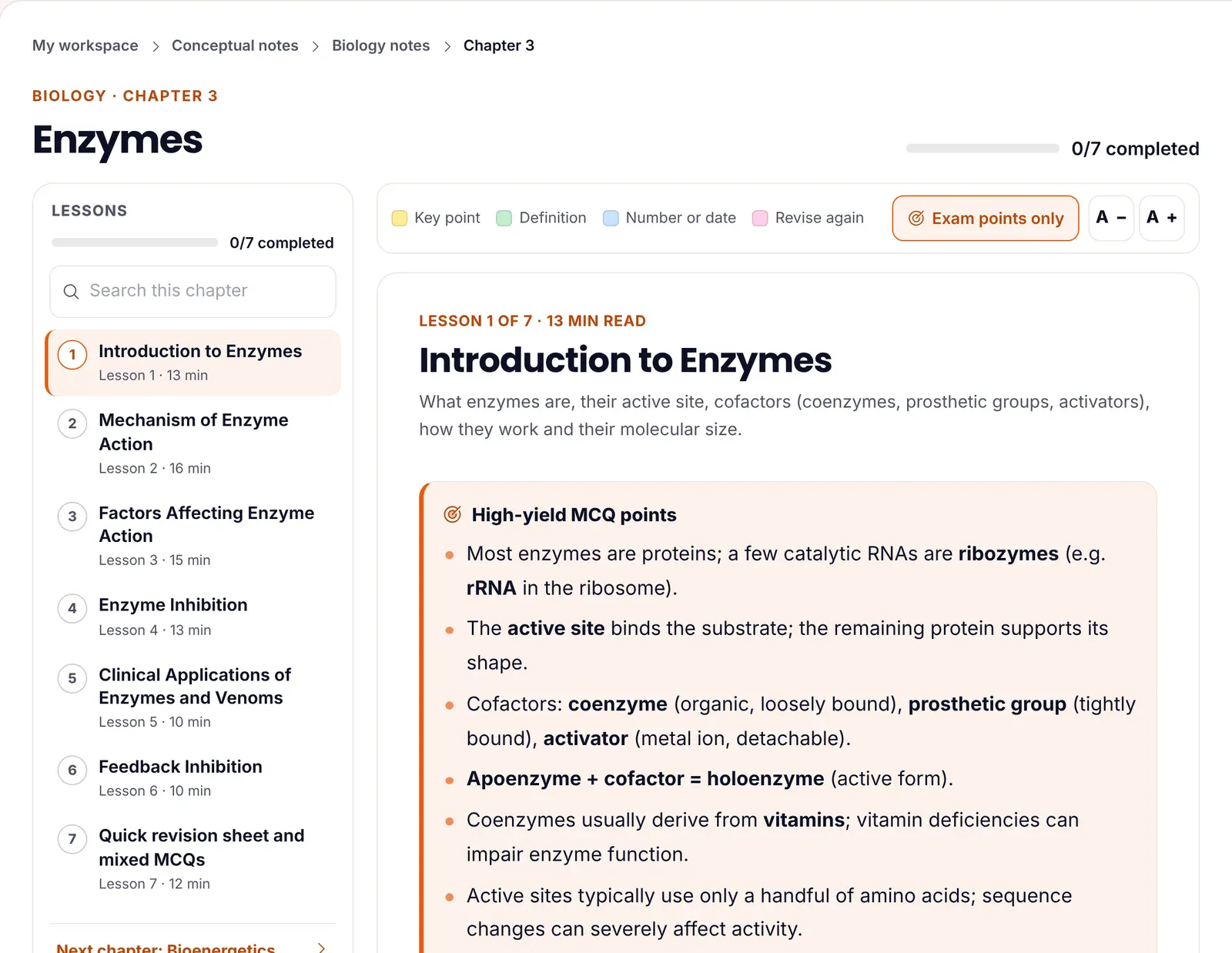
Memory tricks help most with the red items, because they give a weak fact something to hang on.
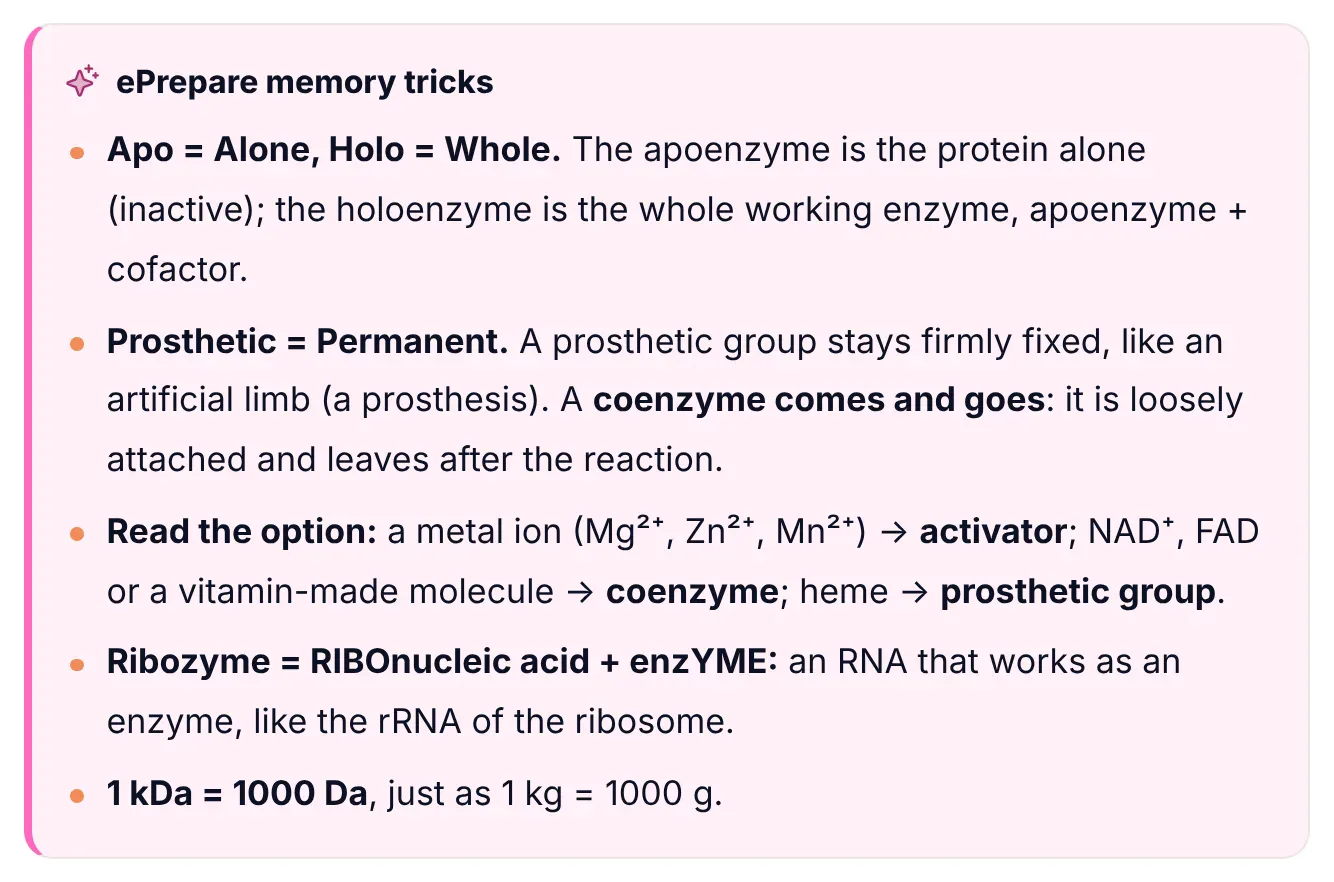
Step 4 · MCQs (15 minutes)
Now test the corrected knowledge in exam format. Solve about 20 MCQs on the chapter and read the explanation of every one you get wrong, and of every one you guessed right. ePrepare's notes have practice MCQs inside each lesson, with an explanation that says why the right option is right and why the others are wrong.
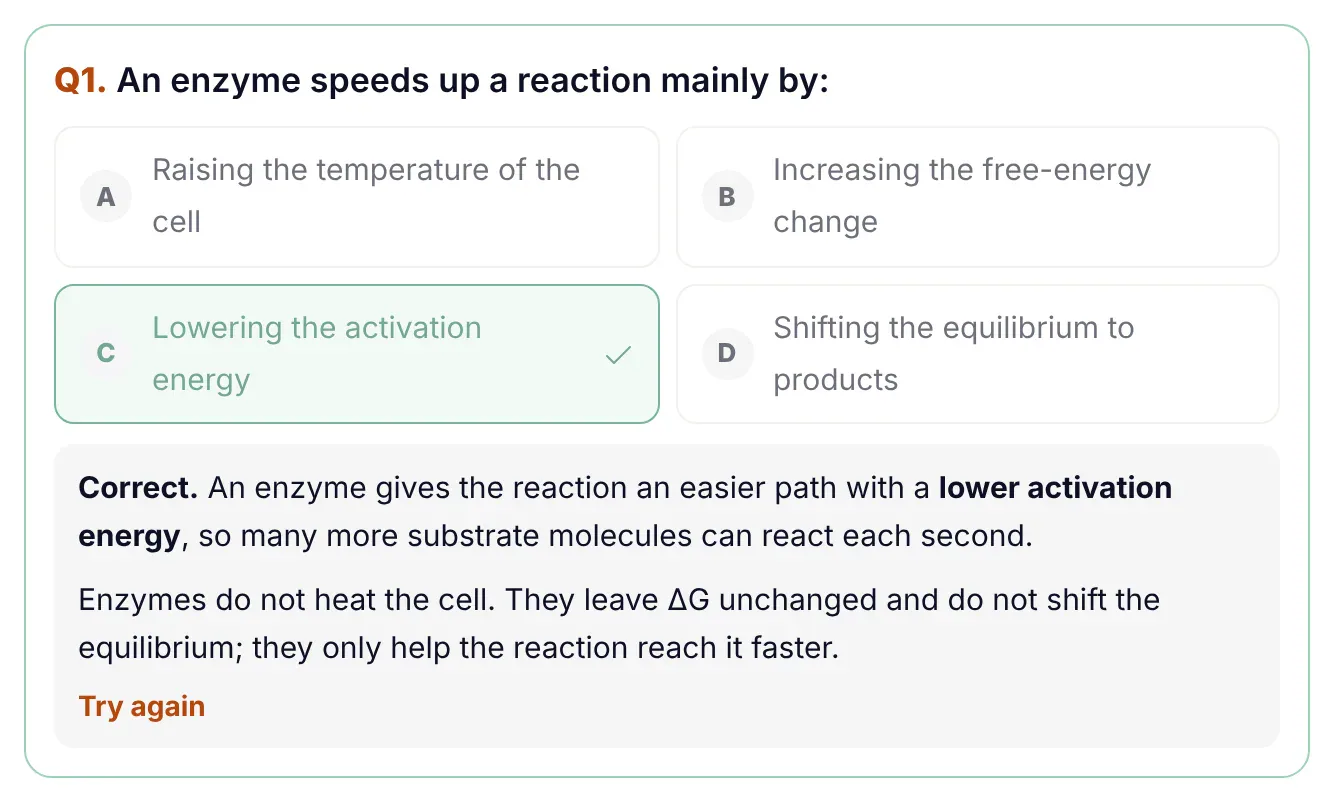
Try these six now, before opening the answers:
1. Enzymes increase the rate of a reaction without changing its:
A. Activation energy B. Pathway C. Free-energy change (ΔG) D. Rate constant
Show answer
C. An enzyme lowers the activation energy by giving a new pathway, which raises the rate constant, but the energies of reactants and products, and so ΔG, stay the same.
2. NAD+ working with alcohol dehydrogenase is an example of a:
A. Prosthetic group B. Coenzyme C. Metal activator D. Substrate
Show answer
B. NAD+ is organic, loosely attached and regenerated after the reaction: a coenzyme.
3. Which pairing of enzyme and optimum pH is correct?
A. Pepsin 8, trypsin 2 B. Pepsin 2, trypsin 8 C. Pepsin 7, trypsin 7 D. Pepsin 2, trypsin 4.5
Show answer
B. Pepsin works in the acidic stomach (about pH 2); trypsin in the slightly alkaline small intestine (about pH 8).
4. The effect of which inhibitor can be overcome by adding more substrate?
A. Cyanide B. Heavy metal ions C. Malonate D. Snake venom
Show answer
C. Malonate is a competitive inhibitor of succinate dehydrogenase, so more succinate out-competes it. Cyanide and heavy metals are irreversible.
5. A human enzyme is heated to 70 °C and then cooled to 37 °C. It will usually be:
A. Fully active again B. Permanently inactive C. Twice as active D. Active only at 0 °C
Show answer
B. At 70 °C a human enzyme is denatured, and heat denaturation is usually irreversible. Only cold-inactivated enzymes recover on warming.
6. Which statement about feedback inhibition is correct?
A. The product binds the active site B. The first enzyme of the pathway is inhibited C. The enzyme is destroyed D. The substrate is the inhibitor
Show answer
B. The end product binds a regulatory (allosteric) site on the first enzyme, reversibly, and the whole pathway slows.
Step 5 · Log the mistakes (5 minutes)
Every red item and every wrong MCQ goes into tomorrow's prompts. Write them as questions on a small list at the end of your page. On ePrepare this part is done for you: every MCQ you get wrong goes into your Wrong MCQs list, and smart revision brings your mistakes and weak topics back on a spaced schedule. A question leaves the list automatically once you answer it correctly later.
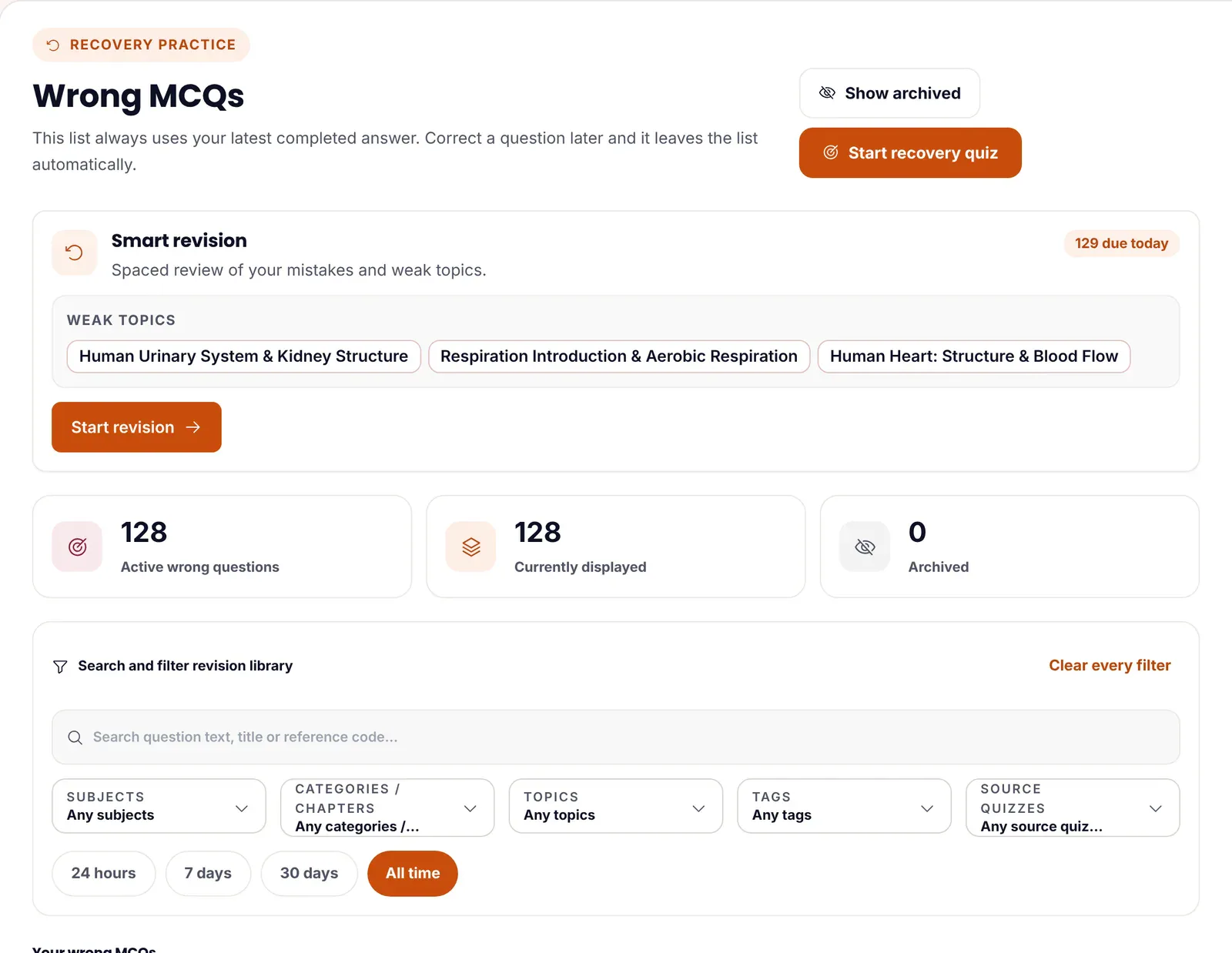
More on this tool in Wrong MCQs and smart revision for MDCAT.
The spaced re-test schedule
One session is not enough. Memory fades, and each re-test, made just as recall is getting harder, makes the next fade slower. So schedule short re-tests with growing gaps:
| When | What to do | Time |
|---|---|---|
| Day 0 | The full five-step session | About 50 min |
| Day 1 | Quick blank page; answer yesterday's red items | 10–15 min |
| Day 3 | Prompts only from memory, then 10 MCQs | 15–20 min |
| Day 7 | 20 mixed MCQs and a review of wrong MCQs | 20–25 min |
| Day 14 | Blank page again; compare it with Day 0 | 15 min |
| Day 30 | Timed chapter test, or the chapter inside a full-length paper | As set |
Treat these days as a sensible starting point, not a rule. If a re-test goes well, stretch the next gap. If it goes badly, shorten it. The principle is simply that each gap is longer than the last.
Remember this: the first re-test matters most. A 10-minute blank page the next day protects much of the hour you spent on Day 0.
How to fit it into a normal study week
Re-tests are short, so they stack. A typical day might be one new chapter's full session plus two or three short re-tests of older chapters, for example Day 1 of yesterday's chapter, Day 3 of Monday's and Day 7 of last week's. Keep a simple calendar of which chapter is due when, or let ePrepare's study plan, which includes spaced revision and weekly tests, and smart revision keep track for you.
For whole-paper practice, the Day 30 step fits neatly inside full-length papers. See MDCAT mock tests and FLPs.
Common mistakes with active recall
- Peeking. Checking the notes after every line turns recall back into reading. Finish the blank page first.
- Only doing MCQs. MCQs are recognition with four hints. The blank page and prompts make you produce the answer, which is harder and more useful.
- Re-reading after a mistake instead of re-testing. Correct it, then test it again the next day.
- Skipping the spacing. One perfect session followed by nothing for a month is close to starting over.
- Recalling before understanding. If a whole area is blank, learn it properly first, from a lecture or conceptual notes, then start recall.
Quick revision table
| Step | Notes open? | Purpose |
|---|---|---|
| Blank page | No | Find what you can produce freely |
| Prompts | No | Check the corners you did not think of |
| Check | Yes | Mark green, amber, red; correct in your own words |
| MCQs | No | Test in exam format; read every explanation |
| Log and re-test | No | Bring mistakes back after 1, 3, 7, 14 and 30 days |
آسان الفاظ میں: active recall کا مطلب ہے کتاب بند کر کے یاد سے لکھنا یا بولنا، دوبارہ پڑھنا نہیں۔ پہلے خالی صفحے پر topic کے بارے میں جو یاد ہے لکھیں، پھر چھوٹے سوالوں کے جواب یاد سے دیں۔ اس کے بعد notes کھول کر check کریں، غلطیاں سرخ رنگ سے درست کریں، اور MCQs حل کریں۔ جو غلط ہوا اسے اگلے دن، تیسرے دن، ایک ہفتے اور دو ہفتے بعد دوبارہ test کریں۔ یہ پڑھنے سے مشکل لگتا ہے، مگر یاد زیادہ دیر تک رہتا ہے۔
Frequently asked questions
What is active recall in studying?
It is revising by retrieving information from memory, with your notes closed, for example by writing a topic out on a blank page or answering questions, and then checking. It contrasts with passive methods like re-reading and highlighting.
Is active recall better than re-reading for MDCAT?
Yes. Memory research has repeatedly found that testing yourself leads to longer-lasting memory than reading the same material again, and MDCAT itself is a recall test: you must produce answers without your notes.
How often should I revise a chapter with active recall?
A good starting schedule is the day you study it, then after 1 day, 3 days, 7 days, 14 days and about 30 days. Stretch the gaps when re-tests go well and shorten them when they do not.
Are MCQs enough for active recall?
MCQs help, but they show you the answer among four options. Combine them with blank-page recall and short question prompts, which make you produce the answer without hints.
How long should an active recall session be?
About 45 to 60 minutes for a full chapter session, and 10 to 25 minutes for each later re-test. Short, regular re-tests matter more than long ones.
Can I use active recall for Physics and Chemistry too?
Yes. For Physics, recall formulas, units and the steps of a standard numerical, then solve problems without looking. For Chemistry, redraw reaction maps and tables from memory; see how to memorize organic chemistry reactions.