

Organic chemistry is where many MDCAT students give up on memory and start guessing. Hydrocarbons, alkyl halides, alcohols and phenols, aldehydes and ketones, carboxylic acids: each chapter has a page of reactions, and each reaction has a reagent and a condition that can change the product. Reading the list again and again rarely works. What works is giving the reactions a shape, learning reagents by the job they do, and then testing yourself until you can rebuild the whole map from a blank page.
The short answer: Do not memorise organic reactions as a list. First learn one spine: alkane → alkyl halide → alcohol → aldehyde or ketone → carboxylic acid, with the reagent on each arrow. Then attach the side reactions to each box, learn reagents by their job (oxidiser, reducer, base, nucleophile, test), and drill the condition pairs that change the product. Finally, redraw the map from memory and solve fill-the-reagent and conversion exercises every few days.
Why reading reaction lists does not stick
A list gives your brain nothing to hold on to. Each reaction looks like a separate fact, so after fifty of them they blur. MDCAT does not ask you to recite a list either. It gives you a reagent and asks for the product, gives you two compounds and asks for the reagent, or changes one condition and waits for you to miss it.
So you need three things: a structure (how the families connect), reagent meanings (what each reagent does to any molecule), and retrieval practice (pulling the answers out of memory, not re-reading them). The rest of this guide builds each one.
Step 1: Learn the spine of five boxes
Nearly every reaction in MDCAT organic chemistry either moves a molecule along one chain of functional groups or branches off it. Learn the chain first.
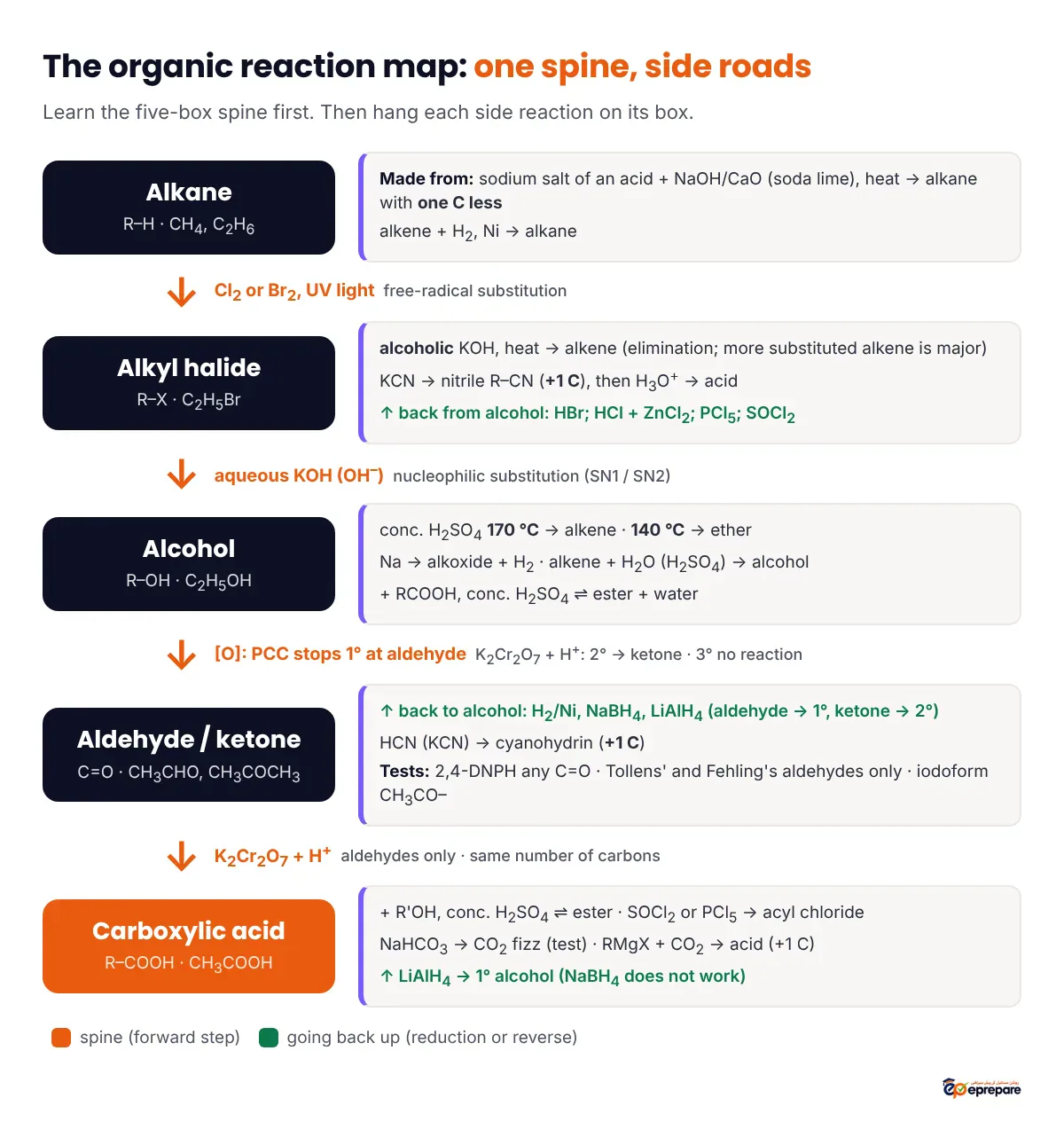
| From → to | Reagent and condition | Reaction type | Example |
|---|---|---|---|
| Alkane → alkyl halide | Cl2 or Br2, UV (diffused) light | Free-radical substitution | CH4 + Cl2 → CH3Cl + HCl (no reaction in the dark) |
| Alkyl halide → alcohol | Aqueous KOH, warm | Nucleophilic substitution | C2H5Br + KOH(aq) → C2H5OH + KBr |
| 1° alcohol → aldehyde | PCC in CH2Cl2 (no water) | Mild oxidation | CH3CH2OH → CH3CHO |
| 2° alcohol → ketone | K2Cr2O7 + H+ (or PCC) | Oxidation | CH3CH(OH)CH3 → CH3COCH3 |
| Aldehyde → carboxylic acid | K2Cr2O7 + H+ | Oxidation, same number of carbons | CH3CHO → CH3COOH |
Say the spine aloud a few times: "halogen and light, aqueous base, PCC or dichromate, dichromate again." Notice the pattern from alcohol onwards: each step adds oxygen or removes hydrogen. That is the oxidation ladder, and it explains a lot of MCQs on its own.
The α-hydrogen rule for oxidising alcohols
Count the hydrogens on the carbon that carries the –OH:
- Primary (two α-H): oxidised to an aldehyde, then on to a carboxylic acid. PCC stops it at the aldehyde.
- Secondary (one α-H): oxidised to a ketone, and it stops there.
- Tertiary (no α-H): no reaction. The orange dichromate stays orange.
With 1° and 2° alcohols, acidified dichromate turns from orange to green. That colour change is itself a favourite MCQ.
Step 2: Hang the side reactions on each box
Once the spine is solid, add the branches one box at a time. Keep it to four or five per box; MDCAT asks about the common ones far more than the rare ones.
- Alkyl halide: alcoholic KOH with heat gives an alkene by elimination, and the more substituted alkene is the major product (2-bromobutane gives mainly but-2-ene). KCN gives a nitrile with one carbon more, which hydrolyses to a carboxylic acid.
- Alcohol: conc. H2SO4 at 170 °C gives an alkene; at 140 °C with excess alcohol it gives an ether. Sodium metal gives an alkoxide and hydrogen gas. Alcohols go back to alkyl halides with HBr, HCl + anhydrous ZnCl2, PCl5 or SOCl2.
- Alkene: adds HBr by Markovnikov's rule (propene gives 2-bromopropane) and adds water with an acid catalyst to make an alcohol (propene gives propan-2-ol). Bromine adds across the double bond and loses its red-brown colour.
- Aldehyde or ketone: reduced back to alcohols by H2/Ni, NaBH4 or LiAlH4 (an aldehyde gives a 1° alcohol, a ketone a 2° alcohol, never a 3° one). HCN adds to make a cyanohydrin, again with one carbon more.
- Carboxylic acid: with an alcohol and conc. H2SO4 it forms an ester (reversible). SOCl2 or PCl5 make the acid chloride. LiAlH4 reduces it to a 1° alcohol; NaBH4 does not. Its sodium salt heated with soda lime (NaOH/CaO) gives an alkane with one carbon less: sodium acetate gives methane.
Keep a carbon count
Many MCQs hide a change in chain length. Remember three reactions that add a carbon and one that removes it:
| Change | Reaction | Example |
|---|---|---|
| +1 C | R–X + KCN → R–CN, then hydrolysis | Bromoethane → propanenitrile → propanoic acid |
| +1 C | Aldehyde or ketone + HCN → cyanohydrin | CH3CHO → CH3CH(OH)CN |
| +1 C | Grignard reagent + CO2, then acid | CH3MgBr → CH3COOH |
| −1 C | Sodium salt of acid + soda lime, heat (decarboxylation) | CH3COONa → CH4 |
Step 3: Learn reagents by the job they do
Instead of learning "ethanol plus dichromate gives acetaldehyde, propan-2-ol plus dichromate gives acetone…", learn once that dichromate is an oxidiser and apply it to any molecule. A reagent you understand works on compounds you have never seen.
| Job | Reagent | What it does |
|---|---|---|
| Oxidisers | K2Cr2O7 + H+ | 1° alcohol → acid, 2° → ketone, aldehyde → acid; orange → green |
| KMnO4 + H+ | Same oxidations; purple → colourless | |
| PCC in CH2Cl2 | Mild: 1° alcohol → aldehyde only | |
| Cold dilute KMnO4 (Baeyer's test) | Alkene → ethylene glycol; purple fades, brown MnO2 | |
| Reducers | H2 with Ni, Pt or Pd | Reduces C=C and C=O |
| NaBH4 | Reduces C=O of aldehydes and ketones only; not acids | |
| LiAlH4 (dry ether) | Reduces aldehydes, ketones, acids and esters to alcohols | |
| Zn(Hg) + conc. HCl (Clemmensen) | C=O → CH2 (acetone → propane) | |
| Halogen sources | Cl2 or Br2, UV light | Substitutes H in alkanes (free radicals) |
| HBr, HI; HCl + anhydrous ZnCl2 | Alcohol → alkyl halide (HCl needs ZnCl2) | |
| PCl5; PX3 | –OH → –Cl; one PX3 for three ROH | |
| SOCl2 (pyridine) | –OH → –Cl; cleanest, both by-products (SO2, HCl) are gases | |
| Water removers | Conc. H2SO4 | 170 °C: alkene; 140 °C: ether; few drops: esterification catalyst |
| Al2O3, 400 °C | Ethanol → ethene (industrial) | |
| P2O5 | Two acids → anhydride; amide → nitrile | |
| Bases and nucleophiles | Aqueous KOH | Substitution: alkyl halide → alcohol |
| Alcoholic KOH | Elimination: alkyl halide → alkene | |
| KCN; sodium alkoxide | Nitrile (+1 C); Williamson ether with a methyl or 1° halide |
The tests: one table to learn cold
| Test | Positive for | What you see |
|---|---|---|
| Bromine water (or Br2 in CCl4) | Alkenes (C=C) | Red-brown colour disappears |
| Lucas reagent (conc. HCl + ZnCl2), room temperature | Classifies alcohols | 3° cloudy at once, 2° in about 5 minutes, 1° stays clear |
| Neutral FeCl3 | Phenol | Violet colour |
| 2,4-DNPH | Any C=O (aldehydes and ketones) | Yellow-orange precipitate |
| Tollens' reagent, warm | Aldehydes | Silver mirror |
| Fehling's or Benedict's solution | Aldehydes | Blue → brick-red Cu2O |
| Iodoform (I2 + NaOH) | CH3CO– compounds, ethanol, acetaldehyde | Yellow CHI3 precipitate |
| NaHCO3 | Carboxylic acids (not phenols) | Brisk fizz of CO2 |
Step 4: Drill the condition pairs
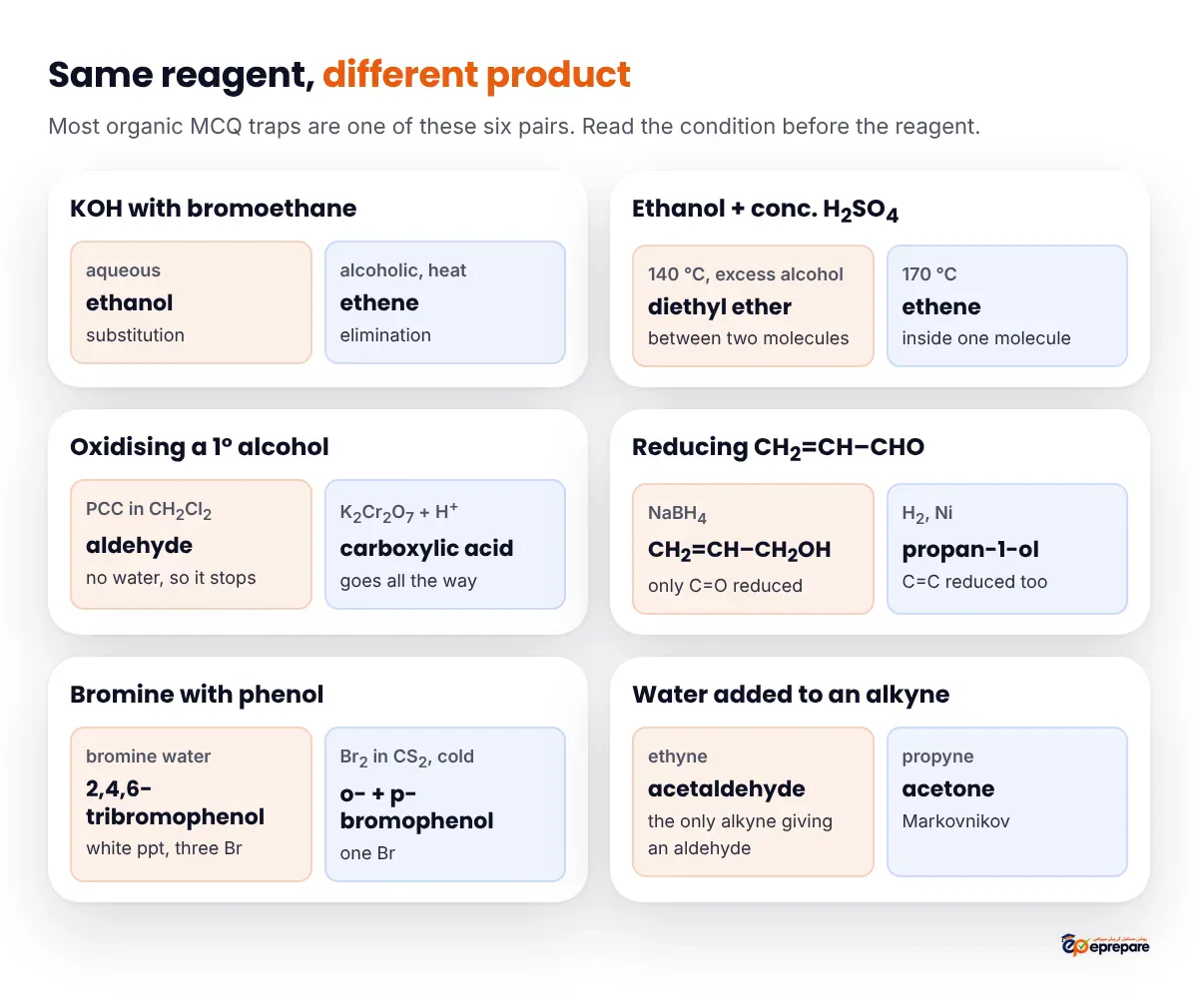
The most common organic trap in MDCAT is not an unknown reaction. It is a known reagent under a different condition. Learn these as pairs, never alone.
Step 5: Understand the one mechanism you cannot skip
For alkyl halides, MDCAT loves SN1 versus SN2. Here understanding beats memory, because the two are opposites in almost every row. SN1 needs a stable carbocation, so it prefers tertiary halides, weak nucleophiles and polar protic solvents. SN2 needs an open back side for the attack, so it prefers methyl and primary halides, strong nucleophiles and polar aprotic solvents.
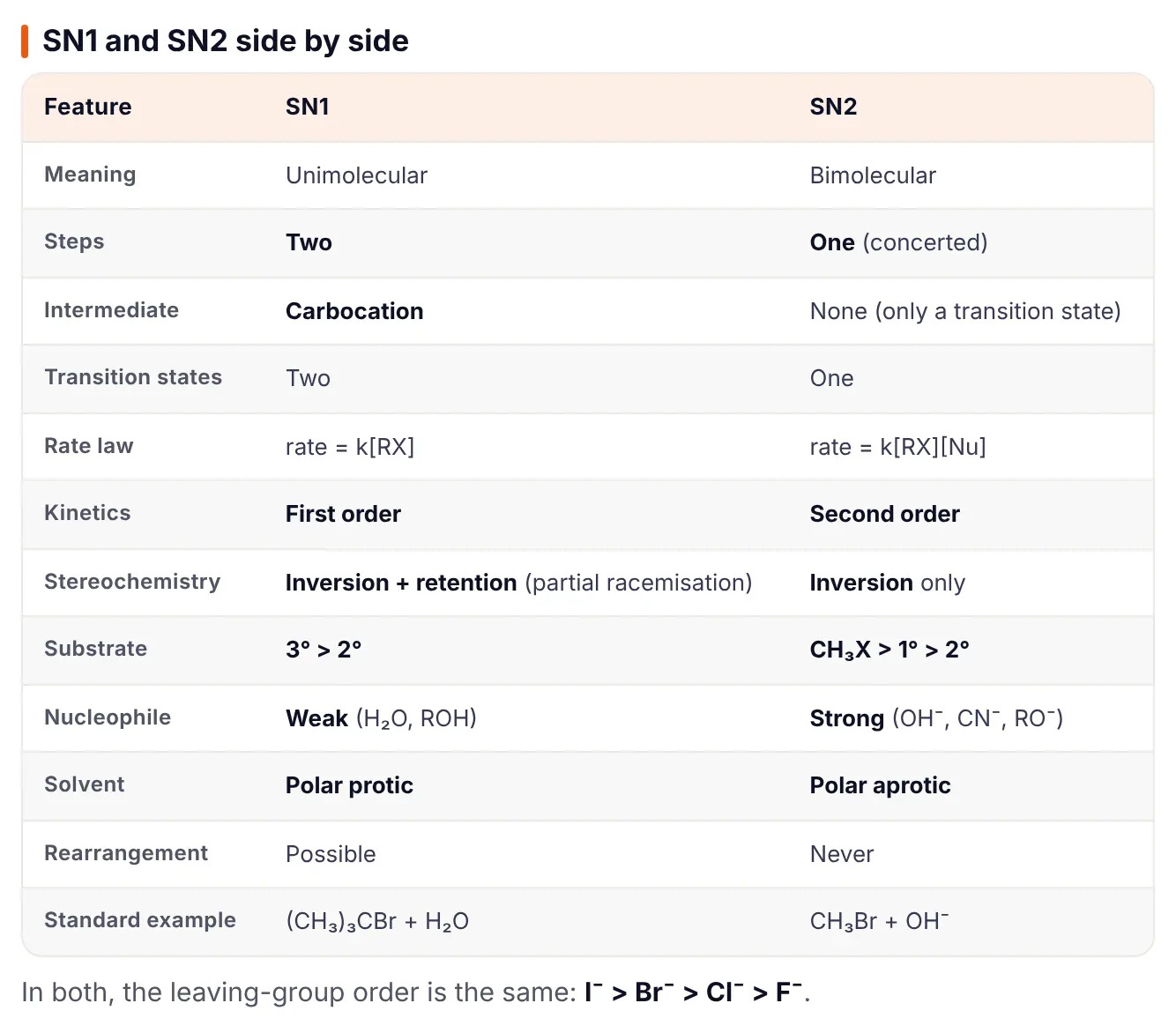
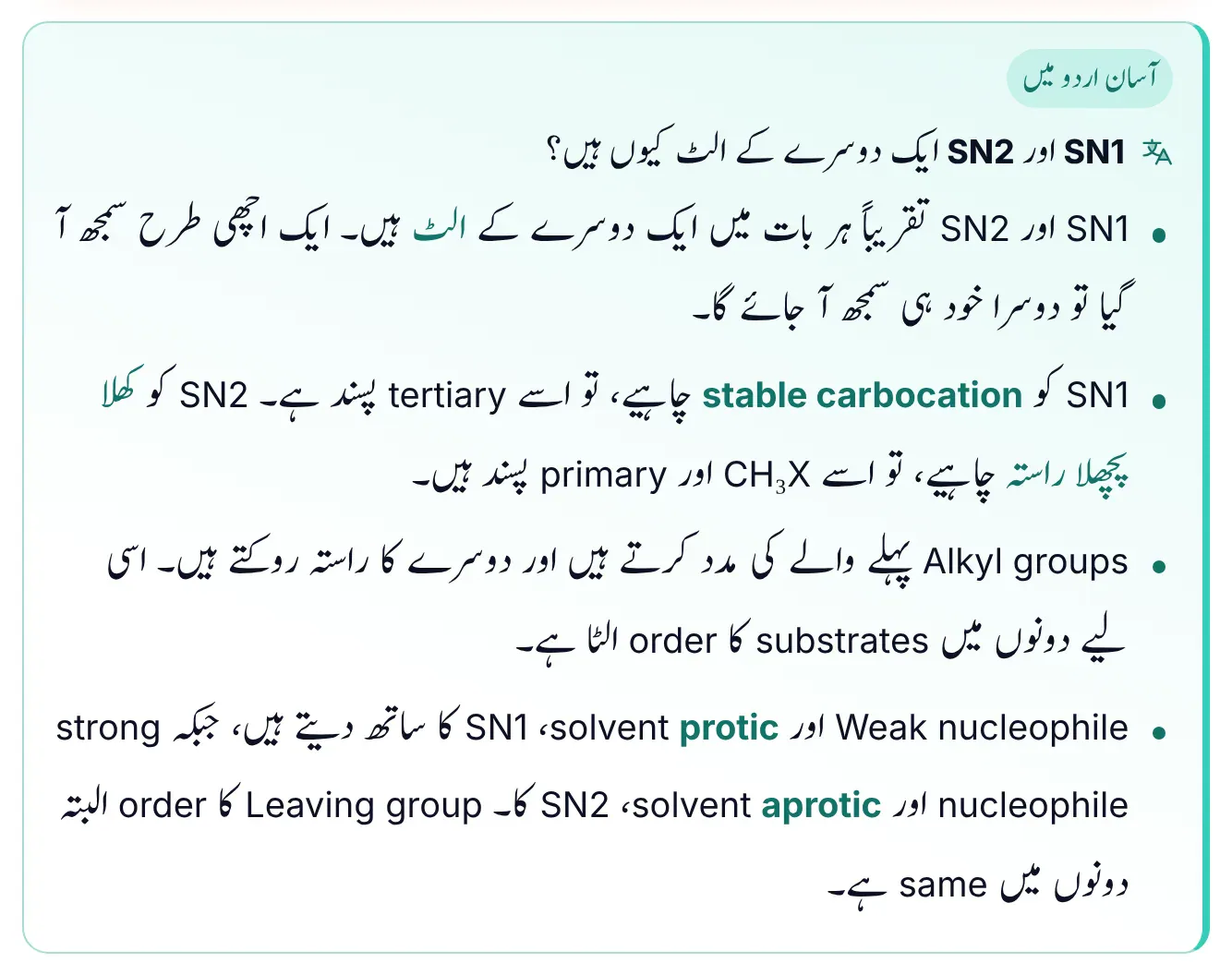
Learn one column properly and the other follows by reversing it. The full lessons, with mechanisms, diagrams and practice MCQs, are in ePrepare's conceptual notes, which cover all 20 Chemistry units.
Step 6: Retrieval exercises (try before you open the answers)
This is the step that makes the rest stick. Cover the map, attempt each item on paper, then open the answer. A wrong answer here is useful: it tells you exactly which arrow to relearn. For the method behind this, see active recall for MDCAT revision.
Set A: Name the reagent
- CH4 → CH3Cl
- CH3CH2Br → CH3CH2OH
- CH3CH2Br → CH2=CH2
- CH3CH2OH → CH3CHO, stopping at the aldehyde
- CH3COOH → CH3COCl
- CH3COCH3 → CH3CH(OH)CH3
Show answers to Set A
1. Cl2 with UV (diffused) light. 2. Aqueous KOH, warm. 3. Alcoholic KOH, heat. 4. PCC in CH2Cl2. 5. SOCl2 (or PCl5, PCl3). 6. NaBH4 then water, or H2 with Ni.
Set B: Predict the main product
- 2-Bromobutane + alcoholic KOH, heat
- Propene + HBr
- 2-Methylpropan-2-ol + K2Cr2O7 + H+
- CH3CH2Br + KCN
- CH3COONa + NaOH/CaO, heat
- Propyne + H2O (H2SO4, HgSO4)
Show answers to Set B
1. But-2-ene (the more substituted alkene; but-1-ene is minor). 2. 2-Bromopropane (Markovnikov). 3. No reaction: a tertiary alcohol has no α-hydrogen, so the dichromate stays orange. 4. Propanenitrile, CH3CH2CN, one carbon more. 5. Methane + Na2CO3, one carbon less. 6. Acetone (through propen-2-ol, by Markovnikov's rule).
Set C: Plan the conversion
- Ethene → ethanoic acid
- Bromoethane → propanoic acid
- Propan-1-ol → propan-2-ol
- Ethanol → ethyl ethanoate, using ethanol as the only organic starting material
Show answers to Set C
1. Ethene + H2O (H2SO4 catalyst) → ethanol; then K2Cr2O7 + H+ → acetaldehyde → ethanoic acid. 2. KCN → propanenitrile (+1 C); then acid hydrolysis → propanoic acid. 3. Conc. H2SO4 at 170 °C → propene; then add water with an acid catalyst → propan-2-ol by Markovnikov's rule. 4. Oxidise part of the ethanol with K2Cr2O7 + H+ to ethanoic acid; then warm it with more ethanol and a few drops of conc. H2SO4 → ethyl ethanoate + water.
Set D: Blank-page map
Take a blank page. Draw the five spine boxes and write the reagent on every arrow. Then add as many side reactions as you can in five minutes. Compare with the map above and circle what you missed. Repeat the same drawing after one day, three days and a week; each time, the circled parts should shrink.
MDCAT-style practice MCQs
1. Which reagent converts a primary alcohol into an aldehyde without oxidising it further?
A. Acidified K2Cr2O7 B. Acidified KMnO4 C. PCC in CH2Cl2 D. Conc. H2SO4
Show answer
C. PCC is a mild oxidiser used without water, so the reaction stops at the aldehyde. Dichromate and permanganate go on to the acid.
2. Ethanol heated with conc. H2SO4 at 140 °C, with ethanol in excess, gives mainly:
A. Ethene B. Diethyl ether C. Acetaldehyde D. Ethyl hydrogen sulphate only
Show answer
B. At 140 °C water is removed between two molecules, giving diethyl ether. At 170 °C it is removed from one molecule, giving ethene.
3. Which compound gives a yellow precipitate in the iodoform test?
A. Methanol B. Propanal C. Acetone D. Benzaldehyde
Show answer
C. Acetone has the CH3CO– group. Propanal (CH3CH2CHO) does not; acetaldehyde is the only aldehyde that gives the test.
4. Which reagent reduces a carboxylic acid to a primary alcohol?
A. NaBH4 B. LiAlH4 C. Zn(Hg) + conc. HCl D. PCC
Show answer
B. LiAlH4 is strong enough to reduce acids; NaBH4 reduces only aldehydes and ketones. Clemmensen turns C=O into CH2, and PCC is an oxidiser.
5. tert-Butyl bromide in water, a polar protic solvent, mainly undergoes substitution by:
A. SN1 B. SN2 C. Free-radical substitution D. Electrophilic substitution
Show answer
A. A tertiary halide forms a stable carbocation and blocks back-side attack, and water is a weak nucleophile in a protic solvent: all signs of SN1.
6. Compound X gives a yellow-orange precipitate with 2,4-DNPH but no silver mirror with Tollens' reagent. X is most likely:
A. An aldehyde B. A ketone C. An alcohol D. A carboxylic acid
Show answer
B. 2,4-DNPH shows a C=O group is present; failing Tollens' rules out an aldehyde, so it is a ketone.
7. Which reaction increases the length of a carbon chain by one carbon?
A. Sodium acetate + soda lime B. Bromoethane + KCN C. Ethanol + PCC D. Propene + HBr
Show answer
B. The cyanide carbon joins the chain, giving propanenitrile. Soda lime removes a carbon; the other two keep the count the same.
8. Phenol shaken with bromine water gives:
A. o-Bromophenol only B. p-Bromophenol only C. A white precipitate of 2,4,6-tribromophenol D. No reaction without a catalyst
Show answer
C. In water, phenol is so activated that three bromines add at positions 2, 4 and 6 without a catalyst. Br2 in CS2 at low temperature gives the mono-bromo products instead.
A two-week schedule to lock it in
| Day | Task | Time |
|---|---|---|
| 1 | Learn the spine; draw it three times from memory | 40 min |
| 2 | Side reactions of alkyl halides and alcohols; Set A | 45 min |
| 3 | Side reactions of carbonyls and acids; carbon-count table | 45 min |
| 4 | Reagent-by-job table and tests table; Set B | 45 min |
| 5 | Condition pairs; SN1 vs SN2; 30 chapter MCQs | 60 min |
| 7 | Blank-page map (Set D); Set C; fix what you missed | 40 min |
| 10 | Blank-page map again; 40 mixed organic MCQs | 50 min |
| 14 | Blank-page map; re-attempt every MCQ you got wrong | 40 min |
For mixed practice, ePrepare's Quiz Builder lets you pick the organic chapters, the number of MCQs and a timer, and Wrong MCQs with smart revision brings your mistakes back on a spaced schedule. To see which organic chapters carry the most MCQs, read high-yield MDCAT Chemistry chapters.
Quick revision table
| Remember | Because MCQs ask |
|---|---|
| Alkane + Cl2 needs UV light | No reaction in the dark |
| Aqueous KOH substitutes; alcoholic KOH eliminates | The product changes with the solvent |
| Conc. H2SO4: 140 °C ether, 170 °C alkene | Temperature decides the product |
| 1° → aldehyde → acid; 2° → ketone; 3° no reaction | Count the α-H |
| PCC stops at the aldehyde | Which reagent stops oxidation? |
| NaBH4: C=O only; LiAlH4: acids and esters too | Which reducer reduces an acid? |
| KCN, HCN, Grignard + CO2: +1 C; soda lime: −1 C | Count the carbons |
| Tollens' and Fehling's: aldehydes; 2,4-DNPH: any C=O | Telling aldehydes from ketones |
| Iodoform: CH3CO–, ethanol, acetaldehyde | Which compound gives yellow CHI3? |
| SN1: 3°, weak Nu, protic. SN2: CH3X, 1°, strong Nu, aprotic | Which mechanism, which conditions? |
آسان الفاظ میں: organic reactions کو list کی طرح رٹا نہ لگائیں۔ پہلے ایک سیدھی لائن یاد کریں: alkane سے alkyl halide، پھر alcohol، پھر aldehyde یا ketone، اور آخر میں carboxylic acid، ہر تیر پر reagent کے ساتھ۔ پھر ہر box کے ساتھ اس کے side reactions جوڑیں، اور reagents کو ان کے کام سے یاد کریں: کون oxidise کرتا ہے، کون reduce۔ Aqueous اور alcoholic KOH، یا 140 اور 170 °C جیسے جوڑوں پر خاص دھیان دیں۔ آخر میں خالی کاغذ پر پورا map خود بنائیں، اور یہ کام ہر چند دن بعد دہرائیں۔
Frequently asked questions
What is the fastest way to memorise organic chemistry reactions for MDCAT?
Learn the five-box spine (alkane, alkyl halide, alcohol, aldehyde or ketone, carboxylic acid) with the reagent on each arrow, then add side reactions box by box. Test yourself by redrawing the map from a blank page every few days instead of re-reading.
Which organic chapters are in the MDCAT syllabus?
PM&DC's Chemistry curriculum includes Fundamental principles of organic chemistry, Hydrocarbons, Alkyl halides, Alcohols and phenols, Aldehydes and ketones, Carboxylic acids and Macromolecules. Amines are not listed. See the MDCAT syllabus for every topic.
Do I need to learn reaction mechanisms for MDCAT?
Yes, for the ones in the syllabus: free-radical substitution of alkanes, electrophilic addition to alkenes, electrophilic substitution in benzene, SN1, SN2 and elimination for alkyl halides, and nucleophilic addition to aldehydes and ketones. Understanding them makes products easier to predict.
How do I remember which reagent gives which product?
Learn reagents by their job. Once you know dichromate is an oxidiser and NaBH4 a mild reducer, you can apply them to any compound. Then drill the condition pairs, such as aqueous versus alcoholic KOH, where one change flips the product.
How do I tell an aldehyde from a ketone in an MCQ?
Both give a yellow-orange precipitate with 2,4-DNPH. Only aldehydes give a silver mirror with Tollens' reagent or a brick-red precipitate with Fehling's solution, and only aldehydes are oxidised further to acids by acidified dichromate.
How many MCQs does organic chemistry carry in MDCAT?
Chemistry has 45 of the 180 MCQs, and PM&DC does not fix a separate count for each chapter. Organic chemistry makes up seven of PM&DC's 20 Chemistry units (units 13 to 19), so it is worth learning properly.