Stationary waves link three parts of the MDCAT Waves chapter: superposition, vibrating strings and organ pipes. Once you understand nodes, antinodes and the "half a wavelength per loop" rule, the string and pipe numericals become simple counting. This guide explains how stationary waves form, the facts MCQs test, the string harmonics formula fn = nv/2L, and a full comparison with progressive waves.
The short answer: A stationary (standing) wave forms when two identical waves (same frequency, amplitude and speed) travel in opposite directions along the same line and superpose, usually a wave and its reflection. The pattern stays in place: nodes never move and antinodes vibrate with the largest amplitude. Node to node is λ/2, node to the next antinode is λ/4, and no net energy is carried along. On a string fixed at both ends, fn = nv/2L.
What a stationary wave is
Tie one end of a rope to a wall and shake the other end steadily. Your waves travel to the wall, reflect and come back. Now two waves share the rope: the one going towards the wall and the reflected one coming back. At the right shaking frequencies they add up to a pattern of loops that stay in one place. The rope swings up and down inside fixed loops, and no wave shape runs along it.
The conditions MDCAT asks for:
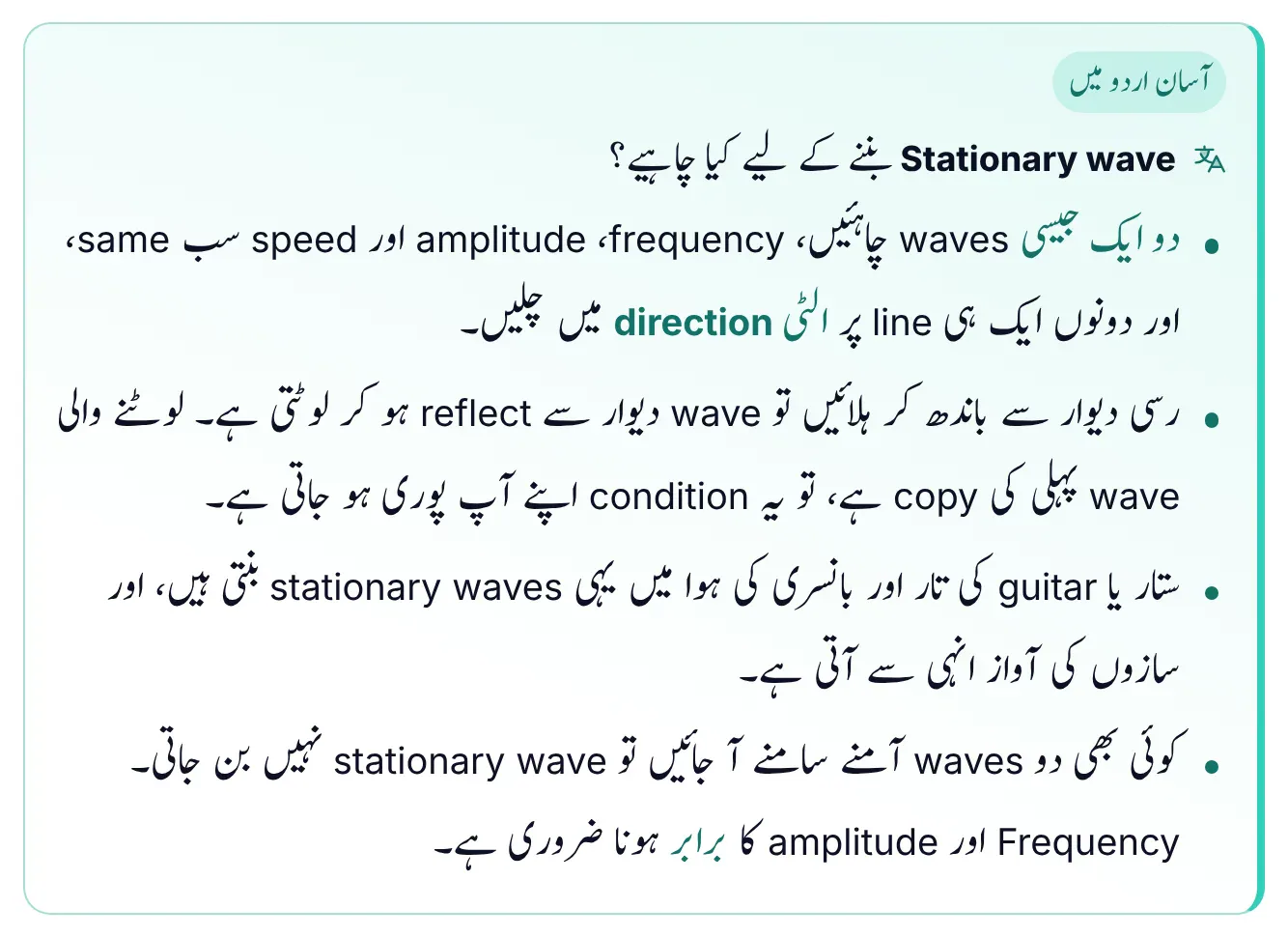
- Two waves of the same frequency, same amplitude and same speed (same medium).
- Travelling in opposite directions along the same line.
- Reflection gives this automatically, because the reflected wave is a copy of the incident wave.
How it forms: the graphical method
The PM&DC syllabus asks you to explain the formation of stationary waves using the graphical method. The idea is to draw the two waves and their sum at a few moments, a quarter period apart.
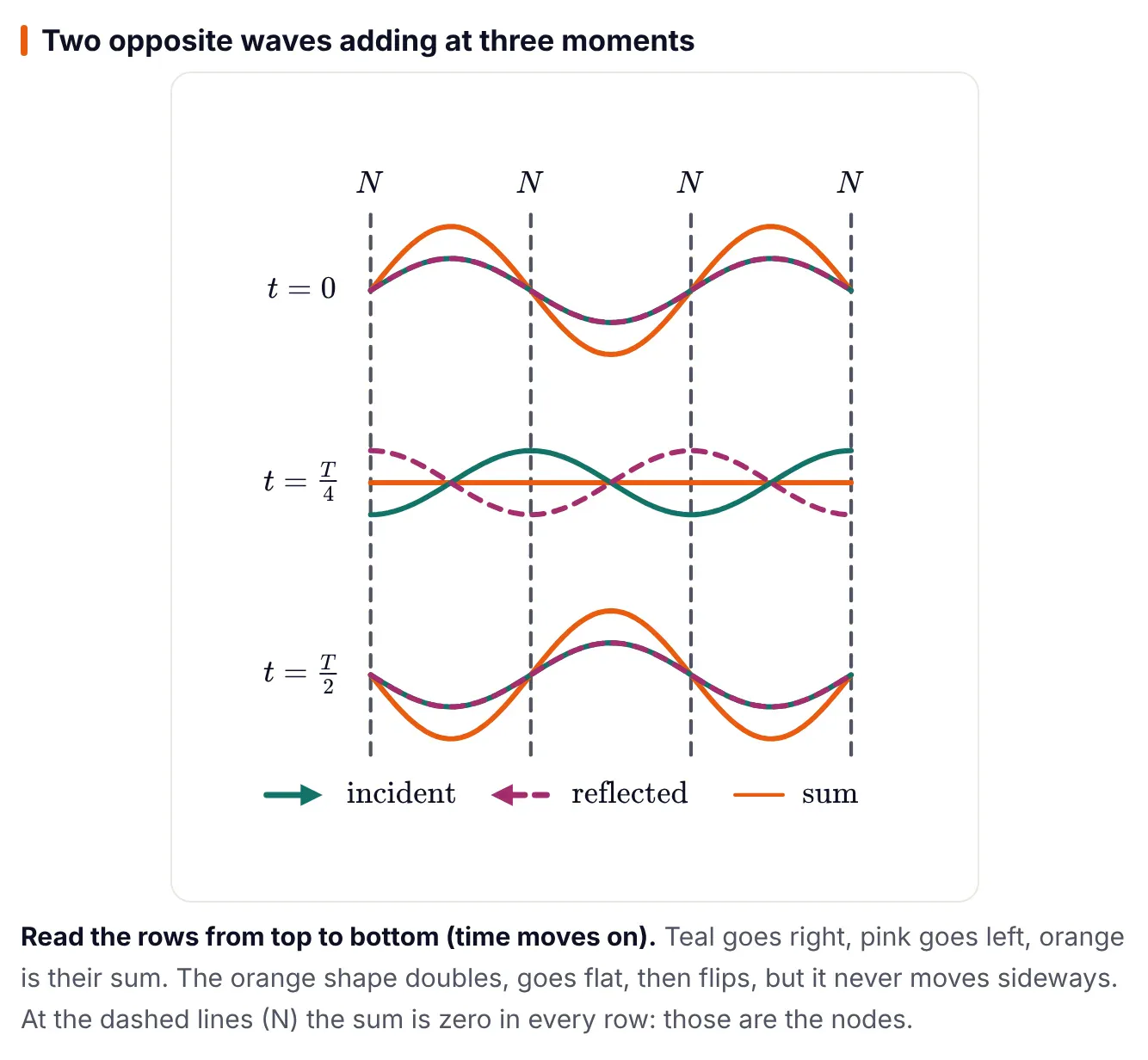
- t = 0: crest lies on crest, so the sum has double the height.
- t = T/4: each wave has moved λ/4 in opposite directions, so they are shifted λ/2 relative to each other. Crest sits on trough everywhere, and the rope is flat for an instant.
- t = T/2: trough lies on trough, and the loops appear upside down.
- Some points have zero displacement in every row. These are the nodes. Midway between them, the rope swings the most: the antinodes.
Nodes, antinodes and phase
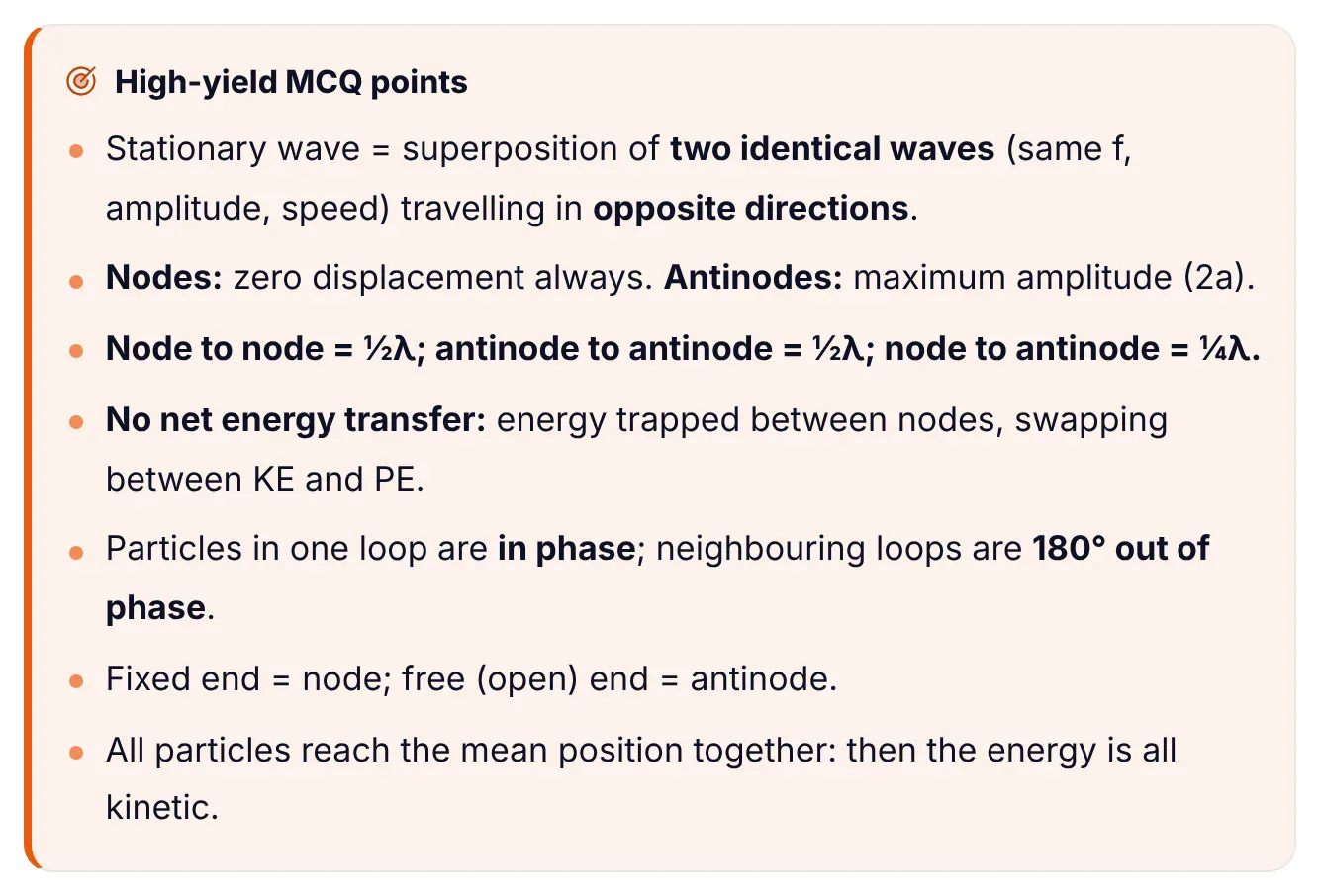
- Node (N): a point that never moves (zero displacement at all times). The two waves always arrive there exactly out of step and cancel.
- Antinode (A): a point midway between two nodes with the largest amplitude. If each wave has amplitude a, the antinode vibrates with amplitude 2a.
- Amplitude varies: from zero at a node to 2a at an antinode. In a progressive wave, every particle has the same amplitude.
- Loop: the part between two neighbouring nodes. Particles in one loop move up together and down together (in phase). Particles in neighbouring loops move in opposite directions (180° out of phase).
- All particles reach their extreme positions together, and all pass through the mean position together. So the string looks straight twice in every cycle.
- End rules: a fixed end (clamp, wall, closed end of a pipe) is a node; a free end (open end of a pipe) is an antinode.
Distances in a stationary wave
| From | To | Distance |
|---|---|---|
| Node | Next node | λ/2 |
| Antinode | Next antinode | λ/2 |
| Node | Next antinode | λ/4 |
| Node | Alternate node (two loops) | λ |
| A length holding n loops | L = n × λ/2 |
Remember this: one loop is only half a wavelength. A loop that is up now will be down half a period later, so one full wavelength needs two loops (one up, one down). Count the loops, then halve: 4 loops = 2λ.
Why a stationary wave carries no net energy
A progressive wave carries energy forward. In a stationary wave, two equal waves carry equal energy in opposite directions, so the net transfer of energy is zero. Nodes never move, so no energy passes through them; the energy of each loop stays trapped between its two nodes.
Inside a loop the energy keeps changing form. At the extreme positions the particles are momentarily at rest and the energy is all potential. When they all pass through the mean position together, the string is straight and the energy is all kinetic.
Harmonics on a string: fn = nv/2L
A sitar or guitar string is fixed at both ends, so both ends must be nodes. Between them the string can only hold whole loops: L = λ/2, 2(λ/2), 3(λ/2) and so on. Each allowed pattern is a mode of vibration, and only these frequencies set up a steady stationary wave.
Step by step: L = n × λn/2, so λn = 2L/n. Using v = fλ, fn = v/λn = nv/2L. The fundamental (n = 1) is f1 = v/2L, and every mode is fn = nf1.
Speed of waves on a string: v = √(T/μ), so f1 = (1/2L)√(T/μ).
| Symbol | Meaning | SI unit |
|---|---|---|
| fn | Frequency of the nth harmonic | Hz (s−1) |
| n | Harmonic number = number of loops (1, 2, 3 …) | no unit |
| v | Speed of the transverse wave on the string | m s−1 |
| L | Vibrating length of the string | m |
| λn | Wavelength of the nth harmonic (2L/n) | m |
| T | Tension in the string | N |
| μ | Mass per unit length (mass ÷ length) | kg m−1 |
| Mode | Loops | Nodes | Antinodes | λ | f |
|---|---|---|---|---|---|
| 1st harmonic (fundamental) | 1 | 2 | 1 | 2L | f1 |
| 2nd harmonic (1st overtone) | 2 | 3 | 2 | L | 2f1 |
| 3rd harmonic (2nd overtone) | 3 | 4 | 3 | 2L/3 | 3f1 |
| 4th harmonic (3rd overtone) | 4 | 5 | 4 | L/2 | 4f1 |
Key facts: a string gives all harmonics, odd and even; n loops give n + 1 nodes and n antinodes; the nth harmonic is the (n − 1)th overtone. Tighter, shorter or thinner strings give a higher pitch (f ∝ √T, f ∝ 1/L, f ∝ 1/√μ). Air columns follow the same logic with different end rules; see organ pipe numericals for MDCAT.
Progressive vs stationary waves
| Feature | Progressive wave | Stationary wave |
|---|---|---|
| Made by | One wave from a source | Two identical waves moving in opposite directions |
| Wave shape | Moves forward at speed v | Stays in place (loops) |
| Energy | Carried forward | No net transfer; trapped between nodes |
| Amplitude | Same for every particle | Zero at nodes, maximum (2a) at antinodes |
| Particles always at rest | None | Particles at the nodes |
| Phase | Changes from point to point | Same within a loop; opposite in the next loop |
| Whole medium straight at one instant? | No | Yes, twice every cycle |
Worked numericals (no calculator)
Example 1: wave speed from node spacing
Neighbouring nodes of a stationary wave are 25 cm apart and the frequency is 40 Hz. Find the speed of the travelling waves.
- Node to node = λ/2, so λ = 2 × 25 = 50 cm = 0.5 m.
- v = fλ = 40 × 0.5 = 20 m s−1.
Example 2: node to antinode
The distance between a node and the next antinode is 5 cm. Find the wavelength.
- Node to antinode = λ/4, so λ = 4 × 5 = 20 cm.
Example 3: counting loops
A string 1.2 m long vibrates in 4 loops at 100 Hz. Find λ, the wave speed, and the numbers of nodes and antinodes.
- λ = 2L/n = 2.4/4 = 0.6 m.
- v = fλ = 100 × 0.6 = 60 m s−1.
- 4 loops: 5 nodes, 4 antinodes.
Example 4: harmonics from length and speed
Waves travel at 200 m s−1 on a string 0.5 m long. Find its three lowest frequencies.
- f1 = v/2L = 200/(2 × 0.5) = 200 Hz.
- All harmonics: 200 Hz, 400 Hz, 600 Hz.
Example 5: using tension and mass per unit length
A string 1 m long has tension 100 N and mass per unit length 0.01 kg m−1. Find the fundamental and the first overtone.
- v = √(T/μ) = √(100/0.01) = √10 000 = 100 m s−1.
- f1 = v/2L = 100/2 = 50 Hz.
- First overtone = 2nd harmonic = 100 Hz.
Example 6: two neighbouring resonant frequencies
A string resonates at 300 Hz and 400 Hz, with no resonance in between. Find the fundamental and say which harmonic 300 Hz is.
- Neighbouring modes of a string differ by f1: f1 = 400 − 300 = 100 Hz.
- 300 = 3 × 100, so 300 Hz is the 3rd harmonic (3 loops, the 2nd overtone).
More quick-working habits for Waves numericals are in MDCAT Physics numericals without a calculator.
Where stationary waves appear in MDCAT
- Strings: sitar, guitar and violin (modes, harmonics, tension and length).
- Air columns: flutes, whistles and organ pipes, where open ends are antinodes and closed ends are nodes.
- Resonance: a string or pipe vibrates strongly only at its natural frequencies, the harmonics. See resonance in physics for MDCAT.
Common mistakes
- "Node to node is one wavelength." Wrong. It is λ/2; one wavelength spans two loops.
- "A stationary wave carries energy along." Wrong. The net transfer is zero; energy stays between nodes.
- "All particles have the same amplitude." Wrong. That is a progressive wave. Here the amplitude is zero at nodes and 2a at antinodes.
- "Neighbouring loops move together." Wrong. They are 180° out of phase.
- "n loops have n nodes." Wrong. On a string, n loops have n + 1 nodes.
- "The 1st overtone is the 1st harmonic." Wrong. The 1st overtone is the 2nd harmonic.
- "Doubling the tension doubles the frequency." Wrong. f ∝ √T, so you need 4 times the tension.
MDCAT-style practice MCQs
1. The distance between two consecutive nodes of a stationary wave is:
A) λ/4 B) λ/2 C) λ D) 2λ
Show answer
B) λ/2. One loop is half a wavelength.
2. The distance between a node and the adjacent antinode is 8 cm. The wavelength is:
A) 8 cm B) 16 cm C) 24 cm D) 32 cm
Show answer
D) 32 cm. Node to antinode = λ/4, so λ = 4 × 8 = 32 cm.
3. In a stationary wave, energy is:
A) carried in the direction of the incident wave B) carried in the direction of the reflected wave C) not transferred along the medium D) concentrated only at the nodes
Show answer
C). Equal energy flows both ways, so there is no net transfer; it stays trapped in each loop.
4. Particles in two neighbouring loops of a stationary wave have a phase difference of:
A) 0° B) 90° C) 180° D) 360°
Show answer
C) 180°. When one loop is up, the next is down.
5. A string fixed at both ends vibrates in its 3rd harmonic. The numbers of nodes and antinodes are:
A) 3 and 3 B) 4 and 3 C) 3 and 4 D) 4 and 4
Show answer
B) 4 nodes, 3 antinodes. 3 loops give n + 1 = 4 nodes and 3 antinodes.
6. Waves travel at 240 m s−1 on a string 0.6 m long. Its 2nd harmonic is:
A) 100 Hz B) 200 Hz C) 400 Hz D) 600 Hz
Show answer
C) 400 Hz. f1 = 240/1.2 = 200 Hz, so f2 = 400 Hz.
7. The tension in a sonometer string is made 4 times. Its fundamental frequency becomes:
A) 4 times B) 2 times C) half D) 16 times
Show answer
B) 2 times. f ∝ √T and √4 = 2.
8. Two waves, each of amplitude a, form a stationary wave. The amplitude at an antinode is:
A) 0 B) a/2 C) a D) 2a
Show answer
D) 2a. At an antinode the two waves always arrive in step and add.
Quick revision table
| Point | What to remember |
|---|---|
| Formed by | Two identical waves moving in opposite directions (usually by reflection) |
| Node / antinode | Zero displacement / maximum amplitude 2a |
| N to N, A to A | λ/2 |
| N to A | λ/4 |
| Energy | No net transfer; KE and PE swap within each loop |
| Phase | Same within a loop; 180° between neighbouring loops |
| Ends | Fixed end node; free end antinode |
| String harmonics | fn = nv/2L, all harmonics; λn = 2L/n |
| Wave speed on string | v = √(T/μ) |
| Counting | n loops: n + 1 nodes, n antinodes |
The complete lesson, with the graphical-method diagram, Urdu explanation boxes and practice MCQs with explanations, is in ePrepare's MDCAT conceptual notes. To plan how much time Waves deserves, see MDCAT Physics high-yield chapters and the MDCAT syllabus.
خلاصہ: دو ایک جیسی waves الٹی direction میں چلیں تو stationary wave بنتی ہے۔ Node کبھی نہیں ہلتا، antinode سب سے زیادہ ہلتا ہے۔ Node سے node تک آدھی wavelength، اور node سے antinode تک چوتھائی۔ Energy آگے نہیں جاتی، loops میں ہی قید رہتی ہے۔ String پر f = nv/2L، یعنی ہر loop کے ساتھ ایک f₁ اور جڑ جاتا ہے۔
Frequently asked questions
What is a stationary wave in simple words?
It is the pattern made when two identical waves travel in opposite directions and add up. The loops stay in place: some points (nodes) never move, and others (antinodes) move the most.
What is the distance between two nodes?
Half a wavelength (λ/2). The distance from a node to the next antinode is a quarter wavelength (λ/4).
Do stationary waves transfer energy?
No net energy is transferred. The two waves carry equal energy in opposite directions, and the energy of each loop stays trapped between its nodes.
What is the formula for harmonics on a string?
fn = nv/2L, where n is the number of loops, v the wave speed and L the length. The fundamental is v/2L, and a string gives all harmonics.
What is the difference between a harmonic and an overtone?
Harmonics are whole-number multiples of the fundamental, counting the fundamental as the 1st harmonic. Overtones count only the frequencies above the fundamental, so on a string the 1st overtone is the 2nd harmonic.
Is the stationary wave in an organ pipe transverse?
No. Sound in air is longitudinal, so the stationary wave in a pipe is longitudinal. Diagrams draw it sideways only to show how far the air moves at each point.