


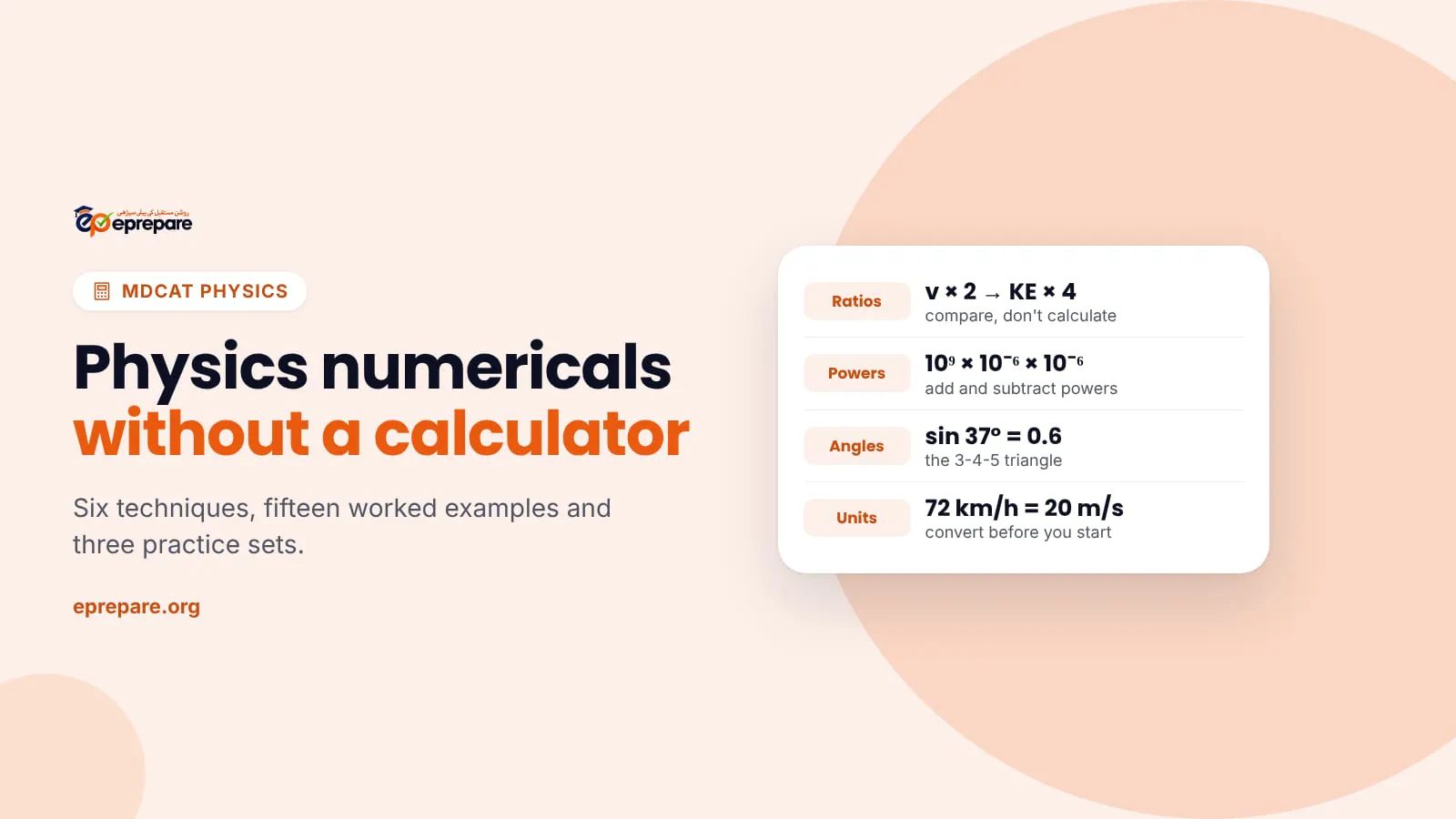
MDCAT does not allow a calculator, and Physics has 36 of the 180 MCQs. That worries many students who are used to punching numbers in for board numericals. The truth is reassuring: MDCAT numericals are built so the arithmetic is small. The numbers are chosen to cancel, the angles are friendly, and many questions only ask "how many times bigger?". What you need is not a calculator but a handful of habits. This guide is a workbook: six techniques, fifteen worked examples across the syllabus, and three practice sets with answers.
The short answer: Solve MDCAT Physics numericals without a calculator by (1) using ratios instead of full calculations ("if v doubles, KE becomes 4 times"), (2) writing every number in powers of ten and handling the powers separately, (3) rounding sensibly (g ≈ 10, π² ≈ 10), (4) knowing the standard values (sin 37° = 0.6, cos 37° = 0.8, √2 ≈ 1.41, √3 ≈ 1.73), (5) converting units before you start, and (6) eliminating options by units, size and limiting cases.
First, learn the values card
Most "hard arithmetic" in MDCAT disappears if a few values are automatic. Learn this card until you can write it from memory.
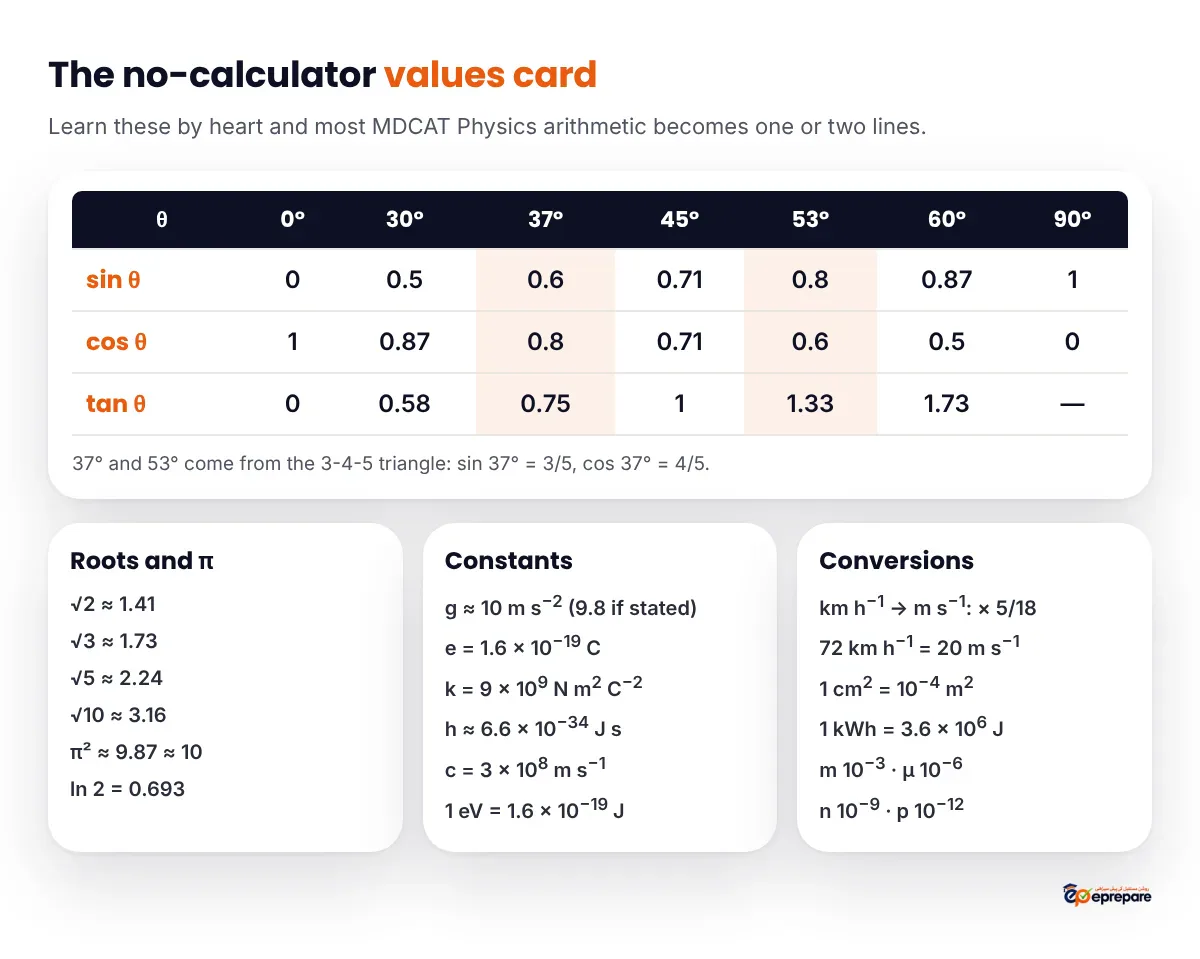
Two notes. Use g = 10 m s−2 unless the question gives 9.8. And the 37° and 53° values are not exact (the true angles in a 3-4-5 triangle are about 36.9° and 53.1°), but MDCAT questions use them because the numbers come out clean.
Technique 1: Ratios and proportionality
Many MDCAT numericals never ask for a number. They ask what happens when something doubles, halves or rises by a percentage. Write the formula, keep only what changes, and compare.
The rule: if y ∝ xn, then y2/y1 = (x2/x1)n.
Example 1 · Work and energy: speed doubled
A car's speed doubles. What happens to its kinetic energy?
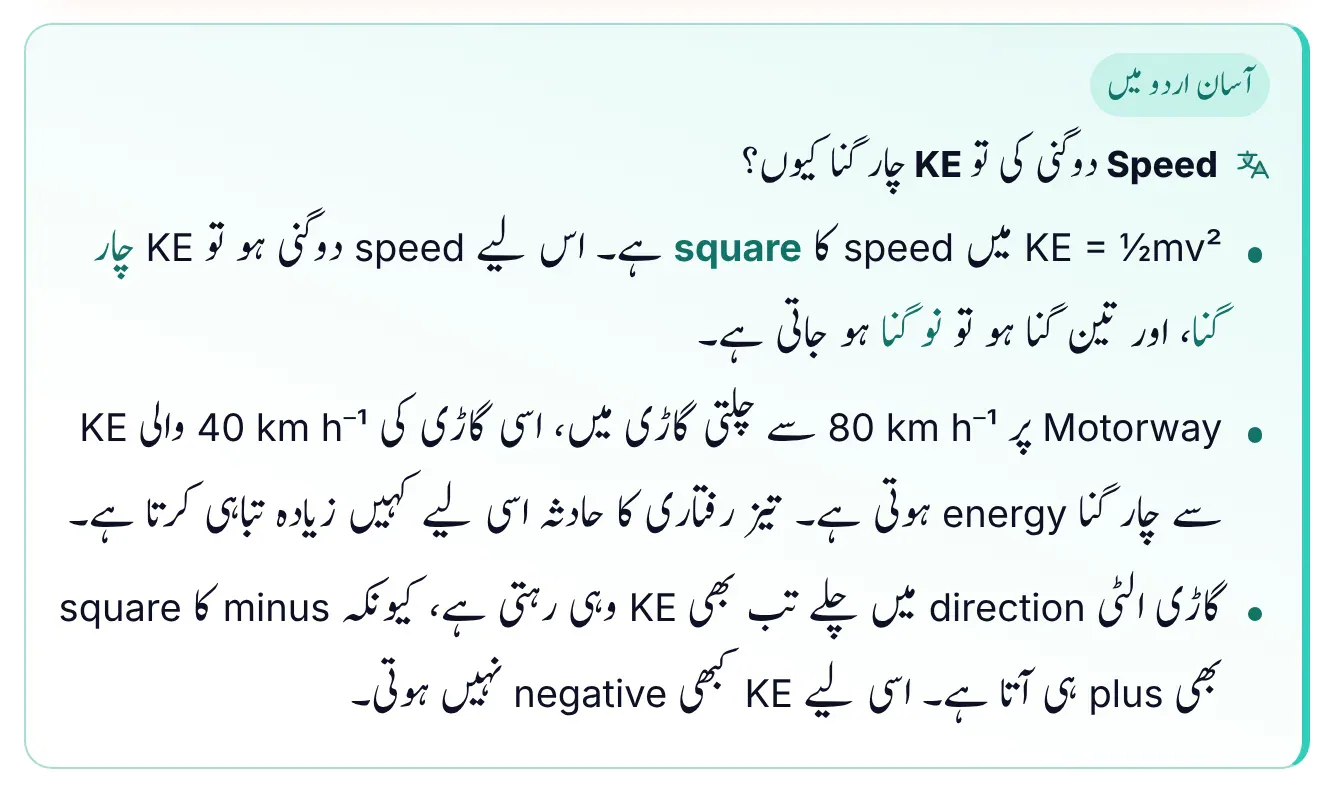
KE = ½mv2, so KE ∝ v2. Ratio = 22 = 4. KE becomes 4 times. Three times the speed gives 9 times the KE.
Example 2 · Momentum up 20%
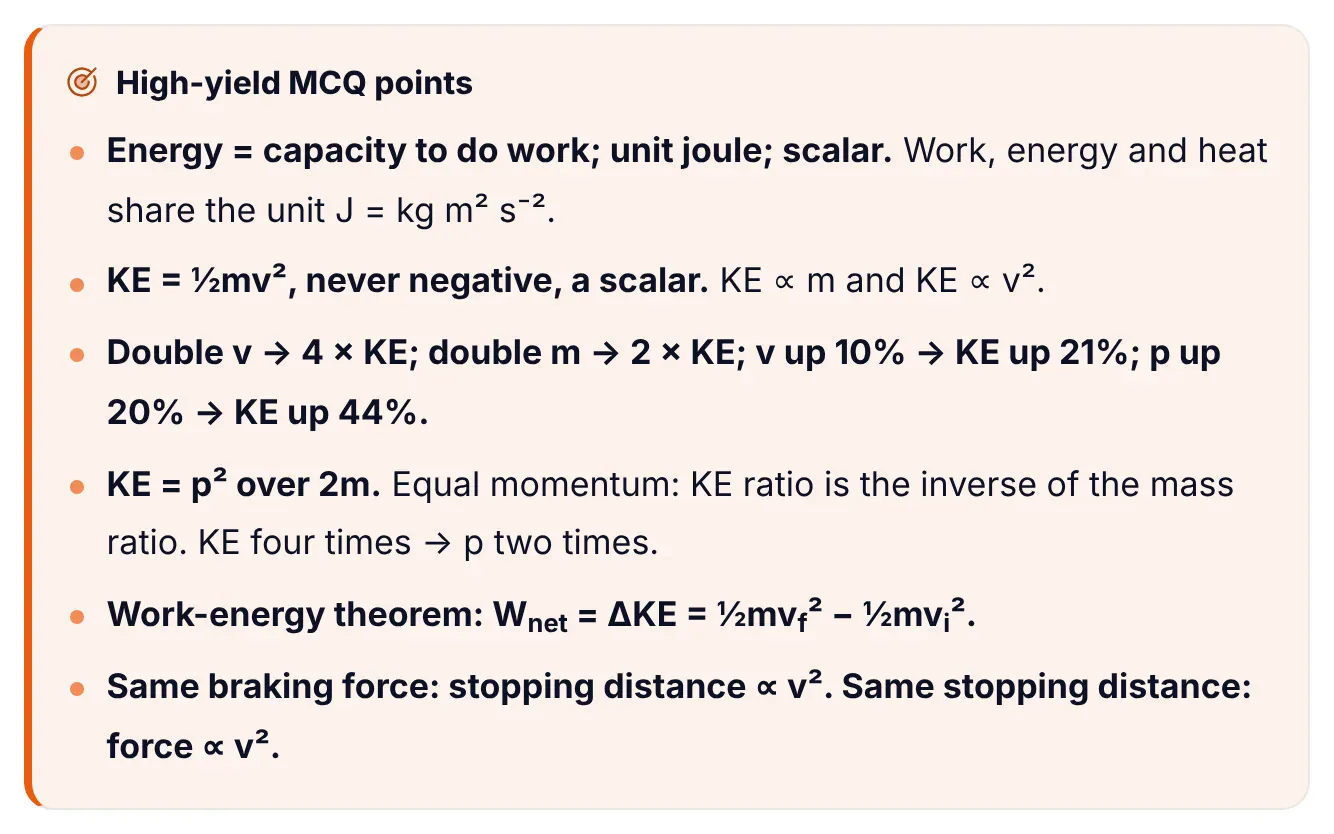
The momentum of a body increases by 20%. By what percentage does its kinetic energy increase?
KE = p2/2m, so KE ∝ p2. New p = 1.2p, so new KE = (1.2)2 = 1.44 times. KE increases by 44%. (Not 40%: squaring a percentage increase is the trap.)
Example 3 · Current electricity: wire stretched
A wire of resistance R is stretched to twice its length. What is its new resistance?
R = ρL/A. The volume (L × A) stays the same, so if L doubles, A halves. New R = ρ(2L)/(A/2) = 4ρL/A. New resistance = 4R. Stretched n times, it becomes n2R.
Example 4 · Electrical power: bulb on half voltage
A 100 W, 220 V bulb is connected to 110 V. Assuming its resistance stays constant, what power does it use?
P = V2/R, so P ∝ V2. Voltage halves, so power is (½)2 = ¼ of 100 W. P = 25 W.
Example 5 · Waves: string tension made 4 times
The tension in a stretched string is made 4 times. What happens to the frequency of its fundamental note?
Wave speed on a string v = √(T/μ), and for the same length and mode f ∝ v. So f ∝ √T. √4 = 2. The frequency doubles.
Example 6 · Fluid dynamics: pipe narrows
Water flows through a pipe. The radius halves at a narrow section. How does the speed change?
Equation of continuity: A1v1 = A2v2. Area ∝ r2, so halving r makes the area ¼. Speed must become 4 times.
Technique 2: Powers of ten
Constants like k = 9 × 10⁹, e = 1.6 × 10⁻¹⁹ and h ≈ 6.6 × 10⁻³⁴ look frightening, but they are easy if you split every number into "a small number × a power of ten". Multiply the small numbers, add the powers. Divide the small numbers, subtract the powers.
Example 7 · Electrostatics: Coulomb's law
Find the force between charges of 2 μC and 3 μC placed 3 cm apart in air (k = 9 × 10⁹ N m2 C−2).
- Convert: q1 = 2 × 10⁻⁶ C, q2 = 3 × 10⁻⁶ C, r = 3 × 10⁻² m, so r2 = 9 × 10⁻⁴ m2.
- Small numbers: 9 × 2 × 3 ÷ 9 = 6.
- Powers: 109 × 10−6 × 10−6 ÷ 10−4 = 109 − 6 − 6 + 4 = 101.
- F = 6 × 101 = 60 N.
Notice how the 9 in k cancelled the 9 in r2. MDCAT numbers are often chosen to do exactly that, so look for the cancellation before multiplying.
Example 8 · Dawn of modern physics: photon energy
Find the energy of a photon of wavelength 6.6 × 10⁻⁷ m (h = 6.6 × 10⁻³⁴ J s, c = 3 × 10⁸ m s−1). Express it in eV too.
- E = hc/λ = (6.6 × 10−34 × 3 × 108) ÷ (6.6 × 10⁻⁷).
- The 6.6 cancels, leaving 3. Powers: 10−34 + 8 + 7 = 10−19.
- E = 3 × 10⁻¹⁹ J. In eV: 3 ÷ 1.6 ≈ 1.9 eV.
Example 9 · Electromagnetism: force on a moving charge
A proton (q = 1.6 × 10⁻¹⁹ C) moves at 2 × 10⁶ m s−1 at 30° to a field of 0.5 T. Find the magnetic force.
- F = qvB sin θ = 1.6 × 10−19 × 2 × 106 × 0.5 × 0.5.
- Small numbers: 1.6 × 2 × 0.5 × 0.5 = 0.8. Powers: 10−19 + 6 = 10−13.
- F = 0.8 × 10−13 = 8 × 10⁻¹⁴ N.
Example 10 · Nuclear physics: half-life
A sample of 64 g has a half-life of 2 days. How much is left after 8 days? What is its decay constant if the half-life were 6.93 s instead?
8 ÷ 2 = 4 half-lives: 64 → 32 → 16 → 8 → 4. 4 g remain (that is 64 ÷ 24). For the second part, λ = 0.693/T½ = 0.693/6.93 = 0.1 s−1. Spot that 6.93 is just 0.693 × 10.
Technique 3: Standard angles and the 3-4-5 triangle
MDCAT angles are almost always 30°, 37°, 45°, 53°, 60° or 90°. With the values card, components become mental arithmetic.
Example 11 · Vectors: components at 37°
A force of 10 N acts at 37° to the horizontal. Find its components.
Horizontal = 10 cos 37° = 10 × 0.8 = 8 N. Vertical = 10 sin 37° = 10 × 0.6 = 6 N. It is the 3-4-5 triangle scaled by 2: 6-8-10.
Example 12 · Force and motion: projectile at 37°
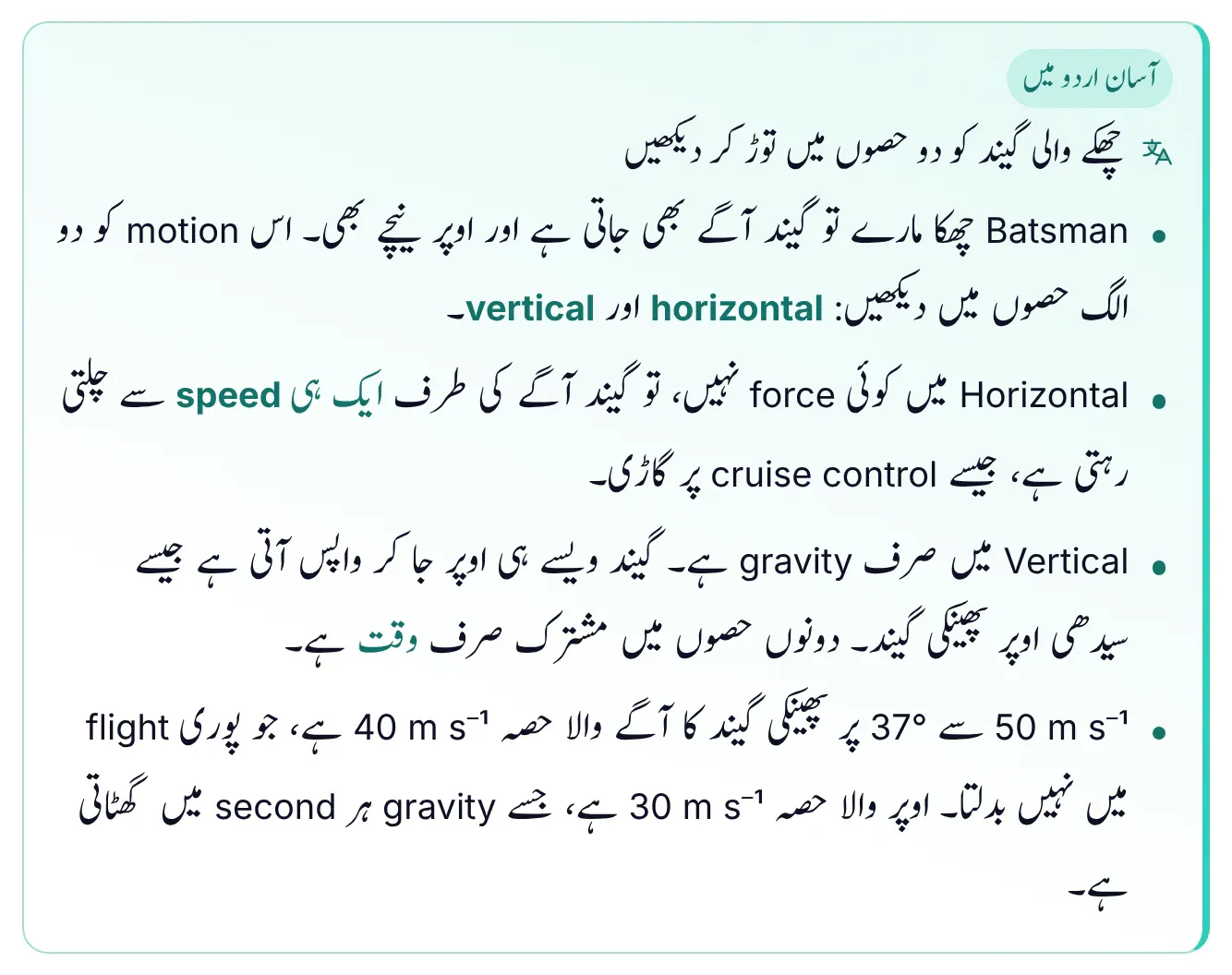
A ball is launched at 50 m s−1 at 37° above the horizontal (g = 10 m s−2). Find the time of flight, the maximum height and the range.
- Split the velocity: ux = 50 × 0.8 = 40 m s−1; uy = 50 × 0.6 = 30 m s−1.
- Time of flight T = 2uy/g = 60/10 = 6 s.
- Maximum height H = uy2/2g = 900/20 = 45 m.
- Range R = ux × T = 40 × 6 = 240 m.
Check with the range formula: R = u2 sin 2θ/g, and sin 74° = 2 sin 37° cos 37° = 2 × 0.6 × 0.8 = 0.96, so R = 2500 × 0.96/10 = 240 m. Same answer. Its speed at the highest point is just ux = 40 m s−1.
Technique 4: Approximate sensibly
When options are far apart, round the inputs, solve, and pick the nearest option. When options are close, keep exact values.
- g ≈ 10. Free fall from 20 m: v = √(2gh) = √(2 × 10 × 20) = √400 = 20 m s−1. With g = 9.8 the exact answer is about 19.8 m s−1. If the options are 10, 20, 40 and 400, pick 20 straight away.
- π2 ≈ g. Pendulum formulas contain both. See Example 13.
- Squares near round numbers. (1.1)2 = 1.21, so a 10% rise in speed raises KE by 21%; (0.9)2 = 0.81.
Example 13 · Simple harmonic motion: pendulum
Find the time period of a simple pendulum 1 m long, taking g = π2 m s−2.
T = 2π√(L/g) = 2π√(1/π2) = 2π × (1/π) = 2 s. Since π2 ≈ 9.87, this is very close to the real value with g = 9.8.
Technique 5: Convert units before you start
Half the "wrong arithmetic" in MDCAT is really a unit slip. Convert everything to SI first, then calculate.
Example 14 · Kinematics: a braking car
A car moving at 72 km h−1 brakes uniformly and stops in 4 s. Find its deceleration and stopping distance.
- Convert: 72 × 5/18 = 20 m s−1.
- a = Δv/t = 20/4 = 5 m s−2 (deceleration).
- Distance = average speed × time = (20 + 0)/2 × 4 = 40 m. (Check: v2/2a = 400/10 = 40 m.)
Example 15 · Electromagnetic induction: transformer
An ideal transformer has 1000 turns on the primary and 100 on the secondary. The primary is on 220 V. Find the secondary voltage.
Vs/Vp = Ns/Np = 100/1000 = 1/10. Vs = 220/10 = 22 V (a step-down transformer).
| Given in | Convert to | Rule |
|---|---|---|
| km h−1 | m s−1 | × 5/18 (36 → 10, 72 → 20, 90 → 25, 108 → 30) |
| cm, cm2, cm3 | m, m2, m3 | × 10−2, × 10−4, × 10−6 |
| mm2 | m2 | × 10−6 |
| μC, nC | C | × 10−6, × 10−9 |
| kWh | J | × 3.6 × 10⁶ |
| eV | J | × 1.6 × 10⁻¹⁹ |
| g | kg | × 10−3 |
Technique 6: Eliminate options before calculating
Often you can strike out two options without any arithmetic, and sometimes three.
- Units and dimensions. For the speed of a wave on a string, only √(T/μ) has units of m s−1: T is in kg m s−2 and μ in kg m−1, so T/μ is m2 s−2.
- Size sense. In Example 12 the speed at the top cannot be more than the launch speed of 50 m s−1, and it cannot be zero (the horizontal part stays). That kills two options at once.
- Limiting cases. Put θ = 90° into a range formula: a ball thrown straight up lands where it started, so the range must be zero. Any option that does not give zero is wrong.
- Order of magnitude. A visible-light photon carries about 10−19 J. An option of 10−9 J or 10−29 J is a powers-of-ten slip.
- Ratio direction. If something increases, cross out every option smaller than the original.
Physics is a fifth of the paper (36 of 180 MCQs), so every minute you save on its numericals is a minute for the rest of the paper. For pacing the whole paper, see MDCAT time management.
Practice sets (attempt on paper, no calculator)
Set A: Ratios
- A car's speed rises from 20 m s−1 to 60 m s−1. By what factor does its KE increase?
- With the same braking force, a car's speed is doubled. What happens to its stopping distance?
- The distance between two point charges is halved. What happens to the force between them?
- A 10 Ω wire is stretched to three times its length. What is its new resistance?
- A 60 W, 220 V bulb is run on 110 V. What power does it use (constant resistance)?
Show answers to Set A
1. Speed × 3, so KE × 9. 2. Stopping distance ∝ v2, so it becomes 4 times. 3. F ∝ 1/r2, so it becomes 4 times. 4. n2R = 9 × 10 = 90 Ω. 5. P ∝ V2, so ¼ × 60 = 15 W.
Set B: Powers of ten
- Energy of a photon of wavelength 3.3 × 10⁻⁷ m (h = 6.6 × 10⁻³⁴ J s, c = 3 × 10⁸ m s−1).
- Force on an electron moving at 106 m s−1 perpendicular to a 0.1 T field.
- Electric field 3 cm from a 1 μC point charge (k = 9 × 10⁹).
- Decay constant of a nuclide with a half-life of 69.3 s.
- 2 kWh in joules.
Show answers to Set B
1. (6.6 × 3 ÷ 3.3) × 10−34 + 8 + 7 = 6 × 10⁻¹⁹ J. 2. 1.6 × 10−19 × 106 × 0.1 = 1.6 × 10⁻¹⁴ N. 3. 9 × 109 × 10−6 ÷ (9 × 10⁻⁴) = 107 N C−1. 4. 0.693 ÷ 69.3 = 0.01 s−1. 5. 2 × 3.6 × 106 = 7.2 × 10⁶ J.
Set C: Angles, approximation and units
- Components of a 20 N force at 37° to the horizontal.
- A ball is thrown at 20 m s−1 at 30° above the horizontal (g = 10). Find its time of flight and maximum height.
- Convert 36 km h−1 to m s−1.
- Time period of a 4 m pendulum with g = π2.
- Resultant of 10 N and 10 N acting at right angles.
- Resultant of 3 N and 4 N at right angles, and its angle with the 4 N force.
Show answers to Set C
1. 20 × 0.8 = 16 N horizontal, 20 × 0.6 = 12 N vertical. 2. uy = 20 × 0.5 = 10 m s−1; T = 2 × 10/10 = 2 s; H = 102/20 = 5 m. 3. 36 × 5/18 = 10 m s−1. 4. 2π√(4/π2) = 2π × 2/π = 4 s. 5. 10√2 ≈ 14.1 N. 6. 5 N, at 37° to the 4 N force (tan θ = 3/4).
MDCAT-style MCQs
1. If the speed of a body increases by 10%, its kinetic energy increases by:
A. 10% B. 20% C. 21% D. 100%
Show answer
C. KE ∝ v2; (1.1)2 = 1.21, an increase of 21%.
2. A projectile is launched at 25 m s−1 at 53° above the horizontal (g = 10 m s−2). Its time of flight is:
A. 2 s B. 3 s C. 4 s D. 5 s
Show answer
C. uy = 25 × sin 53° = 25 × 0.8 = 20 m s−1; T = 2 × 20/10 = 4 s.
3. Two charges of 1 μC each are 1 m apart in air. The force between them is (k = 9 × 10⁹):
A. 9 × 10⁻³ N B. 9 × 10³ N C. 9 × 10⁻¹² N D. 9 N
Show answer
A. 9 × 109 × 10−6 × 10⁻⁶ ÷ 1 = 9 × 10⁻³ N.
4. A radioactive sample falls to one-eighth of its original amount in 15 days. Its half-life is:
A. 3 days B. 5 days C. 7.5 days D. 15 days
Show answer
B. One-eighth = (½)3, so three half-lives take 15 days: one half-life is 5 days.
5. A car moving at 108 km h−1 has a speed of:
A. 18 m s−1 B. 25 m s−1 C. 30 m s−1 D. 36 m s−1
Show answer
C. 108 × 5/18 = 6 × 5 = 30 m s−1.
6. Water flows through a pipe whose diameter narrows from 4 cm to 2 cm. If the speed in the wide part is 1 m s−1, the speed in the narrow part is:
A. 0.25 m s−1 B. 2 m s−1 C. 4 m s−1 D. 8 m s−1
Show answer
C. Diameter halves, so area becomes ¼ and speed becomes 4 times (continuity: Av = constant).
Practise numericals the way MDCAT asks them
ePrepare's conceptual notes teach every Physics chapter with worked numericals, easy-Urdu boxes, diagrams and in-lesson MCQs with explanations. The Work and Energy lesson, for example, builds the KE formula from a block pushed by a force.
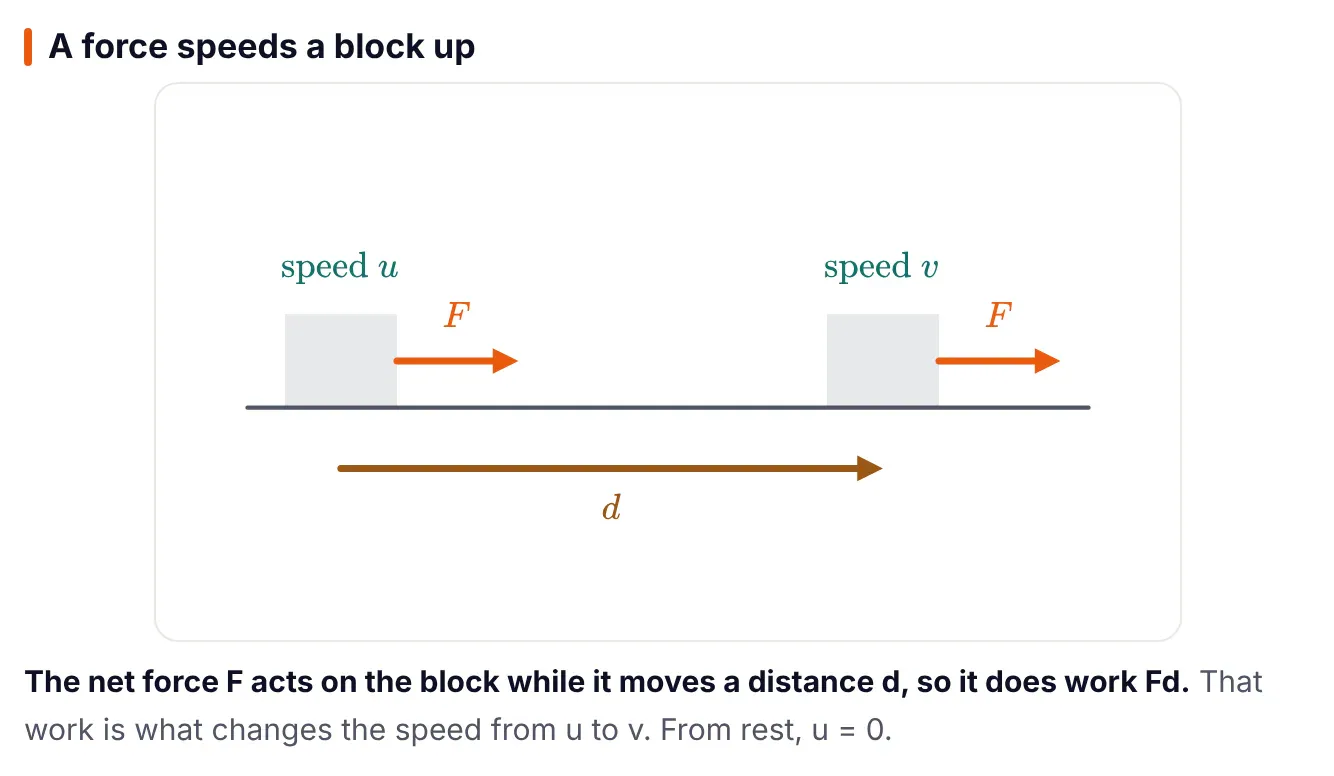
Read more about the notes in ePrepare's conceptual notes for MDCAT, and see which chapters carry the most numericals in high-yield MDCAT Physics chapters. To drill one chapter's numericals under time, build a timed test with the Quiz Builder.
Quick revision table
| Technique | Use it when | Example |
|---|---|---|
| Ratios | "What happens if…" questions | v × 2 → KE × 4; wire stretched × 2 → R × 4 |
| Powers of ten | Constants like k, e, h, c | Coulomb's force = 60 N |
| Standard angles | 30°, 37°, 45°, 53°, 60° | 50 m s−1 at 37° → 40 and 30 |
| Approximation | Options far apart | g ≈ 10, π2 ≈ 10 |
| Units first | km h−1, cm, μC, kWh, eV | 72 km h−1 = 20 m s−1 |
| Elimination | Before any arithmetic | Units, size, limiting cases |
آسان الفاظ میں: MDCAT میں calculator نہیں ہوتا، مگر سوال اسی طرح بنائے جاتے ہیں کہ حساب چھوٹا رہے۔ پہلے دیکھیں کہ کیا صرف ratio پوچھا گیا ہے، جیسے speed دگنی تو KE چار گنا۔ بڑے constants کو power of ten میں لکھیں اور powers الگ جمع تفریق کریں۔ g کو 10 لیں، اور sin 37° = 0.6، cos 37° = 0.8 زبانی یاد رکھیں۔ حساب سے پہلے units کو SI میں بدلیں، اور units یا limiting case سے غلط options پہلے ہی کاٹ دیں۔
Frequently asked questions
Is a calculator allowed in MDCAT?
No. MDCAT is a paper-based MCQ test without calculators, so Physics numericals are designed with simple numbers that you can handle by hand.
What value of g should I use in MDCAT?
Use 10 m s−2 unless the question gives 9.8 m s−2. If the options are close together, check whether the question specifies g.
How do I find sin 37° without a calculator?
Use the 3-4-5 right triangle: the angle opposite the side of 3 is about 37°, so sin 37° = 3/5 = 0.6 and cos 37° = 4/5 = 0.8. For 53°, the values swap.
How many Physics MCQs are numericals in MDCAT?
PM&DC fixes 36 Physics MCQs but does not fix how many are numerical. Expect a mix of conceptual and numerical questions, many of them ratio-type.
How can I get faster at MDCAT Physics numericals?
Learn the values card, practise ratio questions daily, convert units first, and solve chapter-wise MCQs under a timer. Review every numerical you get wrong to see whether the slip was the concept, the units or the arithmetic.
Which formulas do I need to memorise for no-calculator numericals?
Mainly the chapter formulas in your notes. The arithmetic helpers are few: the trig values for standard angles, √2 and √3, π2 ≈ 10, the main constants and the common unit conversions shown above.