Ask any MDCAT topper what changed their score and you will rarely hear "I memorised more lines". You will hear "I finally understood it". The MDCAT rewards students who know why an answer is right, because its options are built to catch students who only remember the words. That is why so many students search for MDCAT conceptual notes: notes that explain the idea first, so the facts make sense and stay in memory.
This guide explains what conceptual notes are, what good ones should contain, and how ePrepare's conceptual notes work, with real screenshots from inside a student account. You will see how hard topics are explained in easy Urdu, how the diagrams and memory tricks are laid out, and how to turn the notes into marks with a simple daily routine.
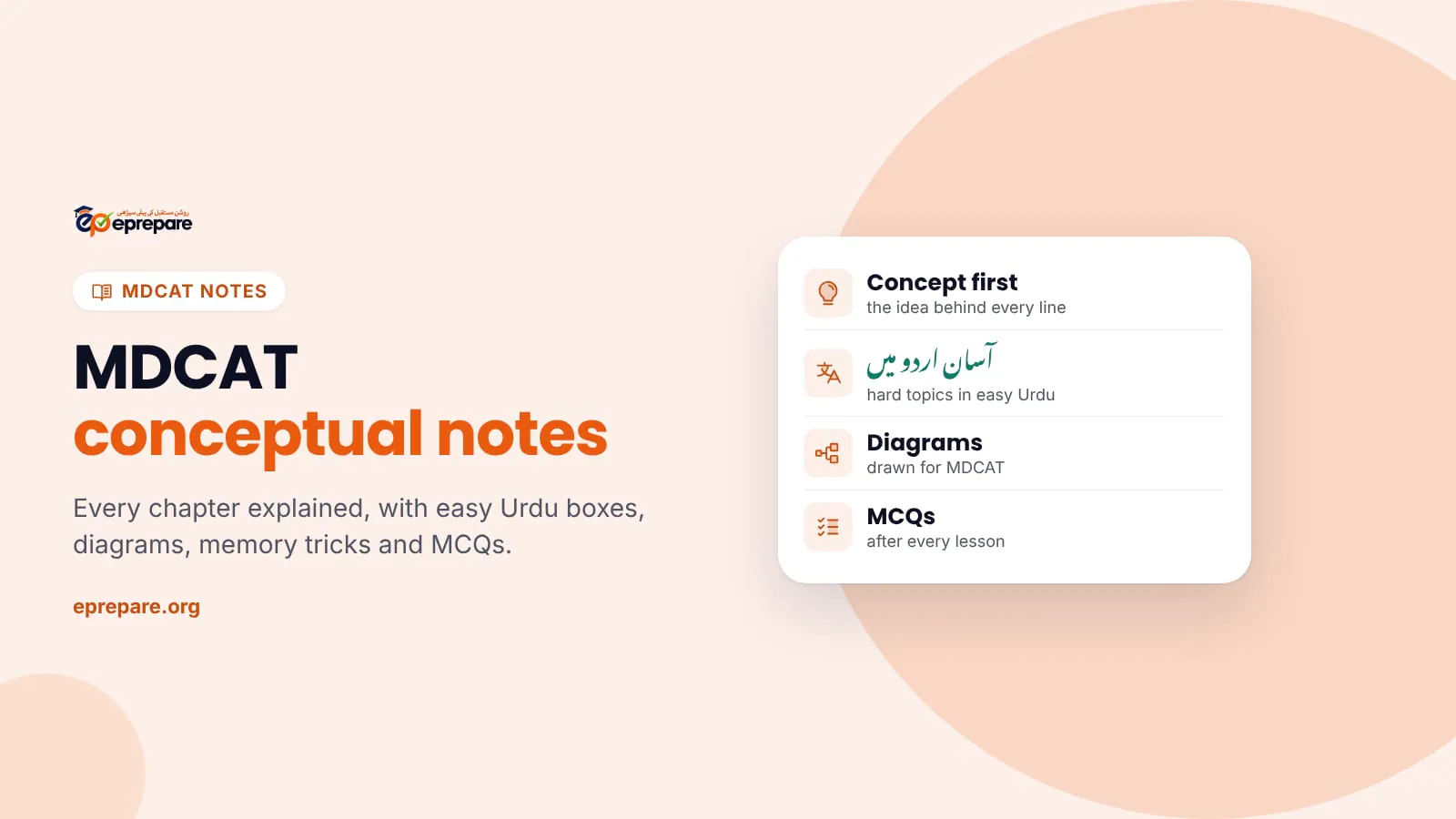
The short answer: MDCAT conceptual notes explain why something happens, not just what to memorise. ePrepare's conceptual notes cover 63 chapters across Biology (16), Chemistry (20), Physics (16) and English (11), arranged by the PMDC syllabus. Every lesson builds the idea in clear English, then explains the hard parts again in easy Urdu (more than 2,300 Urdu boxes in all), with diagrams, memory tricks, common mistakes, high-yield points and practice MCQs (more than 6,000 inside the notes). You read them online in your ePrepare account, on a laptop or a phone.
What are MDCAT conceptual notes?
Most MDCAT notes are summaries: a list of facts, definitions and numbers to learn by heart. Conceptual notes go one step deeper. They explain the reason behind each fact, so you can work out the answer even when the MCQ is worded in a way you have never seen.
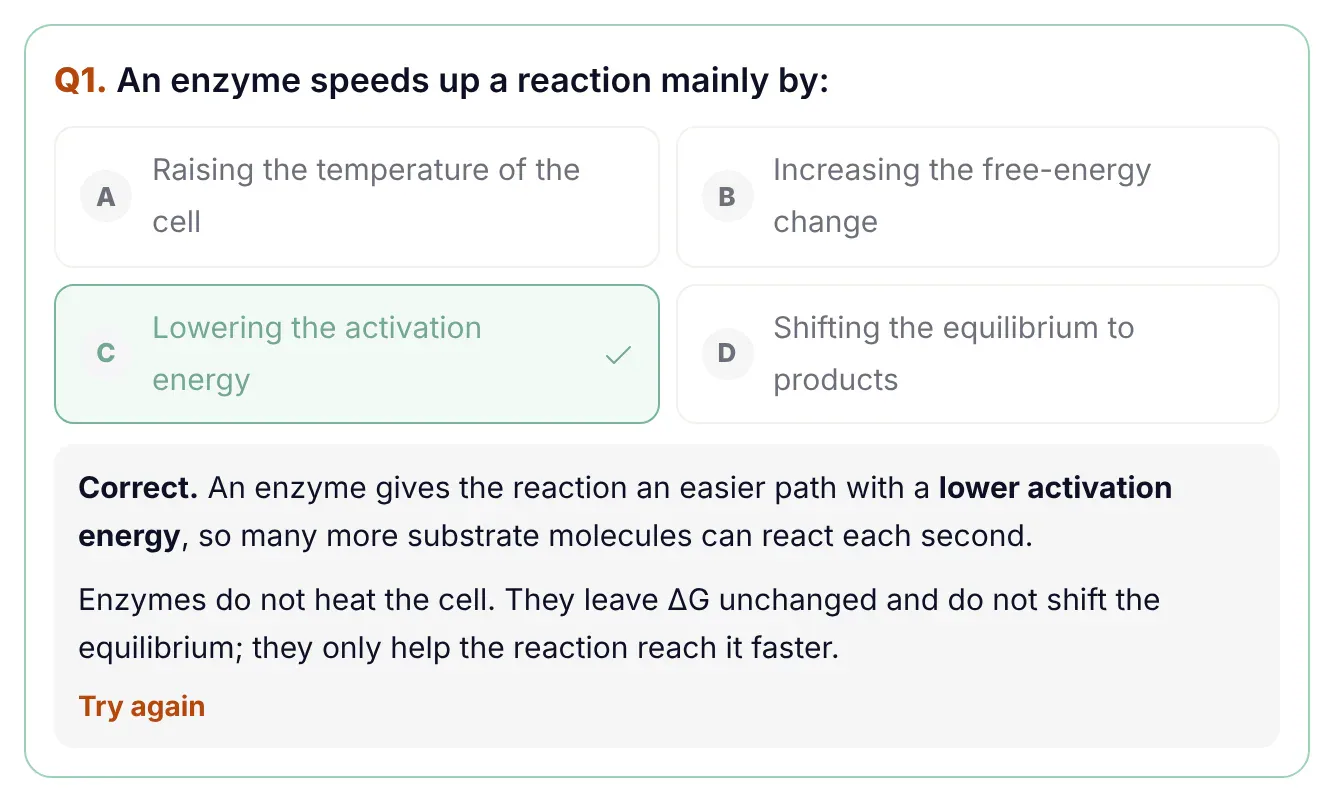
Take enzymes. A summary note says "enzymes are biological catalysts". A conceptual note explains that an enzyme gives the reaction an easier path with a lower activation energy, that it comes out unchanged so a small amount works again and again, and that it does not change the final equilibrium. With that understanding, an MCQ asking "an enzyme speeds up a reaction mainly by..." is easy, and so are the trick options about raising the temperature or shifting the equilibrium.
Good conceptual notes for MDCAT should have five things:
- The idea before the detail: what is happening and why, then the facts that follow from it.
- Explanation in the language you think in: for most students in Pakistan, a hard concept clicks faster when someone explains it in Urdu.
- Diagrams: many MDCAT questions are diagrams in words (shapes of molecules, parts of a cell, graphs of motion).
- Exam focus: the points examiners actually test, and the mistakes students usually make.
- Practice straight after reading: MCQs that check whether the concept has really landed.
What is inside ePrepare's conceptual notes
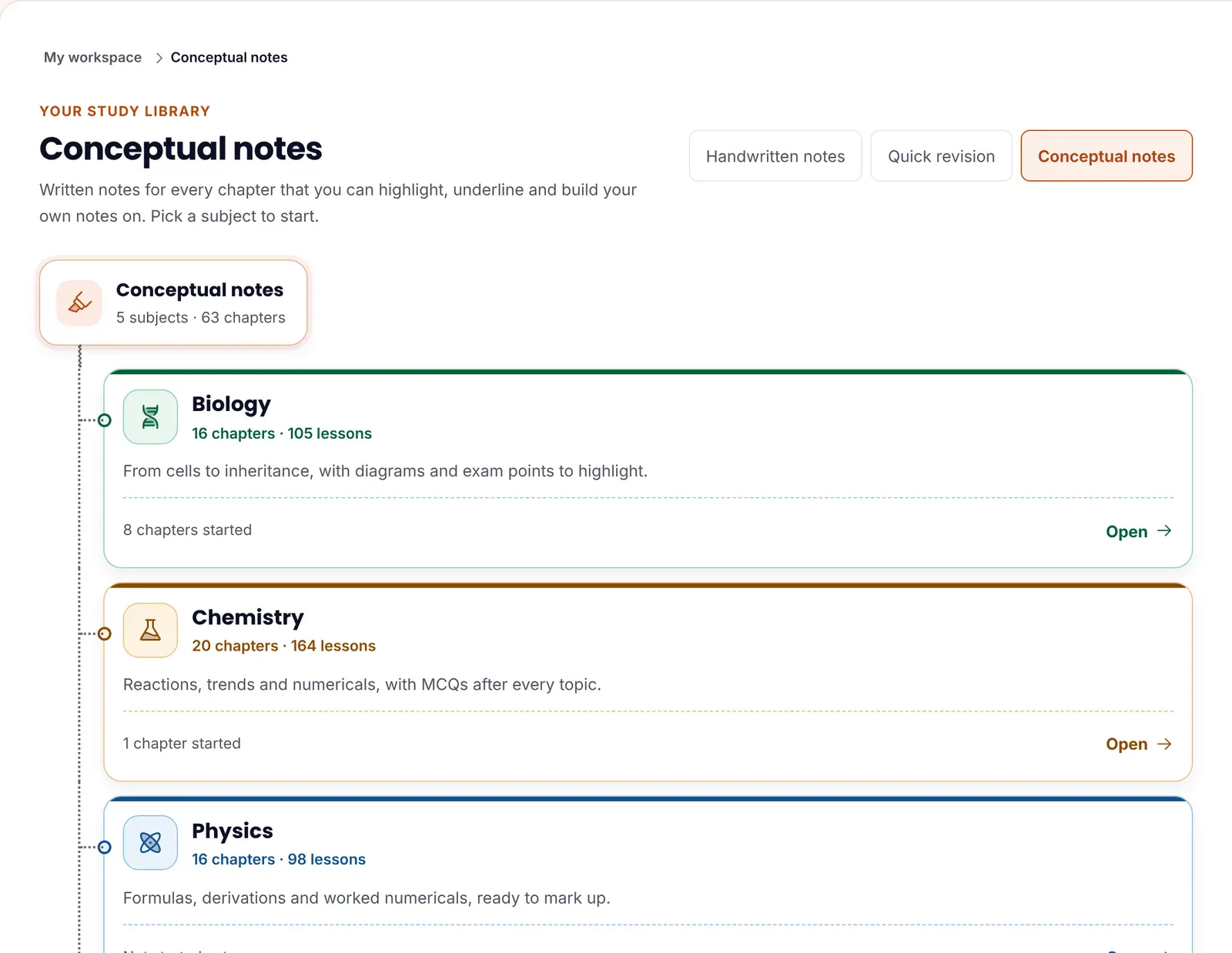
The conceptual notes sit in the Notes section of your ePrepare account, next to the handwritten notes and quick revision notes. They are organised subject by subject and chapter by chapter, following the PMDC MDCAT syllabus.
| Subject | Chapters | Lessons | MDCAT marks (of 180) |
|---|---|---|---|
| Biology | 16 | 105 | 81 |
| Chemistry | 20 | 164 | 45 |
| Physics | 16 | 98 | 36 |
| English | 11 | 168 | 9 |
| Logical reasoning | Coming soon | 9 | |
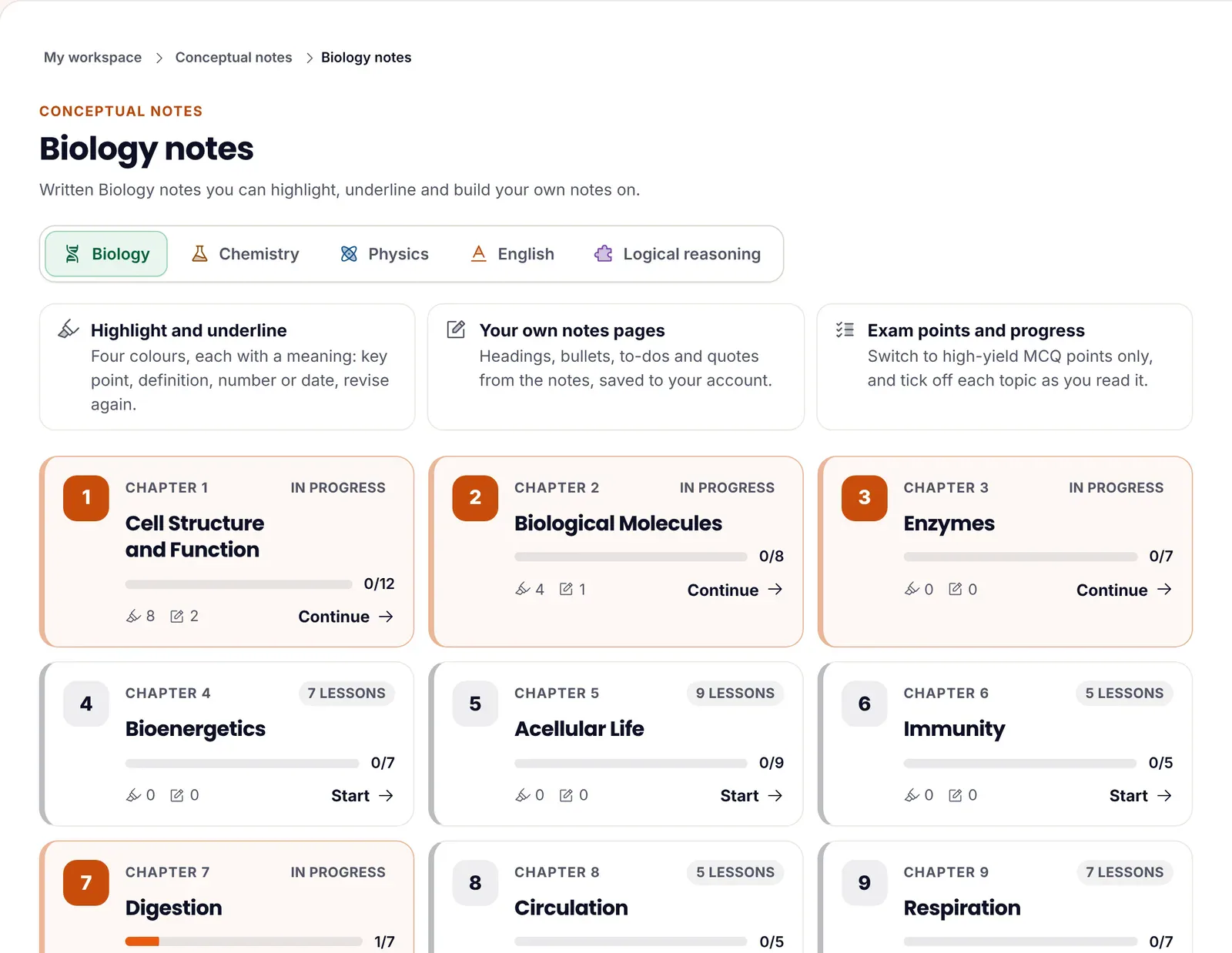
The Biology, Chemistry and Physics chapters match the units of the PMDC syllabus, from Acellular Life to Biotechnology, Stoichiometry to Industrial Chemistry, and Vectors and Equilibrium to Nuclear Physics. Inside a subject, every chapter shows how many lessons it has and how many you have finished, so you can see at a glance where you stand. For the full list of units, see our MDCAT syllabus guide.
How a lesson is built
Each chapter is split into short lessons, with a reading time on each (a typical Biology, Chemistry or Physics lesson takes 10 to 20 minutes). You pick a lesson from the list on the left and read it on the right, one at a time, so a whole chapter never feels like a wall of text.
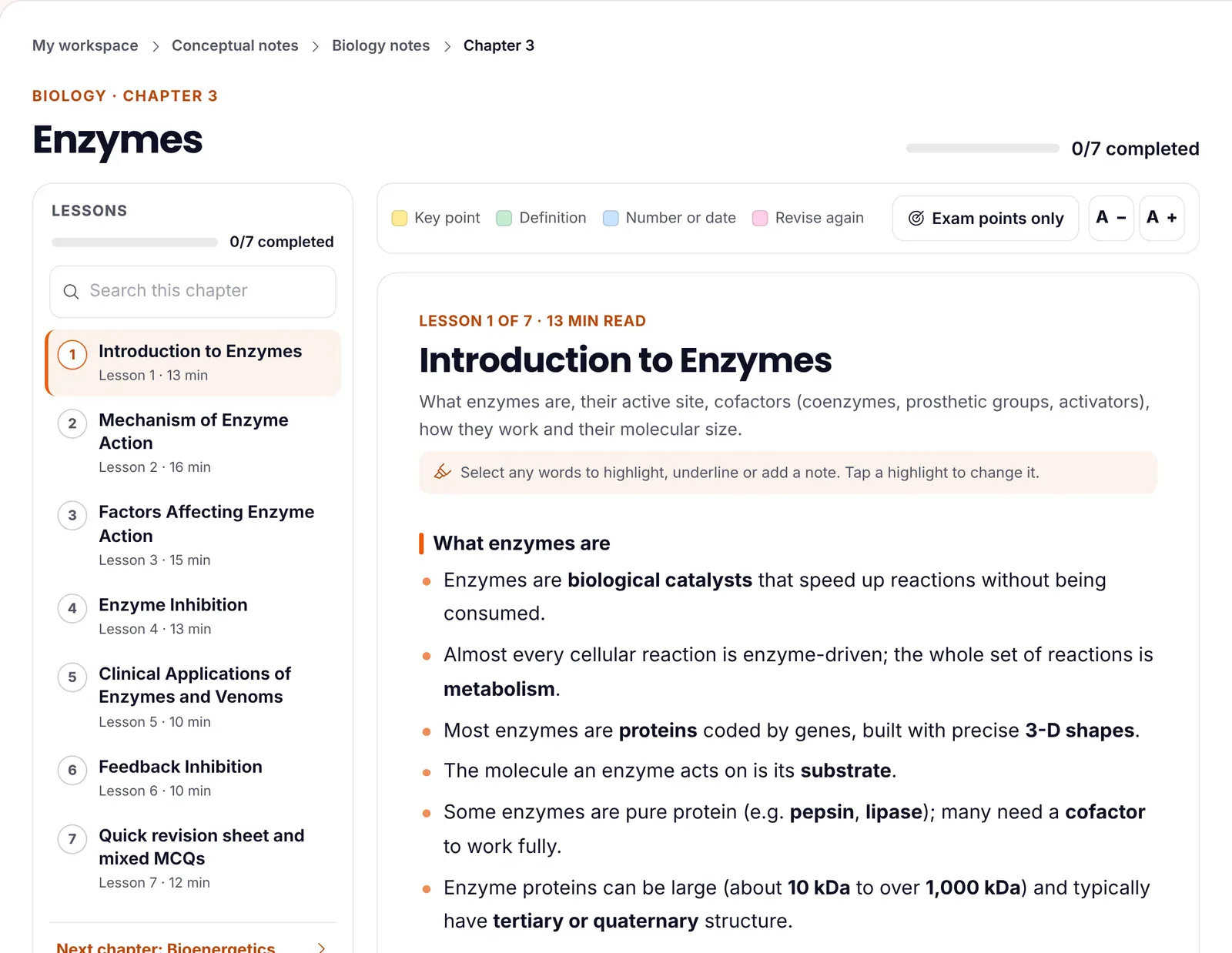
Lessons follow the same order, so you always know what comes next. A typical science lesson has:
- The concept, in clear English: short points with the key words in bold.
- "If you remember only this" (in many lessons): the one idea to keep when everything else fades.
- Easy Urdu boxes: the hard parts explained again in everyday Urdu.
- "Why?" boxes: the simple reasons behind the facts.
- Diagrams, tables and graphs where a picture explains faster than words.
- ePrepare memory tricks for lists, numbers and look-alike terms.
- Common mistakes that cost students marks.
- High-yield MCQ points: what examiners test most.
- Practice MCQs with the answer and the reason.
Most chapters end with a quick revision sheet and a set of mixed MCQs, so you can check the whole chapter in one sitting before moving on.
Hard concepts explained in easy Urdu
This is the part students tell us they use most. After the English explanation, each lesson has boxes marked آسان اردو میں ("in easy Urdu"). They explain the same idea the way a good teacher would in class: in spoken Urdu, with examples from everyday life. Across the four subjects there are more than 2,300 of these boxes, about four per lesson on average.
One rule makes them work for the exam: scientific terms stay in English. Words like enzyme, substrate, active site, electron pair or velocity appear exactly as they will in your MDCAT paper. You understand the idea in Urdu and still learn the English words the paper uses.
Biology: what does an enzyme actually do?
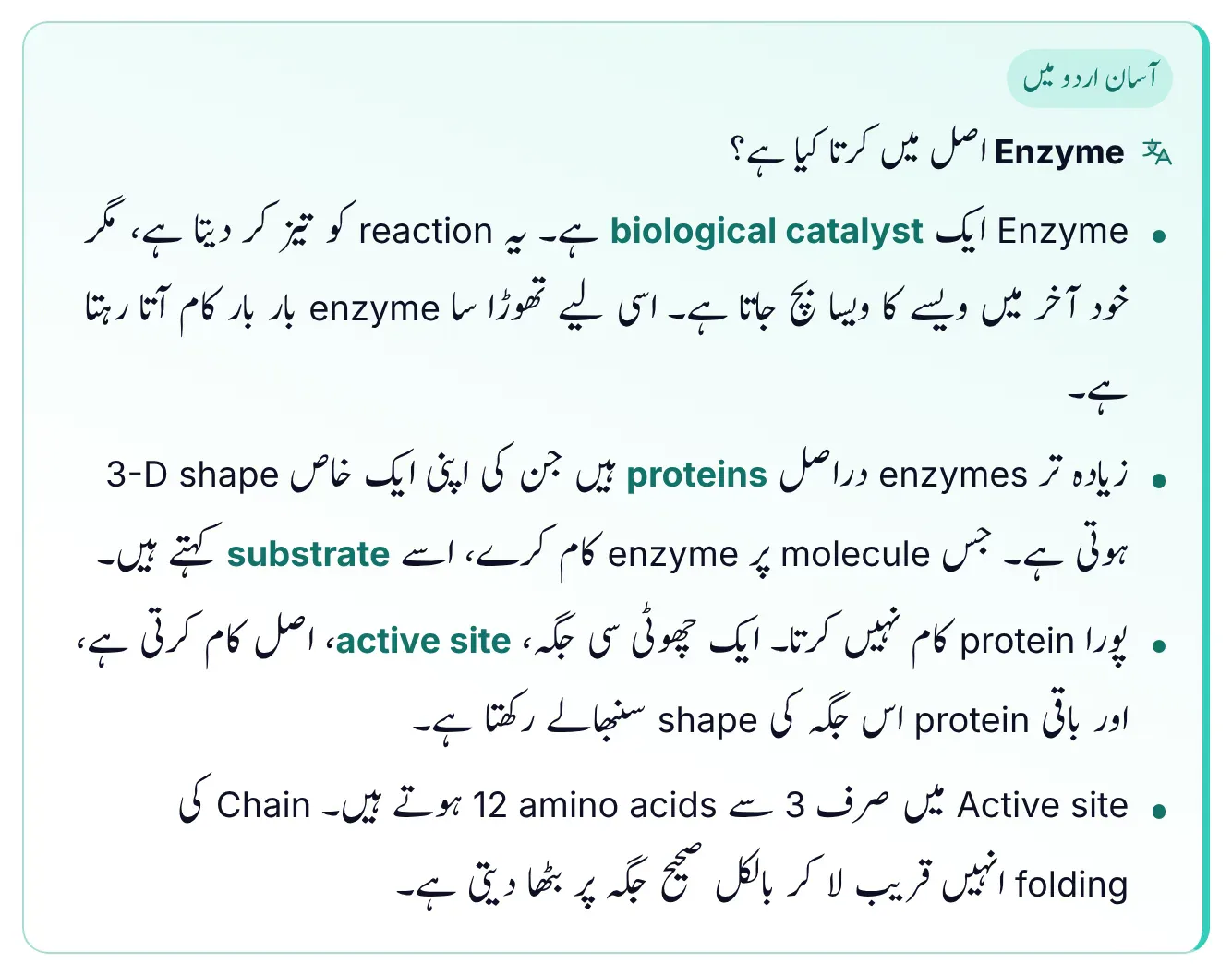
This box explains, in plain Urdu, that an enzyme speeds up a reaction but comes out unchanged, which is why a small amount works again and again; that most enzymes are proteins with their own 3-D shape; and that only a small part, the active site of about 3 to 12 amino acids, does the real work while the rest of the protein holds that shape. Each of those points is a common MDCAT option.
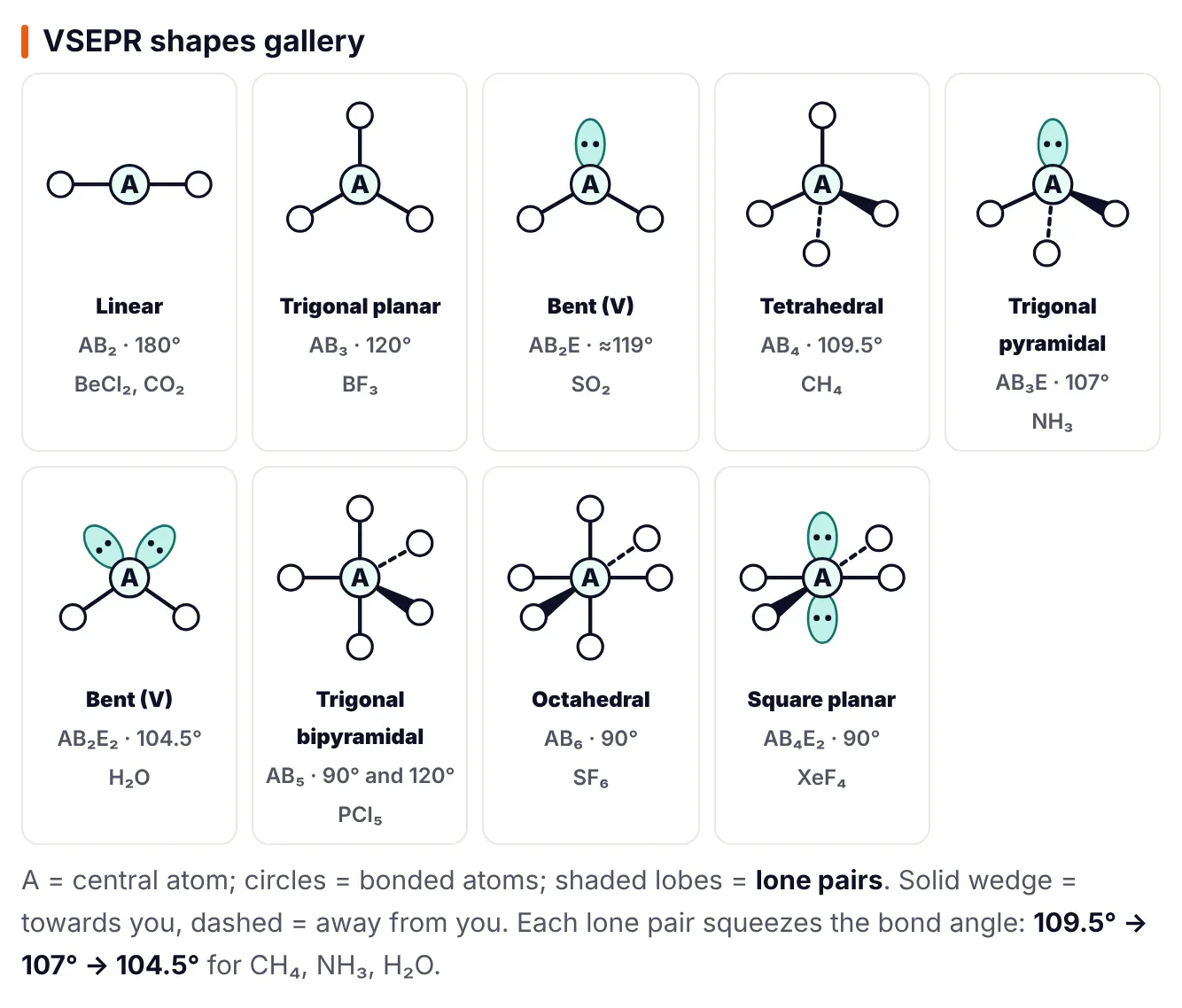
Chemistry: VSEPR theory with balloons
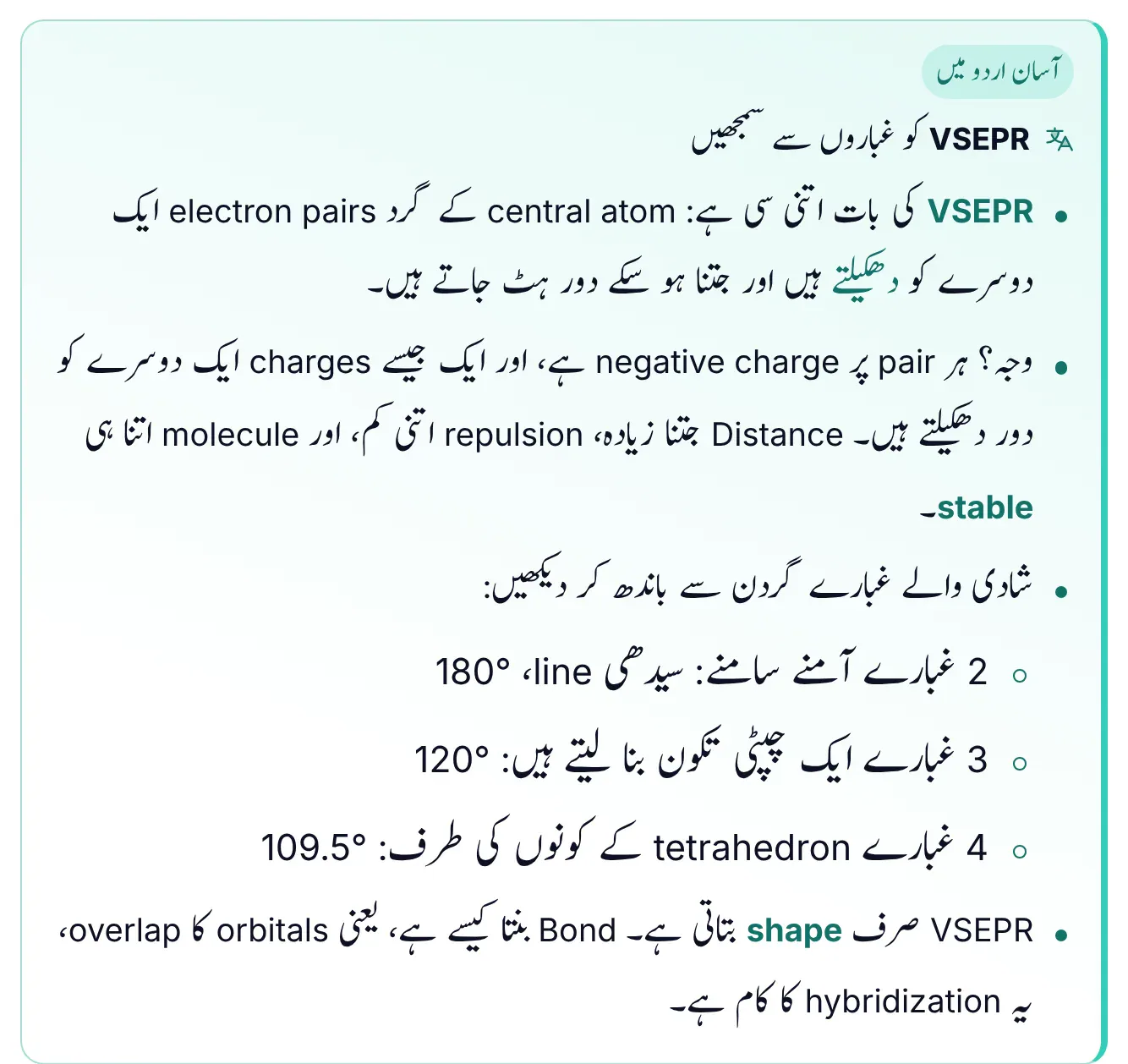
Shapes of molecules are a favourite MDCAT topic and a common headache. Here the notes ask you to picture balloons tied together at the neck, the kind you see at weddings. Two balloons sit opposite each other in a straight line (180°), three spread into a flat triangle (120°), and four point to the corners of a tetrahedron (109.5°). That is exactly how electron pairs push each other apart around a central atom. Once you have seen the balloons, you will not forget the angles.
Physics: projectile motion and a cricket six
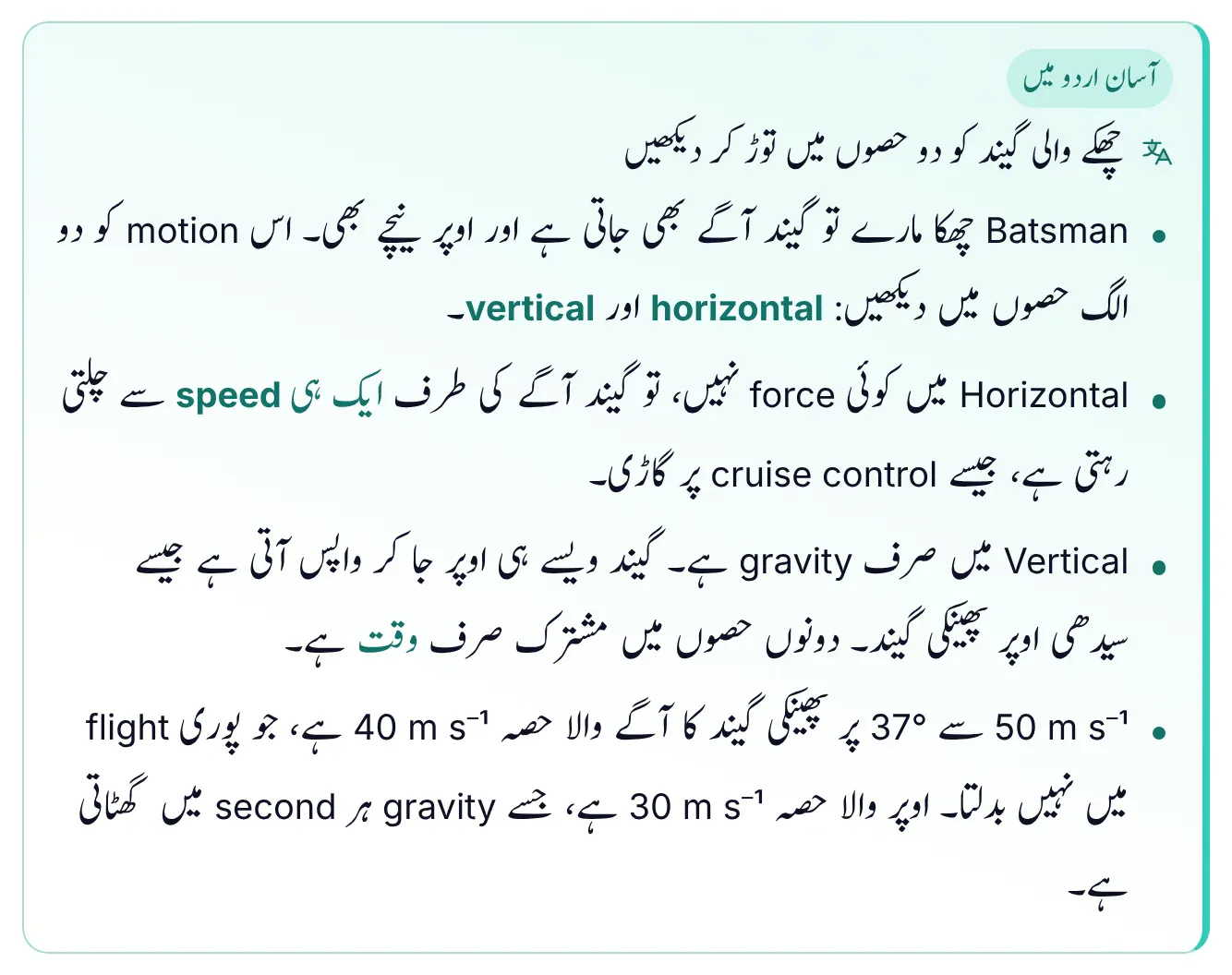
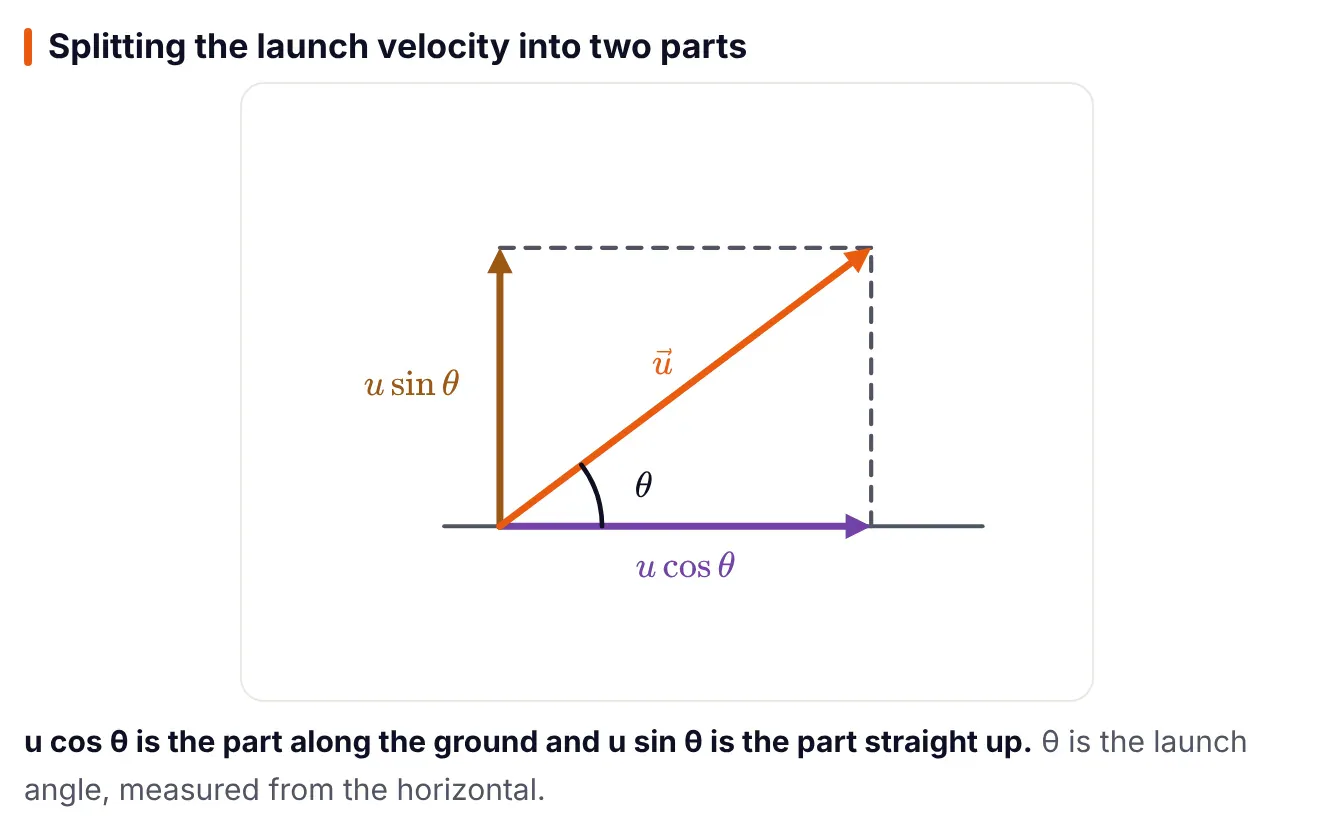
Projectile motion becomes simple when you split it in two. The notes use a ball hit for six: sideways there is no force, so the ball keeps the same horizontal speed, like a car on cruise control; up and down there is only gravity, so it rises and falls like a ball thrown straight up. The only thing the two motions share is time. A worked example shows a ball launched at 50 m s−1 at 37° splitting into 40 m s−1 forwards and 30 m s−1 upwards, numbers you can handle without a calculator.
English: when to use the present perfect

English grammar has Urdu boxes too. This one explains that "She has finished the report" means the result is there now, while a specific past time like "yesterday" calls for the past simple ("finished"). It is the kind of distinction MDCAT sentence-correction questions test.
On your phone
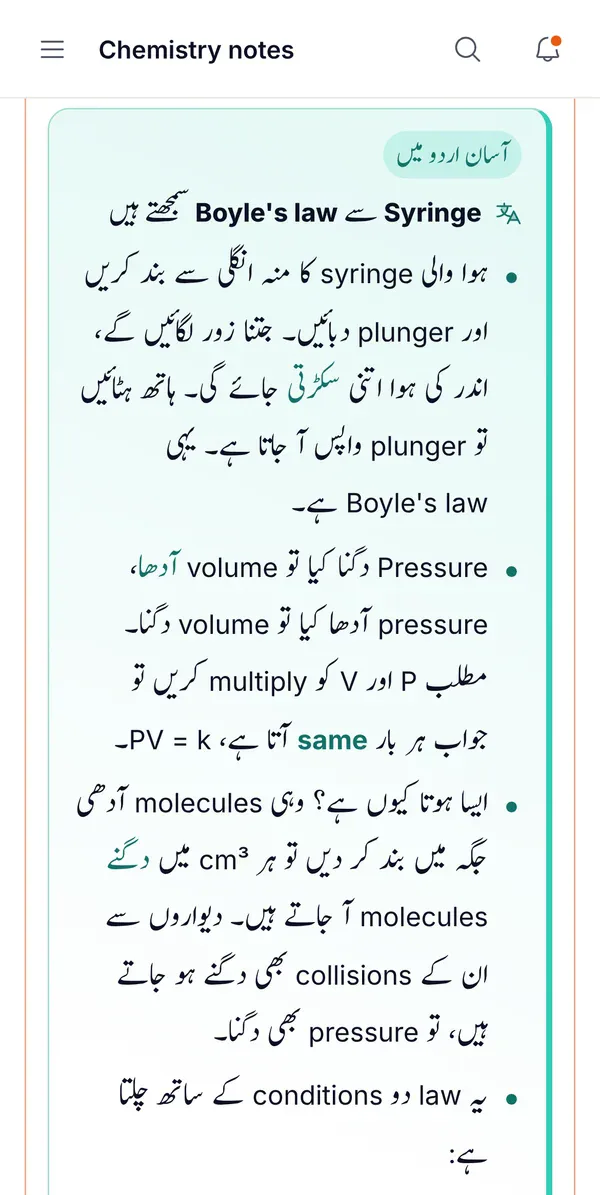
The notes work the same on a phone. Lessons open as a list you tap to expand, and the Urdu text is set in a Nastaleeq font that stays clear on a small screen. Here is the Boyle's law lesson, explained with a syringe you close with your finger.
Diagrams drawn for MDCAT
The notes have more than 850 diagrams, drawings and graphs across Biology, Chemistry and Physics. They are drawn for the exam: every label you might be asked about, nothing decorative. In Chemistry, the VSEPR gallery shows all nine shapes you need, each with its formula type, bond angle and a standard example.
In Physics, graphs and vector drawings carry the maths. The projectile lesson splits the launch velocity into its two parts, u cos θ along the ground and u sin θ straight up, so the formulas that follow make sense instead of being memorised.
Memory tricks and common mistakes
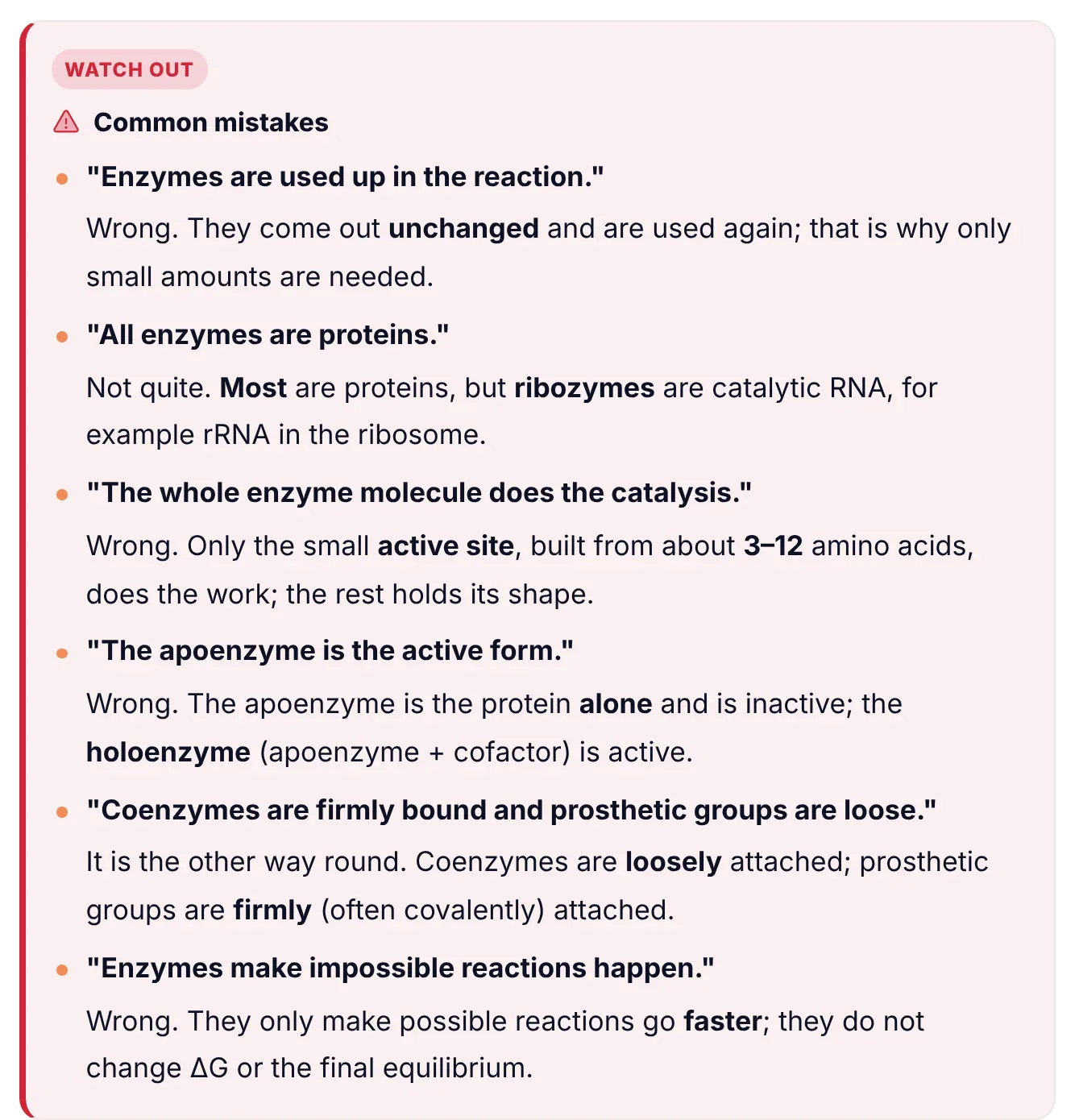
Every lesson has an ePrepare memory tricks box for the things that refuse to stay in your head: lists, numbers and pairs of words that look alike. In the enzymes lesson, "Apo = Alone, Holo = Whole" fixes which form is active, and "Prosthetic = Permanent" separates a prosthetic group from a coenzyme.
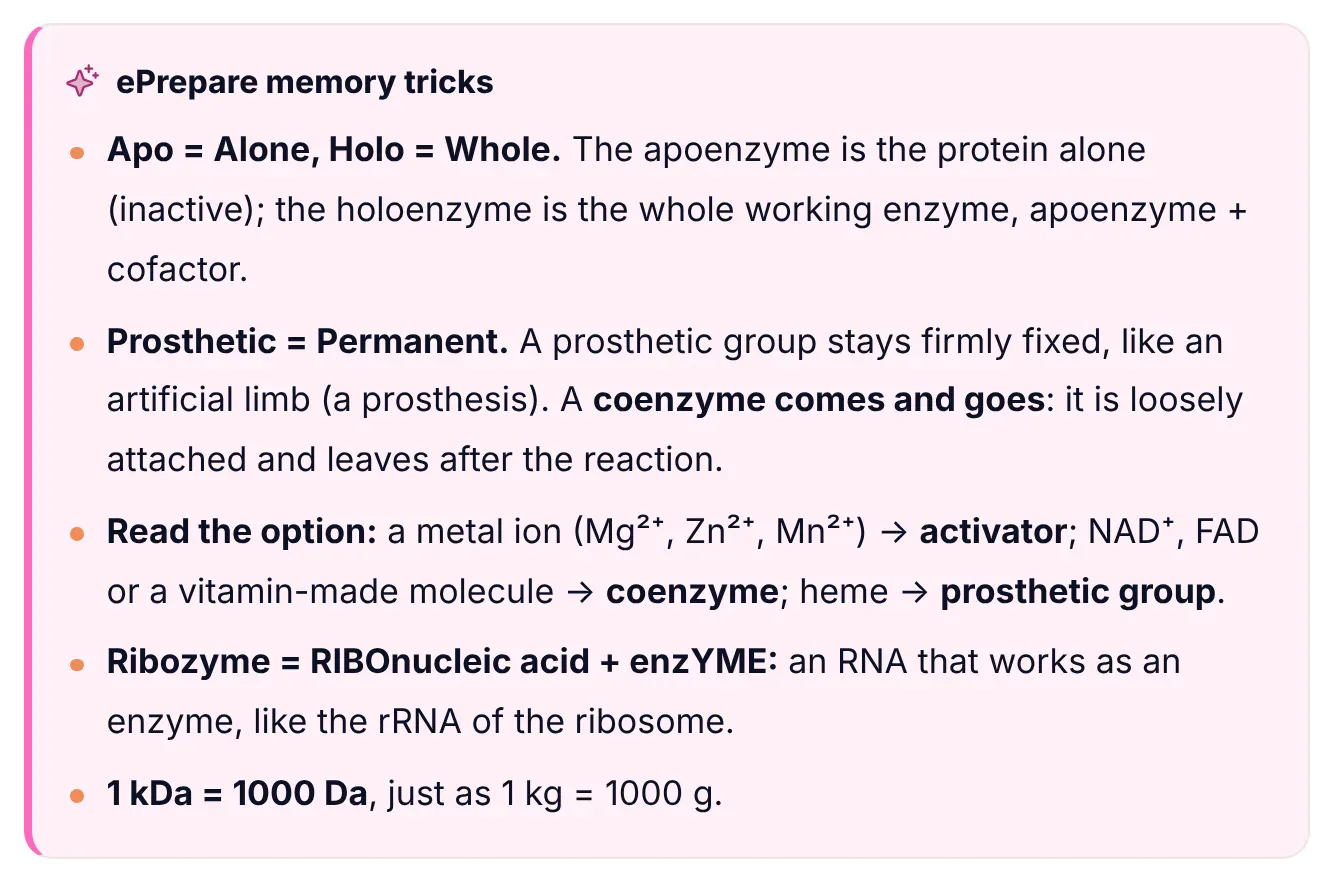
Right after it comes Common mistakes: the wrong ideas that MDCAT options are designed around, each with a one-line correction. If you have ever picked "all enzymes are proteins" and lost the mark to ribozymes, this box is for you.
MCQs inside the notes
Reading is not enough: you need to check the concept has stuck. Every lesson ends with practice MCQs, more than 6,000 across the notes. Tap an option and you see straight away whether it is right, with a short explanation of why, including why the tempting wrong options are wrong.
Exam points only: for the last days
Close to the paper you do not have time to read every lesson again. Turn on Exam points only and each lesson shrinks to its high-yield MCQ points, the facts most likely to appear in your paper. It is the fastest way to revise a whole chapter in a few minutes.
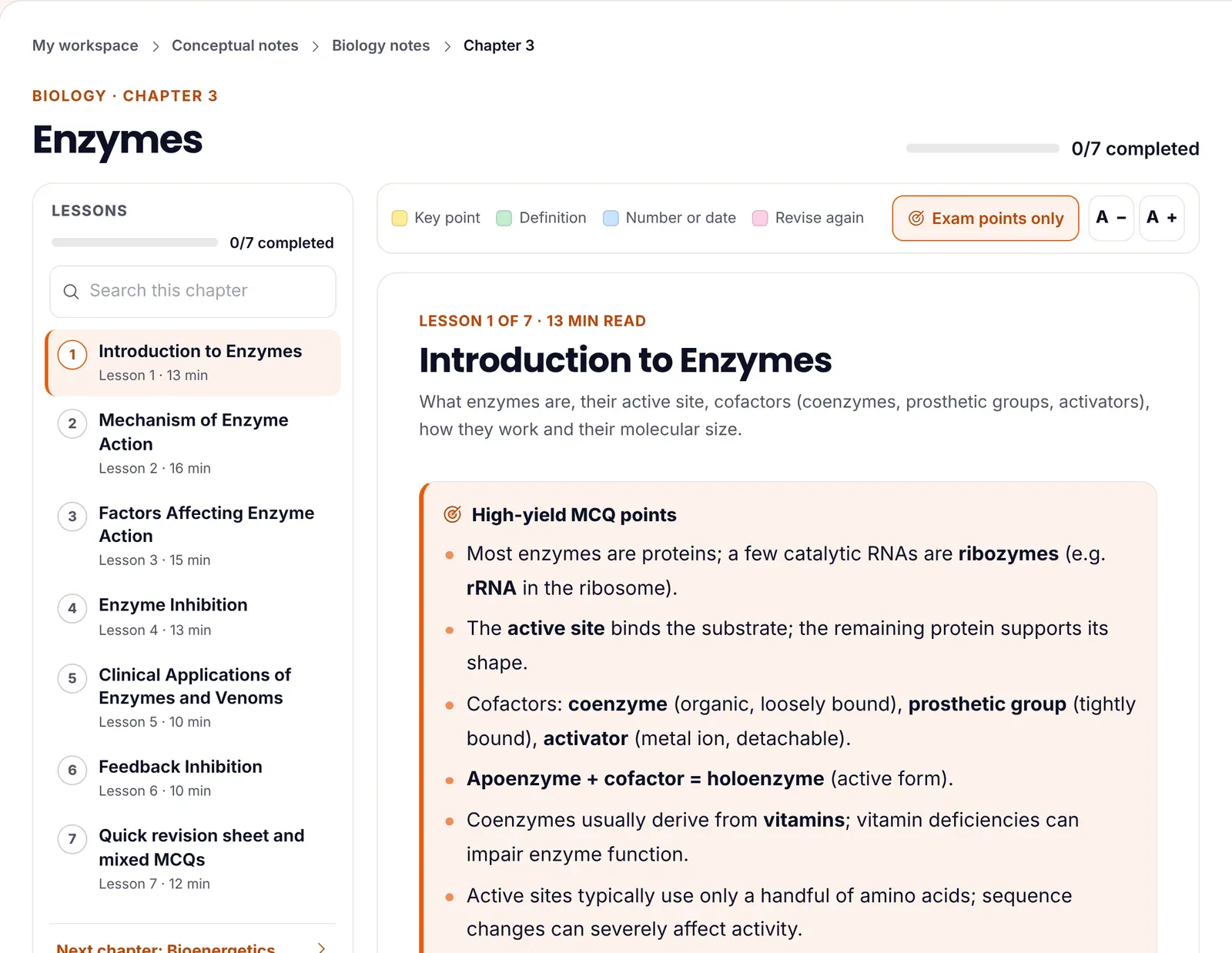
You can also make the notes your own. Select any words to highlight them in four colours (yellow for key points, green for definitions, blue for numbers or dates, pink for "revise again"), underline them or add your own note. The text size can be made larger or smaller. Read more in our guide to highlighting and revising with the notes.
Subject by subject
Biology conceptual notes (16 chapters)
Biology carries 81 of the 180 marks, so it gets the most attention. The notes cover every PMDC unit, from Cell Structure and Function, Biological Molecules and Enzymes to Homeostasis, Reproduction, Inheritance, Evolution and Biotechnology, with labelled drawings of cell parts and organ systems. Pair them with our list of high-yield Biology chapters to decide where to start.
Chemistry conceptual notes (20 chapters)
Chemistry is where concepts matter most, because the same idea (bonding, equilibrium, the mole) comes back in many forms. The notes cover physical, inorganic and organic Chemistry, with equations written out properly, reaction schemes, periodic trends and numericals you can do without a calculator. See the high-yield Chemistry chapters.
Physics conceptual notes (16 chapters)
Physics notes build each formula from the idea behind it, with vector drawings, motion graphs and worked numericals. Every chapter from Vectors and Equilibrium to Nuclear Physics is covered, including the Urdu boxes that turn abstract ideas into everyday pictures. See the high-yield Physics chapters.
English conceptual notes (11 chapters)
English is only 9 marks, but they are quick marks. The notes cover the grammar the MDCAT tests: tenses, nouns, pronouns and agreement, articles, prepositions, adverbs, active and passive voice, direct and indirect speech, punctuation and transitional words, each with rules, examples, Urdu explanations and MCQs. See the English grammar topics for MDCAT.
How to study with conceptual notes: a daily routine
Notes only help if you use them in a routine. This one works well for most students:
- Read one lesson properly (10 to 20 minutes). Read the English first. When a point does not click, stop and read the Urdu box under it.
- Close the notes and explain it aloud in a few sentences, in Urdu or English. If you cannot, read the "Why?" box again.
- Learn the tricks and read the common mistakes. Highlight anything you got wrong in pink.
- Answer the practice MCQs at the end of the lesson. Read the explanation for every question, including the ones you got right.
- Test the chapter. When you finish a chapter, build a chapter test in Quiz Builder from the question bank.
- Fix your mistakes. Go through your wrong MCQs, find the line in the notes behind each one and revise it.
- Before the paper, use Exam points only to revise each chapter in minutes.
Start with the chapters that carry the most marks. Our chapter-wise weightage guide shows which ones those are.
Conceptual notes, PDF notes or the textbook?
| Typical PDF notes | Textbook | ePrepare conceptual notes | |
|---|---|---|---|
| Explains why, not just what | Rarely | Yes, at length | Yes, briefly |
| Hard parts in easy Urdu | Rarely | No | Yes, in every lesson |
| Arranged by PMDC syllabus | Varies | By province | Yes |
| Diagrams labelled for MDCAT | Some | Yes | Yes |
| Memory tricks and common mistakes | Some | No | Yes |
| MCQs with explanations after each topic | Rarely | Exercises only | Yes |
| Exam-points-only revision | No | No | Yes |
The textbook is still your base, because many MDCAT questions come straight from its lines and diagrams. Conceptual notes make the textbook easier to understand and much faster to revise. Use them together: notes to understand and revise, the textbook to fill in detail, and MCQs to test both.
How to open the conceptual notes
- Sign in to your ePrepare account.
- In the sidebar, open Notes, then Conceptual notes.
- Pick a subject (Biology, Chemistry, Physics or English).
- Choose a chapter, then a lesson. Your progress is saved as you read.
Not on ePrepare yet? See what each plan includes on the packages page.
خلاصہ (in Urdu)
MDCAT conceptual notes کا مقصد رٹا لگانا نہیں بلکہ ہر topic کو سمجھنا ہے۔ ePrepare کے notes میں Biology، Chemistry، Physics اور English کے 63 chapters ہیں۔ ہر lesson میں پہلے concept انگریزی میں، پھر مشکل حصے آسان اردو میں سمجھائے گئے ہیں، ساتھ میں diagrams، memory tricks، عام غلطیاں اور practice MCQs بھی ہیں۔ Scientific الفاظ انگریزی ہی میں رکھے گئے ہیں تاکہ paper میں وہی الفاظ پہچان سکیں۔ Paper سے پہلے "Exam points only" سے پورا chapter چند منٹ میں دہرا لیں۔
Frequently asked questions
What are MDCAT conceptual notes?
They are notes that explain the reason behind each fact, not just the fact. Instead of a list to memorise, you get the idea first, then the details that follow from it, so you can answer MCQs worded in new ways.
Are ePrepare's conceptual notes in Urdu or English?
Both. Each lesson explains the concept in clear English, then explains the hard parts again in easy Urdu boxes, more than 2,300 of them in all. Scientific terms stay in English so they match the words in your MDCAT paper.
Do the notes follow the PMDC MDCAT syllabus?
Yes. The Biology, Chemistry and Physics chapters follow the units of the PMDC syllabus, and the English notes cover the grammar topics the MDCAT tests. Logical reasoning notes are coming soon.
Can I download the conceptual notes as a PDF?
No. They are interactive notes you read online in your ePrepare account, on a computer or phone. That is what makes the highlights, your own notes, the tap-to-answer MCQs, Exam points only and progress tracking possible.
Do conceptual notes replace the textbook?
No. Use the notes to understand and revise quickly, and the textbook for detail, because some MDCAT questions come straight from textbook lines and diagrams.
How long does one lesson take?
Each lesson shows its reading time. A typical Biology, Chemistry or Physics lesson takes 10 to 20 minutes, and many English lessons are shorter. One or two lessons a day per subject, each followed by its practice MCQs, gets through a typical chapter in about a week.