"Antibodies from the mother through the placenta give which type of immunity?" "A snake-bite victim is given antivenom: what type of immunity is this?" Questions like these appear again and again in MDCAT Biology, and they all test one skill: placing an example in the right box of the immunity tree. This guide explains innate and acquired immunity, active and passive immunity, natural and artificial routes, memory cells and vaccines, then gives you a simple two-question method that sorts any example in seconds.
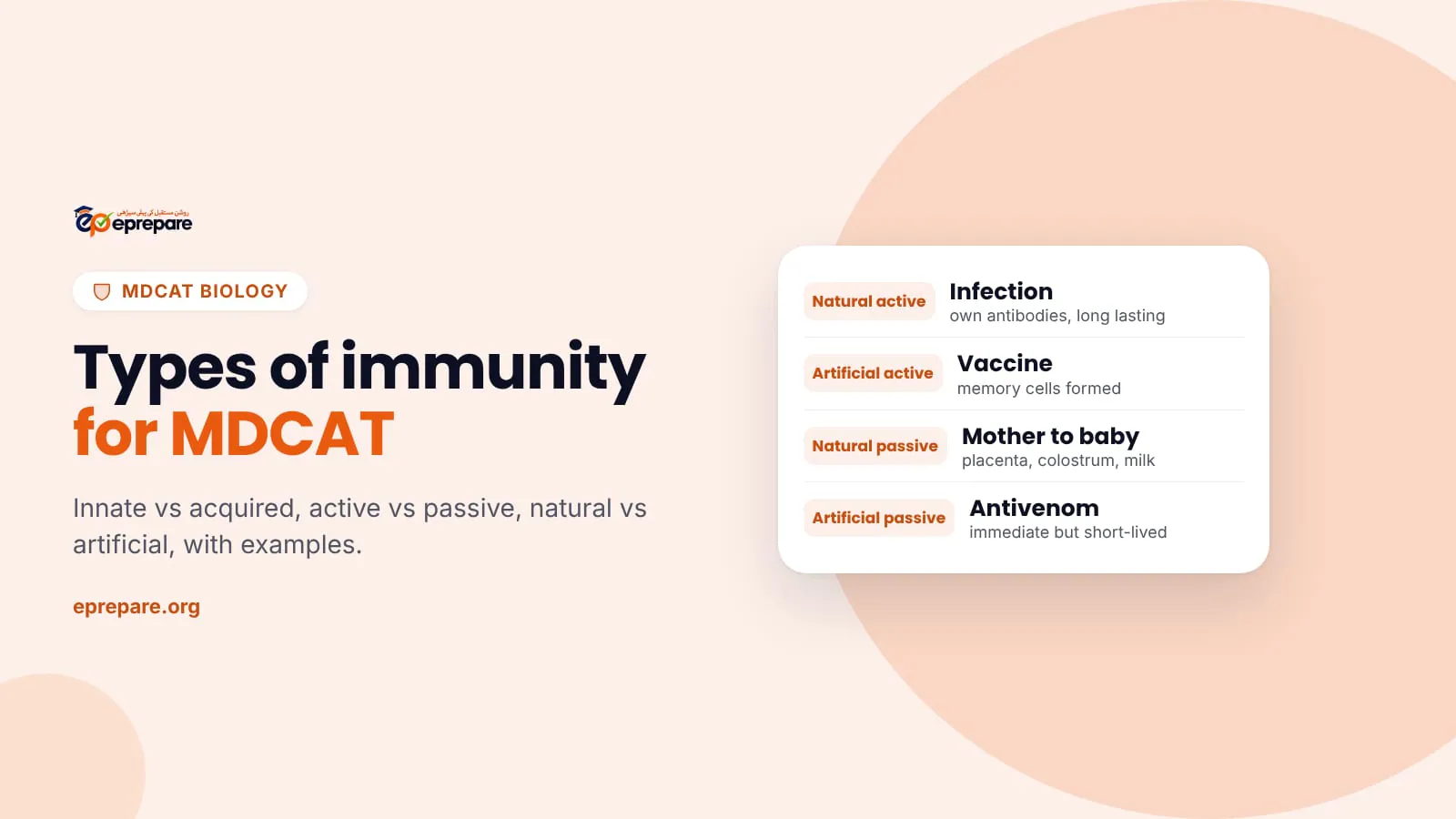
The short answer: Immunity is of two basic types: innate (present from birth, nonspecific) and acquired or adaptive (develops during life, specific, leaves memory). Acquired immunity is active when the body makes its own antibodies (slow to start, long lasting) and passive when ready-made antibodies are received (immediate, short-lived). Each can be natural or artificial: infection = natural active, vaccine = artificial active, mother's antibodies via placenta or milk = natural passive, antiserum or antivenom = artificial passive.
Immunity: the two big branches
Immunity is the body's ability to resist disease. ePrepare's notes split it into two main branches.
Innate (inborn) immunity
- Present from birth.
- Nonspecific: it works against many invaders, not one exact antigen.
- Based on genes and passed from parents to children through genes (not through the placenta).
- Includes the first line of defence (skin, mucous membranes) and the second line (phagocytes, inflammation, fever). In ePrepare's notes, the first and second lines together make innate immunity.
Acquired (adaptive) immunity
- Not present at birth; develops during life after infection, vaccination or receiving antibodies.
- Specific: lymphocytes make antibodies against one particular antigen.
- Leaves memory cells, which make antibodies quickly if the same germ attacks again.
- Protection may be temporary (as in influenza) or lifelong (as in measles, mumps, polio and smallpox).
| Point | Innate immunity | Acquired (adaptive) immunity |
|---|---|---|
| When present | From birth | Develops during life |
| Specificity | Nonspecific | Specific to one antigen |
| Memory | No memory | Memory cells formed |
| Inherited? | Yes, through genes | No; gained by infection, vaccine or received antibodies |
| Lines of defence | First and second lines | Third line (T cells and B cells) |
| Examples | Skin, mucus, stomach acid, phagocytes, fever | Antibodies after measles, after a vaccine, from the mother |
The immunity tree, explained
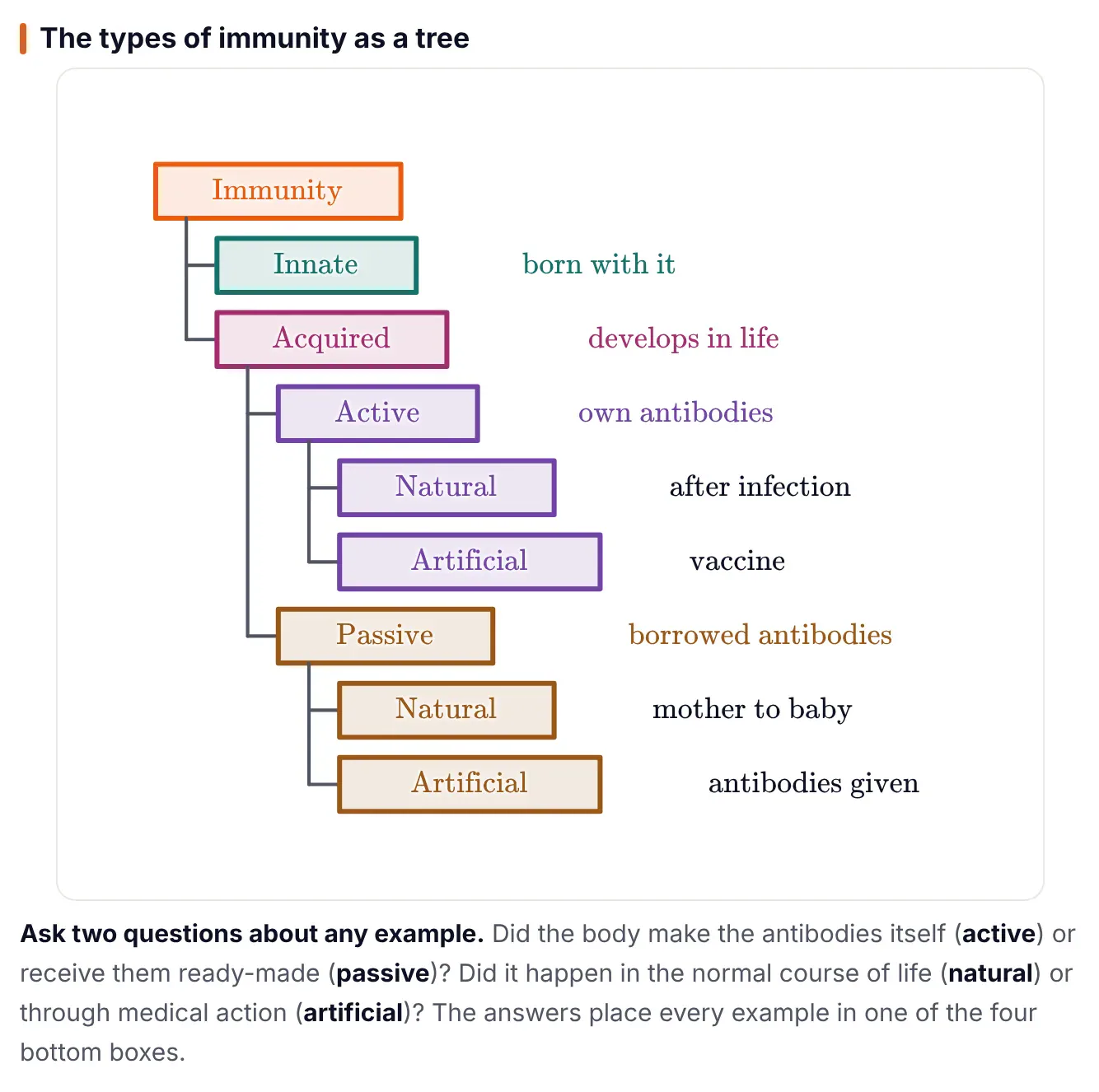
Read the tree from the top. Immunity splits into innate ("born with it") and acquired ("develops in life"). Only the acquired branch splits further: active ("own antibodies") and passive ("borrowed antibodies"). Each of these then splits into natural and artificial. Under active, natural means "after infection" and artificial means "vaccine". Under passive, natural means "mother to baby" and artificial means "antibodies given". The caption under the diagram in ePrepare's notes gives the method that answers almost every MCQ on this topic:
Ask two questions about any example. 1. Did the body make the antibodies itself (active) or receive them ready-made (passive)? 2. Did it happen in the normal course of life (natural) or through medical action (artificial)? The two answers put the example in one of the four bottom boxes.
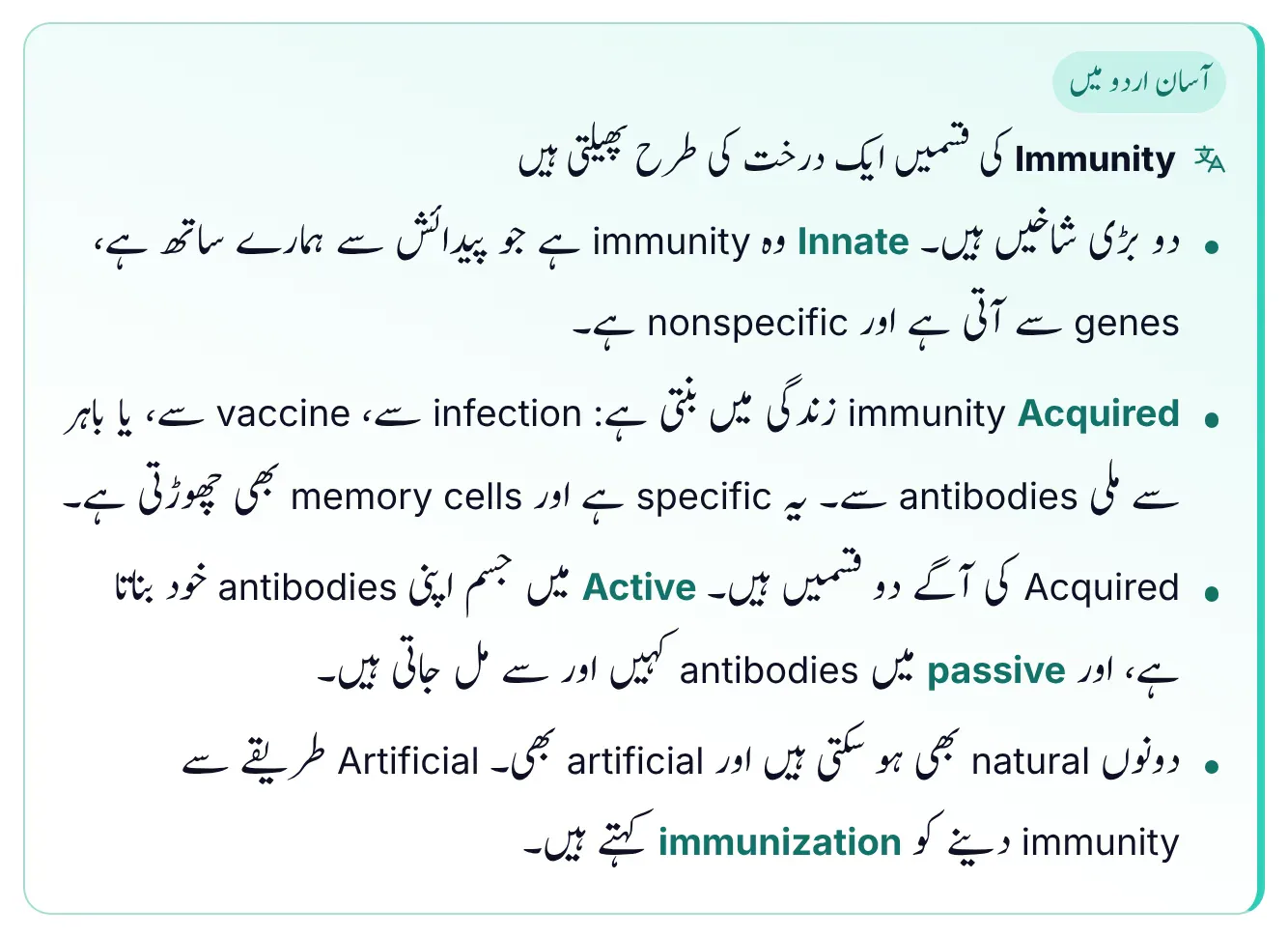
The same tree in easy Urdu. Point one: there are two big branches. Innate immunity is with us from birth, comes from genes and is nonspecific. Point two: acquired immunity forms during life, from an infection, a vaccine or antibodies received from outside; it is specific and also leaves memory cells. Point three: acquired immunity has two further kinds: in active immunity the body makes its own antibodies, and in passive immunity the antibodies come from somewhere else. Point four: both can be natural or artificial, and giving immunity by an artificial method is called immunization.
Active vs passive immunity
| Point | Active immunity | Passive immunity |
|---|---|---|
| Antibodies | The body makes its own | Borrowed (received ready-made) |
| Onset | Slow: needs days or weeks | Immediate |
| Duration | Long lasting, sometimes lifelong | Short: received antibodies are slowly broken down |
| Memory cells | Formed | Not formed |
| Natural form | After an infection | Mother to baby (placenta, colostrum, breast milk) |
| Artificial form | Vaccination | Ready-made antibodies injected (antiserum, antivenom) |
Why is passive immunity short-lived? The borrowed antibodies are slowly broken down, and the body makes no memory cells of its own, so protection fades as their number falls. Why does active immunity take time? The body must find the matching B and T cells, let them multiply and start making antibodies before protection is ready.
The four types of acquired immunity, with examples
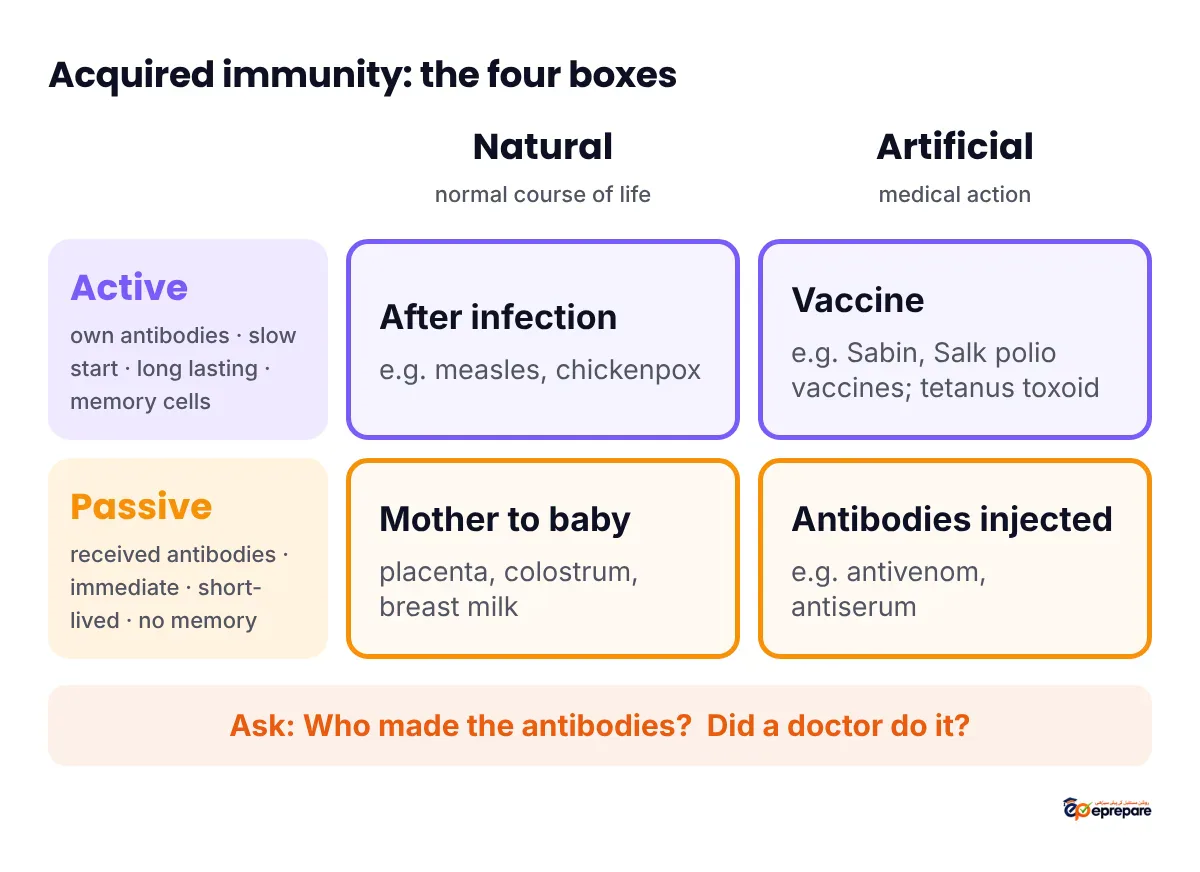
1. Natural active immunity
The body makes its own antibodies after catching an infection. It is usually strong and often long lasting, sometimes for life. This is why a person usually gets measles only once. Long-lasting immunity can also follow chickenpox and mumps.
2. Artificial active immunity
Gained by vaccination. A small amount of antigen (the vaccine) is given by injection or sometimes by mouth, and the body makes its own antibodies and memory cells against it. A booster dose later is a second meeting with the antigen, so memory cells respond fast and protection is renewed.
3. Natural passive immunity
Antibodies pass from mother to baby: across the placenta to the fetus, through colostrum (the first milk, absorbed through the baby's gut) and through breast milk. They protect the baby until its own immune system is fully active. ePrepare's notes call these the mother's three gifts.
4. Artificial passive immunity
Antibodies made in another person or animal are taken out and injected into someone who has been exposed, or may soon be. It acts at once. Earlier, antibodies against tetanus and diphtheria were grown in horses; now human antibodies are used. Antibodies are also given against rabies, some snake venoms (antivenoms) and the human rhesus blood group antigen.
Memory cells: why the second attack fails
After the body fights a germ, some B and T cells stay behind as memory cells. They keep watch for the same antigen for a long time. If it returns, they multiply very quickly.
| Point | Primary response | Secondary response |
|---|---|---|
| When | First meeting with an antigen (infection or vaccine) | Same antigen comes back |
| Speed | Slow, after a lag of several days | Fast, almost at once |
| Strength | Lower peak of antibodies | Much higher peak, lasts longer |
| Memory cells | Makes them | Uses the ones already there |
This is the whole reason vaccines work: the vaccine gives the primary response safely, so a real infection later meets a fast, strong secondary response. It also explains why adults catch fewer colds than small children: their immune systems have already met many cold viruses.
Vaccines and vaccination
Immunization is making the body resistant to an infectious disease, usually by giving a vaccine. A vaccine is an immune-biological substance that stimulates the body's own immune system to give specific protection. The word comes from Latin vacca (cow), because cowpox vaccination protected against smallpox; the two viruses are very similar in structure.
| Type | Example from the notes |
|---|---|
| Live modified (weakened) organisms | Live Sabin polio vaccine, taken by mouth; causes a mild subclinical infection |
| Inactivated or killed organisms | Killed Salk polio vaccine, given by injection |
| Toxoids (detoxified toxins) | Tetanus toxoid |
| Extracted cell parts | Parts of the microbe rather than the whole microbe |
| Combinations | Two or more of the above |
Memory trick from ePrepare's notes: Sabin = Sip (live, by mouth) and Salk = Shot (killed, injected). All vaccines, including toxoids, give artificial active immunity, because the body makes its own antibodies.
Examples asked in MDCAT: sort them in seconds
| Example | Who made the antibodies? | How? | Type |
|---|---|---|---|
| Recovering from measles or chickenpox | Own body | Natural infection | Natural active |
| Polio vaccine (Sabin or Salk) | Own body | Medical action | Artificial active |
| Tetanus toxoid | Own body | Medical action | Artificial active |
| Booster dose | Own body (memory cells) | Medical action | Artificial active |
| Antibodies crossing the placenta | Mother | Natural | Natural passive |
| Antibodies in colostrum or breast milk | Mother | Natural | Natural passive |
| Antivenom after a snake bite | Another person or animal | Injected | Artificial passive |
| Antiserum against tetanus, diphtheria or rabies | Another person or animal | Injected | Artificial passive |
Why is a snake-bite victim given antivenom and not a vaccine? The person needs protection now. Ready-made antibodies act at once; a vaccine would take days to work.
Common mistakes
- "Antibodies crossing the placenta are innate immunity." They are natural passive (acquired) immunity. Innate immunity is passed on through genes.
- "Vaccination gives passive immunity." A vaccine makes the body produce its own antibodies: artificial active immunity.
- "Tetanus toxoid is a dose of ready-made antibodies." A toxoid is a detoxified toxin; it makes the body build its own antibodies (active). Ready-made anti-tetanus antibodies would be passive.
- "Passive immunity lasts for life." It is immediate but short. Active immunity is the long-lasting one.
- "The Salk vaccine is live." Salk is killed; Sabin is live.
- "Natural immunity means innate immunity." In the acquired branch, "natural" only means it happened without medical action (infection, or mother to baby). Do not mix it up with innate.
MDCAT-style practice MCQs
1. Innate immunity is:
- Present from birth and nonspecific
- Developed after vaccination and specific
- Received from the mother and specific
- Made only by memory cells
Show answer
A. Innate immunity is inborn, gene-based and nonspecific. The other options describe acquired immunity.
2. Antibodies that pass from mother to fetus across the placenta give:
- Natural active immunity
- Natural passive immunity
- Artificial passive immunity
- Innate immunity
Show answer
B. The baby receives ready antibodies (passive) without medical action (natural).
3. Vaccination provides:
- Natural active immunity
- Artificial passive immunity
- Artificial active immunity
- Natural passive immunity
Show answer
C. The body makes its own antibodies (active) after a medical step (artificial).
4. A person bitten by a snake is given antivenom. This gives:
- Artificial active immunity
- Natural passive immunity
- Artificial passive immunity
- Lifelong active immunity
Show answer
C. Ready-made antibodies are injected (passive, artificial). They act at once but do not last.
5. A child who recovers from measles usually does not get it again because of:
- Natural active immunity with memory cells
- Natural passive immunity
- Innate immunity
- Artificial passive immunity
Show answer
A. The body made its own antibodies after infection and kept memory cells, so protection is usually lifelong.
6. Passive immunity is short-lived because:
- The received antibodies are broken down and no memory cells form
- The body makes too many memory cells
- The antibodies multiply too fast
- The vaccine is given too early
Show answer
A. Borrowed antibodies are slowly broken down, and passive immunity forms no memory cells.
7. Tetanus toxoid is an example of:
- Ready-made antibodies
- A killed virus vaccine
- A detoxified toxin that gives active immunity
- Natural passive immunity
Show answer
C. A toxoid is a harmless form of the toxin; the body makes its own antibodies against it (artificial active).
8. Compared with the primary immune response, the secondary response is:
- Slower and weaker
- Faster and stronger
- Slower but stronger
- The same in speed and strength
Show answer
B. Memory cells already exist, so the second response starts almost at once and reaches a much higher peak.
Quick revision table
| Type | Key fact | Example |
|---|---|---|
| Innate | From birth, nonspecific, gene-based | Skin, mucus, phagocytes, fever |
| Acquired | Develops in life, specific, memory | All four types below |
| Natural active | Own antibodies after infection; long lasting | Measles once in life |
| Artificial active | Own antibodies after vaccine; long lasting | Sabin, Salk, tetanus toxoid |
| Natural passive | Mother's antibodies; immediate, short | Placenta, colostrum, breast milk |
| Artificial passive | Injected antibodies; immediate, short | Antivenom, antiserum |
| Memory cells | Make the secondary response faster and stronger | Booster dose |
| Vaccine word | Vacca = cow | Cowpox protected against smallpox |
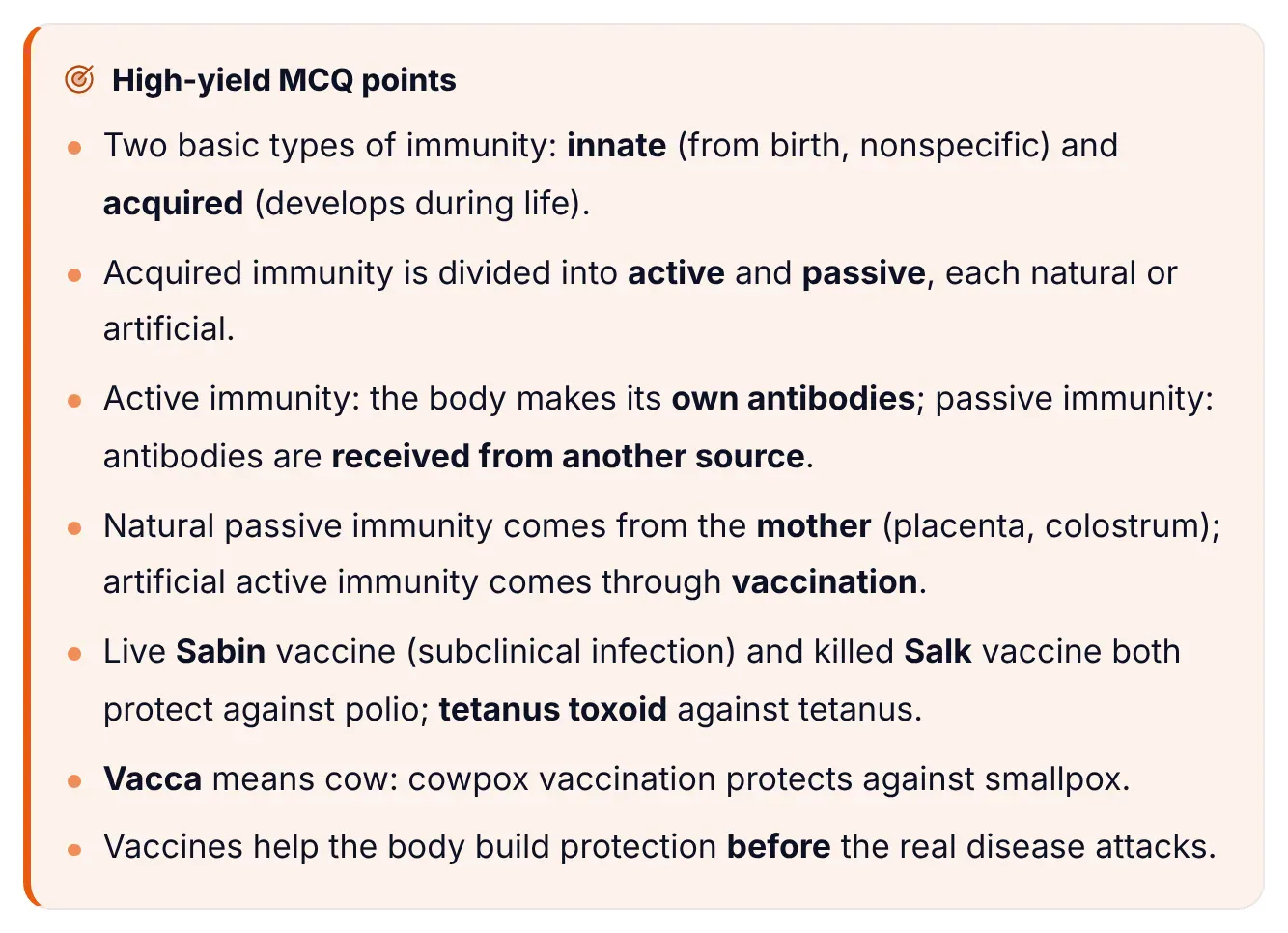
This box is the final checklist from ePrepare's lesson. It lists the seven facts MDCAT most often turns into questions: the two basic types, the active and passive split, own versus received antibodies, where natural passive and artificial active immunity come from, the Sabin, Salk and tetanus toxoid examples, the meaning of vacca, and the purpose of vaccines. The full lesson, with tables on the three ways active immunity develops and 13 practice MCQs with explanations, is in ePrepare's MDCAT conceptual notes.
خلاصہ: Immunity کی دو بڑی قسمیں ہیں: innate، جو پیدائش سے ہوتی ہے اور nonspecific ہے، اور acquired، جو زندگی میں بنتی ہے اور specific ہے۔ Acquired میں اگر جسم اپنی antibodies خود بنائے تو active، اور اگر antibodies کہیں سے ملیں تو passive۔ بیماری کے بعد بنی immunity natural active ہے، vaccine سے artificial active، ماں سے بچے کو placenta یا دودھ کے ذریعے natural passive، اور antivenom جیسی injection سے artificial passive۔ Active دیر سے شروع ہوتی ہے مگر دیر تک چلتی ہے، passive فوراً کام کرتی ہے مگر جلد ختم ہو جاتی ہے۔
Where this fits in your preparation
Immunity is a short chapter that gives reliable marks. See where it stands in our guide to high-yield MDCAT Biology chapters, and revise it alongside circulation and the lymphatic system with our guide to the cardiac cycle. The full syllabus is on the MDCAT syllabus page. When you can sort every example in the table above without looking, test yourself in the Quiz Builder.
Frequently asked questions
What are the main types of immunity?
Two basic types: innate immunity, present from birth and nonspecific, and acquired (adaptive) immunity, which develops during life and is specific. Acquired immunity is either active or passive, and each of those is natural or artificial.
What is the difference between active and passive immunity?
In active immunity the body makes its own antibodies; it takes days or weeks to start but lasts long and forms memory cells. In passive immunity ready-made antibodies are received; protection is immediate but short-lived, and no memory cells form.
Is a vaccine active or passive immunity?
Active. A vaccine contains antigen (live weakened, killed, toxoid or parts of a microbe), and the body responds by making its own antibodies and memory cells. Because it comes through medical action, it is artificial active immunity.
What type of immunity does a baby get from its mother?
Natural passive immunity. Antibodies cross the placenta before birth and come through colostrum and breast milk after birth. They protect the baby for a short time until its own immune system is fully active.
Is innate immunity the same as natural immunity?
Not in MCQs. Innate immunity is inborn and nonspecific. "Natural" active or passive immunity is acquired immunity that happens without medical action, such as after an infection or from the mother. ePrepare's notes do also call innate immunity "inborn or natural", so read the options carefully.
Why do vaccines need booster doses?
A booster is a second meeting with the antigen. Memory cells respond quickly and strongly, so the body makes antibodies much faster and protection is renewed.