Resonance explains why a swing goes higher when you push it at the right moments, why a radio picks up one station and not the others, and why a sitar string or a flute sounds only certain notes. For MDCAT it connects simple harmonic motion with stationary waves in strings and pipes. This guide explains natural frequency, forced oscillations, resonance and damping clearly, then shows how resonance works on a stretched string, with worked numericals and practice MCQs.
The short answer: Every system that can oscillate has a natural frequency, the frequency at which it vibrates freely. If a periodic force drives it at that same frequency, energy is transferred most efficiently and the amplitude becomes maximum. This is resonance. Damping (energy loss to friction or air) lowers the resonance peak and makes it broader, so lightly damped systems give sharp resonance. A string or pipe has many natural frequencies, its harmonics, and resonates at each of them.
Where resonance fits in MDCAT
The PM&DC syllabus does not list resonance as a separate learning outcome. It sits behind three outcomes that are listed: the modes of vibration of strings, stationary waves in air columns, and simple harmonic motion (see the MDCAT syllabus). When a string or pipe "resonates" at its harmonics, that is resonance at work, and FSc Physics covers free and forced oscillations, resonance and damping in its Oscillations chapter. So learn the idea well; it makes the string and pipe questions easier too.
Free oscillations and natural frequency
Pull a pendulum aside or stretch a spring and let go. It oscillates on its own with a frequency fixed by the system itself. These are free oscillations, and that frequency is the natural frequency (f0).
Simple pendulum: T = 2π√(l/g), so f0 = 1/T = (1/2π)√(g/l)
Mass on a spring: T = 2π√(m/k), so f0 = (1/2π)√(k/m)
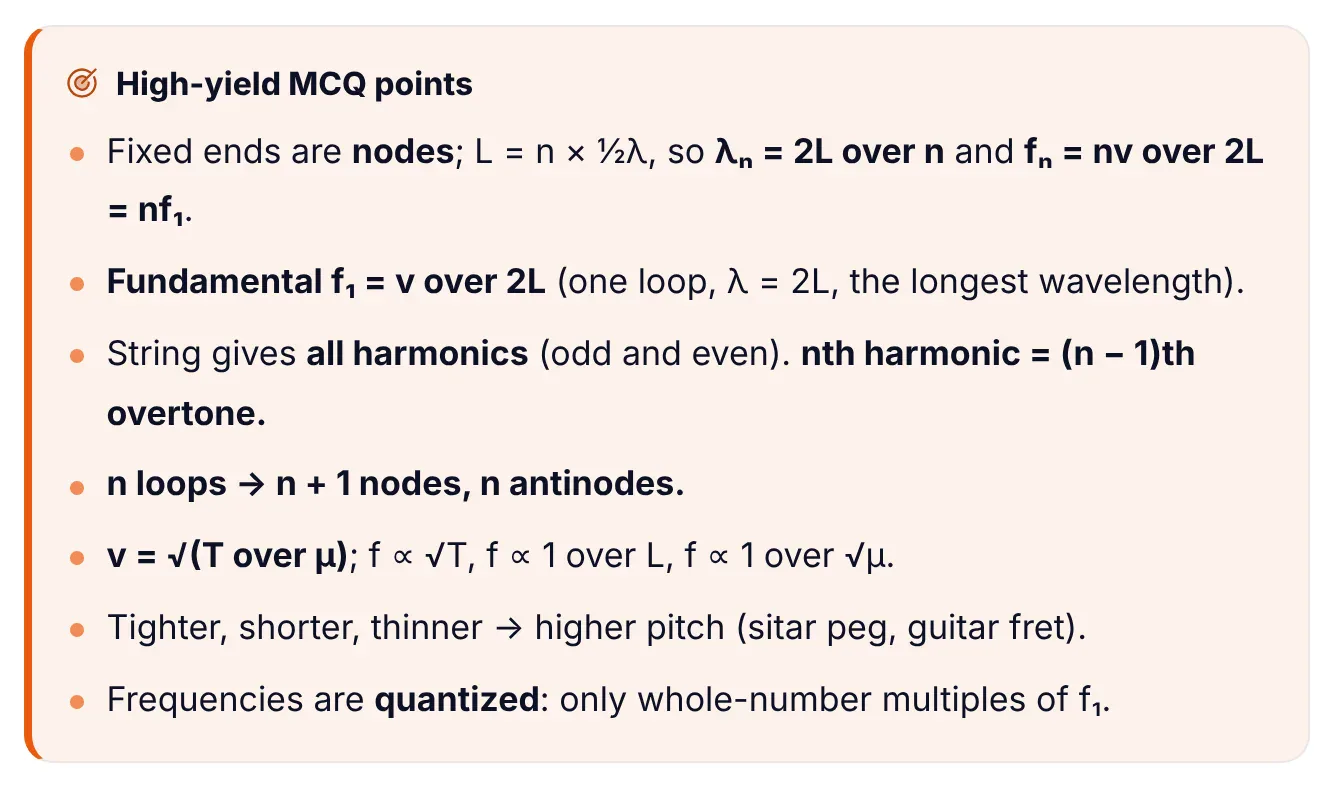
String fixed at both ends: fn = nv/2L (many natural frequencies, one for each mode)
| Symbol | Meaning | SI unit |
|---|---|---|
| f0 | Natural frequency | Hz (s−1) |
| T | Time period (time for one oscillation), T = 1/f | s |
| l | Length of the pendulum | m |
| g | Acceleration due to gravity | m s−2 |
| m | Mass attached to the spring | kg |
| k | Spring constant | N m−1 |
| n, v, L | Harmonic number, wave speed on the string, string length | –, m s−1, m |
The natural frequency depends only on the system: length and g for a pendulum, k and m for a spring, and v and L for a string. It does not depend on the amplitude (for small oscillations). For a refresher on SHM itself, ePrepare's conceptual notes cover it in the same Waves chapter.
Forced oscillations
When a periodic external force keeps pushing a system, it makes forced oscillations. The pushing agent is called the driver. Once the motion settles, the system vibrates at the driver's frequency, not at its own natural frequency. How large the vibration becomes depends on how close the driving frequency is to the natural frequency.
- Driving frequency far from f0: small amplitude. The pushes often arrive at the wrong moment and partly undo each other.
- Driving frequency equal to f0: each push arrives in step with the motion, adding energy every cycle. The amplitude grows to its maximum.
Resonance: the definition MDCAT wants
Remember this: resonance occurs when the frequency of the driving force equals the natural frequency of the system. At resonance, energy transfer from the driver is maximum and the amplitude of the forced oscillations is maximum.
A swing is the classic example. A swing has its own natural frequency. If you push it once every swing, at the moment it starts moving away from you, every push adds energy and it goes higher and higher. Push at random moments and some pushes slow it down.
Damping and the sharpness of resonance
Damping is the loss of energy of an oscillating system to friction, air resistance or other resistive forces. In free oscillations, damping makes the amplitude die away gradually. For light damping, the time period stays practically the same while the amplitude shrinks, a point ePrepare's SHM notes also make.
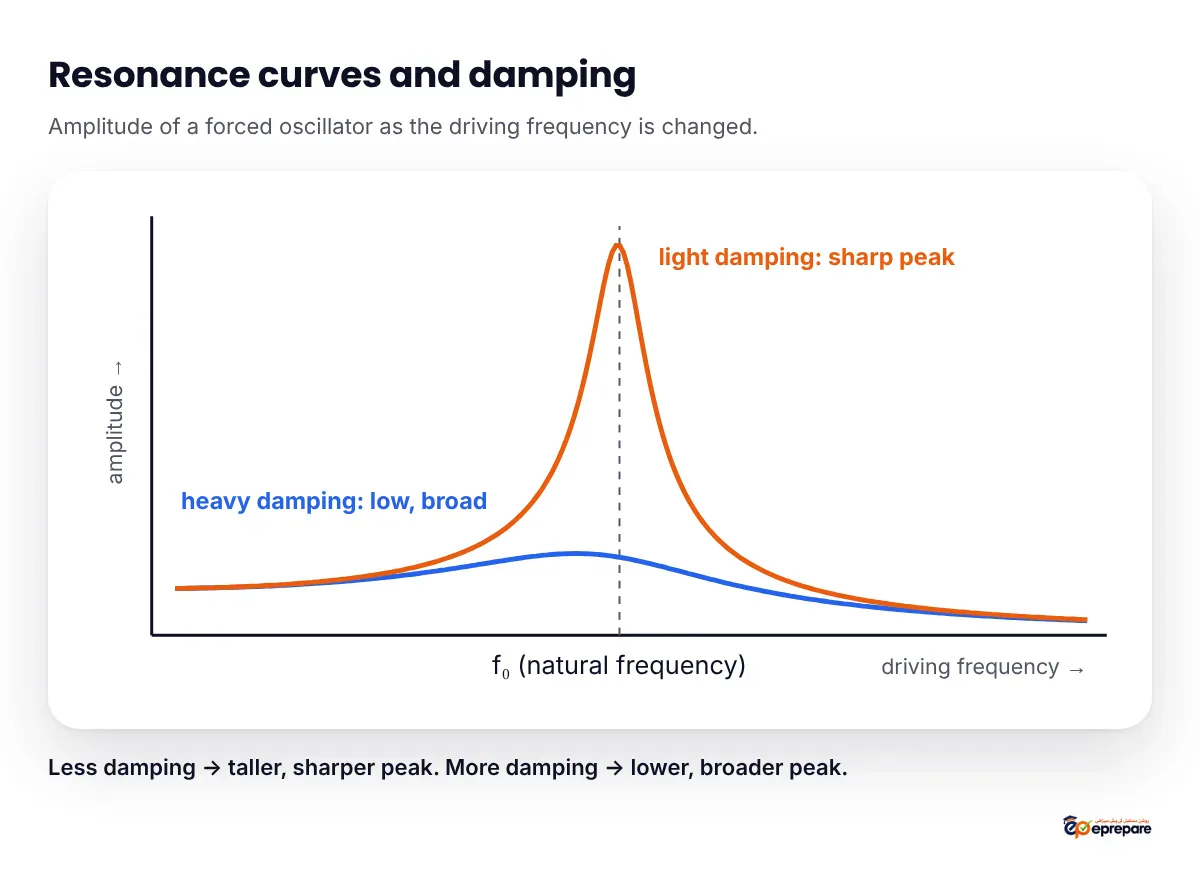
Damping also controls how sharp the resonance is. Plot the amplitude of a forced oscillator against the driving frequency and you get a resonance curve:
| Feature | Light damping | Heavy damping |
|---|---|---|
| Peak amplitude at resonance | Large | Small |
| Shape of the peak | Tall and narrow (sharp) | Low and broad (flat) |
| Range of frequencies that give a big response | Narrow | Wide |
| Free oscillations | Die away slowly | Die away quickly |
| Example | A tuning fork, a well-tuned radio circuit | A car's shock absorbers |
Damping is useful when we want to stop vibrations. Shock absorbers in a car damp the oscillations of the springs, so the car does not keep bouncing after a bump.
Resonance in a stretched string (and pipes)
A pendulum has one natural frequency, but a string fixed at both ends has many. Both ends must be nodes, so the string can only vibrate steadily with whole loops: L = λ/2, 2(λ/2), 3(λ/2) … Each pattern is a mode with its own natural frequency, fn = nv/2L. These are the harmonics from the stationary waves topic.
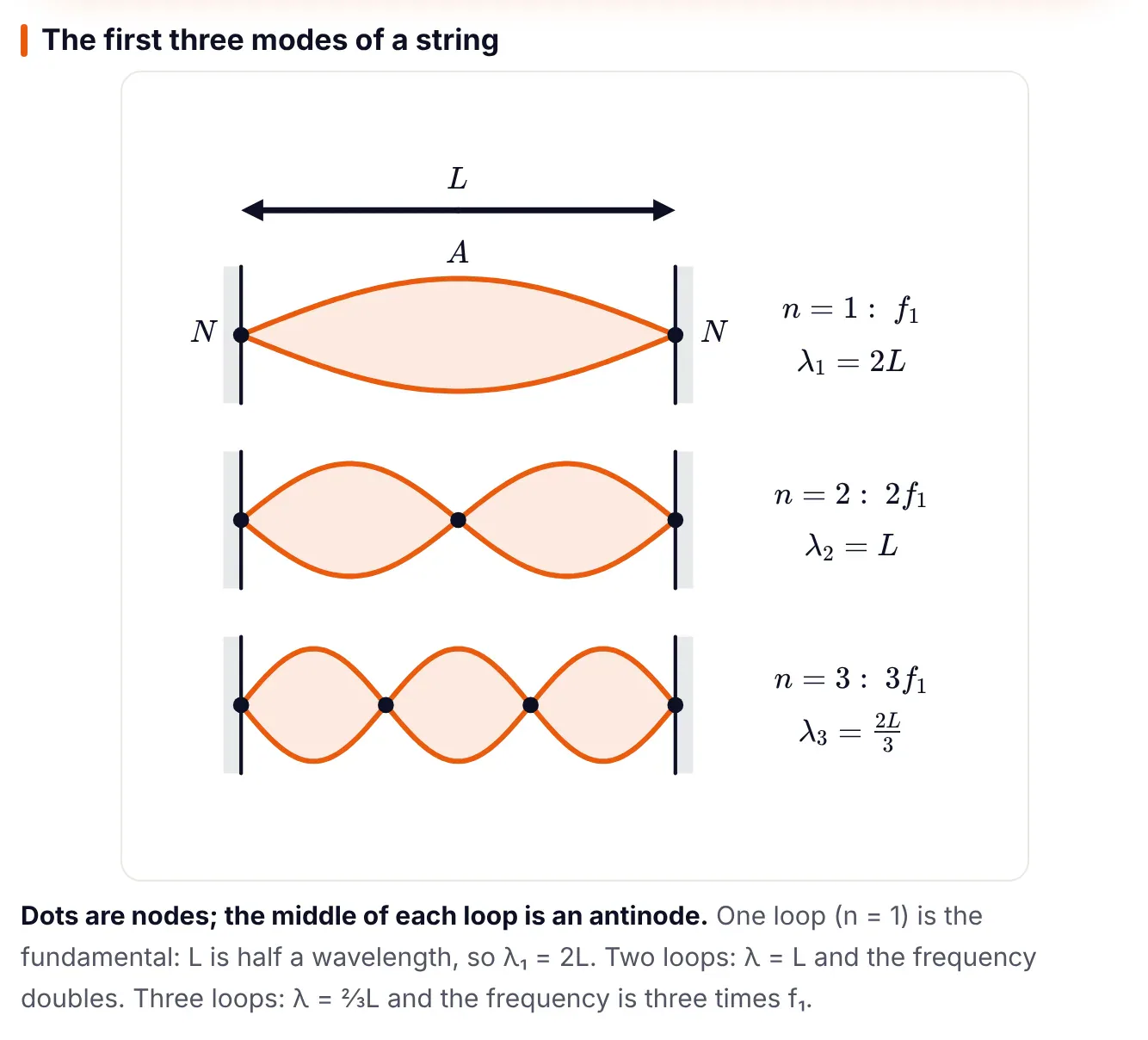
Now drive the string, for example with a vibrator attached to one end, or with a tuning fork pressed on a sonometer box:
- Driving frequency equal to one of the harmonics: the string resonates. A large, steady stationary wave appears with 1, 2, 3 … clear loops. On a sonometer, a small paper rider placed on the string jumps off when the string is tuned to the fork's frequency.
- Driving frequency in between: no steady stationary wave builds up, and the string vibrates only weakly. That is why ePrepare's notes say only these special frequencies are allowed.
Air columns work the same way. An open pipe resonates at nv/2L (all harmonics) and a closed pipe at nv/4L (odd harmonics only). Holding a vibrating tuning fork over a closed tube and changing the air-column length gives a loud sound at L = λ/4, then again at 3λ/4. The full set of pipe numericals is in organ pipe numericals for MDCAT.
Examples of resonance asked in MDCAT and FSc
- Swing: pushed at its natural frequency, its amplitude grows.
- Radio tuning: turning the tuning knob changes the natural frequency of the radio's electrical (LC) circuit. When it matches the frequency of a station's signal, the circuit resonates and picks up that station strongly. This is electrical resonance.
- Soldiers breaking step on a bridge: if the rhythm of marching matched a natural frequency of the bridge, the bridge could build up large, dangerous vibrations. So soldiers are ordered to break step while crossing.
- Musical instruments: strings and air columns resonate at their harmonics. The hollow body of a sitar or guitar is set vibrating by the string and makes the sound louder.
- Sonometer and tuning fork: the string resonates (the paper rider flies off) when its natural frequency matches the fork's.
- A glass shattered by a sound: a loud note at the glass's natural frequency can make it vibrate strongly enough to crack.
- Machines: engines and heavy machines are mounted on damping pads so their vibrations do not set nearby structures into resonance.
Worked numericals (no calculator)
Example 1: which driving frequency makes a string resonate?
A string 0.5 m long carries waves at 100 m s−1. A vibrator drives it at 250 Hz, then at 300 Hz. In which case does it resonate, and with how many loops?
- f1 = v/2L = 100/1 = 100 Hz, so the natural frequencies are 100, 200, 300, 400 Hz …
- 250 Hz is not a whole-number multiple of 100 Hz: no resonance.
- 300 Hz = 3 × 100 Hz: resonance with 3 loops (3rd harmonic).
Example 2: pushing a swing at the right rate
A swing behaves like a simple pendulum of length 1 m. How often should it be pushed for resonance? (Take g ≈ π2 ≈ 10 m s−2.)
- T = 2π√(l/g) = 2π√(1/π2) = 2π × (1/π) = 2 s.
- Natural frequency = 1/T = 0.5 Hz, so push once every 2 s, in step with the swing.
Example 3: natural frequency of a mass-spring system
A 1 kg mass hangs on a spring with k = 40 N m−1. At what driving frequency will it resonate? (Take π2 ≈ 10.)
- T = 2π√(m/k) = 2π√(1/40). Since 40 ≈ 4π2, √(1/40) ≈ 1/(2π).
- T ≈ 2π × 1/(2π) = 1 s, so f0 ≈ 1 Hz. Driving it at about 1 Hz gives resonance.
Example 4: resonance in a closed tube
A tuning fork of 340 Hz is held over a tube closed at the bottom, and the air-column length is slowly increased. Find the first two lengths that give resonance (v = 340 m s−1; ignore end correction).
- λ = v/f = 340/340 = 1 m.
- First resonance: L = λ/4 = 0.25 m. Second resonance: L = 3λ/4 = 0.75 m.
- Successive resonance lengths differ by λ/2 = 0.5 m.
Example 5: tuning a sonometer to a fork
A sonometer wire 0.4 m long carries waves at 200 m s−1. Which tuning fork makes it resonate in its fundamental? What length would resonate in its fundamental with a 500 Hz fork, at the same tension?
- f1 = v/2L = 200/0.8 = 250 Hz, so a 250 Hz fork.
- Same tension, so v is unchanged and f ∝ 1/L. Doubling f needs half the length: L = 0.2 m. (The 0.4 m wire would also resonate with the 500 Hz fork in its 2nd harmonic, with 2 loops.)
For more of these quick-working habits, see MDCAT Physics numericals without a calculator.
Common mistakes
- "At resonance the frequency becomes maximum." Wrong. The amplitude becomes maximum; the frequency equals the natural frequency.
- "A forced oscillator vibrates at its own natural frequency." Wrong. Once settled, it vibrates at the driver's frequency.
- "More damping makes resonance sharper." Wrong. More damping makes the peak lower and broader. Light damping gives sharp resonance.
- "A string has only one natural frequency." Wrong. It has many: f1, 2f1, 3f1 … and it can resonate at each of them.
- "Damping changes the time period a lot." For light damping the period stays practically the same; the amplitude falls.
- "Soldiers break step because marching is tiring for the bridge." The reason is to avoid resonance with the bridge's natural frequency.
MDCAT-style practice MCQs
1. Resonance occurs when:
A) the driving force is very large B) the driving frequency equals the natural frequency C) damping is very large D) the amplitude is very small
Show answer
B). Resonance is the matching of the driving frequency with the natural frequency.
2. At resonance, which quantity of a forced oscillator becomes maximum?
A) frequency B) time period C) amplitude D) damping
Show answer
C) amplitude. Energy transfer from the driver is also maximum.
3. Increasing the damping of a system makes its resonance curve:
A) taller and narrower B) lower and broader C) shift to double the frequency D) unchanged
Show answer
B) lower and broader. Heavy damping gives flat resonance; light damping gives sharp resonance.
4. Soldiers are ordered to break step while crossing a bridge in order to avoid:
A) friction B) resonance C) interference D) refraction
Show answer
B) resonance. Their marching rhythm could match a natural frequency of the bridge.
5. Tuning a radio to a station is an example of:
A) mechanical resonance B) electrical resonance C) damping D) diffraction
Show answer
B) electrical resonance. The circuit's natural frequency is adjusted to match the station's frequency.
6. Once its motion has settled, a system undergoing forced oscillations vibrates at:
A) its natural frequency B) the driver's frequency C) twice the driver's frequency D) zero frequency
Show answer
B) the driver's frequency. Its amplitude is largest when that frequency equals the natural frequency.
7. A string 1 m long carries waves at 200 m s−1. Which driving frequency will NOT make it resonate?
A) 100 Hz B) 200 Hz C) 250 Hz D) 300 Hz
Show answer
C) 250 Hz. f1 = 200/2 = 100 Hz, so the string resonates only at whole-number multiples of 100 Hz.
8. The shock absorbers of a car are a practical use of:
A) resonance B) damping C) interference D) superposition
Show answer
B) damping. They remove energy from the spring's oscillations so the car stops bouncing quickly.
Quick revision table
| Term | What to remember |
|---|---|
| Free oscillations | Vibrating on its own at the natural frequency f0 |
| Natural frequency | Pendulum (1/2π)√(g/l); spring (1/2π)√(k/m); string nv/2L |
| Forced oscillations | Driven by a periodic force; vibrate at the driver's frequency |
| Resonance | Driving frequency = natural frequency; amplitude and energy transfer maximum |
| Damping | Energy loss to friction or air; amplitude decreases |
| Light damping | Tall, sharp resonance peak |
| Heavy damping | Low, broad (flat) resonance peak |
| String | Resonates at f1, 2f1, 3f1 … (whole loops only) |
| Pipes | Open: nv/2L, all; closed: nv/4L, odd only |
| Examples | Swing, radio tuning, soldiers breaking step, instruments, sonometer, shattering glass |
The string, pipe and SHM lessons, with easy-Urdu boxes, diagrams and practice MCQs with explanations, are all in ePrepare's MDCAT conceptual notes. To see how the Waves chapter compares with the rest of Physics, read MDCAT Physics high-yield chapters.
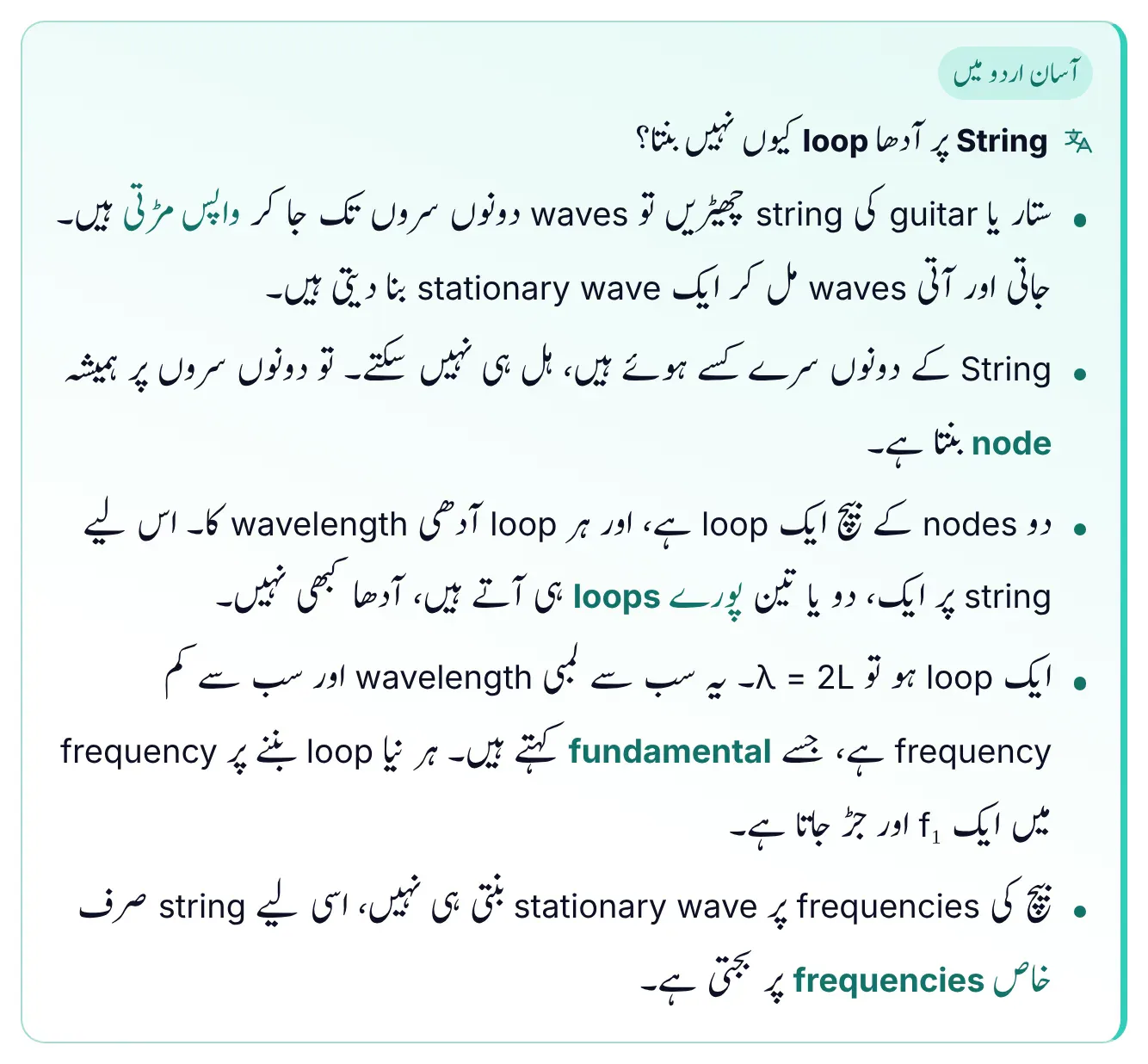
آسان الفاظ میں: ہر چیز کی اپنی ایک natural frequency ہوتی ہے۔ اگر باہر سے اسی frequency پر دھکا دیا جائے تو amplitude سب سے زیادہ ہو جاتا ہے، اسی کو resonance کہتے ہیں، جیسے جھولے کو صحیح وقت پر دھکا دینا۔ Damping یعنی رگڑ سے energy ضائع ہو تو resonance کا peak نیچا اور چوڑا ہو جاتا ہے۔ String کی کئی natural frequencies ہوتی ہیں، f₁، 2f₁، 3f₁، اور وہ انہی پر resonate کرتی ہے۔
Frequently asked questions
What is resonance in simple words?
Resonance is when a system is pushed at its own natural frequency, so each push adds energy in step with the motion and the amplitude becomes as large as possible.
What is the difference between free and forced oscillations?
Free oscillations happen on their own at the natural frequency after the system is disturbed once. Forced oscillations are kept going by a periodic external force and happen at the driver's frequency.
How does damping affect resonance?
More damping lowers the peak amplitude and makes the resonance curve broader. Less damping gives a taller, sharper peak.
Why do soldiers break step on a bridge?
So that the regular rhythm of marching cannot match a natural frequency of the bridge and build up large vibrations through resonance.
How is resonance related to stationary waves?
A string or pipe has many natural frequencies, its harmonics. When it is driven at one of them, a large stationary wave builds up, which is resonance. At other frequencies no steady pattern forms.
Is resonance in the MDCAT syllabus?
It is not a separate learning outcome in the PM&DC syllabus, but it underlies the listed outcomes on strings, air columns and SHM, and it is part of FSc Physics. Understanding it helps with those questions.