
Organ pipe questions are some of the most predictable marks in the MDCAT Waves chapter. Almost every one comes down to two formulas and one rule about which harmonics exist. If you know why an open pipe holds half a wavelength and a closed pipe only a quarter, you can solve them in your head. This guide gives the formulas with every symbol, the quick ratios, and solved numericals in the style MDCAT uses.
The short answer: An open pipe (open at both ends) has antinodes at both ends, so fn = nv/2L with all harmonics (f1, 2f1, 3f1 …). A closed pipe (closed at one end) has a node at the closed end and an antinode at the open end, so fn = nv/4L with odd harmonics only (f1, 3f1, 5f1 …). For the same length, the closed pipe's fundamental is half the open pipe's. Take v ≈ 340 m s−1 unless the question gives another value.
How an air column makes a note
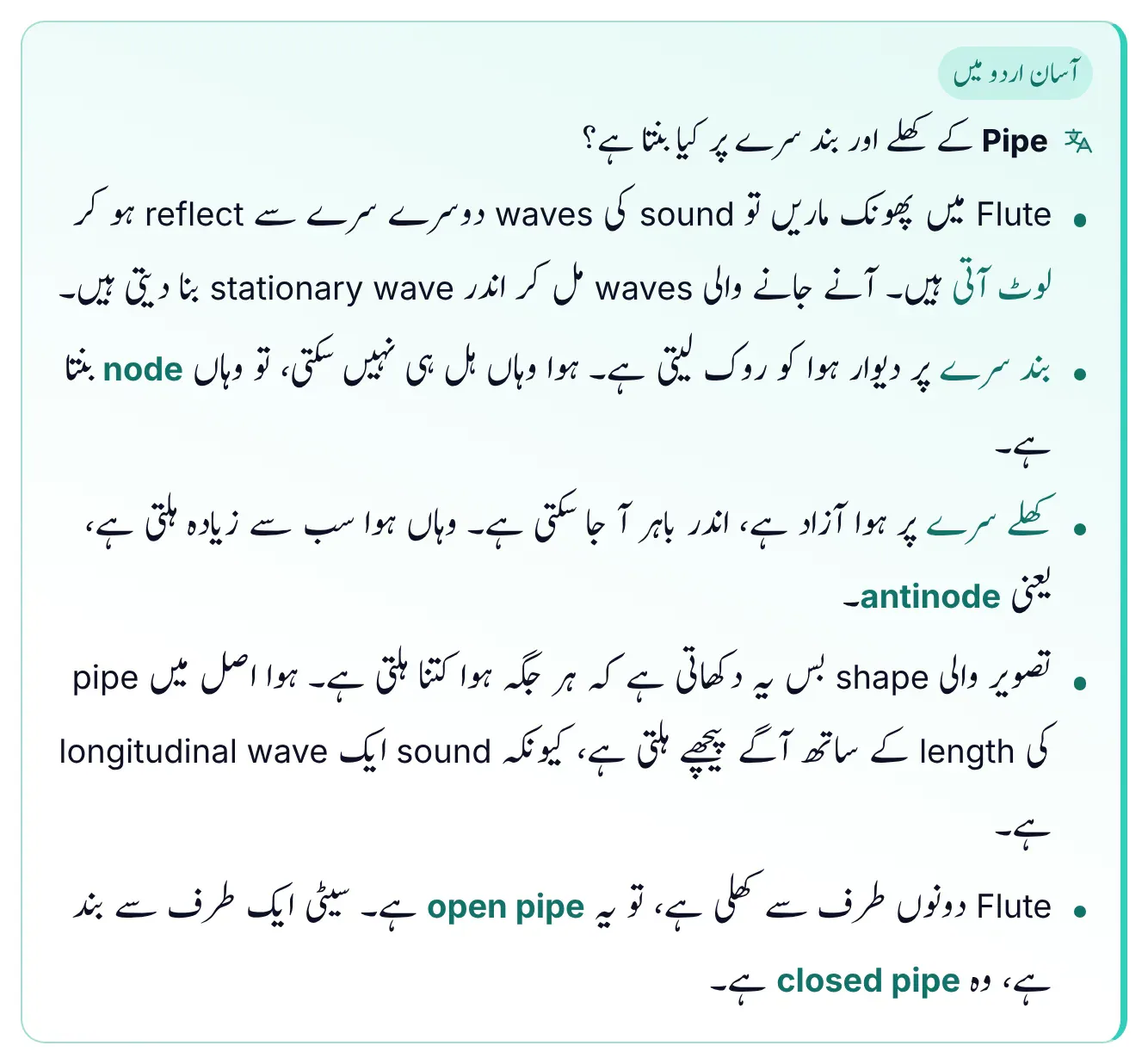
Blow into a flute or whistle and sound waves travel down the air column, reflect at the far end (an open end reflects sound too) and come back. The waves going down and coming back superpose to form a stationary longitudinal wave in the air. At certain frequencies it builds up strongly: the pipe resonates and gives a loud, clear note. If stationary waves are new to you, start with stationary waves for MDCAT.
Two end rules decide everything:
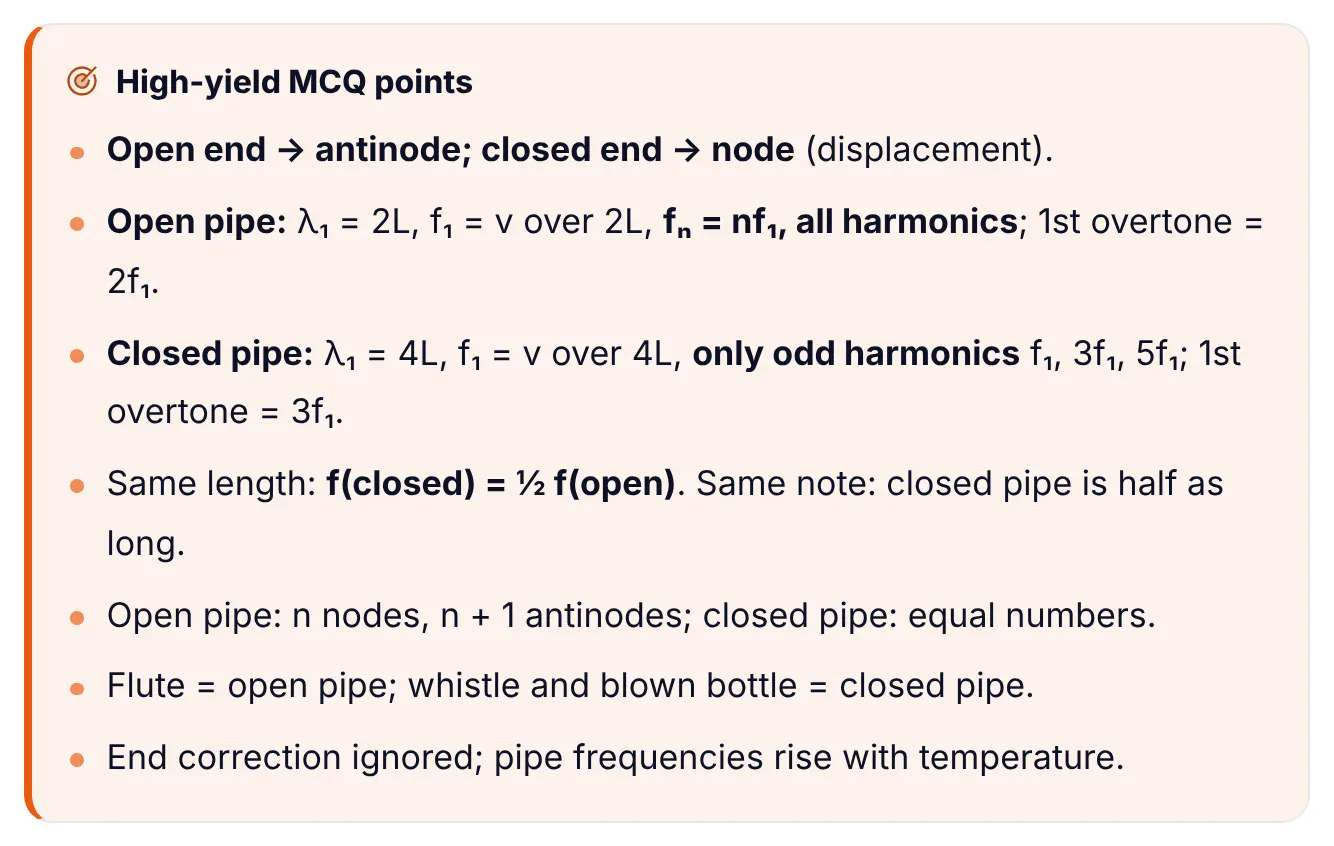
- Open end → antinode (A). The air there is free to move in and out, so it moves the most.
- Closed end → node (N). The wall stops the air, so it cannot move.
These are displacement nodes and antinodes. Pressure is the other way round (a closed end has the largest pressure change), but MCQs mean displacement unless they say pressure.
Open and closed pipe formulas, every symbol
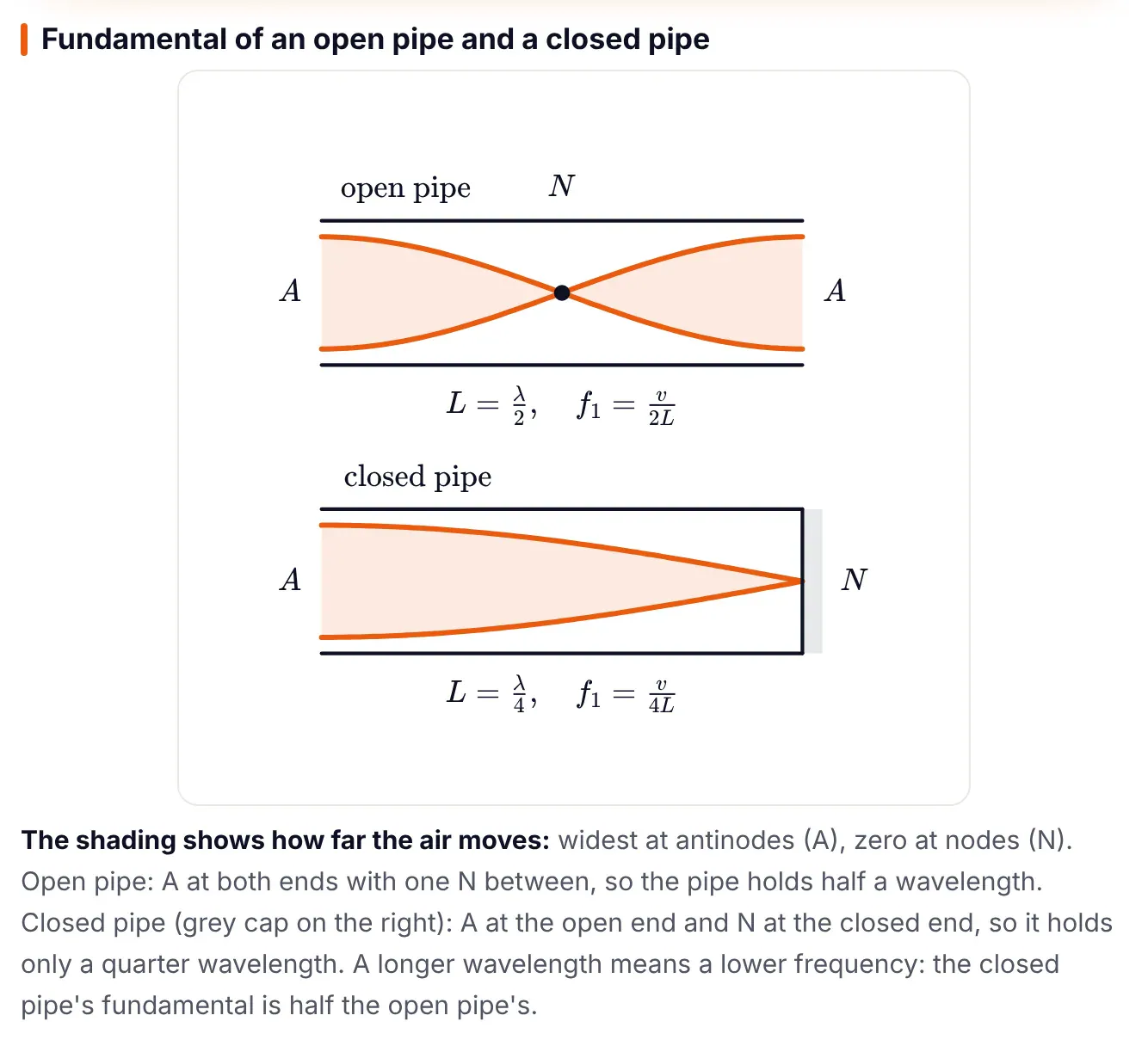
Open pipe (both ends open)
- Fundamental: L = λ1/2, so λ1 = 2L and f1 = v/2L.
- General: L = n(λn/2), so λn = 2L/n and fn = nv/2L = nf1, n = 1, 2, 3 …
- All harmonics are present. In the nth harmonic there are n nodes and n + 1 antinodes.
Closed pipe (one end closed)
- Fundamental: L = λ1/4, so λ1 = 4L and f1 = v/4L.
- Next modes: L = 3λ/4 gives 3f1; L = 5λ/4 gives 5f1.
- General: fn = nv/4L, n = 1, 3, 5 … (odd only). Nodes and antinodes are always equal in number.
| Symbol | Meaning | SI unit |
|---|---|---|
| fn | Frequency of the nth harmonic | Hz |
| f1 | Fundamental frequency (lowest note) | Hz |
| n | Harmonic number (open: 1, 2, 3 …; closed: 1, 3, 5 …) | no unit |
| v | Speed of sound in air (about 340 m s−1; rises with temperature) | m s−1 |
| L | Length of the air column | m |
| λn | Wavelength of the nth harmonic | m |
Why a closed pipe has no even harmonics
One end must be an antinode and the other a node. From an antinode to a node is always an odd number of quarter-wavelengths (λ/4, 3λ/4, 5λ/4 …). Two quarters (half a wavelength) would put the same kind of point at both ends, which cannot happen with one end open and one closed. So 2f1, 4f1 and the other even harmonics are simply missing.
What about end correction?
In reality the antinode forms a little outside an open end, a small "end correction". ePrepare's notes point out that MDCAT ignores it, so take the antinode exactly at the open end unless a question gives you an end correction.
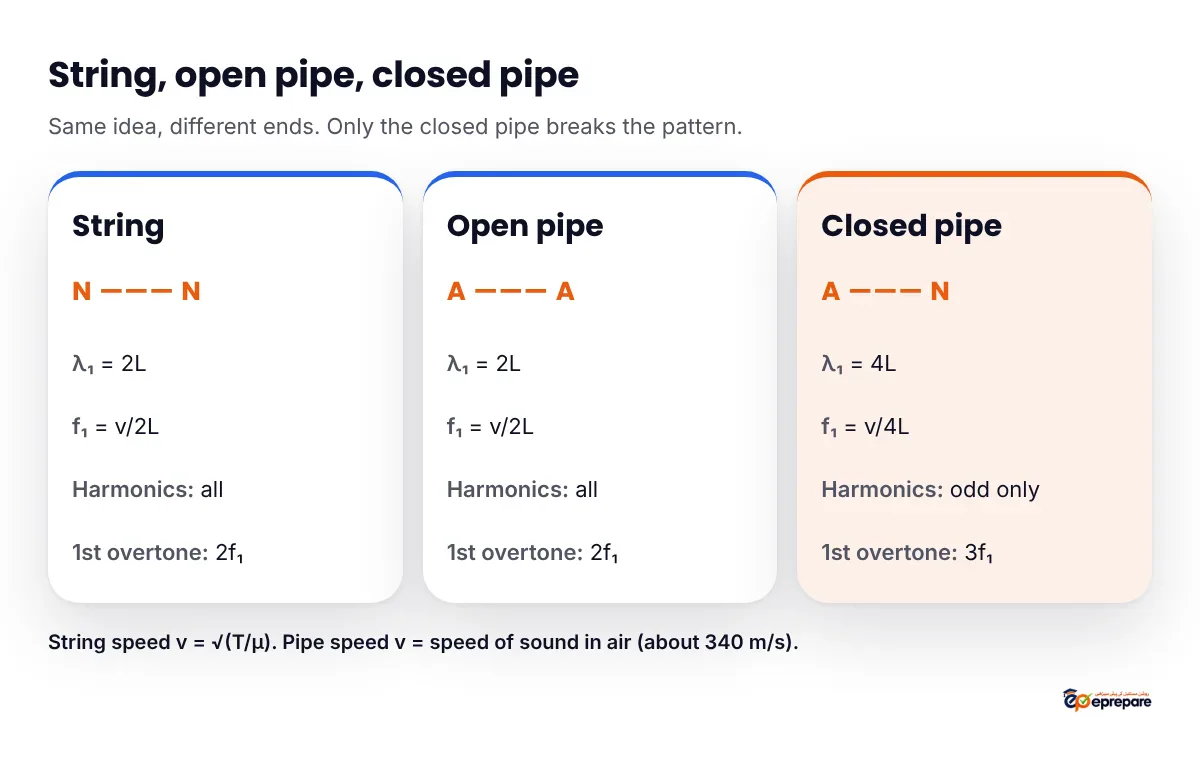
Quick ratios to memorise
| Situation | Result |
|---|---|
| Same length: closed vs open fundamental | fclosed = ½ fopen (an octave lower) |
| Same fundamental: closed vs open length | Lclosed = ½ Lopen |
| Close one end of an open pipe | Fundamental halves |
| Open the closed end of a closed pipe | Fundamental doubles |
| Open pipe harmonics | 1 : 2 : 3 : 4 … |
| Closed pipe harmonics | 1 : 3 : 5 : 7 … |
| Open pipe, nth overtone | (n + 1)f1; 1st overtone = 2f1 |
| Closed pipe, nth overtone | (2n + 1)f1; 1st overtone = 3f1 |
| Neighbouring resonances differ by | f1 (open pipe) or 2f1 (closed pipe) |
| Longer air column | Lower note |
| Warmer air | v rises, so every frequency rises a little |
Organ pipe numericals, solved (v = 340 m s−1)
Each example uses numbers that divide neatly, the way MDCAT sets them. For more no-calculator shortcuts, see MDCAT Physics numericals without a calculator.
Example 1: open pipe, first three frequencies
An open pipe is 0.85 m long. Find its three lowest frequencies.
- f1 = v/2L = 340/1.7 = 200 Hz (1.7 × 200 = 340).
- All harmonics: 200 Hz, 400 Hz, 600 Hz.
Example 2: closed pipe of the same length
A pipe of the same length, 0.85 m, is closed at one end. Find its three lowest frequencies.
- f1 = v/4L = 340/3.4 = 100 Hz, half the open pipe's fundamental.
- Odd harmonics only: 100 Hz, 300 Hz, 500 Hz. There is no 200 Hz.
Example 3: finding the length
What length of closed pipe gives a fundamental of 170 Hz?
- L = v/4f1 = 340/(4 × 170) = 340/680 = 0.5 m.
Example 4: closing one end and the first overtone
An open pipe is 50 cm long. Find its fundamental and first overtone. One end is then closed. Find the new fundamental and first overtone.
- Open: f1 = 340/(2 × 0.5) = 340 Hz; first overtone = 2f1 = 680 Hz.
- Closed: f1 = 340/(4 × 0.5) = 170 Hz (half); first overtone = 3f1 = 510 Hz.
Example 5: open or closed? (the gap test)
A pipe resonates at 255 Hz, 425 Hz and 595 Hz, which are neighbouring modes. Is it open or closed? Find f1 and its length.
- Gap = 425 − 255 = 170 Hz.
- If the pipe were open, f1 would be 170 Hz, but 255 is not a whole-number multiple of 170. So the gap is 2f1: f1 = 85 Hz.
- Check: 255 = 3 × 85, 425 = 5 × 85, 595 = 7 × 85. Odd multiples, so it is a closed pipe.
- L = v/4f1 = 340/(4 × 85) = 340/340 = 1 m.
Example 6: closed fundamental equals open first overtone
The fundamental of a closed pipe equals the first overtone of an open pipe. Find the ratio of their lengths.
- Closed fundamental = v/4Lc. Open first overtone = 2v/2Lo = v/Lo.
- Set equal: v/4Lc = v/Lo, so Lo = 4Lc.
- Lc : Lo = 1 : 4.
Counting nodes and antinodes
- Open pipe, 3rd harmonic: 3 nodes and 4 antinodes.
- Closed pipe, 5th harmonic (2nd overtone): L = 5λ/4, giving A–N–A–N–A–N from the open end, so 3 nodes and 3 antinodes.
Examples MDCAT uses
- Flute: open pipe, all harmonics, richer sound.
- Whistle, stopped organ pipe, blowing across a bottle: closed pipe, odd harmonics only.
- Bottle with less water: longer air column, so a lower note.
- Hot day: sound travels faster, so a pipe's frequencies rise slightly although its length is unchanged.
Common mistakes
- "The closed end is an antinode." Wrong. The air there cannot move: it is a (displacement) node.
- "A closed pipe gives all harmonics." Wrong. Only odd ones: f1, 3f1, 5f1.
- "In a closed pipe, 3f1 is the 2nd harmonic." Wrong. It is the 3rd harmonic and the 1st overtone. The 2nd harmonic does not exist there.
- "A closed pipe of the same length gives a higher note." Wrong. Its wavelength is 4L, so its frequency is half: a lower note.
- Using √(T/μ) for a pipe. That is the wave speed on a string. In a pipe, v is the speed of sound in air.
- Forgetting units: convert cm to m before using f = v/2L or v/4L.
MDCAT-style practice MCQs
1. At the closed end of an organ pipe there is always a:
A) displacement antinode B) displacement node C) pressure node D) crest
Show answer
B) displacement node. The wall stops the air. (It is a pressure antinode.)
2. A pipe closed at one end produces:
A) all harmonics B) only even harmonics C) only odd harmonics D) only the fundamental
Show answer
C) only odd harmonics: f1, 3f1, 5f1 …
3. The fundamental frequency of an open pipe 1.7 m long (v = 340 m s−1) is:
A) 50 Hz B) 100 Hz C) 200 Hz D) 340 Hz
Show answer
B) 100 Hz. f1 = 340/(2 × 1.7) = 340/3.4 = 100 Hz. 50 Hz is the closed-pipe value.
4. The first overtone of a closed pipe 0.5 m long (v = 340 m s−1) is:
A) 170 Hz B) 340 Hz C) 510 Hz D) 680 Hz
Show answer
C) 510 Hz. f1 = 340/2 = 170 Hz; the 1st overtone of a closed pipe is 3f1 = 510 Hz.
5. An open pipe has a fundamental of 300 Hz. If one end is closed, the fundamental becomes:
A) 150 Hz B) 300 Hz C) 450 Hz D) 600 Hz
Show answer
A) 150 Hz. Closing one end doubles the fundamental wavelength (2L → 4L), so the frequency halves.
6. A closed pipe and an open pipe have the same fundamental frequency. The ratio of their lengths Lclosed : Lopen is:
A) 1 : 1 B) 1 : 2 C) 2 : 1 D) 1 : 4
Show answer
B) 1 : 2. v/4Lc = v/2Lo gives Lc = Lo/2.
7. The ratio of the first three resonant frequencies of a closed pipe is:
A) 1 : 2 : 3 B) 1 : 3 : 5 C) 2 : 4 : 6 D) 1 : 4 : 9
Show answer
B) 1 : 3 : 5. Odd harmonics only.
8. A pipe resonates at 300 Hz, 500 Hz and 700 Hz (neighbouring modes). The pipe and its fundamental are:
A) open, 200 Hz B) open, 100 Hz C) closed, 100 Hz D) closed, 200 Hz
Show answer
C) closed, 100 Hz. The gap of 200 Hz is 2f1, and 300, 500, 700 are odd multiples of 100 Hz.
Quick revision table
| Feature | Open pipe | Closed pipe |
|---|---|---|
| Ends | A at both ends | A at open end, N at closed end |
| Fundamental λ | 2L | 4L |
| Fundamental f1 | v/2L | v/4L (half) |
| General formula | fn = nv/2L, n = 1, 2, 3 … | fn = nv/4L, n = 1, 3, 5 … |
| Harmonics present | All | Odd only |
| 1st overtone | 2f1 | 3f1 |
| Nodes and antinodes | n nodes, n + 1 antinodes | Equal numbers |
| Example | Flute | Whistle, bottle, stopped organ pipe |
The full lesson, with harmonic ladders for both pipes, easy-Urdu boxes and practice MCQs with explanations, is part of ePrepare's MDCAT conceptual notes. Pipes resonate only at these frequencies; the idea behind that is explained in resonance in physics for MDCAT. For chapter priorities, read MDCAT Physics high-yield chapters.
یاد رکھنے کی بات: کھلے سرے پر antinode، بند سرے پر node۔ Open pipe میں f = nv/2L اور سب harmonics آتے ہیں۔ Closed pipe میں f = nv/4L اور صرف odd harmonics، یعنی f₁، 3f₁، 5f₁۔ ایک ہی length ہو تو closed pipe کی fundamental frequency open pipe کی آدھی ہوتی ہے۔ MCQ میں closed pipe کے لیے 2f₁ نظر آئے تو سمجھ جائیں یہ trap ہے۔
Frequently asked questions
What is the formula for an open organ pipe?
fn = nv/2L with n = 1, 2, 3 …, so all harmonics are present. The fundamental is v/2L.
What is the formula for a closed organ pipe?
fn = nv/4L with n = 1, 3, 5 … only. The fundamental is v/4L, half that of an open pipe of the same length.
Why does a closed pipe produce only odd harmonics?
The open end must be an antinode and the closed end a node. Antinode to node is always an odd number of quarter-wavelengths, which gives f1, 3f1, 5f1 only.
What is the first overtone of a closed pipe?
3f1, the 3rd harmonic. For an open pipe the first overtone is 2f1.
Do I need end correction for MDCAT?
No. ePrepare's notes state that MDCAT ignores end correction, so take the antinode exactly at the open end unless the question gives a correction.
What speed of sound should I use in organ pipe numericals?
Use the value given in the question. If none is given, 340 m s−1 is the usual choice, and such questions usually use numbers that divide neatly with it.