

Sex-linked inheritance is one of the most reliable sources of MDCAT genetics MCQs. The questions look tricky because they mix sons, daughters, carriers and percentages, but every one of them is solved with the same two-line Punnett square. This guide shows you the notation, the five crosses that cover almost every question, how to read a pedigree, and the wording traps that cost students marks.
The short answer: sex-linked traits are controlled by genes on the sex chromosomes, mostly the X. Haemophilia and red-green colour blindness are X-linked recessive: a male with one recessive allele (XhY) is affected, while a female with one (XHXh) is a normal carrier. A son always gets his X from his mother, so an X-linked trait never passes father → son; it goes criss-cross (maternal grandfather → carrier daughter → grandson). Y-linked (holandric) traits pass father → every son.
What sex-linked inheritance means
Traits controlled by alleles on the sex chromosomes are called sex-linked traits, and their pattern of inheritance is sex linkage. Females are XX and males are XY.
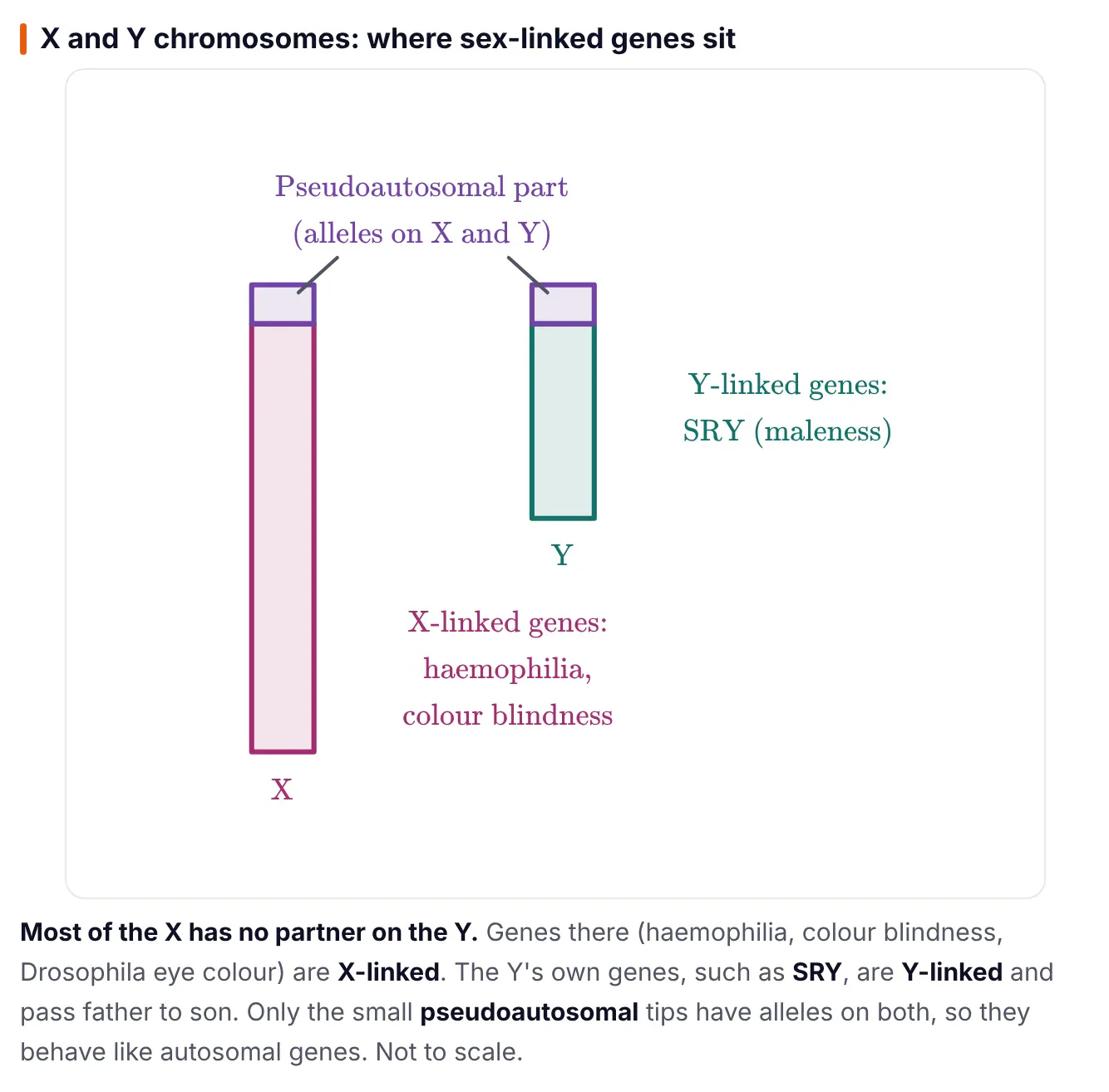
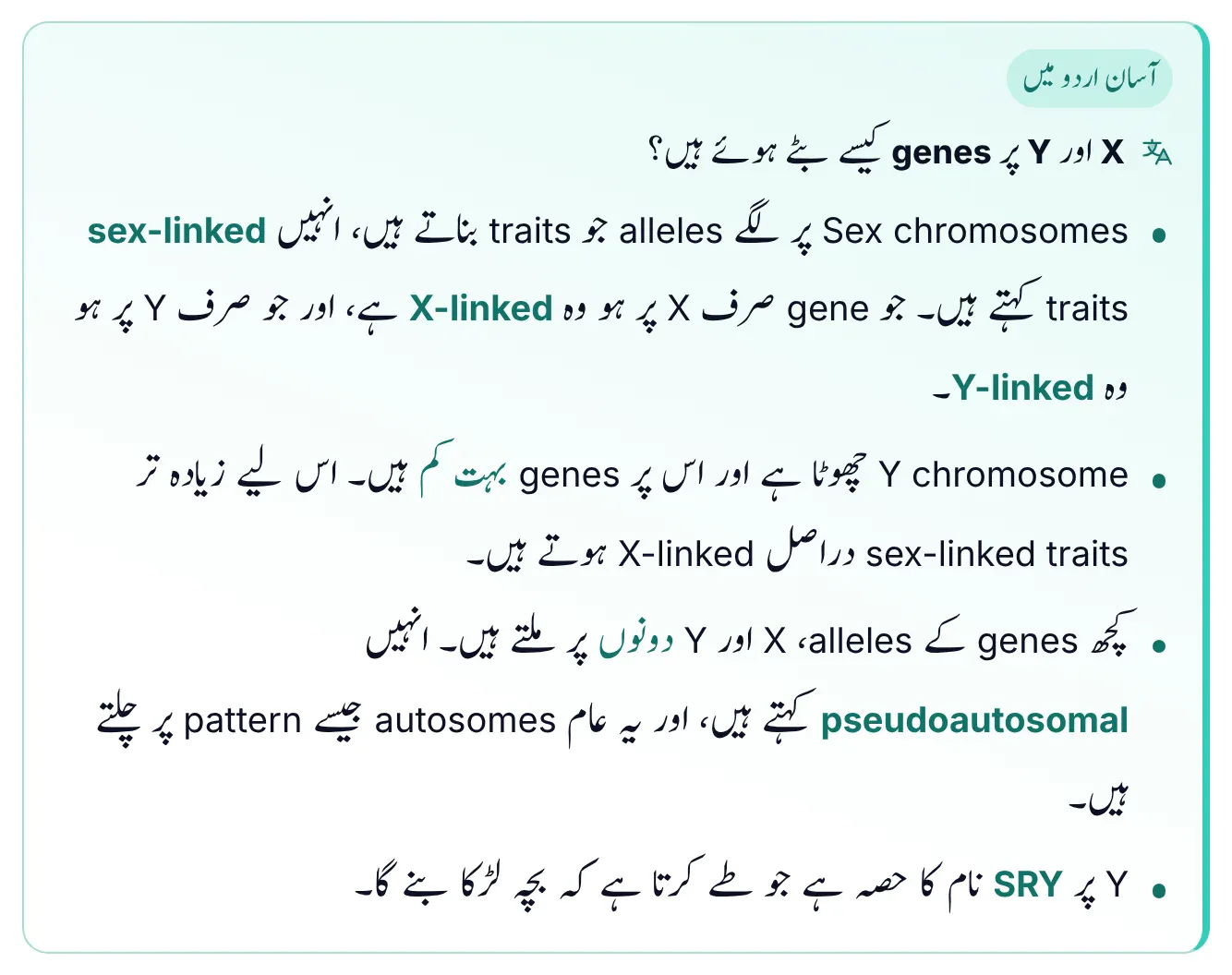
- X-linked genes are on the part of the X that has no partner on the Y. Most sex-linked traits are X-linked because the X is large and carries many genes.
- Y-linked genes are on the part of the Y that has no partner on the X. The Y is small with very few genes, such as SRY, which decides maleness.
- Pseudoautosomal (X-Y linked) genes sit at the small tips where X and Y match. They have alleles on both, so they behave like autosomal genes.
Why males are affected more often
A male has only one X, so he has just one copy of every X-linked gene. He is hemizygous for these genes. There is no second allele to mask a recessive one, so one copy is enough to show the trait. A female has two X chromosomes and needs two recessive alleles to show it; with one, the dominant allele masks it and she is a carrier.
The notation you must use
Always write the allele as a superscript on the X. Never write it on the Y for an X-linked trait, because the Y does not carry that gene.
| Genotype | Sex | Phenotype |
|---|---|---|
| XHXH | Female | Normal |
| XHXh | Female | Normal carrier |
| XhXh | Female | Haemophilic (very rare) |
| XHY | Male | Normal |
| XhY | Male | Haemophilic |
Colour blindness works the same way. Many books write the normal allele XC and the colour-blind allele Xc. Notice there are only five genotypes and that males cannot be carriers: with one X, they either have the allele and show it, or they do not have it.
Five worked crosses that cover most MDCAT questions
Method: put the mother's eggs down the side and the father's sperm (one X, one Y) across the top. Daughters get one X from each parent. Sons get the father's Y and one of the mother's X chromosomes.
Cross 1: carrier mother × normal father (XHXh × XHY)
| Eggs ↓ / Sperm → | XH | Y |
|---|---|---|
| XH | XHXH normal daughter | XHY normal son |
| Xh | XHXh carrier daughter | XhY haemophilic son |
- Ratio: 1 normal daughter : 1 carrier daughter : 1 normal son : 1 haemophilic son.
- Chance that a son is haemophilic: 1/2 (50%).
- Chance that any child is haemophilic: 1/4 (25%).
- Chance that a daughter is affected: 0; chance a daughter is a carrier: 1/2.
This is the most common family pattern behind haemophilia, and it explains why a normal couple can have an affected son.
Cross 2: normal mother × haemophilic father (XHXH × XhY)
| Eggs ↓ / Sperm → | Xh | Y |
|---|---|---|
| XH (all eggs) | XHXh carrier daughter | XHY normal son |
All daughters are carriers; all sons are normal. The father's X goes only to his daughters. This is the first step of criss-cross inheritance.
Cross 3: carrier mother × haemophilic father (XHXh × XhY)
| Eggs ↓ / Sperm → | Xh | Y |
|---|---|---|
| XH | XHXh carrier daughter | XHY normal son |
| Xh | XhXh haemophilic daughter | XhY haemophilic son |
Half the daughters and half the sons are affected; overall 50% of children are affected. This is the only kind of family that can have an affected daughter: the mother must carry the allele and the father must be affected. That is why haemophilic and colour-blind females are rare.
Cross 4: affected mother × normal father (XhXh × XHY)
| Eggs ↓ / Sperm → | XH | Y |
|---|---|---|
| Xh (all eggs) | XHXh carrier daughter | XhY affected son |
All sons are affected; all daughters are normal carriers. The mother's trait appears in her sons and the father's normal allele appears in his daughters, so the traits seem to "cross" between the sexes. This matches Morgan's reciprocal cross in fruit flies: a white-eyed female (XwXw) × red-eyed male (XRY) gave all red-eyed daughters and all white-eyed sons.
Cross 5: colour-blind father and the sons question
A colour-blind man (XcY) marries a woman with normal vision who is not a carrier (XCXC). His sons get his Y and their mother's XC, so all sons have normal vision. All his daughters are XCXc carriers. Whether the father is colour-blind has no effect on his sons. A colour-blind son always inherits the allele from his mother.
Remember this: Dad's X → every daughter. Dad's Y → every son. Mum decides the son's X-linked traits.
Criss-cross inheritance and Y-linked traits
Criss-cross inheritance
Put crosses 2 and 1 together and you get the classic route: an affected man passes his Xh to his daughter (a carrier, Cross 2). She passes it to half her sons (Cross 1). The trait goes maternal grandfather → daughter → grandson and seems to skip a generation. It never goes directly from father to son.
Y-linked (holandric) inheritance
- Genes on the non-matching part of the Y; there is no allele on the X.
- Traits appear only in males and pass from a father to all his sons.
- Y-linked disorders are rare because the Y carries few genes. SRY (maleness) is the key Y-linked gene.
- Hairy ears (hypertrichosis of the pinna) was the classic textbook example of Y linkage. ePrepare's notes point out that this view has since been discredited, and the trait may be sex-limited instead, so read the options carefully if it appears.
X-linked dominant, for completeness
In vitamin D-resistant (hypophosphatemic) rickets, the allele is dominant and on the X. An affected father passes it to all his daughters and none of his sons. An affected heterozygous mother passes it to half her children of either sex. Memory trick from ePrepare's notes: D for D: vitamin D-resistant rickets is X-linked Dominant.
| Feature | X-linked recessive | X-linked dominant | Y-linked |
|---|---|---|---|
| Who is affected more | Males | Males or females | Only males |
| Affected father → sons | No | No | Yes, all sons |
| Affected father → daughters | All daughters are carriers | All daughters affected | No transfer |
| Carrier females | Common | No (one allele shows) | Not possible |
| Examples | Haemophilia, red-green colour blindness | Vitamin D-resistant rickets | SRY (holandric traits) |
How to read a pedigree in MDCAT
Controlled matings are not possible in humans, so human inheritance is traced with pedigrees (family charts).
| Symbol | Meaning |
|---|---|
| Square / circle | Male / female |
| Filled symbol | Affected person |
| Dot inside a circle | Carrier female (X-linked recessive) |
| Diamond | Sex not given |
| Horizontal line between two people | Mating |
| Vertical line down | Their children, first-born on the left |
Five quick checks:
- Look for father → son transmission. If an affected father has an affected son (and the mother is not a carrier), the trait is not X-linked.
- Mostly affected males, skipping generations through normal women → X-linked recessive.
- An affected father whose daughters are all affected and sons all normal → X-linked dominant.
- Only males, every son of an affected father → Y-linked.
- An affected daughter in an X-linked recessive pedigree means her father must be affected and her mother at least a carrier.
Common mistakes in sex-linked MCQs
- Writing the allele on the Y (XhYh). The Y does not carry X-linked genes.
- "A haemophilic father has haemophilic sons." Wrong. His sons are normal (they get his Y); his daughters are all carriers.
- "A carrier female shows the disorder." Wrong. XHXh is phenotypically normal.
- Confusing "probability that a son is affected" with "probability that a child is an affected son". In Cross 1, the first is 1/2 and the second is 1/4. Read who the question is about.
- "Males can be carriers." Wrong. A male has one X, so he either shows the X-linked trait or does not have the allele.
- "Red eye is recessive in Drosophila." Wrong. Red is dominant; white is recessive and X-linked.
- "Pseudoautosomal genes follow the X-linked pattern." Wrong. They behave like autosomal genes.
Sex-linked inheritance MCQs (MDCAT style)
1. A woman who is a carrier of haemophilia marries a normal man. The probability that their son will be haemophilic is:
A. 0%
B. 25%
C. 50%
D. 100%
Show answer
C. Every son gets Y from his father and either XH or Xh from his mother, so half the sons are XhY.
2. In the same family, the probability that any one child will be haemophilic is:
A. 25%
B. 50%
C. 75%
D. 0%
Show answer
A. Only one of the four equally likely children (XhY) is affected: 1 in 4.
3. A haemophilic man marries a normal non-carrier woman. Their daughters will be:
A. All haemophilic
B. All carriers
C. Half carriers
D. All normal non-carriers
Show answer
B. Each daughter gets her father's only X (Xh) and her mother's XH, so all are XHXh carriers.
4. A colour-blind woman marries a man with normal vision. Their sons will be:
A. All normal
B. Half colour-blind
C. All colour-blind
D. All carriers
Show answer
C. The mother (XcXc) gives Xc to every son, and sons get only Y from the father.
5. For a daughter to be colour-blind:
A. Only her mother must carry the allele
B. Only her father must be colour-blind
C. Her father must be colour-blind and her mother must carry at least one allele
D. Her paternal grandfather must be colour-blind
Show answer
C. She needs Xc from both parents, and her father has only one X, so he must be colour-blind.
6. Criss-cross inheritance of an X-linked trait runs from:
A. Father directly to son
B. Maternal grandfather to grandson through his daughter
C. Paternal grandfather to grandson through his son
D. Mother directly to daughter only
Show answer
B. The grandfather's X goes to his daughter (a carrier) and then to her son; father-to-son passing is the Y-linked pattern.
7. Holandric genes are:
A. X-linked recessive genes
B. X-linked dominant genes
C. Y-linked genes passed from father to all sons
D. Genes on both X and Y
Show answer
C. Holandric means "wholly male": Y-linked traits appear only in males and pass father to son.
8. A man with vitamin D-resistant rickets marries a normal woman. Which statement is correct?
A. All sons are affected
B. All daughters are affected
C. Half the sons are affected
D. No child is affected
Show answer
B. It is X-linked dominant, and every daughter receives his X with the dominant allele; no son receives his X.
Practise it in ePrepare's conceptual notes
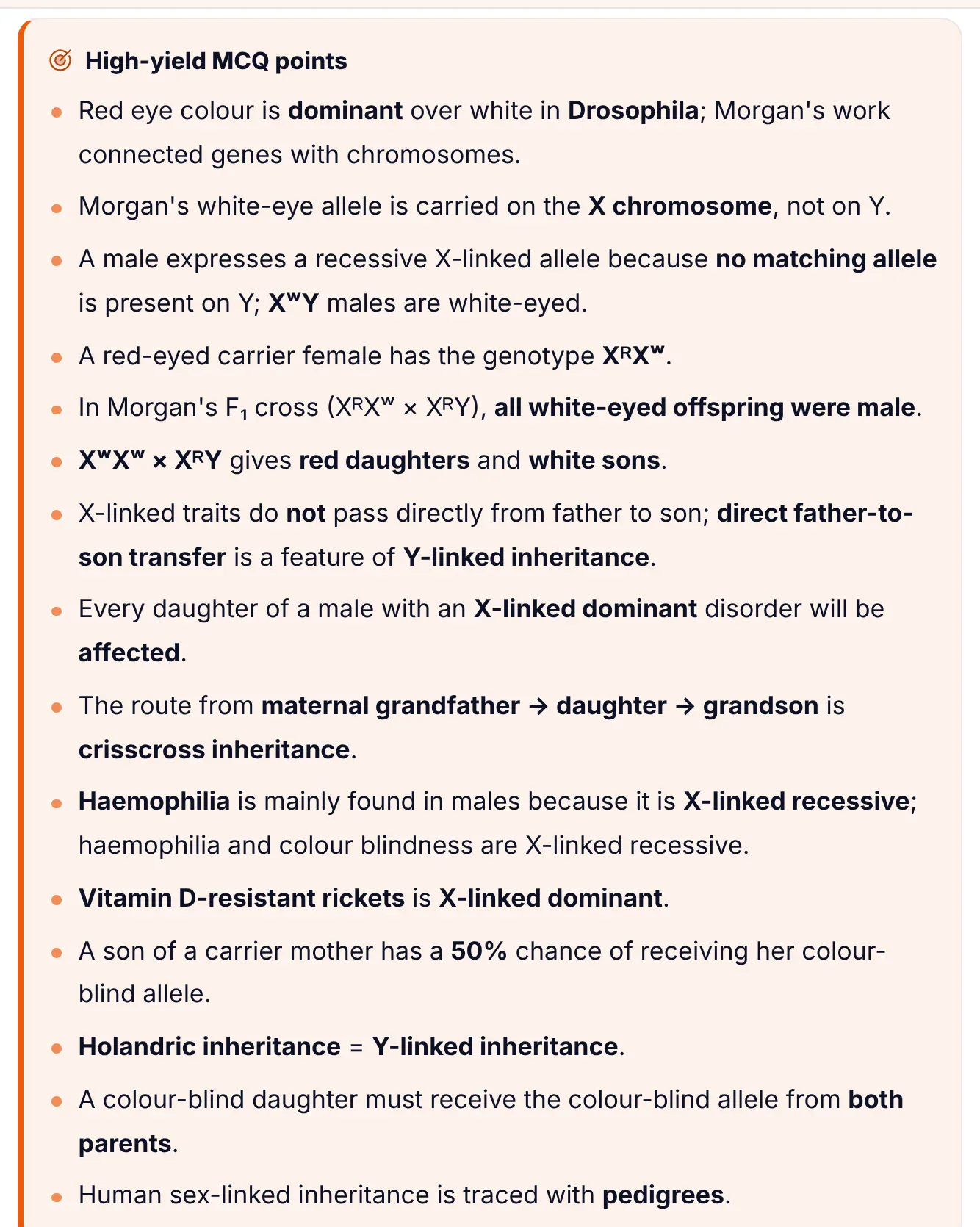
The Inheritance chapter of ePrepare's Biology conceptual notes has a full sex linkage lesson: Morgan's four fruit-fly crosses with Punnett squares, haemophilia crosses worked out, colour blindness, X-linked dominant and Y-linked patterns, pedigree symbols with a drawn three-generation pedigree, memory tricks, common mistakes and 15 practice MCQs with explanations. The lesson ends with the high-yield box below.
See how the notes are organised in ePrepare's MDCAT conceptual notes, and why Inheritance deserves extra time in MDCAT Biology high-yield chapters. Next, try the other genetics patterns in incomplete dominance vs codominance. If you keep getting cross questions wrong, Wrong MCQs smart revision brings them back until they stick.
Quick revision table
| Cross or idea | Result |
|---|---|
| XHXh × XHY | Sons 1/2 affected; daughters 1/2 carriers; any child 1/4 affected |
| XHXH × XhY | All daughters carriers; all sons normal |
| XHXh × XhY | Half of daughters and half of sons affected |
| XhXh × XHY | All sons affected; all daughters carriers |
| Hemizygous | Male: one copy of each X-linked gene |
| Criss-cross | Maternal grandfather → daughter → grandson |
| Y-linked (holandric) | Only males; father → all sons |
| X-linked dominant | Vitamin D-resistant rickets; affected father → all daughters |
| Morgan | Drosophila; white eye recessive, on the X |
یاد رکھنے کی بات: لڑکے کو X ہمیشہ ماں سے ملتا ہے اور باپ سے Y۔ اس لیے haemophilia یا colour blindness باپ سے بیٹے میں نہیں جاتی۔ Carrier ماں کے بیٹوں میں 50% chance ہے کہ وہ affected ہوں، اور affected باپ کی سب بیٹیاں carrier ہوتی ہیں۔ بیٹی تب ہی affected ہو گی جب باپ affected ہو اور ماں کم از کم carrier ہو۔ Y-linked trait صرف لڑکوں میں ہوتا ہے اور باپ سے ہر بیٹے میں جاتا ہے۔
Frequently asked questions
Why is haemophilia more common in males?
Haemophilia is X-linked recessive. A male has one X, so a single recessive allele makes him haemophilic. A female needs two copies, one from each parent, and usually has a normal allele that masks it.
Can a girl be haemophilic or colour-blind?
Yes, but it is rare. Her father must be affected and her mother must be at least a carrier, as in the cross XHXh × XhY.
What is the difference between sex-linked and Y-linked inheritance?
Sex-linked is the general term for genes on either sex chromosome. Most are X-linked. Y-linked (holandric) is the special case of genes on the Y, which pass only from father to son.
What does carrier mean in genetics?
A carrier has one recessive allele that she does not show, such as XHXh. She can pass it on: each of her children has a 50% chance of receiving it.
How do I know whether a question is asking about sons or all children?
Look at the subject of the question. "Probability that their son is affected" means count only the sons (1/2 in a carrier × normal cross). "Probability that a child is an affected son" counts all four boxes (1/4).
Is sex linkage in the MDCAT syllabus?
Yes. It is part of the Inheritance chapter of Biology, along with Mendel's laws, linkage and crossing over. Check the full list on the MDCAT syllabus page.