"Pink flowers or AB blood?" is the quickest way to tell incomplete dominance from codominance, and MDCAT tests the difference every year in some form. Both patterns break Mendel's simple rule that one allele hides the other, and both give the same 1:2:1 ratio in F2. That is exactly why students mix them up. This guide sets them side by side with complete dominance, works through the crosses, and gives you practice MCQs.
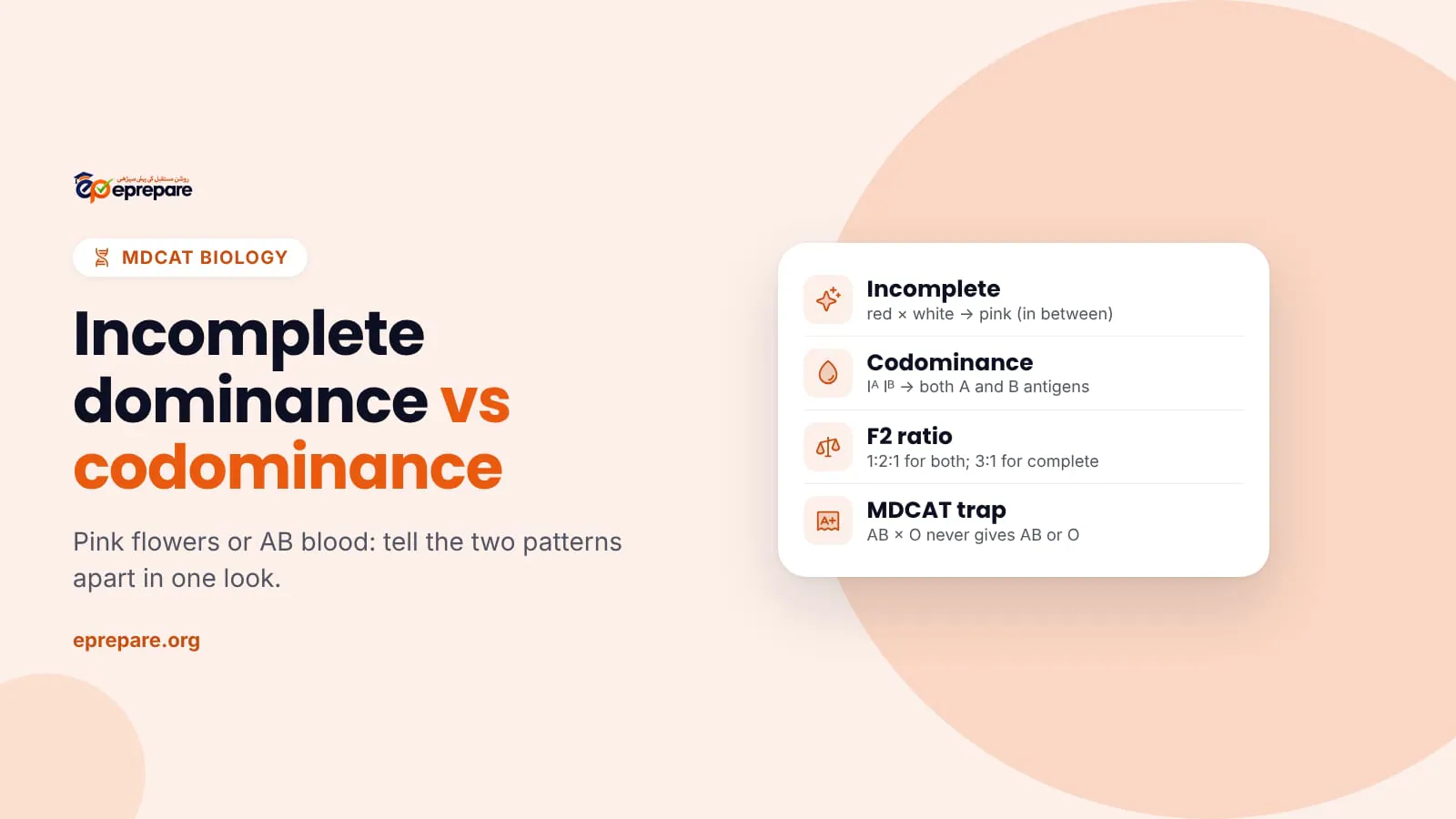
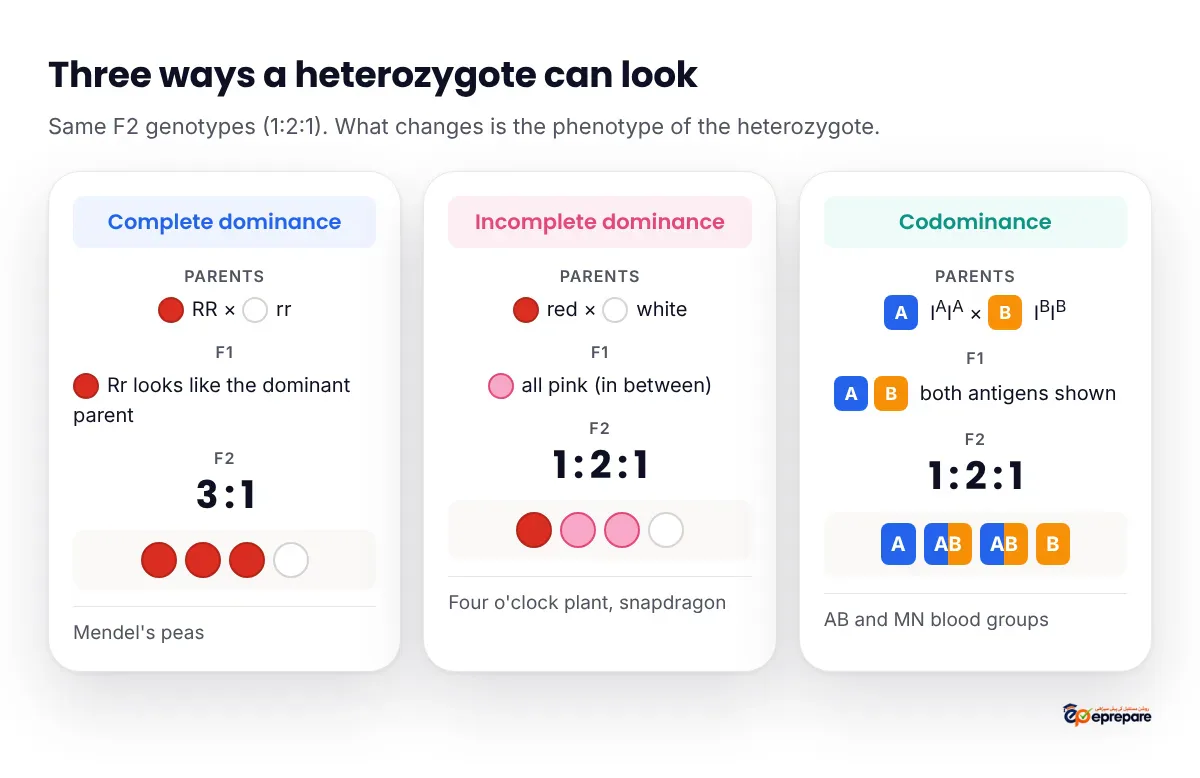
The short answer: in incomplete dominance, neither allele is fully dominant, so the heterozygote shows an intermediate phenotype: red × white four o'clock (or snapdragon) flowers give pink. In codominance, both alleles are fully expressed together in the heterozygote: a person with IAIB has both A and B antigens (blood group AB). In both cases the F2 phenotypic ratio is 1:2:1, the same as the genotypic ratio, instead of the 3:1 of complete dominance.
Start with complete dominance (Mendel's pattern)
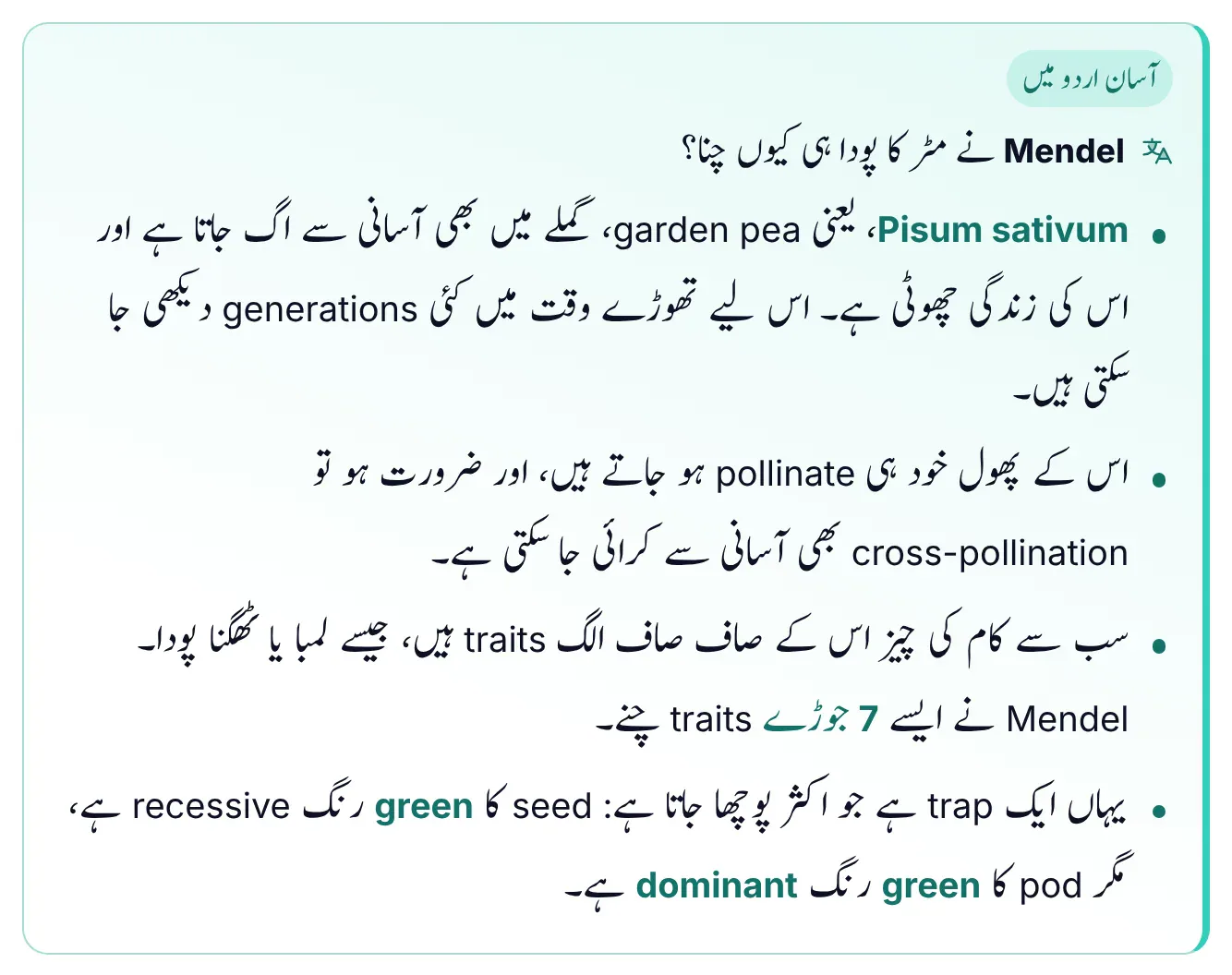
Mendel worked on the garden pea, Pisum sativum. In his seed-shape cross, round (RR) × wrinkled (rr) gave all round (Rr) plants in F1. Selfing the F1 gave:
- Genotypic ratio: 1 RR : 2 Rr : 1 rr
- Phenotypic ratio: 3 round : 1 wrinkled
The phenotypic ratio is 3:1 because RR and Rr look the same: one dominant allele is enough to give the full dominant phenotype. This is complete dominance, and it is the law of dominance Mendel described.
Incomplete dominance and codominance are the two main exceptions. In both, the heterozygote looks different from both homozygotes, so all three genotypes can be seen. That is why the phenotypic ratio becomes 1:2:1.
Incomplete dominance: the blended-looking heterozygote
In incomplete dominance, one allele is not completely dominant over the other. The heterozygote shows a phenotype in between the two parents.
The classic example: four o'clock plant and snapdragon
Flower colour in the four o'clock plant (Mirabilis jalapa) and the snapdragon (Antirrhinum majus) is the standard FSc example. Because neither allele is recessive, it is clearer to write them as CR (red) and CW (white). Some books simply write RR for red, rr for white and Rr for pink; the result is the same.
Cross 1: P generation red (CRCR) × white (CWCW)
- Gametes: CR and CW
- F1: all CRCW, pink
Cross 2: F1 × F1 pink (CRCW) × pink (CRCW)
| Gametes | CR | CW |
|---|---|---|
| CR | CRCR red | CRCW pink |
| CW | CRCW pink | CWCW white |
F2: 1 red : 2 pink : 1 white. Genotypic and phenotypic ratios are the same, so you can tell every genotype just by looking at the flower.
Why this is not "blending"
Pink looks like red paint mixed with white paint, but the alleles have not mixed. The proof is in F2: pure red and pure white flowers reappear. If the alleles had blended, pink × pink could only ever give pink. The alleles keep their identity and separate in gamete formation, exactly as Mendel's law of segregation says. Only the phenotype of the heterozygote is intermediate.
Two more crosses MDCAT likes
- Pink × white (CRCW × CWCW) → 1 pink : 1 white.
- Pink × red (CRCW × CRCR) → 1 red : 1 pink.
Codominance: both alleles show fully
In codominance, both alleles are expressed fully and at the same time in the heterozygote. There is no intermediate. You see both parental characters side by side.
Example 1: AB blood group
The ABO blood group is controlled by one gene with three alleles: IA, IB and i. IA makes antigen A on red blood cells, IB makes antigen B, and i makes neither.
- IA and IB are each dominant over i (complete dominance).
- IA and IB are codominant with each other: an IAIB person makes both A and B antigens and has blood group AB.
- Because the gene has more than two alleles in the population, ABO is also an example of multiple alleles: 3 alleles give 6 genotypes and 4 phenotypes.
| Blood group | Genotype(s) | Antigen on red cells |
|---|---|---|
| A | IAIA or IAi | A |
| B | IBIB or IBi | B |
| AB | IAIB | A and B (codominance) |
| O | ii | Neither |
Example 2: MN blood group
The MN blood group has two alleles, LM and LN. LMLM people have M antigen, LNLN have N antigen, and LMLN people have both (blood group MN). This is a neat two-allele example of codominance.
Example 3: roan cattle
Roan coat colour in cattle is often quoted as codominance: a cross of red and white cattle gives roan offspring that have red hairs and white hairs growing side by side, not pink hairs. Some older books describe roan as incomplete dominance, so if it appears in an MCQ, read the options carefully. The blood group examples are the safest to remember.
Worked codominance crosses
Cross 1: AB × AB (IAIB × IAIB)
| Gametes | IA | IB |
|---|---|---|
| IA | IAIA group A | IAIB group AB |
| IB | IAIB group AB | IBIB group B |
Result: 1 A : 2 AB : 1 B, the same 1:2:1 pattern as incomplete dominance. No child can be group O, because neither parent has i.
Cross 2: heterozygous A × heterozygous B (IAi × IBi)
| Gametes | IB | i |
|---|---|---|
| IA | IAIB group AB | IAi group A |
| i | IBi group B | ii group O |
Result: 1 AB : 1 A : 1 B : 1 O. This is a favourite MDCAT question: parents of groups A and B can have a child of any of the four blood groups, each with a 25% chance.
Cross 3: AB × O (IAIB × ii)
Gametes: IA or IB from one parent, only i from the other. Children: IAi (group A) and IBi (group B) in a 1:1 ratio. They can be neither AB nor O. MDCAT often asks this one as "which blood group is not possible?"
Cross 4: MN × MN
LMLN × LMLN gives 1 M : 2 MN : 1 N.
Incomplete dominance vs codominance vs complete dominance
| Feature | Complete dominance | Incomplete dominance | Codominance |
|---|---|---|---|
| Heterozygote looks like | The dominant parent | Intermediate between parents | Both parents at once |
| Is either allele hidden? | Yes, the recessive one | No, but each is only partly expressed | No, both fully expressed |
| F2 phenotypic ratio | 3:1 | 1:2:1 | 1:2:1 |
| F2 genotypic ratio | 1:2:1 | 1:2:1 | 1:2:1 |
| Can you read genotype from phenotype? | Not for the dominant phenotype (RR or Rr) | Yes | Yes |
| Examples | Mendel's peas: round/wrinkled, tall/dwarf | Four o'clock and snapdragon flower colour | AB blood group, MN blood group, roan cattle |
| Picture it as | One colour covers the other | Red + white → pink | Red and white spots side by side |
Remember this: In-complete = in-between (pink). Co-dominance = co-operation, both show (AB). Same F2 ratio (1:2:1), different heterozygote.
How MDCAT asks about these patterns
- Identify the pattern from a description: "The heterozygote shows both parental phenotypes" → codominance. "The heterozygote is intermediate" → incomplete dominance.
- Give the F2 ratio: red × white snapdragons, F2 phenotypic ratio? (1:2:1). Watch for an option of 3:1, which is the complete-dominance trap.
- Blood group possibilities: which blood group is impossible in the children of AB × O? (AB and O).
- Combine with multiple alleles: how many genotypes and phenotypes does the ABO system have? (6 and 4).
- Test the blending idea: "Reappearance of red and white in F2 shows that…" (alleles do not blend).
Common mistakes
- "Incomplete dominance is blending inheritance." Wrong. Only the heterozygote's phenotype is intermediate; the alleles stay separate and red and white come back in F2.
- "Codominance gives a 3:1 ratio." Wrong. Both incomplete dominance and codominance give 1:2:1 phenotypically in a monohybrid F2.
- "AB blood group is incomplete dominance." Wrong. AB people make both antigens fully; nothing is intermediate.
- "IA is codominant with i." Wrong. IA and IB are codominant with each other; each is completely dominant over i.
- Writing pink as Rr and then calling r "recessive". If you use Rr, remember r is not recessive here; that is why CRCW notation is clearer.
- Forgetting that AB × O can never give AB or O children. Each child gets IA or IB plus i.
MDCAT-style practice MCQs
1. When red-flowered and white-flowered four o'clock plants are crossed, all F1 plants have pink flowers. This is an example of:
A. Complete dominance
B. Codominance
C. Incomplete dominance
D. Multiple alleles
Show answer
C. The heterozygote is intermediate (pink) between the two parents, which is incomplete dominance.
2. The F2 phenotypic ratio of a monohybrid cross showing incomplete dominance is:
A. 3:1
B. 1:2:1
C. 9:3:3:1
D. 1:1
Show answer
B. The heterozygote has its own phenotype, so the phenotypic ratio equals the genotypic ratio, 1:2:1.
3. A person with blood group AB has the genotype IAIB. The relationship between IA and IB is:
A. IA dominant over IB
B. Incomplete dominance
C. Codominance
D. IB recessive to IA
Show answer
C. Both A and B antigens are made fully on the same red cells, so the alleles are codominant.
4. A man of blood group AB marries a woman of blood group O. Which blood groups are NOT possible in their children?
A. A and B
B. AB and O
C. A and O
D. B and AB
Show answer
B. Every child gets i from the mother and IA or IB from the father, so children can only be A (IAi) or B (IBi).
5. Parents with genotypes IAi and IBi have a child. The probability that the child has blood group O is:
A. 0
B. 1/4
C. 1/2
D. 3/4
Show answer
B. The cross gives 1 AB : 1 A : 1 B : 1 O, so the chance of ii is 1 in 4.
6. A pink snapdragon is crossed with a white snapdragon. The expected offspring are:
A. All pink
B. 1 red : 2 pink : 1 white
C. 1 pink : 1 white
D. 3 pink : 1 white
Show answer
C. CRCW × CWCW gives half CRCW (pink) and half CWCW (white).
7. The reappearance of red and white flowers in the F2 of a red × white snapdragon cross shows that:
A. The alleles blended in F1
B. Red is completely dominant
C. The alleles kept their identity and segregated
D. A mutation occurred in F1
Show answer
C. If the alleles had blended, pink × pink could give only pink; the return of both parental colours shows segregation.
8. How many genotypes and phenotypes are possible for the ABO blood group system?
A. 3 genotypes, 3 phenotypes
B. 4 genotypes, 4 phenotypes
C. 6 genotypes, 4 phenotypes
D. 6 genotypes, 6 phenotypes
Show answer
C. Three alleles give 6 genotypes (IAIA, IAi, IBIB, IBi, IAIB, ii) but only 4 blood groups (A, B, AB, O).
What ePrepare's notes cover for this topic
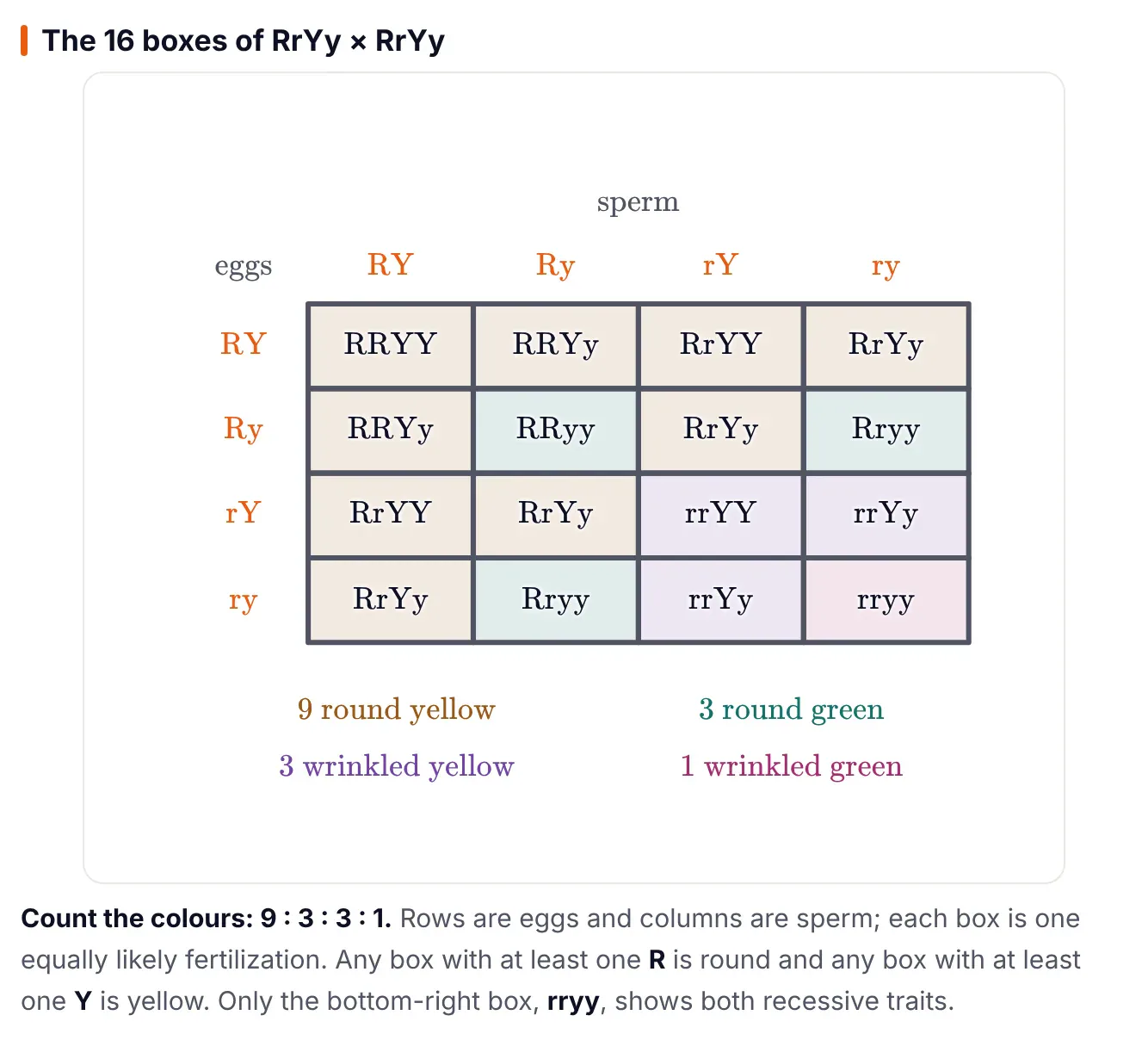
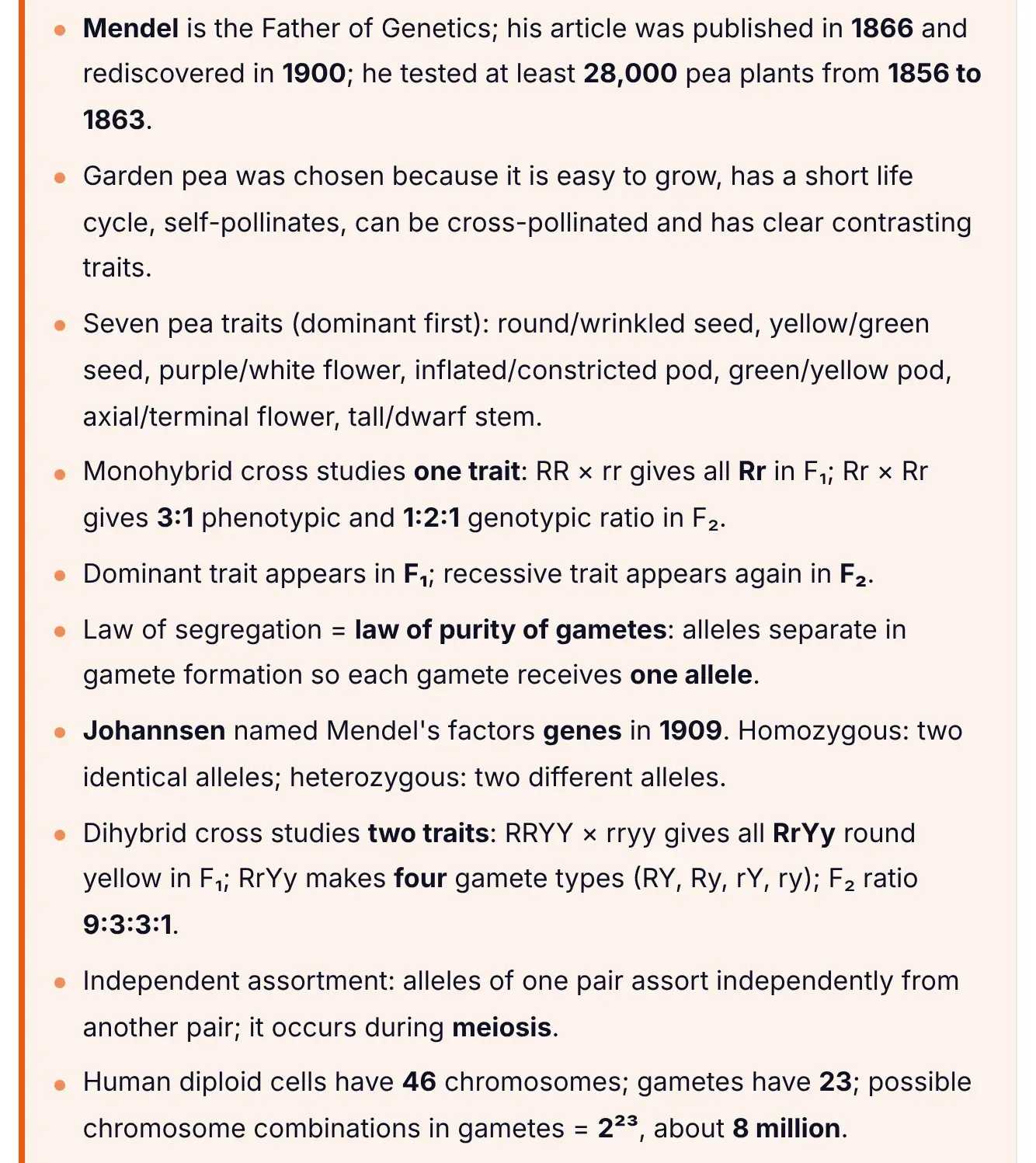
ePrepare's Biology conceptual notes cover the base you need for these questions in the Inheritance chapter: Mendel's experiments, his laws of dominance, segregation and independent assortment, monohybrid and dihybrid crosses with Punnett squares, and probability rules. Incomplete dominance and codominance are not separate lessons in the notes, so use this post for them and the notes for the Mendelian groundwork they build on.
Read how the notes work in ePrepare's MDCAT conceptual notes, and see why Inheritance is worth the effort in MDCAT Biology high-yield chapters. For the other big genetics pattern, go to sex-linked inheritance MCQs. To drill the topic under time pressure, build a chapter test with the Quiz Builder.
Quick revision table
| Point | Remember |
|---|---|
| Complete dominance | Heterozygote = dominant parent; F2 3:1 |
| Incomplete dominance | Heterozygote intermediate; F2 1:2:1 |
| Codominance | Both alleles fully shown; F2 1:2:1 |
| Incomplete example | Four o'clock (Mirabilis) and snapdragon: red × white → pink |
| Codominance examples | AB blood group (IAIB), MN blood group, roan cattle |
| ABO alleles | IA, IB codominant; both dominant over i; 6 genotypes, 4 phenotypes |
| IAi × IBi | 1 AB : 1 A : 1 B : 1 O |
| AB × O | 1 A : 1 B; no AB, no O |
| Not blending | Parental types reappear in F2 |
آسان الفاظ میں: incomplete dominance میں کوئی allele پوری طرح dominant نہیں ہوتا، اس لیے heterozygote درمیان والا رنگ دکھاتا ہے، جیسے red اور white سے pink پھول۔ Codominance میں دونوں alleles ایک ساتھ پوری طرح نظر آتے ہیں، جیسے AB blood group میں A اور B دونوں antigens۔ دونوں میں F2 کا ratio 1:2:1 ہوتا ہے، جبکہ complete dominance میں 3:1۔
Frequently asked questions
What is the main difference between incomplete dominance and codominance?
In incomplete dominance the heterozygote is a mix in between the parents (pink from red and white). In codominance the heterozygote shows both parental traits fully at the same time (both A and B antigens in group AB).
Why is the F2 ratio 1:2:1 in both?
Because in both patterns the heterozygote looks different from either homozygote. Each genotype has its own phenotype, so the phenotypic ratio is the same as the genotypic ratio, 1:2:1.
Is the AB blood group codominance or multiple alleles?
Both. The ABO gene has three alleles in the population (multiple alleles), and two of them, IA and IB, are codominant with each other in an AB person.
Is incomplete dominance the same as blending inheritance?
No. The heterozygote looks blended, but the alleles stay separate. Red and white flowers reappear in F2, which could not happen if the alleles had truly mixed.
What are the standard examples for MDCAT?
Incomplete dominance: flower colour in the four o'clock plant and snapdragon. Codominance: the AB blood group and the MN blood group. Roan cattle is also quoted for codominance.
Which chapter are these in for MDCAT?
They are part of the Inheritance chapter of Biology, with Mendel's laws, sex linkage, and linkage and crossing over. See the full MDCAT syllabus guide.