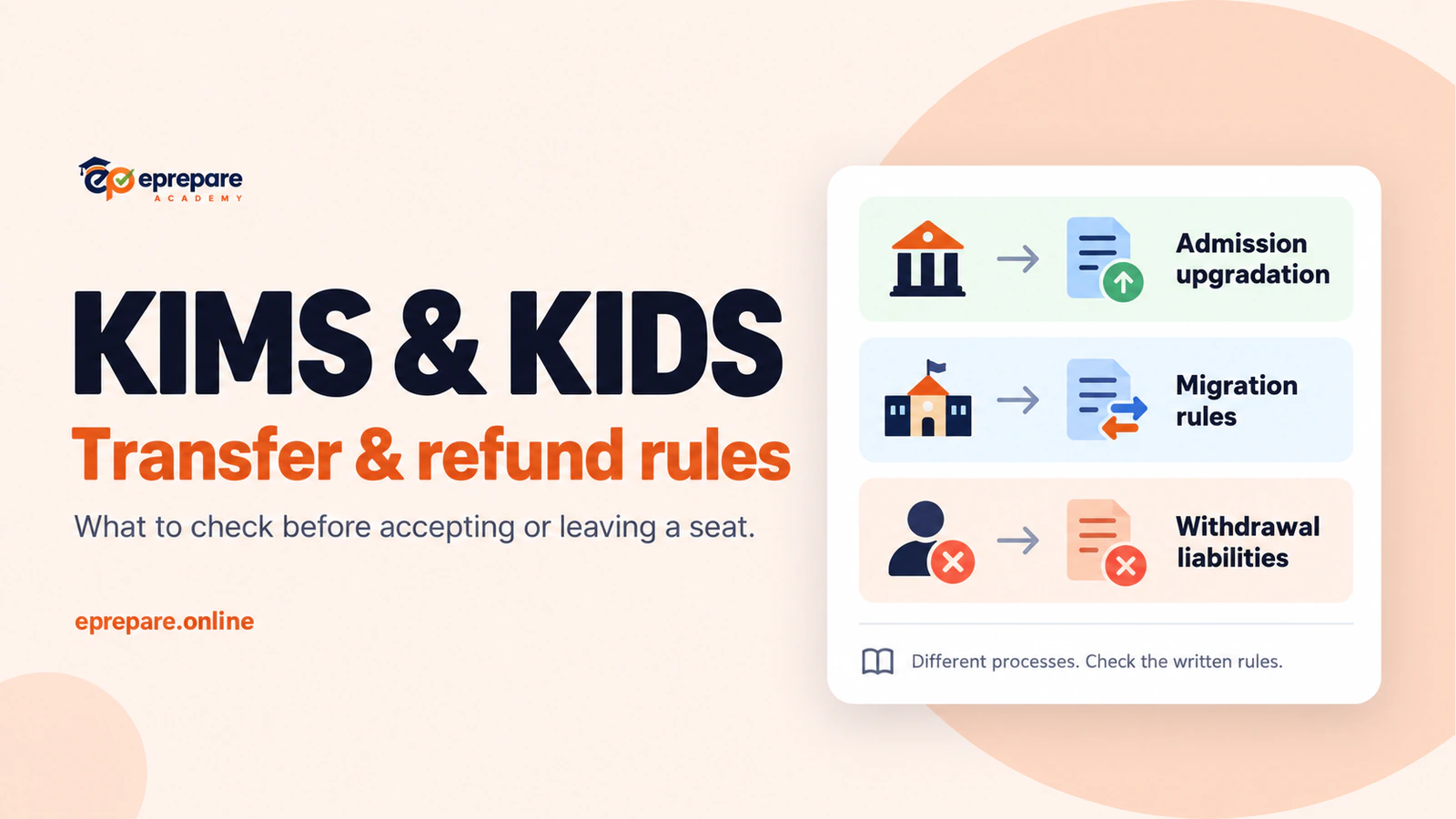
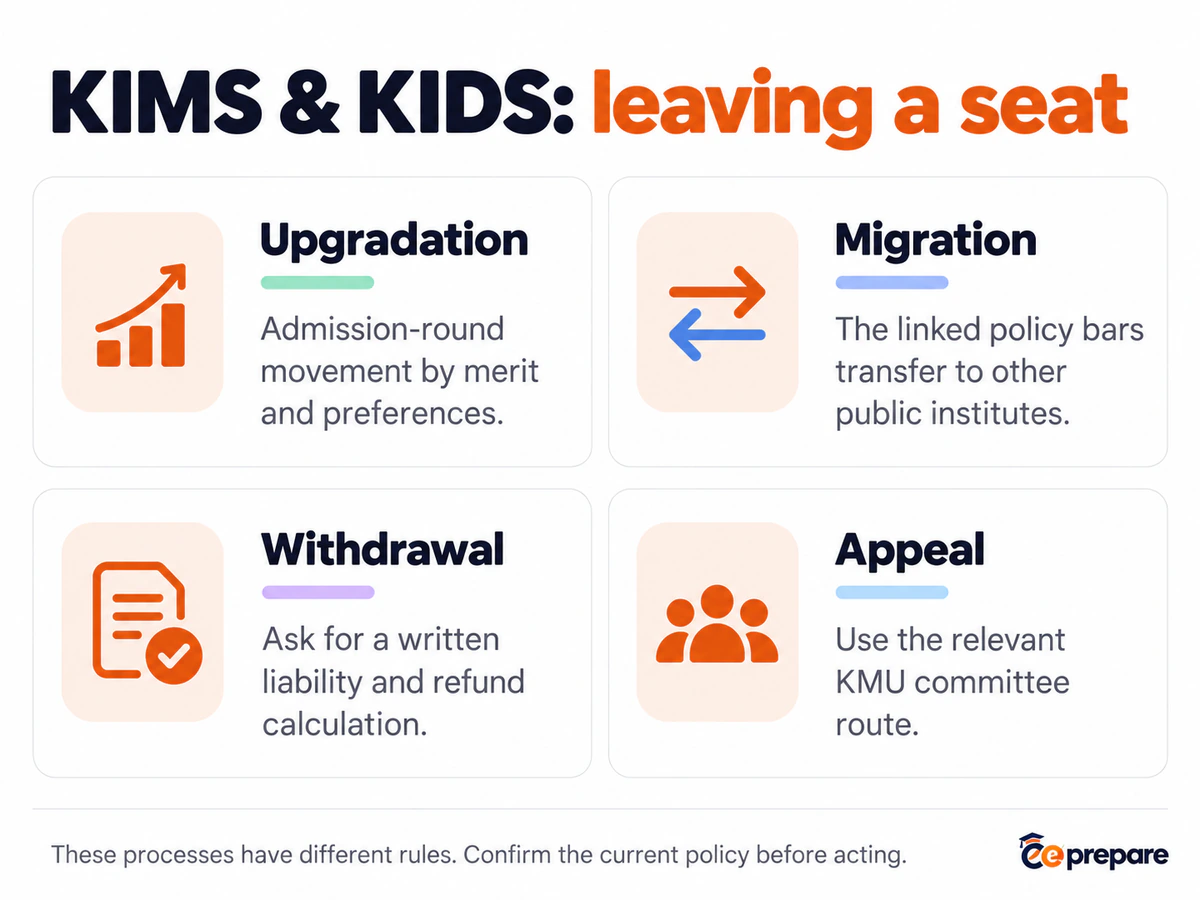
Upgradation, migration and withdrawal are different decisions. The linked KIMS/KIDS policy gives them different treatment, and it contains an institute-specific restriction on migration to other public-sector institutes.
Read these rules before accepting a place you intend to leave later. A higher preference during the admission rounds is not the same as moving colleges after enrolment, and a request to withdraw does not establish a right to a full refund.
Policy-based reference: this guide explains an earlier edition of the linked KMU policy. Figures and conditions are not independently verified as current. Check the latest KMU notice and written fee demand before applying or paying.
The distinction that prevents expensive assumptions
| Process | What it means here | Source treatment |
|---|---|---|
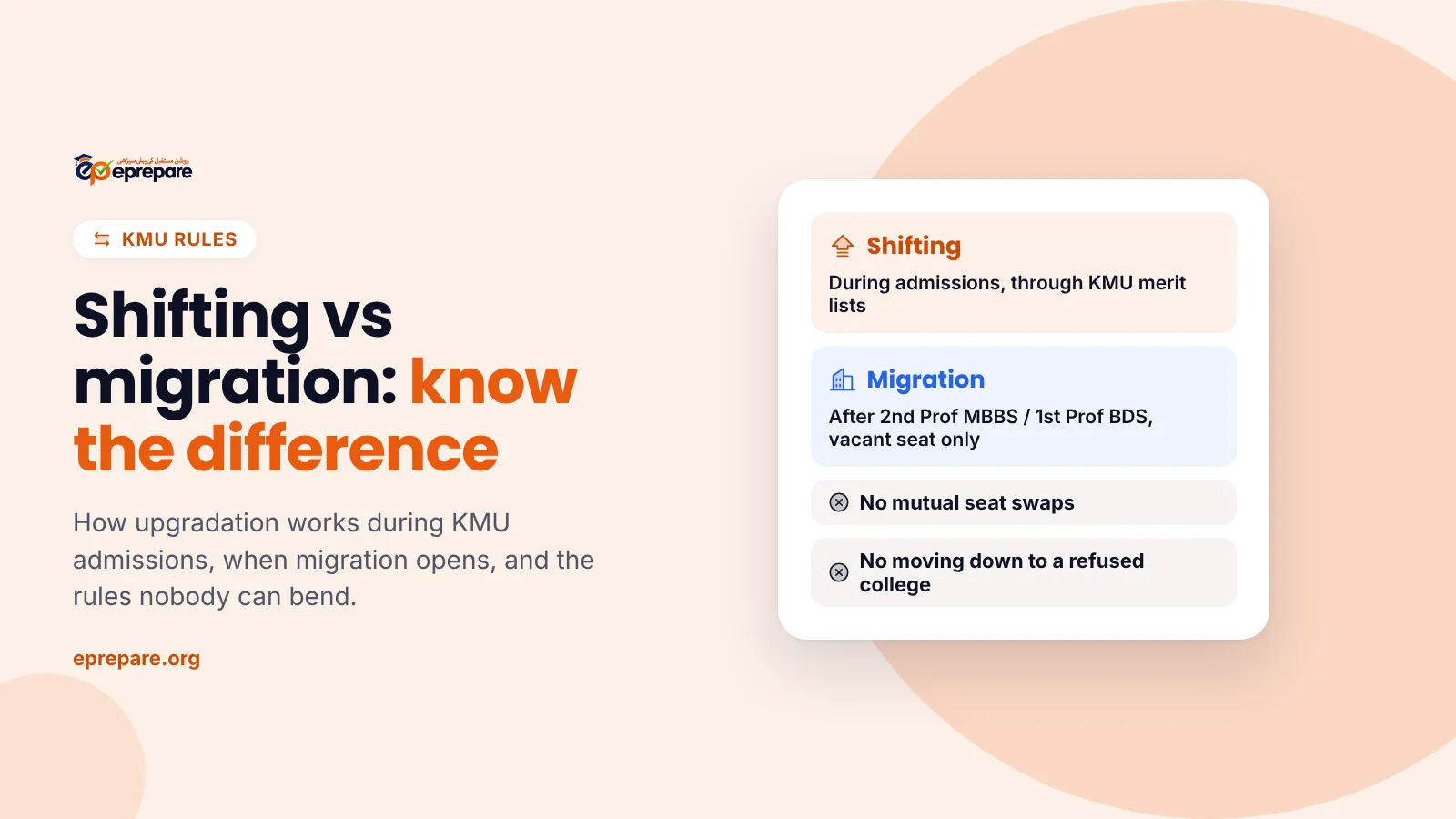
| Admission-round upgradation | Movement through the central placement process according to merit and preferences | Discussed under vacancy/merit-list rules, including transfer of deposited fees for upgraded candidates. |
| Migration after admission | A move from one enrolled institute to another | The KIMS/KIDS-specific clause says migration to other public-sector institutes is not allowed. |
| Withdrawal or resignation | Leaving the accepted place | The policy describes prescribed penalties, non-refund situations and undertakings. |
| Board migration certificate | An educational-board document submitted at admission | A document requirement, not an approval for later college-to-college migration. |
What the KIMS/KIDS migration clause says
The institute-specific migration section explains that KIMS and KIDS are KMU constituent institutes and states that migration from them to other public-sector institutes is not allowed. That is the relevant clause to read before accepting a place as a temporary route to another public college.
The document also has a general provision about leaving for a college in another province or country before the admission closing date, with conditions. Do not assume that general paragraph cancels the specific KIMS/KIDS restriction. Obtain the currently applicable written position for your case before acting.
This guide explains the linked policy; it does not issue a legal determination about a later rule, court order or individual entitlement.
Upgradation within the admission process
The general rules describe filling vacancies on merit-cum-choice and upgrading admitted candidates according to preferences. They say a fee deposited by an upgraded candidate transfers to the new institution without deduction.
That is an admission-round process governed by the placement authority. It should not be treated as a promise that you can independently arrange a transfer after enrolment. Check the notice, the category of the new offer and any fee difference.
The policy also warns against assuming a previously refused institution remains available later. Plan your preference list and offer decisions with the application guide.
Withdrawal, non-refund wording and the prescribed penalty
The source says an admitted student who resigns or withdraws must pay the prescribed penalty before leaving. Elsewhere it states that admission fees and other dues are not refunded in specified situations, including forged-document cancellation, expulsion/removal and voluntary discontinuation.
The general paragraph about leaving for another province or country also refers to non-refund of paid fees, recovery of scholarship amounts and enforcement of financial undertakings. These provisions should be read together, not reduced to “withdraw whenever you want and get everything back”.
| Question | Why it matters |
|---|---|
| Which process is being recorded? | Upgradation, migration, resignation and cancellation have different rules. |
| Which current clause or undertaking applies? | Identify the actual authority, document and circumstances. |
| What paid amounts are refundable, non-refundable or transferable? | Do not assume tuition, institutional charges and deposits receive identical treatment. |
| Is a penalty or scholarship recovery payable? | Ask for the amount, basis and calculation in writing. |
| How will originals and other records be released? | The policy says the college retains original documents until leaving; complete the official release process. |
The guardian undertaking is not a universal flat withdrawal fee
The appendix contains a guardian undertaking referring to PKR 100,000 per academic year of study in the stated case of breach of the undertaking. It does not establish that every possible withdrawal automatically has one flat charge of that amount.
Read the actual signed undertaking and the current prescribed withdrawal rule. Ask which clause is being invoked and how any liability is calculated. Do not multiply an appendix amount across an assumed course length without confirmation.
The policy separately describes a financial condition for a candidate who previously used a KMU-ward reserved seat and seeks another chance while changing discipline. That category-specific issue should not be presented as a rule for every ordinary applicant.
Attendance, document verification and provisional admission
Admissions in the source are provisional and subject to verification. Incorrect or forged information can lead to cancellation and other action under the stated rules; payment alone does not make an ineligible application valid.
The document also says continuous absence from the beginning of the session for four weeks without a valid reason can lead to removal from the college roll and replacement from the waiting list. If an issue prevents reporting, contact the college through the official process promptly rather than assuming silence preserves the seat.
Complaints and appeals
The general provisions describe KMU-AC decisions, an appellate KMU committee and review before the Chairman PAC, with a short working-day period in the stated final-selection context. Merged Districts matters and medical-board decisions have their own described routes.
Use the committee and deadline relevant to the decision you are challenging. An academic, medical-board or nomination issue should not be sent to an unrelated office simply because it has “admission” in its name. Obtain the current procedure and keep a record of submission.
Frequently asked questions
Can I accept KIMS or KIDS and later migrate to another public college?
The linked policy’s institute-specific clause says that migration to other public-sector institutes is not allowed. Confirm the currently applicable position before treating a seat as a temporary arrangement.
Is upgradation the same as migration?
No. Upgradation is discussed as part of the admission-round merit-and-preference process. Later migration is covered by a separate restrictive clause.
Will I receive a full refund if I resign?
Do not assume so. The policy contains non-refund provisions, prescribed penalties and undertaking-related liabilities. Ask for the current written calculation for your case.
Is the appendix amount the withdrawal fee for everyone?
No. The undertaking describes a stated breach-related liability. The withdrawal clause refers to the prescribed penalty; it does not make every case identical.
Can paying the fee protect a place obtained with incorrect documents?
No. The source makes admission provisional and subject to verification, and it describes cancellation for ineligibility or false evidence.
Related KIMS and KIDS guides
- How to apply to KIMS and KIDS: documents, preferences and merit-list steps
- KIMS & KIDS fees: KIMS MBBS open-merit and self-finance breakdown
- KIMS & KIDS fees: KIDS BDS open-merit and self-finance breakdown
Official source
KMU admission policy for KIMS and KIDS. Relevant physical PDF pages: PDF page 5 · PDF page 6 · PDF page 7 · PDF page 12 · PDF page 15 · PDF page 17 · PDF page 18 · PDF page 21.
This is an independent explanatory guide based on the supplied policy edition, not an official admission notice, a current fee demand or an admission guarantee. Check the latest official instructions for changes.