

The mole is the one idea that ties almost every Chemistry numerical in MDCAT together. Once you can move confidently between grams, moles and particles, questions on molar mass, percentage composition, isotopes and empirical formulas become short, predictable calculations. This guide answers the questions students search for most, such as the molar mass of NaCl, the mass of one mole of copper atoms and the mass of a proton in amu, and then works through each method step by step.
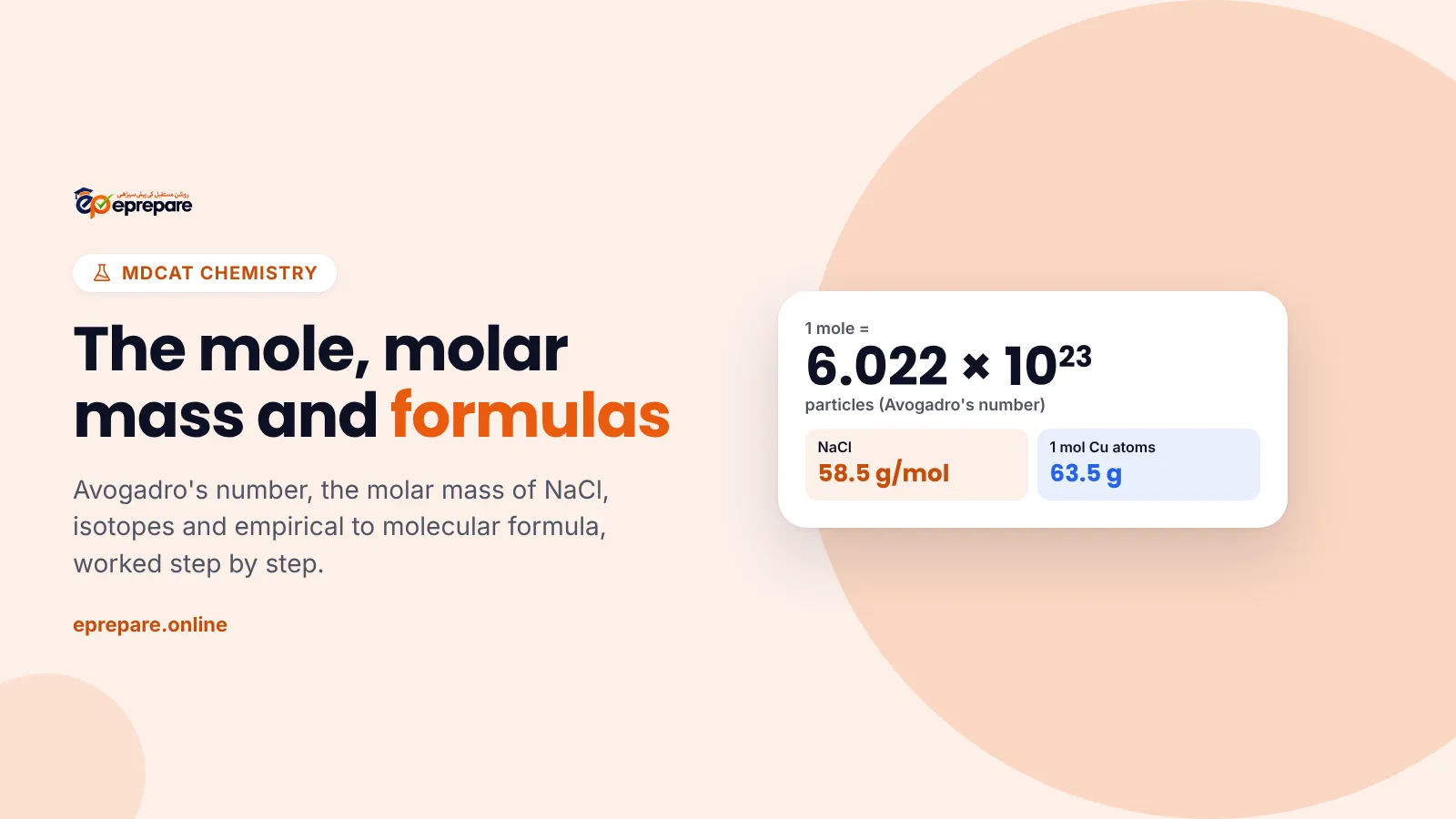
The short answer: one mole is 6.022 × 10²³ particles (Avogadro's number). The molar mass of NaCl is 58.5 g/mol (23 + 35.5), and one mole of copper atoms weighs 63.5 g. To get a molecular formula, divide the molar mass by the empirical formula mass and multiply every subscript in the empirical formula by that whole number.
What is a mole?
A mole is the amount of substance that contains exactly 6.02214076 × 10²³ elementary entities: atoms, molecules, ions or formula units. That number is the Avogadro constant (NA), usually written 6.022 × 10²³ mol−1 in calculations. Since 2019 it has been an exact, defined value in the SI system.
Think of the mole as a chemist's "dozen". A dozen eggs is 12 eggs; a mole of carbon atoms is 6.022 × 10²³ carbon atoms. Atoms are so small that we need a counting unit this large to deal with amounts we can weigh on a balance.
Two formulas carry almost every mole question:
Moles (n) = mass (m) ÷ molar mass (M) and Number of particles (N) = n × NA
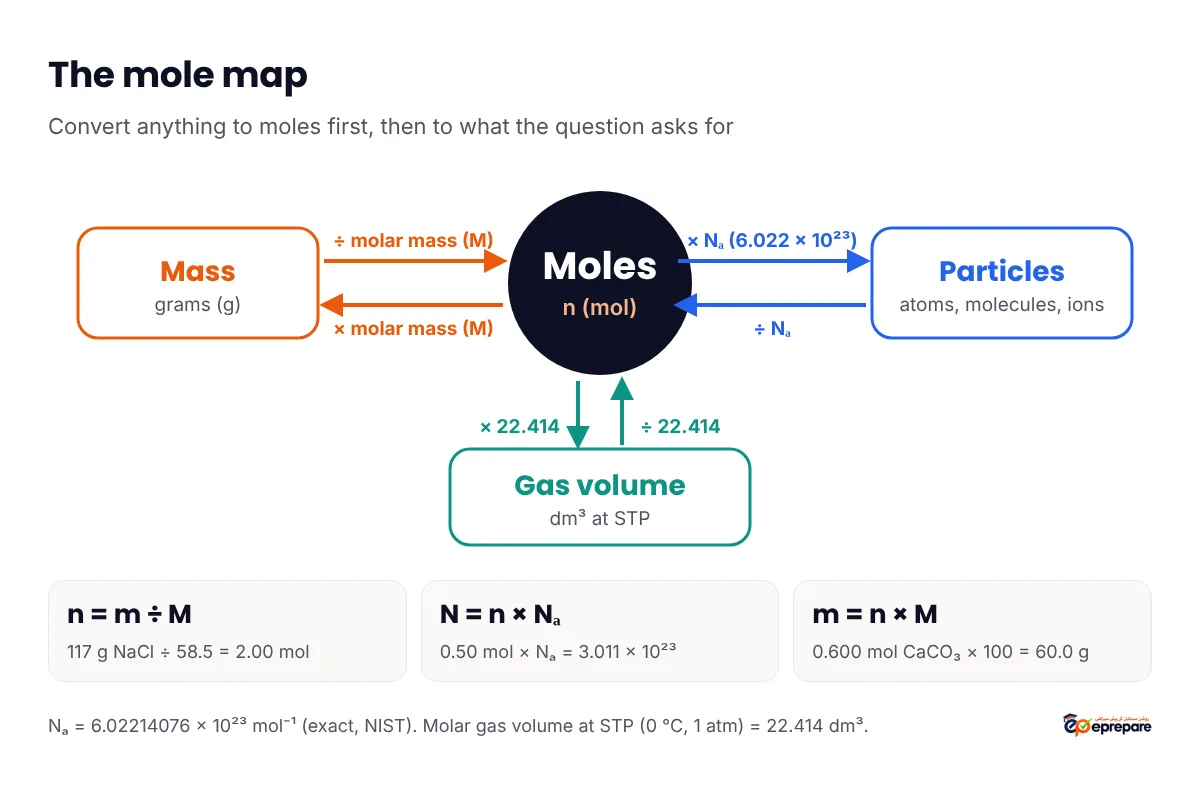
For gases there is a third route: one mole of any ideal gas occupies 22.414 dm3 at STP (0 °C and 1 atm), which most MDCAT questions round to 22.4 dm3.
The atomic mass unit and the masses of the proton, neutron and electron
Atoms are far too light to weigh in grams, so chemists use the atomic mass unit (amu, written u or Da). One atomic mass unit is defined as one-twelfth of the mass of one carbon-12 atom, which is 1.66054 × 10⁻²⁷ kg.
| Particle | Charge | Mass (amu) | Relative mass |
|---|---|---|---|
| Proton (p) | +1 (1.602 × 10⁻¹⁹ C) | 1.007276 | 1 |
| Neutron (n) | 0 | 1.008665 | 1 |
| Electron (e) | −1 (1.602 × 10⁻¹⁹ C) | 0.000549 (5.486 × 10⁻⁴) | 1/1836 |
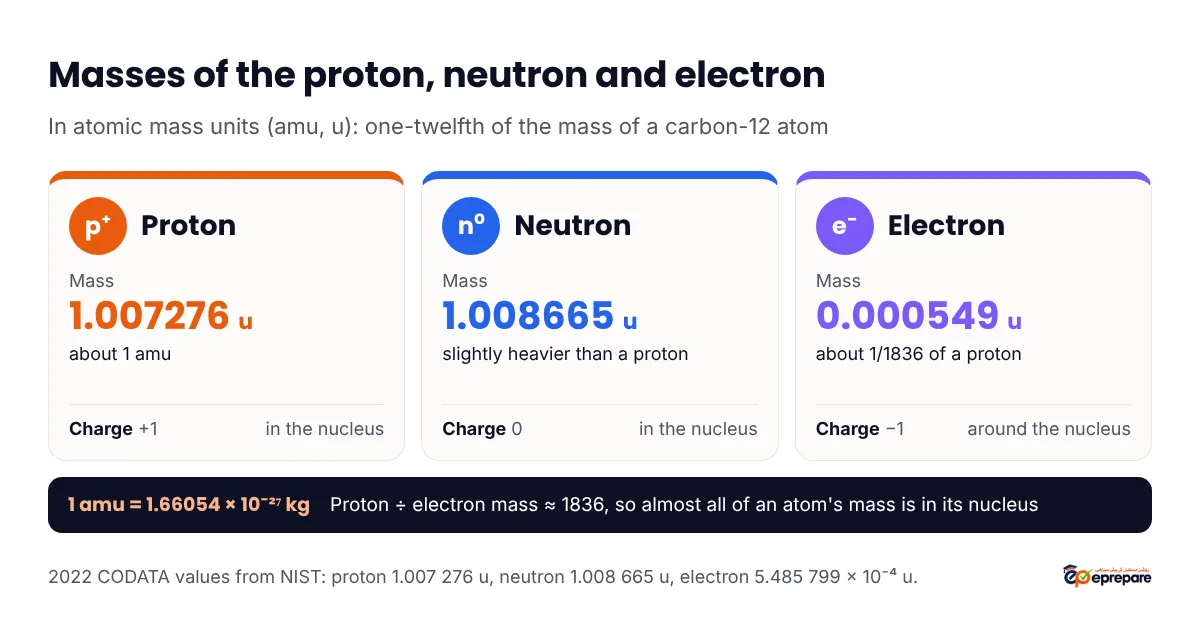
- Mass of a proton in amu: 1.007276 u, about 1 u.
- Mass of a neutron in amu: 1.008665 u, about 1 u. The neutron is very slightly heavier than the proton, a favourite one-line MCQ.
- Mass of an electron in amu: 0.000549 u. The proton is about 1836 times heavier, which is why an atom's mass is almost all in its nucleus.
The relative atomic mass (Ar) of an element is the average mass of its atoms compared with one-twelfth of the mass of a carbon-12 atom. Because it is a ratio, it has no unit. For example, Ar of copper is 63.546, often rounded to 63.5.
Molar mass: what it is and how to calculate it
The molar mass (M) is the mass of one mole of a substance, in grams per mole (g/mol or g mol−1). It is numerically equal to the relative atomic, molecular or formula mass. So if one carbon-12 atom has a mass of exactly 12 u, one mole of carbon-12 atoms has a mass of exactly 12 g.
To calculate a molar mass, add the atomic masses of all the atoms in the formula, taking the subscripts into account.
| Substance | Working (rounded values) | Molar mass for MDCAT | Precise value |
|---|---|---|---|
| NaCl | 23 + 35.5 | 58.5 g/mol | 58.44 g/mol |
| KCl | 39 + 35.5 | 74.5 g/mol | 74.55 g/mol |
| Cl2 | 2 × 35.5 | 71 g/mol | 70.90 g/mol |
| H2O | 2 × 1 + 16 | 18 g/mol | 18.02 g/mol |
| CaCO3 | 40 + 12 + 3 × 16 | 100 g/mol | 100.09 g/mol |
| Al2O3 | 2 × 27 + 3 × 16 | 102 g/mol | 101.96 g/mol |
| AlCl3 | 27 + 3 × 35.5 | 133.5 g/mol | 133.33 g/mol |
Precise values use the IUPAC standard atomic weights (Na 22.990, Cl 35.45, K 39.098, Ca 40.078, C 12.011, O 15.999, Al 26.982, H 1.008). In the exam, always use the atomic masses printed in the question; if none are given, the rounded values in the second column are the standard choice.
What is the molar mass of NaCl?
The molar mass of sodium chloride is 58.5 g/mol: Na (23) + Cl (35.5) = 58.5. With IUPAC values it is 22.990 + 35.45 = 58.44 g/mol. Because NaCl is ionic, this is strictly its formula mass, but "molar mass of NaCl" means the same thing.
A related question: the mass percentage of chlorine in NaCl is (35.5 ÷ 58.5) × 100 = 60.7%, and sodium makes up the other 39.3%.
What is the mass of 1 mole of copper atoms?
One mole of copper atoms has a mass of 63.5 g (63.546 g with the precise atomic weight), and it contains 6.022 × 10²³ copper atoms. Dividing gives the mass of a single copper atom: 63.5 ÷ (6.022 × 10²³) = 1.05 × 10⁻²² g.
What is true about the molar mass of chlorine gas?
Chlorine gas is made of Cl2 molecules, so its molar mass is 71 g/mol, twice the atomic mass of chlorine (35.5). Mixing up "1 mole of chlorine atoms" (35.5 g) and "1 mole of chlorine molecules" (71 g) is one of the commonest mistakes in mole questions. The same applies to H2, N2, O2 and the other diatomic elements.
Worked examples: grams, moles and particles
Example 1: the mass of 0.600 mol of calcium carbonate
- Molar mass of CaCO3 = 40 + 12 + (3 × 16) = 100 g/mol.
- Mass = n × M = 0.600 × 100 = 60.0 g.
With precise atomic weights (M = 100.09 g/mol) the answer is 60.05 g, which still rounds to 60.0 g at three significant figures.
Example 2: moles and formula units in 117 g of NaCl
- n = m ÷ M = 117 ÷ 58.5 = 2.00 mol.
- Formula units = 2.00 × 6.022 × 1023 = 1.204 × 1024.
- Each formula unit has one Na+ and one Cl−, so there are 1.204 × 1024 of each ion, and 2.408 × 1024 ions in total.
Example 3: molecules in 90 g of glucose
- Molar mass of C6H12O6 = (6 × 12) + (12 × 1) + (6 × 16) = 180 g/mol.
- n = 90 ÷ 180 = 0.50 mol.
- Molecules = 0.50 × 6.022 × 1023 = 3.011 × 10²³.
What is a formula unit?
Ionic compounds such as NaCl and Al2O3 do not form separate molecules. They form giant lattices of ions. Their formula shows only the simplest whole-number ratio of ions, and one set of ions in that ratio is called a formula unit.
- Formula unit of sodium chloride: NaCl, one Na+ for every Cl−.
- Formula unit of aluminium oxide: Al2O3. Aluminium forms Al3+ and oxygen forms O2−; two Al3+ (total +6) balance three O2− (total −6). Its formula mass is 102 (101.96 precisely), so one mole of Al2O3 weighs 102 g.
For covalent substances such as H2O or CO2, the formula describes a real molecule, and we speak of molecular mass instead of formula mass.
Isotopes and average atomic mass (the weighted average)
Isotopes are atoms of the same element (same number of protons) with different numbers of neutrons, and so different mass numbers. Chlorine-35 and chlorine-37 both have 17 protons, but 18 and 20 neutrons. Isobars are the opposite: atoms of different elements with the same mass number, such as argon-40, potassium-40 and calcium-40.
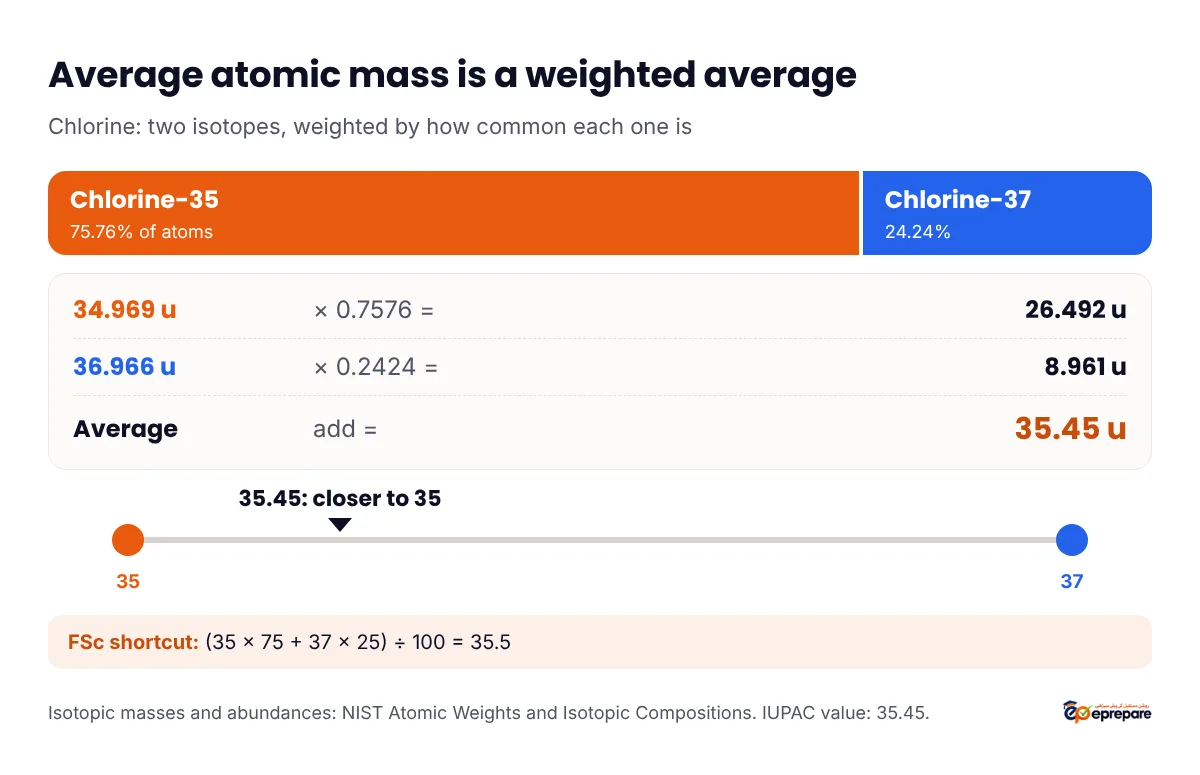
The atomic mass on the periodic table is not the mass of any one atom. It is the weighted average of the masses of an element's naturally occurring isotopes, weighted by how abundant each one is:
Average atomic mass = Σ (isotopic mass × fractional abundance), or, with percentages, (mass1 × %1 + mass2 × %2) ÷ 100.
Example 4: the average atomic mass of chlorine
- Chlorine-35: 34.969 u × 0.7576 = 26.492 u.
- Chlorine-37: 36.966 u × 0.2424 = 8.961 u.
- Average = 26.492 + 8.961 = 35.45 u.
The FSc-style shortcut uses whole-number masses and rounded abundances: (35 × 75 + 37 × 25) ÷ 100 = 35.5. That is where the familiar 35.5 comes from.
Example 5: the average atomic mass of copper
Copper-63 (62.930 u, 69.15%) and copper-65 (64.928 u, 30.85%):
- 62.930 × 0.6915 = 43.516 u.
- 64.928 × 0.3085 = 20.030 u.
- Average = 63.55 u (IUPAC: 63.546).
"How do I calculate the atomic mass of an isotope?" The mass of a single isotope is measured with a mass spectrometer, and it is always very close to its mass number (chlorine-35 is 34.969 u). What MDCAT asks you to calculate is the element's average atomic mass from the isotopes, as above. Sometimes the question runs backwards: given the average, find the abundance. Let the abundance of one isotope be x, the other (1 − x), and solve.
How to find the molecular formula from the empirical formula
- The empirical formula is the simplest whole-number ratio of atoms in a compound. For glucose it is CH2O.
- The molecular formula gives the actual number of each atom in one molecule. For glucose it is C6H12O6.
- The molecular formula is always a whole-number multiple (n) of the empirical formula. Sometimes n = 1, as in water (H2O) and carbon dioxide (CO2).
The method: n = molar mass ÷ empirical formula mass. Molecular formula = (empirical formula) × n.
- Write the empirical formula and calculate its formula mass.
- Divide the given molar mass by the empirical formula mass to get n. It must come out as a whole number (or very close to one).
- Multiply every subscript in the empirical formula by n.
| Empirical formula (mass) | Molar mass | n | Molecular formula |
|---|---|---|---|
| CH2O (30) | 180 g/mol | 6 | C6H12O6 (glucose) |
| CH2O (30) | 60 g/mol | 2 | C2H4O2 (acetic acid) |
| CH (13) | 78 g/mol | 6 | C6H6 (benzene) |
| HO (17) | 34 g/mol | 2 | H2O2 (hydrogen peroxide) |
| NO2 (46) | 92 g/mol | 2 | N2O4 |
| CH2 (14) | 28 g/mol | 2 | C2H4 (ethene) |
Starting from percentage composition
Often you are given only the percentage of each element and the molar mass. Work it out in full:
Example 6: from percentages to the molecular formula
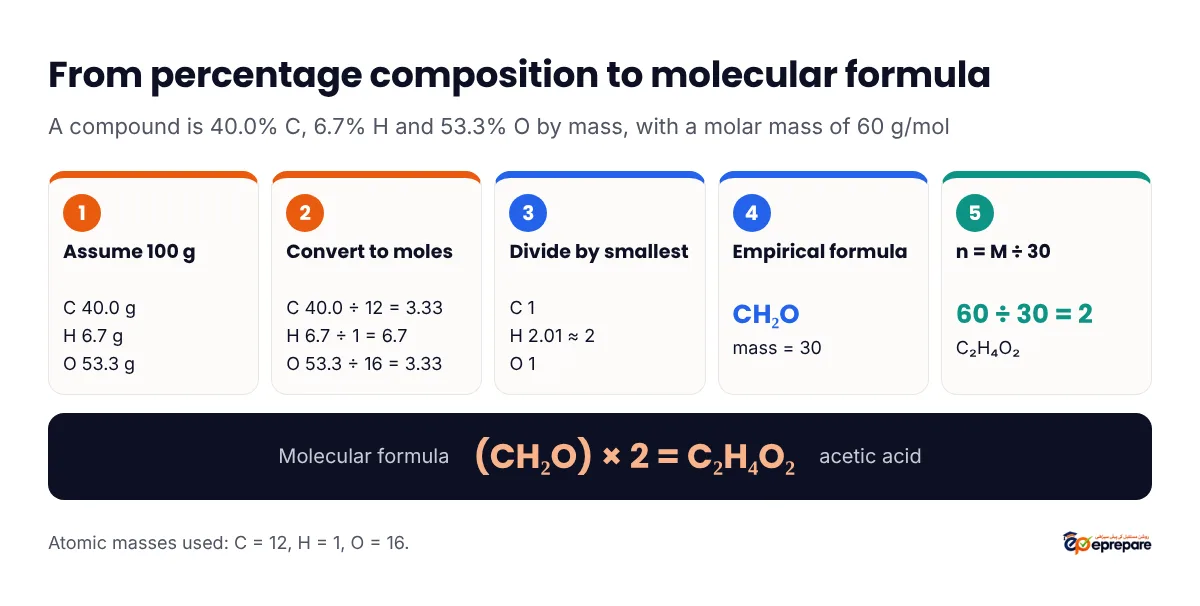
A compound contains 40.0% carbon, 6.7% hydrogen and 53.3% oxygen by mass. Its molar mass is 60 g/mol. Find its molecular formula.
- Assume 100 g, so the percentages become grams: C 40.0 g, H 6.7 g, O 53.3 g.
- Convert to moles: C = 40.0 ÷ 12 = 3.33; H = 6.7 ÷ 1 = 6.7; O = 53.3 ÷ 16 = 3.33.
- Divide by the smallest (3.33): C = 1, H = 2.01 ≈ 2, O = 1.
- Empirical formula: CH2O, mass = 12 + 2 + 16 = 30.
- Find n: 60 ÷ 30 = 2, so the molecular formula is C2H4O2.
If step 3 gives a ratio such as 1 : 1.5, multiply everything by 2; for 1 : 1.33, multiply by 3. Only round when the number is within about 0.1 of a whole number.
MDCAT shortcuts and common traps: (1) Use the atomic masses given in the question; otherwise Na 23, Cl 35.5, Ca 40, Cu 63.5. (2) Chlorine gas is Cl2: 1 mol weighs 71 g, not 35.5 g. (3) A neutron (1.008665 u) is slightly heavier than a proton (1.007276 u); an electron is about 1/1836 of a proton. (4) In ionic compounds, count formula units, then ions: 1 mol NaCl contains 2 mol of ions. (5) n in "molecular = (empirical) × n" must be a whole number; if it is not, recheck the empirical formula mass. (6) Average atomic mass is pulled towards the most abundant isotope; check that your answer lies between the isotope masses.
Practice MCQs on the mole and formulas
Try these first, then open the answers. For more, practise the fundamental concepts chapter in our MDCAT Chemistry MCQs.
Question 1
What is the mass of 0.25 mol of sodium chloride? (Na = 23, Cl = 35.5)
- 14.6 g
- 58.5 g
- 23.4 g
- 11.7 g
Show answer
Answer: A. M(NaCl) = 23 + 35.5 = 58.5 g/mol. Mass = 0.25 × 58.5 = 14.625 g ≈ 14.6 g.
Question 2
How many copper atoms are present in 6.35 g of copper? (Cu = 63.5, NA = 6.022 × 10²³)
- 6.022 × 10²³
- 6.022 × 10²²
- 3.011 × 10²³
- 1.204 × 10²³
Show answer
Answer: B. Moles = 6.35 ÷ 63.5 = 0.100 mol. Atoms = 0.100 × 6.022 × 1023 = 6.022 × 10²².
Question 3
A compound has the empirical formula CH2O and a molar mass of 180 g/mol. Its molecular formula is:
- C2H4O2
- C3H6O3
- C12H22O11
- C6H12O6
Show answer
Answer: D. The empirical formula mass of CH2O is 12 + 2 + 16 = 30. n = 180 ÷ 30 = 6, so the molecular formula is C6H12O6.
Question 4
An element has two isotopes with masses of 10 u and 11 u, present in the ratio 20% : 80%. Its average atomic mass is:
- 10.2 u
- 10.5 u
- 10.8 u
- 11.0 u
Show answer
Answer: C. (10 × 20 + 11 × 80) ÷ 100 = (200 + 880) ÷ 100 = 10.8 u. The answer is closer to 11 because that isotope is four times as abundant.
Question 5
The mass of a neutron in atomic mass units is closest to:
- 0.000549 u
- 1.008665 u
- 1.007276 u
- 1/12 u
Show answer
Answer: B. A neutron's mass is 1.008665 u, slightly more than a proton's (1.007276 u). 0.000549 u is the mass of an electron.
The mole sits in the first unit of the Chemistry syllabus, and nearly every physical chemistry numerical depends on it. See how it fits with the other units in our MDCAT Chemistry high-yield chapters guide, and check the official learning outcomes, including stoichiometric calculations with moles, masses and gas volumes, in the MDCAT syllabus.
Frequently asked questions
What is the molar mass of NaCl?
The molar mass of sodium chloride is 58.5 g/mol using the rounded atomic masses Na = 23 and Cl = 35.5. With IUPAC standard atomic weights it is 58.44 g/mol.
What is the mass of 1 mole of copper atoms?
One mole of copper atoms weighs 63.5 g (63.546 g precisely) and contains 6.022 × 10²³ atoms. A single copper atom therefore weighs about 1.05 × 10⁻²² g.
What is the mass of a proton in amu?
A proton has a mass of 1.007276 amu, usually rounded to 1 amu. A neutron is 1.008665 amu and an electron 0.000549 amu.
How do you find the molecular formula from the empirical formula?
Calculate the empirical formula mass, divide the compound's molar mass by it to get a whole number n, then multiply every subscript in the empirical formula by n. For CH2O with a molar mass of 180 g/mol, n = 6 and the molecular formula is C6H12O6.
How do you calculate the average atomic mass from isotopes?
Multiply each isotope's mass by its fractional abundance and add the results. For chlorine: 34.969 × 0.7576 + 36.966 × 0.2424 = 35.45 u.
What is the average atomic mass of chlorine?
The average atomic mass of chlorine is 35.45 (IUPAC abridged value), usually rounded to 35.5 in MDCAT. It is closer to 35 than 37 because about three-quarters of chlorine atoms are chlorine-35.
What is the formula unit of aluminium oxide?
The formula unit of aluminium oxide is Al2O3: two Al3+ ions balance the charge of three O2− ions. Its molar mass is 102 g/mol (101.96 g/mol precisely).
What is Avogadro's number?
Avogadro's number is 6.02214076 × 10²³, the number of particles in one mole. Since 2019 it has been an exact value that defines the mole.
Mole calculations get faster with every set you solve. Work through them in the ePrepare question bank, where each MCQ has a step-by-step explanation, and note the traps you fall into in your own revision notes. Create a free ePrepare account to start practising.
Sources: Avogadro constant, elementary charge, atomic mass constant and the masses of the proton, neutron and electron in u from the NIST Reference on Constants (2022 CODATA values); standard and abridged atomic weights from IUPAC CIAAW, abridged standard atomic weights (2024); isotopic masses and abundances of chlorine and copper from NIST Atomic Weights and Isotopic Compositions; molar volume at STP as used in our Chemistry revision sheet; learning outcomes from the PM&DC MDCAT curriculum (Chemistry, fundamental concepts unit).