

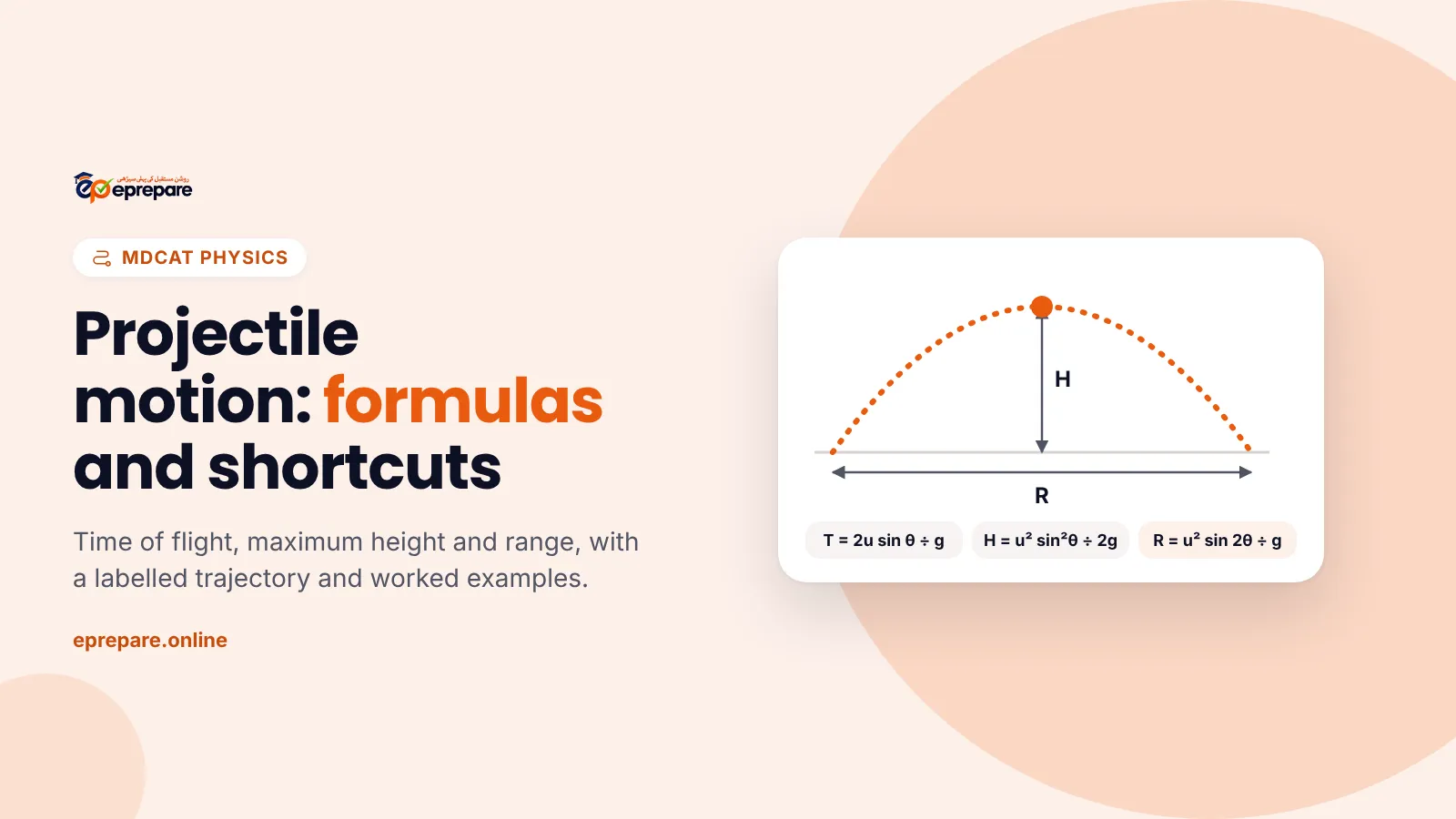
The short answer: Projectile motion is the two-dimensional motion of an object thrown into the air and moving under gravity alone. Its horizontal velocity stays constant (zero horizontal acceleration) while gravity accelerates it downward at g, so its path is a parabola. Time of flight T = 2u sin θ ÷ g, maximum height H = u² sin²θ ÷ 2g, and range R = u² sin 2θ ÷ g, which is greatest at 45°.
Projectile motion is one of the most dependable sources of MDCAT Physics questions: a few formulas, a couple of shortcuts, and numericals that can be solved in under a minute once you see the idea. This guide defines a projectile, shows why the motion splits into two independent parts, derives each formula in a line or two, and collects the shortcuts examiners like, including complementary angles and the 45° rule. Worked examples, five practice MCQs and answers to the questions students search follow.
PM&DC's MDCAT curriculum lists projectile motion under Force and motion. It asks you to explain that projectile motion is "two-dimensional motion in a vertical plane", that the horizontal component of velocity is constant, and that the acceleration is vertical and "the same as that of a vertically free-falling object". It then asks you to work out how high a projectile goes, how far it travels, where it is after a given time, how long it stays in the air, the launch angle for maximum range, and the relation between launch angles that give the same range. All of that is covered below.
What is a projectile and what is projectile motion?
A projectile is any object that is thrown, kicked or launched into the air and then moves under the effect of gravity alone. Once it leaves the hand, the bat or the launcher, nothing pushes it forward any more. A thrown cricket ball, a football kicked into the air, a stone thrown across a river and water from a hose are all projectiles.
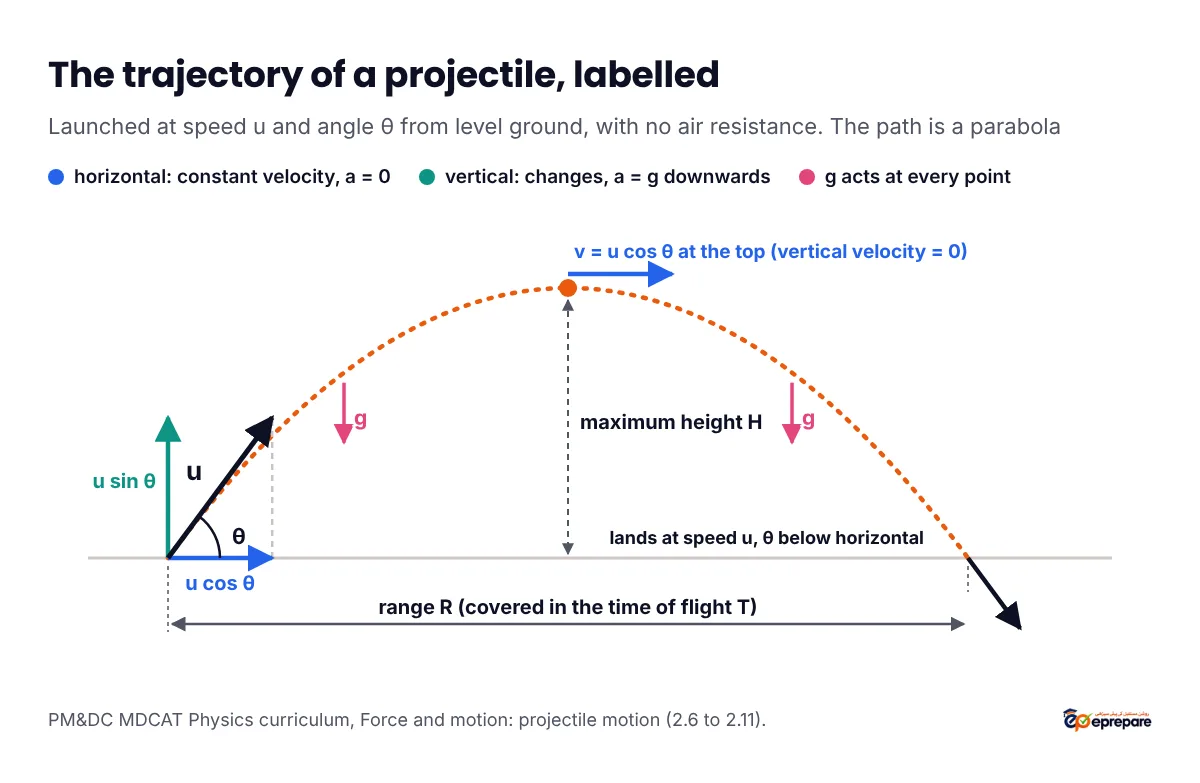
Projectile motion is the motion of such an object. It happens in two dimensions, horizontally and vertically, within a vertical plane. In MDCAT problems we treat the projectile as ideal: air resistance is ignored, and g is taken as constant. Under these conditions the path, called the trajectory, is a parabola.
Two independent motions: horizontal and vertical
The key to every projectile question is to split the motion into a horizontal part and a vertical part and treat them separately. They share only one thing: the time.
A projectile launched with speed u at angle θ above the horizontal has initial velocity components:
- Horizontal: ux = u cos θ
- Vertical: uy = u sin θ
| Quantity | Horizontal motion | Vertical motion |
|---|---|---|
| Acceleration | Zero (no horizontal force) | g downwards (about 9.8 m/s²) |
| Initial velocity | u cos θ | u sin θ |
| Velocity at time t | vx = u cos θ (constant) | vy = u sin θ − gt (changes) |
| Displacement at time t | x = (u cos θ) t | y = (u sin θ) t − ½gt² |
| At the highest point | Still u cos θ | Zero |
| Type of motion | Uniform velocity | Uniformly accelerated, like free fall |
Because the horizontal velocity never changes, the projectile is never at rest during its flight, not even at the top. At the highest point its velocity is u cos θ, pointing horizontally, and its acceleration is still g, pointing straight down.
Projectile motion formulas, with where they come from
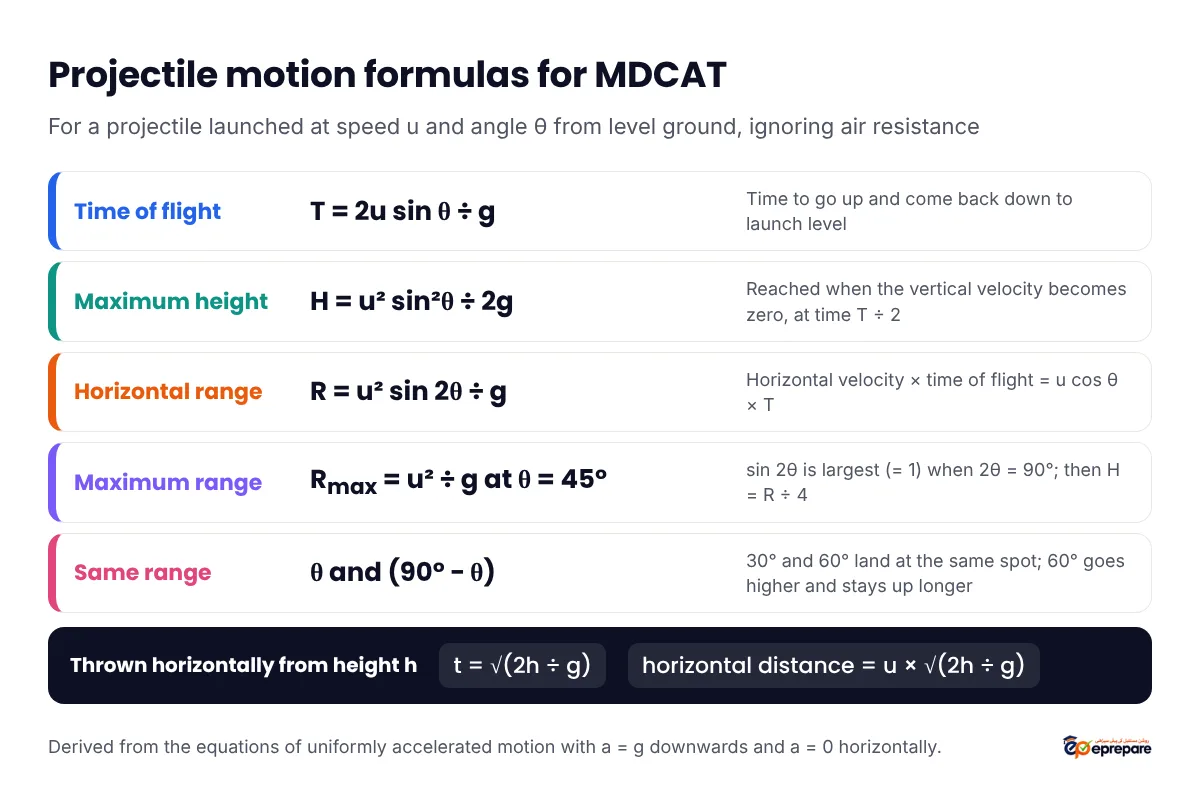
Each formula below is for a projectile launched from level ground and landing at the same level, with no air resistance. All of them come from the equations of uniformly accelerated motion applied to the vertical direction.
Time of flight: T = 2u sin θ ÷ g. Maximum height: H = u² sin²θ ÷ 2g. Range: R = u² sin 2θ ÷ g.
Time of flight
At the top, the vertical velocity is zero: 0 = u sin θ − gt, so the time to reach the top is u sin θ ÷ g. The way down takes the same time, so the time of flight is T = 2u sin θ ÷ g.
Maximum height
Using vy² = uy² − 2gH with vy = 0 at the top: 0 = u² sin²θ − 2gH, which gives H = u² sin²θ ÷ 2g.
Horizontal range
The range is horizontal velocity × time of flight: R = u cos θ × (2u sin θ ÷ g) = u² (2 sin θ cos θ) ÷ g. Since 2 sin θ cos θ = sin 2θ, R = u² sin 2θ ÷ g.
Range at 45°: the maximum range
For a given launch speed, R is largest when sin 2θ is largest. The biggest value sin 2θ can take is 1, when 2θ = 90°, so the range is maximum at θ = 45°:
- Rmax = u² ÷ g
- At 45°, H = u² ÷ 4g, so the maximum range is four times the height reached: Rmax = 4H.
Complementary angles give the same range
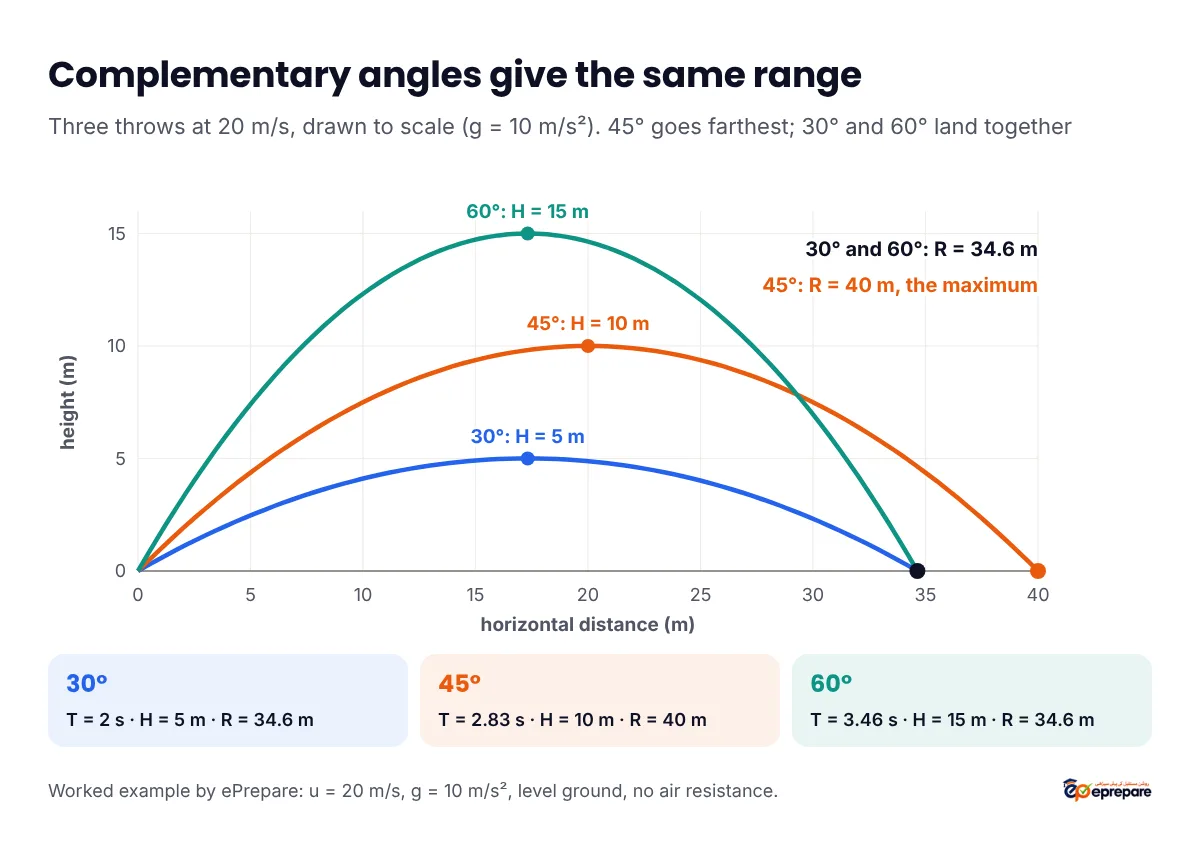
Angles θ and (90° − θ) give the same range, because sin 2(90° − θ) = sin (180° − 2θ) = sin 2θ. So 30° and 60° land at the same spot, as do 15° and 75°. They are not identical throws: the larger angle goes higher and stays in the air longer.
Horizontal projectile motion
When an object is thrown or rolls off horizontally from a height h, such as a ball rolling off a table, the initial vertical velocity is zero. Its vertical motion is then exactly free fall:
- Time to reach the ground: h = ½gt², so t = √(2h ÷ g).
- Horizontal distance travelled: x = u × √(2h ÷ g), where u is the horizontal launch speed.
The time to fall depends only on the height, not on the horizontal speed. A ball thrown horizontally and a ball dropped from the same height at the same moment hit level ground together.
Worked examples
We use g = 10 m/s² so the arithmetic stays clean; check whether an MDCAT question asks for 9.8 m/s² instead.
Example 1: the three main quantities
A ball is thrown at 20 m/s at 30° above the horizontal. Find the time of flight, maximum height, range and the velocity at the top.
- Components: ux = 20 cos 30° = 17.3 m/s; uy = 20 sin 30° = 10 m/s.
- T = 2u sin θ ÷ g = 2 × 10 ÷ 10 = 2 s.
- H = u² sin²θ ÷ 2g = 10² ÷ 20 = 5 m.
- R = u² sin 2θ ÷ g = 400 × sin 60° ÷ 10 = 400 × 0.866 ÷ 10 = 34.6 m. Check: ux × T = 17.3 × 2 = 34.6 m.
- Velocity at the top = u cos θ = 17.3 m/s, horizontal.
Example 2: the complementary angle
The same ball is thrown at 20 m/s at 60° instead. Compare.
- R = 400 × sin 120° ÷ 10 = 400 × 0.866 ÷ 10 = 34.6 m: the same range as at 30°.
- H = (20 sin 60°)² ÷ 20 = (17.3)² ÷ 20 = 300 ÷ 20 = 15 m: three times higher.
- T = 2 × 17.3 ÷ 10 = 3.46 s: in the air longer.
Example 3: maximum range
What is the greatest distance the ball can be thrown at 20 m/s on level ground, and how high does it go then?
- Rmax = u² ÷ g = 400 ÷ 10 = 40 m, at 45°.
- H = u² sin²45° ÷ 2g = 400 × 0.5 ÷ 20 = 10 m, which is R ÷ 4 as expected.
Example 4: where is it after a given time?
For the ball in Example 1, find its position and vertical velocity 1.5 s after launch.
- x = uxt = 17.3 × 1.5 ≈ 26.0 m.
- y = uyt − ½gt² = 10 × 1.5 − 5 × 1.5² = 15 − 11.25 = 3.75 m above the ground.
- vy = uy − gt = 10 − 15 = −5 m/s, so it is on the way down (it reached the top at 1 s).
Example 5: thrown horizontally
A ball rolls off a table 1.25 m high at 3 m/s. How long does it take to land, and how far from the table?
- t = √(2h ÷ g) = √(2 × 1.25 ÷ 10) = √0.25 = 0.5 s.
- x = ut = 3 × 0.5 = 1.5 m from the foot of the table.
MDCAT shortcuts and common traps. Horizontal acceleration is zero; vertical acceleration is g downwards throughout, even at the top. At the highest point the velocity is u cos θ, not zero, so the kinetic energy there is (initial KE) × cos²θ, which is half at 45°. Maximum range is at 45°, where R = u² ÷ g = 4H. Angles θ and 90° − θ give equal ranges, but the larger angle gives greater H and T. Doubling the launch speed multiplies T by 2 but H and R by 4. Use cos θ for the horizontal component and sin θ for the vertical one, and check which value of g the question wants.
Practice MCQs: projectile motion
Try each one before opening the answer. Take g = 10 m/s². For more, practise the Force and motion chapter in our MDCAT Physics MCQs.
Question 1
Ignoring air resistance, what is the horizontal acceleration of a projectile?
- g
- g sin θ
- Zero
- g cos θ
Show answer
Answer: C. Once launched, the only force on an ideal projectile is its weight, which acts vertically. With no horizontal force there is no horizontal acceleration, so the horizontal velocity stays constant.
Question 2
A projectile is launched with speed u at angle θ. What is its velocity at the highest point of its path?
- Zero
- u sin θ
- u cos θ
- u
Show answer
Answer: C. At the top the vertical component is zero, but the horizontal component, u cos θ, never changes. Option A is the most common mistake: the projectile is moving horizontally at the top, not stopped.
Question 3
A ball thrown at 30° to the horizontal lands 40 m away. At what other angle, with the same speed, would it land at the same point?
- 15°
- 45°
- 60°
- 75°
Show answer
Answer: C. Complementary angles, θ and 90° − θ, give the same range because sin 2θ is the same for both. 90° − 30° = 60°.
Question 4
A stone is projected at 20 m/s at 30° above the horizontal. What is its time of flight?
- 1 s
- 2 s
- 3.46 s
- 4 s
Show answer
Answer: B. T = 2u sin θ ÷ g = 2 × 20 × 0.5 ÷ 10 = 2 s. Option A (1 s) is only the time to reach the top, and option C uses sin 60° by mistake.
Question 5
A body is projected at 45° with kinetic energy E. What is its kinetic energy at the highest point?
- E
- E/2
- E/4
- Zero
Show answer
Answer: B. At the top only the horizontal velocity, u cos 45° = u ÷ √2, remains. KE = ½m(u ÷ √2)² = ½ × ½mu² = E/2. In general, KE at the top = E cos²θ.
Frequently asked questions
What is projectile motion?
Projectile motion is the two-dimensional motion of an object launched into the air that then moves under gravity alone. It combines constant-velocity horizontal motion with uniformly accelerated vertical motion, and with no air resistance the path is a parabola.
What is a projectile in physics?
A projectile is any object that has been given an initial velocity and then moves only under the force of gravity, such as a thrown ball, a kicked football or a stone thrown across a river.
What is the horizontal acceleration of a projectile?
Zero, when air resistance is ignored. No horizontal force acts on the projectile, so its horizontal velocity, u cos θ, stays the same throughout the flight. Its only acceleration is g, vertically downward.
What is the path of a projectile called, and what shape is it?
The path is called the trajectory. For an ideal projectile, with no air resistance and constant g, it is a parabola.
At what angle is the range of a projectile maximum?
At 45°, for launch and landing on the same level. The maximum range is u² ÷ g, and at that angle the range is four times the maximum height.
Which launch angles give the same range?
Complementary angles, θ and (90° − θ), such as 30° and 60° or 15° and 75°, when the launch speed is the same. The larger angle reaches a greater height and stays in the air longer.
What is horizontal projectile motion?
The motion of an object launched horizontally from a height, such as a ball rolling off a table. Its vertical motion is free fall, starting from zero vertical velocity, while its horizontal velocity stays constant.
How do you find the time in horizontal projectile motion?
Use the vertical motion alone: h = ½gt², so t = √(2h ÷ g). The horizontal speed does not affect the time; it only decides how far the object travels, x = ut.
Keep practising projectile motion
Projectile numericals become quick once the split into horizontal and vertical motion is automatic. Revise the related formulas in our MDCAT Physics high-yield chapters and formula sheet, see where this topic sits in the full MDCAT syllabus, and register on ePrepare to practise timed Physics MCQs with step-by-step explanations.
Sources: PM&DC uniform MDCAT curriculum, Physics unit 2 (Force and motion: projectile motion, outcomes 2.6 to 2.11), as published by KMU; NIST CODATA value of standard acceleration of gravity (9.80665 m/s²).