

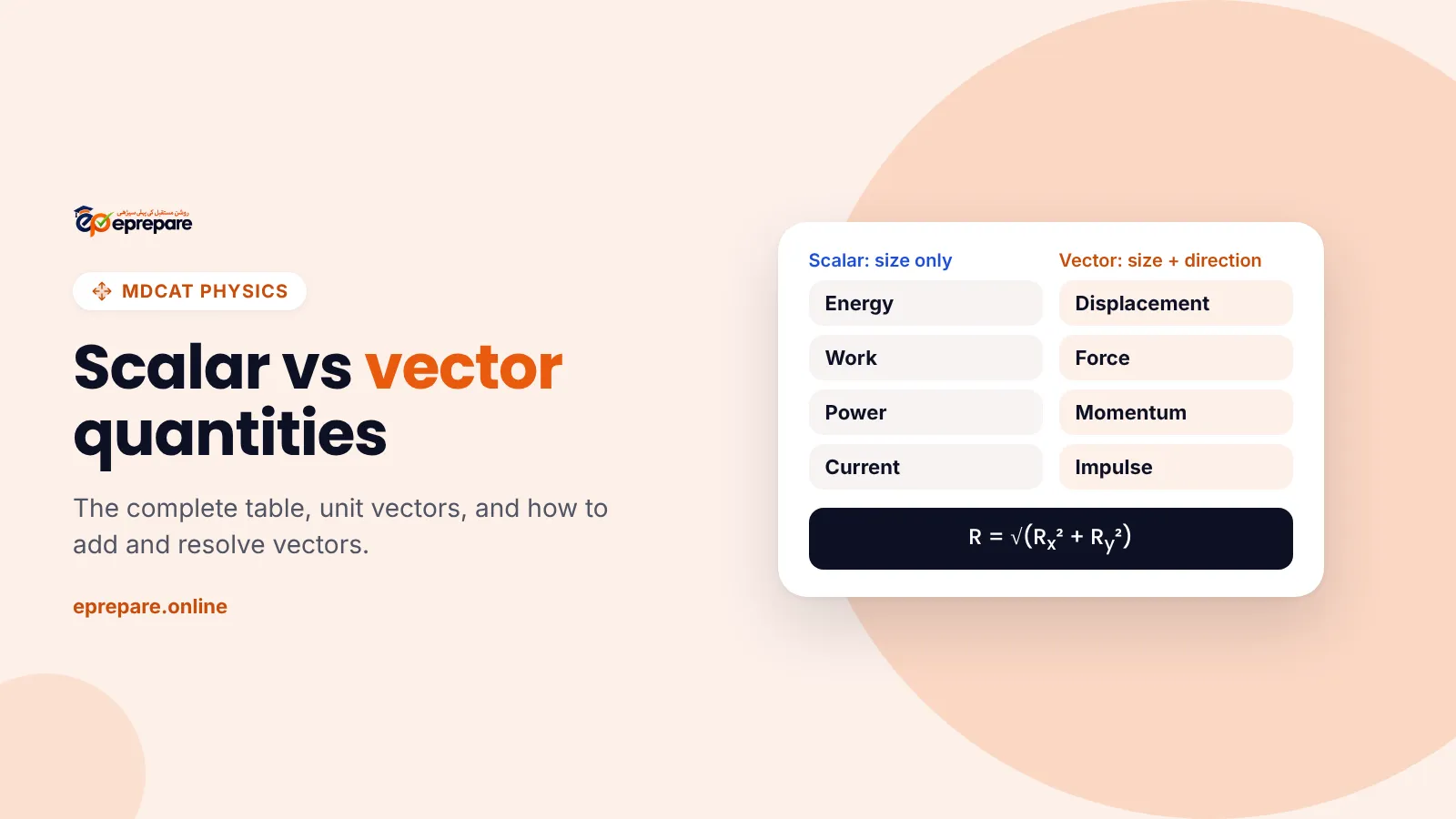
The short answer: A scalar has magnitude only (energy, work, power, mass, time, electric current). A vector has magnitude and direction and adds by the head-to-tail rule (displacement, velocity, acceleration, force, momentum, impulse, torque). So displacement and momentum are vectors, and energy is a scalar.
"Is it a scalar or a vector?" turns up in MDCAT Physics every year, often as a quick one-line MCQ. A few quantities, especially electric current, pressure and moment of inertia, catch students out. This guide gives you a complete table with the reason for each answer, then explains unit vectors, how to add vectors (head-to-tail and by components) and how to resolve a vector. It finishes with worked examples, five practice MCQs and answers to the questions students actually search.
Vectors open the MDCAT Physics curriculum. PM&DC's first learning outcome is to "determine the sum of vectors using perpendicular components", followed by the scalar and vector products, so this topic is examined directly as well as underpinning motion, forces and fields.
What is a scalar and what is a vector?
A scalar quantity is fully described by its magnitude (a number with a unit) alone. "5 kg", "20 s" and "300 J" need nothing more. Scalars add, subtract and multiply like ordinary numbers.
A vector quantity needs both magnitude and direction, and it must combine by the rules of vector addition (the head-to-tail or parallelogram rule). "20 N" is incomplete for a force: 20 N upwards and 20 N downwards have opposite effects. In print, vectors are written in bold (F) or with an arrow over the symbol; their magnitude is written |F| or simply F.
The second condition matters. Having a direction is not enough to make something a vector; it must also add like a vector. Electric current is the classic example, as you will see below.
The complete table: scalar or vector?
Here are the quantities students ask about most, with the reason for each answer and the SI unit.
| Quantity | Type | Why | SI unit |
|---|---|---|---|
| Displacement | Vector | Straight-line change in position, in a stated direction | m |
| Velocity | Vector | Rate of change of displacement | m/s |
| Acceleration | Vector | Rate of change of velocity | m/s² |
| Force | Vector | A push or pull acts in a direction; F = ma | N |
| Momentum | Vector | p = mv: a scalar (mass) times a vector (velocity) | kg m/s |
| Impulse | Vector | Impulse = FΔt = change in momentum | N s |
| Torque | Vector | τ = r × F, a vector (cross) product | N m |
| Energy (kinetic, potential) | Scalar | KE = ½mv² depends on v², not on direction | J |
| Work | Scalar | W = F·d, a scalar (dot) product | J |
| Power | Scalar | P = F·v, a scalar (dot) product | W |
| Moment of inertia | Scalar at FSc level | I = Σmr² about a fixed axis; never a vector (strictly a tensor) | kg m² |
| Electric current | Scalar | Has a direction but adds algebraically, not by the vector rule | A |
| Pressure | Scalar | Force per unit area; at a point it acts equally in all directions | Pa |
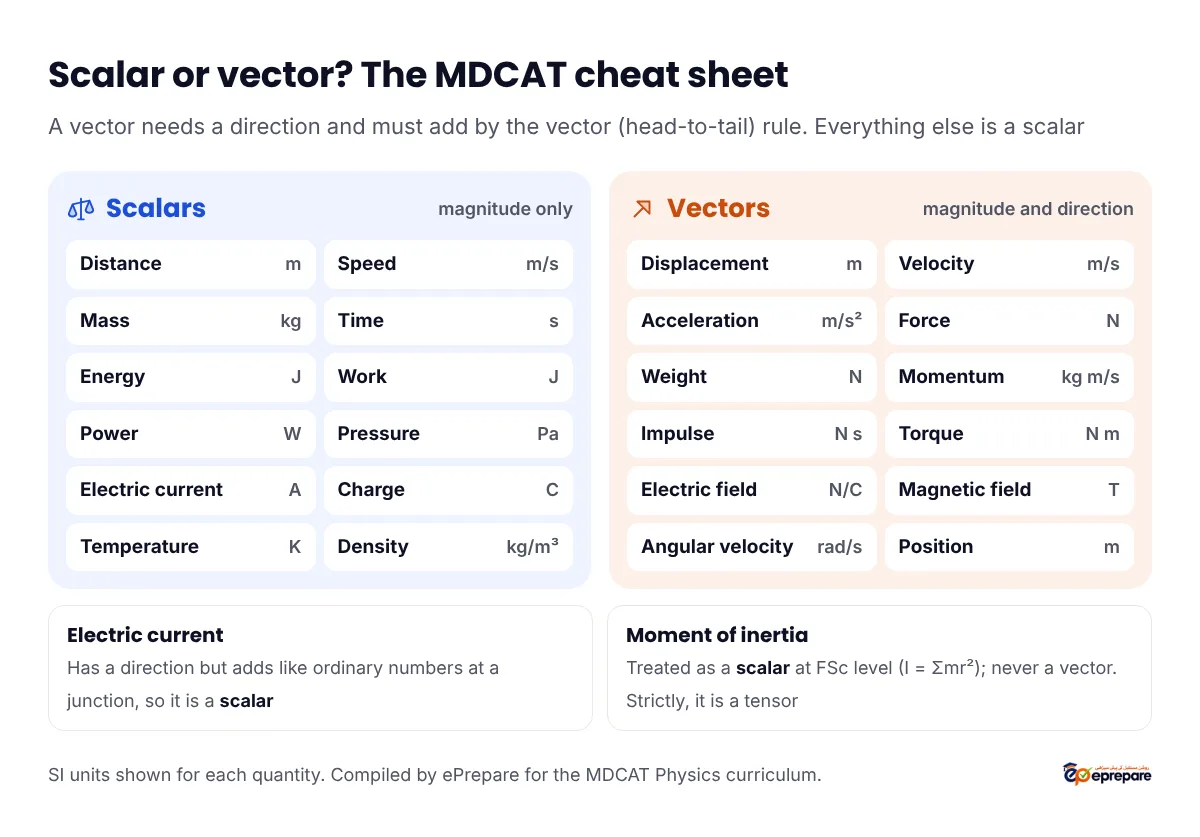
A few more that appear in MCQs: distance, speed, mass, time, charge, temperature, density, electric potential, electric flux and capacitance are scalars. Position, weight, electric field intensity, magnetic field, angular velocity and angular momentum are vectors.
Why is electric current a scalar?
Current flows in a direction along a wire, so it looks like a vector. But at a junction, currents simply add as numbers: 2 A and 3 A flowing into a junction give 5 A flowing out, whatever the angle between the wires. Because current does not obey the vector addition rule, it is a scalar.
Is moment of inertia a scalar or a vector?
For a body turning about a fixed axis, as in FSc and MDCAT, moment of inertia is treated as a scalar: I = Σmr², which has no direction. It is never a vector. In advanced physics it is described as a tensor, so if an MCQ offers "tensor" as an option, that is the precise answer; between scalar and vector, choose scalar.
Why are work and power scalars when force is a vector?
Because they come from the scalar (dot) product of two vectors: W = F·d = Fd cos θ and P = F·v. A dot product always gives a scalar. Torque comes from the vector (cross) product, τ = r × F, with magnitude rF sin θ, and a cross product always gives a vector. This one idea explains several rows of the table.
What is a unit vector?
A unit vector is a vector with a magnitude of exactly 1 that is used only to show a direction. You get the unit vector of any vector by dividing the vector by its own magnitude:
Unit vector: Â = A ÷ |A|. It has magnitude 1, no unit, and points in the same direction as A.
The unit vectors along the x, y and z axes have their own symbols: î, ĵ and k̂. Any vector in a plane can be written with them, for example A = 3î + 4ĵ, meaning 3 units along x and 4 units along y.
Example: for A = 3î + 4ĵ, |A| = √(3² + 4²) = 5, so  = (3î + 4ĵ) ÷ 5 = 0.6î + 0.8ĵ. Check: √(0.6² + 0.8²) = √(0.36 + 0.64) = 1.
How to add vectors
Scalars add like numbers; vectors do not. A 3 N force and a 4 N force can give any resultant from 1 N (opposite directions) to 7 N (same direction), and exactly 5 N when they are at right angles. There are two methods.
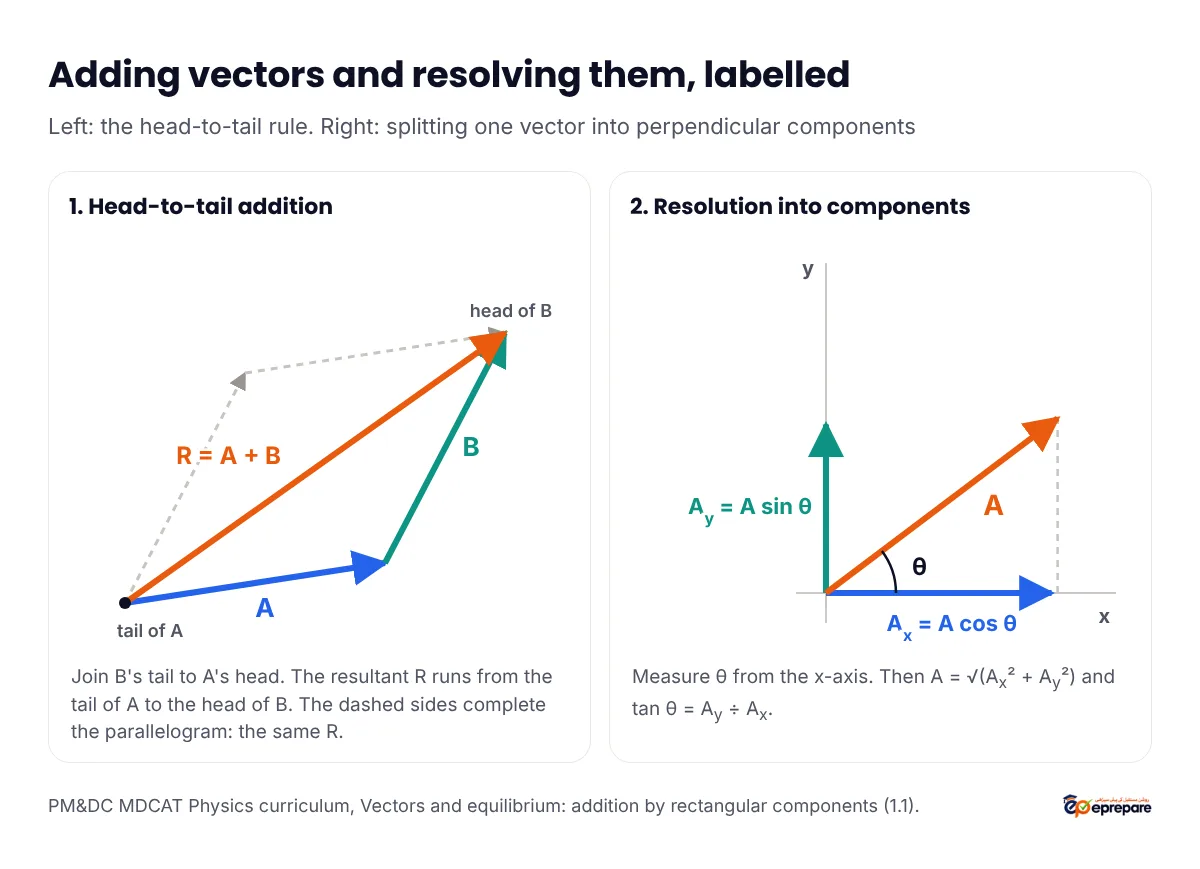
Method 1: the head-to-tail rule (graphical)
- Draw the first vector A to scale, in its direction.
- Draw the second vector B starting from the head (arrow tip) of A.
- The resultant R = A + B is the arrow from the tail of A to the head of B.
The parallelogram rule gives the same answer: draw A and B from the same point, complete the parallelogram, and the diagonal from that point is R. To subtract, add the negative: A − B = A + (−B), where −B has the same magnitude as B but the opposite direction.
Method 2: rectangular components (the MDCAT method)
- Resolve each vector into x and y components.
- Add all the x components to get Rx, and all the y components to get Ry.
- Find the magnitude: R = √(Rx² + Ry²).
- Find the direction: θ = tan⁻¹(Ry ÷ Rx), measured from the +x axis. Check the signs of Rx and Ry to place θ in the right quadrant.
For two vectors at an angle θ to each other, the magnitude of the resultant can also be found directly: R = √(A² + B² + 2AB cos θ).
Resolution of a vector into components
Resolving a vector means splitting it into two perpendicular vectors that together have the same effect. If a vector A makes an angle θ with the x-axis:
- Horizontal (x) component: Ax = A cos θ
- Vertical (y) component: Ay = A sin θ
Going back the other way, A = √(Ax² + Ay²) and tan θ = Ay ÷ Ax. Resolution is how projectile motion is solved: the launch velocity is split into a horizontal part that stays constant and a vertical part that gravity changes.
Worked examples
Example 1: distance vs displacement
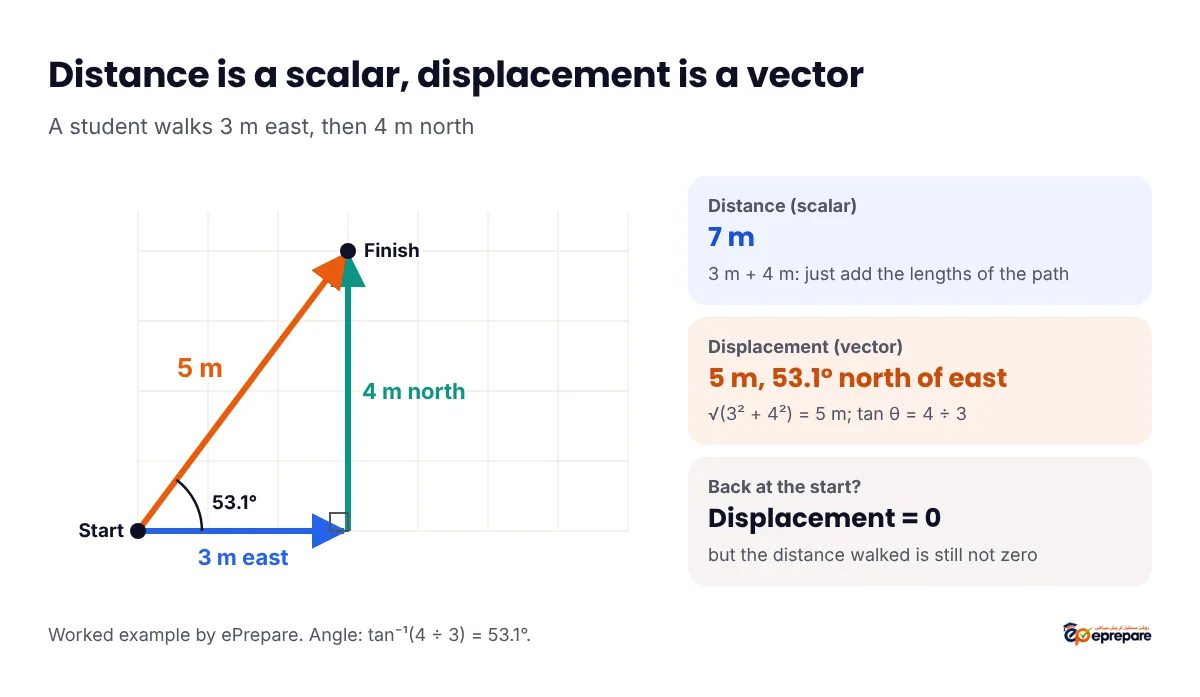
A student walks 3 m east and then 4 m north. Find the distance covered and the displacement.
- Distance is a scalar, so add the path lengths: 3 + 4 = 7 m.
- Displacement is a vector from start to finish: √(3² + 4²) = √25 = 5 m.
- Direction: θ = tan⁻¹(4 ÷ 3) = 53.1° north of east.
Example 2: resolving a force
A 20 N force acts at 30° above the horizontal. Find its components.
- Fx = 20 cos 30° = 20 × 0.866 = 17.3 N.
- Fy = 20 sin 30° = 20 × 0.5 = 10 N.
Example 3: adding vectors by components
Add A = 3î + 4ĵ and B = 5î − 2ĵ.
- Rx = 3 + 5 = 8 and Ry = 4 + (−2) = 2, so R = 8î + 2ĵ.
- |R| = √(8² + 2²) = √68 ≈ 8.25 units.
- θ = tan⁻¹(2 ÷ 8) ≈ 14.0° above the +x axis.
Example 4: the range of possible resultants
Two forces of 6 N and 8 N act on a body. Between what values can the resultant lie, and what is it when they are perpendicular?
- Largest (same direction): 6 + 8 = 14 N. Smallest (opposite directions): 8 − 6 = 2 N.
- At 90°: R = √(6² + 8²) = √100 = 10 N.
MDCAT shortcuts and common traps. Momentum, impulse and torque are vectors; energy, work and power are scalars. Current and pressure are scalars even though they seem to have direction. Product rule: scalar × vector = vector (p = mv), dot product = scalar (W, P), cross product = vector (τ). The resultant of A and B always lies between |A − B| and A + B. Learn the 3-4-5 and 6-8-10 right triangles. Use cos θ for the component next to the angle and sin θ for the one opposite it.
Practice MCQs: scalars and vectors
Try each one before opening the answer. For more, practise the vectors chapter in our MDCAT Physics MCQs.
Question 1
Which of the following is a vector quantity?
- Work
- Power
- Impulse
- Kinetic energy
Show answer
Answer: C. Impulse equals FΔt, which is the change in momentum, so it has the direction of the force. Work and power are dot products (scalars), and kinetic energy depends on v², so it has no direction.
Question 2
Which of the following is a scalar quantity?
- Torque
- Momentum
- Electric current
- Acceleration
Show answer
Answer: C. Electric current has a direction of flow but adds algebraically at a junction rather than by the vector rule, so it is a scalar. Torque, momentum and acceleration are all vectors.
Question 3
Two forces of 5 N and 12 N act at right angles to each other. What is the magnitude of the resultant?
- 7 N
- 13 N
- 17 N
- 60 N
Show answer
Answer: B. R = √(5² + 12²) = √(25 + 144) = √169 = 13 N. 17 N would be correct only if the forces acted in the same direction, and 7 N only if they were opposite.
Question 4
What is the unit vector in the direction of A = 6î − 8ĵ?
- 0.6î − 0.8ĵ
- 0.8î − 0.6ĵ
- 6î − 8ĵ
- 0.6î + 0.8ĵ
Show answer
Answer: A. |A| = √(6² + 8²) = 10, so  = (6î − 8ĵ) ÷ 10 = 0.6î − 0.8ĵ. Option D has the wrong sign on ĵ, so it points in a different direction.
Question 5
A ball is thrown at 40 m/s at 60° above the horizontal. What is the horizontal component of its velocity?
- 20 m/s
- 34.6 m/s
- 40 m/s
- 80 m/s
Show answer
Answer: A. vx = v cos θ = 40 × cos 60° = 40 × 0.5 = 20 m/s. Option B (40 sin 60°) is the vertical component, which is the most common slip.
Frequently asked questions
Is displacement a vector or a scalar?
Displacement is a vector. It is the straight-line change in position from start to finish, in a stated direction. The scalar version is distance, the total length of the path, which can never be smaller than the magnitude of the displacement.
Is momentum scalar or vector?
Momentum is a vector. p = mv is a scalar (mass) multiplied by a vector (velocity), so it points in the direction of the velocity. Impulse, the change in momentum, is a vector too.
Is energy scalar or vector?
Energy is a scalar. Kinetic energy, ½mv², depends on the square of speed and has no direction, and potential energy depends only on position. Work and power, which are closely linked to energy, are scalars as well.
Is force a vector or scalar? Is acceleration a vector?
Both are vectors. A force always acts in a direction, and Newton's second law, F = ma, shows that acceleration points the same way as the net force.
Is electric current a scalar or a vector?
Scalar. Although current flows in a direction, currents meeting at a junction add like ordinary numbers rather than by the vector rule, so current does not qualify as a vector.
Is moment of inertia a vector?
No. At FSc and MDCAT level it is treated as a scalar (I = Σmr² about a given axis). Strictly it is a tensor, so pick "tensor" if that option is offered.
What is a unit vector?
A vector of magnitude 1 that shows direction only. You find it by dividing a vector by its magnitude, Â = A ÷ |A|. The unit vectors along the x, y and z axes are î, ĵ and k̂.
How do you add vectors in physics?
Either draw them head to tail and join the tail of the first to the head of the last, or resolve each into x and y components, add the components separately, and combine them with R = √(Rx² + Ry²) and θ = tan⁻¹(Ry ÷ Rx).
Keep practising vectors
Vectors come back in projectile motion, forces, momentum and electric fields, so time spent here pays off across the paper. See where the unit sits in the full MDCAT syllabus and the formulas that matter most in our MDCAT Physics high-yield chapters guide. When you are ready, register on ePrepare to practise chapter-wise Physics MCQs with step-by-step explanations.