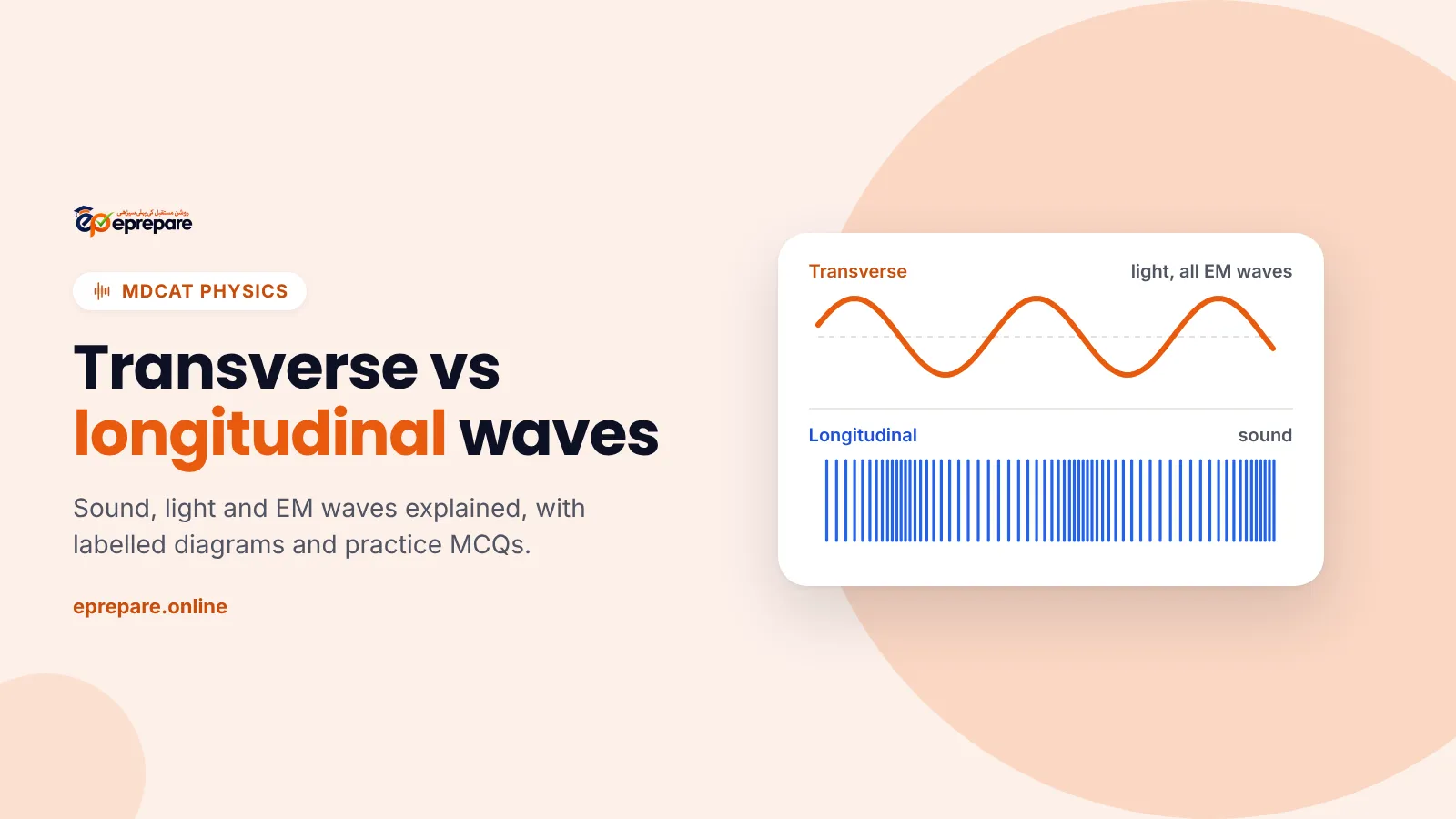
The short answer: Sound waves are longitudinal. Light and every other electromagnetic (EM) wave are transverse. In a transverse wave the particles (or fields) vibrate at right angles to the direction the wave travels; in a longitudinal wave they vibrate back and forth along that direction.
"Transverse or longitudinal?" is one of the most common one-line questions in MDCAT Physics, and it is easy marks once the idea is clear. This guide defines both kinds of wave, labels every part of each (crest, trough, compression, rarefaction, wavelength and amplitude), settles the sound, light and EM wave questions for good, and briefly covers stationary waves. It ends with worked examples, five practice MCQs and answers to the exact questions students search.
Waves is the largest unit in the MDCAT Physics curriculum by number of learning outcomes. PM&DC's learning outcomes ask you to "compare transverse and longitudinal waves" and to define and apply terms such as compression, rarefaction, crest, trough, wavelength and amplitude, so everything below is directly on the syllabus.
What is a wave?
A wave is a disturbance that carries energy from one place to another without carrying matter along with it. When a wave passes along a rope, each bit of rope only vibrates about its own rest position (its mean position); the rope itself does not travel down the room. What moves forward is the pattern, and the energy with it.
Waves come in two families:
- Mechanical waves need a medium (a solid, liquid or gas) because they travel by making the particles of that medium vibrate. Waves on ropes and springs, water waves and sound are mechanical.
- Electromagnetic waves need no medium. They are vibrating electric and magnetic fields, so they can cross a vacuum. Light, radio waves and X-rays are electromagnetic.
Either family can be sorted again by how it vibrates compared with the direction it travels. That gives the two types this article is about.
What is a transverse wave?
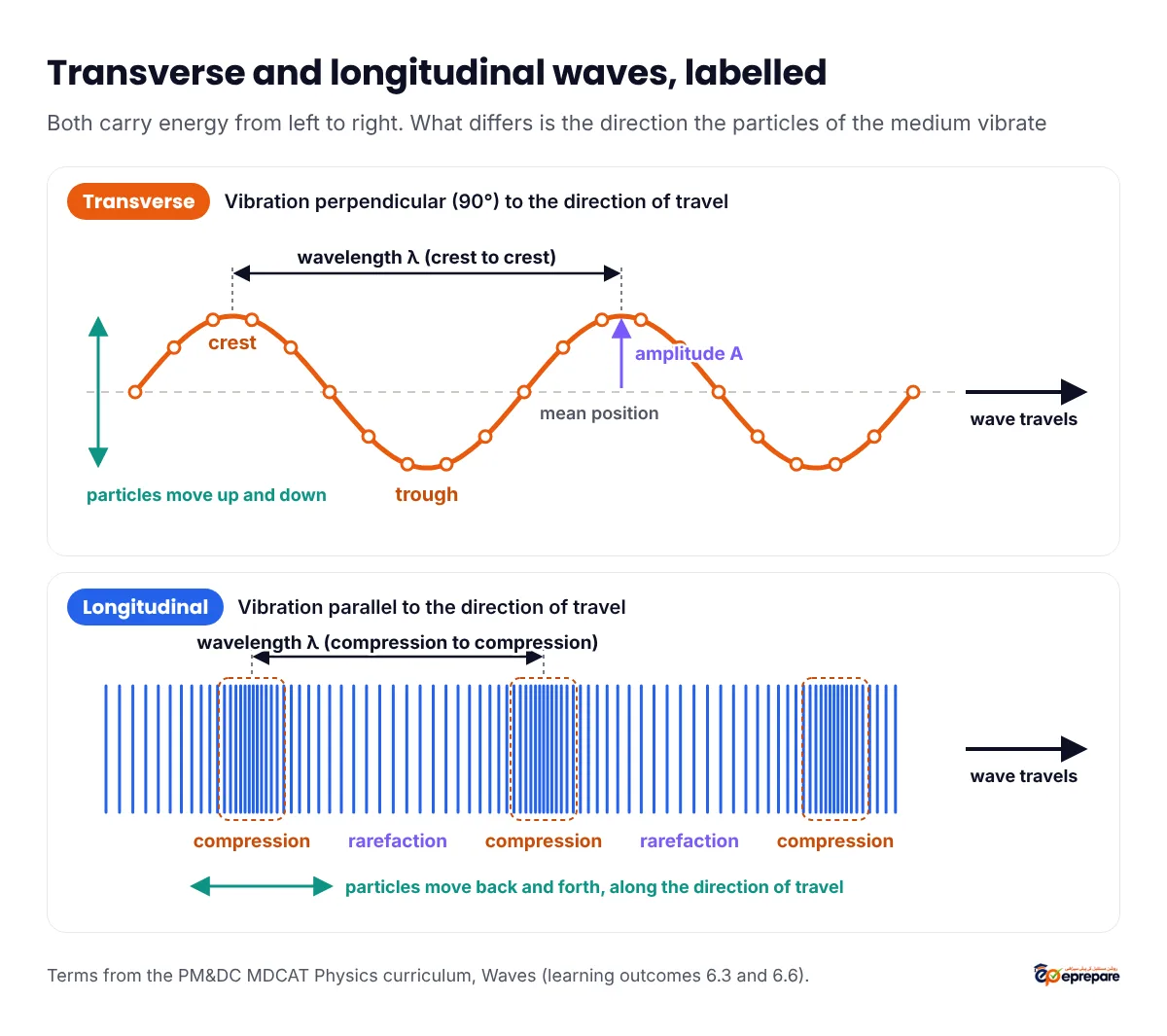
A transverse wave is a wave in which the particles of the medium vibrate perpendicular (at 90°) to the direction in which the wave travels.
Flick one end of a stretched rope up and down. The hump runs along the rope horizontally, but each point on the rope only moves up and down. That is a transverse wave. A transverse wave forms two kinds of point:
- Crest: the highest point of the wave, where the particle has its maximum displacement above the mean position.
- Trough: the lowest point of the wave, where the particle has its maximum displacement below the mean position.
Examples: waves on a stretched string or rope, a slinky shaken side to side, and every electromagnetic wave, including light.
What is a longitudinal wave?
A longitudinal wave is a wave in which the particles of the medium vibrate parallel to the direction in which the wave travels, moving back and forth along the same line as the wave.
Push and pull one end of a slinky along its length. Some coils bunch up while others spread out, and these regions move along the spring. A longitudinal wave forms:
- Compression: a region where the particles are pushed closer together than normal, so the density and pressure are higher.
- Rarefaction: a region where the particles are spread farther apart than normal, so the density and pressure are lower.
Examples: sound in air and other fluids, and a slinky pushed and pulled along its length.
Transverse vs longitudinal waves: the comparison table
| Feature | Transverse wave | Longitudinal wave |
|---|---|---|
| Direction of vibration | Perpendicular (90°) to the direction of travel | Parallel to the direction of travel |
| Parts of the wave | Crests and troughs | Compressions and rarefactions |
| Wavelength measured | Crest to next crest, or trough to next trough | Compression to next compression, or rarefaction to next rarefaction |
| Half a wavelength | Crest to the next trough | Compression to the next rarefaction |
| Pressure and density change? | No change in the medium's density along the wave | Yes: high at compressions, low at rarefactions |
| Can be polarised? | Yes | No |
| Medium | Mechanical ones need a medium that can be shaken sideways, such as a string or a solid; EM ones need no medium | Need a medium: solid, liquid or gas |
| Examples | Light, radio waves, X-rays, waves on a string | Sound in air, a slinky pushed and pulled |
The polarisation row is the one examiners like most. Polarisation means restricting the vibrations to a single plane. That is only possible when the vibrations are sideways to the direction of travel, so only transverse waves can be polarised. Light can be polarised, which is the experimental proof that light is transverse. Sound cannot be polarised, because it is longitudinal.
Wavelength, amplitude, period and frequency
These terms apply to both types of wave. The only difference is where you measure them.
- Wavelength (λ): the distance between two neighbouring points that are vibrating in step (in the same phase): crest to crest, or compression to compression. It is also the distance the wave moves in one complete vibration. SI unit: metre (m).
- Amplitude (A): the maximum displacement of a particle from its mean position. In a transverse wave it is the height of a crest above the mean position. In a longitudinal wave it is the greatest distance a particle moves forward or backward from its mean position, measured along the direction of travel. SI unit: metre (m).
- Period (T): the time for one complete vibration. SI unit: second (s).
- Frequency (f): the number of complete vibrations per second, f = 1 ÷ T. SI unit: hertz (Hz).
All four are linked by the wave equation, which works for every wave, transverse or longitudinal, mechanical or electromagnetic:
Wave equation: v = fλ. Wave speed (m/s) = frequency (Hz) × wavelength (m).
One point that catches students: the frequency of a wave is set by its source. When a wave passes from one medium into another, its speed and wavelength change, but its frequency stays the same.
Are sound waves longitudinal or transverse?
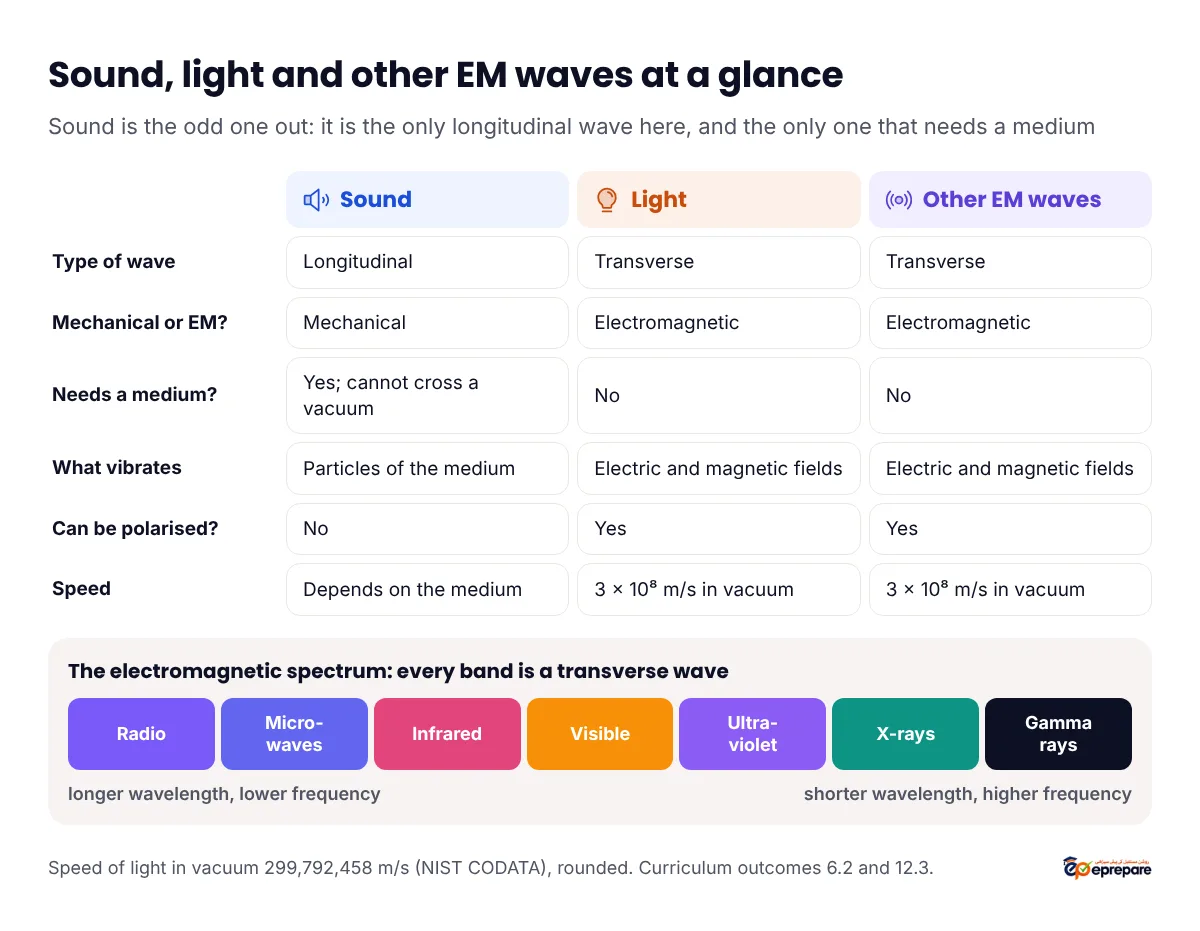
Sound waves are longitudinal. A vibrating loudspeaker cone pushes the air in front of it, squeezing the air molecules into a compression, then pulls back and leaves a rarefaction. These pressure changes travel outward, while each air molecule only vibrates back and forth along the direction the sound is moving.
Sound in air has to be longitudinal. Gases and liquids cannot resist being sheared sideways, so they cannot carry a sideways (transverse) vibration; they can only pass on squeezes and stretches. (Solids can carry both kinds of mechanical wave, but when an MDCAT question says "sound wave", the expected answer is longitudinal.)
Because sound is mechanical, it needs a medium and cannot travel through a vacuum. Its speed depends on the medium it travels through. That is why the curriculum follows this topic with Newton's formula for the speed of sound and Laplace's correction.
Are light and electromagnetic waves transverse or longitudinal?
Light and all electromagnetic waves are transverse. An EM wave is made of an electric field and a magnetic field vibrating at right angles to each other, and both vibrate at right angles to the direction the wave travels. There are no particles moving at all, which is why EM waves can cross the vacuum of space.
All EM waves travel at the same speed in a vacuum, about 3 × 10⁸ m/s (exactly 299,792,458 m/s). The family runs, from the longest wavelength to the shortest: radio waves, microwaves, infrared, visible light, ultraviolet, X-rays and gamma rays. Every one of them is transverse, and every one can be polarised.
Crest vs trough, compression vs rarefaction
Students often search for the difference between a crest and a trough. Both are points of maximum displacement, in opposite directions:
| Term | Wave type | What it is |
|---|---|---|
| Crest | Transverse | Highest point: maximum displacement above the mean position |
| Trough | Transverse | Lowest point: maximum displacement below the mean position |
| Compression | Longitudinal | Particles closest together: high pressure and density |
| Rarefaction | Longitudinal | Particles farthest apart: low pressure and density |
A useful pairing: a compression plays the role of a crest and a rarefaction plays the role of a trough. In both waves, one crest-trough (or compression-rarefaction) pair makes up one full wavelength.
Stationary waves, briefly
Everything above describes progressive (travelling) waves, which carry energy forward. A stationary wave (also called a standing wave) forms when two identical progressive waves, with the same frequency, amplitude and speed, travel in opposite directions along the same line and overlap. This usually happens when a wave reflects back on itself, for example from the fixed end of a string.
- Nodes are points that never move: zero amplitude.
- Antinodes are points that vibrate with the largest amplitude.
- Node to next node = λ/2; node to next antinode = λ/4.
- The pattern stays in place, so a stationary wave does not carry energy along; the energy stays trapped between the nodes.
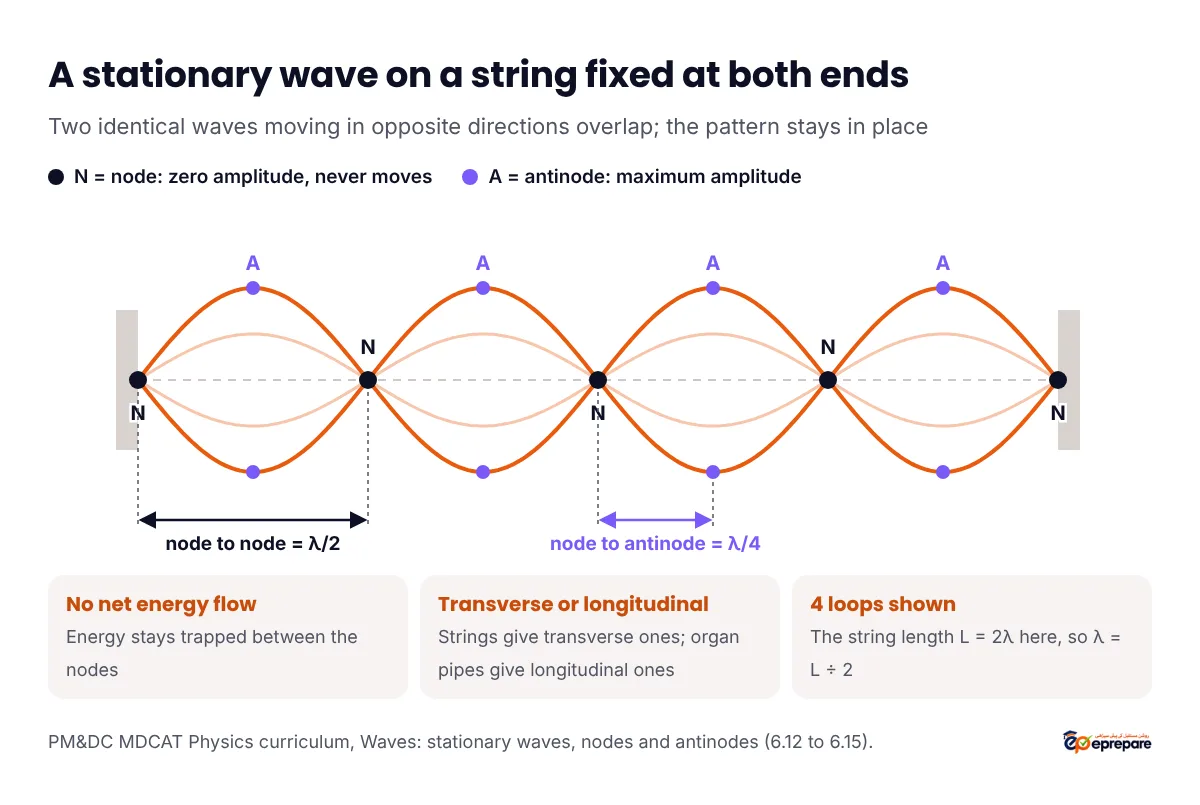
Stationary waves can be either type. On a stretched string they are transverse; in the air column of an organ pipe they are longitudinal. For a string fixed at both ends, the allowed frequencies are fn = nv ÷ 2L, where n = 1, 2, 3 and so on. The full treatment of strings and open and closed pipes is in our MDCAT Physics high-yield chapters and formula sheet.
Worked examples
Example 1: sound in air
A tuning fork of frequency 680 Hz produces sound in air. Taking the speed of sound as 340 m/s, find the wavelength and the distance between a compression and the next rarefaction.
- λ = v ÷ f = 340 ÷ 680 = 0.5 m.
- A compression to the next rarefaction is half a wavelength: 0.5 ÷ 2 = 0.25 m.
Example 2: a radio wave
A radio station broadcasts at 100 MHz. Find the wavelength of its waves in air (take the speed as 3 × 10⁸ m/s).
- Convert: 100 MHz = 100 × 106 Hz = 1 × 10⁸ Hz.
- λ = v ÷ f = (3 × 10⁸) ÷ (1 × 10⁸) = 3 m.
Example 3: reading a transverse wave
On a wave along a rope, a crest and the next trough are 0.6 m apart horizontally, and the vertical distance from the top of a crest to the bottom of a trough is 10 cm. Find the wavelength and the amplitude.
- Crest to next trough is half a wavelength, so λ = 2 × 0.6 = 1.2 m.
- Crest to trough vertically is twice the amplitude, so A = 10 ÷ 2 = 5 cm = 0.05 m.
Example 4: a stationary wave on a string
A string 1.2 m long, fixed at both ends, vibrates in 3 loops at 250 Hz. Find the wavelength and the wave speed.
- Each loop is λ/2, so 3 × λ/2 = 1.2 m, giving λ = 0.8 m.
- v = fλ = 250 × 0.8 = 200 m/s.
MDCAT shortcuts and common traps. Sound: longitudinal. Light, radio, X-rays and every EM wave: transverse. "Can be polarised" means transverse. Crest to the next trough, or compression to the next rarefaction, is λ/2, not λ. Crest-to-trough height is 2A, not A. Node to node is λ/2 and node to antinode is λ/4. Frequency does not change when a wave enters a new medium. Convert MHz and kHz to Hz, and cm to m, before using v = fλ.
Practice MCQs: transverse and longitudinal waves
Try each one before opening the answer. For more, practise the waves chapter in our MDCAT Physics MCQs.
Question 1
Which of the following is a longitudinal wave?
- Light
- Radio waves
- Sound in air
- X-rays
Show answer
Answer: C. Sound in air is longitudinal: air molecules vibrate back and forth along the direction of travel. Light, radio waves and X-rays are all electromagnetic waves, and every EM wave is transverse.
Question 2
In a sound wave of frequency 425 Hz, the distance between a compression and the next rarefaction is 0.4 m. What is the speed of the wave?
- 170 m/s
- 340 m/s
- 680 m/s
- 1062.5 m/s
Show answer
Answer: B. A compression to the next rarefaction is half a wavelength, so λ = 2 × 0.4 = 0.8 m. Then v = fλ = 425 × 0.8 = 340 m/s. Option A comes from forgetting to double 0.4 m.
Question 3
Which property of light shows that it is a transverse wave?
- Reflection
- Refraction
- Polarisation
- Interference
Show answer
Answer: C. Reflection, refraction and interference happen with both transverse and longitudinal waves (sound shows all three). Only transverse waves can be polarised, so polarisation proves light is transverse.
Question 4
In a stationary wave, the distance between a node and the next antinode is 15 cm. What is the wavelength?
- 15 cm
- 30 cm
- 45 cm
- 60 cm
Show answer
Answer: D. Node to next antinode is λ/4, so λ = 4 × 15 = 60 cm. Option B (30 cm) would be correct if 15 cm were the node-to-node distance, which is λ/2.
Question 5
A sound wave passes from air into water. Which quantity stays the same?
- Speed
- Wavelength
- Frequency
- Both speed and wavelength
Show answer
Answer: C. The frequency is fixed by the source and does not change from one medium to another. The speed changes with the medium, and since v = fλ with f fixed, the wavelength changes in proportion to the speed.
Frequently asked questions
Are electromagnetic waves longitudinal or transverse?
Transverse. In an electromagnetic wave the electric and magnetic fields vibrate at right angles to each other and to the direction of travel. This is true for every EM wave, from radio waves to gamma rays, and it is why all of them can be polarised.
Are sound waves longitudinal or transverse?
Longitudinal. The air molecules vibrate back and forth along the direction the sound travels, forming compressions and rarefactions. Sound cannot be polarised and cannot travel through a vacuum.
Are light waves transverse or longitudinal?
Light waves are transverse, because light is an electromagnetic wave. Polarisation of light is the evidence: only transverse waves can be polarised.
What is a transverse wave in physics?
A wave in which the particles of the medium (or, for EM waves, the electric and magnetic fields) vibrate perpendicular to the direction the wave travels. It forms crests and troughs. Waves on a string and light are examples.
What is the difference between transverse and longitudinal waves?
The direction of vibration. In transverse waves the vibration is perpendicular to the direction of travel, forming crests and troughs; in longitudinal waves it is parallel, forming compressions and rarefactions. Transverse waves can be polarised and longitudinal waves cannot.
What is a crest and a trough in physics?
In a transverse wave, a crest is the highest point, where a particle has its maximum displacement above the mean position, and a trough is the lowest point, where it has its maximum displacement below. The horizontal distance from a crest to the next trough is half a wavelength.
What is the amplitude of a longitudinal wave?
It is the maximum distance a particle moves from its mean position, measured along the direction of travel, because that is the direction the particles vibrate in. Amplitude has the same meaning in any vibration: for a pendulum, it is the maximum displacement of the bob from its mean (rest) position.
What are stationary waves?
Waves formed when two identical progressive waves travel in opposite directions along the same line and overlap. They have fixed nodes (zero amplitude) and antinodes (maximum amplitude), adjacent nodes are λ/2 apart, and they do not carry energy along. They can be transverse, as on a string, or longitudinal, as in an organ pipe.
Keep practising waves
Waves rewards students who know the definitions cold and can use v = fλ without hesitating. Check where this topic sits in the full MDCAT syllabus, then register on ePrepare to practise chapter-wise Physics MCQs with explained answers and see in your progress report which topics still need work.
Sources: PM&DC uniform MDCAT curriculum, Physics unit 6 (Waves) and outcome 12.3 (EM spectrum), as published by KMU; NIST CODATA value of the speed of light in vacuum.