Is evaporation endothermic or exothermic? What about boiling water, a synthesis reaction or an oxidation? These look like simple one-word questions, and MDCAT asks them that way. But the safe way to answer every one of them is to understand one idea: where the heat goes. This guide gives you the quick answers first, then the reasoning, the energy profile diagrams and the bond-energy method, so that no new example can catch you out.
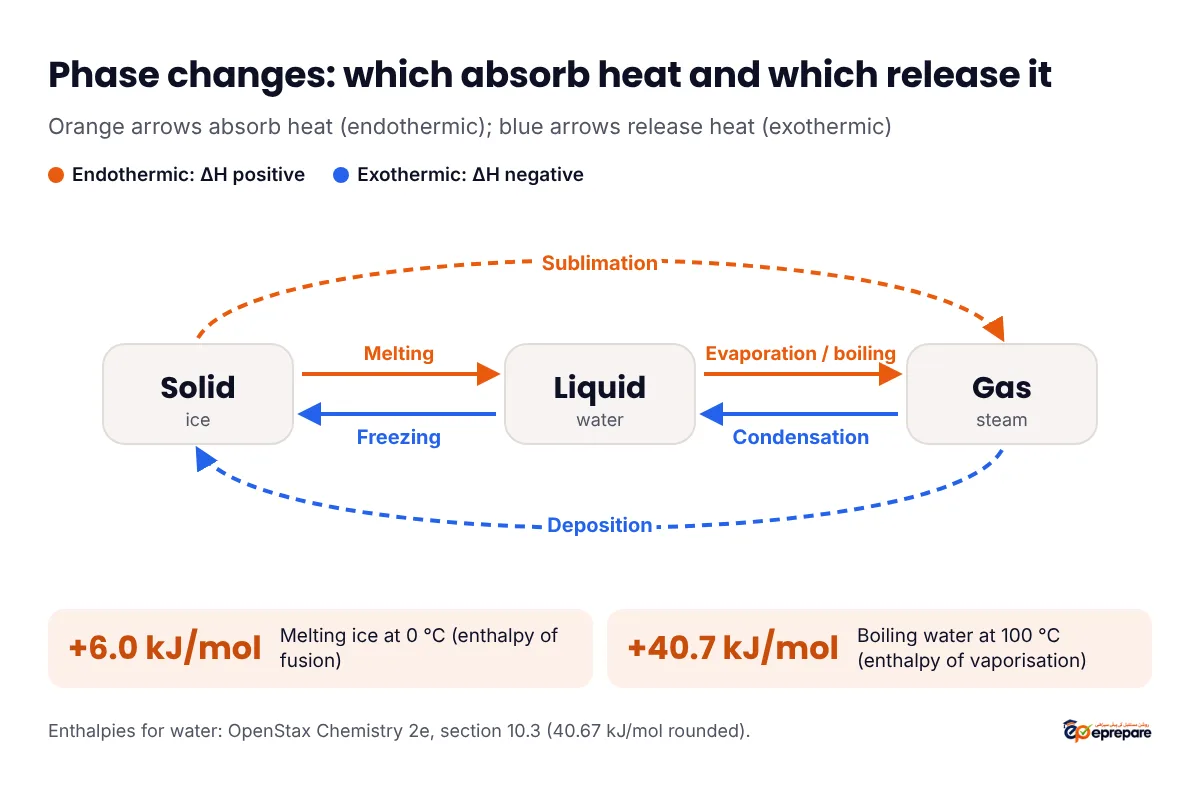
The short answer: an endothermic process absorbs heat from the surroundings (ΔH is positive); an exothermic process releases heat (ΔH is negative). Evaporation, boiling and melting are endothermic. Condensation, freezing and combustion are exothermic. Synthesis and oxidation reactions are usually exothermic, but not always, so check the ΔH.
Definitions and the sign of ΔH
In thermochemistry the system is the reaction or substance you are studying, and the surroundings are everything else: the beaker, the water, the air, your hand.
- Exothermic process: heat flows out of the system into the surroundings. The surroundings get warmer. Example: burning natural gas.
- Endothermic process: heat flows into the system from the surroundings. The surroundings get cooler. Example: ice melting in your hand.
The heat change at constant pressure is the enthalpy change, ΔH, measured in kJ mol−1:
ΔH = H(products) − H(reactants). If the products have less enthalpy than the reactants, ΔH is negative and the reaction is exothermic. If the products have more, ΔH is positive and it is endothermic.
| Feature | Exothermic | Endothermic |
|---|---|---|
| Heat flow | System → surroundings | Surroundings → system |
| Sign of ΔH | Negative (ΔH < 0) | Positive (ΔH > 0) |
| Temperature of surroundings | Rises | Falls |
| Enthalpy of products | Lower than reactants | Higher than reactants |
| Bond energies | Energy released making bonds > energy used breaking bonds | Energy used breaking bonds > energy released making bonds |
| Typical examples | Combustion, neutralisation, condensation, freezing, respiration | Evaporation, boiling, melting, photosynthesis, thermal decomposition |
One rule follows directly: if a reaction is exothermic in one direction, it is endothermic by exactly the same amount in reverse. Forming liquid water from hydrogen and oxygen has ΔH = −285.8 kJ mol−1, so splitting water back into hydrogen and oxygen needs +285.8 kJ mol−1.
Examples: endothermic or exothermic?
These are the processes students search for most, with a one-line reason for each. Learn the reason, not just the label.
| Process | Type | Why |
|---|---|---|
| Evaporation of water | Endothermic | Molecules need energy to escape the attractions of the liquid |
| Boiling water | Endothermic | Same change, liquid → gas, throughout the liquid |
| Melting (fusion) of ice | Endothermic | Energy loosens the fixed arrangement of the solid |
| Sublimation (iodine, dry ice) | Endothermic | Solid → gas: attractions must be overcome |
| Condensation (gas → liquid) | Exothermic | Attractions form again, releasing energy |
| Freezing (liquid → solid) | Exothermic | The reverse of melting |
| Combustion (burning) | Exothermic | Strong bonds in CO2 and H2O release more energy than is used |
| Neutralisation (acid + base) | Exothermic | H+ + OH− → H2O releases heat |
| Respiration | Exothermic | Glucose is oxidised to CO2 and water |
| Photosynthesis | Endothermic | Light energy is stored in glucose |
| Thermal decomposition (CaCO3 → CaO + CO2) | Endothermic | Needs continuous strong heating |
| Bond breaking | Endothermic | Energy is always needed to pull bonded atoms apart |
| Bond formation | Exothermic | Energy is always released when a bond forms |
| Ionisation energy (atom → positive ion) | Endothermic | Energy is needed to remove an electron |
| Electrolysis of water | Endothermic | Electrical energy drives a reaction with positive ΔH |
Is evaporation endothermic or exothermic?
Evaporation is endothermic. In a liquid, molecules are held together by intermolecular forces (hydrogen bonds, in the case of water). For a molecule to escape into the gas, it must have enough energy to break free of those attractions, and that energy is taken from the rest of the liquid and its surroundings. This is why sweating cools you: as sweat evaporates, it draws heat from your skin.
Is boiling water endothermic or exothermic?
Boiling water is endothermic. Boiling is the same change as evaporation (liquid → gas), but it happens throughout the liquid at the boiling point rather than only at the surface. The water keeps absorbing heat from the stove while its temperature stays at 100 °C; that heat is used to separate the molecules, not to raise the temperature. The enthalpy of vaporisation of water at its boiling point is about +40.7 kJ mol−1.
The trap: the burning gas under the pot is exothermic. The boiling water is endothermic. A question about "boiling water" is asking about the water.
Is gas to liquid endothermic or exothermic?
Gas to liquid (condensation) is exothermic. As the molecules come together, attractions form between them and energy is released. That is why a steam burn is worse than a burn from water at the same temperature: the steam releases its enthalpy of vaporisation as it condenses on the skin.
Synthesis, oxidation and SN2: it depends on the reaction
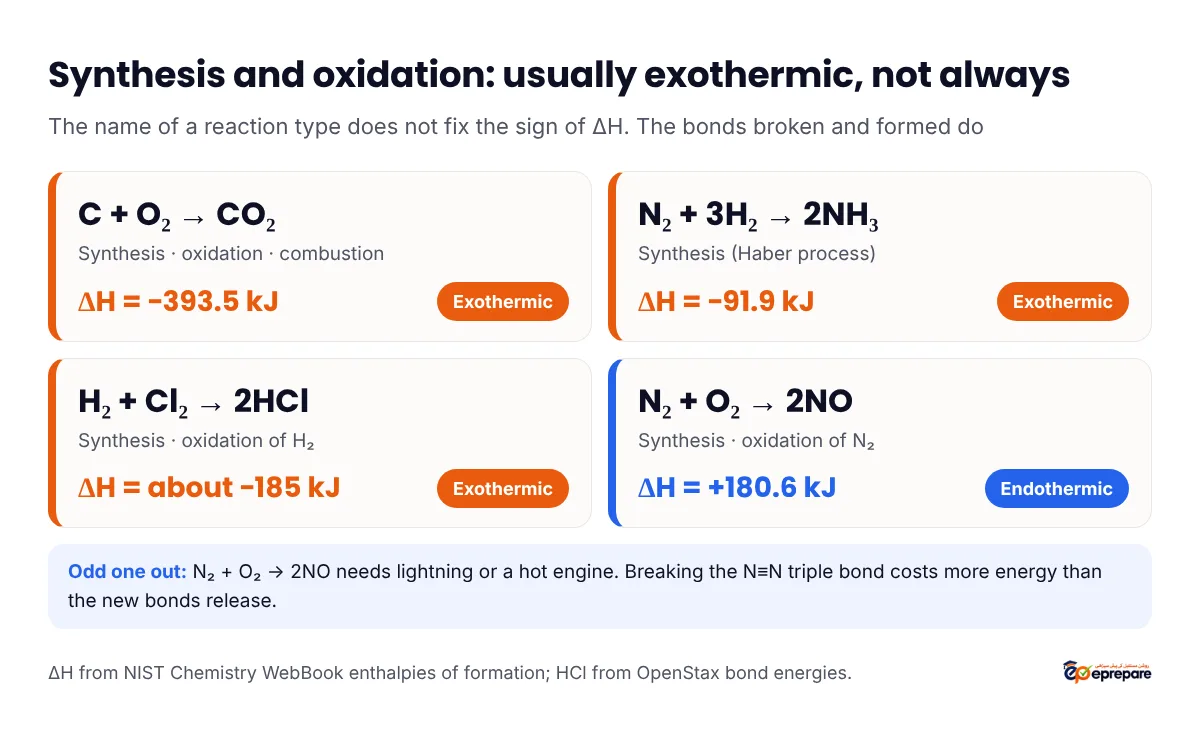
Words such as "synthesis", "oxidation" and "SN2" describe what kind of change happens, not which way the heat flows. Most of the examples you meet are exothermic, which is why students learn them as a rule, but the real answer comes from the ΔH of the particular reaction.
| Reaction | Kind | ΔH | Type |
|---|---|---|---|
| C + O2 → CO2 | Synthesis, oxidation, combustion | −393.5 kJ | Exothermic |
| N2 + 3H2 → 2NH3 (Haber process) | Synthesis | −91.9 kJ | Exothermic |
| H2 + Cl2 → 2HCl | Synthesis, oxidation of H2 | about −185 kJ | Exothermic |
| N2 + O2 → 2NO | Synthesis, oxidation of N2 | +180.6 kJ | Endothermic |
Is synthesis endothermic or exothermic?
Most synthesis (combination) reactions are exothermic, because new, strong bonds form. Burning carbon to CO2, the Haber process and H2 + Cl2 → 2HCl all release heat. But some syntheses are endothermic. Nitrogen and oxygen combine to form nitric oxide only at very high temperatures, such as in lightning or a car engine, and that reaction has ΔH = +180.6 kJ for 2 mol of NO. So the correct answer is "usually exothermic, but it depends on the reaction". The reverse of a synthesis, a decomposition, is usually endothermic for the same reason.
Is oxidation endothermic or exothermic?
Oxidation by oxygen is usually exothermic: combustion, rusting and respiration all release energy. But oxidation simply means loss of electrons (or gain of oxygen), and some oxidations absorb energy:
- The oxidation of N2 to NO is endothermic (ΔH = +180.6 kJ, as above).
- Removing an electron from a gaseous atom, Na(g) → Na+(g) + e−, is an oxidation, and its energy is the ionisation energy. Ionisation energy is always endothermic.
Is SN2 exothermic or endothermic?
SN2 is a mechanism (nucleophilic substitution in one step), so it has no fixed sign of ΔH. What SN2 does always have is a single energy hump: the nucleophile attacks as the leaving group departs, through one transition state, with no intermediate. Whether a particular SN2 reaction releases or absorbs heat depends on the bonds broken and formed. In an exam, answer from the data given, or describe the one-step energy profile.
Electron affinity, lattice energy and heat of hydrogenation
- Electron affinity: the first electron affinity of most non-metals, such as chlorine, is exothermic: the nucleus attracts the incoming electron and energy is released. The second electron affinity (for example O− → O2−) is always endothermic, because an electron is being forced onto an ion that is already negative.
- Lattice energy: the sign depends on the definition. Many FSc books define it as the energy released when one mole of an ionic solid forms from its gaseous ions, so it is exothermic (negative). Other books define it as the energy needed to separate the solid into gaseous ions and quote it as positive. Read the definition the question uses.
- Heat of hydrogenation: the enthalpy change when one mole of an unsaturated compound, such as an alkene, reacts with hydrogen to become saturated. Hydrogenation of alkenes is exothermic, so heats of hydrogenation are negative.
Energy profile diagrams
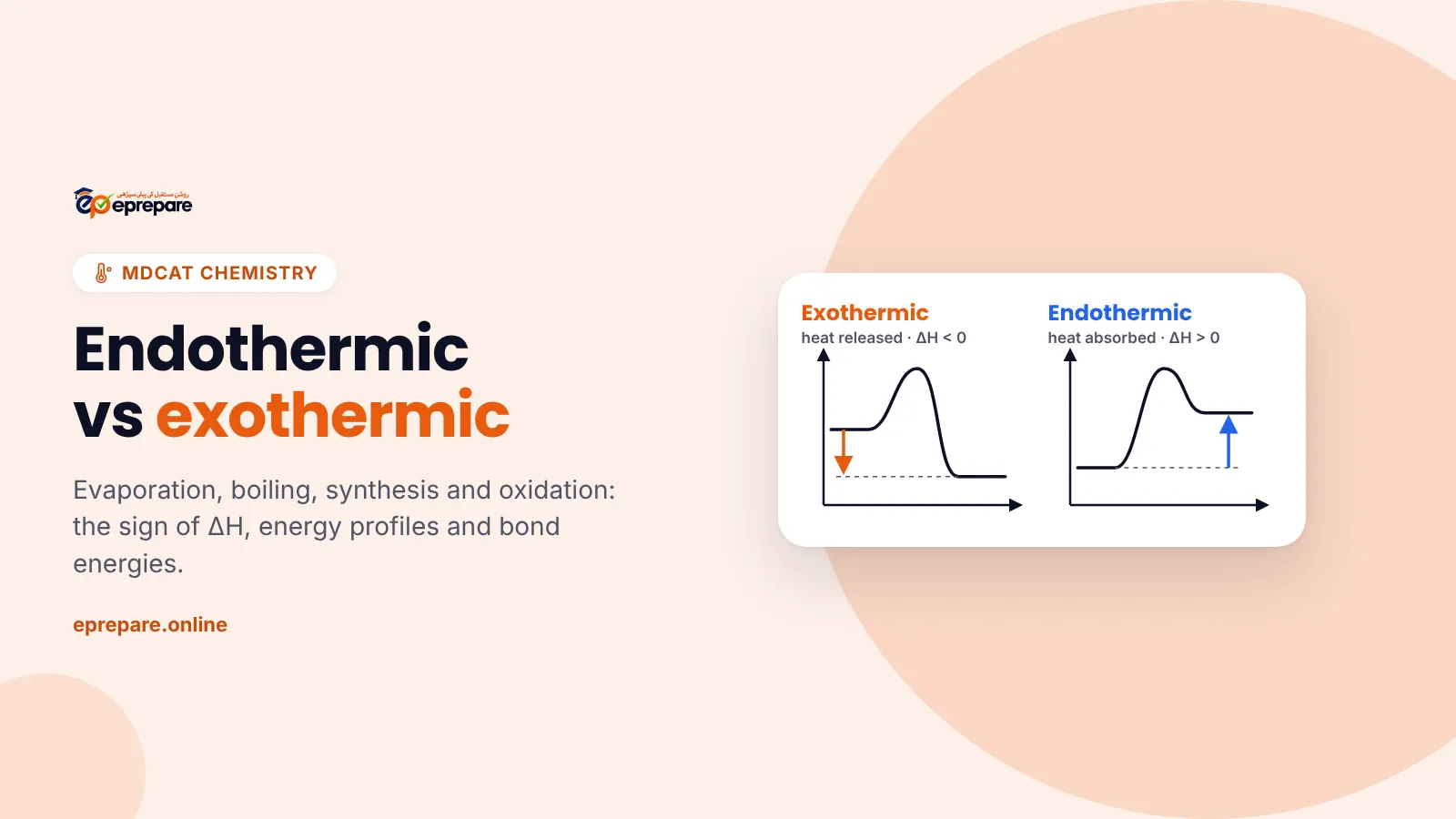
An energy profile diagram plots the energy of the reacting system against the progress of the reaction. It shows three things at once: the energy of the reactants, the energy of the products, and the energy barrier between them.
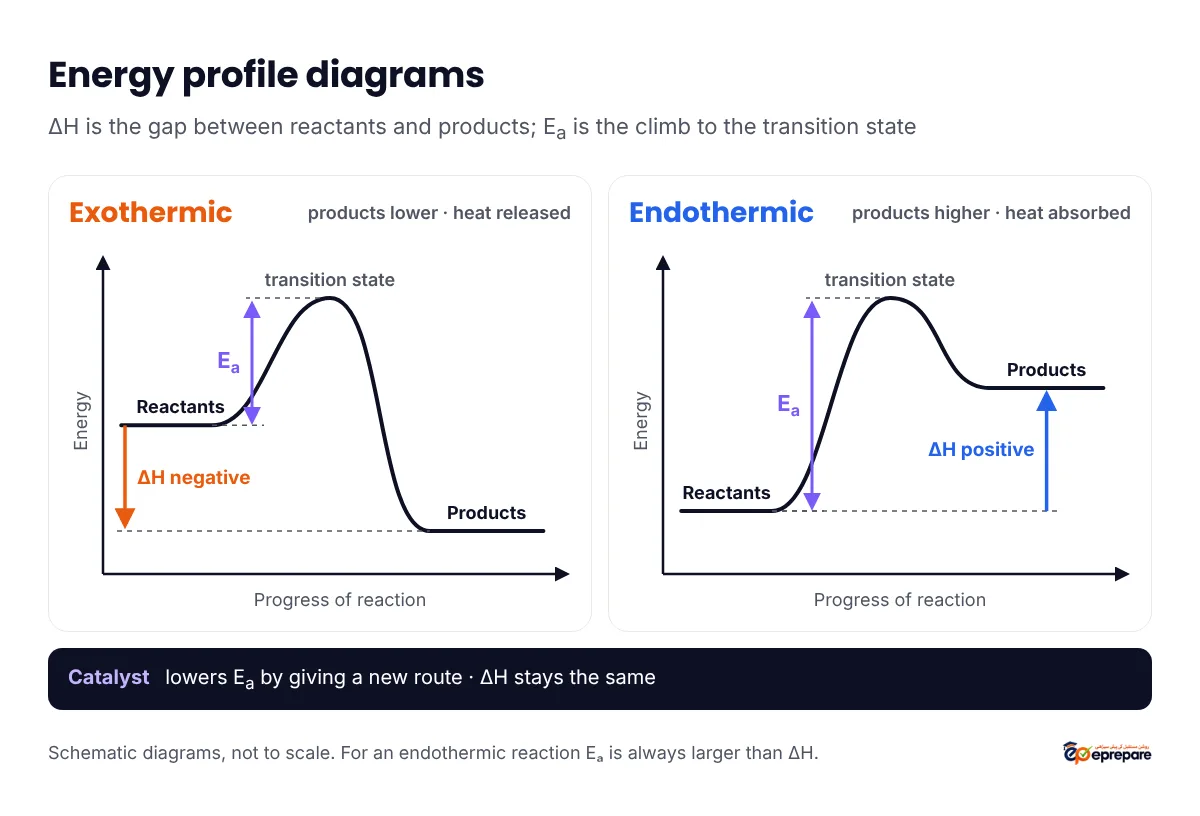
- Activation energy (Ea): the minimum energy the reactants need to reach the transition state at the top of the hump. Even exothermic reactions need it, which is why paper does not burst into flame until you light it.
- Transition state (activated complex): the highest-energy arrangement, where old bonds are partly broken and new bonds partly formed.
- ΔH: the vertical gap between reactants and products. It points down for exothermic and up for endothermic.
- For an endothermic reaction, Ea is always larger than ΔH, because the hump must rise above the products.
- A catalyst provides a route with a lower Ea. It does not change ΔH, because the reactants and products are the same.
Bond breaking vs bond making
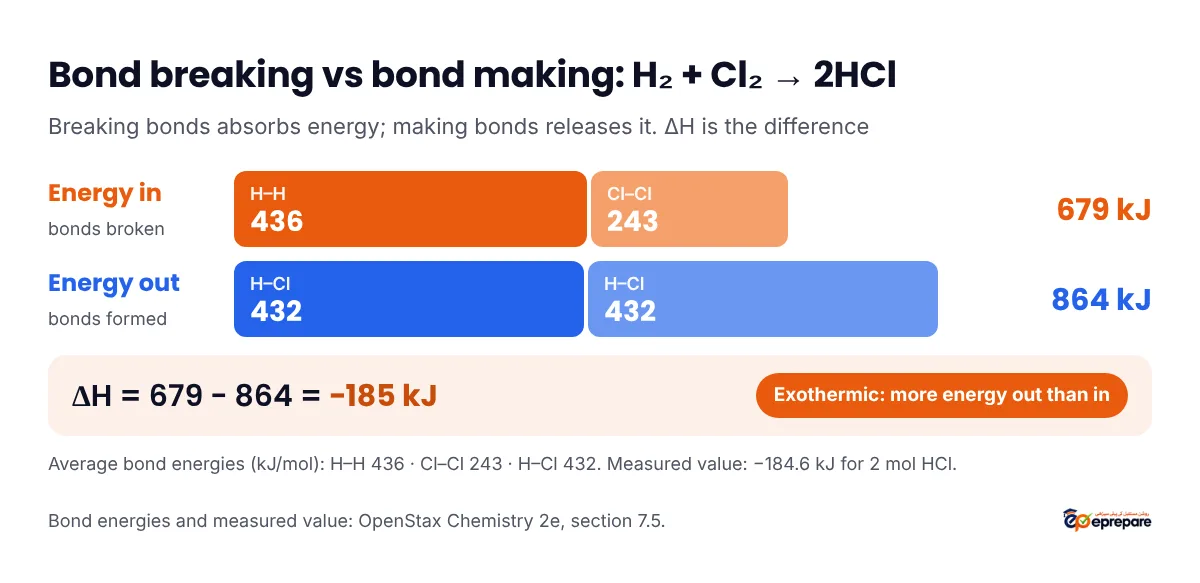
Every reaction breaks some bonds and makes others. Breaking a bond always absorbs energy; making a bond always releases energy. The overall ΔH is the balance between the two:
ΔH ≈ Σ(bond energies of bonds broken) − Σ(bond energies of bonds formed). If more energy is released making bonds than is used breaking them, ΔH is negative and the reaction is exothermic.
Worked examples
Example 1: ΔH from bond energies
Calculate ΔH for H2(g) + Cl2(g) → 2HCl(g). Average bond energies: H–H 436, Cl–Cl 243, H–Cl 432 kJ mol−1.
- Bonds broken: one H–H and one Cl–Cl = 436 + 243 = 679 kJ (energy in).
- Bonds formed: two H–Cl = 2 × 432 = 864 kJ (energy out).
- ΔH = 679 − 864 = −185 kJ. Exothermic.
This agrees closely with the measured value of −184.6 kJ for two moles of HCl. Bond energies are averages, so answers from them are close, not exact.
Example 2: heat released by burning methane
CH4 + 2O2 → CO2 + 2H2O(l), ΔH = −890 kJ mol−1. How much heat is released when 8.0 g of methane burns?
- Molar mass of CH4 = 12 + 4 × 1 = 16 g mol−1.
- Moles = 8.0 ÷ 16 = 0.50 mol.
- Heat released = 0.50 × 890 = 445 kJ (ΔH = −445 kJ for this amount).
Example 3: heat needed to boil water
How much heat is needed to turn 9.0 g of water at 100 °C into steam at 100 °C? ΔHvap = +40.7 kJ mol−1.
- Moles of water = 9.0 ÷ 18 = 0.50 mol.
- Heat absorbed = 0.50 × 40.7 = 20.4 kJ (rounded). Endothermic, so ΔH = +20.4 kJ.
Example 4: reversing a reaction
Given H2 + ½O2 → H2O(l), ΔH = −285.8 kJ mol−1, find ΔH for 2H2O(l) → 2H2 + O2.
- Reverse the equation: the sign changes, so +285.8 kJ per mole of water.
- Double it for two moles: ΔH = +571.6 kJ. Endothermic, which is why electrolysis needs a continuous supply of electrical energy.
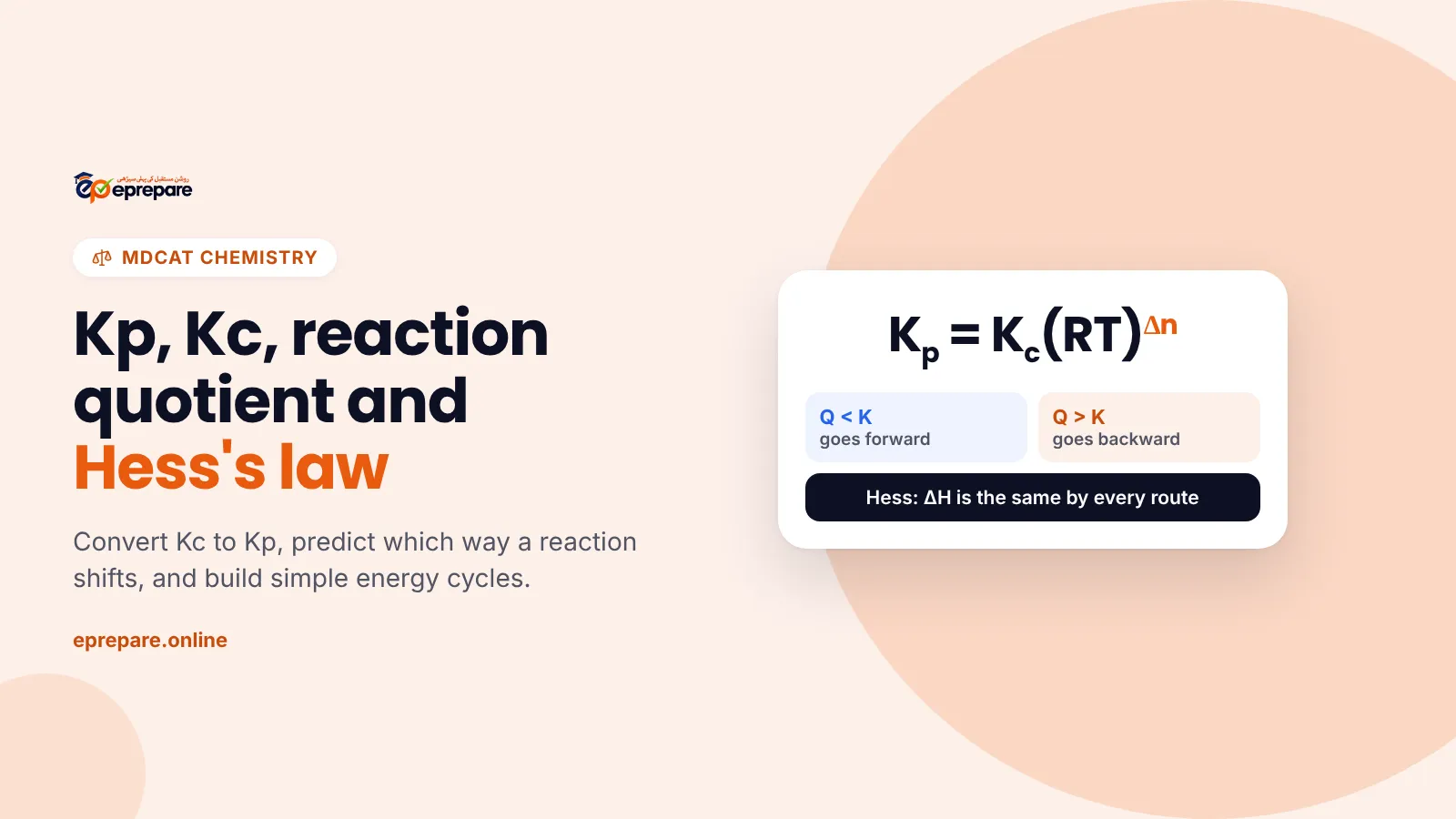
This kind of reversing and adding of equations is the basis of Hess's law: the total enthalpy change of a reaction is the same whatever route it takes, because enthalpy is a state function.
MDCAT shortcuts and common traps: (1) Towards the gas (melting, evaporation, boiling, sublimation) = endothermic; towards the solid (condensation, freezing, deposition) = exothermic. (2) "Boiling water" is endothermic even though the flame under it is exothermic. (3) Bond breaking is always endothermic and bond making always exothermic: never the other way round. (4) Synthesis and oxidation are usually exothermic, but N2 + O2 → 2NO is endothermic. (5) Ionisation energy is always endothermic; first electron affinity is usually exothermic, the second always endothermic. (6) A catalyst lowers Ea but never changes ΔH. (7) Reversing a reaction flips the sign of ΔH; doubling it doubles ΔH.
Practice MCQs on endothermic and exothermic processes
Try each one before opening the answer. More are waiting in our MDCAT Chemistry MCQs.
Question 1
Which of the following processes is exothermic?
- Evaporation of water
- Melting of ice
- Condensation of steam
- Sublimation of iodine
Show answer
Answer: C. Condensation (gas → liquid) releases energy as intermolecular attractions form again. Evaporation, melting and sublimation all absorb energy.
Question 2
Using the bond energies H–H = 436, I–I = 150 and H–I = 295 kJ mol−1, ΔH for H2(g) + I2(g) → 2HI(g) is about:
- +4 kJ
- −4 kJ
- −295 kJ
- +586 kJ
Show answer
Answer: B. Bonds broken = 436 + 150 = 586 kJ. Bonds formed = 2 × 295 = 590 kJ. ΔH = 586 − 590 = −4 kJ, so the reaction is very slightly exothermic.
Question 3
In the energy profile diagram of an endothermic reaction:
- the products lie below the reactants
- ΔH is negative
- there is no activation energy
- the products lie above the reactants and Ea is greater than ΔH
Show answer
Answer: D. In an endothermic reaction the products have more enthalpy than the reactants, so ΔH is positive. The activation energy hump must rise above the products, so Ea is larger than ΔH.
Question 4
Adding a catalyst to a reaction:
- lowers the activation energy but leaves ΔH unchanged
- makes ΔH more negative
- turns an endothermic reaction into an exothermic one
- raises the activation energy
Show answer
Answer: A. A catalyst offers an alternative route with a lower Ea. The reactants and products are unchanged, so ΔH is unchanged.
Question 5
For N2(g) + O2(g) → 2NO(g), ΔH = +180.6 kJ. Which statement is correct?
- It is exothermic because it is a synthesis reaction
- It is exothermic because nitrogen is oxidised
- It is endothermic: more energy is needed to break the bonds than is released forming the new ones
- The reverse reaction, 2NO → N2 + O2, is also endothermic
Show answer
Answer: C. A positive ΔH means endothermic, whatever the type of reaction. Breaking the very strong N≡N triple bond costs more energy than forming the bonds in two NO molecules releases. The reverse reaction is exothermic, with ΔH = −180.6 kJ.
Thermochemistry is one of the physical chemistry units listed in our MDCAT Chemistry high-yield chapters guide. The official learning outcomes, including classifying reactions as exothermic and endothermic and Hess's law, are in the MDCAT syllabus. To see why evaporation depends on attractions between molecules, read our guide to intermolecular forces.
Frequently asked questions
Is evaporation endothermic or exothermic?
Evaporation is endothermic. Molecules need energy to overcome the attractions holding them in the liquid, and they take it from the surroundings, which is why evaporation causes cooling.
Is boiling water endothermic or exothermic?
Boiling water is endothermic. The water absorbs heat (about 40.7 kJ per mole at 100 °C) to change from liquid to gas, and its temperature stays at the boiling point until all of it has turned to steam.
Is synthesis endothermic or exothermic?
Most synthesis reactions are exothermic because strong new bonds form, for example the Haber process (ΔH = −91.9 kJ for 2 mol NH3). But some are endothermic, such as N2 + O2 → 2NO (ΔH = +180.6 kJ). Check the ΔH of the reaction.
Is oxidation endothermic or exothermic?
Oxidation by oxygen, such as combustion, rusting and respiration, is usually exothermic. Not every oxidation is: the oxidation of nitrogen to nitric oxide is endothermic, and removing an electron from a gaseous atom (ionisation energy) is always endothermic.
Is bond formation endothermic or exothermic?
Bond formation is always exothermic: energy is released when two atoms bond. Bond breaking is always endothermic. Whether a whole reaction is exothermic depends on which of the two is larger.
Is the Haber process exothermic?
Yes. N2 + 3H2 ⇌ 2NH3 has ΔH = −91.9 kJ for 2 mol of ammonia, so it is exothermic. By Le Chatelier's principle, a lower temperature would favour more ammonia, but the reaction would be too slow, so a compromise temperature and an iron catalyst are used.
Is electrolysis endothermic or exothermic?
The reactions driven by electrolysis are endothermic. Splitting water, 2H2O → 2H2 + O2, has ΔH = +571.6 kJ, and the electrical energy supplies it.
Is ionisation energy endothermic or exothermic?
Ionisation energy is always endothermic, because energy must be supplied to pull an electron away from the attraction of the nucleus.
Thermochemistry rewards students who understand the sign of ΔH rather than memorising lists. Practise it in the ePrepare question bank, where every MCQ has a worked explanation, and use the Quiz Builder to mix thermochemistry with the other physical chemistry units before your mocks. Create a free ePrepare account to start.
Sources: standard enthalpies of formation of H2O(l), CO2, NH3 and NO, and the enthalpy of combustion of methane, from the NIST Chemistry WebBook; enthalpies of vaporisation and fusion of water from OpenStax Chemistry 2e, section 10.3; sign convention for ΔH and Hess's law from OpenStax Chemistry 2e, section 5.3; average bond energies and the H2 + Cl2 example from OpenStax Chemistry 2e, section 7.5; learning outcomes from the PM&DC MDCAT curriculum (Chemistry, thermochemistry unit).