Why is water a liquid at room temperature while hydrogen sulfide, a heavier molecule, is a gas? Why is iodine a solid but fluorine a gas? The answers come from intermolecular forces: the attractions between molecules. MDCAT tests them directly ("which force is present in…?") and indirectly, through boiling points, solubility and the structure of DNA and proteins. This guide defines each force, compares them in one table, and shows how they decide boiling points.
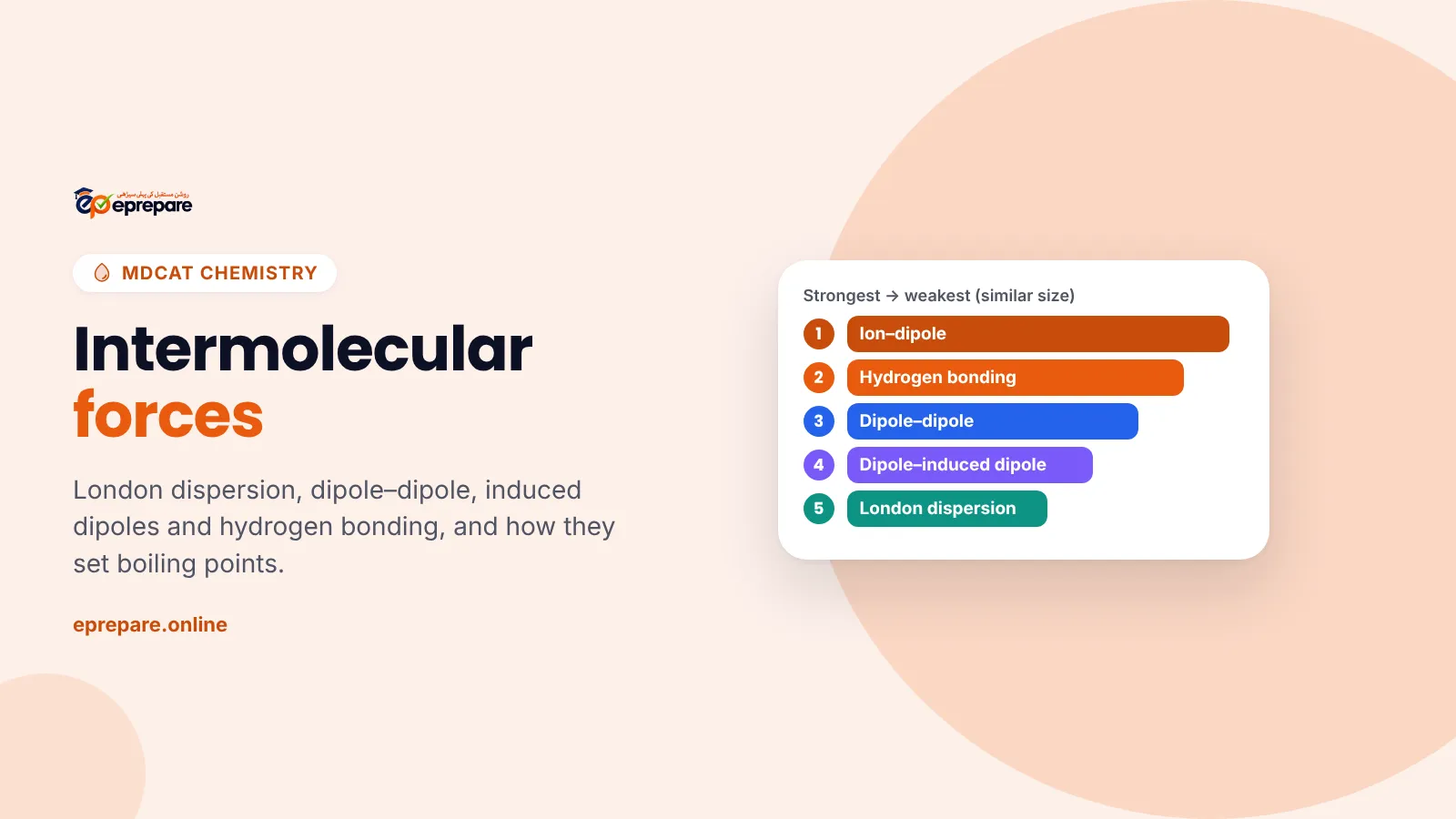
The short answer: intermolecular forces are the attractions between molecules. In order of strength for molecules of similar size: ion–dipole > hydrogen bonding > dipole–dipole > dipole–induced dipole > London dispersion. London dispersion forces act between all molecules; they arise from temporary dipoles and grow stronger as molecules get bigger.
What are intermolecular forces?
Intermolecular forces are the attractive forces between neighbouring molecules (or between molecules and ions). They are different from intramolecular forces, the covalent bonds that hold the atoms together inside each molecule.
Intermolecular forces are much weaker than covalent bonds. Turning one mole of liquid HCl into gas, which only overcomes the forces between molecules, takes about 17 kJ. Breaking the H–Cl bonds themselves takes about 430 kJ, roughly 25 times more. That is why boiling water gives you steam (H2O molecules), not hydrogen and oxygen.
All the intermolecular forces in this guide are electrostatic: a positive charge (full or partial) attracting a negative one. They differ in where those charges come from. Some textbooks group the dipole–dipole, dipole–induced dipole and London forces together as van der Waals forces.
What is a dipole in chemistry?
A dipole is a separation of positive and negative charge over a distance. In a polar covalent bond, such as H–Cl, the more electronegative atom pulls the shared electrons towards itself, so it carries a partial negative charge (δ−) and the other atom a partial positive charge (δ+). This is a bond dipole, drawn as an arrow pointing towards the negative end.
A molecule with an overall dipole is a polar molecule. Whether the bond dipoles add up or cancel depends on the shape: H2O (bent) and NH3 (pyramidal) are polar, but CO2 (linear) and CCl4 (tetrahedral) are nonpolar because their bond dipoles cancel. The size of a molecule's dipole is its dipole moment (charge × distance), measured in debye (D). For how electronegativity decides bond polarity, see our guide to ionic vs covalent bonds.
The types of intermolecular forces
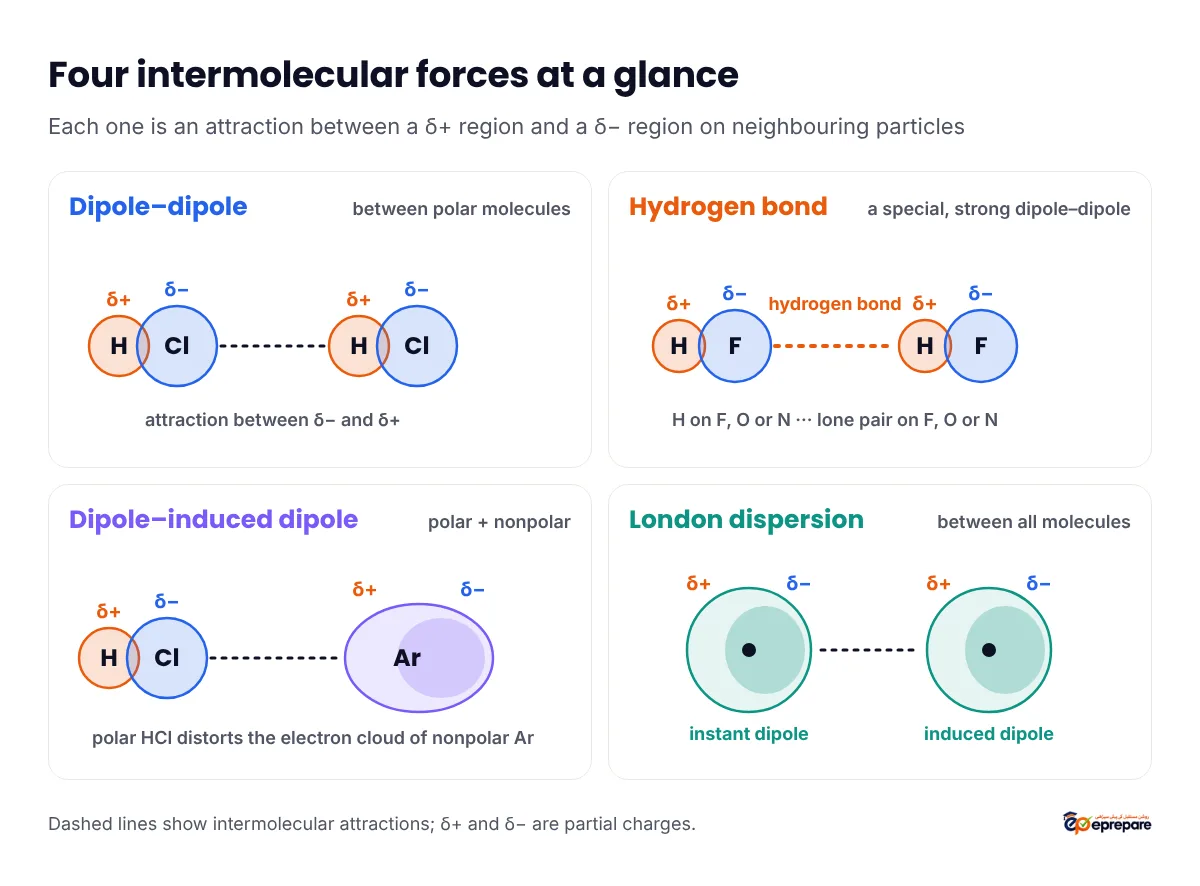
London dispersion forces
London dispersion forces are weak attractions caused by temporary dipoles. Electrons are always moving, so at any instant the electron cloud of an atom or molecule may be slightly more on one side than the other. That momentary (instantaneous) dipole distorts the electron cloud of a neighbouring molecule, creating an induced dipole, and the two attract. A moment later the dipoles vanish and reform elsewhere.
- They act between all atoms and molecules, polar or not. For nonpolar substances (noble gases, H2, N2, Cl2, CH4, CO2, I2) they are the only intermolecular force.
- They grow with size. A large atom or molecule has more electrons, held further from the nucleus, so its electron cloud distorts more easily (it is more polarisable). That is why the boiling points of the halogens and the noble gases rise down the group.
- They depend on shape. Long, straight molecules touch each other over a larger surface than compact, branched ones, so they attract more strongly.
Dipole–dipole forces
Dipole–dipole forces are attractions between the δ+ end of one polar molecule and the δ− end of another. They act only between polar molecules, which line up so that opposite ends are close together. Examples: HCl, H2S, SO2, CHCl3, CH3Cl and propanone (acetone). Polar molecules also have London forces, so dipole–dipole forces add to them.
Which molecules have dipole–dipole forces? Any polar molecule. Check two things: does it have polar bonds, and does its shape stop the bond dipoles from cancelling? HCl and H2S do; CO2, CH4, CCl4 and BF3 do not.
What is an induced dipole?
An induced dipole is a temporary dipole created in a nonpolar atom or molecule when a nearby charge or dipole distorts its electron cloud. When a polar molecule such as HCl approaches an argon atom, the δ− end of HCl pushes argon's electrons away (or the δ+ end pulls them closer), and argon becomes slightly polar for as long as the HCl is near. The resulting attraction is a dipole–induced dipole force (also called a Debye force). It explains why small amounts of nonpolar gases such as O2 and N2 dissolve in water, which matters for aquatic life. In London forces, the dipole that does the inducing is itself temporary.
Hydrogen bonding
A hydrogen bond is an especially strong dipole–dipole attraction between a hydrogen atom covalently bonded to fluorine, oxygen or nitrogen and a lone pair on an F, O or N atom of a neighbouring molecule. It is written with dots or a dashed line: O–H···O.
Two features make it strong. F, O and N are the most electronegative elements, so the H–F, H–O and H–N bonds are very polar. And hydrogen is tiny, with no inner electrons, so its δ+ charge can come very close to the lone pair. Even so, a hydrogen bond is only about 5 to 10% as strong as a covalent bond.
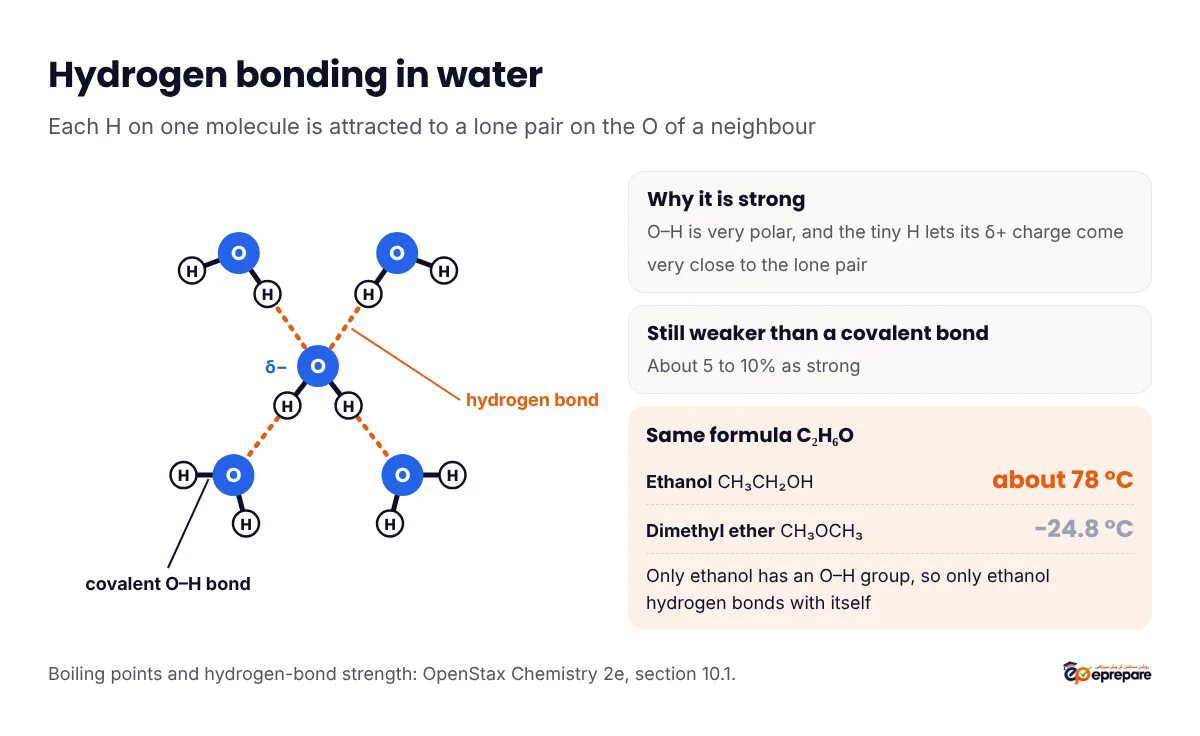
The examples in the MDCAT curriculum are H2O, NH3 and HF. Hydrogen bonding also explains:
- the high boiling point of water compared with H2S (see below);
- why ice floats: in ice, hydrogen bonds hold the molecules in an open hexagonal arrangement, so ice is less dense than liquid water;
- why alcohols and carboxylic acids have higher boiling points than hydrocarbons of similar mass, and why small alcohols mix with water;
- base pairing in DNA (A with T, G with C) and the shapes of proteins, which links Chemistry directly to MDCAT Biology.
The trap: CH4, HCl and H2S contain hydrogen, but they do not form hydrogen bonds. The hydrogen must be bonded to F, O or N.
Ion–dipole forces
An ion–dipole force is the attraction between an ion and a polar molecule. When NaCl dissolves in water, the δ− oxygen ends of water molecules cluster around each Na+ ion and the δ+ hydrogen ends around each Cl− ion. Because one partner has a full charge, ion–dipole forces are the strongest of the forces in this guide. They are why ionic compounds dissolve in polar solvents such as water. Solid NaCl itself has no dipole–dipole forces: it is held together by ionic bonds.
Comparison table of intermolecular forces
| Force | Acts between | Cause | Examples |
|---|---|---|---|
| Ion–dipole | An ion and a polar molecule | Full charge attracts a partial charge | Na+ and Cl− in water |
| Hydrogen bonding | H on F, O or N and a lone pair on F, O or N | Very polar bond and a tiny H atom | H2O, NH3, HF, ethanol, DNA bases |
| Dipole–dipole | Polar molecules | Permanent δ+ and δ− ends | HCl, H2S, SO2, propanone |
| Dipole–induced dipole | A polar and a nonpolar molecule | A dipole distorts a neighbour's electron cloud | HCl and Ar; O2 dissolved in water |
| London dispersion | All molecules (the only force in nonpolar ones) | Temporary dipole induces a dipole | He, Cl2, I2, CH4, CO2 |
The strength order, and its one big exception
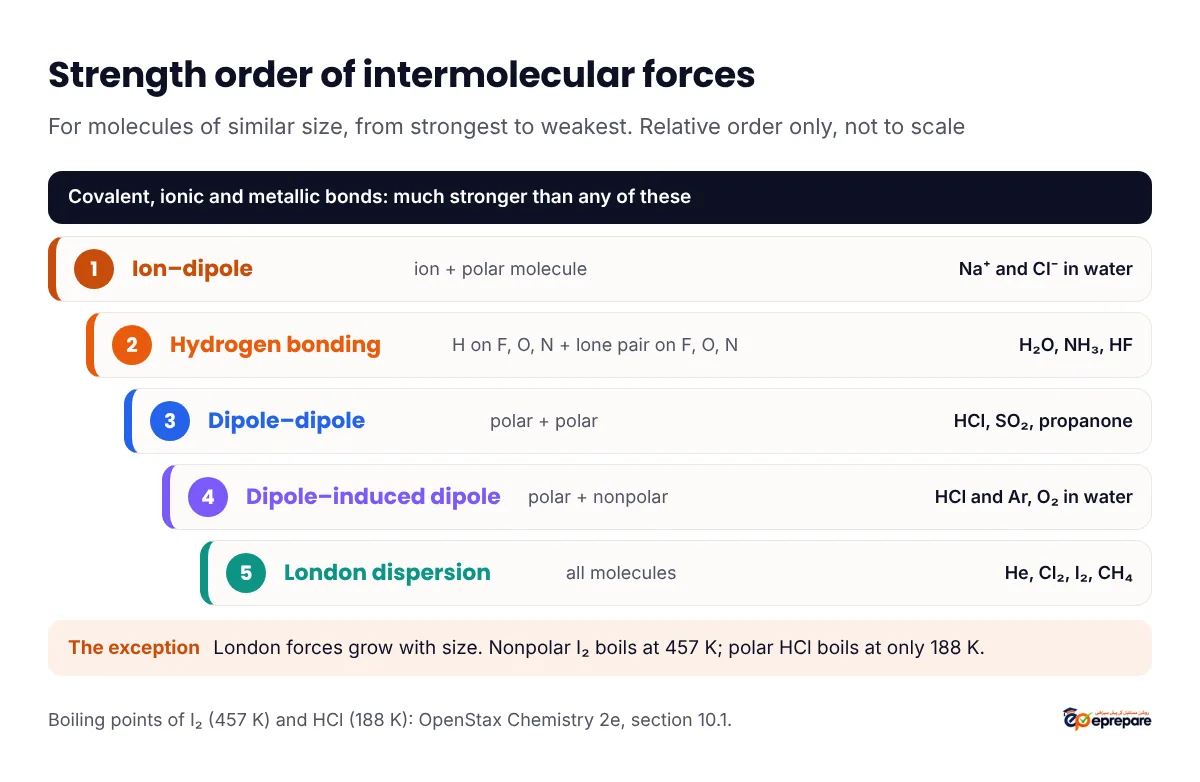
Strength order (similar-sized molecules): ion–dipole > hydrogen bonding > dipole–dipole > dipole–induced dipole > London dispersion. All of them are much weaker than covalent, ionic and metallic bonds.
The phrase "similar size" matters. London forces grow with the number of electrons, so in a large molecule they can outweigh the dipole–dipole forces of a small polar molecule. Iodine (I2) is nonpolar, with only London forces, yet it is a solid that boils at 457 K. Hydrogen chloride is polar, with dipole–dipole forces as well, yet it boils at only 188 K. The many electrons of I2 make its London forces stronger than all the forces between the small HCl molecules.
How intermolecular forces affect boiling point
To boil a liquid, the molecules must be separated from one another. The stronger the intermolecular forces, the more energy this takes, and the higher the boiling point. The same reasoning applies to melting points, enthalpies of vaporisation and viscosity, and in reverse to vapour pressure: strong forces mean fewer molecules escape, so the vapour pressure is lower.
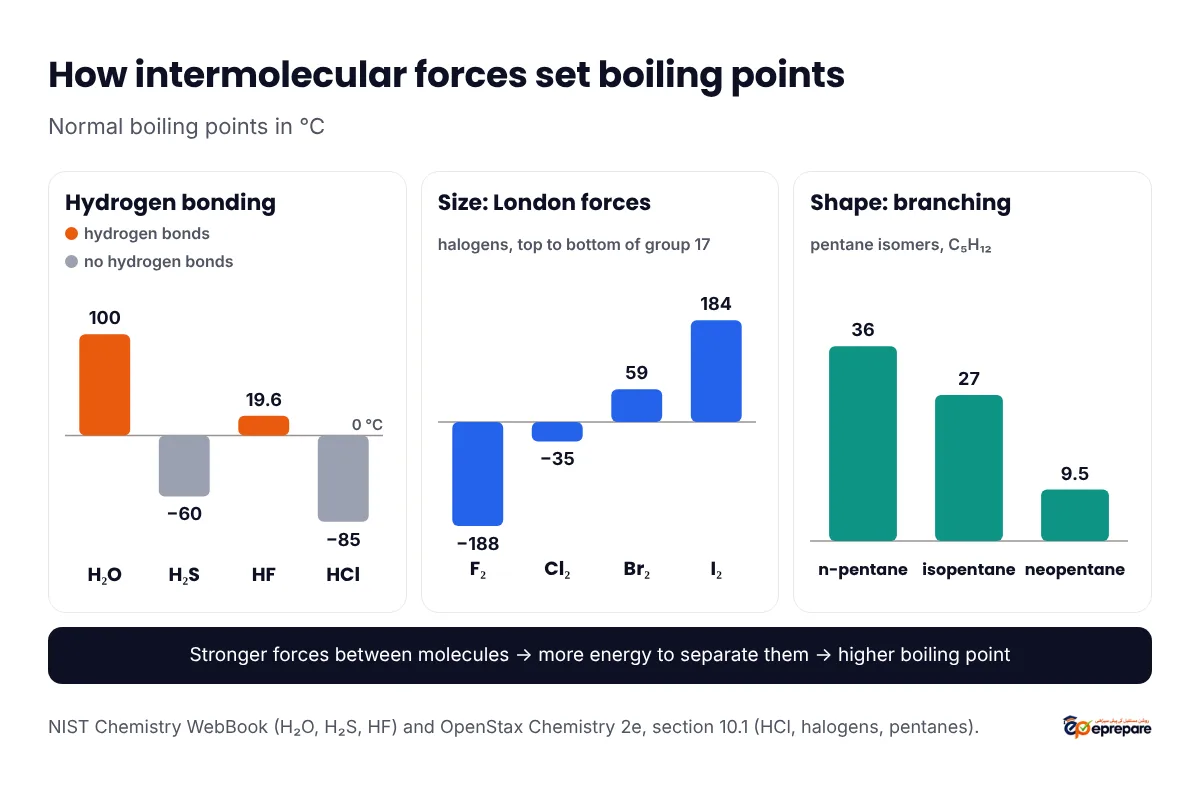
1. Hydrogen bonding raises boiling points sharply
| Pair | Boiling points | Reason |
|---|---|---|
| H2O vs H2S | 100 °C vs −60 °C | Water hydrogen bonds; H2S does not, though it is heavier |
| HF vs HCl | 19.6 °C vs −85 °C | HF hydrogen bonds; HCl has dipole–dipole forces only |
| Ethanol vs dimethyl ether (both C2H6O) | about 78 °C vs −24.8 °C | Ethanol has an O–H group; the ether has no H on O |
Without hydrogen bonding, the trend down a group would predict water boiling far below 0 °C. Its boiling point of 100 °C is one of the clearest signs of how strong hydrogen bonds are.
2. Bigger molecules have stronger London forces
The halogens are all nonpolar, so only London forces act between their molecules. As the molecules get bigger down the group, the forces and the boiling points rise: F2 (85 K, −188 °C) and Cl2 (238 K, −35 °C) are gases at room temperature, Br2 (332 K, 59 °C) is a liquid, and I2 (457 K, 184 °C) is a solid. The noble gases and the straight-chain alkanes follow the same pattern.
3. Branching lowers the boiling point
n-Pentane, isopentane and neopentane all have the formula C5H12 and the same number of electrons. But n-pentane is a long chain (36 °C), isopentane is branched (27 °C) and neopentane is almost spherical (9.5 °C). The more compact the molecule, the smaller the area of contact between neighbours, and the weaker the London forces.
Worked example: arrange in order of increasing boiling point
Arrange CH4, HF, HCl and Ne in order of increasing boiling point.
- Identify the forces. Ne and CH4 are nonpolar: London forces only. HCl is polar: dipole–dipole plus London. HF hydrogen bonds.
- Compare the London-only pair. Ne (10 electrons) and CH4 (10 electrons) have the same number of electrons, but CH4 is a larger molecule and more polarisable, so its boiling point is higher.
- Place the polar molecules. HCl (dipole–dipole) comes next, and HF (hydrogen bonding) is highest.
- Answer: Ne < CH4 < HCl < HF.
MDCAT shortcuts and common traps: (1) London forces act between all molecules; nonpolar molecules have nothing else. (2) Hydrogen bonding needs H bonded directly to F, O or N: CH4, HCl and H2S do not hydrogen bond. (3) The strength order only holds for molecules of similar size; big nonpolar molecules such as I2 can beat small polar ones such as HCl. (4) Branching lowers boiling point; a longer chain raises it. (5) Boiling breaks intermolecular forces, not covalent bonds. (6) Ion–dipole forces explain why salts dissolve in water; solid NaCl is held by ionic bonds, not dipole–dipole forces.
Practice MCQs on intermolecular forces
Answer each one before opening the explanation. Find many more in our MDCAT Chemistry MCQs.
Question 1
Which of the following molecules can form hydrogen bonds with each other?
- CH4
- H2S
- NH3
- HCl
Show answer
Answer: C. In NH3, hydrogen is bonded to nitrogen, which also has a lone pair, so N–H···N hydrogen bonds form. In CH4, H2S and HCl, hydrogen is bonded to C, S or Cl, which are not electronegative enough.
Question 2
The only intermolecular force present between molecules of iodine, I2, is:
- London dispersion forces
- dipole–dipole forces
- hydrogen bonding
- ion–dipole forces
Show answer
Answer: A. I2 is a nonpolar molecule of two identical atoms, so it has no permanent dipole. Only London dispersion forces act, and because I2 is large and polarisable they are strong enough to make iodine a solid.
Question 3
Water (H2O) boils at 100 °C but hydrogen sulfide (H2S) boils at about −60 °C. The main reason is that:
- H2S has a larger molar mass
- the O–H covalent bond is stronger than the S–H bond
- H2O is nonpolar
- water molecules form hydrogen bonds with one another
Show answer
Answer: D. Boiling separates molecules; it does not break covalent bonds, so option B is irrelevant. Water forms strong hydrogen bonds between molecules; H2S cannot, so despite its larger molar mass it boils far lower.
Question 4
Which of the following has the lowest boiling point?
- n-pentane
- neopentane
- isopentane
- All three are the same because they have the same formula
Show answer
Answer: B. All three are C5H12, but neopentane is the most branched and almost spherical. It has the smallest surface of contact, the weakest London forces and the lowest boiling point (9.5 °C, compared with 27 °C for isopentane and 36 °C for n-pentane).
Question 5
When oxygen gas dissolves slightly in water, the main attraction between O2 and H2O is:
- hydrogen bonding
- ion–dipole attraction
- dipole–induced dipole attraction
- covalent bonding
Show answer
Answer: C. Water is polar and O2 is nonpolar. The dipole of a water molecule distorts the electron cloud of O2, inducing a temporary dipole, and the two attract weakly.
Intermolecular forces sit in the states of matter units (gases, liquids and solids) and connect to bonding and polarity. See where they fit in our MDCAT Chemistry high-yield chapters guide, and check the official learning outcomes, including hydrogen bonding in H2O, NH3 and HF, in the MDCAT syllabus. Evaporation and boiling are endothermic for exactly the reasons above; see endothermic vs exothermic processes.
Frequently asked questions
What are intermolecular forces?
Intermolecular forces are the attractions between molecules (or between molecules and ions). They include ion–dipole forces, hydrogen bonding, dipole–dipole forces, dipole–induced dipole forces and London dispersion forces. They are much weaker than the covalent bonds inside molecules.
What are London dispersion forces?
London dispersion forces are weak attractions that arise when a temporary, instantaneous dipole in one atom or molecule induces a dipole in a neighbour. They act between all molecules, are the only force between nonpolar molecules, and get stronger as molecules get larger and more polarisable.
What are dipole–dipole forces?
Dipole–dipole forces are attractions between the partially positive end of one polar molecule and the partially negative end of another, as in HCl or SO2. They are stronger than London forces for molecules of similar size.
What is an induced dipole?
An induced dipole is a temporary dipole created in a nonpolar atom or molecule when a nearby ion or dipole distorts its electron cloud. The attraction it produces with a polar molecule is called a dipole–induced dipole force.
What is a dipole in chemistry?
A dipole is a separation of positive and negative charge. In a polar bond such as H–Cl, the more electronegative atom becomes δ− and the other δ+. A molecule whose bond dipoles do not cancel, such as H2O, has an overall dipole and is polar.
What is hydrogen bonding?
Hydrogen bonding is a strong attraction between a hydrogen atom bonded to F, O or N and a lone pair on an F, O or N atom of another molecule. It gives water, ammonia and hydrogen fluoride unusually high boiling points.
Which intermolecular force is the strongest?
For molecules of similar size, ion–dipole forces are the strongest, followed by hydrogen bonding, dipole–dipole, dipole–induced dipole and London dispersion forces. Between neutral molecules alone, hydrogen bonding is the strongest.
What is the boiling point of benzene?
Benzene boils at about 80 °C (353.3 K). It is nonpolar, so only London forces act between its molecules, but its flat ring of 42 electrons makes those forces fairly strong.
Intermolecular forces turn into easy marks once you can name the force and predict the boiling point in a few seconds. Practise them alongside bonding in the ePrepare question bank, where every MCQ has an explanation, and test yourself under time pressure in a full-length paper before the exam. Create a free ePrepare account to start.
Sources: definitions, the HCl energy comparison, hydrogen-bond strength and the boiling points of the halogens, HCl, the pentanes, ethanol and dimethyl ether from OpenStax Chemistry 2e, section 10.1; boiling points of water, H2S, HF and benzene from the NIST Chemistry WebBook; learning outcomes from the PM&DC MDCAT curriculum (Chemistry, liquids and chemical bonding units).