Few MDCAT topics look as easy as bonding, and few cost as many careless marks. Is NaCl ionic or covalent? Why is HCl a covalent gas but an acid full of ions in water? What exactly is a dative bond, and how do you count sigma and pi bonds without missing one? This guide answers each of those questions directly, then teaches the idea behind it so you can handle any new compound in the paper.
The short answer: NaCl (sodium chloride) is ionic: sodium gives an electron to chlorine and the Na+ and Cl− ions are held in a lattice. HCl and HI are covalent molecules (HCl is polar covalent, HI only slightly polar). They form ions only when they react with water.
Ionic and covalent bonds: the definitions
Every chemical bond comes from atoms trying to reach a stable electron arrangement, usually a full outer shell. They do it in one of two main ways.
- Ionic (electrovalent) bond: the electrostatic attraction between oppositely charged ions, formed when one atom transfers one or more electrons to another. It usually forms between a metal with low electronegativity (Na, K, Mg, Ca) and a non-metal with high electronegativity (Cl, O, F).
- Covalent bond: a pair of electrons shared between two atoms. It usually forms between non-metals. A single bond shares one pair, a double bond two pairs and a triple bond three pairs.
- Polar covalent bond: a covalent bond in which the shared pair sits closer to the more electronegative atom, giving it a partial negative charge (δ−) and the other atom a partial positive charge (δ+). H–Cl is the classic example.
- Nonpolar covalent bond: a covalent bond between atoms of equal (or nearly equal) electronegativity, so the pair is shared evenly. H–H and Cl–Cl are examples.
- Coordinate (dative) covalent bond: a covalent bond in which both shared electrons come from the same atom. It is covered in its own section below.
The single idea that links all of these is electronegativity: the ability of an atom in a molecule to attract a shared pair of electrons towards itself.
The electronegativity-difference guide
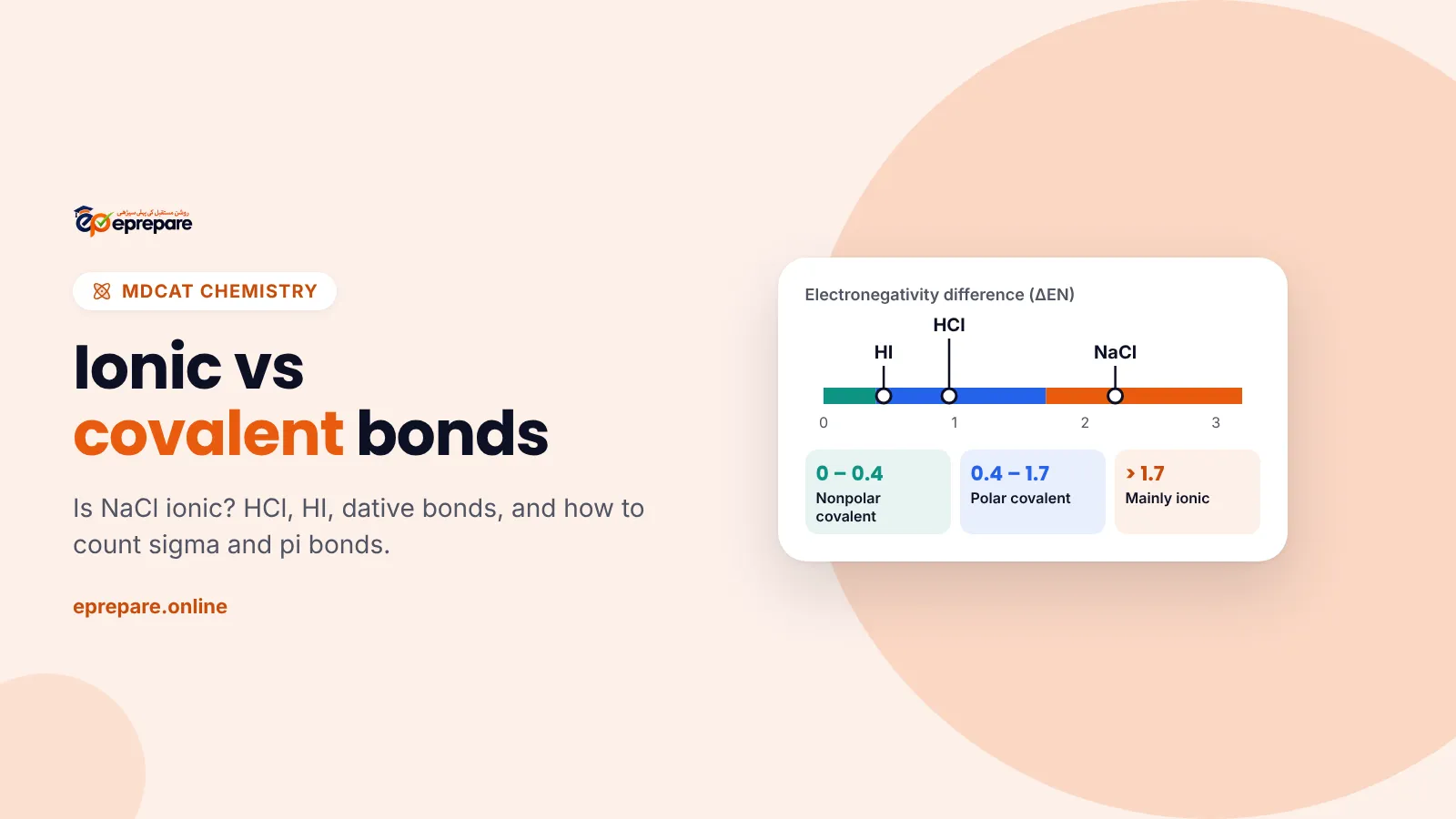
To decide what kind of bond two atoms form, find the difference in their electronegativities (ΔEN). Subtract the smaller value from the larger one, using the Pauling scale. The bigger the difference, the more unevenly the electrons are shared, until at large differences the electron is effectively transferred.
| ΔEN (Pauling) | Bond type | Example |
|---|---|---|
| 0 to about 0.4 | Nonpolar covalent | Cl–Cl (0), C–H (0.35) |
| About 0.4 to 1.7 | Polar covalent | H–Cl (0.96), O–H (1.24) |
| More than about 1.7 | Mainly ionic | Na–Cl (2.23), Na–O in Na2O (2.51) |
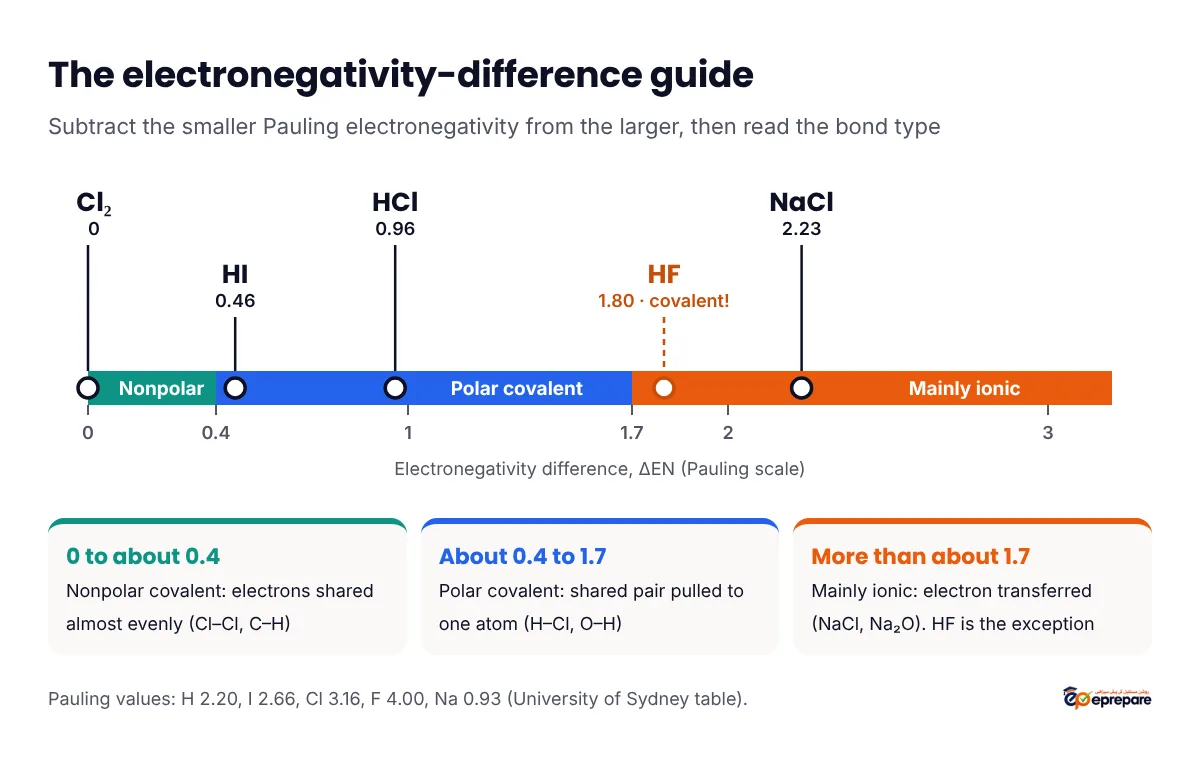
A difference of about 1.7 corresponds to roughly 50% ionic character, which is why many FSc books use it as the dividing line. Other textbooks draw the lines at 0.4 and 1.8. Either way, treat the numbers as a guide, not a law. Bonding changes gradually from covalent to ionic; there is no sudden switch.
The trap: H–F has ΔEN = 4.00 − 2.20 = 1.80, above 1.7, yet HF is a covalent molecule (a very polar one). A bare H+ ion would be just a proton, so tiny that it would pull fluorine's electrons straight back towards itself; the electrons stay shared and HF never forms an ionic lattice. When a question asks about HF, think "most polar covalent bond", not "ionic".
How to find the electronegativity difference
- Look up the Pauling electronegativity of each atom. Useful values: F 4.00, O 3.44, Cl 3.16, N 3.04, Br 2.96, I 2.66, C 2.55, H 2.20, Al 1.61, Mg 1.31, Na 0.93, K 0.82.
- Subtract the smaller from the larger. For NaCl: 3.16 − 0.93 = 2.23.
- Read the bond type from the table above, then check for exceptions such as HF.
The periodic trend: electronegativity increases from left to right across a period (the nuclear charge rises while the atoms get smaller) and decreases down a group (the outer electrons are further from the nucleus and more shielded). So fluorine, at the top right, is the most electronegative element, and caesium and francium, at the bottom left, are among the least.
Is NaCl ionic or covalent?
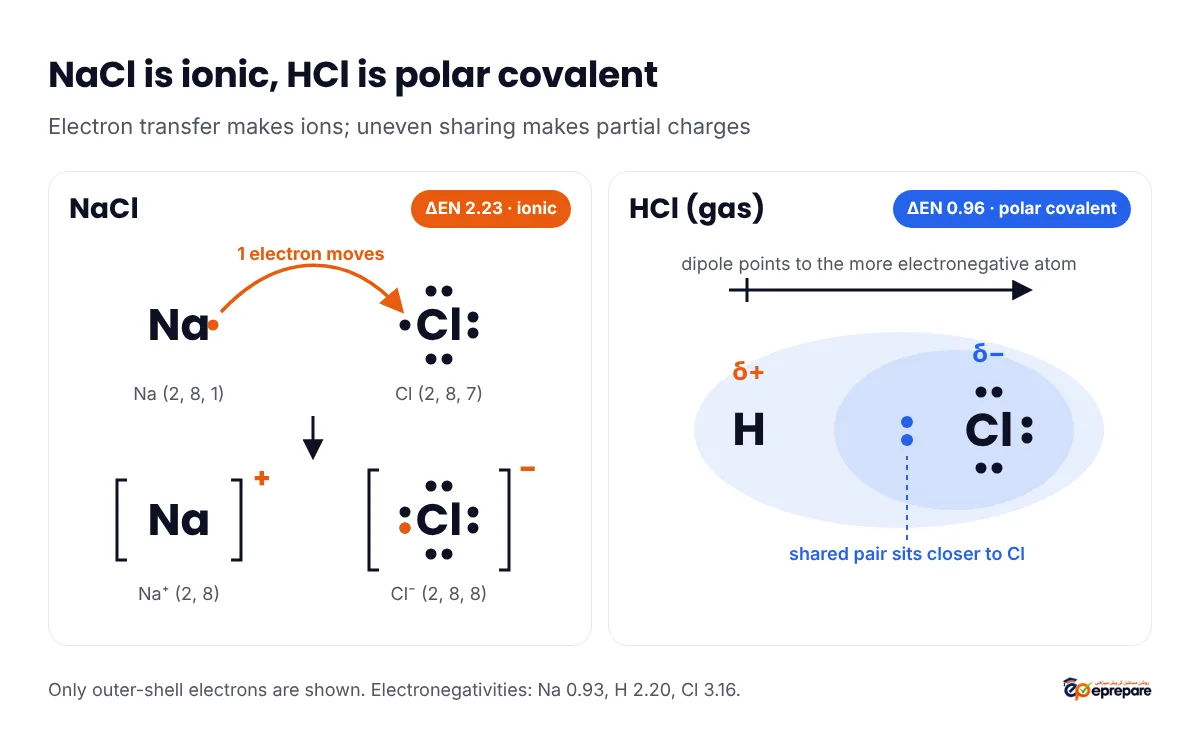
Sodium chloride is ionic. Three pieces of evidence point the same way:
- Electronegativity: ΔEN = 3.16 − 0.93 = 2.23, well above 1.7.
- Electron configuration: sodium (2, 8, 1) loses its single outer electron easily to become Na+ (2, 8). Chlorine (2, 8, 7) gains it to become Cl− (2, 8, 8). Both ions now have a noble-gas arrangement.
- Properties: NaCl is a hard crystalline solid with a high melting point. It conducts electricity when molten or dissolved in water, but not as a solid, because only then can its ions move.
Is NaCl a molecule or a compound?
NaCl is a compound, but it is not made of separate molecules. A crystal of salt is a giant lattice in which each Na+ is surrounded by six Cl− ions and each Cl− by six Na+ ions. The formula NaCl only gives the 1 : 1 ratio, so chemists call it a formula unit, not a molecule. For the same reason, the mass of NaCl is called its formula mass.
Is NaCl an organic compound?
No. Organic compounds are compounds of carbon (with a few simple exceptions such as CO2 and carbonates). NaCl contains no carbon, so it is an inorganic ionic compound.
Does NaCl have dipole–dipole forces?
No. Dipole–dipole forces act between polar molecules. Solid NaCl has no molecules: it is held together by ionic bonds, the attraction between full positive and negative charges, which is much stronger. For the forces between molecules, see our guide to intermolecular forces.
Is hydrogen chloride ionic or covalent?
Hydrogen chloride is a polar covalent molecule. In the gas phase, HCl molecules contain an H–Cl bond in which one pair of electrons is shared. Chlorine (3.16) is more electronegative than hydrogen (2.20), so ΔEN = 0.96 and the pair is pulled towards chlorine: Hδ+–Clδ−.
So why is hydrochloric acid full of ions? Because HCl reacts with water. The water molecule pulls the H+ off:
In water: HCl + H2O → H3O+ + Cl−. Pure HCl gas is covalent; its solution (hydrochloric acid) contains ions and conducts electricity.
The same answers the search "are acids ionic or covalent": HCl, HBr, HI, HNO3 and H2SO4 are covalent molecules that ionise in water. That is very different from NaCl, which is made of ions before it ever touches water.
Is HI ionic or molecular?
Hydrogen iodide is molecular (covalent). Iodine (2.66) is only a little more electronegative than hydrogen (2.20), so ΔEN = 0.46. The H–I bond is only slightly polar, much less polar than H–Cl. Like HCl, HI is a gas at room temperature and becomes ionic only in water, where it is a strong acid.
A common MDCAT twist: HI is a stronger acid than HCl even though its bond is less polar. Acid strength among the hydrogen halides is decided mainly by bond strength. The large iodine atom makes the H–I bond longer and weaker, so it releases H+ more easily. The acid strength order is HI > HBr > HCl > HF.
Quick verdicts for other compounds students ask about
| Substance | ΔEN | Verdict |
|---|---|---|
| Cl2 (chlorine) | 0 | Nonpolar covalent |
| HI | 0.46 | Covalent, only slightly polar |
| HCl | 0.96 | Polar covalent |
| H2O (O–H bond) | 1.24 | Polar covalent |
| AlCl3 | 1.55 | Covalent character; its vapour contains Al2Cl6 molecules |
| HF | 1.80 | Polar covalent (the exception) |
| Al2O3 | 1.83 | Mainly ionic, with some covalent character |
| NaCl | 2.23 | Ionic |
| Na2O | 2.51 | Ionic |
Aluminium compounds sit near the borderline. The Al3+ ion is small and highly charged, so it pulls the electron cloud of a neighbouring anion towards itself (polarisation). This gives even its ionic compounds some covalent character. The effect is stronger with the large, easily distorted Cl− ion than with O2−, which is why AlCl3 behaves as a covalent compound.
Polar vs nonpolar: bonds and molecules
A molecule can contain polar bonds and still be nonpolar overall. What matters is whether the bond dipoles cancel, and that depends on the shape.
| Molecule | Shape | Polar bonds? | Polar molecule? |
|---|---|---|---|
| CO2 | Linear | Yes (C=O) | No: the two dipoles cancel |
| CCl4 | Tetrahedral | Yes (C–Cl) | No: four equal dipoles cancel |
| H2O | Bent | Yes (O–H) | Yes |
| NH3 | Trigonal pyramidal | Yes (N–H) | Yes |
| HCl | Linear (two atoms) | Yes | Yes |
The size of a molecule's overall polarity is measured by its dipole moment. A symmetrical molecule such as CO2, BF3 or CCl4 has zero dipole moment even though each of its bonds is polar.
What is a dative (coordinate) bond?
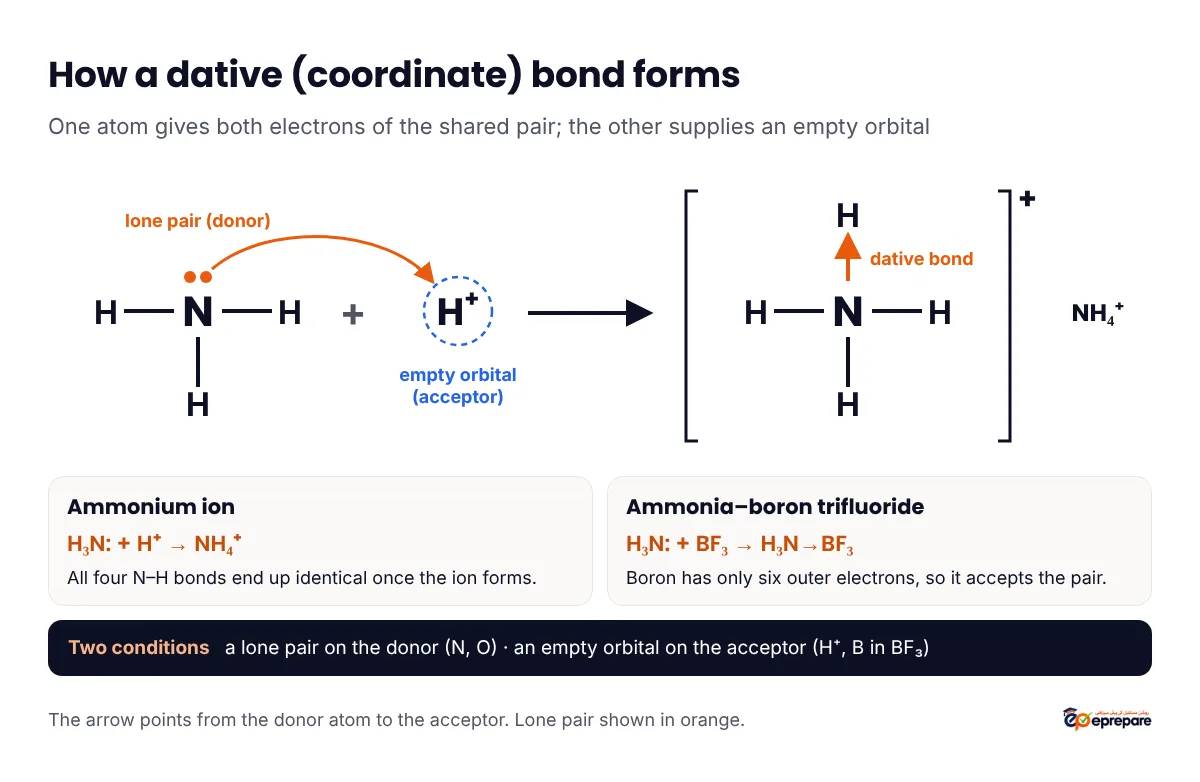
A dative bond, also called a coordinate covalent bond, is a covalent bond in which both electrons of the shared pair are donated by one atom. The atom that gives the pair is the donor; the atom that receives it is the acceptor. It is drawn as an arrow from donor to acceptor (N→H).
Two conditions must be met:
- The donor has a lone pair of electrons (N in NH3, O in H2O).
- The acceptor has an empty orbital that can take the pair (H+, or B in BF3, which has only six electrons around it).
Examples that come up again and again:
- Ammonium ion, NH4+: NH3 donates its lone pair to H+. Once formed, all four N–H bonds are identical; you cannot tell which one was dative.
- Hydronium ion, H3O+: water donates a lone pair on oxygen to H+.
- H3N→BF3: ammonia (a Lewis base) donates to boron trifluoride (a Lewis acid).
- Carbon monoxide, CO: of the three bonds between C and O, one is a dative bond from oxygen to carbon.
- Al2Cl6: a chlorine atom from one AlCl3 donates a lone pair to the aluminium of the other.
A dative bond is still a covalent bond: once it has formed, it is a shared pair like any other. Only its origin is different.
Properties of ionic and covalent compounds
| Property | Ionic compounds (NaCl, MgO) | Covalent molecular compounds (HCl, CH4, sugar) |
|---|---|---|
| How formed | Electron transfer, ions | Electron sharing, molecules |
| Physical state | Crystalline solids | Gases, liquids or soft solids |
| Melting and boiling points | High: strong attraction throughout the lattice | Usually low: only weak forces between molecules |
| Electrical conductivity | Conduct when molten or in water, not as solids | Usually do not conduct |
| Solubility | Usually soluble in water, insoluble in organic solvents | Usually soluble in organic solvents; many insoluble in water |
| Reactions in solution | Fast (ions react directly) | Slower (bonds must break) |
The exception to remember: giant covalent substances such as diamond and silicon dioxide (SiO2) have very high melting points, because there are no separate molecules and every atom is held by strong covalent bonds.
Sigma and pi bonds: what they are and how to count them
Covalent bonds are formed when atomic orbitals overlap. The way they overlap gives two kinds of bond.
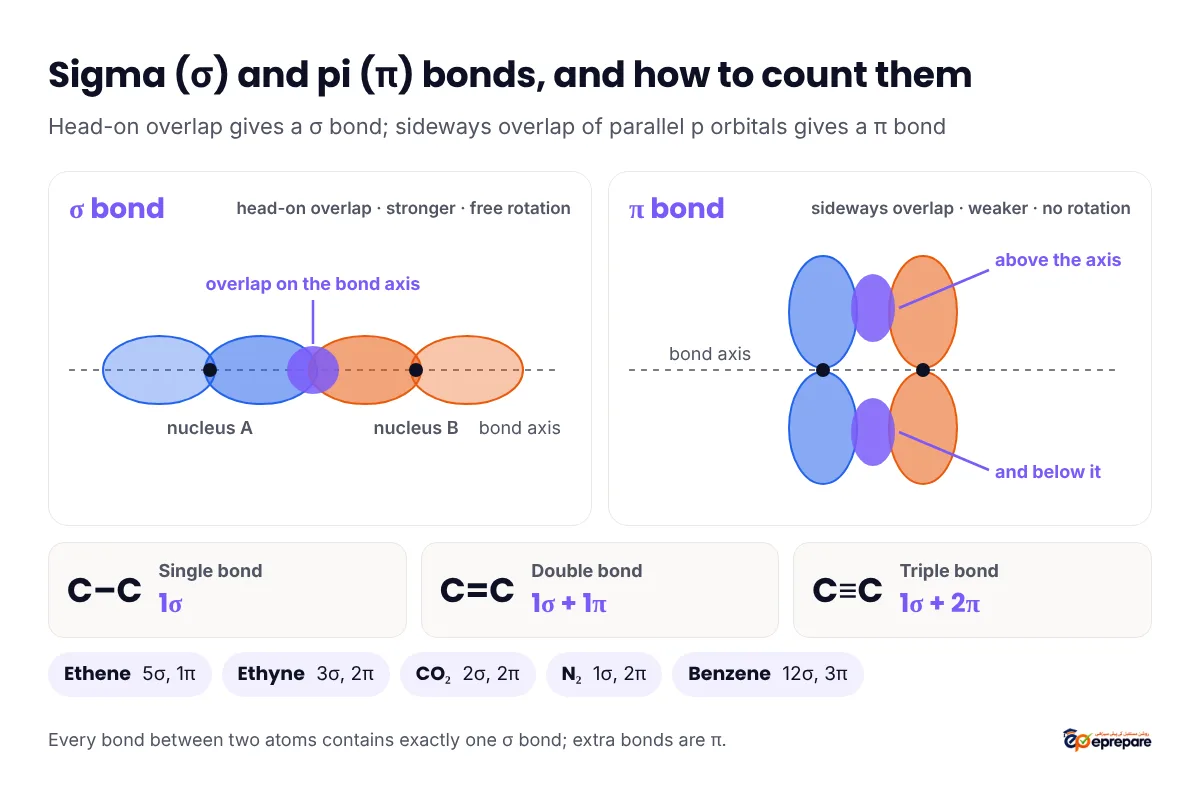
- Sigma (σ) bond: formed by head-on (end-to-end) overlap of orbitals along the line joining the two nuclei, for example s–s, s–p or p–p along the axis. The electron density lies on the bond axis. It is the stronger of the two, and atoms can rotate freely about a single σ bond.
- Pi (π) bond: formed by sideways overlap of two parallel p orbitals. The electron density lies above and below the bond axis. It is weaker than a σ bond, and it stops rotation, which is why alkenes can show cis–trans isomerism.
How to find the number of sigma and pi bonds
The counting rule: every single bond = 1σ. Every double bond = 1σ + 1π. Every triple bond = 1σ + 2π. So the number of σ bonds equals the number of bonded atom pairs, and each extra line in a multiple bond is a π bond.
- Draw the full structural formula, showing every bond including C–H bonds.
- Count all the bonds between pairs of atoms (each pair counts once, whatever its order). That is the σ total.
- Add one π for each double bond and two π for each triple bond.
Worked examples
| Molecule | Bonds | σ | π |
|---|---|---|---|
| Ethane, C2H6 | 6 C–H, 1 C–C | 7 | 0 |
| Ethene, C2H4 | 4 C–H, 1 C=C | 5 | 1 |
| Ethyne, C2H2 | 2 C–H, 1 C≡C | 3 | 2 |
| Nitrogen, N2 | 1 N≡N | 1 | 2 |
| Carbon dioxide, O=C=O | 2 C=O | 2 | 2 |
| Hydrogen cyanide, H–C≡N | 1 C–H, 1 C≡N | 2 | 2 |
| Benzene, C6H6 | 6 C–H, 6 C–C (3 drawn as C=C) | 12 | 3 |
| Acetic acid, CH3COOH | 3 C–H, 1 C–C, 1 C=O, 1 C–O, 1 O–H | 7 | 1 |
Check yourself on acetic acid: there are seven pairs of bonded atoms (three C–H, C–C, C=O, C–O and O–H), so 7σ. Only the C=O is a double bond, so 1π. In benzene the six π electrons are actually spread over the whole ring, but for counting you still say 3π bonds.
MDCAT shortcuts and common traps: (1) ΔEN above about 1.7 means mainly ionic, but HF (ΔEN 1.80) is covalent. (2) HCl gas is covalent; it only forms ions in water. (3) NaCl is a formula unit, not a molecule, and has no dipole–dipole forces. (4) Polar bonds do not guarantee a polar molecule: CO2, BF3 and CCl4 are nonpolar. (5) A dative bond needs a lone pair on the donor and an empty orbital on the acceptor; in NH4+ all four bonds end up identical. (6) Count every C–H bond when counting σ bonds, and never count a π bond on its own: every multiple bond already contains one σ.
Practice MCQs on ionic and covalent bonding
Try these before opening the answers. For hundreds more, work through our MDCAT Chemistry MCQs by chapter.
Question 1
Using Pauling electronegativities (H 2.20, I 2.66, Cl 3.16, Na 0.93), which substance has the greatest ionic character?
- HI
- HCl
- Cl2
- NaCl
Show answer
Answer: D. ΔEN for NaCl is 3.16 − 0.93 = 2.23, far larger than HCl (0.96), HI (0.46) or Cl2 (0). The bigger the difference, the greater the ionic character.
Question 2
How many sigma (σ) and pi (π) bonds are present in one molecule of ethyne, C2H2?
- 3σ and 2π
- 2σ and 3π
- 5σ and 1π
- 3σ and 1π
Show answer
Answer: A. H–C≡C–H has two C–H single bonds (2σ) and one C≡C triple bond (1σ + 2π). Total: 3σ and 2π.
Question 3
Which of the following contains a coordinate (dative) covalent bond?
- CH4
- NH4+
- H2O
- CO2
Show answer
Answer: B. NH4+ forms when the lone pair on nitrogen in NH3 is donated to H+, which has an empty orbital. CH4, H2O and CO2 contain only ordinary covalent bonds.
Question 4
Carbon dioxide contains polar C=O bonds, yet its dipole moment is zero. The best reason is that:
- carbon and oxygen have equal electronegativities
- CO2 contains π bonds
- the molecule is linear, so the two bond dipoles cancel
- CO2 is an ionic compound
Show answer
Answer: C. Oxygen (3.44) is more electronegative than carbon (2.55), so each C=O bond is polar. In the linear O=C=O molecule the two equal dipoles point in opposite directions and cancel.
Question 5
Hydrogen chloride gas does not conduct electricity, but its solution in water does. This is because:
- HCl is ionic in the gas and covalent in water
- water itself is a good conductor
- the H–Cl bond is nonpolar
- HCl is a covalent molecule that ionises in water to H3O+ and Cl−
Show answer
Answer: D. Gaseous HCl is made of polar covalent molecules with no free ions. In water, HCl + H2O → H3O+ + Cl−, and these mobile ions carry the current.
Bonding is part of the Chemistry high-yield list. See where it fits in our MDCAT Chemistry high-yield chapters guide, and check the exact learning outcomes in the MDCAT syllabus.
Frequently asked questions
Is NaCl ionic or covalent?
NaCl is ionic. Sodium transfers its outer electron to chlorine, forming Na+ and Cl− ions held in a crystal lattice. The electronegativity difference is 2.23, well above the usual ionic threshold of about 1.7.
Is hydrogen chloride ionic or covalent?
Hydrogen chloride is a polar covalent molecule (ΔEN = 0.96). It becomes ionic only when it reacts with water to form H3O+ and Cl− ions in hydrochloric acid.
Is HI ionic or molecular?
HI is molecular. The H–I bond is covalent and only slightly polar (ΔEN = 0.46). In water, HI ionises completely and is a stronger acid than HCl because the H–I bond is weaker.
What is a dative bond?
A dative (coordinate covalent) bond is a covalent bond in which both shared electrons come from one atom, the donor, which has a lone pair. The acceptor must have an empty orbital. The ammonium ion, NH4+, formed from NH3 and H+, is the standard example.
How do you find sigma and pi bonds?
Draw the full structure. Every single bond is one σ bond, every double bond is one σ plus one π, and every triple bond is one σ plus two π. Count the bonded atom pairs for σ, then add the extra π bonds. Ethene has 5σ and 1π; ethyne has 3σ and 2π.
What electronegativity difference is ionic?
A difference greater than about 1.7 on the Pauling scale is usually taken as mainly ionic, and about 0.4 to 1.7 as polar covalent. Some textbooks use 1.8. These are guidelines with exceptions, such as HF, which is covalent despite a difference of 1.80.
Is NaCl a molecule or a compound?
NaCl is a compound but not a molecule. It is a giant ionic lattice, and the formula NaCl gives only the 1 : 1 ratio of ions, called a formula unit.
Is aluminium oxide ionic or covalent?
Aluminium oxide is mainly ionic (ΔEN = 1.83), but the small, highly charged Al3+ ion polarises the oxide ion, so the bonding has some covalent character. Aluminium chloride has more covalent character and exists as Al2Cl6 molecules in the vapour.
Bonding questions are quick marks once the rules are automatic. Practise them chapter by chapter in the ePrepare question bank, where every MCQ comes with an explanation, and keep the counting rule and the electronegativity guide in your own notes for the final weeks. When you are ready to test yourself across the whole syllabus, create a free ePrepare account and start practising.
Sources: Pauling electronegativity values from the University of Sydney table of Pauling electronegativities; electronegativity-difference guide and periodic trend from OpenStax Chemistry 2e, section 7.2 , LibreTexts Chemistry, Bond Polarity and Oklahoma State University ChemSource (1.7 as about 50% ionic character, and HF as the exception); definition of a dative bond from the IUPAC Gold Book; learning outcomes from the PM&DC MDCAT curriculum (Chemistry, units on liquids and chemical bonding).