Your MDCAT result arrives as marks out of 180, your FSc result as marks out of 1100 or 1200, and admission forms talk about percentages and aggregates. This guide shows how to turn each result into a percentage, what that percentage adds to your MBBS aggregate, and why percentage, percentile and aggregate are three different things.
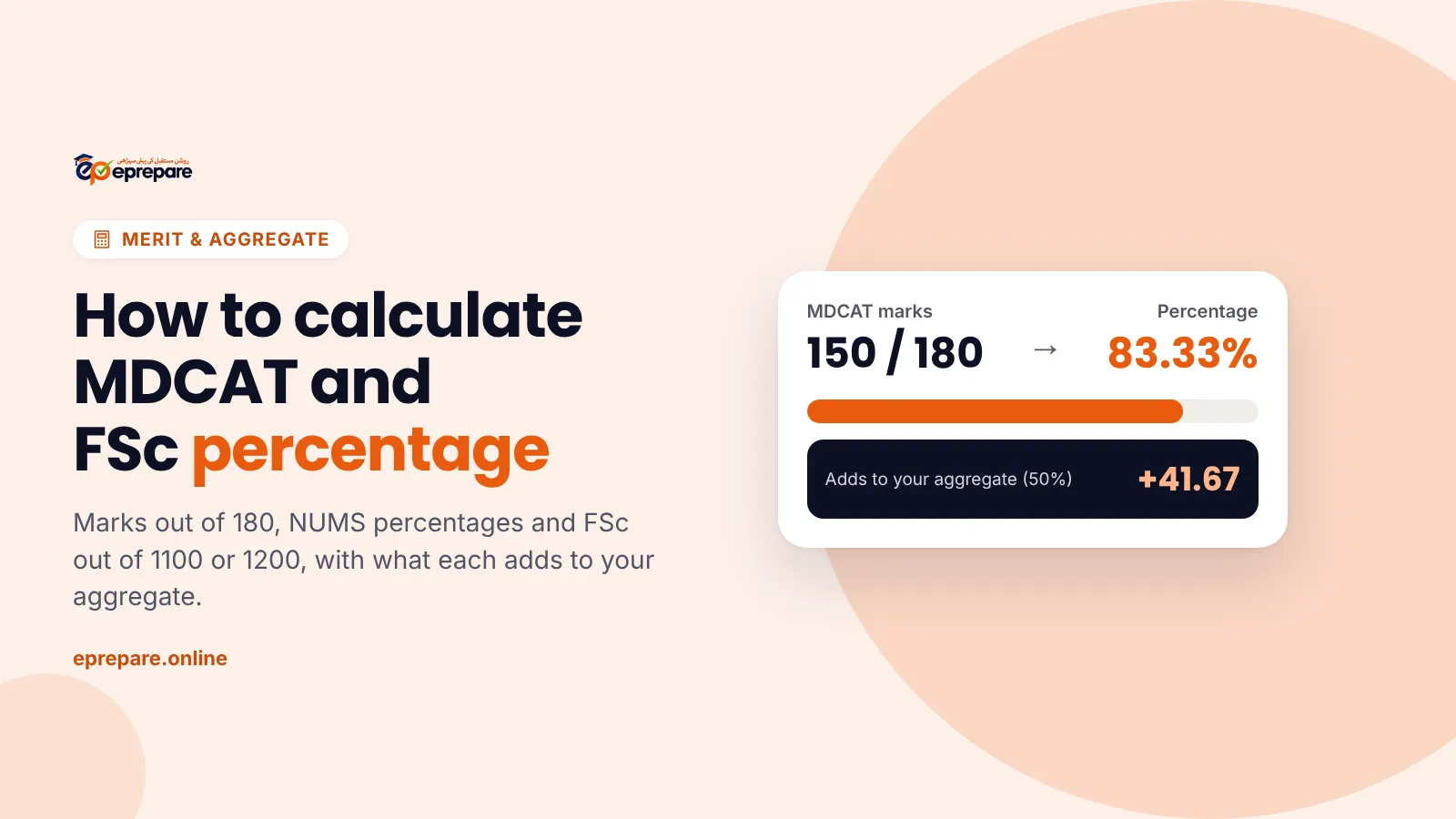
The short answer: MDCAT percentage = MDCAT marks ÷ 180 × 100, so each mark is worth about 0.556%. FSc percentage = FSc marks ÷ your FSc total (1100 or 1200) × 100. For example, 150/180 in MDCAT is 83.33%, and because the MDCAT counts 50% of your aggregate, it adds 41.67 aggregate points.
How to calculate MDCAT percentage
The PM&DC MDCAT has 180 MCQs of one mark each (Biology 81, Chemistry 45, Physics 36, English 9 and Logical Reasoning 9), and there is no negative marking. So your score is simply the number of correct answers, out of 180.
MDCAT % = MDCAT marks ÷ 180 × 100
- Take your MDCAT marks, for example 150.
- Divide by 180: 150 ÷ 180 = 0.83333.
- Multiply by 100: 83.33%.
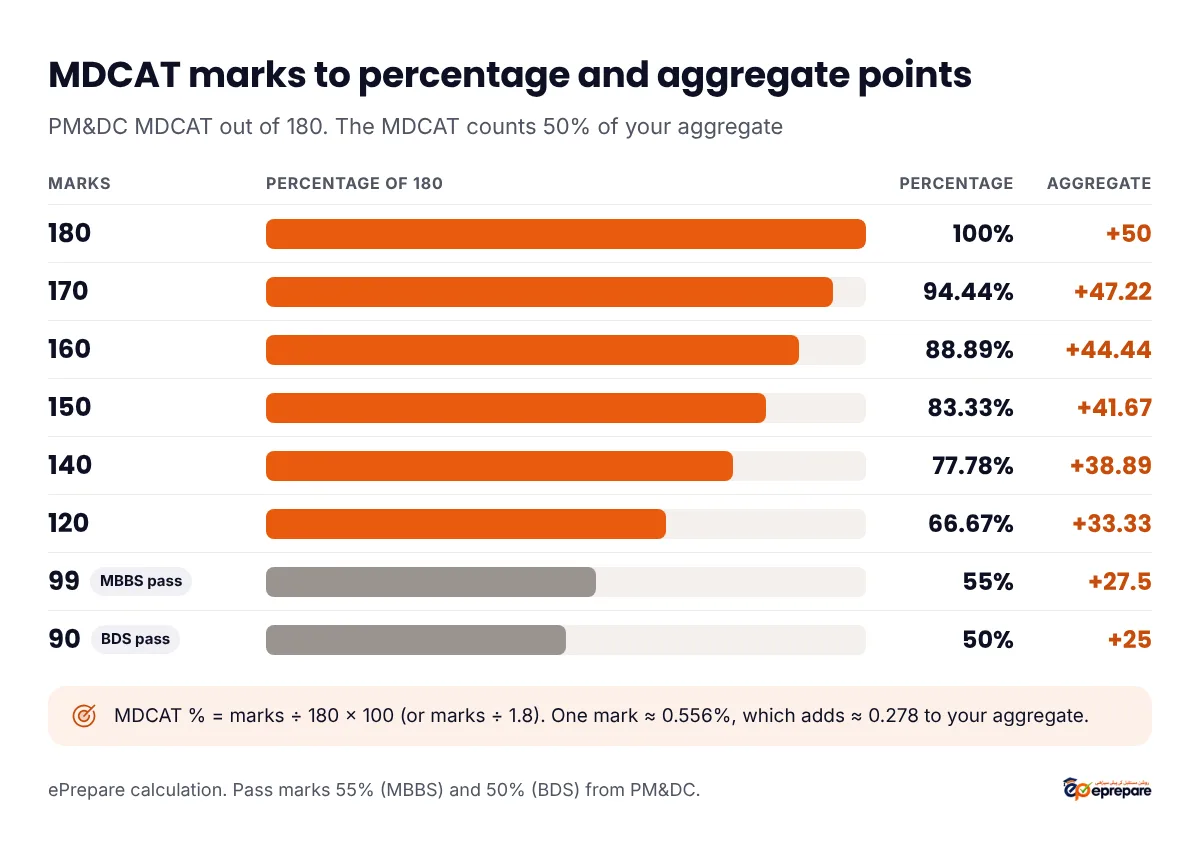
A shortcut: divide your marks by 1.8. 150 ÷ 1.8 = 83.33. Going the other way, marks = percentage × 1.8, so 55% is 55 × 1.8 = 99 marks, the MBBS passing mark, and 50% is 90 marks, the BDS passing mark. Our MDCAT passing marks guide explains what those minimums do and do not get you.
Quick conversion: MDCAT marks, percentage and aggregate points
Because the MDCAT counts 50% in every admitting university's aggregate, your MDCAT percentage is worth exactly half as many aggregate points. That makes a simple three-column table:
| MDCAT marks (out of 180) | Percentage | Aggregate points (50%) |
|---|---|---|
| 180 | 100.00% | 50.0000 |
| 175 | 97.22% | 48.6111 |
| 170 | 94.44% | 47.2222 |
| 165 | 91.67% | 45.8333 |
| 160 | 88.89% | 44.4444 |
| 155 | 86.11% | 43.0556 |
| 150 | 83.33% | 41.6667 |
| 145 | 80.56% | 40.2778 |
| 140 | 77.78% | 38.8889 |
| 130 | 72.22% | 36.1111 |
| 120 | 66.67% | 33.3333 |
| 110 | 61.11% | 30.5556 |
| 99 (MBBS pass) | 55.00% | 27.5000 |
| 90 (BDS pass) | 50.00% | 25.0000 |
For any score not in the table, the MDCAT marks and percentage calculator gives the percentage, tells you whether it clears the MBBS and BDS minimums, and shows what it adds to your aggregate.
Worth remembering: 5 more marks in MDCAT add 2.78% to your MDCAT percentage and 1.39 points to your aggregate. On a merit list ranked to four or five decimals, that can be the difference between one college and the next.
NUMS MDCAT: 200 MCQs, but use your percentage
The NUMS test is different. It has 200 MCQs in two papers: Paper I with 150 subject MCQs (Biology 55, Chemistry 40, Physics 40 and English 15) and Paper II, a 50-MCQ psychological test. NUMS announces your result as a percentage, and states its pass marks as percentages: 55% for MBBS and 50% for BDS.
So for NUMS you do not need to calculate anything: the percentage on your result is your test percentage. Do not try to rebuild it from marks out of 200 or 150. NUMS has not published a worked example of exactly how Paper II is scored into the total, so the figure on your result is the one that counts. Half of it goes into your NUMS aggregate:
| NUMS result | Aggregate points (50%) |
|---|---|
| 90% | 45.0 |
| 85% | 42.5 |
| 80% | 40.0 |
| 75% | 37.5 |
| 70% | 35.0 |
| 55% (MBBS pass) | 27.5 |
If you are using an older PM&DC MDCAT result that was out of 200, divide by 200 instead: 160 out of 200 is 80%. MDCAT results stay valid for three years. Our PM&DC MDCAT vs NUMS MDCAT comparison covers how the two tests differ chapter by chapter.
How to calculate FSc percentage (out of 1100 or 1200)
FSc % = FSc marks ÷ FSc total × 100
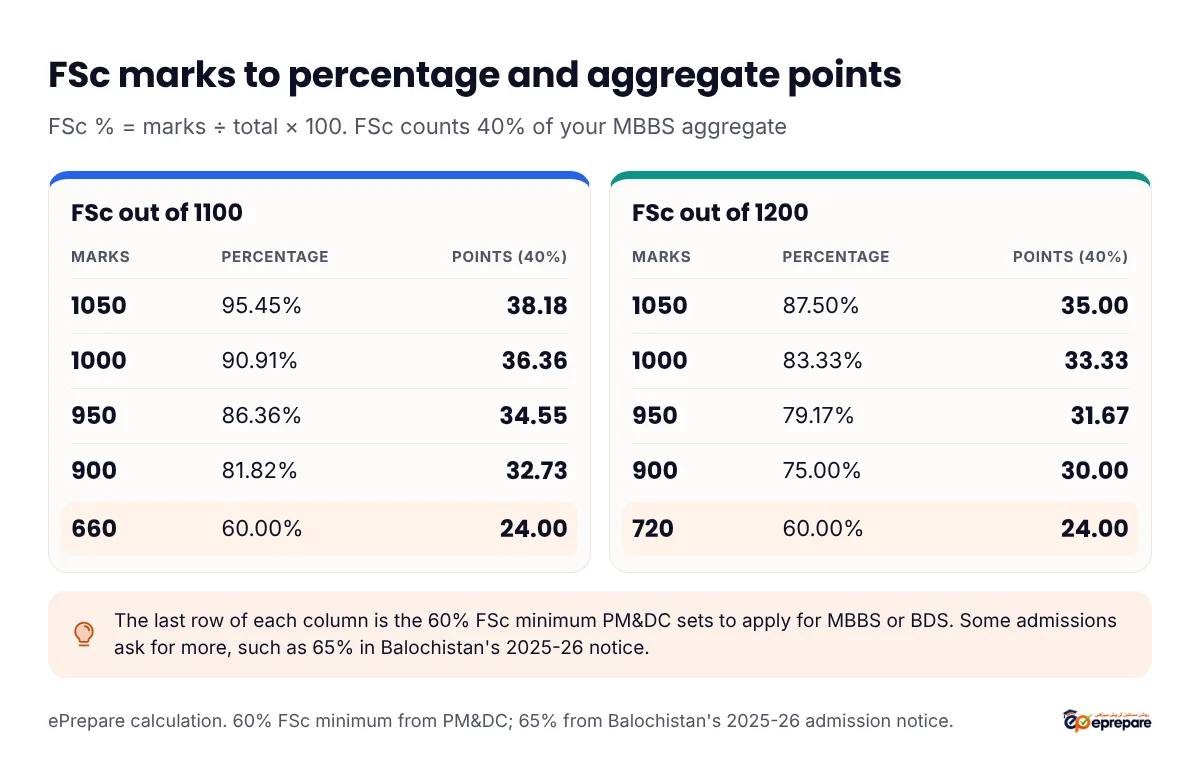
Pakistani boards have used both 1100 and 1200 as the total, so read yours from your result card. The same marks give a different percentage on each total:
- 1000 out of 1100: 1000 ÷ 1100 × 100 = 90.91%
- 1000 out of 1200: 1000 ÷ 1200 × 100 = 83.33%
FSc counts 40% of the MBBS aggregate, so its aggregate points are FSc % × 0.40, or more simply FSc marks ÷ total × 40.
| FSc marks | % out of 1100 | Points (1100) | % out of 1200 | Points (1200) |
|---|---|---|---|---|
| 1050 | 95.45% | 38.18 | 87.50% | 35.00 |
| 1000 | 90.91% | 36.36 | 83.33% | 33.33 |
| 950 | 86.36% | 34.55 | 79.17% | 31.67 |
| 900 | 81.82% | 32.73 | 75.00% | 30.00 |
| 850 | 77.27% | 30.91 | 70.83% | 28.33 |
| 800 | 72.73% | 29.09 | 66.67% | 26.67 |
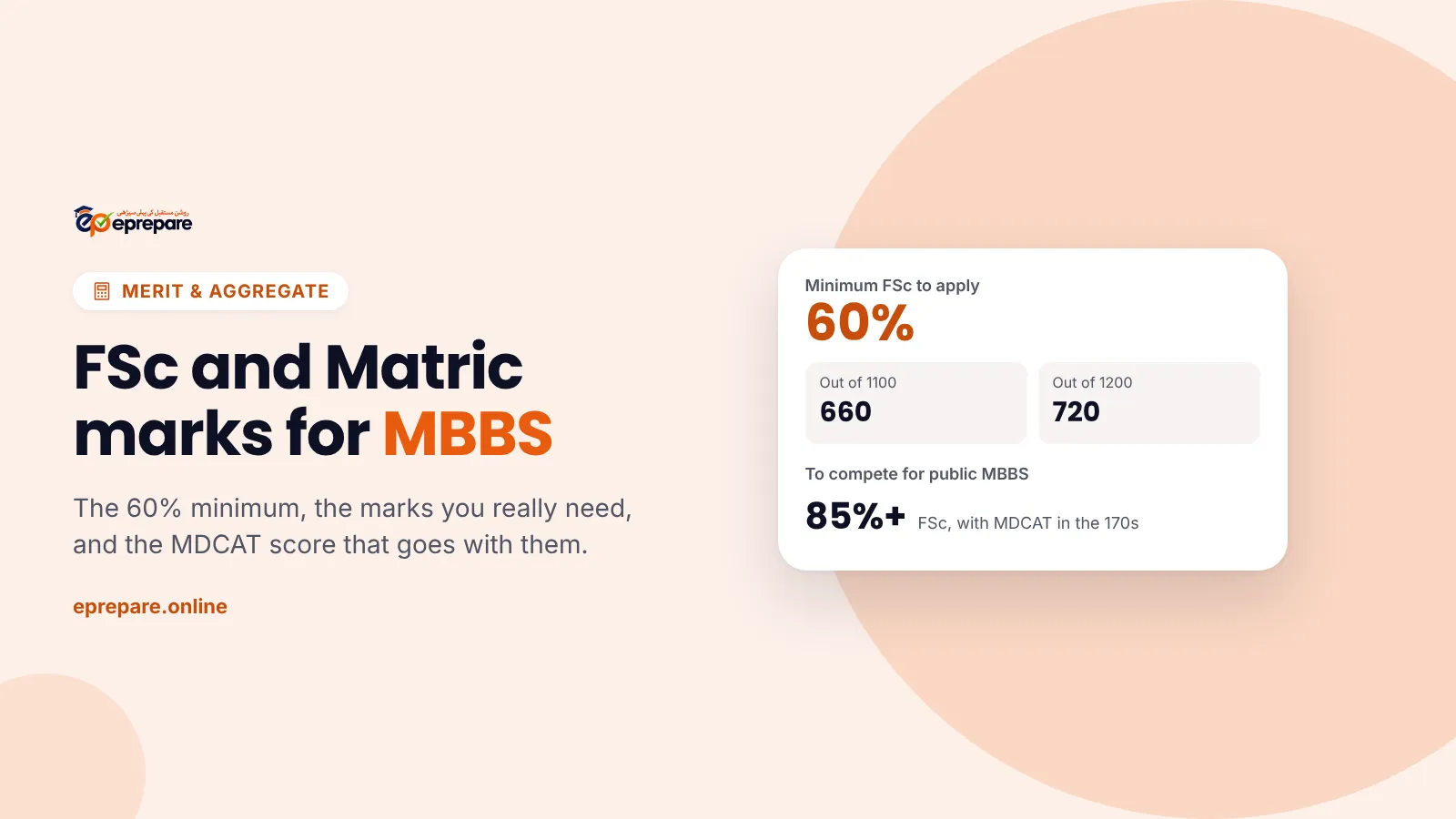
PM&DC's minimum to apply for MBBS or BDS is 60% in FSc (HSSC pre-medical or equivalent): 660 out of 1100 or 720 out of 1200. Some admissions have asked for more in a given year, such as 65% in Balochistan's 2025-26 notice, so check your university's current notice.
Matric works the same way with a 10% weight: Matric marks ÷ total × 10. Our guide to calculating aggregate percentage of Matric and FSc has full conversion tables for both totals.
What if I only have my FSc Part 1 result?
You can estimate. Work out your Part 1 percentage (Part 1 marks ÷ the Part 1 total printed on your card × 100) and assume the same percentage for the full FSc. Treat it as an estimate only: admission uses your final FSc result, submitted by the university's closing date.
Percentage vs percentile vs aggregate
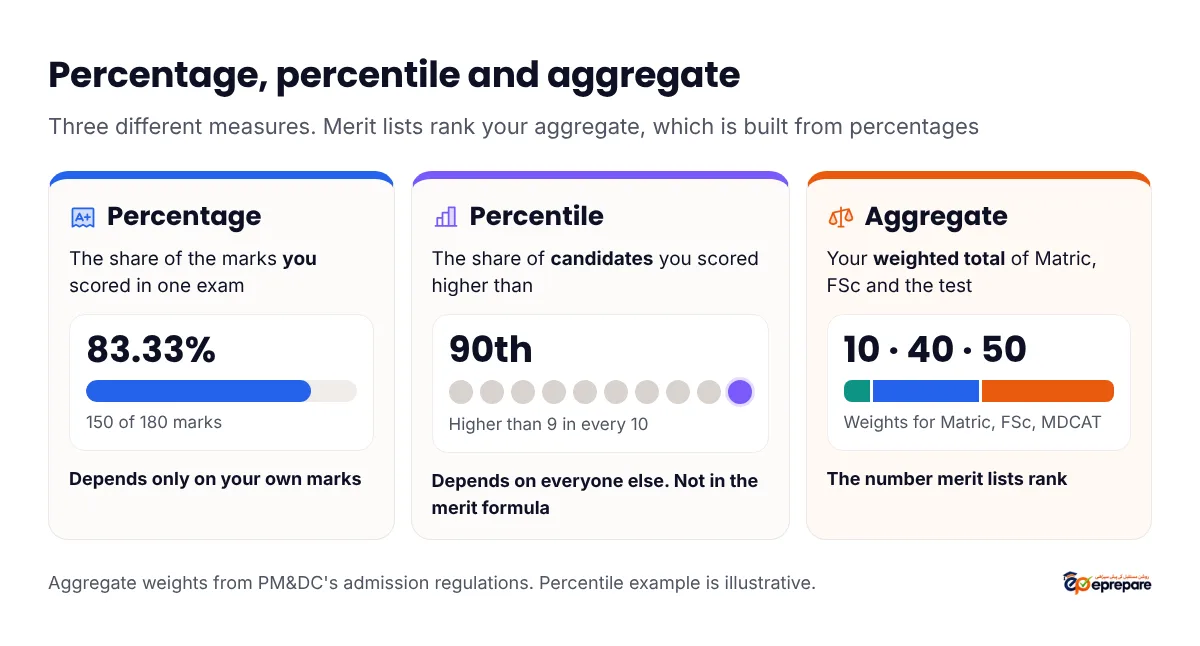
These three words get mixed up all the time, but they measure different things:
| Term | What it measures | Example |
|---|---|---|
| Percentage | The share of the marks you scored in one exam | 150/180 = 83.33% |
| Percentile | The share of candidates you scored higher than | Higher than 90 of every 100 candidates = 90th percentile |
| Aggregate | Your weighted total of Matric, FSc and the test | 10% Matric + 40% FSc + 50% MDCAT |
The key difference: your percentage depends only on your own marks, while a percentile depends on how everyone else did. The MBBS merit formula uses percentages, not percentiles. Your aggregate is then ranked against other applicants, and that rank is what decides your seat. Two students with the same MDCAT percentage can be on very different merit positions because of their FSc marks.
What "MBBS percentage" usually means
When students search for "MBBS percentage", they usually mean one of three numbers:
- The minimum to apply: 55% in MDCAT for MBBS (99/180) or 50% for BDS (90/180), and 60% in FSc.
- Your aggregate: 10% of your Matric percentage + 40% of your FSc percentage + 50% of your MDCAT percentage. Our guide on how to calculate MDCAT aggregate works it through for every university.
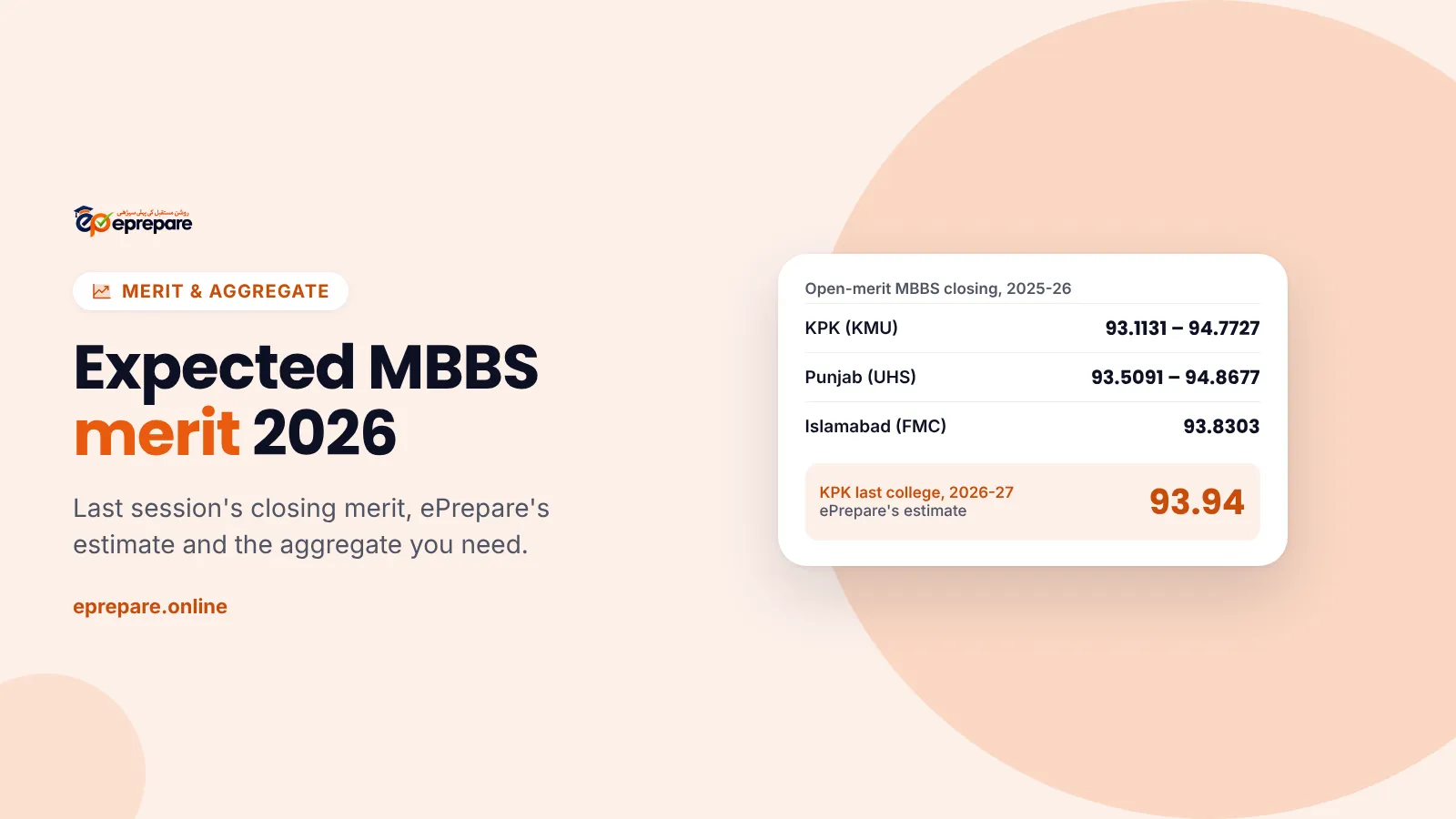
- The closing merit: the aggregate of the last student admitted to a college. In KPK, the last open-merit MBBS seat in a public college closed at 93.107 in 2025-26, so the passing marks are only a starting line. See the closing merit for every province.
A full example
Hamza has Matric 1000/1100, FSc 1000/1100 and MDCAT 160/180.
- Matric: 90.91%, adding 9.0909 points (10%)
- FSc: 90.91%, adding 36.3636 points (40%)
- MDCAT: 88.89%, adding 44.4444 points (50%)
- Aggregate = 89.8990%
All three of his percentages are near 90, and so is his aggregate. To reach KPK's 2025-26 closing of 93.107 with the same board marks, he would have needed 172 in MDCAT. The aggregate calculator works out targets like this for your own marks.
Frequently asked questions
How do I calculate my MDCAT percentage?
Divide your MDCAT marks by 180 and multiply by 100, or simply divide by 1.8. For example, 160 ÷ 180 × 100 = 88.89%.
What percentage is 150 out of 180 in MDCAT?
83.33%. It adds 41.67 points to your aggregate, because the MDCAT counts 50%.
What is 55% of 180?
99 marks, the MDCAT passing mark for MBBS. 50% of 180 is 90 marks, the passing mark for BDS.
How do I calculate my NUMS MDCAT percentage?
You do not need to: NUMS announces the result as a percentage. Use that figure as it is; half of it counts towards your NUMS aggregate.
How do I calculate FSc percentage out of 1100 or 1200?
Divide your FSc marks by the total on your result card and multiply by 100. 1000 out of 1100 is 90.91%; 1000 out of 1200 is 83.33%.
Is percentage the same as percentile?
No. A percentage is the share of marks you scored; a percentile is the share of candidates you scored higher than. MBBS merit uses percentages in the aggregate formula, then ranks applicants by that aggregate.
What percentage is required for MBBS?
To apply: at least 55% in MDCAT and 60% in FSc, with some universities asking for a higher FSc percentage. To get a public-college seat you need a far higher aggregate; in KPK the last open-merit MBBS seat closed at 93.107 in 2025-26.
From percentage to preparation
Your FSc percentage is nearly fixed by the time you sit the MDCAT, but every MDCAT mark still adds 0.278 to your aggregate. If you are preparing, ePrepare's full-length papers show your predicted MDCAT score and percentage after every attempt, so you can see how close you are to your target. Create your free ePrepare account to start.
Sources: PM&DC uniform MDCAT curriculum; PM&DC on FSc and MDCAT minimums; NUMS centralised admissions advert; NUMS MDCAT table of specifications; KMU admission policy and merit lists (cas.kmu.edu.pk). Conversions are ePrepare's own calculations.