A seat category is an eligibility route, not just a different price. At KIMS and KIDS in Kohat, the linked policy distinguishes open merit, general self-finance, KMU-ward and minority subcategories, foreign self-finance and project allocations. Each needs to be read alongside the institute’s actual seat table.
This guide explains the documents and conditions behind those labels. It does not create a seat where the allocation table shows none.
Policy-based reference: this guide explains an earlier edition of the linked KMU policy. Figures and conditions are not independently verified as current. Check the latest KMU notice and written fee demand before applying or paying.
Categories shown for KIMS and KIDS
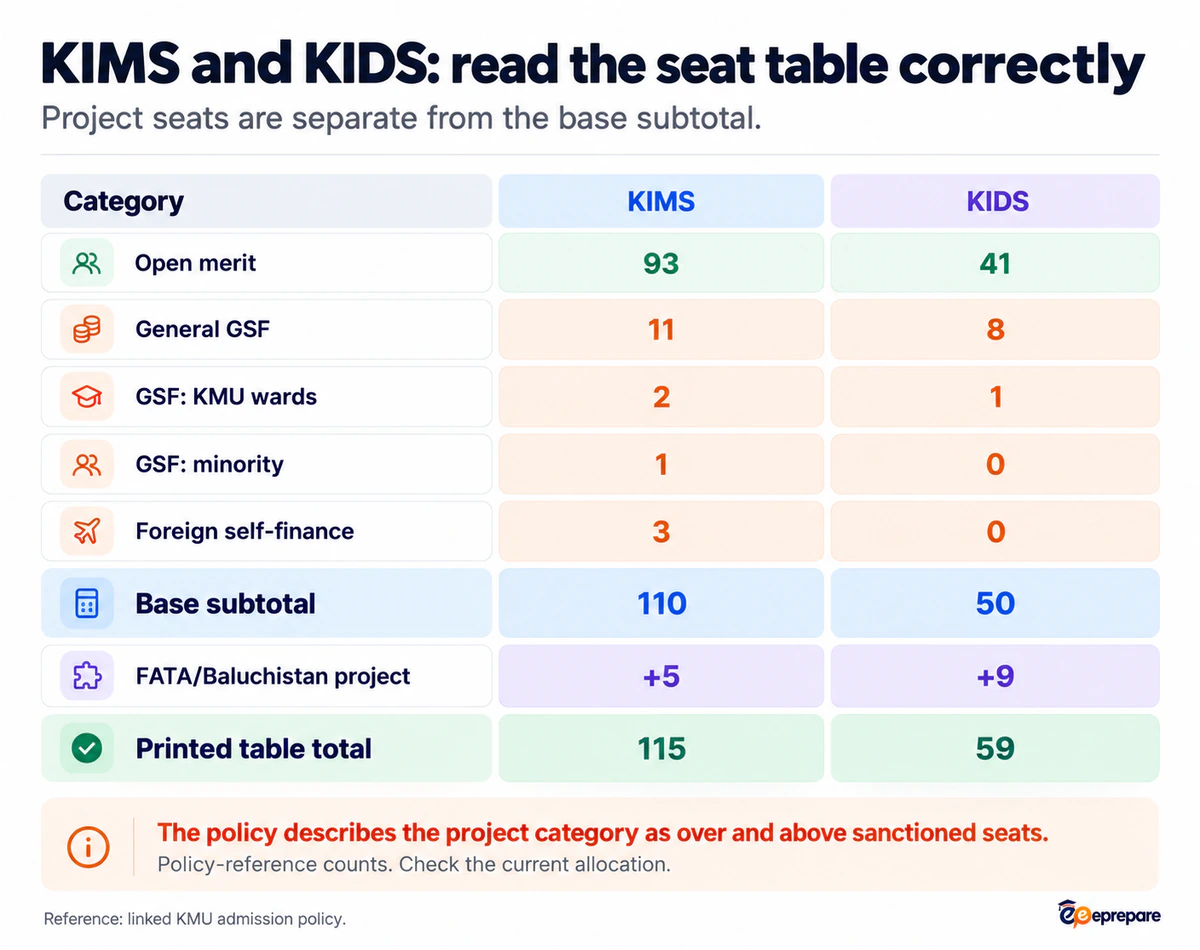
| Category | KIMS | KIDS | Key evidence or distinction |
|---|---|---|---|
| Open merit | 93 | 41 | Relevant applicant and parent domicile evidence |
| General self-finance | 11 | 8 | KP/MDs domicile conditions and willingness to accept the applicable fee category |
| GSF: KMU wards | 2 | 1 | Qualifying parent’s KMU service and the stated domicile requirements |
| GSF: minority | 1 | 0 | Non-Muslim applicant eligibility and domicile conditions |
| Foreign self-finance | 3 | 0 | Nationality/residency, overseas study and other foreign-category conditions |
| FATA/Baluchistan project row | 5 | 9 | Relevant nomination/project route; described separately from the base allocation |
Open merit: the domicile condition still matters
The open-merit section refers to a valid KP domicile for the applicant and father, including the backward areas. If the father is not alive, it refers to the mother’s valid domicile instead. The supporting-document section also asks for the father’s death certificate where that substitution is used.
“Open merit” in this document should not be read as automatically open to every domicile in the country. Use the category’s wording, and confirm any updated eligibility in the current notice.
General self-finance: merit is still required
The policy’s GSF wording includes KP, backward areas and Merged Districts domiciles. It requires the applicant’s and father’s relevant domicile, with the stated mother/death-certificate arrangement where the father has died.
It also says selection within each category is on inter se merit among eligible applicants. A higher fee does not waive the HSSC, MDCAT, subject or documentary requirements.
General GSF, KMU-ward GSF and minority GSF appear as separate columns. Do not assume that selecting one automatically establishes eligibility for the other two. Confirm how the current form accepts multiple category choices and what each requires.
KMU wards: the parent’s employment record
The policy describes qualifying KMU employment, retirement or fixed-pay/CP Fund service and a minimum of seven years’ service by the closing date for the specified cases. It also separately mentions confirmed employees who died while serving the university.
| Check | What to establish |
|---|---|
| Parent and relationship | The applicant is a qualifying employee’s son or daughter; provide the required relationship and service evidence. |
| Employment nature and service | Official KMU service certificate showing employment category, length of service and the relevant status at the closing date. |
| Excluded employment cases | The source excludes dismissed, removed or terminated employees and those serving on deputation at KMU. |
| Applicant and parent domicile | Meet the stated KP/MDs conditions and the applicable evidence requirement. |
| Previous ward-seat admission | The source attaches financial consequences to taking the chance again while changing discipline; obtain a written calculation before accepting another offer. |
The policy provides a distinct deceased-employee provision. Have KMU confirm which conditions and documents apply to that case rather than assuming every service requirement is identical.
Minority GSF and other minority consideration
The policy describes non-Muslim applicants with the relevant KP/MDs domicile, together with the parent-domicile condition. It discusses consideration under open merit and minority-related routes subject to eligibility.
The institute-specific table prints one minority GSF place at KIMS and zero at KIDS. General category wording elsewhere does not create an additional KIDS place. Follow the current notified allocation if it changes.
Foreign self-finance has several separate conditions
The linked edition describes permanent foreign/dual-national or overseas-Pakistani status in its foreign-category wording, together with KP domicile, qualifying HSSC/equivalent study abroad, a minimum academic threshold, residence abroad at application and a certificate from the last institution attended.
Its nationality wording is not perfectly drafted, so do not reduce it to “anyone with a foreign passport qualifies”. Ask KMU to confirm your exact nationality, domicile, residency and educational situation against the current notice.
- The source says eligible applicants use KMU’s online route.
- Vacant foreign-self-finance seats may be transferred to GSF when eligible foreign applicants are unavailable.
- The policy says the foreign-student fee continues despite a later change in the admitted student’s status.
- The fee page itself contains ambiguous USD alternatives; the KIMS fee guide explains why a written demand is necessary.
Only KIMS has a positive foreign allocation in this table. A generic foreign BDS fee heading is not proof that KIDS is offering foreign BDS places.
Disability assessment and project nominations
The policy describes disability-related identity evidence, Social Welfare registration, prescribed medical documentation, assessment by KMU’s medical board and an appeal route. The board’s assessment and the notified allocation both matter; registration alone is not a complete admission decision.
There is no separate numbered disability row in this KIMS/KIDS table. Confirm an actual allocation before claiming an additional seat. For the project row, follow the relevant nomination notice and the KMU/Home & Tribal Affairs process rather than treating it as ordinary self-finance.
Frequently asked questions
Is self-finance admission available without merit?
No. The policy requires eligibility and selection by merit among eligible candidates in the category.
Does a high aggregate automatically make me a KMU-ward applicant?
No. The ward category requires a qualifying parent’s service and other specified evidence. Aggregate and category eligibility are separate checks.
Can I use a foreign passport alone for foreign self-finance?
Do not assume so. The source also describes domicile, overseas study, residence and certificate conditions; its wording needs confirmation for individual cases.
Is there a minority GSF seat at KIDS in this table?
No. The source prints zero for KIDS and one for KIMS.
Does the general disability section prove a reserved KIMS/KIDS count?
No. Confirm the current institute-specific allocation as well as the assessment requirements.
Related KIMS and KIDS guides
- KIMS and KIDS Kohat admissions: eligibility, merit and your next steps
- KIMS and KIDS seat distribution: open merit, self-finance and project seats
- How to apply to KIMS and KIDS: documents, preferences and merit-list steps
Official source
KMU admission policy for KIMS and KIDS. Relevant physical PDF pages: PDF page 7 · PDF page 11 · PDF page 12 · PDF page 13 · PDF page 14 · PDF page 15.
This is an independent explanatory guide based on the supplied policy edition, not an official admission notice, a current fee demand or an admission guarantee. Check the latest official instructions for changes.