KIMS and KIDS are KMU’s medical and dental institutes in Kohat. KIMS is the Khyber Medical University Institute of Medical Sciences; KIDS is the Khyber Medical University Institute of Dental Sciences. Choosing between them means choosing between MBBS and BDS, but it also means checking a different seat allocation, fee schedule and programme application.
This guide helps you read the linked admission policy in the right order: eligibility first, aggregate second, then the seat category, cost and application evidence. The dedicated guides linked below explain each decision in detail.
Policy-based reference: this guide explains an earlier edition of the linked KMU policy. Figures and conditions are not independently verified as current. Check the latest KMU notice and written fee demand before applying or paying.
Start with the correct institute and programme
| Name | Programme in the policy | What to check next |
|---|---|---|
| KIMS: KMU Institute of Medical Sciences, Kohat | MBBS | Medical eligibility, KIMS seat categories and its MBBS fee tables |
| KIDS: KMU Institute of Dental Sciences, Kohat | BDS | Dental eligibility, KIDS seat categories and its separate BDS fee tables |
A similarly named medical college in Karachi follows a different admissions route. When searching, include KMU and Kohat so you are reading information about the correct institution.
The policy says medical and dental applications are separate: a candidate who has not applied to a programme cannot claim admission to that programme. Do not assume that selecting MBBS automatically creates a BDS application.
Eligibility: the three checks before calculating merit
| Requirement | KIMS MBBS | KIDS BDS |
|---|---|---|
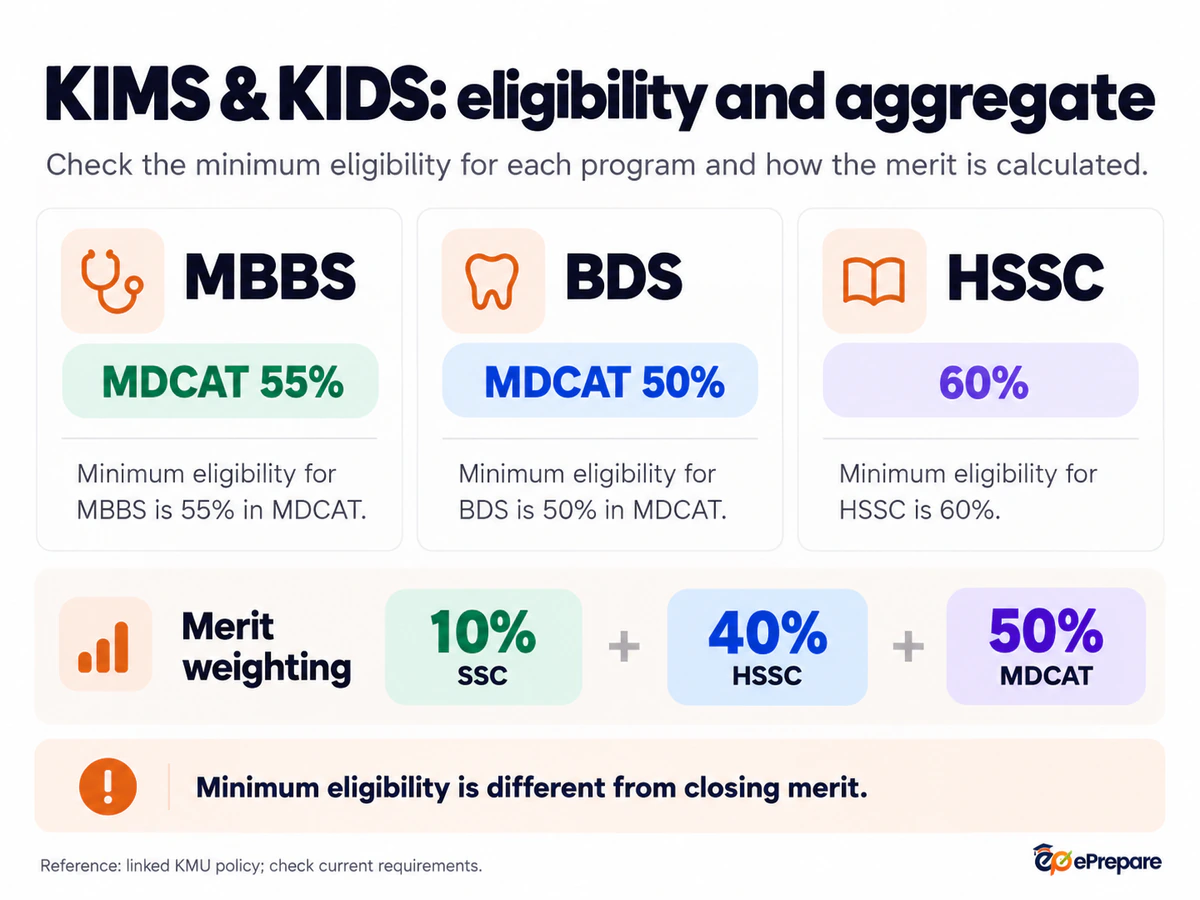
| HSSC or recognised equivalent | At least 60%, or a higher minimum notified by the regulator | At least 60%, or a higher minimum notified by the regulator |
| MDCAT percentage | At least 55% | At least 50% |
| HSSC/equivalent subjects | Biology and chemistry, plus physics or mathematics | Biology and chemistry, plus physics or mathematics |
Eligibility and selection are different. Passing the minimum requirements lets you compete; it does not mean your aggregate will reach the closing merit of your programme and category. The policy does not supply a current closing merit for either institute.
Use the explicit percentage criteria in the eligibility section. The policy’s later worked example contains passing-score wording that does not align with those percentages. Do not copy that example’s fixed test marks into your eligibility calculation; use your result’s actual total and the current official notice.
IBCC equivalence and foreign-system qualifications
The policy requires an applicable IBCC equivalence certificate with the application before the closing date and attested evidence when admission is confirmed. It also sets science-subject requirements for the relevant school qualifications and says English must have been passed at O or A Level. Ask IBCC and KMU to confirm unusual subject combinations rather than assuming a percentage alone is sufficient.
The document also describes a narrow special federal programme for foreign students. That is a specific nomination arrangement, not a general exemption from the ordinary admission requirements.
How the admission aggregate is calculated
Aggregate = (SSC percentage × 0.10) + (HSSC percentage × 0.40) + (MDCAT percentage × 0.50).
Convert each result to a percentage first: marks obtained ÷ total marks × 100. Applying a weight directly to raw marks from different totals gives the wrong answer.
| Result | Example percentage | Contribution |
|---|---|---|
| SSC | 90% | 90 × 0.10 = 9 |
| HSSC | 85% | 85 × 0.40 = 34 |
| MDCAT | 80% | 80 × 0.50 = 40 |
| Aggregate | — | 83% |
The policy describes calculation to five decimal places. It also contains a special cohort-specific HSSC rule and a separate provision for improved results. Those are exceptions tied to the policy’s original admission context; do not apply them to every applicant. If they affect you, obtain the applicable written instruction before entering your marks.
What happens when two aggregates are equal?
The general rules give preference to the older candidate, then higher SSC marks and then higher entrance-test marks if the tie continues. A later provision again refers to age when merit is equal to five decimal places. Confirm the tie-breaking sequence in the admission notice used for your application.
Read the seat allocation before choosing a category
The policy’s table totals are 115 for KIMS and 59 for KIDS. Those figures include a project row of five and nine seats respectively. The same policy describes that project category as over and above sanctioned seats, so the table totals should not be presented as a fresh statement of sanctioned intake.
Our KIMS and KIDS seat-distribution guide explains the base subtotals, every category and why a general disability discussion does not create an extra numbered seat in these two tables.
Compare the fee category you would actually accept
Open merit and self-finance carry different schedules. Tuition is only one component: the tables also include admission, litigation, other charges, KMU retention/affiliation and student funds. Living expenses are not priced in those tables.
- For MBBS, read the KIMS fee breakdown, including the unresolved dual figures in its self-finance table.
- For BDS, read the KIDS fee breakdown, which distinguishes the four listed fee levels from a claim about the complete current programme cost.
Do not choose a self-finance seat on the assumption that a high aggregate gives you the open-merit fee. The accepted category determines which fee demand you need to verify.
Application, preferences and the offer stage
The policy uses KMU’s online admission process, merit-cum-choice placement and category-wise lists. It says a college omitted from your preference list will not be offered. Prepare complete documents, keep the contact details reachable and read the offer’s payment deadline immediately.
The application and documents guide separates initial uploads from originals required later, explains preferences and covers objections, waiting lists and upgradation.
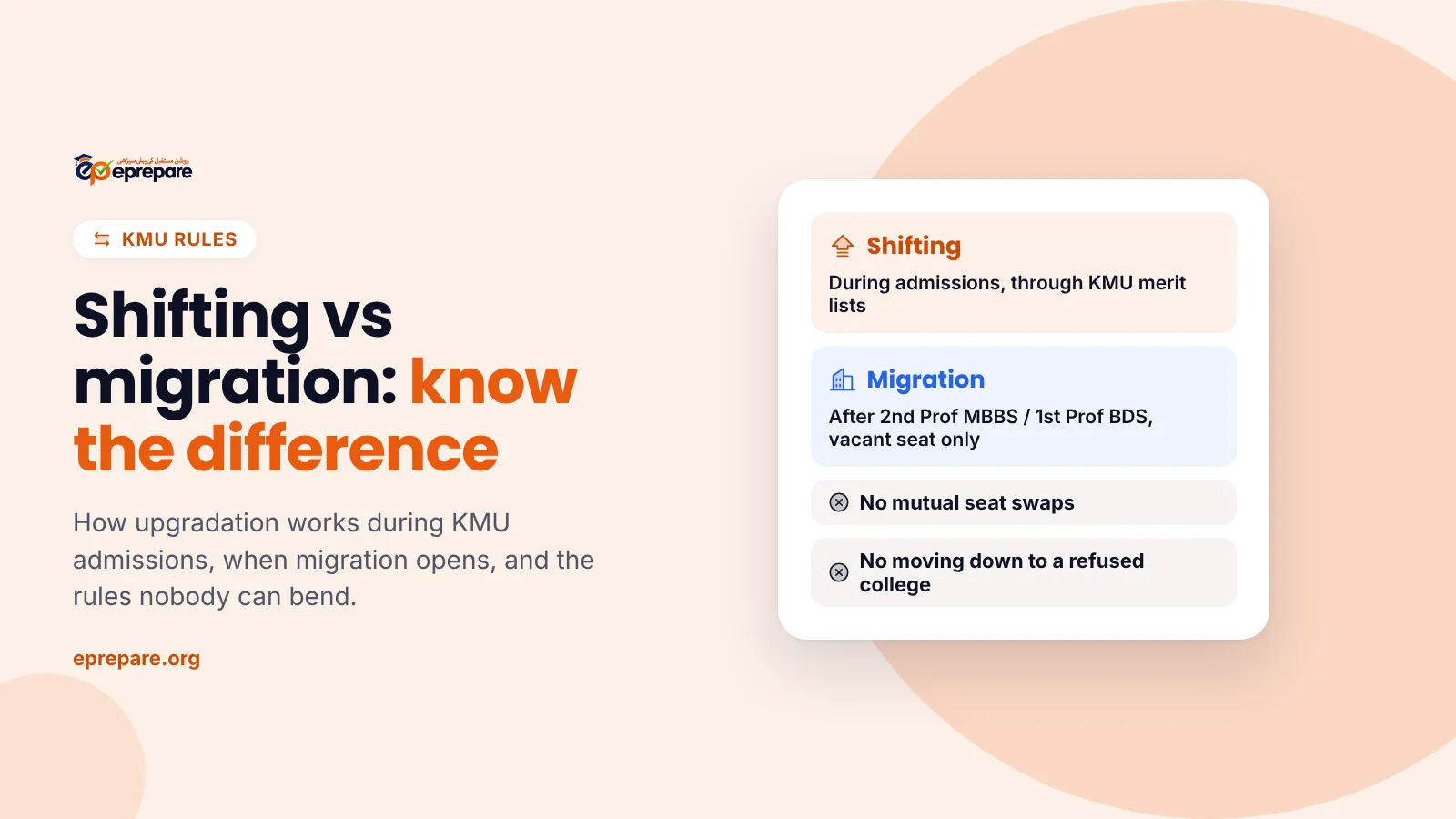
Before accepting a seat you might later leave, also read the migration, withdrawal and refund guide. Admission-round upgradation and migration after admission are different processes.
Frequently asked questions
Are KIMS and KIDS the same college?
They are separate KMU institutes in Kohat. The policy lists MBBS for KIMS and BDS for KIDS, with different seat and fee tables.
Is there an age limit in this policy?
The linked edition says there is no lower or upper age limit for admission. Check the current notice for any changed requirement, and do not confuse an age-limit rule with age used to break a merit tie.
Can I apply to both MBBS and BDS?
The policy requires separate programme applications. If you want to be considered for both, complete the required process for each; an application to one does not automatically cover the other.
Does the guide give the current deadline or closing merit?
No. The linked document is an earlier policy edition. Use KMU’s current admission notice and the relevant programme/category merit lists for those time-sensitive facts.
Can any applicant choose any reserved category?
No. Each category has eligibility and evidence requirements. Read the quota eligibility guide before selecting a category.
Official source
KMU admission policy for KIMS and KIDS. Relevant physical PDF pages: PDF page 4 · PDF page 7 · PDF page 11 · PDF page 12 · PDF page 14.
This is an independent explanatory guide based on the supplied policy edition, not an official admission notice, a current fee demand or an admission guarantee. Check the latest official instructions for changes.