

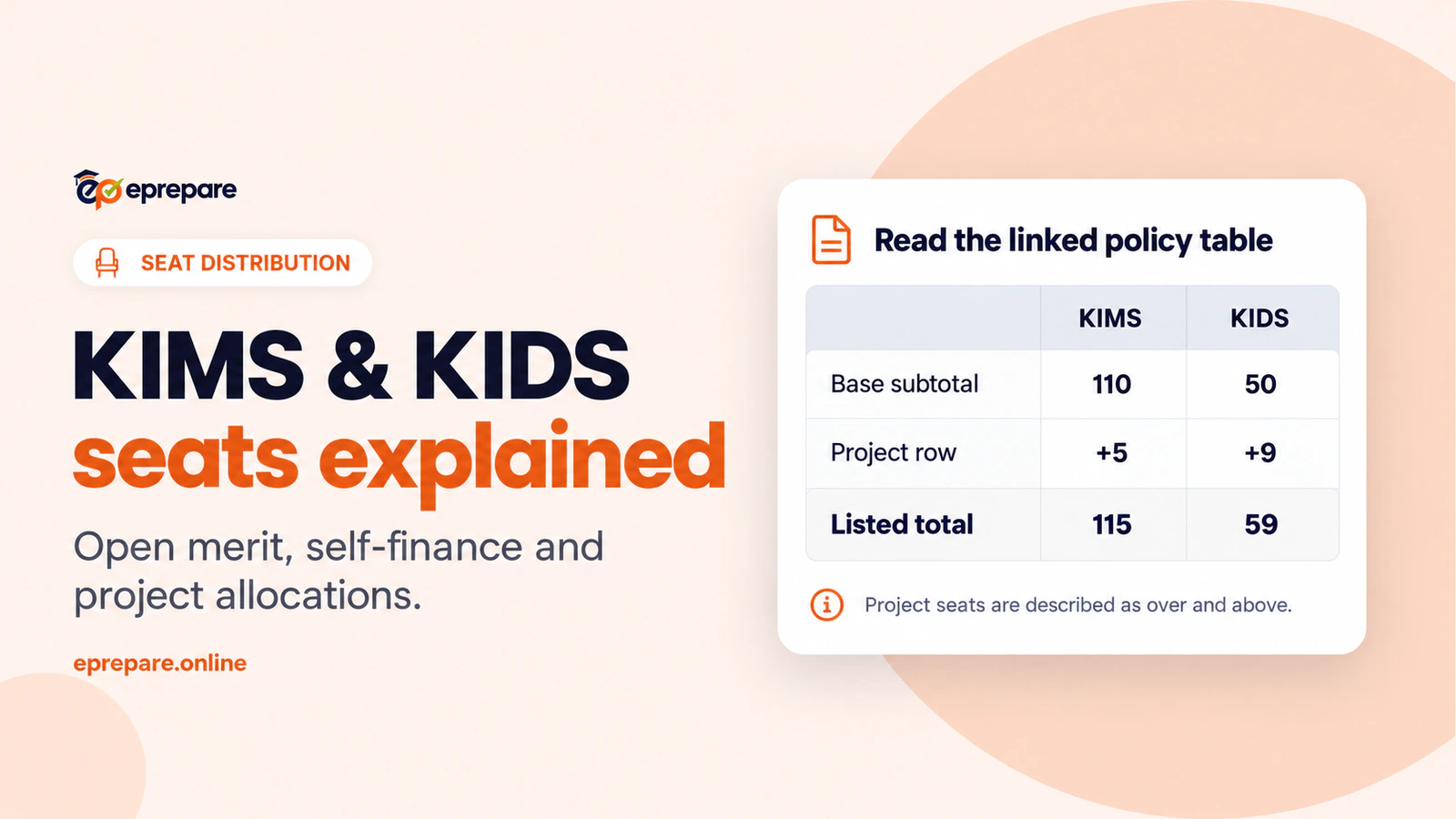
The most useful way to read the KIMS and KIDS seat table is to separate ordinary listed categories, project seats and the printed total. A headline total on its own can hide both the number of open-merit places and the way the project row is counted.
This guide reproduces every category in KMU’s linked policy for its medical and dental institutes in Kohat. KIMS refers to MBBS; KIDS refers to BDS.
Policy-based reference: this guide explains an earlier edition of the linked KMU policy. Figures and conditions are not independently verified as current. Check the latest KMU notice and written fee demand before applying or paying.
Complete KIMS and KIDS seat distribution
| Category in the policy | KIMS MBBS | KIDS BDS | Combined |
|---|---|---|---|
| Open merit | 93 | 41 | 134 |
| General self-finance | 11 | 8 | 19 |
| Foreign self-finance | 3 | 0 | 3 |
| GSF: KMU wards | 2 | 1 | 3 |
| GSF: minority | 1 | 0 | 1 |
| Base subtotal, calculated from the five rows above | 110 | 50 | 160 |
| FATA/Baluchistan project row | 5 | 9 | 14 |
| Total printed in the policy table | 115 | 59 | 174 |
The source labels the last category “FATA/Baluchistan”. We retain that wording when identifying its row, while using Merged Districts when discussing the policy’s broader terminology.
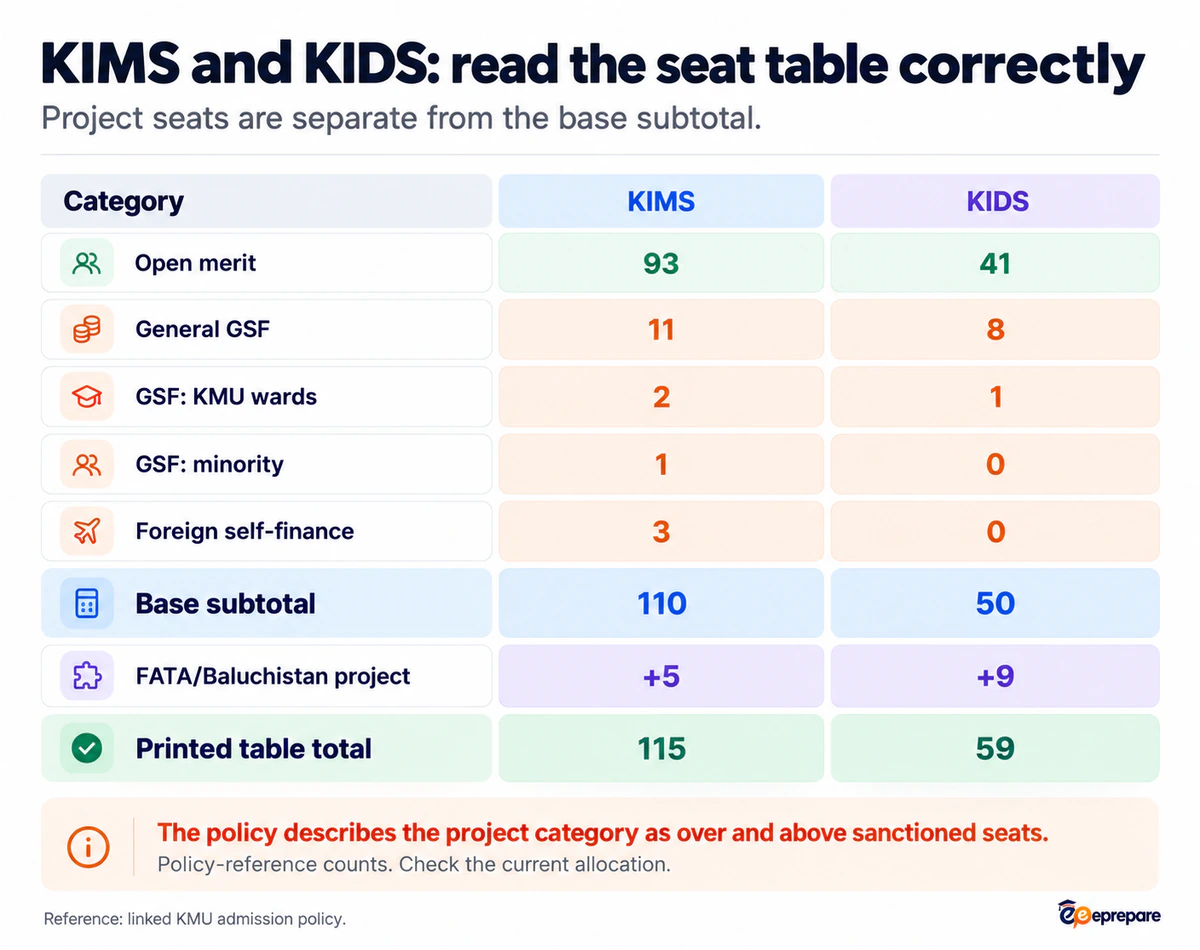
Why 115 and 59 need an explanation
Add the five non-project rows: KIMS has 110 and KIDS has 50. The project row then adds 5 and 9, producing the printed totals of 115 and 59. Across both institutes, that is a base subtotal of 160 plus 14 project seats, giving 174 in the table.
The policy’s general rules describe seats for the erstwhile FATA/Baluchistan project as over and above the sanctioned allocation. These calculated subtotals help explain the table; they are not a new notice of approved intake.
Use the table without overstating it: say “the linked policy lists 115 and 59 including its project row”, rather than claiming that these are independently verified current sanctioned intakes.
Open merit: 93 MBBS places and 41 BDS places in the table
The open-merit row lists 93 at KIMS and 41 at KIDS, a combined 134. These are not the same as the printed overall totals because self-finance and project categories occupy separate rows.
The policy’s open-merit section requires the relevant KP domicile evidence for the applicant and parent, with a mother’s domicile considered where the father has died. Eligibility is not determined by the seat number alone; see the domicile and quota guide.
Self-finance has more than one row
The policy distinguishes general self-finance, GSF for KMU wards and GSF for minority candidates. Do not count the special subcategories twice by adding them to an already combined total.
| Institute | General GSF | KMU wards | Minority GSF | Grouped GSF subtotal |
|---|---|---|---|---|
| KIMS | 11 | 2 | 1 | 14 |
| KIDS | 8 | 1 | 0 | 9 |
Those grouped subtotals are calculations from the source rows, not extra seats. A KMU-ward or minority applicant must still meet that subcategory’s conditions and pay the fee applicable to the offered category.
Foreign self-finance: a KIMS row, not a KIDS allocation
The foreign-self-finance row is 3 for KIMS and 0 for KIDS. A generic foreign-fee table elsewhere in the document does not create a foreign BDS seat that is absent from the allocation table.
The policy says a vacant foreign-self-finance seat can transfer to general self-finance when eligible foreign candidates are unavailable. That is an official allocation process; it is not a seat an individual applicant can convert by request.
Project seats and the nomination route
The five KIMS and nine KIDS project seats should be read with the policy’s nomination and Merged Districts provisions. The general rules identify nominating agencies, and the procedure section refers to KMU working with the Home & Tribal Affairs Department/Merged Districts authorities.
Do not assume that ticking a general open-merit box is a complete application to a separately nominated project. Check the current agency notice, required domicile/location evidence and the relevant submission route.
Does the policy allocate disability or other seats here?
The document discusses disability assessment and other admission categories, but its KIMS/KIDS seat table does not give a separate numbered disability row. A general eligibility discussion and an institute-specific allocation are different pieces of evidence.
Ask KMU for the current numbered allocation if a category you intend to claim is not shown. Do not add an assumed seat to the totals, borrow a quota from another college or treat a category heading as an allocation notification.
What if a seat stays vacant?
The general rules discuss filling vacancies on merit-cum-choice and converting unfilled categories where no eligible candidate remains. Foreign self-finance is specifically described as transferring to general self-finance. Actual placement and conversion must follow KMU’s official process.
During admission rounds, higher preferences can matter when vacancies become available. Our application and preference guide explains why leaving an acceptable college off the list can remove that option.
Frequently asked questions
How many MBBS seats does the policy list at KIMS?
It prints a total of 115, including five project seats. The non-project rows add to 110, and the open-merit row is 93. These are policy-reference figures, not a fresh intake announcement.
How many BDS seats does the policy list at KIDS?
It prints 59, including nine project seats. The non-project rows add to 50, and the open-merit row is 41.
Are the two KMU-ward seats part of KIMS’s 11 general GSF seats?
The table prints 11 general GSF and two KMU-ward GSF in separate columns, with one minority GSF as another column. Adding those three rows gives 14 grouped GSF places.
Does KIDS have foreign self-finance seats in this table?
No. Its foreign-self-finance cell is zero. Do not infer a foreign BDS allocation from a generic fee heading elsewhere.
Can I use these counts as the latest seat announcement?
No. Use them to understand the linked policy and check KMU’s current allocation notice for any revisions before applying.
Related KIMS and KIDS guides
- KIMS and KIDS Kohat admissions: eligibility, merit and your next steps
- KIMS & KIDS fees: KIMS MBBS open-merit and self-finance breakdown
- KIMS & KIDS fees: KIDS BDS open-merit and self-finance breakdown
Official source
KMU admission policy for KIMS and KIDS. Relevant physical PDF pages: PDF page 7 · PDF page 12 · PDF page 13 · PDF page 16 · PDF page 17.
This is an independent explanatory guide based on the supplied policy edition, not an official admission notice, a current fee demand or an admission guarantee. Check the latest official instructions for changes.