Every year a small number of students from abroad study MBBS and BDS in Khyber Pakhtunkhwa's government colleges without ever filling KMU's ordinary admission form. They come through the Pakistan Technical Assistance Programme (PTAP), a federal programme that offers places in Pakistani colleges to students from partner countries, and to students of Pakistani origin who hold a foreign nationality.
Khyber Medical University (KMU) keeps 6 PTAP seats in KP's public colleges. They are few, but they are some of the least understood seats in the whole policy: students write to KMU when they should be writing to their own embassy, or assume PTAP is the same as a foreign self-finance seat. This guide explains what PTAP is, what KMU's policy says, what the Economic Affairs Division asks for, and how the nomination actually reaches a KP college.
It is based on KMU's latest admission policy for public sector medical and dental colleges, published on the KMU admission portal, and on the PTAP admission notices published by the Economic Affairs Division (EAD), the federal ministry that runs the programme.
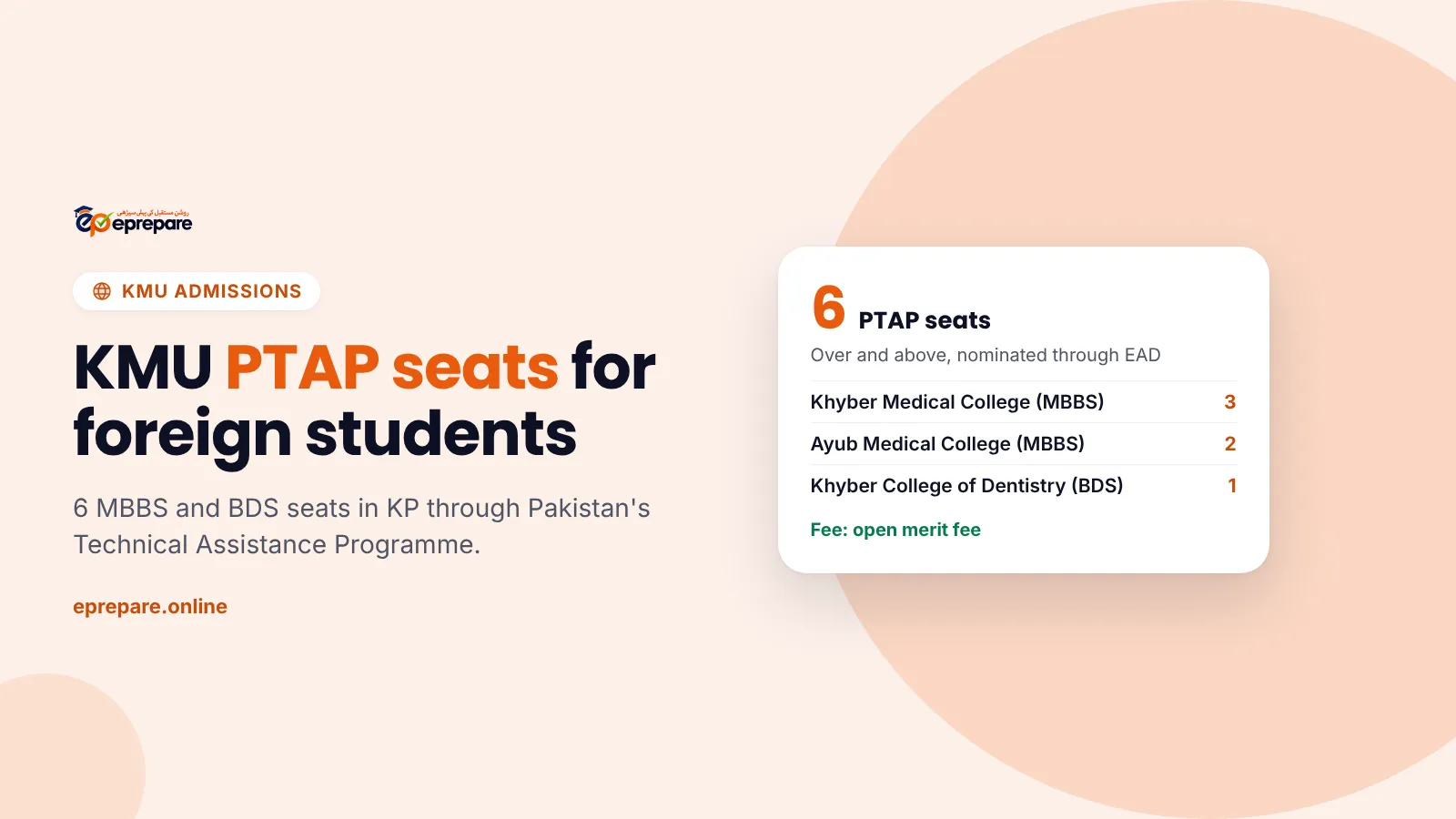
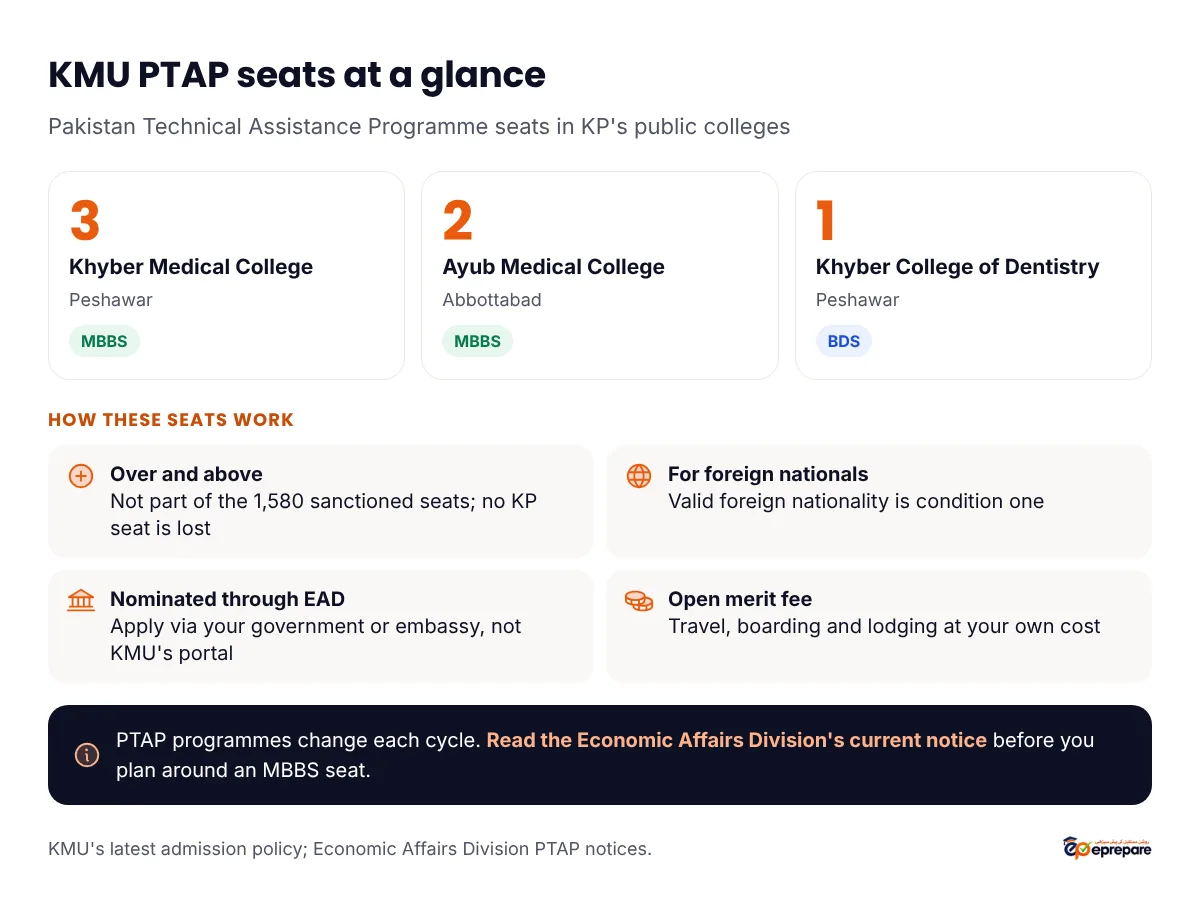
The short answer: KMU's latest policy has 6 PTAP seats: 3 MBBS at Khyber Medical College, 2 MBBS at Ayub Medical College and 1 BDS at Khyber College of Dentistry. They are over and above the 1,580 sanctioned seats, so they take nothing away from KP students. They are for applicants with a valid foreign nationality. You do not apply on KMU's portal: you apply through your own government or embassy to the Economic Affairs Division in Islamabad, which selects candidates on merit and sends their names to KMU. PTAP students pay the open merit fee. Check EAD's current notice, because the programmes it opens change from one admission cycle to the next.
What is the Pakistan Technical Assistance Programme?
PTAP is a long-running federal programme administered by the Ministry of Economic Affairs (Economic Affairs Division), Government of Pakistan. In its admission notices, EAD describes the programme as "designed to strengthen technical collaboration, foster goodwill, and promote human resource development among partner developing countries", and says that through PTAP "Pakistan has enabled thousands of international students to pursue and successfully complete higher education in its institutions".
Under PTAP, EAD places students in professional degree programmes at public sector institutions across Pakistan, such as medicine, dentistry, pharmacy and engineering. KP's public medical and dental colleges are among them, through the 6 seats in KMU's policy.
Two streams in EAD's notices
EAD publishes two kinds of PTAP admission notice. They are worth telling apart, because the conditions differ.
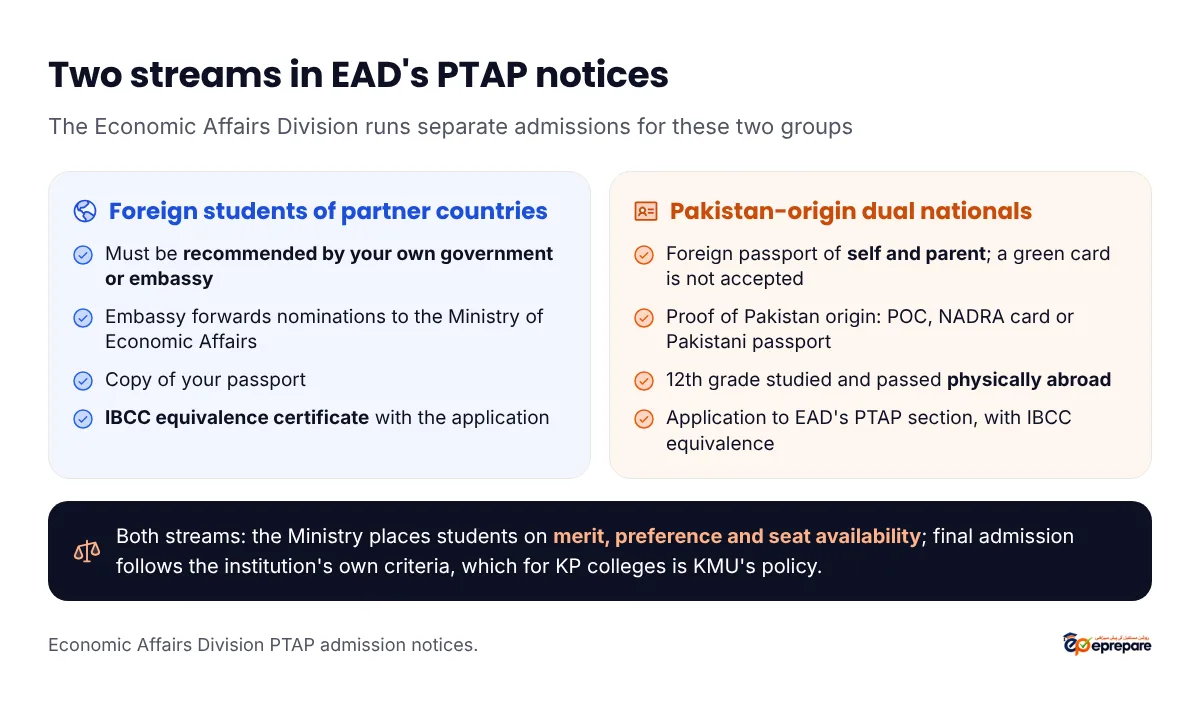
| Point | Foreign students of partner countries | Pakistan-origin dual nationals |
|---|---|---|
| Who | Nationals of partner developing countries | Students of Pakistani origin with a foreign nationality |
| How you apply | Recommended by your own government or embassy, which forwards the nomination to EAD | Application form submitted to EAD's PTAP section |
| Nationality proof | Copy of your passport | Foreign passport of self and parent; EAD says a green card is not accepted |
| Other conditions | IBCC equivalence certificate with the application | Proof of Pakistan origin; 12th grade studied physically abroad; IBCC equivalence certificate |
In both streams, EAD's notices say placement in institutions "shall be determined by the Ministry of Economic Affairs (MoEA) on the basis of merit, students' preference and availability of seats", and that final admission is "subject to the eligibility criteria and admission requirement by the institutions concerned". For KP's public colleges, those institution criteria come from KMU's policy.
Check which programmes are open: the programmes offered under PTAP change from cycle to cycle. EAD's earlier notices for Pakistan-origin students included MBBS and BDS, and EAD has published MBBS and BDS merit lists. Its most recent notices, at the time of writing, invited applications for B.Sc. Engineering and Doctor of Pharmacy. Always read the current notice on EAD's PTAP page before you plan around a medical seat.
KMU's 6 PTAP seats
| College | Programme | PTAP seats |
|---|---|---|
| Khyber Medical College (KMC), Peshawar | MBBS | 3 |
| Ayub Medical College (AMC), Abbottabad | MBBS | 2 |
| Khyber College of Dentistry (KCD), Peshawar | BDS | 1 |
| Total | 5 MBBS, 1 BDS | 6 |
These seats are over and above. KMU's policy says seats for the "Pakistan Technical Assistance Program" are "considered as over and above of the total number of sanctioned seats". Together with 68 additional foreign seats and 4 IIOJK seats, they make 78 seats on top of the 1,580 that PM&DC sanctions, which the seat table labels as the 5% allowed above each college's sanctioned seats. A PTAP admission does not reduce open merit or any other category.
Who is eligible under KMU's policy?
KMU's policy says an applicant is eligible for these seats subject to these conditions, word for word:
i. The applicant holds a valid foreign nationality.
ii. The applicant must have passed HSSC/ equivalent (Pre-medical) examination, having a certificate from the Institution last attended.
iii. The applicant must also fulfill the criteria laid down by Economic Affairs Division, Ministry of Economic Affairs & Statistics, and Government of Pakistan Islamabad.
iv. Nomination of the candidates must be routed through Economic Affairs Division, Ministry of Economic Affairs & Statistics, Government of Pakistan Islamabad.
In plain words:
- Foreign nationality is the key. A Pakistani citizen living in Pakistan cannot use these seats. A Pakistani living abroad on a green card or iqama without a foreign nationality does not meet condition (i) either, and EAD's notice for Pakistan-origin students says a green card is not accepted as proof of foreign nationality.
- Pre-medical HSSC or equivalent, with a certificate from the institution you last attended.
- EAD's own criteria apply on top, such as the IBCC equivalence certificate and minimum marks in its current notice.
- The nomination must come through EAD. KMU does not select PTAP students itself.
Do PTAP students need the MDCAT?
KMU's PTAP section does not mention the MDCAT. We will not pretend it does. But three other things point the same way, so plan for it:
- KMU's general policy says no category of seat may be created "which permits a student who has not qualified the MDCAT" to be admitted. The only exception it describes is the special over-and-above seats for a Federal Government programme for foreign students under bilateral agreements, whose students may instead qualify through SAT-II (at least 550 in each subject) or a foreign MCAT or UCAT with 50% marks.
- EAD's earlier PTAP notice for MBBS and BDS asked Pakistan-origin candidates for at least 60% in HSSC after IBCC conversion and to have "passed Medical and Dental College Admission Test (MDCAT)/University Clinical Aptitude Test (UCAT) examination, as per condition laid down by Pakistan Medical and Dental Council (PMDC)", with the result card attached.
- PM&DC's rules decide what a foreign student needs for MBBS or BDS in Pakistan.
So prepare for the MDCAT (or UCAT, if your notice allows it) and confirm the exact requirement in EAD's current notice and with your embassy. Our guide to MDCAT passing marks explains the 55% (MBBS) and 50% (BDS) pass marks.
How a PTAP nomination reaches a KP college
KMU's policy describes the route clearly: foreign candidates "shall submit their applications through their own Government/Embassy to the Economic Affair Division Government of Pakistan Islamabad which will make on merit necessary selection and allocation". EAD then communicates the names of selected candidates to KMU, "with a copy to Secretary Health, Government of Khyber Pakhtunkhwa for endorsement".
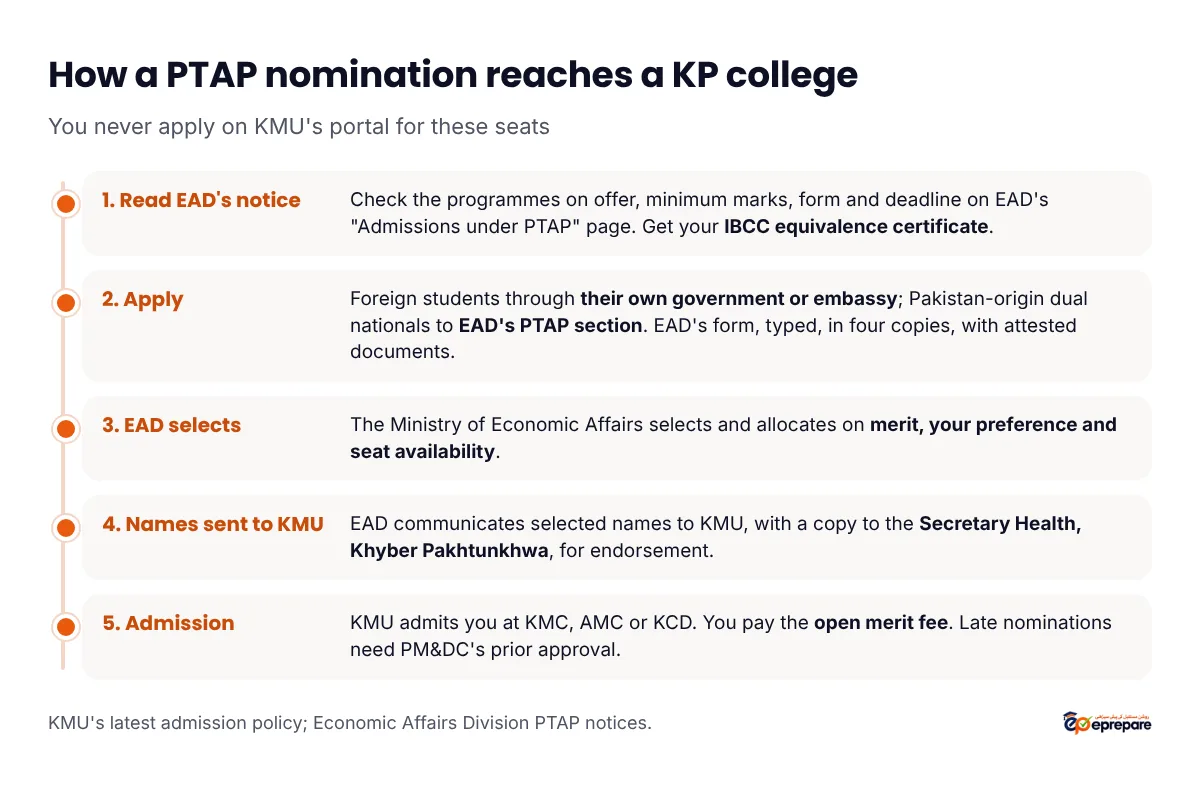
- Read EAD's current PTAP notice on its "Admissions under PTAP" page. It gives the programmes on offer, minimum marks, the application form and the deadline.
- Get your IBCC equivalence certificate first. EAD's notices say "no application will be considered without Equivalency Certificate" issued by IBCC, Islamabad, and point applicants to IBCC's online equivalence service.
- Apply through the right channel. Foreign students apply through their own government or embassy, which forwards nominations to EAD. Pakistan-origin dual nationals submit EAD's form to its PTAP section. EAD asks for the form "preferably typed, printed, and submitted in quadruplicate" (four copies) with attested documents.
- EAD selects and allocates on merit, your preference and the seats available.
- EAD sends the names to KMU, with a copy to the Secretary Health, KP, for endorsement. KMU then admits you at the college allocated.
Nominations sometimes arrive after KMU's own admission dates. KMU's policy says candidates sent by nominating agencies "after the closure of admission date will be admitted, subject to prior approval of PM&DC".
What fee do PTAP students pay?
KMU's normal-fee list includes "Students under Pakistan Technical Assistance Program and Foreign Nationals/Equal to Open Merit Fee". So a PTAP student pays the open merit fee, not the foreign self-finance dollar fee.
| Year | KMC and AMC (MBBS) | KCD (BDS) |
|---|---|---|
| 1st year | Rs 102,000 | Rs 87,000 to Rs 102,000 |
| 2nd year | Rs 102,000 | Rs 83,500 to Rs 102,000 |
| 3rd year | Rs 112,000 | Rs 90,750 to Rs 112,000 |
| 4th year | Rs 123,200 | Rs 99,825 to Rs 123,200 |
| Final year (MBBS) | Rs 135,520 | BDS ends after 4th year |
| Total | Rs 574,720 | Rs 361,075 to Rs 439,200 |
KMU's policy does not say which of its two open merit rates applies to Khyber College of Dentistry, so the BDS fee is a range. EAD's notices add that PTAP students pay "the prescribed fee applicable under the Program to the institution concerned", that "expenses on traveling, boarding & lodging etc. are also to be borne by students themselves", and that any fee concession depends on the institution. See the full KMU fee structure.
PTAP vs foreign self-finance vs additional foreign seats
KMU has three kinds of seat for foreign nationals. Choosing the wrong one wastes a year.
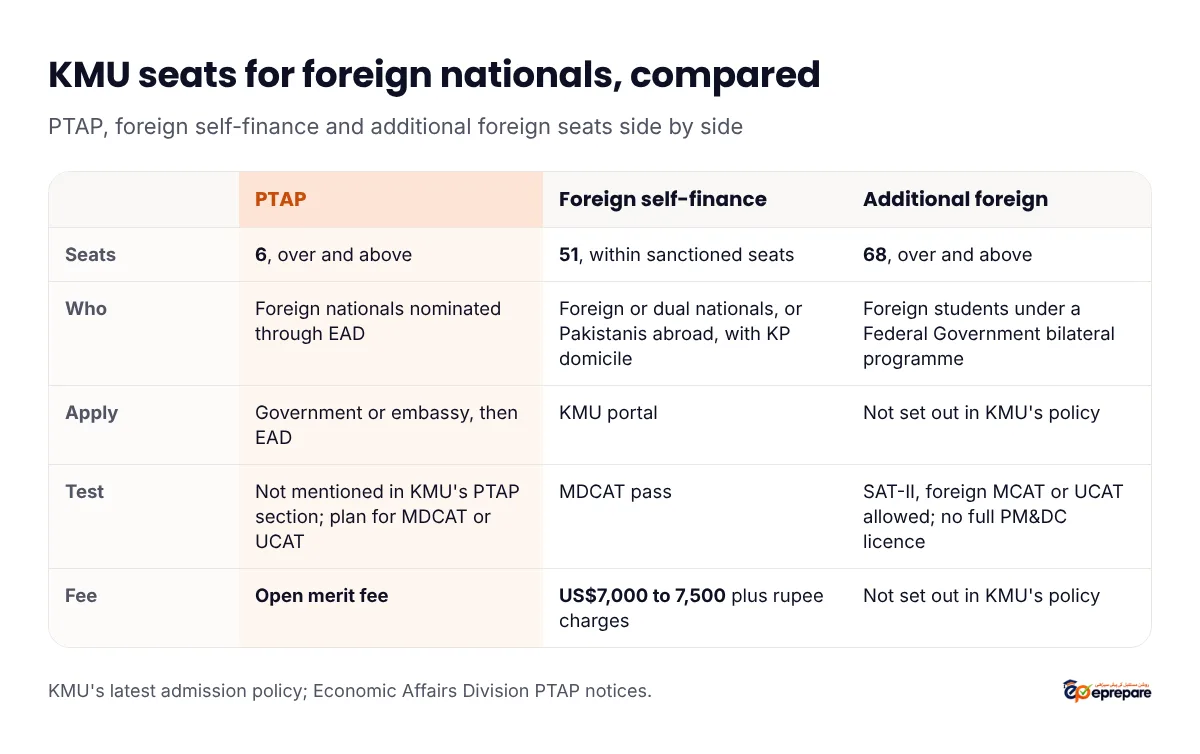
| Point | PTAP | Foreign self-finance | Additional foreign |
|---|---|---|---|
| Seats | 6, over and above | 51, within the sanctioned seats | 68, over and above |
| Who | Foreign nationals nominated through EAD | Foreign or dual nationals, or Pakistanis living abroad, with KP domicile | Foreign students under a Federal Government bilateral programme |
| Where you apply | Government or embassy, then EAD | KMU portal | Not set out in KMU's policy |
| Fee | Open merit fee | US$7,000 to 7,500 a year plus rupee charges | Not set out in KMU's policy |
A Pakistan-origin dual national with a KP domicile may qualify for both PTAP and foreign self-finance. PTAP is far cheaper but has very few seats and depends on what EAD opens in a given year, so many families apply for foreign self-finance on KMU's portal as well. Compare them in our guides to KMU foreign self-finance seats and all KMU seats for foreign and overseas students. Afghan nationals have their own 12 seats, applied for on KMU's portal: see KMU Afghan national seats.
Documents EAD asks for
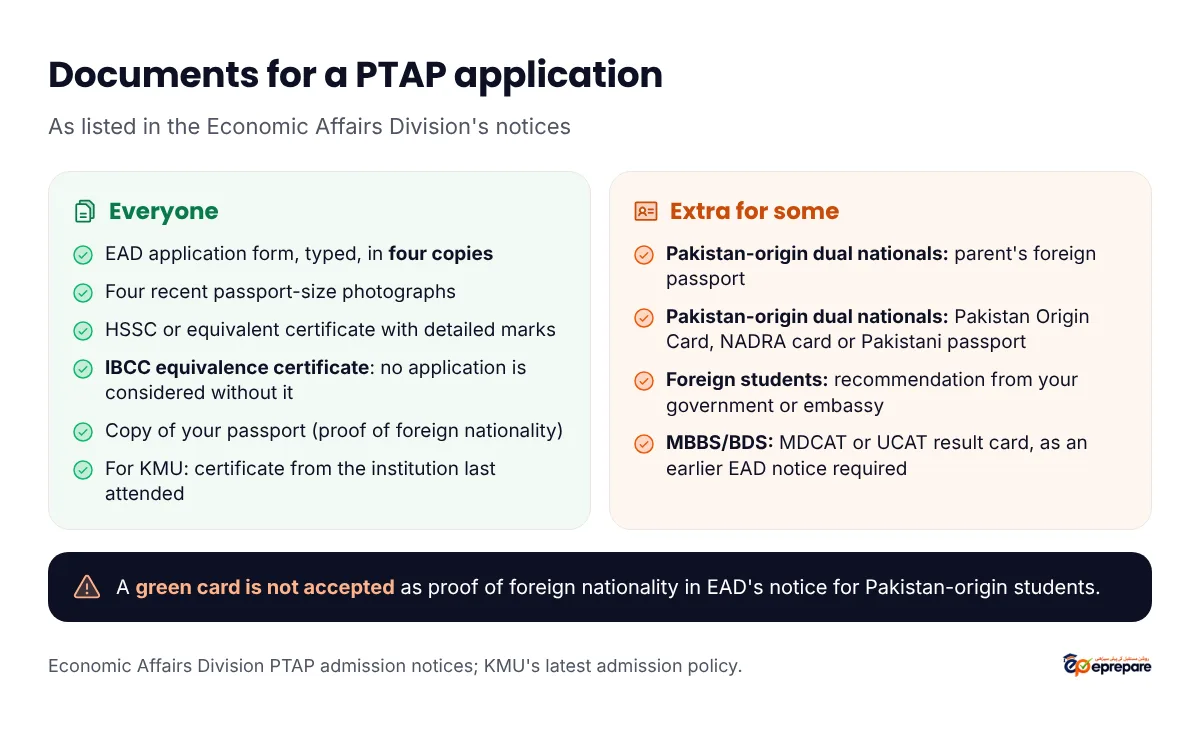
- EAD's application form, typed, in four copies
- Four recent passport-size photographs
- HSSC or equivalent certificate with detailed marks or transcripts
- IBCC equivalence certificate, without which no application is considered
- Copy of your passport (proof of foreign nationality)
- For Pakistan-origin dual nationals: your parent's foreign passport, and proof of Pakistan origin (Pakistan Origin Card, NADRA identity card or Pakistani passport)
- For MBBS or BDS: your MDCAT or UCAT result card, as an earlier EAD notice required
- For KMU: a certificate from the institution you last attended, as KMU's PTAP conditions require
Once you are admitted, the college verifies your documents like any other student's. All admissions are provisional, and a false document means cancellation. See our KMU admission documents checklist.
After admission
- Migration is category-wise. KMU's migration rules list "Technical Assistance Program seats" among the categories that migrate category-wise: you can move to another college only into a vacant PTAP seat, after passing the 2nd Professional (MBBS) or 1st Professional (BDS). EAD's notices add that migration is "governed by the relevant policy of the institutions concerned". See the KMU migration policy.
- The same rules as every student. Attendance, the college medical examination and the undertakings apply to PTAP students too. A first-year student absent for four continuous weeks without a valid reason is struck off the roll.
Mistakes that cost PTAP seats
- Applying on KMU's portal for PTAP. KMU does not select PTAP students; your nomination must come through EAD.
- Applying without IBCC equivalence. EAD considers no application without it.
- Using a green card as proof of nationality. EAD's notice for Pakistan-origin students says it is not accepted.
- Assuming MBBS is open every cycle. Read EAD's current notice; some cycles open only engineering and pharmacy.
- Missing the embassy's deadline. Embassies collect nominations before EAD's deadline, and EAD says nominations after the deadline are not entertained.
- Ignoring the MDCAT. Plan for MDCAT or UCAT unless your notice clearly says otherwise.
Frequently asked questions
How many PTAP seats does KMU have?
Six: 3 MBBS at Khyber Medical College, 2 MBBS at Ayub Medical College and 1 BDS at Khyber College of Dentistry. They are over and above the 1,580 sanctioned seats.
Can I apply for a PTAP seat on KMU's portal?
No. PTAP nominations are routed through the Economic Affairs Division. Foreign students apply through their own government or embassy; Pakistan-origin dual nationals apply to EAD's PTAP section. EAD then sends selected names to KMU.
Who runs the Pakistan Technical Assistance Programme?
The Ministry of Economic Affairs (Economic Affairs Division), Government of Pakistan, which publishes PTAP admission notices, forms and merit lists on its website.
Can Pakistani-origin students with a foreign passport apply?
EAD runs a separate PTAP stream for Pakistan-origin dual nationals. They need proof of foreign nationality for themselves and a parent (a green card is not accepted), proof of Pakistan origin, 12th grade studied physically abroad, and an IBCC equivalence certificate. Which programmes and colleges are offered, including KMU's seats, depends on EAD's notice and allocation that cycle.
What fee do PTAP students pay at KMU colleges?
The open merit fee: Rs 102,000 in the first year at KMC and AMC. Travel, boarding and lodging are paid by the student.
Do PTAP students need to pass the MDCAT?
KMU's PTAP section does not mention it, but KMU's general policy requires the MDCAT for every category except special bilateral-programme seats, and EAD's earlier MBBS/BDS notice asked for MDCAT or UCAT as per PMDC's conditions. Plan for it and confirm in EAD's current notice.
Do PTAP seats reduce open merit seats for KP students?
No. PTAP seats are over and above the seats sanctioned by PM&DC.
Is PTAP the same as a foreign self-finance seat?
No. Foreign self-finance has 51 seats, is applied for on KMU's portal, needs a KP domicile and charges US$7,000 to 7,500 a year. PTAP has 6 seats, comes through EAD and charges the open merit fee.
Whichever route brings you to a KP college, a strong MDCAT score widens your options. ePrepare's online MDCAT courses work from anywhere in the world, with KPK textbook MCQs, full-length tests and a predicted score. Questions about your nomination itself should go to your embassy and EAD's PTAP section ([email protected], as given in its notices).
Sources: Khyber Medical University, latest Admission Policy for Public Sector Medical and Dental Colleges of Khyber Pakhtunkhwa (Pakistan Technical Assistance Program seats, general policy notes, over-and-above seats, admission procedure, migration policy and fee schedule), on cas.kmu.edu.pk; Ministry of Economic Affairs (Economic Affairs Division), "Admissions under PTAP" page and its admission notices for foreign students and for Pakistan-origin dual national students (ead.gov.pk). EAD's programmes, deadlines and conditions change each cycle; always read its current notice.