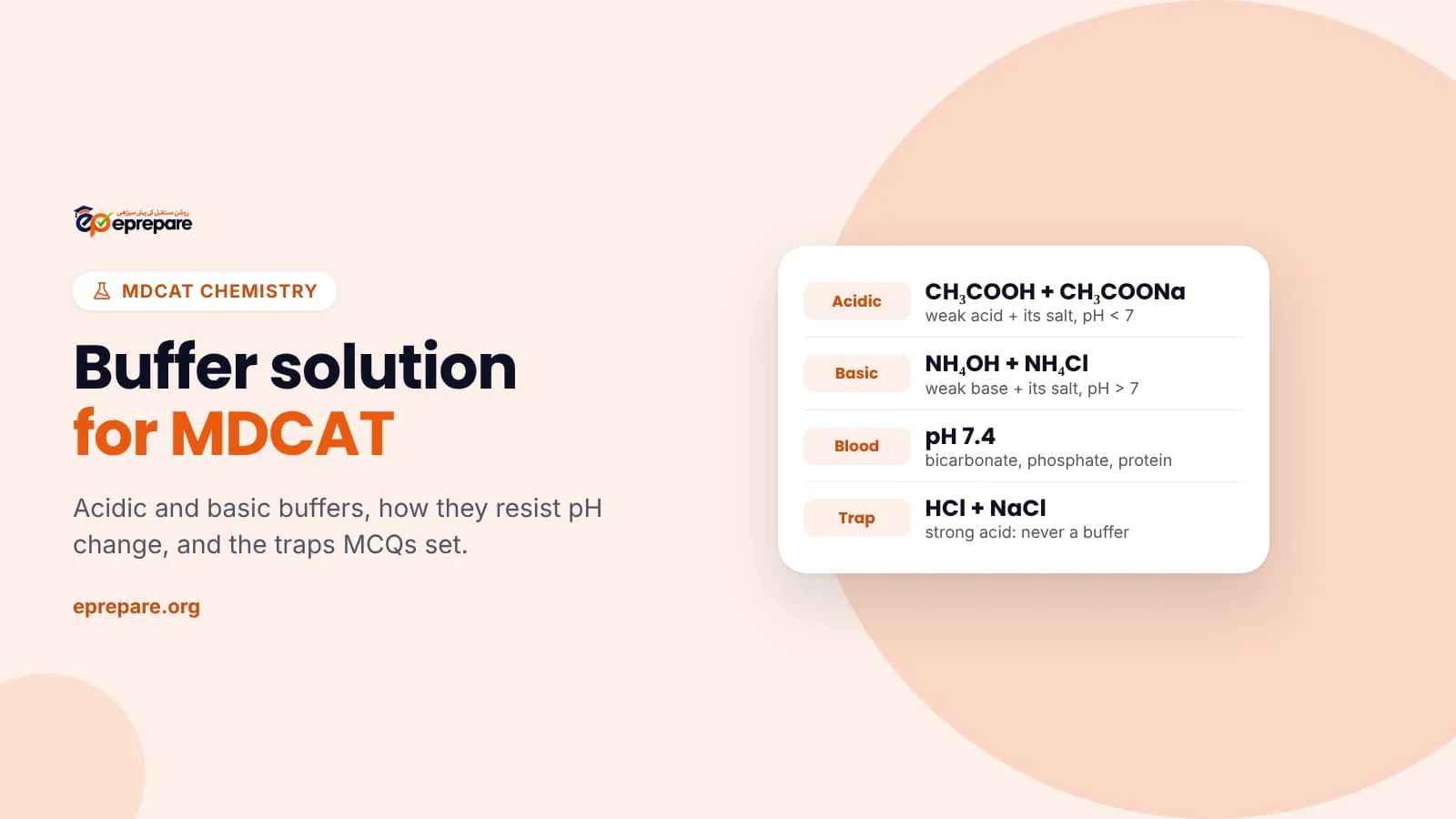
Buffer solutions sit at the end of the Chemical Equilibrium chapter, right after the common ion effect, and MDCAT likes them because one small idea produces many quick MCQs: which mixture is a buffer, which ion removes the added acid, what the pH of blood is, and why HCl + NaCl does not work. This guide explains what a buffer is, how acidic and basic buffers resist a change in pH (with the equations), the Henderson equation with sums you can do in your head, buffer capacity, and the carbonic acid–bicarbonate buffer in blood.
The short answer: A buffer solution resists a change in pH when a small amount of strong acid or strong base is added. An acidic buffer is a weak acid plus its salt with a strong base, such as CH3COOH + CH3COONa (pH below 7). A basic buffer is a weak base plus its salt with a strong acid, such as NH4OH + NH4Cl (pH above 7). One partner removes added H+ and the other removes added OH−, so the pH hardly changes.
What is a buffer solution?
Even pure water cannot hold its pH at 7 for long. Carbon dioxide from the air dissolves in it and makes it slightly acidic, and silicates from glass can change it too. Yet many processes need a fixed pH: blood must stay at about 7.4, and every enzyme works properly only at its own pH. A solution that holds its pH steady is a buffer.
Key definitions
- Buffer solution: a solution that resists a change in pH when a small amount of a strong acid or strong base is added to it.
- Buffer action: the resistance a buffer offers to a change in pH on adding an acid or a base.
- Acidic buffer: a weak acid + its salt with a strong base (CH3COOH + CH3COONa); pH < 7.
- Basic buffer: a weak base + its salt with a strong acid (NH4OH + NH4Cl); pH > 7.
- Buffer capacity: how much strong acid or base a buffer can take before its pH changes noticeably. FSc textbooks define it as the number of moles of acid or base needed to change the pH of 1 dm3 of the buffer by one unit.
Remember this: a buffer = a weak acid or weak base + its salt. It has two "bodyguards": one catches added H+, the other catches added OH−. It resists change; it does not fix the pH exactly, and it works only for small additions.
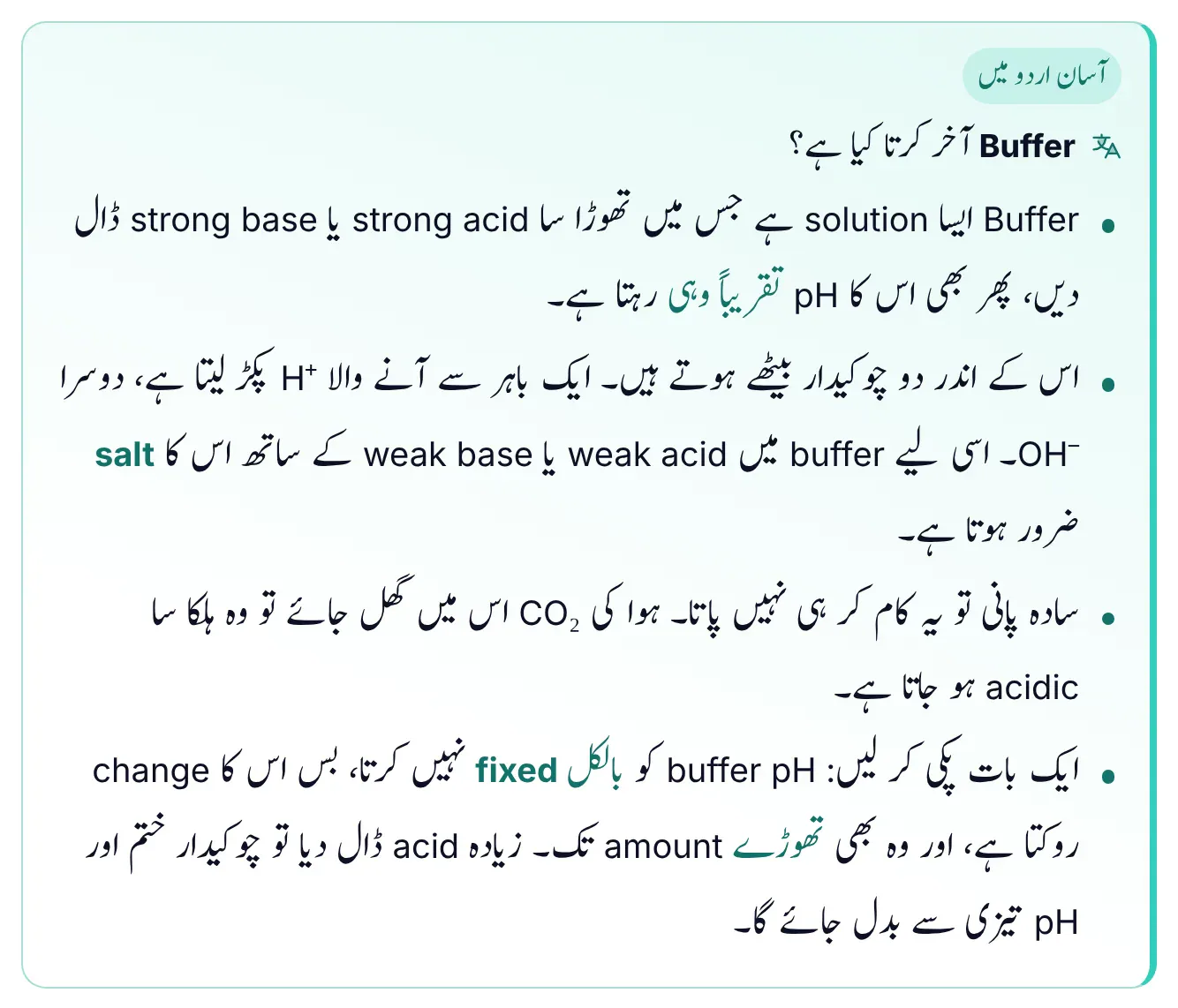
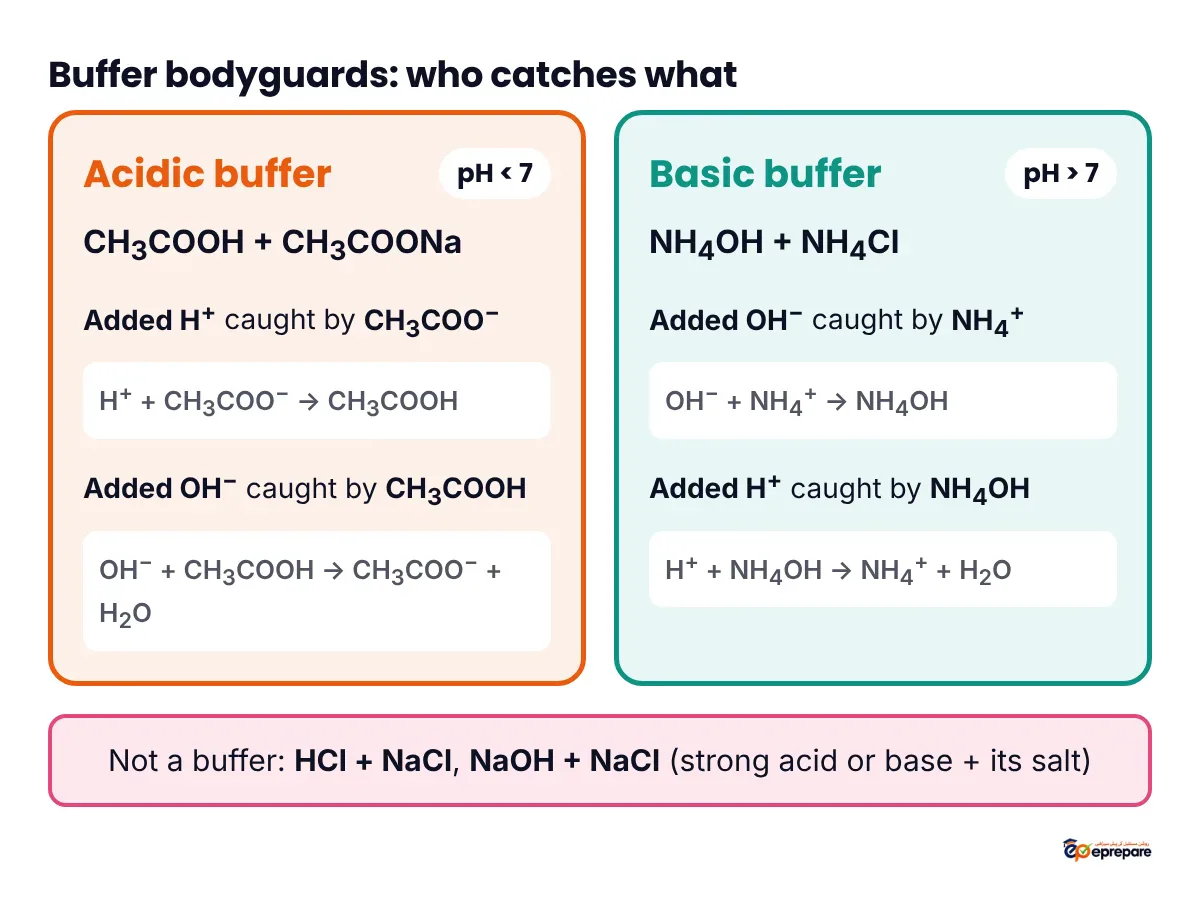
This box from ePrepare's notes explains buffers in plain spoken Urdu. Point one: a buffer is a solution whose pH stays almost the same even when a little strong acid or strong base is added. Point two uses a picture: inside it sit two chowkidars (guards), one that catches incoming H+ and one that catches OH−, which is why a buffer always contains a weak acid or weak base with its salt. Point three: plain water cannot do this, because CO2 from the air dissolves in it and makes it slightly acidic. Point four is the exam warning: a buffer does not make the pH fully fixed; it only resists change, and only for a small amount. Add too much acid and the guards are used up, so the pH changes quickly.
Acidic buffer: how CH3COOH + CH3COONa works
The secret is that the mixture holds large stocks of both partners. Acetic acid is weak, so it stays mostly as molecules (a big store of acid). Sodium acetate is a salt, so it ionises fully (a big store of CH3COO−). The CH3COO− from the salt also pushes back the ionisation of the acid (the common ion effect), so the acid stays mostly un-ionised.
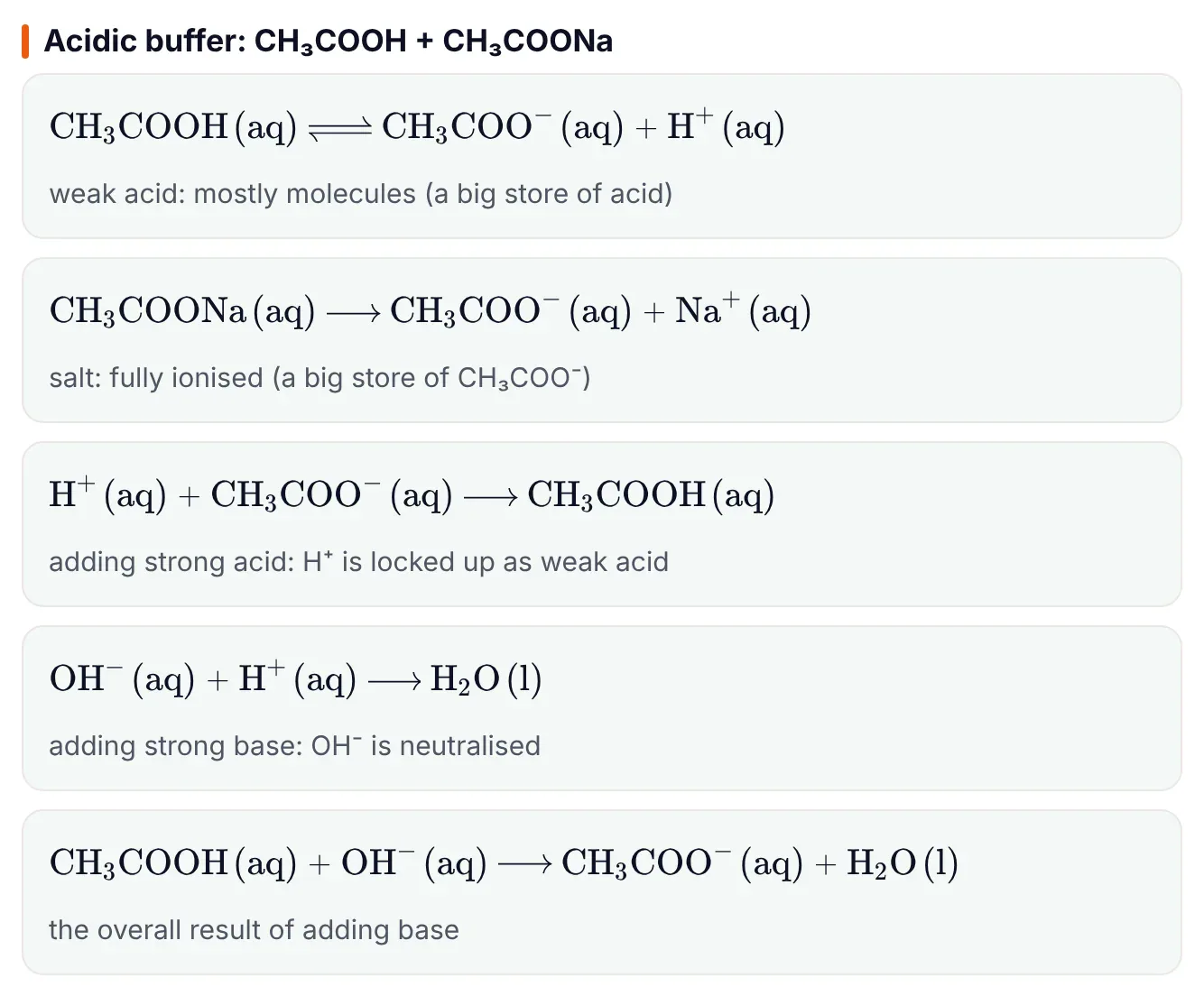
Read the panel from top to bottom:
- CH3COOH ⇌ CH3COO− + H+: the weak acid ionises only a little, so most of it stays as molecules.
- CH3COONa → CH3COO− + Na+: the salt ionises fully and supplies plenty of acetate ions.
- Add a little strong acid: H+ + CH3COO− → CH3COOH. The added H+ is locked away inside a weak acid that hardly ionises, so the pH hardly falls.
- Add a little strong base: OH− + H+ → H2O. The OH− is neutralised; the acetic acid equilibrium then shifts right and more CH3COOH ionises to replace the lost H+.
- The overall result of adding base: CH3COOH + OH− → CH3COO− + H2O.
So the jobs are split. The salt's CH3COO− deals with added acid; the weak acid CH3COOH deals with added base. Na+ is a spectator and does nothing.
Basic buffer: how NH4OH + NH4Cl works
This is the mirror image. NH4OH is a weak base (mostly molecules), and NH4Cl ionises fully to give a large stock of NH4+.
- NH4OH ⇌ NH4+ + OH− (weak base, partly ionised)
- NH4Cl → NH4+ + Cl− (salt, fully ionised)
- Add a little strong base: NH4+ + OH− → NH4OH. The added OH− is locked up in a weak base, so the pH stays nearly constant.
- Add a little strong acid: H+ + OH− → H2O. The NH4OH equilibrium shifts right and more NH4OH ionises to replace the lost OH−. Overall: H+ + NH4OH → NH4+ + H2O.
Why the pH barely moves: the Henderson equation
ePrepare's notes show the reason in symbols. For acetic acid, Ka = [CH3COO−][H+] / [CH3COOH], and Ka stays constant at a given temperature. Rearranging:
[H+] = Ka × [CH3COOH] / [CH3COO−]
So [H+] depends only on the ratio of acid to salt. Written for pH, this is the Henderson equation for an acidic buffer:
pH = pKa + log ([salt] / [acid])
Adding a little H+ or OH− changes the salt-to-acid ratio only slightly, and the log of a ratio close to 1 changes even less. That is why the pH hardly moves. For a basic buffer, FSc books give the matching form: pOH = pKb + log ([salt] / [base]).
Worked examples (no calculator needed)
Take pKa of acetic acid as 4.74 (Ka = 1.8 × 10⁻⁵), the value used in textbooks.
- Equal concentrations: 0.1 M CH3COOH + 0.1 M CH3COONa. Ratio = 1, log 1 = 0, so pH = pKa = 4.74.
- Salt ten times the acid: 0.1 M acid + 1 M salt. Ratio = 10, log 10 = 1, so pH = 4.74 + 1 = 5.74.
- Acid ten times the salt: 1 M acid + 0.1 M salt. Ratio = 0.1, log 0.1 = −1, so pH = 4.74 − 1 = 3.74.
- Diluting a buffer: if you add water to the first buffer so both become 0.01 M, the ratio is still 1 and the pH is still 4.74. Dilution hardly changes a buffer's pH; it lowers its capacity.
MDCAT shortcut: when [salt] = [acid], pH = pKa. This is also where the buffer resists change best.
Buffer capacity: why a buffer can fail
A buffer has a limited stock of each partner. In the acetate buffer, every added H+ uses up one CH3COO−. Add enough acid to use up all the acetate, and extra H+ stays free, so the pH falls sharply. ePrepare's notes put it simply: add too much and the "guards" run out.
- A buffer with higher concentrations of acid and salt has a larger buffer capacity (a bigger stock of both partners).
- A buffer works best when the concentrations of acid and salt are equal (pH = pKa), because it then has equal reserves for added acid and added base.
The buffer in your blood
Human blood is kept at about pH 7.4, slightly basic. ePrepare's notes list the blood buffers as bicarbonates, phosphates and proteins (remember "B-P-P"), and name H2CO3 + NaHCO3 (carbonic acid and bicarbonate) as the buffer in blood. It works exactly like the acetate buffer:
- Added acid: H+ + HCO3− → H2CO3
- Added base: OH− + H2CO3 → HCO3− + H2O
Why does the body care so much? Enzymes and other proteins work only in a narrow pH range; even a small shift can stop them working properly. Do not confuse the numbers: blood is 7.4, pure water is 7, and gastric juice in the stomach is about 1.5. Other buffers you may see: NaH2PO4 + Na2HPO4 (phosphate buffer).
Buffer or not? The favourite MDCAT question
| Mixture | Buffer? | Reason |
|---|---|---|
| CH3COOH + CH3COONa | Yes, acidic | Weak acid + its salt with a strong base |
| H2CO3 + NaHCO3 | Yes, acidic | Weak acid + its salt (blood buffer) |
| NaH2PO4 + Na2HPO4 | Yes | Phosphate buffer |
| NH4OH + NH4Cl | Yes, basic | Weak base + its salt with a strong acid |
| HCl + NaCl | No | Strong acid; Cl− cannot take up added H+ |
| HNO3 + KNO3 | No | Strong acid and its salt |
| NaOH + NaCl | No | Strong base; Na+ cannot take up added OH− |
The quick test: is there a weak acid or weak base, and is its own salt present? If either answer is no, it is not a buffer.
Acidic vs basic buffer
| Point | Acidic buffer | Basic buffer |
|---|---|---|
| Made of | Weak acid + its salt with a strong base | Weak base + its salt with a strong acid |
| Standard example | CH3COOH + CH3COONa | NH4OH + NH4Cl |
| pH | Below 7 | Above 7 |
| Removes added H+ by | CH3COO− (from the salt) | NH4OH (via its OH−) |
| Removes added OH− by | CH3COOH (via its H+) | NH4+ (from the salt) |
| Henderson form | pH = pKa + log [salt]/[acid] | pOH = pKb + log [salt]/[base] |
Uses worth knowing for MCQs: industries such as leather, photographic materials and dyes run in buffers; bacterial culture media are buffered; protein studies are done in buffers because the size and kind of charge on a protein depend on pH; and laboratories use buffers to calibrate pH meters.
Common mistakes
- "HCl + NaCl is a buffer because it has an acid and its salt." HCl is a strong acid, and Cl− is far too weak a base to catch added H+.
- "A buffer keeps the pH at exactly 7." An acetate buffer stays below 7 and an ammonia buffer above 7. A buffer only resists change.
- "A buffer can absorb any amount of acid." It works only for small additions. Once a partner is used up, the pH changes sharply.
- "In the acetate buffer, CH3COOH removes added H+." It is the other way round: CH3COO− removes H+; CH3COOH removes OH−.
- "An acidic buffer uses the salt of a weak base." The salt must be of the weak acid with a strong base, such as CH3COONa.
- "Blood has a pH of 7.0." Blood is buffered at 7.4. Gastric juice is about 1.5.
MDCAT-style practice MCQs
1. Which one is a buffer solution?
- HCl + NaCl
- HNO3 + KNO3
- NH4OH + NH4Cl
- NaOH + NaCl
Show answer
C. NH4OH is a weak base and NH4Cl is its salt with a strong acid. The other three pair a strong acid or base with its salt.
2. An acidic buffer is prepared by mixing:
- A weak acid and its salt with a strong base
- A strong acid and its salt with a weak base
- A weak base and its salt with a strong acid
- A strong acid and a strong base
Show answer
A. For example CH3COOH + CH3COONa. Option C describes a basic buffer.
3. When a little HCl is added to a CH3COOH + CH3COONa buffer, the added H+ is removed by:
- Na+
- CH3COO−
- CH3COOH
- Cl−
Show answer
B. H+ + CH3COO− → CH3COOH, a weak acid that hardly ionises. CH3COOH handles added OH−.
4. When a little NaOH is added to an NH4OH + NH4Cl buffer, the added OH− is removed by:
- NH4+
- Cl−
- NH4OH
- Na+
Show answer
A. NH4+ + OH− → NH4OH, a weak base. Cl− and Na+ are spectator ions.
5. The pH of human blood is maintained at about:
- 1.5
- 6.4
- 7.0
- 7.4
Show answer
D. Blood is buffered at pH 7.4 by bicarbonate, phosphate and protein buffers. 1.5 is gastric juice and 7.0 is pure water.
6. A buffer contains 0.1 M CH3COOH and 0.1 M CH3COONa. If pKa of acetic acid is 4.74, the pH of the buffer is:
- 3.74
- 4.74
- 5.74
- 7.00
Show answer
B. pH = pKa + log (0.1/0.1) = 4.74 + log 1 = 4.74 + 0 = 4.74.
7. In an acetate buffer, the concentration of the salt is made ten times that of the acid (pKa = 4.74). The pH becomes:
- 3.74
- 4.74
- 5.74
- 14.74
Show answer
C. pH = 4.74 + log 10 = 4.74 + 1 = 5.74. Swapping the ratio (acid ten times the salt) would give 3.74.
8. Adding a large amount of strong acid to a buffer will:
- Have no effect on the pH
- Change the pH sharply
- Raise the pH
- Turn it into a basic buffer
Show answer
B. The buffer's stock of CH3COO− runs out (its capacity is exceeded), so extra H+ stays free and the pH falls sharply.
Quick revision table
| Point | Fact to remember |
|---|---|
| Buffer | Resists pH change on adding a small amount of strong acid or base |
| Acidic buffer | Weak acid + its salt with strong base; CH3COOH + CH3COONa; pH < 7 |
| Basic buffer | Weak base + its salt with strong acid; NH4OH + NH4Cl; pH > 7 |
| Acetate buffer | Added H+ removed by CH3COO−; added OH− by CH3COOH |
| Ammonia buffer | Added OH− removed by NH4+; added H+ by NH4OH |
| Henderson equation | pH = pKa + log [salt]/[acid]; equal amounts → pH = pKa |
| Buffer capacity | Higher with more concentrated buffer; best when [salt] = [acid] |
| Never a buffer | Strong acid or strong base + its salt (HCl + NaCl, NaOH + NaCl) |
| Blood | pH 7.4; bicarbonate (H2CO3/HCO3−), phosphate, protein |
| Uses | Leather, photographic materials, dyes, culture media, protein studies |
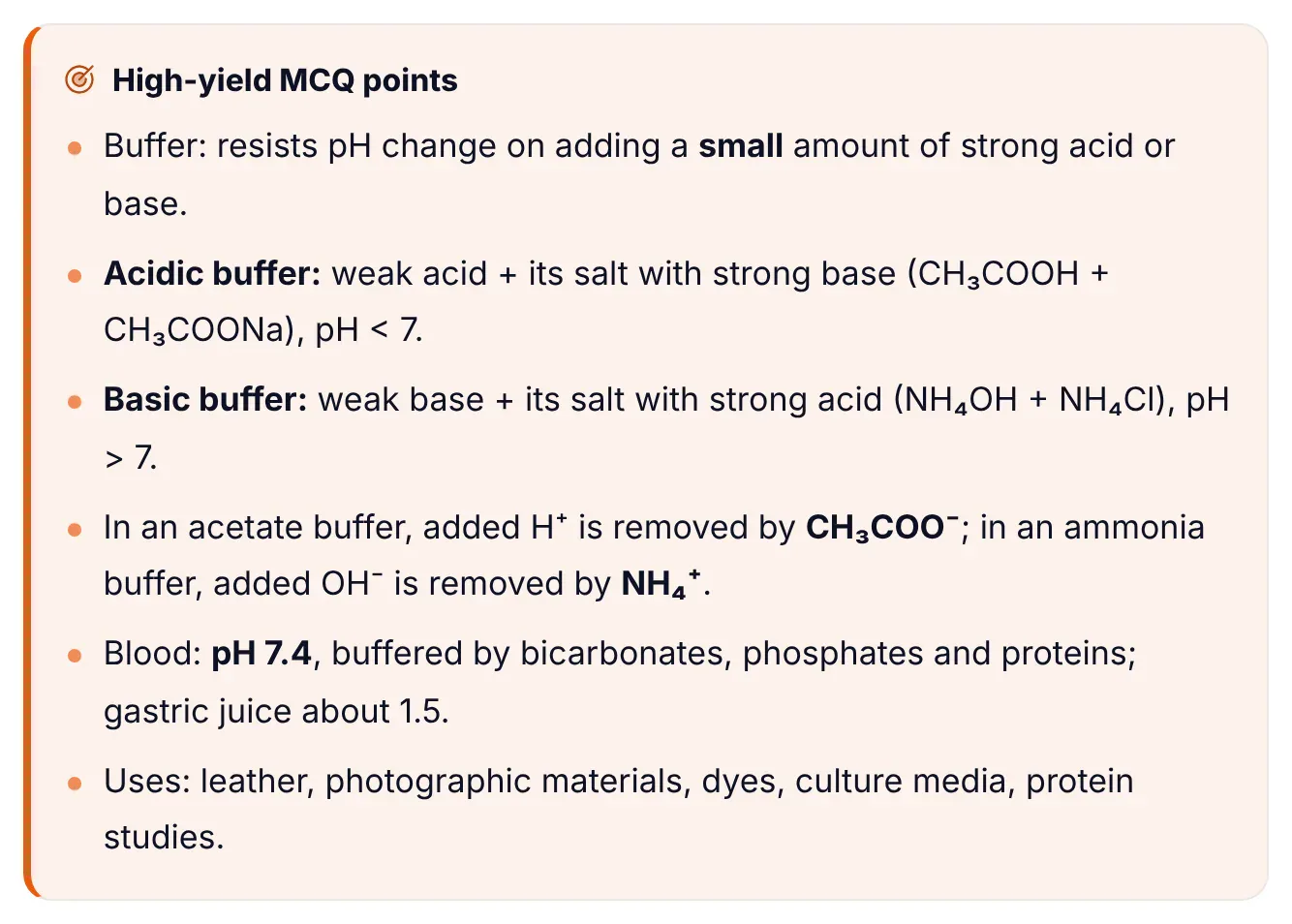
This box is the last-day checklist from ePrepare's buffer lesson. Each line is a common MCQ stem: the definition (note the word "small"), the two buffer types with their pH side of 7, which ion removes the added acid or base, the blood pH with its three buffers, and the industrial uses. The full lesson, with the basic-buffer diagram, the "buffer or not" table and 12 practice MCQs with explanations, is in ePrepare's MDCAT conceptual notes.
خلاصہ: Buffer وہ solution ہے جس میں تھوڑا سا strong acid یا strong base ڈالنے پر بھی pH تقریباً وہی رہتا ہے۔ Acidic buffer میں weak acid اور اس کا salt ہوتا ہے، جیسے CH3COOH اور CH3COONa، اور basic buffer میں weak base اور اس کا salt، جیسے NH4OH اور NH4Cl۔ ایک partner آنے والا H+ پکڑتا ہے اور دوسرا OH−۔ HCl اور NaCl جیسا strong acid والا جوڑا کبھی buffer نہیں ہوتا، اور خون کا pH تقریباً 7.4 پر buffer رکھتا ہے۔
Where this fits in your preparation
Revise buffers together with the common ion effect and Le Chatelier's principle, since all three come from the same chapter. Our guide to high-yield MDCAT Chemistry chapters shows where Chemical Equilibrium stands, and the electrochemical cell guide covers another topic that MDCAT tests with the same kind of "which one and why" MCQs. Then test yourself with a short chapter quiz in the Quiz Builder.
Frequently asked questions
What is a buffer solution in simple words?
It is a solution whose pH stays almost the same when you add a little strong acid or strong base. It does this because it contains two partners, one that removes added H+ and one that removes added OH−.
Why is HCl + NaCl not a buffer?
HCl is a strong acid that ionises completely, and Cl− is far too weak a base to take up added H+. Nothing in the mixture can soak up extra acid, so the pH falls. A buffer needs a weak acid or weak base.
Is the Henderson equation in the MDCAT syllabus?
The MDCAT buffer topic centres on what buffers are, the two types and how they work. The Henderson equation, pH = pKa + log [salt]/[acid], appears in ePrepare's notes and FSc books as the reason a buffer's pH depends on the salt-to-acid ratio. Know that when [salt] = [acid], pH = pKa; check the official MDCAT syllabus for the exact learning outcomes.
What is buffer capacity?
It is how much strong acid or base a buffer can take before its pH changes noticeably. A more concentrated buffer has a larger capacity, and a buffer works best when the concentrations of acid and salt are equal.
Which buffer keeps the pH of blood constant?
Blood is kept at about pH 7.4 by bicarbonate (carbonic acid and bicarbonate, H2CO3/HCO3−), phosphate and protein buffers. Added H+ is taken up by HCO3− to form H2CO3.
Does diluting a buffer change its pH?
Very little. Dilution lowers the acid and salt concentrations by the same factor, so their ratio, and therefore the pH, stays about the same. What dilution does reduce is the buffer capacity.