


Electrochemistry is a short chapter in the MDCAT Chemistry syllabus, and one idea from it keeps coming back in papers: which electrode is the anode, which is the cathode, what sign each one carries, and which way the electrons flow. Students lose marks here because they learn "anode is positive" by heart and then meet a Daniell cell, where the anode is negative. This guide fixes that idea once, then takes you through the Daniell cell, the salt bridge, the standard hydrogen electrode (S.H.E.) and E°cell sums you can do without a calculator.
The short answer: An electrochemical cell has two electrodes. Oxidation always happens at the anode and reduction always at the cathode, in every cell. In a galvanic (voltaic) cell such as the Daniell cell, the anode is negative and the cathode positive; in an electrolytic cell the battery makes the anode positive and the cathode negative. In both, electrons travel through the outer wire from the anode to the cathode, and E°cell = E°cathode − E°anode.
What is an electrochemical cell?
An electrochemical cell is a set-up in which a redox reaction and electricity are linked. Either a reaction that happens by itself produces an electric current, or an electric current forces a reaction that would not happen on its own. That gives the two kinds of cell you must know:
- Galvanic (voltaic) cell: a spontaneous redox reaction produces electricity. Chemical energy changes into electrical energy. Examples: the Daniell cell, a dry cell, a lead battery while it is being used.
- Electrolytic cell: a battery drives a reaction that is not spontaneous. Electrical energy changes into chemical energy. Examples: electroplating, Nelson's cell, charging a battery.
Key definitions
- Electrode: a metal plate, rod or wire (or graphite) through which current enters or leaves the electrolyte.
- Anode: the electrode where oxidation takes place (species there lose electrons).
- Cathode: the electrode where reduction takes place (species there gain electrons).
- Half-cell: an electrode dipping into a solution of its own ions, such as a zinc rod in ZnSO4 solution.
- Electrode potential: the potential difference between an element and a solution of its ions when the two are in equilibrium.
Remember this: "An Ox, Red Cat". Anode = Oxidation, Reduction = Cathode. This is true in every cell. Only the sign (+ or −) of the electrodes changes from one kind of cell to the other.
Galvanic vs electrolytic cell: why the signs swap
This is the single most tested comparison in the topic. The jobs of the electrodes stay the same; only the charge on them changes.
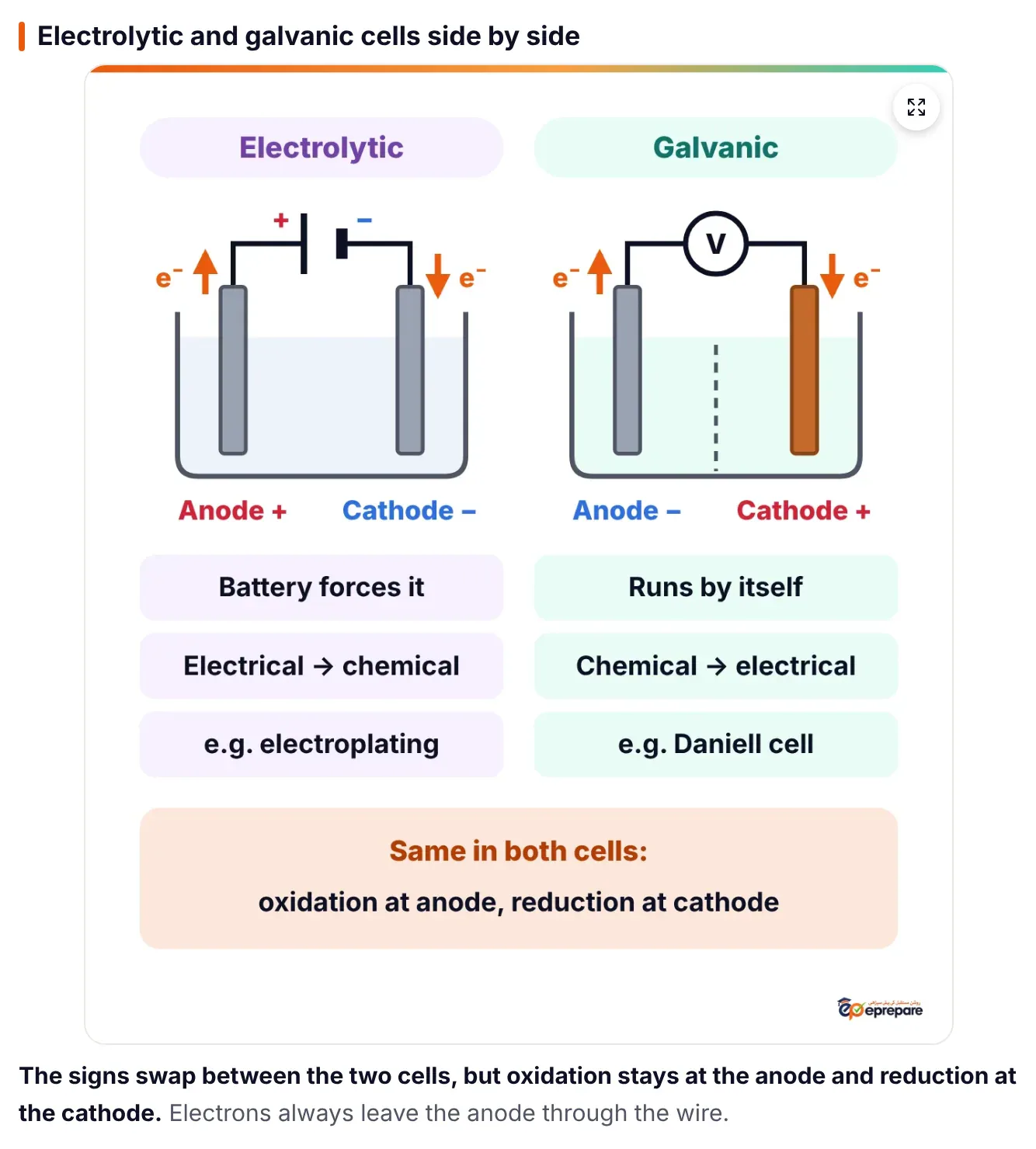
Read the diagram from left to right. In the electrolytic cell on the left, the anode is joined to the battery's positive terminal, so it is marked Anode +; the cathode is joined to the negative terminal and is Cathode −. The row below says "battery forces it", "electrical → chemical" and gives electroplating as the example. In the galvanic cell on the right there is no battery, only a voltmeter. Here the labels flip to Anode − and Cathode +, the reaction "runs by itself", the energy change is chemical → electrical, and the example is the Daniell cell. The orange arrows show electrons leaving the anode and entering the cathode in both cells. The peach box at the bottom is the line to memorise: oxidation at the anode, reduction at the cathode, in both cells.
Why the anode is negative in one cell and positive in the other
- Galvanic cell: the reaction decides the sign. At the anode the metal itself is oxidised (Zn → Zn2+ + 2e−). The released electrons pile up on the rod, so it becomes negative. At the cathode, Cu2+ ions take electrons from the rod, leaving it short of electrons, so it is positive.
- Electrolytic cell: the battery decides the sign. The anode is joined to the positive terminal, which pulls electrons out of it, so it is positive. Anions arrive there and give up electrons (oxidation). The cathode is joined to the negative terminal, which pumps electrons in, so it is negative, and cations arrive there to be reduced.
| Feature | Galvanic (voltaic) cell | Electrolytic cell |
|---|---|---|
| Energy change | Chemical → electrical | Electrical → chemical |
| Redox reaction | Spontaneous (runs by itself) | Not spontaneous; forced by a battery |
| Anode | Negative (−); oxidation | Positive (+); oxidation |
| Cathode | Positive (+); reduction | Negative (−); reduction |
| Electron flow in the wire | Anode → cathode, through a bulb or voltmeter | Out of the anode to the battery's + terminal; the battery pushes them from its − terminal into the cathode |
| Examples | Daniell cell, dry cell, lead battery in use | Electroplating, Nelson's cell, charging a battery |
ePrepare's notes also give this idea a picture in easy Urdu, which many students find easier to remember than the table:
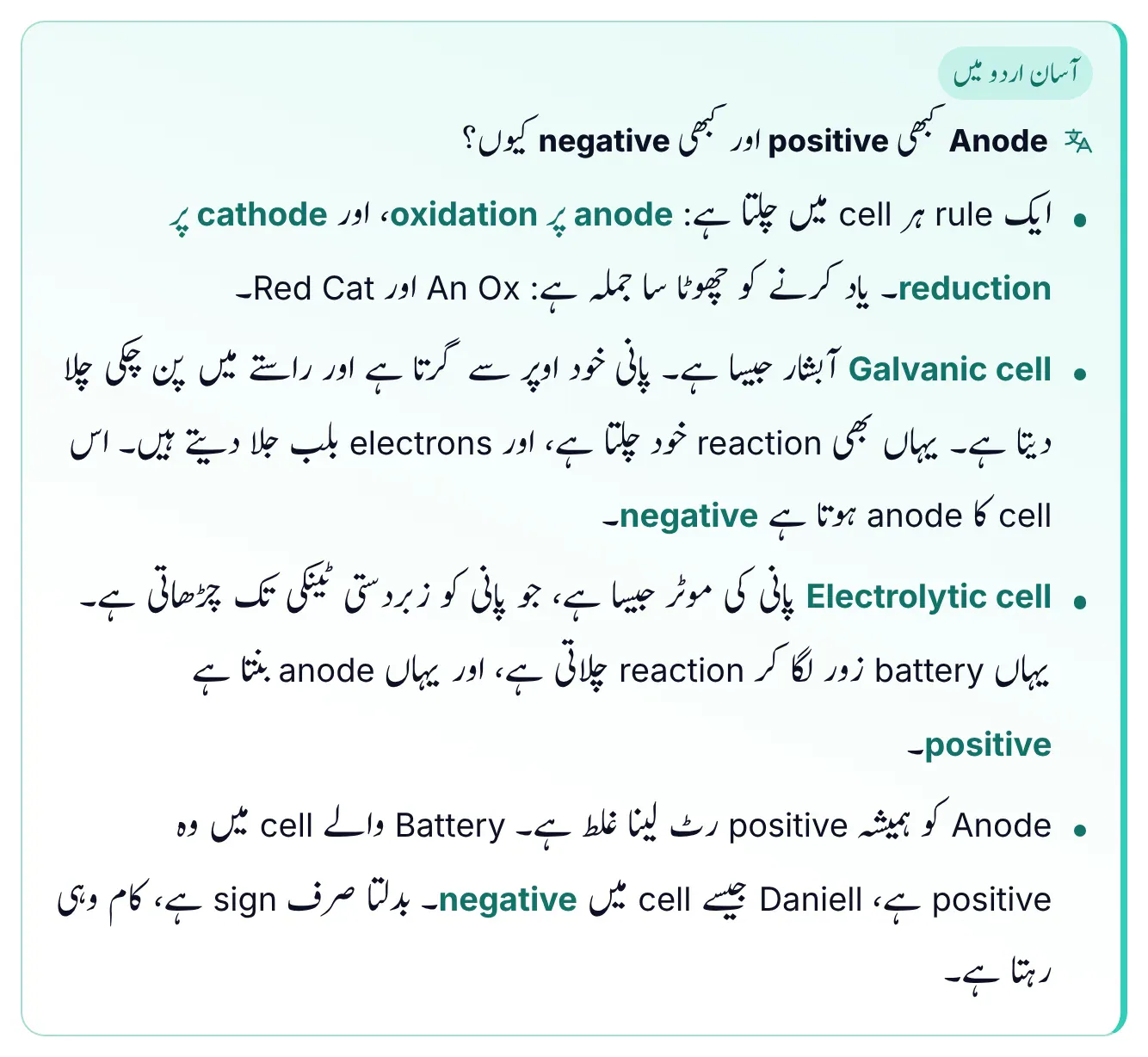
The box says that one rule works in every cell: oxidation at the anode, reduction at the cathode ("An Ox, Red Cat"). A galvanic cell is like a waterfall: water falls by itself and turns a mill on the way, just as the reaction runs by itself and the electrons light a bulb; its anode is negative. An electrolytic cell is like a water pump that forces water up to a tank: the battery forces the reaction, and here the anode is positive. The last point warns that learning "anode is always positive" by heart is wrong. Only the sign changes; the job stays the same.
The Daniell cell, step by step
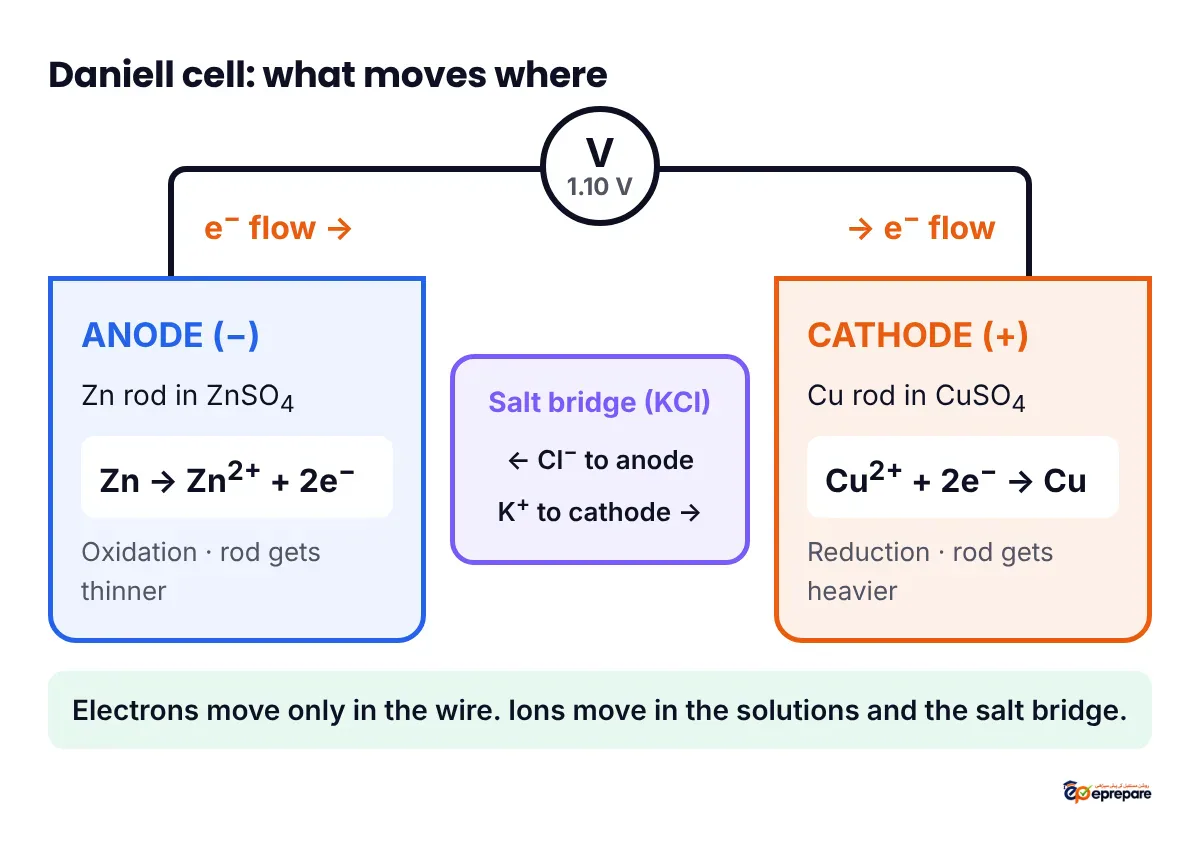
The Daniell cell is the standard galvanic cell in FSc books and in MDCAT questions. A zinc rod dips into zinc sulphate solution, and a copper rod dips into copper sulphate solution. The rods are joined by a wire through a voltmeter, and the two solutions are joined by a salt bridge.
- Anode (−), zinc: Zn(s) → Zn2+(aq) + 2e−. Zinc dissolves, so the zinc rod gets thinner (loses mass).
- Cathode (+), copper: Cu2+(aq) + 2e− → Cu(s). Copper is deposited, so the copper rod gets heavier.
- Overall reaction: Zn(s) + Cu2+(aq) → Zn2+(aq) + Cu(s).
- Voltage: the voltmeter reads 1.10 V under standard conditions.
- Cell notation: Zn(s) | Zn2+(aq, 1 M) || Cu2+(aq, 1 M) | Cu(s). The anode is written on the left, the cathode on the right; a single line | is a boundary between a solid and a solution, and the double line || is the salt bridge.
Electron flow, current and ion movement
MDCAT questions on direction are easy marks once you separate three things that move: electrons, conventional current and ions.
| What moves | Where | Direction |
|---|---|---|
| Electrons | Outer wire only | Anode (Zn) → cathode (Cu) |
| Conventional current | Outer wire | Cathode (Cu) → anode (Zn), opposite to the electrons |
| Cations (K+ from the salt bridge) | Salt bridge and solution | Towards the cathode |
| Anions (Cl− from the salt bridge) | Salt bridge and solution | Towards the anode |
Two facts settle most of these questions. First, electrons never travel through the solution or the salt bridge; only ions do. Second, cations go to the cathode and anions go to the anode (both pairs start with the same letters: "Cat" and "An").
What does the salt bridge do?
The salt bridge is a U-tube holding a concentrated solution of KCl (often in a gel). Its jobs:
- It gives a conducting path between the two solutions, so the circuit is complete inside the cell.
- Its ions move into the solutions and keep each one electrically neutral. Without it, positive charge (extra Zn2+) would build up on the zinc side and the reaction would stop almost at once.
- It stops the two solutions from mixing directly.
KCl is chosen because K+ and Cl− do not react at the electrodes. A salt such as AgNO3 or CuSO4 would bring in metal ions that react, and NaOH would precipitate the metal ions as hydroxides.
Electrode potential and the standard hydrogen electrode
When a metal strip is put into a solution of its own ions, charges separate. Zinc atoms leave the rod as Zn2+ ions and leave electrons behind, so the zinc rod becomes negative and attracts a layer of Zn2+ ions (an electrical double layer). With copper the opposite happens: Cu2+ ions take electrons from the rod, and the rod becomes positive. Either way a potential difference forms. That is the electrode potential.
The catch: a single electrode potential cannot be measured. A voltmeter needs two contacts, and the probe dipped into the solution becomes a second electrode. So every reading is a difference between two electrodes. Chemists solved this by choosing one electrode as zero, just as heights are measured from sea level.
The S.H.E. recipe ("1-1-25-0")
- A platinum foil coated with platinum black (finely divided platinum, which has a huge surface area and speeds up the hydrogen reaction)
- dipping into a 1 M H+ solution (for example 1 M HCl),
- with pure H2 gas at 1 atm bubbled over it,
- at 25 °C (298 K).
- Its potential is 0.00 V by agreement, not because nothing happens there. It is written Pt, H2(1 atm) | H+(1 M).
The S.H.E. can act as either electrode; its partner decides. With copper (E° = +0.34 V) it is the anode (H2 → 2H+ + 2e−). With zinc (E° = −0.76 V) it is the cathode (2H+ + 2e− → H2).
Standard electrode potential (E°)
Standard electrode potential (E°) is the potential of an electrode in contact with a 1 M solution of its own ions at 298 K and 1 atm, measured against the S.H.E. By IUPAC agreement, tables list reduction potentials. To get an oxidation potential, keep the number and change the sign: E°red of zinc is −0.76 V, so its E°ox is +0.76 V.
| Half-reaction | E° (V) | What it tells you |
|---|---|---|
| Li+ + e− ⇌ Li | −3.05 | Strongest reducing agent in water |
| Mg2+ + 2e− ⇌ Mg | −2.38 | Gives off H2 with dilute acid |
| Al3+ + 3e− ⇌ Al | −1.67 | Lower than zinc, so Zn is the cathode against Al |
| Zn2+ + 2e− ⇌ Zn | −0.76 | Anode in the Daniell cell |
| Fe2+ + 2e− ⇌ Fe | −0.44 | Gives off H2 with dilute acid |
| 2H+ + 2e− ⇌ H2 | 0.00 | Reference (S.H.E.) |
| Cu2+ + 2e− ⇌ Cu | +0.34 | Cathode in the Daniell cell; no H2 with dilute acid |
| Ag+ + e− ⇌ Ag | +0.80 | Copper displaces silver |
| F2 + 2e− ⇌ 2F− | +2.87 | Strongest oxidising agent |
The rule that answers almost every question: the lower E° is the anode (it loses electrons, it is the reducing agent), and the higher E° is the cathode (it gains electrons, it is the oxidising agent). Electrons always flow from the lower E° to the higher E°. ePrepare's notes call this "Lower is the Loser".
Calculating E°cell without a calculator
E°cell = E°cathode − E°anode, using both values as reduction potentials straight from the table. A positive answer means the reaction runs by itself as written.
Example 1: the Daniell cell
Zinc (−0.76 V) is lower, so it is the anode; copper (+0.34 V) is the cathode.
E°cell = (+0.34) − (−0.76) = 0.34 + 0.76 = +1.10 V.
Example 2: magnesium and copper
Mg (−2.38 V) is the anode; Cu (+0.34 V) is the cathode.
E°cell = (+0.34) − (−2.38) = +2.72 V.
Example 3: zinc and silver (the doubling trap)
The balanced reaction is Zn + 2Ag+ → Zn2+ + 2Ag. Zinc is the anode, silver the cathode.
E°cell = (+0.80) − (−0.76) = +1.56 V.
Do not double silver's E° because the equation has 2Ag+. E° is an intensive property; it does not depend on amount.
Example 4: when zinc becomes the cathode
Pair zinc (−0.76 V) with aluminium (−1.67 V). Now zinc has the higher value, so zinc is the cathode and aluminium is the anode.
E°cell = (−0.76) − (−1.67) = +0.91 V.
This is a favourite MDCAT twist: zinc is the anode in the Daniell cell but the cathode against aluminium.
Question types asked in MDCAT
- Sign questions: "In an electrolytic cell, the cathode is…" (negative). "In a galvanic cell, the anode is…" (negative, where oxidation occurs).
- Site questions: "Reduction always takes place at the…" (cathode). "Which electrode loses mass in the Daniell cell?" (zinc anode).
- Direction questions: "Electrons flow from…" (anode to cathode through the wire). "Anions move towards…" (the anode).
- S.H.E. questions: its E° (0.00 V), H+ concentration (1 M), H2 pressure (1 atm), why platinum black (surface area).
- E°cell sums: Daniell 1.10 V, Mg–Cu 2.72 V, and the doubling trap with silver.
- Prediction questions: "CuSO4 solution can be stored safely in a vessel made of…" (silver, because Ag has a higher E° than Cu; a zinc or iron pot would dissolve).
Anode vs cathode at a glance
| Point | Anode | Cathode |
|---|---|---|
| Process | Oxidation (loss of electrons) | Reduction (gain of electrons) |
| Sign in a galvanic cell | Negative | Positive |
| Sign in an electrolytic cell | Positive | Negative |
| Ions attracted | Anions | Cations |
| Electrons in the wire | Leave from here | Arrive here |
| E° (galvanic cell) | Lower value | Higher value |
| Cell notation | Written on the left | Written on the right |
| Daniell cell | Zn, gets thinner | Cu, gets heavier |
Common mistakes
- "The anode is always positive." Only in an electrolytic cell. In the Daniell cell the zinc anode is negative.
- "Electrons flow through the salt bridge." Electrons move only through the wire. The salt bridge carries ions.
- "The S.H.E. is 0.00 V because no reaction happens there." Hydrogen is oxidised or H+ is reduced there. Zero is a value chosen by agreement.
- "The S.H.E. is always the anode." It is the anode against copper and the cathode against zinc.
- "E°cell = E°anode − E°cathode" or "just add the numbers". It is cathode minus anode, keeping each sign in brackets. Dropping zinc's minus sign gives 0.42 V instead of 1.10 V.
- "Doubling a half-reaction doubles its E°." E° never changes with the amount.
- "A big E°cell means a fast reaction." E° tells you whether a reaction is favourable, not how fast it goes.
MDCAT-style practice MCQs
1. In an electrolytic cell, the cathode is:
- Positive, where oxidation occurs
- Negative, where reduction occurs
- Positive, where reduction occurs
- Negative, where oxidation occurs
Show answer
B. The cathode is joined to the battery's negative terminal, so it is negative, and reduction always happens at the cathode.
2. In the Daniell cell, the electrode that loses mass is:
- The copper cathode
- The zinc cathode
- The zinc anode
- The copper anode
Show answer
C. Zinc is oxidised (Zn → Zn2+ + 2e−) and dissolves, so the zinc anode gets thinner. Copper is deposited on the cathode.
3. In a galvanic cell, electrons flow through the external wire from:
- Cathode to anode
- Anode to cathode
- Salt bridge to anode
- Cathode to salt bridge
Show answer
B. Electrons are released at the anode by oxidation and travel through the wire to the cathode. They never pass through the salt bridge.
4. The main function of the salt bridge is to:
- Carry electrons between the two solutions
- Keep both solutions electrically neutral
- Raise the voltage of the cell
- Supply metal ions to the cathode
Show answer
B. Ions from the KCl move into the solutions and keep each one neutral, which completes the circuit. Electrons move only in the wire.
5. Which set of conditions describes the standard hydrogen electrode?
- 0.1 M H+, 1 atm H2, 25 °C
- 1 M H+, 760 atm H2, 0 °C
- 1 M H+, 1 atm H2, 25 °C
- 1 M H+, 2 atm H2, 25 °C
Show answer
C. 1 M H+, H2 at 1 atm and 25 °C on platinum black. Watch the trap: 1 atm is 760 mm Hg, not 760 atm.
6. E° for Zn2+/Zn is −0.76 V and for Cu2+/Cu is +0.34 V. E°cell of the Daniell cell is:
- −0.42 V
- +0.42 V
- +1.10 V
- −1.10 V
Show answer
C. E°cell = E°cathode − E°anode = (+0.34) − (−0.76) = +1.10 V. 0.42 V comes from dropping zinc's minus sign.
7. A cell is made from Zn (E° = −0.76 V) and Ag (E° = +0.80 V). The cell reaction is Zn + 2Ag+ → Zn2+ + 2Ag. E°cell is:
- 0.04 V
- 1.56 V
- 2.36 V
- 0.84 V
Show answer
B. (+0.80) − (−0.76) = 1.56 V. Silver's E° is not doubled for 2Ag+; doubling it wrongly gives 2.36 V.
8. Zinc is the anode in the Daniell cell but the cathode when paired with aluminium because:
- E° of Zn is higher than that of Al
- E° of Zn is lower than that of Al
- Zinc is heavier than aluminium
- Aluminium cannot lose electrons
Show answer
A. Zn (−0.76 V) is higher than Al (−1.67 V). The lower E° is always the anode, so aluminium is oxidised and zinc becomes the cathode.
Quick revision table
| Point | Fact to remember |
|---|---|
| Anode / cathode | Oxidation at anode, reduction at cathode, in every cell |
| Galvanic cell signs | Anode −, cathode + |
| Electrolytic cell signs | Anode +, cathode − |
| Electron flow | Through the wire, anode → cathode |
| Daniell cell | Zn anode (thinner), Cu cathode (heavier), 1.10 V |
| Salt bridge | Concentrated KCl; completes circuit, keeps solutions neutral |
| S.H.E. | Platinum black, 1 M H+, 1 atm H2, 25 °C, 0.00 V by agreement |
| E°cell | E°cathode − E°anode (both reduction potentials) |
| Lower E° | Anode, reducing agent |
| Extremes | Li −3.05 V (best reducing agent); F2 +2.87 V (best oxidising agent) |
| Cell notation | Anode | anode ions || cathode ions | cathode |
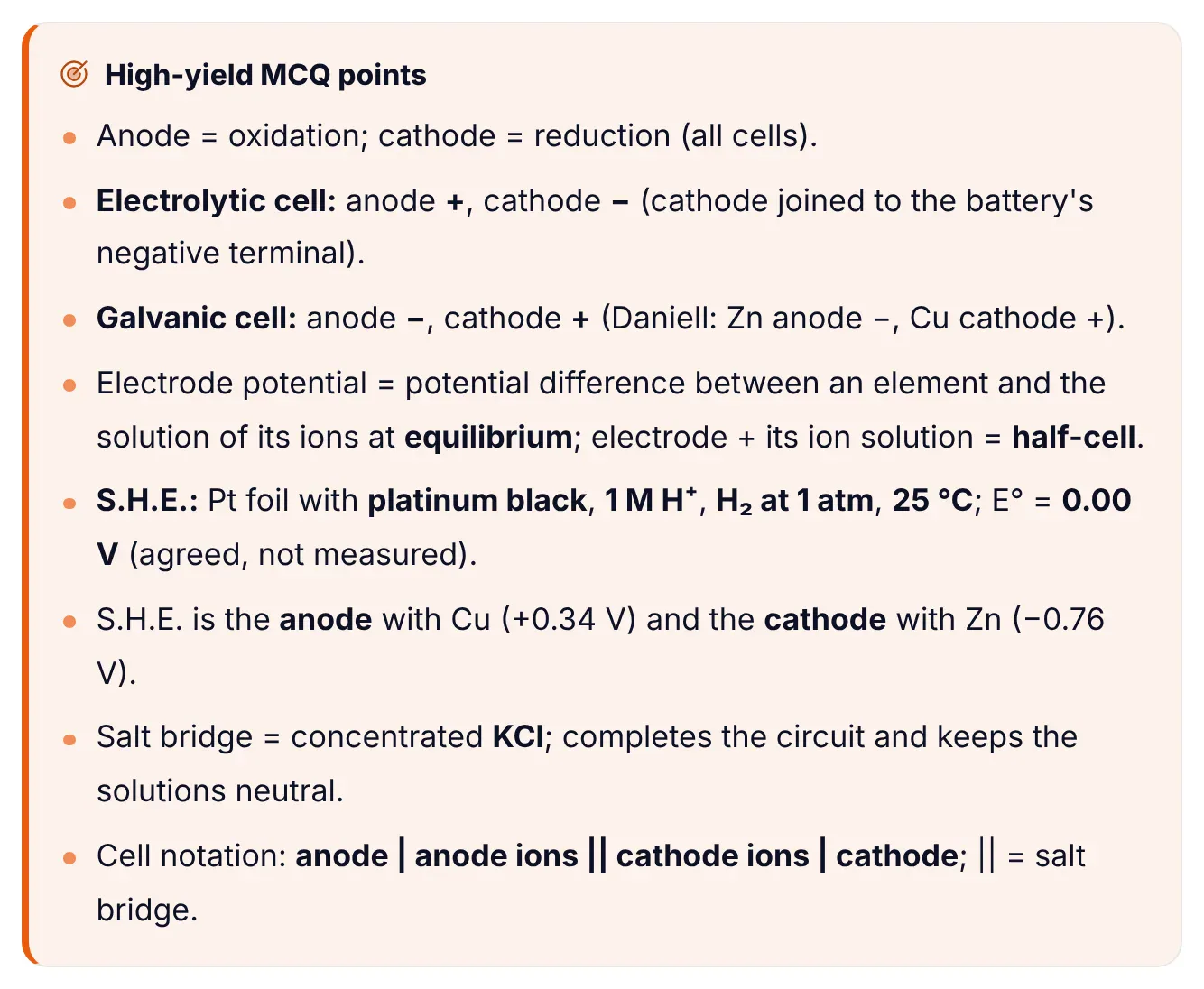
This box closes the lesson in ePrepare's notes and works as a last-minute check: if you can explain each line without looking, you are ready for this part of the chapter. The full lesson, with more worked examples, a labelled Daniell cell and S.H.E. diagram, and 14 practice MCQs with explanations, is in ePrepare's MDCAT conceptual notes.
خلاصہ: ہر cell میں anode پر oxidation اور cathode پر reduction ہوتی ہے۔ Galvanic cell، جیسے Daniell cell، میں anode negative ہوتا ہے، اور electrolytic cell میں battery کی وجہ سے anode positive۔ Electrons ہمیشہ تار کے ذریعے anode سے cathode کی طرف جاتے ہیں، salt bridge میں صرف ions چلتے ہیں۔ Voltage نکالنا ہو تو E°cathode میں سے E°anode منفی کریں، اور sign کو bracket میں رکھنا مت بھولیں۔
Where this fits in your preparation
Electrochemistry links straight to redox and oxidation numbers, so revise them together. See how the chapter ranks in our guide to high-yield MDCAT Chemistry chapters, and check its share of questions in the MDCAT chapter-wise weightage. Another equilibrium topic that MDCAT tests in the same style is the buffer solution. When you are done reading, build a short topic test in the Quiz Builder and let Wrong MCQs smart revision bring back the ones you miss.
Frequently asked questions
Is the anode positive or negative?
It depends on the cell. In a galvanic cell such as the Daniell cell or a dry cell, the anode is negative. In an electrolytic cell, such as electroplating, the anode is positive because it is joined to the battery's positive terminal. In both, oxidation happens at the anode.
Which way do electrons flow in an electrochemical cell?
Electrons flow through the external wire from the anode to the cathode. Conventional current in the wire flows the other way, from cathode to anode. Inside the cell, charge is carried by ions, not electrons.
Why is the E° of the standard hydrogen electrode zero?
A single electrode potential cannot be measured, so one electrode had to be chosen as a reference. The S.H.E. was given 0.00 V by agreement, and every other E° is measured against it, like heights measured from sea level.
What is the formula for E°cell?
E°cell = E°cathode − E°anode, using the standard reduction potentials from the table. For the Daniell cell: (+0.34) − (−0.76) = +1.10 V. A positive E°cell means the cell reaction is spontaneous.
What happens if the salt bridge is removed?
The circuit breaks and the current stops. Charge builds up in the two solutions (extra positive ions on the zinc side, extra negative ions on the copper side), and with no ions to balance it the reaction cannot continue.
Is electrochemistry important for MDCAT?
Yes. It is part of the PM&DC Chemistry syllabus, and anode and cathode signs, electron flow, the S.H.E. and E°cell are tested often because they make quick conceptual MCQs. Check the full list of topics on the MDCAT syllabus page.