

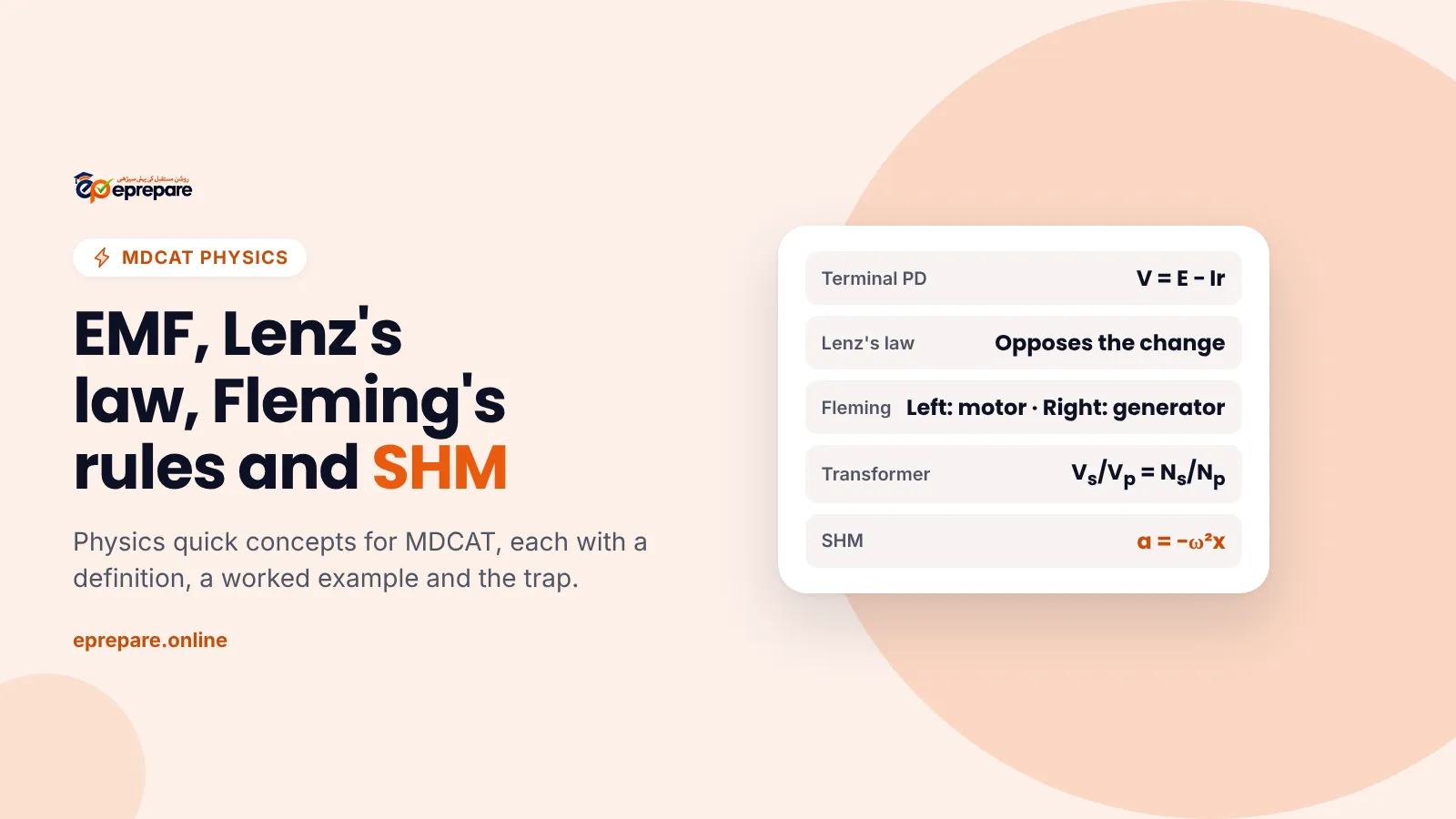
The short answer: EMF is the energy a source gives each coulomb of charge (in volts), and the terminal potential difference is what is left after the internal resistance takes its share: V = E − Ir. Lenz's law says an induced current always opposes the change that causes it. Fleming's left-hand rule is for motors, the right-hand rule for generators. SHM is motion where acceleration is proportional to displacement and directed towards the mean position: a = −ω²x.
These are the short, definition-style Physics questions that MDCAT loves: one concept, one sentence, often one quick calculation. Students search for each one separately, so this guide gathers them in one place, each with a precise definition, a worked example and the trap examiners set.
What is EMF in physics?
Electromotive force (EMF), symbol E, is the energy a source such as a cell, battery or generator converts from another form (chemical or mechanical) into electrical energy for each coulomb of charge it drives round the complete circuit:
EMF: E = W ÷ q. Its unit is the joule per coulomb, which is the volt. Despite the name, EMF is not a force; it is energy per unit charge.
What is terminal potential difference?
Every real source has some internal resistance r. When a current I flows, part of the EMF is used up driving the current through the source itself (I × r, sometimes called the "lost volts"). The rest appears across the terminals and drives the current through the external circuit. That remainder is the terminal potential difference:
Terminal potential difference: V = E − Ir. With no current (an open circuit), V = E, so a high-resistance voltmeter across an unconnected cell reads almost exactly its EMF. While a battery is being charged, the current is reversed and V = E + Ir.
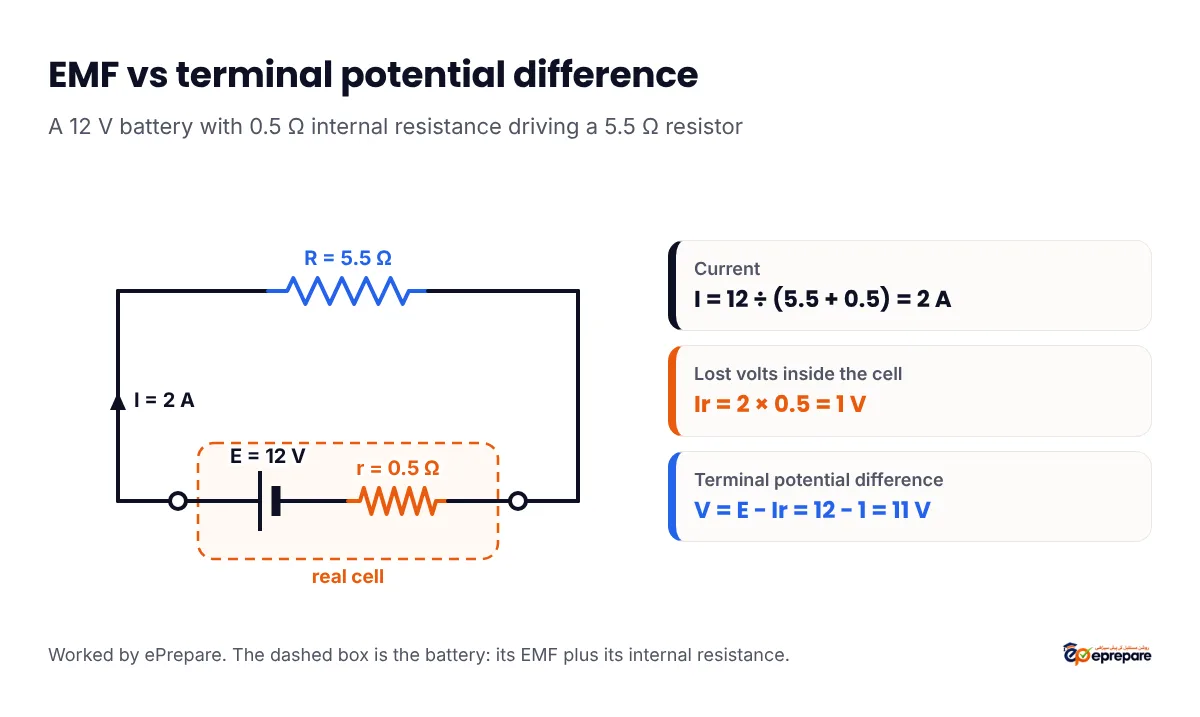
Worked example: EMF and terminal PD
A battery of EMF 12 V and internal resistance 0.5 Ω is connected to a 5.5 Ω resistor.
- Current: I = E ÷ (R + r) = 12 ÷ (5.5 + 0.5) = 12 ÷ 6 = 2 A.
- Lost volts: Ir = 2 × 0.5 = 1 V.
- Terminal PD: V = E − Ir = 12 − 1 = 11 V. Check: IR = 2 × 5.5 = 11 V.
PM&DC's curriculum also asks for the condition for maximum power transfer: a source delivers the most power to an external resistor when R equals the internal resistance r. For this battery, R = 0.5 Ω would receive the maximum, E² ÷ 4r = 144 ÷ 2 = 72 W.
| EMF (E) | Terminal potential difference (V) |
|---|---|
| Energy converted into electrical form per coulomb, inside the source | Electrical energy converted into other forms per coulomb, in the external circuit |
| Fixed for a given source | Falls as the current drawn rises |
| Equals V when no current flows | Less than E while the source supplies current |
| Unit: volt | Unit: volt |
Faraday's law of electromagnetic induction
An EMF is induced in a circuit whenever the magnetic flux through it changes. Magnetic flux is Φ = B · A = BA cos θ, measured in webers (1 Wb = 1 T m²), where θ is the angle between the field and the normal to the area.
Faraday's law: the induced EMF equals the rate of change of flux linkage, E = −N ΔΦ ÷ Δt, for a coil of N turns. The minus sign expresses Lenz's law.
Example: the flux through a 100-turn coil falls from 0.05 Wb to 0.01 Wb in 0.2 s. The size of the EMF is E = N ΔΦ ÷ Δt = 100 × 0.04 ÷ 0.2 = 20 V.
Motional EMF. A straight conductor of length L moving at speed v perpendicular to a field B has an EMF E = BLv across its ends, because it sweeps out area and changes the flux. A 0.5 m rod moving at 4 m/s through a 0.2 T field gives E = 0.2 × 0.5 × 4 = 0.4 V.
What is Lenz's law?
Lenz's law: the direction of an induced current is always such that it opposes the change that produces it.
Push the north pole of a magnet towards a coil and the induced current makes the near face of the coil a north pole, which repels the approaching magnet. Pull the magnet away and the near face becomes a south pole, which attracts it back. Either way, you have to do work against the coil.
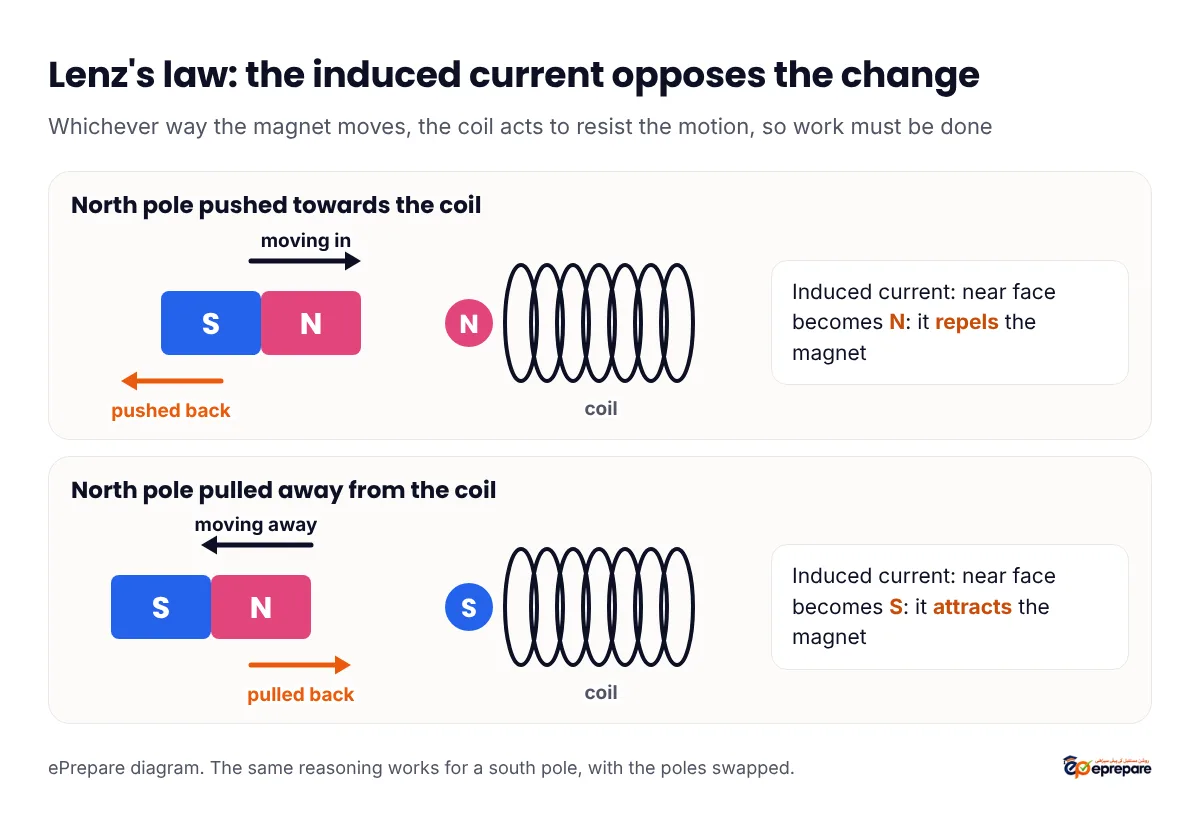
Why Lenz's law is conservation of energy. The electrical energy of the induced current comes from the work you do moving the magnet against the opposing force. If the induced current helped the motion instead, the magnet would speed up by itself and produce ever more current: energy from nothing. That is why PM&DC asks you to relate Lenz's law to the principle of conservation of energy.
What is an inductor?
An inductor is a coil that opposes changes in the current through it. A changing current changes its own flux and induces a back EMF, E = −L ΔI ÷ Δt, where L is the self-inductance. The unit of self-inductance is the henry (H): 1 H = 1 V s A−1, the inductance in which a current changing at 1 A per second induces 1 V. In an AC circuit, the current through a pure inductor lags the voltage by 90°.
Fleming's left-hand and right-hand rules
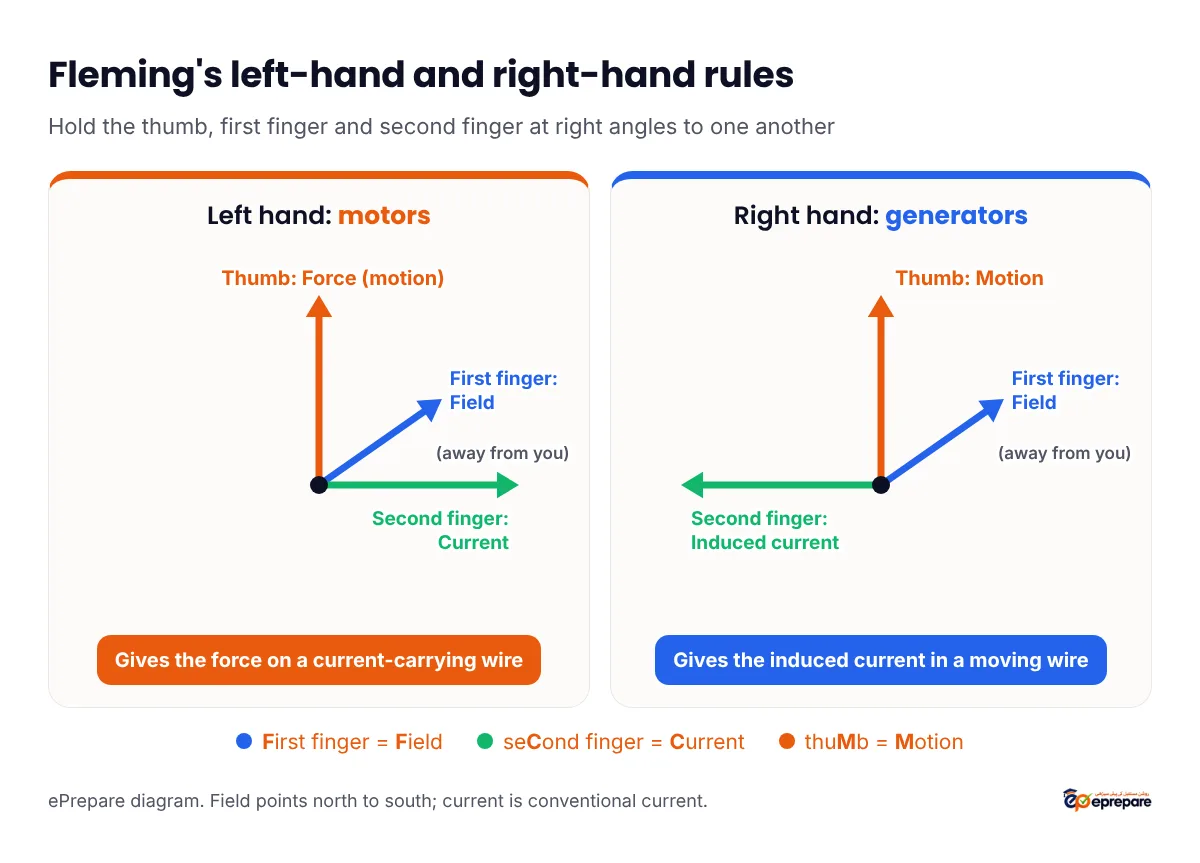
Hold the thumb, first finger and second finger of a hand at right angles to one another. The First finger points along the Field (north to south), the seCond finger along the Current (conventional, + to −), and the thuMb along the Motion.
| Rule | Used for | Thumb | First finger | Second finger |
|---|---|---|---|---|
| Left-hand rule | Motors: force on a current-carrying conductor in a field | Force (motion) | Field | Current |
| Right-hand rule | Generators: current induced in a conductor moving through a field | Motion of the conductor | Field | Induced current |
Memory hook: in Pakistan we drive on the left, so motors use the left hand; generators use the right.
The size of the motor force is F = BIL sin θ on a wire of length L, or F = qvB sin θ on a single charge moving at speed v; θ is the angle between the current (or velocity) and the field. Example: a wire carries current to the right through a field pointing into the page. Point your left first finger into the page and second finger to the right: the thumb points up, so the force on the wire is upwards.
What is Ampere's law?
Ampere's law links a magnetic field to the current that produces it. Around any closed path, add up the component of B along each small piece of the path times its length: the total equals μ0 times the current passing through the path.
Ampere's law: Σ B∥ΔL = μ0I, where μ0 ≈ 4π × 10−7 T m A−1 is the permeability of free space. For a long straight wire it gives B = μ0I ÷ 2πr; for a long solenoid with n turns per metre, B = μ0nI.
Example: 10 A in a long straight wire produces, 5 cm (0.05 m) away, B = (4π × 10−7 × 10) ÷ (2π × 0.05) = 4 × 10⁻⁵ T. Ampere's law is FSc groundwork; PM&DC's MDCAT curriculum does not list it as a separate learning outcome, so a brief understanding is enough.
What is a transformer in physics?
A transformer changes the voltage of an alternating supply. Two coils, the primary (Np turns) and the secondary (Ns turns), are wound on a shared laminated soft-iron core. An alternating current in the primary produces a changing flux in the core, and this changing flux induces an EMF in the secondary by mutual induction. A steady DC produces no changing flux, so a transformer does not work on DC.
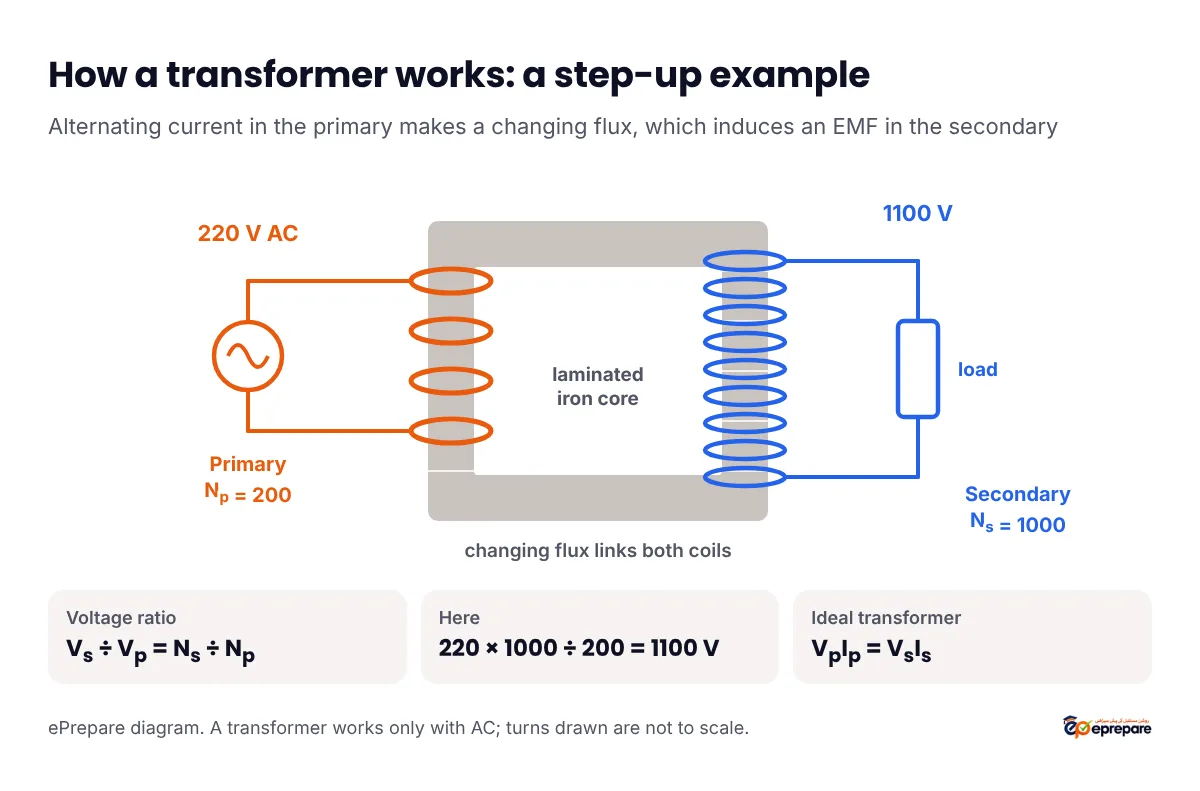
Transformer equations: Vs ÷ Vp = Ns ÷ Np. For an ideal (100% efficient) transformer, power in equals power out: VpIp = VsIs. A step-up transformer has Ns > Np; a step-down transformer has Ns < Np.
Example: Np = 200, Ns = 1000 and Vp = 220 V give Vs = 220 × 1000 ÷ 200 = 1100 V (step-up). If the secondary supplies 1 A, an ideal transformer draws 1100 × 1 ÷ 220 = 5 A from the primary.
Why power lines use high voltage. The power lost as heat in a cable is I²R. To send 100 kW, a 10 kV line carries 10 A, while a 1 kV line would carry 100 A. Through a cable of 5 Ω the losses are 10² × 5 = 500 W against 100² × 5 = 50,000 W: ten times the voltage cuts the loss a hundredfold. Step-up transformers raise the voltage at the power station and step-down transformers lower it near homes.
What is SHM in physics?
Simple harmonic motion (SHM) is the to-and-fro motion of a body in which the acceleration is directly proportional to its displacement from the mean position and is always directed towards the mean position.
Condition for SHM: a = −ω²x, where x is the displacement and ω the angular frequency. The minus sign says the acceleration always points back towards the mean position. Then T = 2π ÷ ω and f = 1 ÷ T.
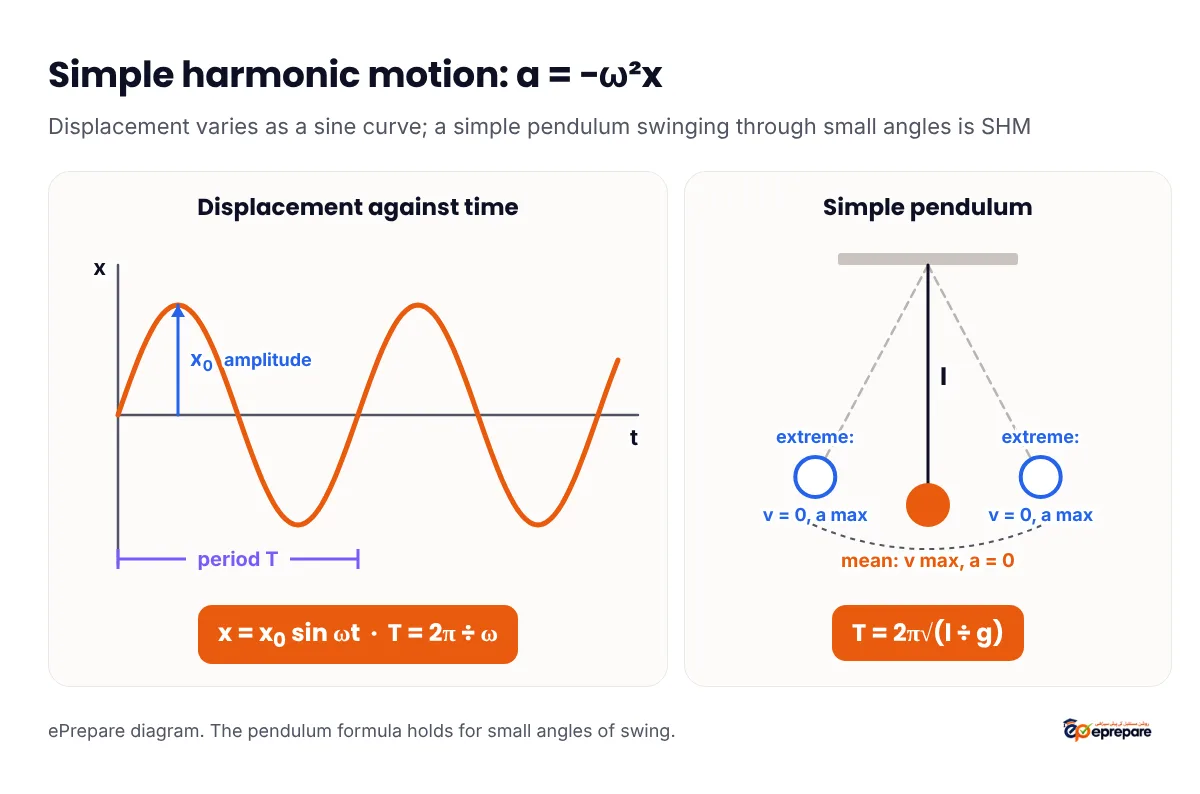
Terms used in SHM: amplitude, period and phase
- Displacement (x): distance from the mean position at any instant.
- Amplitude (x0): the maximum displacement from the mean position. It is half the total distance between the two extremes.
- Time period (T): the time for one complete oscillation. Frequency (f) is the number of oscillations per second, f = 1 ÷ T, in hertz. Angular frequency ω = 2πf.
- Phase: the angle (ωt + φ) in x = x0 sin(ωt + φ) that tells you where the body is in its cycle and which way it is moving.
- Phase difference: the difference in phase between two oscillations, or two points on a wave. Two oscillations in phase (phase difference 0 or 360°) move together; two in antiphase (180°, or π rad) always move opposite ways. A body at the mean position and an identical one at an extreme are 90° (π/2) out of phase.
Speed in SHM is v = ω√(x0² − x²): it is greatest, ωx0, at the mean position and zero at the extremes. The acceleration is zero at the mean position and greatest, ω²x0, at the extremes. Kinetic energy is greatest at the mean position, potential energy at the extremes, and the total stays constant. PM&DC also asks you to recognise that the projection of uniform circular motion onto a diameter is SHM.
Example: a body oscillates in SHM with amplitude 0.1 m and period 0.5 s. Then ω = 2π ÷ 0.5 = 4π ≈ 12.6 rad s−1, the maximum speed is ωx0 ≈ 1.26 m s−1, and the maximum acceleration is ω²x0 = 16π² × 0.1 ≈ 15.8 m s−2.
The simple pendulum and the mass-spring system
For small swings, a simple pendulum moves in SHM with T = 2π√(l ÷ g), where l is its length. The period does not depend on the mass of the bob or on the (small) amplitude. A 1 m pendulum with g = 9.8 m s−2 has T = 2π√(1 ÷ 9.8) ≈ 2.0 s. A mass m on a spring of spring constant k has T = 2π√(m ÷ k).
MDCAT shortcuts and common traps
Shortcuts and traps. (1) EMF is energy per coulomb, not a force. (2) Terminal PD equals the EMF only when no current flows. (3) Lenz's law = conservation of energy. (4) Left hand for motors (force), right hand for generators (induced current). (5) Transformers need AC; Vs ÷ Vp = Ns ÷ Np, but the current ratio is the inverse. (6) In SHM, speed is maximum at the mean position while acceleration is maximum at the extremes. (7) Quadruple a pendulum's length to double its period; its mass does not matter.
Where these sit in the syllabus: PM&DC's MDCAT curriculum lists internal resistance and maximum power transfer (Current electricity), Faraday's law, Lenz's law and the transformer (Electromagnetic induction), the force on a charge in a magnetic field (Electromagnetism), phase in AC circuits, and SHM with its link to circular motion (Waves and simple harmonic motion). See every outcome on the MDCAT syllabus page and how each unit ranks in MDCAT Physics high-yield chapters and formula sheet.
Practice MCQs: EMF, induction and SHM
Question 1
A cell of EMF 6 V and internal resistance 1 Ω is connected to a 5 Ω resistor. The terminal potential difference is:
- 6 V
- 5 V
- 1 V
- 1.2 V
Show answer
Answer: B, 5 V. I = 6 ÷ (5 + 1) = 1 A, so V = E − Ir = 6 − 1 × 1 = 5 V. 6 V would be the reading with no current flowing.
Question 2
Lenz's law is a consequence of the law of conservation of:
- charge
- momentum
- energy
- mass
Show answer
Answer: C, energy. The induced current opposes the change, so work must be done to produce it; that work becomes the electrical energy.
Question 3
Fleming's right-hand rule gives the direction of:
- the force on a current-carrying conductor in a magnetic field
- the induced current in a conductor moving through a magnetic field
- the magnetic field around a straight wire
- the acceleration of a body in SHM
Show answer
Answer: B, the induced current in a moving conductor. That is the generator rule. The force on a current-carrying conductor (motor) uses the left-hand rule.
Question 4
The length of a simple pendulum is made four times as long. Its time period:
- halves
- doubles
- becomes four times as long
- does not change
Show answer
Answer: B, doubles. T = 2π√(l ÷ g), so T is proportional to √l, and √4 = 2.
Question 5
A transformer has 200 turns in the primary and 1000 turns in the secondary. If the primary voltage is 220 V AC, the secondary voltage is:
- 44 V, step-down
- 1100 V, step-up
- 220 V, no change
- 1100 V, step-down
Show answer
Answer: B, 1100 V, step-up. Vs = Vp × Ns ÷ Np = 220 × 1000 ÷ 200 = 1100 V. More turns on the secondary means a step-up transformer.
Practise many more past-paper questions on these topics, with step-by-step solutions, on our free MDCAT Physics MCQs page. Related explainers: ammeter, voltmeter and galvanometer and capacitors and equivalent capacitance.
Frequently asked questions
What is EMF in physics?
Electromotive force is the energy a source converts into electrical energy per coulomb of charge it drives round a complete circuit, E = W ÷ q. It is measured in volts and, despite its name, is not a force.
What is terminal potential difference?
The potential difference across the terminals of a source while it supplies current. It is the EMF minus the voltage used inside the source: V = E − Ir.
What is Lenz's law?
The direction of an induced current is always such that it opposes the change producing it. It follows from the conservation of energy.
What is Fleming's right-hand rule?
The rule for generators. With the thumb, first finger and second finger of the right hand at right angles, the thumb shows the motion of the conductor, the first finger the field and the second finger the induced current. The left-hand rule, for motors, gives the force on a current-carrying conductor.
What is SHM in physics?
Simple harmonic motion is oscillation in which the acceleration is proportional to the displacement from the mean position and always directed towards it, a = −ω²x. A simple pendulum swinging through small angles and a mass on a spring are examples.
What is phase difference?
The difference in phase angle between two oscillations or two points on a wave, showing how far one is ahead of the other in its cycle. 0° means in phase, 180° means antiphase.
What is Ampere's law?
Around any closed path, the sum of B∥ΔL equals μ0 times the current enclosed. It gives the field of a long straight wire, B = μ0I ÷ 2πr, and of a solenoid, B = μ0nI.
What is a transformer in physics?
A device that steps an alternating voltage up or down by mutual induction between two coils on a shared iron core, with Vs ÷ Vp = Ns ÷ Np. It works only with AC.
Build your Physics concepts with ePrepare
Definition questions are the quickest marks in MDCAT Physics, provided you know each idea precisely. Register on ePrepare for Physics lectures, chapter-wise MCQs with worked explanations and full-length papers that train you for exam day.
Sources: PM&DC Uniform Curriculum MDCAT (hosted by KMU) for the syllabus outcomes; NIST CODATA value of the vacuum magnetic permeability μ0 (1.25664 × 10⁻⁶ N A−2, which is 4π × 10−7 to the accuracy used here); NIST standard acceleration of gravity (9.80665 m s−2, rounded to 9.8). All other formulas and numbers are derived and worked in this article.