

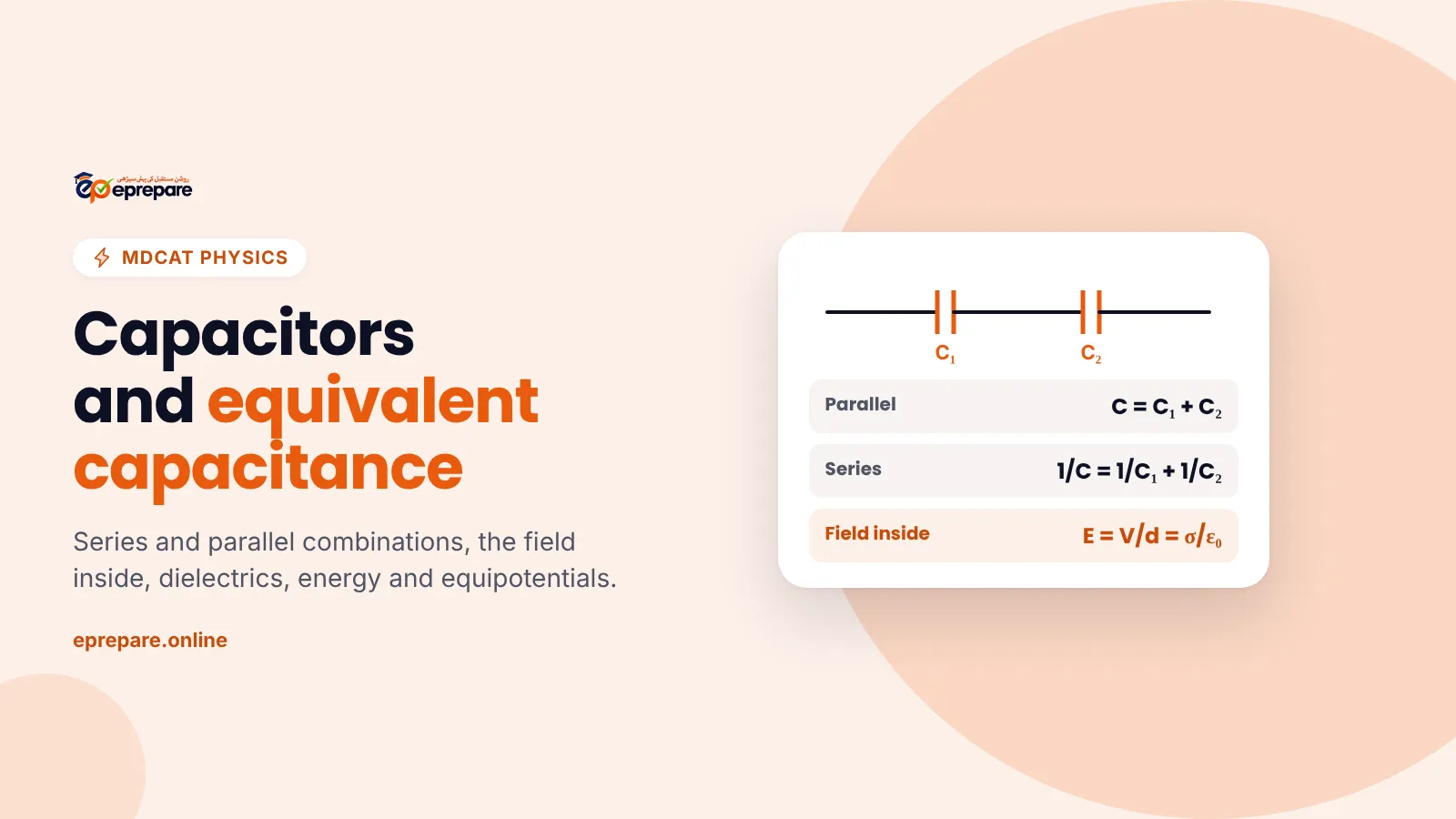
The short answer: capacitors in parallel add directly (C = C1 + C2 + …) and capacitors in series add as reciprocals (1/C = 1/C1 + 1/C2 + …), the opposite of resistors. The electric field inside a parallel-plate capacitor is uniform, E = V ÷ d = σ ÷ ε0, and it is always perpendicular to the equipotential surfaces.
"What is the equivalent capacitance of the combination shown?" is one of the most common Physics questions students search, and the answer depends on spotting which capacitors are in series and which are in parallel. This guide explains capacitance from the start, solves three typical combinations with diagrams, and then covers the field inside a capacitor, dielectrics, stored energy and equipotential surfaces, all at FSc and MDCAT level.
What is a capacitor and what is capacitance?
A capacitor is a device that stores charge, and with it electrical energy. The simplest is the parallel-plate capacitor: two conducting plates separated by a small gap of air or an insulator. When it is connected to a battery, one plate gains charge +Q and the other −Q, and a potential difference V builds up between them.
The charge stored is proportional to the potential difference. The constant of proportionality is the capacitance:
Capacitance: C = Q ÷ V. Its SI unit is the farad (F), where 1 F = 1 coulomb per volt. A farad is huge, so values are usually in microfarads (1 μF = 10−6 F), nanofarads (10−9 F) or picofarads (10−12 F).
Is capacitance scalar or vector? Scalar. It is the ratio of two scalars, charge and potential, and has no direction.
For a parallel-plate capacitor with plate area A and separation d, with vacuum (or, very nearly, air) between the plates:
Parallel-plate capacitor: C = ε0A ÷ d, where ε0 ≈ 8.85 × 10⁻¹² F m−1 is the permittivity of free space. With a dielectric of relative permittivity εr filling the gap, C = εrε0A ÷ d.
Example: plates of area 0.02 m² separated by 1 mm (0.001 m) give C = 8.85 × 10−12 × 0.02 ÷ 0.001 = 1.77 × 10⁻¹⁰ F, that is 177 pF. Fill the gap with a dielectric of εr = 5 and it becomes 5 × 177 = 885 pF.
Capacitors in series and parallel
Remember two facts and you can derive everything else: in parallel, every capacitor has the same potential difference; in series, every capacitor carries the same charge.
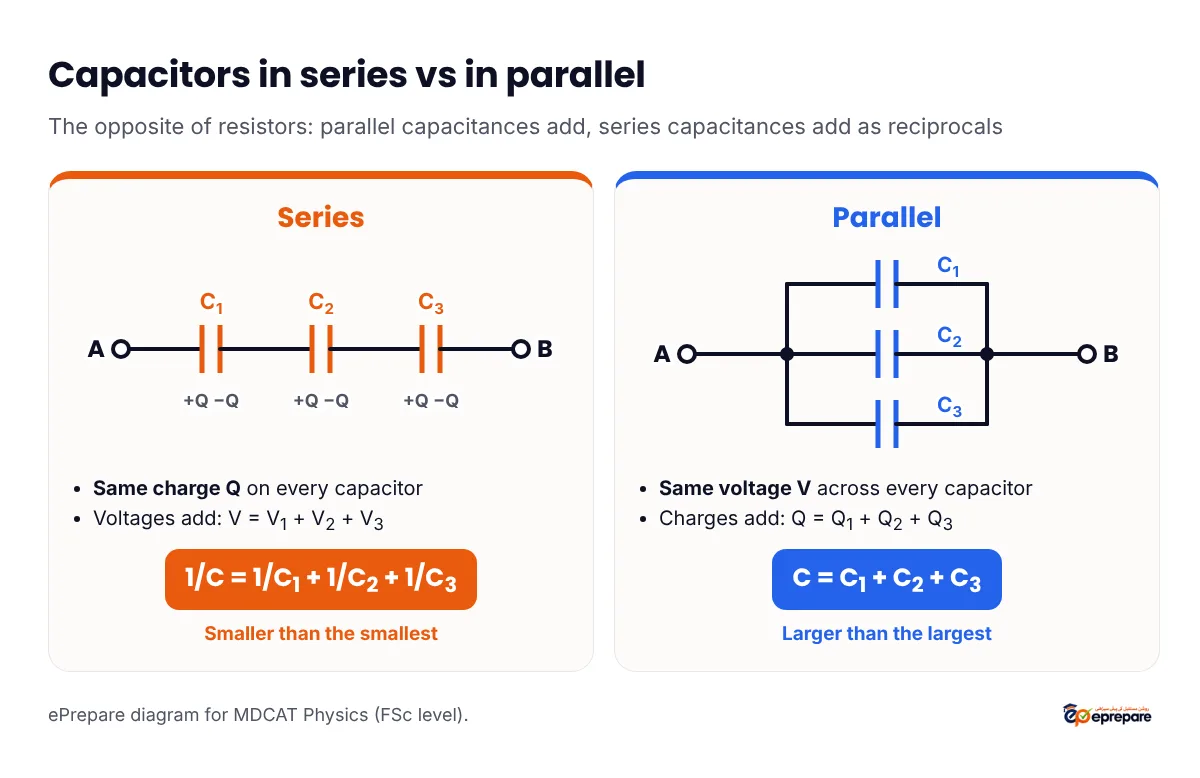
| Property | Series | Parallel |
|---|---|---|
| Same for every capacitor | Charge Q | Potential difference V |
| Shared between capacitors | Voltage: V = V1 + V2 + … | Charge: Q = Q1 + Q2 + … |
| Equivalent capacitance | 1/C = 1/C1 + 1/C2 + … | C = C1 + C2 + … |
| Two capacitors | C = C1C2 ÷ (C1 + C2) | C = C1 + C2 |
| n identical capacitors C | C ÷ n | nC |
| Result compared with the parts | Smaller than the smallest | Larger than the largest |
Why the formulas work. In parallel, the charges add while V is common: Q = C1V + C2V, so C = Q ÷ V = C1 + C2. In series, the voltages add while Q is common: V = Q/C1 + Q/C2, so 1/C = V ÷ Q = 1/C1 + 1/C2. Physically, putting capacitors in parallel is like increasing the plate area, and putting them in series is like increasing the gap.
Equivalent capacitance of the combination shown: worked examples
For any combination between points A and B, work from the inside out: combine the simplest series or parallel group, redraw, and repeat.
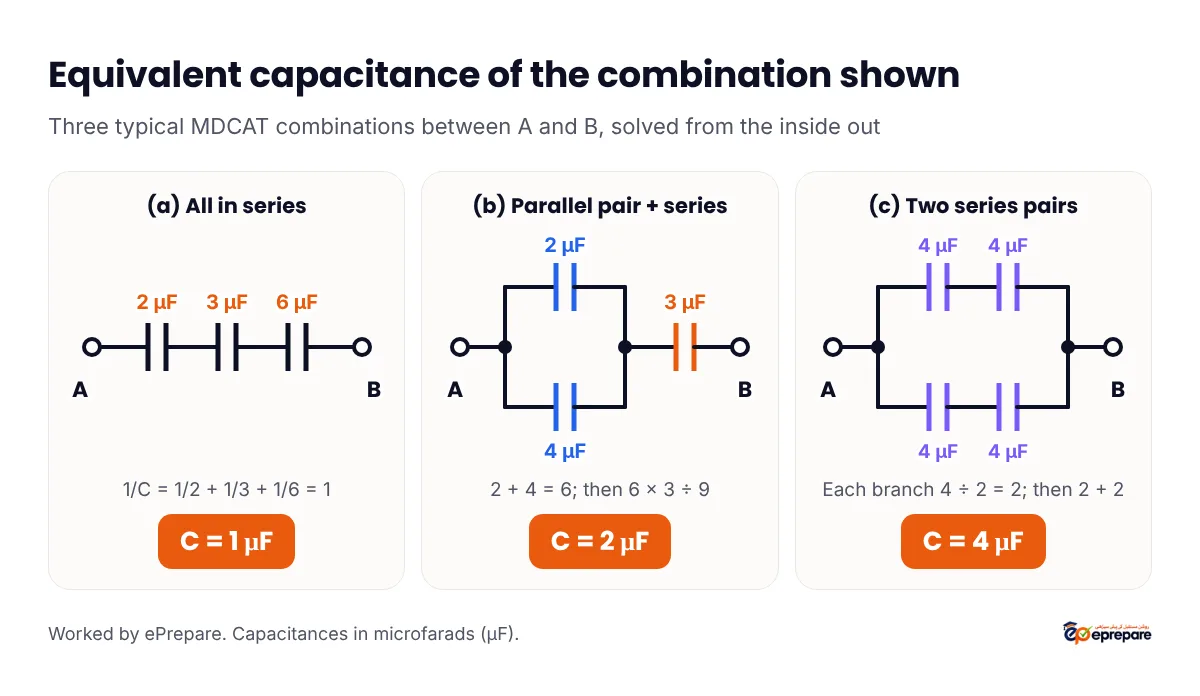
Example (a): three capacitors in series
2 μF, 3 μF and 6 μF are in series between A and B.
- 1/C = 1/2 + 1/3 + 1/6 = 3/6 + 2/6 + 1/6 = 6/6 = 1.
- C = 1 μF, smaller than the smallest (2 μF), as it must be.
Example (b): a parallel pair in series with a third capacitor
2 μF and 4 μF are in parallel, and that pair is in series with 3 μF. A 12 V battery is connected across A and B.
- Parallel pair: 2 + 4 = 6 μF.
- 6 μF in series with 3 μF: C = (6 × 3) ÷ (6 + 3) = 18 ÷ 9 = 2 μF.
- Total charge: Q = CV = 2 μF × 12 V = 24 μC. The 3 μF capacitor is in series with the pair, so it carries all 24 μC and its PD is 24 ÷ 3 = 8 V.
- The pair gets the remaining 12 − 8 = 4 V. So the 2 μF capacitor stores 2 × 4 = 8 μC and the 4 μF stores 4 × 4 = 16 μC. Check: 8 + 16 = 24 μC.
Example (c): four identical capacitors
Four 4 μF capacitors are arranged as two branches between A and B, each branch being two capacitors in series.
- Each branch: 4 ÷ 2 = 2 μF (n identical in series gives C ÷ n).
- Two branches in parallel: 2 + 2 = 4 μF. Four capacitors arranged like this behave exactly like one.
Spotting the connection. Two capacitors are in parallel if both their ends join the same two points. They are in series if they share one point and nothing else branches off there. If a wire with no component connects the two ends of a capacitor, that capacitor is short-circuited and drops out of the calculation.
What is the electric field strength inside a capacitor?
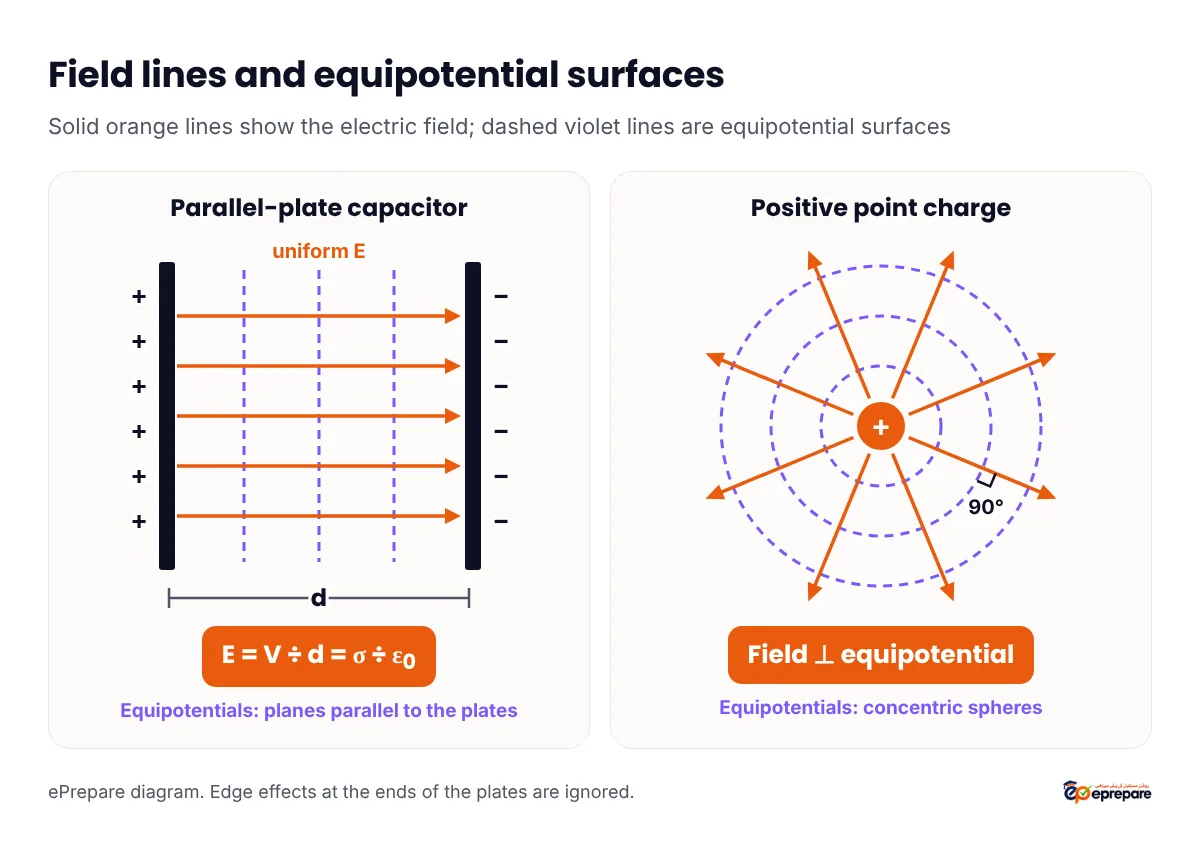
Between the plates of a charged parallel-plate capacitor the field is uniform: the same strength and direction at every point (except near the edges), pointing from the positive plate to the negative plate. Outside the plates it is practically zero.
Field inside a parallel-plate capacitor: E = V ÷ d = σ ÷ ε0, where σ = Q ÷ A is the surface charge density on each plate. Its unit is V m−1, which is the same as N C−1. With a dielectric and the same charge, E = σ ÷ (εrε0).
Where σ ÷ ε0 comes from. One large charged sheet produces a field of σ ÷ 2ε0 on each side. Between the plates, the field of the positive plate (pointing away from it) and the field of the negative plate (pointing towards it) are in the same direction and add: σ/2ε0 + σ/2ε0 = σ/ε0. Outside, they point in opposite directions and cancel.
Worked example: field between the plates
A capacitor's plates are 2 mm apart with a potential difference of 100 V between them.
- Convert: d = 2 mm = 0.002 m.
- E = V ÷ d = 100 ÷ 0.002 = 5 × 10⁴ V m−1.
- Surface charge density: σ = ε0E = 8.85 × 10−12 × 5 × 104 ≈ 4.4 × 10⁻⁷ C m−2.
Because the field is uniform, a charge q between the plates feels the same force F = qE wherever it is, which is why a capacitor is used to deflect charged particles.
Dielectrics: what they do to a capacitor
A dielectric is an insulator placed between the plates. The field polarises its molecules, which line up to produce a small opposing field. This reduces the net field for the same charge, so the plates can hold more charge at the same voltage. The capacitance rises by the factor εr, the relative permittivity or dielectric constant, which is 1 for vacuum, very close to 1 for air and greater than 1 for every other material.
What happens next depends on whether the battery stays connected. This is the favourite trap in capacitor MCQs:
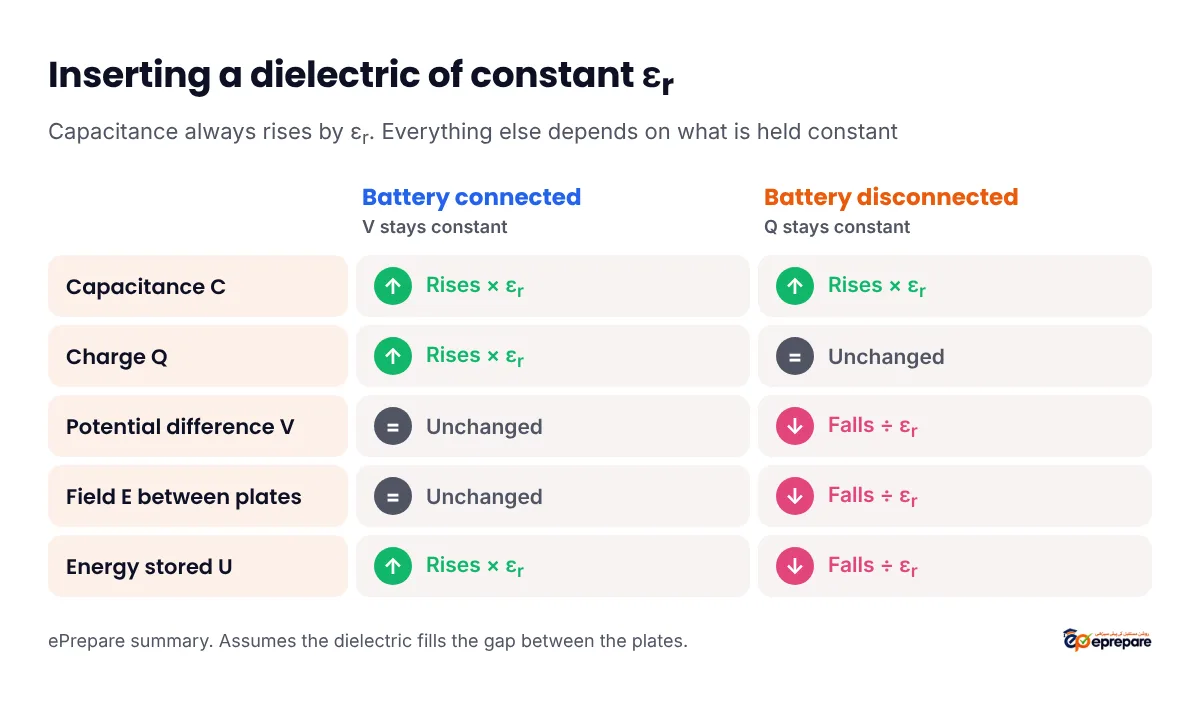
| Quantity | Battery still connected (V constant) | Battery disconnected (Q constant) |
|---|---|---|
| Capacitance C | × εr | × εr |
| Charge Q | × εr | Unchanged |
| Potential difference V | Unchanged | ÷ εr |
| Field E between plates | Unchanged | ÷ εr |
| Energy stored U | × εr | ÷ εr |
Energy stored in a capacitor
Charging a capacitor takes work, because each new bit of charge must be pushed onto a plate that already repels it. That work is stored as electric potential energy in the field between the plates. On a graph of V against Q the line is straight, and the energy is the area under it, a triangle:
Energy stored: U = ½QV = ½CV² = Q² ÷ 2C. Use ½CV² when V is fixed and Q² ÷ 2C when Q is fixed.
Example: a 10 μF capacitor charged to 100 V stores U = ½ × 10 × 10−6 × 100² = ½ × 10−5 × 104 = 0.05 J. Its charge is Q = CV = 10−3 C, and ½QV = ½ × 10−3 × 100 gives the same 0.05 J.
Charging and discharging through a resistor
PM&DC's curriculum names this directly. A capacitor does not charge instantly through a resistor R: the charge rises quickly at first and then more and more slowly towards its maximum Q0 = CV. The speed is set by the time constant τ = RC (in seconds when R is in ohms and C in farads). In one time constant a charging capacitor reaches about 63% of its final charge, and a discharging capacitor falls to about 37% of its starting charge. For R = 100 kΩ and C = 10 μF, τ = 105 × 10−5 = 1 s.
What is an equipotential surface?
An equipotential surface is a surface on which every point is at the same electric potential. Because the potential does not change along it, no work is done in moving a charge from one point on it to another (W = qΔV = 0).
- The field is perpendicular to it. The angle between the electric field and an equipotential surface is always 90°. If the field had a component along the surface, moving a charge along it would need work, which contradicts the definition.
- Equipotentials never cross. One point cannot have two different potentials.
- Closely spaced surfaces mean a strong field. The field strength equals the potential change per metre, E = ΔV ÷ Δd, pointing from high to low potential.
- Shapes: concentric spheres around a point charge; flat planes parallel to the plates inside a parallel-plate capacitor, evenly spaced because the field there is uniform.
- A conductor's surface is equipotential. In a conductor at rest, charges would move if there were any field inside, so in equilibrium the field inside is zero and the whole conductor is at one potential.
In the 100 V, 2 mm capacitor above, the plane halfway between the plates is the 50 V equipotential (taking the negative plate as 0 V), and every plane parallel to the plates is an equipotential.
MDCAT shortcuts and common traps
Shortcuts and traps. (1) Capacitors combine the opposite way to resistors: parallel adds, series uses reciprocals. (2) Series result is below the smallest; parallel result is above the largest. (3) Two in series: product ÷ sum. (4) Convert mm to m and μF to F before substituting into E = V ÷ d or U = ½CV². (5) With a dielectric, decide first whether V or Q is constant. (6) E inside a capacitor does not depend on where you are between the plates; it is uniform. (7) The angle between field lines and equipotential surfaces is always 90°.
Where this sits in the syllabus: PM&DC's MDCAT curriculum lists the field due to a charged plate, electric potential, and charging and discharging a capacitor through a resistance. The NUMS syllabus also lists capacitance, energy stored in a capacitor and the field between parallel plates. Series and parallel combinations, dielectrics and equipotential surfaces are the FSc groundwork for those outcomes. See every unit on the MDCAT syllabus page and how Electrostatics ranks in MDCAT Physics high-yield chapters and formula sheet.
Practice MCQs: capacitors and equipotential surfaces
Question 1
Capacitors of 2 μF, 3 μF and 6 μF are connected in series. The equivalent capacitance is:
- 11 μF
- 1 μF
- 0.5 μF
- 6 μF
Show answer
Answer: B, 1 μF. 1/C = 1/2 + 1/3 + 1/6 = 1, so C = 1 μF. 11 μF is the parallel answer.
Question 2
The plates of a parallel-plate capacitor are 5 mm apart and the potential difference between them is 200 V. The electric field strength between the plates is:
- 4 × 10⁴ V m−1
- 1000 V m−1
- 40 V m−1
- 4 × 10² V m−1
Show answer
Answer: A, 4 × 10⁴ V m−1. E = V ÷ d = 200 ÷ 0.005 = 40,000 V m−1. Using d = 5 instead of 0.005 m gives the trap answer of 40.
Question 3
The angle between the electric field and an equipotential surface is:
- 0°
- 45°
- 90°
- 180°
Show answer
Answer: C, 90°. No work is done moving a charge along an equipotential surface, so the field can have no component along it.
Question 4
A capacitor storing energy U is disconnected from the battery, and a dielectric of constant 4 is then inserted to fill the gap. The energy stored becomes:
- 4U
- U
- U ÷ 4
- U ÷ 16
Show answer
Answer: C, U ÷ 4. With the battery removed, Q is constant and C becomes 4C, so U = Q² ÷ 2C falls to a quarter. If the battery had stayed connected, U = ½CV² would have become 4U.
Question 5
A 2 μF and a 4 μF capacitor are in parallel, and this pair is in series with a 3 μF capacitor. A 12 V battery is connected across the combination. The charge on the 4 μF capacitor is:
- 24 μC
- 16 μC
- 8 μC
- 48 μC
Show answer
Answer: B, 16 μC. The equivalent capacitance is 6 × 3 ÷ 9 = 2 μF, so the total charge is 24 μC. The 3 μF takes 24 ÷ 3 = 8 V, leaving 4 V across the pair, and Q = 4 μF × 4 V = 16 μC.
Practise many more past-paper electrostatics questions, with worked solutions, on our free MDCAT Physics MCQs page. Related explainers: ammeter, voltmeter and galvanometer and EMF, Lenz's law, Fleming's rules and SHM.
Frequently asked questions
What is the equivalent capacitance of the combination shown?
Find groups that are purely in series or purely in parallel, replace each with one capacitor (parallel: add; series: add reciprocals), redraw and repeat until one capacitor is left between the two points. For 2 μF and 4 μF in parallel, in series with 3 μF, the answer is 2 μF.
What is the electric field strength inside a capacitor?
For a parallel-plate capacitor it is uniform and equal to E = V ÷ d, or σ ÷ ε0 in terms of the surface charge density, directed from the positive plate to the negative plate. Outside the plates it is practically zero.
What is an equipotential surface?
A surface on which every point has the same electric potential. No work is done moving a charge along it, and the electric field is perpendicular to it everywhere.
What is the angle between the electric field and an equipotential surface?
90°. Electric field lines always cross equipotential surfaces at right angles.
Is capacitance a scalar or a vector?
Scalar. Capacitance is charge divided by potential difference, both scalars, so it has magnitude only. Its unit is the farad.
Why is the electric field zero inside a conductor?
A conductor has free charges. If there were a field inside, they would move until their own field cancelled it. In electrostatic equilibrium the field inside is therefore zero and the conductor is an equipotential.
What happens to capacitance when a dielectric is inserted?
It increases by the dielectric constant εr, because C = εrε0A ÷ d. Whether the charge or the voltage then changes depends on whether the battery is still connected.
Practise electrostatics with ePrepare
Capacitor questions become quick once you have solved enough combinations to spot series and parallel at a glance. Register on ePrepare for Physics lectures, chapter-wise MCQs with worked explanations and full-length papers under exam timing.
Sources: PM&DC Uniform Curriculum MDCAT (hosted by KMU) for the syllabus units; NIST CODATA value of the vacuum electric permittivity ε0 (8.854 × 10⁻¹² F m−1, rounded here to 8.85). The NUMS syllabus topics are as compared in our PMDC MDCAT vs NUMS MDCAT guide. All other formulas and numbers are derived and worked in this article.