


First law of thermodynamics numericals are short, usually one line of arithmetic, but they are full of sign traps. "Work done on the gas" or "work done by the gas"? Heat "supplied" or heat "released"? Get one sign wrong and the answer jumps from 250 J to 550 J, and both will be sitting in the options. This guide gives you one sign convention, shows how to switch to the other form in a second, and works through every process MDCAT asks about.
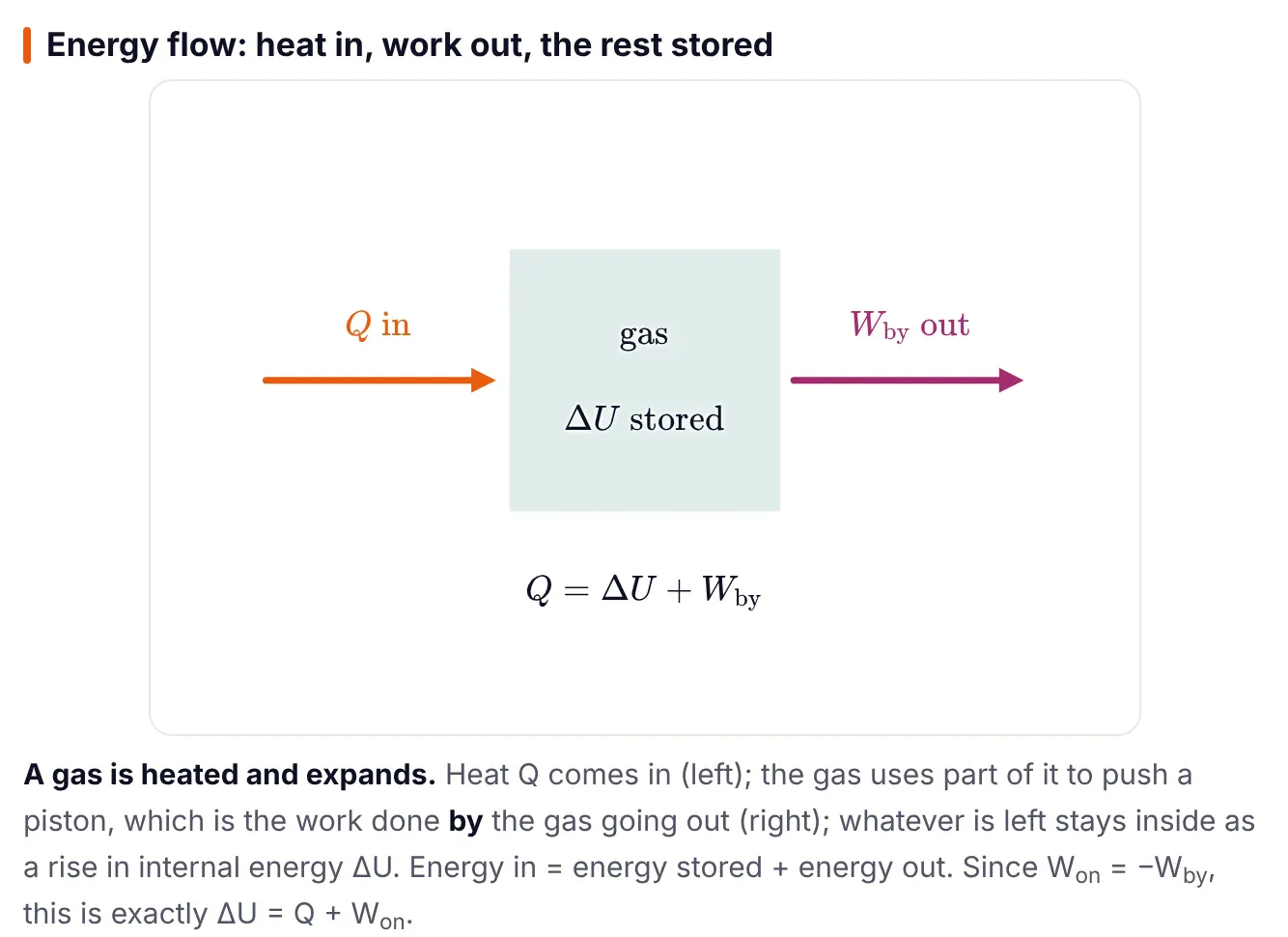
The short answer: The first law is ΔU = Q + W, where Q is the heat added to the gas and W is the work done on the gas (the form used in ePrepare's Physics notes and the MDCAT syllabus). Anything that brings energy in is positive. The same law written with work done by the gas is Q = ΔU + Wby, because Won = −Wby. Read which work the question gives, pick the matching form, and never mix the two.
The concept: two doors for energy
Internal energy (U) is the total energy of the random motion of a gas's molecules. For an ideal gas there are no forces between molecules, so U is only kinetic energy and it depends only on temperature. Hotter means ΔU is positive; cooler means ΔU is negative; the same temperature means ΔU = 0.
There are only two ways to change U:
- Heating (Q): energy flows in because the surroundings are hotter.
- Doing work (W): a piston pushes in and squeezes the gas, like a bicycle pump.
The first law simply adds the two: the change in internal energy equals the energy that came in by heating plus the energy that came in by work. It is the law of conservation of energy written for heat and work. Q, W and ΔU are all energies, measured in joules (J).
Sign convention (the part that decides your mark)
| Quantity | Positive (+) | Negative (−) |
|---|---|---|
| Q (heat) | Heat goes into the gas (supplied, absorbed) | Heat comes out (released, rejected, lost) |
| W (work on the gas) | Gas is compressed | Gas expands |
| ΔU | Temperature rises | Temperature falls |
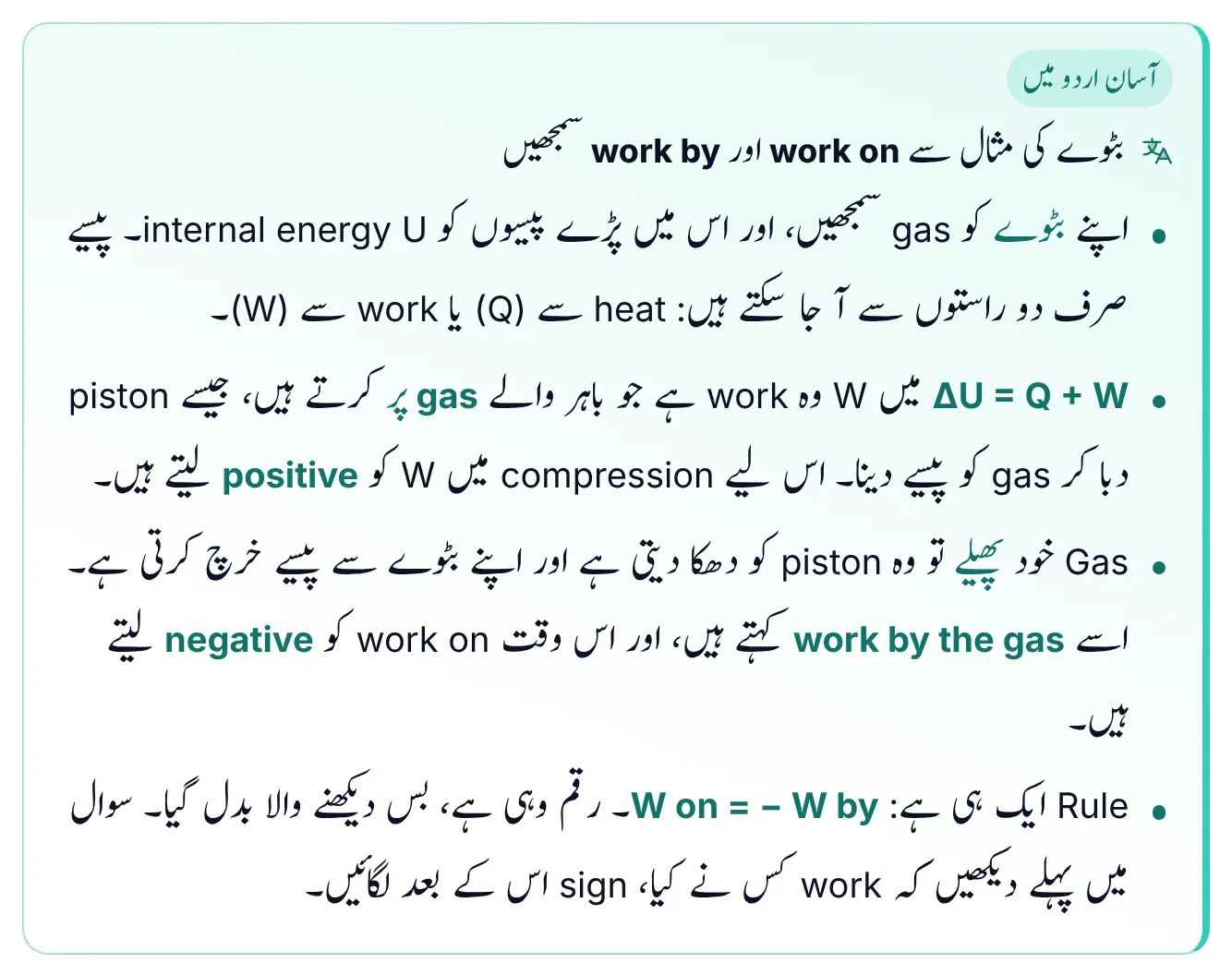
Easy rule: energy in is plus. Expansion means the gas pushes the piston out and spends its own energy, so the work done on it is negative.
Converting between the two forms
- Start with ΔU = Q + Won.
- Work done on the gas is minus the work done by it: Won = −Wby.
- Substitute: ΔU = Q − Wby.
- Rearrange: Q = ΔU + Wby ("heat in = energy stored + work out").
Many books, and many MCQ options, use Q = ΔU + W with W meaning work done by the system. ePrepare's Chemistry notes write the same law as ΔE = q + w, again with w done on the system. They are all one law. The only real mistake is putting a "work by" number into the "work on" formula without changing its sign.
Formulas with symbols and units
| Formula | Meaning |
|---|---|
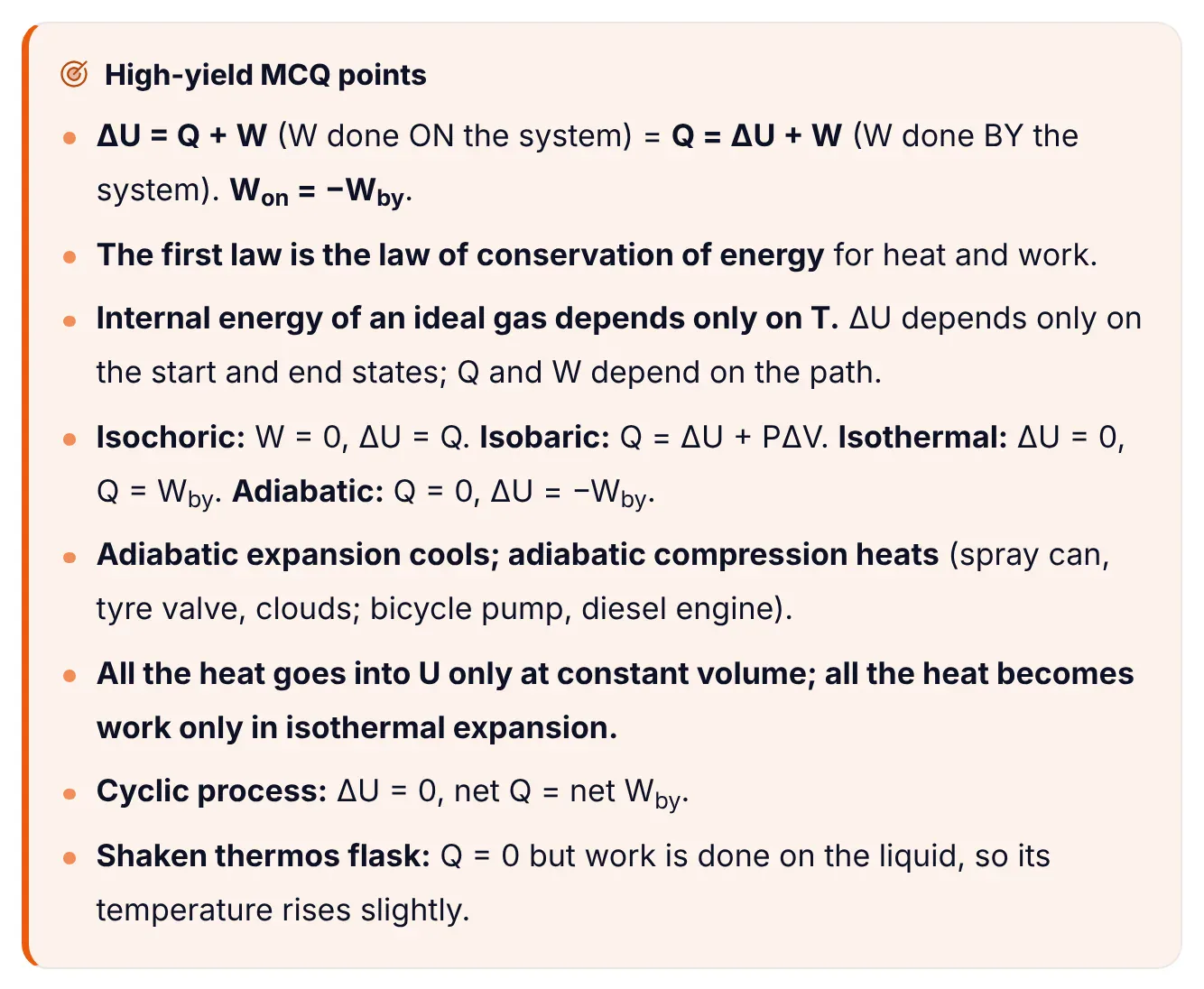
| ΔU = Q + Won | First law, syllabus form |
| Q = ΔU + Wby | Same law, work done by the gas |
| Won = −Wby | The conversion between the two |
| Wby = PΔV = P(V2 − V1) | Work by a gas at constant pressure |
| PΔV = nRΔT | Same work for an ideal gas at constant pressure |
| ΔU = nCvΔT | Change in U of an ideal gas (any process) |
- ΔU: change in internal energy (J), final minus initial
- Q: heat added (J); W: work (J)
- P: pressure in pascals (Pa = N m−2); ΔV: change in volume in m3
- n: moles; R = 8.314 J mol−1 K−1; ΔT in K (a change of 1 °C equals a change of 1 K)
- Cv: molar heat capacity at constant volume (1.5R for a monatomic gas)
Unit traps in PΔV: 1 L = 1 dm3 = 10−3 m3; 1 cm3 = 10−6 m3; 1 kPa = 103 Pa. A handy shortcut from the notes: kPa × L = J.
The four processes: one term becomes zero
MDCAT tests the first law mostly through four special processes. Each keeps one thing fixed, so one term of the law is zero or simple.
| Process | Kept constant | Key fact | First law becomes |
|---|---|---|---|
| Isochoric | Volume | W = 0 | ΔU = Q (all heat goes into U) |
| Isobaric | Pressure | Wby = PΔV | Q = ΔU + PΔV |
| Isothermal | Temperature | ΔU = 0 | Q = Wby = −Won |
| Adiabatic | No heat flow | Q = 0 | ΔU = Won = −Wby |
| Cyclic | Returns to start | ΔU = 0 | Net Q = net Wby |
- Isothermal expansion: all the heat taken in comes out as work, and the temperature does not change even though heat goes in.
- Adiabatic expansion cools the gas (spray from an aerosol can, air let out of a tyre valve). Adiabatic compression heats it (a bicycle pump, a diesel engine). Fast changes are close to adiabatic; slow changes in contact with a steady-temperature surrounding are close to isothermal.
Step-by-step method for any first law numerical
- Write down the three quantities Q, W and ΔU, and mark which one is unknown.
- Give each a sign. Heat supplied/absorbed: +Q. Heat released/lost: −Q. For work, note whether it is done on the gas or by the gas.
- Pick the matching form: work on → ΔU = Q + Won; work by → Q = ΔU + Wby.
- Use the process clue if there is one: isochoric W = 0, isothermal ΔU = 0, adiabatic Q = 0, cycle ΔU = 0.
- Convert units before PΔV (L or dm3 to m3, kPa to Pa).
- Check the sign of ΔU against the temperature: hotter must be positive, cooler negative.
Worked numericals (no calculator)
Numerical 1: heat in, gas expands
600 J of heat is supplied to a gas and the gas does 200 J of work on its surroundings. Find ΔU.
- Q = +600 J. The gas did the work, so Wby = +200 J and Won = −200 J.
- Syllabus form: ΔU = Q + Won = 600 + (−200) = +400 J
- Other form: 600 = ΔU + 200, so ΔU = 400 J. Same answer; the gas gets hotter.
Numerical 2: work done on the gas, heat lost
500 J of work is done on a gas to compress it, and it gives out 200 J of heat. Find ΔU. Does the gas get hotter?
- Won = +500 J, Q = −200 J
- ΔU = −200 + 500 = +300 J. Positive, so yes, it gets hotter.
Numerical 3: finding the heat
The internal energy of a gas rises by 80 J while it does 120 J of work by expanding. How much heat was supplied?
- Work is given as work by the gas, so use Q = ΔU + Wby = 80 + 120 = 200 J
- Check with the syllabus form: ΔU = 200 + (−120) = 80 J.
Numerical 4: isobaric expansion with litres
A gas at a constant pressure of 1 × 10⁵ Pa expands from 2 L to 6 L while absorbing 1000 J of heat. Find the work done by the gas and ΔU.
- ΔV = 6 − 2 = 4 L = 4 × 10⁻³ m3
- Wby = PΔV = 1 × 105 × 4 × 10−3 = 400 J (so Won = −400 J)
- ΔU = Q − Wby = 1000 − 400 = 600 J
- Shortcut check: 100 kPa × 4 L = 400 J.
Numerical 5: isochoric cooling
250 J of heat is removed from a gas in a sealed rigid container. Find W and ΔU.
- Volume cannot change, so W = 0
- ΔU = Q = −250 J. The temperature and pressure both fall.
Numerical 6: isothermal compression
300 J of work is done on an ideal gas to compress it slowly at constant temperature. Find ΔU and Q.
- Temperature constant, so ΔU = 0
- 0 = Q + 300, so Q = −300 J: 300 J of heat must leave the gas to keep its temperature fixed.
Numerical 7: adiabatic expansion
A gas in an insulated cylinder expands quickly and does 150 J of work. Find Q and ΔU.
- Insulated (adiabatic), so Q = 0
- Won = −150 J, so ΔU = 0 + (−150) = −150 J. The gas pays from its own internal energy and cools.
Numerical 8: a full cycle
In one cycle an engine's gas absorbs 900 J of heat and rejects 600 J. Find ΔU and the net work done by the gas.
- The gas returns to its starting state, so ΔU = 0
- Net Q = 900 − 600 = 300 J, so net Wby = 300 J
Numerical 9 (stretch): using nRΔT
2 mol of a monatomic ideal gas is heated at constant pressure so that its temperature rises by 10 K. Find the work done by the gas, ΔU and Q (R = 8.314 J mol−1 K−1, Cv = 1.5R).
- Wby = PΔV = nRΔT = 2 × 8.314 × 10 = 20 × 8.314 = 166.28 J (about 166 J)
- ΔU = nCvΔT = 2 × 1.5 × 8.314 × 10 = 30 × 8.314 = 249.42 J (about 249 J)
- Q = ΔU + Wby = 249.42 + 166.28 = 415.7 J (which is 50 × 8.314, that is nCpΔT with Cp = 2.5R)
Common sign mistakes
- Putting work by the gas straight into ΔU = Q + W. If the gas does 150 J of work, Won is −150 J, not +150 J. With 400 J of heat in and 150 J of work done by the gas, this one slip gives 550 J instead of the correct 250 J.
- Treating "heat released" as positive. Heat leaving the gas is −Q.
- Believing heat always raises temperature. In isothermal expansion heat goes in but T stays the same; all of it becomes work.
- Mixing up isothermal and adiabatic. Isothermal: T constant, so heat must flow. Adiabatic: no heat flows, so T must change.
- Forgetting litres to m3. 105 Pa × 4 L is 400 J only after 4 L becomes 4 × 10⁻³ m3. Using 4 gives 400,000 J.
- Adding 273 to a temperature change. A rise of 10 °C is a rise of 10 K, not 283 K.
- Saying W = 0 means nothing happens. At constant volume W = 0, but heat still changes U and T.
MDCAT-style practice MCQs
1. 300 J of heat is supplied to a gas and the gas does 100 J of work on the surroundings. The change in internal energy is:
A. 400 J B. 200 J C. −200 J D. 300 J
Show answer
B. 200 J. ΔU = 300 + (−100) = 200 J. 400 J treats work done by the gas as work done on it.
2. 200 J of work is done on a gas and its internal energy rises by 150 J. The heat exchanged is:
A. +350 J B. −50 J C. +50 J D. −350 J
Show answer
B. −50 J. 150 = Q + 200, so Q = −50 J: 50 J of heat leaves the gas.
3. An ideal gas expands isothermally and absorbs 400 J of heat. The work done by the gas and its change in internal energy are:
A. 0 J and 400 J B. 400 J and 400 J C. 400 J and 0 J D. 200 J and 200 J
Show answer
C. Isothermal means ΔU = 0, so all 400 J of heat comes out as work done by the gas.
4. When a gas expands adiabatically, its temperature:
A. Rises B. Falls C. Stays the same D. First rises, then falls
Show answer
B. Falls. Q = 0, so the work done by the gas comes from its internal energy; U and T fall.
5. In which process does all the heat supplied go into increasing the internal energy?
A. Isothermal B. Isobaric C. Adiabatic D. Isochoric
Show answer
D. Isochoric. At constant volume W = 0, so ΔU = Q. In isobaric heating part of the heat becomes work.
6. A gas expands by 2 L at a constant pressure of 2 × 10⁵ Pa. The work done by the gas is:
A. 4 J B. 40 J C. 400 J D. 4 × 10⁵ J
Show answer
C. 400 J. PΔV = 2 × 105 × 2 × 10−3 = 400 J. 4 × 10⁵ J forgets to convert litres to m3.
7. For a gas taken through a complete cycle:
A. ΔU = 0 and net heat absorbed = net work done by the gas
B. Q = 0 and ΔU = W
C. W = 0 and ΔU = Q
D. ΔU is maximum at the end
Show answer
A. The gas returns to the same state, so U is the same and ΔU = 0; the net heat in must leave as net work.
8. In ΔU = Q + W, where W is the work done on the gas, W for an expanding gas is:
A. Positive B. Negative C. Zero D. Equal to Q
Show answer
B. Negative. An expanding gas does work on the surroundings, so the work done on it is negative (Won = −Wby).
Quick revision table
| Situation | What to write |
|---|---|
| Work done on the gas given | ΔU = Q + Won |
| Work done by the gas given | Q = ΔU + Wby |
| Heat supplied / released | Q positive / Q negative |
| Compression / expansion | Won positive / Won negative |
| Isochoric | W = 0, ΔU = Q |
| Isobaric | Q = ΔU + PΔV |
| Isothermal (ideal gas) | ΔU = 0, Q = Wby |
| Adiabatic | Q = 0, ΔU = Won; expansion cools, compression heats |
| Cycle | ΔU = 0, net Q = net Wby |
| Units | 1 L = 10−3 m3; kPa × L = J; ΔT in °C = ΔT in K |
خلاصہ: ΔU = Q + W میں W وہ work ہے جو gas پر کیا گیا۔ جو energy اندر آئے وہ positive: heat دی گئی تو Q مثبت، gas دبائی گئی تو W مثبت۔ Gas پھیلے تو وہ خود work کرتی ہے، اس لیے W on منفی ہو جاتا ہے۔ سوال میں work by دیا ہو تو Q = ΔU + W by لگائیں۔ Isochoric میں W صفر، isothermal میں ΔU صفر، اور adiabatic میں Q صفر۔
The full Thermodynamics chapter in ePrepare's MDCAT conceptual notes has the complete first law lesson, along with work done by a gas, Cp − Cv = R and a revision sheet, each with practice MCQs explained in English and easy Urdu. For where Thermodynamics sits in your plan, see MDCAT Physics high-yield chapters. For more arithmetic shortcuts, read MDCAT Physics numericals without a calculator, and because PV = nRT appears in the stretch numerical above, the companion guide on gas laws numericals with correct units is worth a read too.
Frequently asked questions
Is the first law ΔU = Q + W or ΔU = Q − W?
Both are correct; they use different meanings of W. ΔU = Q + W uses work done on the gas (the MDCAT syllabus and ePrepare's notes). ΔU = Q − W, or Q = ΔU + W, uses work done by the gas. Since Won = −Wby, they give identical answers if you keep the meaning straight.
Why is work negative when a gas expands?
In ΔU = Q + W, W is the work done on the gas. When a gas expands, it pushes the piston and the surroundings, so the gas does positive work and the work done on it is negative. Energy leaves the gas.
What is ΔU in an isothermal process?
Zero, for an ideal gas. Its internal energy depends only on temperature, and the temperature does not change. So the heat absorbed equals the work done by the gas.
Why does a gas cool in adiabatic expansion?
No heat can enter (Q = 0), yet the gas does work pushing the piston. It must pay for that work from its own internal energy, so U falls and the temperature drops. That is why gas from an aerosol can feels cold.
How do I convert litres to joules in PΔV?
Change litres to m3 (1 L = 10−3 m3) and pressure to pascals, then multiply. Or use the shortcut kPa × L = J: 100 kPa × 4 L = 400 J.
Is the first law the same in Physics and Chemistry?
Yes. Chemistry writes it as ΔE = q + w, with w the work done on the system, which is the same sign convention as ΔU = Q + W in Physics. E and U both mean internal energy.