

Gas laws numericals are among the most scoring questions in MDCAT Chemistry, and among the easiest to get wrong. The chemistry is simple; the trouble is units. Leave a temperature in °C, a volume in cm³ or a pressure in mm Hg, or use 8.314 where 0.0821 belongs, and your answer is off by a factor of 1000 or 100, and that wrong value is often one of the options. This guide covers Boyle's, Charles's and Avogadro's laws and PV = nRT, with every unit conversion and worked numericals you can do without a calculator.
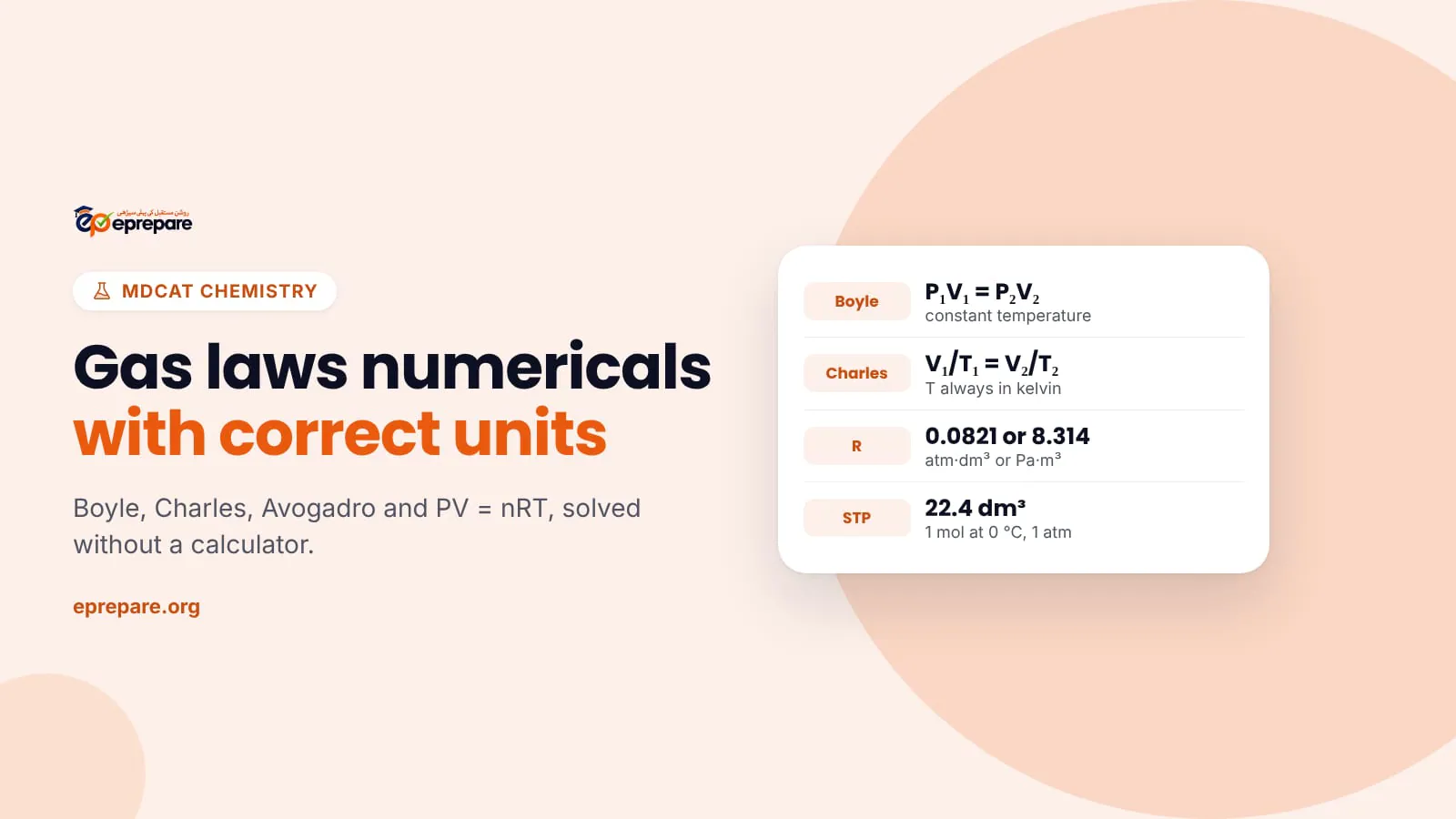
The short answer: Use P1V1 = P2V2 (Boyle, constant T), V1/T1 = V2/T2 (Charles, constant P, T in kelvin), P1V1/T1 = P2V2/T2 when both change, and PV = nRT for moles. Before you calculate: change °C to K (add 273), and match R to your units: 0.0821 dm³ atm K⁻¹ mol⁻¹ with atm and dm³, or 8.314 J K⁻¹ mol⁻¹ with Pa and m³. At STP (0 °C, 1 atm) one mole of any ideal gas occupies 22.4 dm³.
The gas laws in one picture
A gas is described by four quantities: pressure P, volume V, kelvin temperature T and amount n (moles). Each simple law keeps two of them fixed and links the other two:
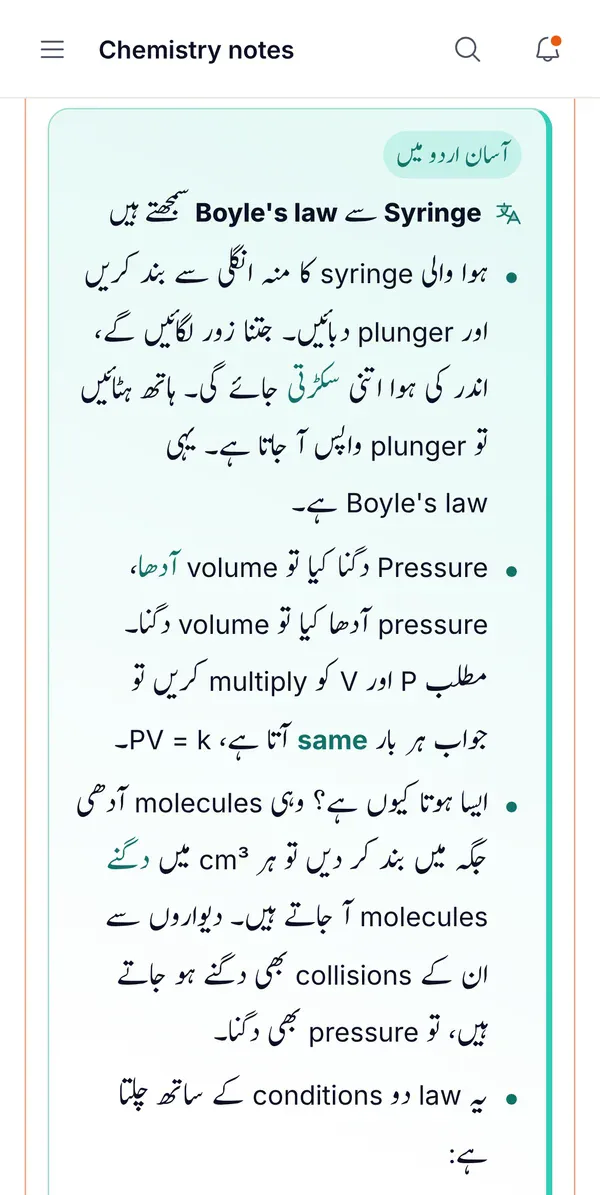
- Boyle's law: at constant temperature and fixed mass, V is inversely proportional to P. Double the pressure, halve the volume.
- Charles's law: at constant pressure and fixed mass, V is directly proportional to T (in kelvin). Double the kelvin temperature, double the volume.
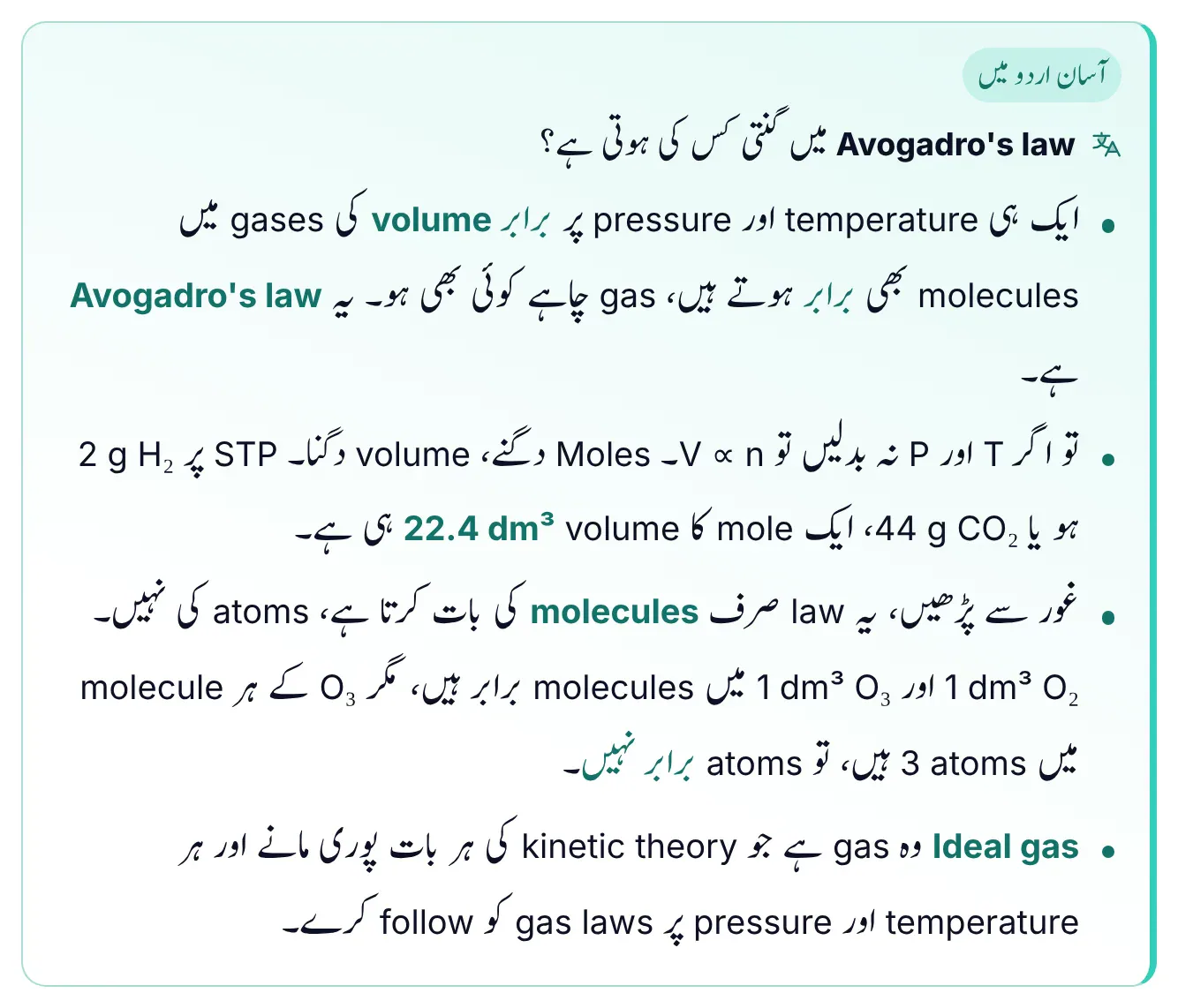
- Avogadro's law: at the same temperature and pressure, equal volumes of gases contain equal numbers of molecules, so V ∝ n.
- Pressure law (Gay-Lussac): at constant volume, P ∝ T.
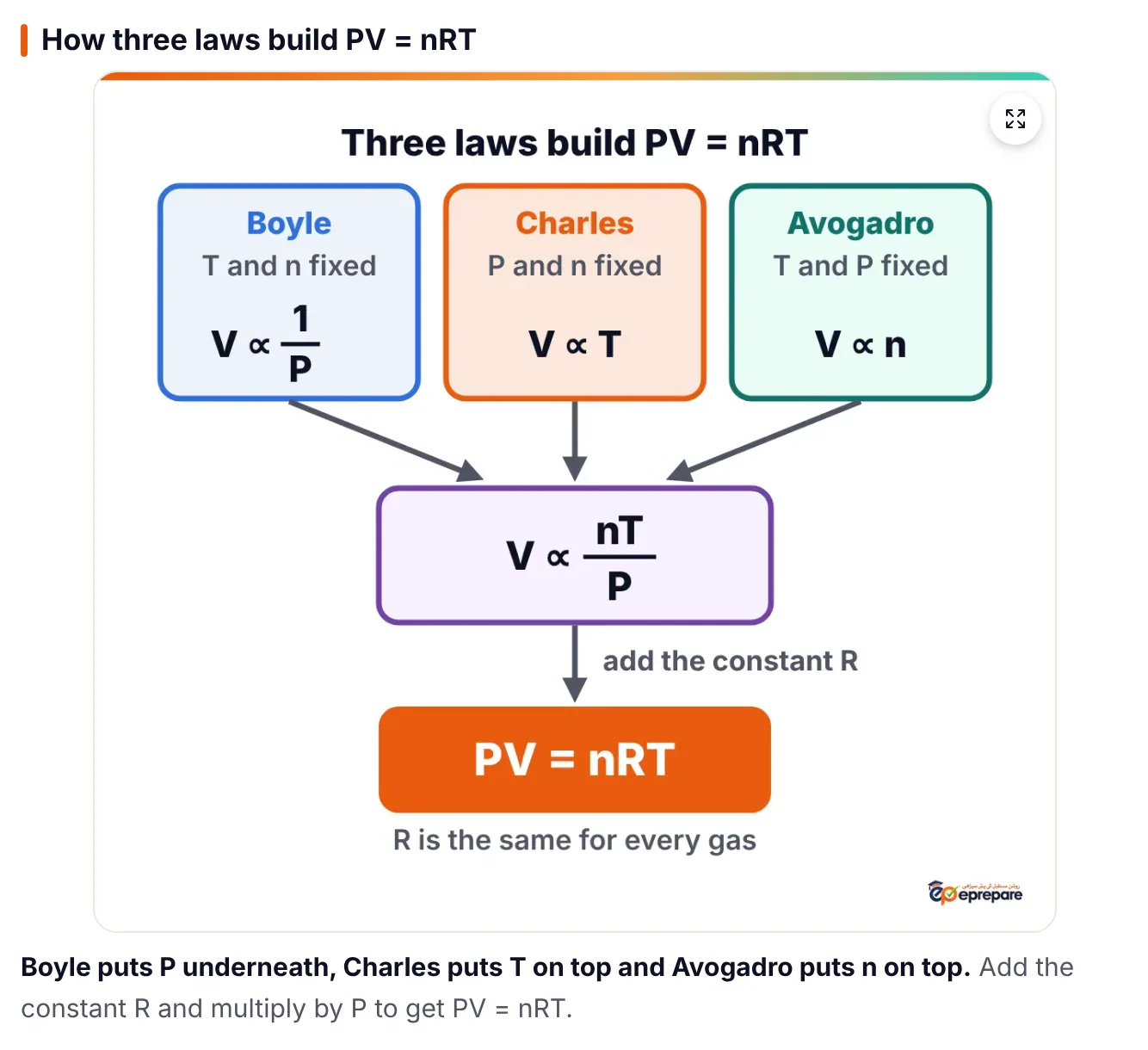
This also works backwards, which is the fastest way to remember the laws: start from PV = nRT and cross out whatever is constant. Fix n and T and you get PV = constant (Boyle). Fix n and P and you get V/T = constant (Charles).
Formulas with symbols and units
| Law | Kept constant | Formula for numericals |
|---|---|---|
| Boyle's law | T and n | P1V1 = P2V2 |
| Charles's law | P and n | V1/T1 = V2/T2 |
| Pressure law | V and n | P1/T1 = P2/T2 |
| Avogadro's law | T and P | V1/n1 = V2/n2 |
| General gas equation | n | P1V1/T1 = P2V2/T2 |
| Ideal gas equation | none | PV = nRT |
| Moles from mass | n = m/M, so PV = (m/M)RT | |
| Density of a gas | d = PM/(RT) | |
| Moles at STP only | n = V (dm³)/22.4 |
- P: pressure (atm, mm Hg, torr, Pa or kPa)
- V: volume (dm³ = L, cm³, or m³)
- T: absolute temperature in kelvin (K), never °C
- n: amount in moles (mol); m: mass (g); M: molar mass (g mol⁻¹)
- R: the universal gas constant (value depends on the units)
- d: density (g dm⁻³ when R = 0.0821 and P in atm)
Remember this: in the ratio laws (Boyle, Charles, general gas equation) any pressure unit and any volume unit work, as long as both sides use the same one. Temperature is the exception: it must always be in kelvin. Only PV = nRT forces you to match all units to R.
R values and unit conversions
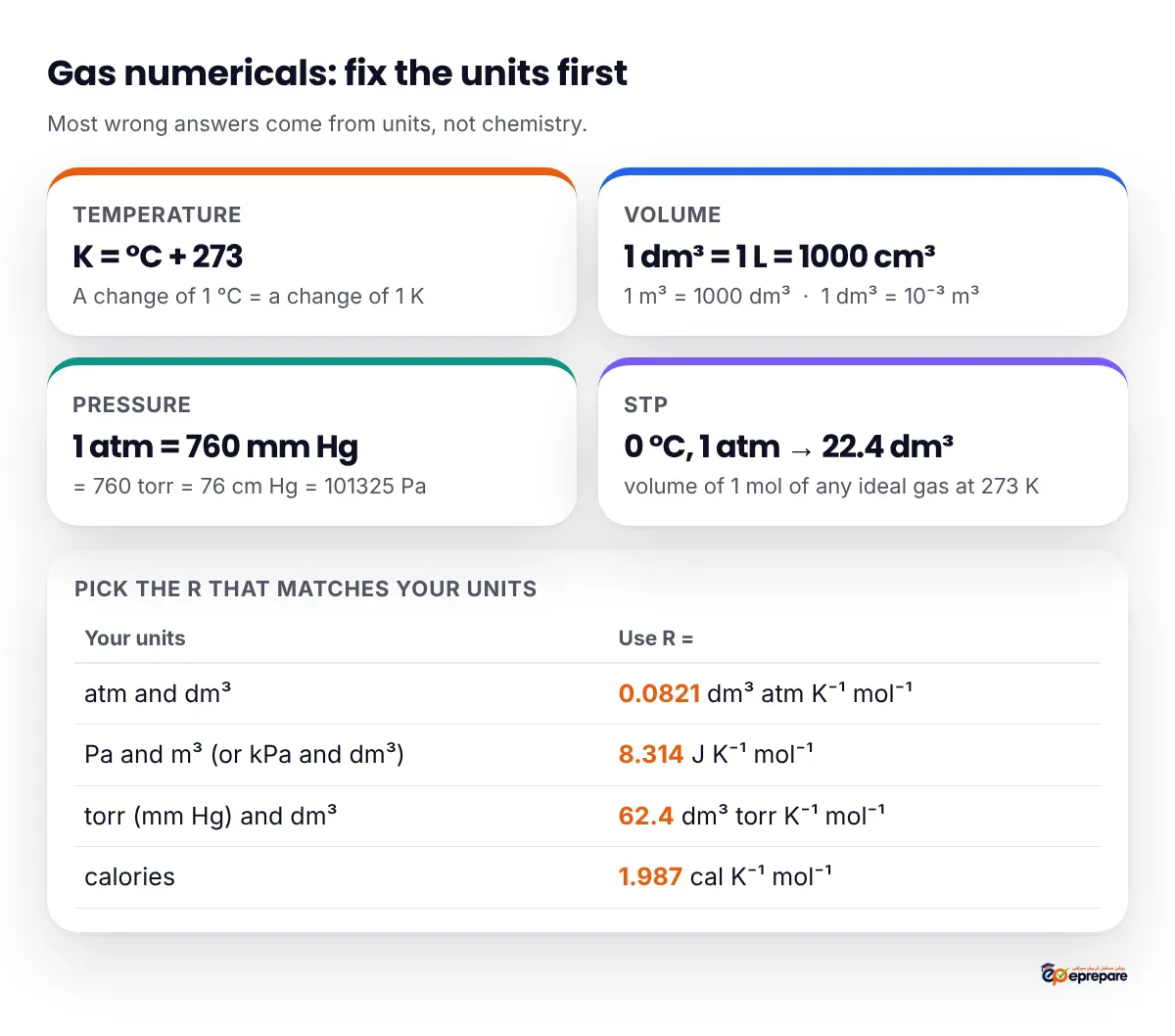
| Value of R | Pressure unit | Volume unit |
|---|---|---|
| 0.0821 dm³ atm K⁻¹ mol⁻¹ | atm | dm³ (L) |
| 8.314 J K⁻¹ mol⁻¹ (= N m K⁻¹ mol⁻¹) | Pa (N m⁻²) | m³ |
| 8.314 (same number) | kPa | dm³ |
| 62.4 dm³ torr K⁻¹ mol⁻¹ | torr or mm Hg | dm³ |
| 1.987 cal K⁻¹ mol⁻¹ | Energy in calories (thermochemistry) | |
Why does kPa with dm³ use the same 8.314 as Pa with m³? Because kPa × dm³ = (10³ Pa) × (10⁻³ m³) = Pa m³ = J. The two factors of 1000 cancel. The values are linked too: 0.0821 × 101.3 ≈ 8.314 and 0.0821 × 760 ≈ 62.4.
- Temperature: T (K) = t (°C) + 273. A temperature change is the same on both scales (a rise of 10 °C is a rise of 10 K).
- Volume: cm³ → dm³: divide by 1000. dm³ → m³: divide by 1000. 1 L = 1 dm³.
- Pressure: mm Hg (torr) → atm: divide by 760. atm → Pa: multiply by 101325 (about 1.01 × 10⁵). 76 cm Hg = 760 mm Hg = 1 atm.
- STP: 0 °C (273 K) and 1 atm. Molar volume 22.4 dm³, containing 6.022 × 10²³ molecules. At 0.5 atm and 0 °C (or at 273 °C and 1 atm) the molar volume is 44.8 dm³.
Step-by-step method for any gas numerical
- List what is given and what is constant. This tells you which law to use.
- Convert temperature to kelvin. Always, in every gas law.
- For ratio laws: make both sides use the same pressure unit and the same volume unit.
- For PV = nRT: choose R first, then convert P and V to match it (atm + dm³ for 0.0821; Pa + m³ for 8.314).
- Rearrange before substituting, then cancel common factors before multiplying.
- Sense-check: more pressure means less volume (Boyle); hotter means bigger (Charles). If your answer goes the wrong way, you flipped a ratio.
Worked numericals (no calculator)
Numerical 1: Boyle's law, including mixed units
(a) 2 dm³ of a gas at 1 atm is compressed to 0.5 dm³ at constant temperature. Find the new pressure. (b) 4 dm³ of a gas is at 380 mm Hg. What volume will it occupy at 1 atm at the same temperature?
- (a) P2 = P1V1/V2 = (1 × 2)/0.5 = 4 atm. Volume became a quarter, so pressure became four times.
- (b) Units differ, so match them: 1 atm = 760 mm Hg.
- V2 = P1V1/P2 = (380 × 4)/760 = 4/2 = 2 dm³. Pressure doubled, volume halved.
Numerical 2: Charles's law and the kelvin trap
(a) 300 cm³ of a gas at 27 °C is heated to 127 °C at constant pressure. Find the new volume. (b) To what temperature must a gas at 27 °C be heated to double its volume at constant pressure?
- (a) T1 = 27 + 273 = 300 K; T2 = 127 + 273 = 400 K
- V2 = V1 × T2/T1 = 300 × 400/300 = 400 cm³ (cm³ is fine here; it is a ratio law)
- (b) Double the kelvin temperature: 2 × 300 = 600 K = 600 − 273 = 327 °C. Not 54 °C, which wrongly doubles the Celsius number.
Numerical 3: Avogadro's law and STP
Find the moles, mass and number of molecules in 11.2 dm³ of oxygen gas (O₂, M = 32 g mol⁻¹) at STP.
- n = 11.2/22.4 = 0.5 mol (divide the given volume by 22.4, not the other way)
- Mass = n × M = 0.5 × 32 = 16 g
- Molecules = 0.5 × 6.022 × 10²³ = 3.011 × 10²³
- The same 11.2 dm³ of H₂ or CO₂ at STP also holds 0.5 mol, because equal volumes hold equal numbers of molecules.
Numerical 4: PV = nRT with the cm³ trap
2 mol of a gas is held in a 4000 cm³ container at 27 °C. Find its pressure in atm (R = 0.0821 dm³ atm K⁻¹ mol⁻¹).
- Units for 0.0821: V = 4000 cm³ = 4 dm³; T = 300 K
- P = nRT/V = (2 × 0.0821 × 300)/4
- Simplify first: 2 × 300/4 = 150, so P = 0.0821 × 150 = 12.3 atm (12.315)
- Leaving V as 4000 gives 0.0123 atm, a thousand times too small.
Numerical 5: PV = nRT at a high temperature
Find the pressure of 0.5 mol of a gas in 11.2 dm³ at 273 °C.
- T = 273 + 273 = 546 K
- P = (0.5 × 0.0821 × 546)/11.2
- Useful fact: 0.0821 × 273 ≈ 22.4, so 0.0821 × 546 ≈ 44.8
- P ≈ (0.5 × 44.8)/11.2 = 22.4/11.2 = 2 atm
- Check with logic: at STP, 0.5 mol fills 11.2 dm³ at 1 atm. Doubling the kelvin temperature at the same volume doubles the pressure: 2 atm.
Numerical 6: PV = nRT in SI units
1 mol of an ideal gas is at 300 K in a volume of 25 dm³. Find its pressure in pascals (R = 8.314 J K⁻¹ mol⁻¹).
- Method A (SI): V = 25 dm³ = 0.025 m³. P = (1 × 8.314 × 300)/0.025 = 8.314 × 12000 = 99,768 Pa ≈ 1.0 × 10⁵ Pa
- Method B (shortcut): keep V in dm³ with 8.314, and P comes out in kPa: P = 8.314 × 300/25 = 8.314 × 12 = 99.8 kPa. Same answer, and it is close to 1 atm, as expected for 1 mol near room temperature.
Numerical 7: general gas equation
A gas occupies 6 dm³ at 1 atm and 27 °C. Find its volume at 2 atm and 127 °C.
- T1 = 300 K, T2 = 400 K
- V2 = P1V1T2/(P2T1) = (1 × 6 × 400)/(2 × 300) = 2400/600 = 4 dm³
- Logic check: doubling P alone halves V to 3 dm³; raising T from 300 K to 400 K multiplies by 4/3, giving 4 dm³.
Numerical 8: molar mass from density at STP
A gas has a density of 1.25 g dm⁻³ at STP. Find its molar mass.
- 1 mol occupies 22.4 dm³ at STP, so the mass of 1 mol = 1.25 × 22.4 = 28 g mol⁻¹
- That matches N₂ or CO. The general form is M = dRT/P.
Common mistakes
- Using °C in any gas law. At 0 °C the formula would give zero volume. Always add 273.
- Using 8.314 with atm and dm³. The answer comes out about 100 times too small. With atm and dm³, use 0.0821.
- Leaving volume in cm³ with R = 0.0821. n or P comes out 1000 times off.
- Using 22.4 dm³ away from STP. n = V/22.4 works only at 0 °C and 1 atm. Elsewhere use PV = nRT.
- Thinking STP is 25 °C. 25 °C (298 K) is room temperature. STP is 0 °C and 1 atm.
- Reading 760 cm Hg as 1 atm. 1 atm is 76 cm Hg or 760 mm Hg; 760 cm Hg would be 10 atm.
- Adding 273 to a temperature change. A change of 10 °C is a change of 10 K.
- Counting atoms in Avogadro's law. Equal volumes contain equal numbers of molecules. 1 dm³ of O₂ and 1 dm³ of O₃ have the same number of molecules but not the same number of atoms.
MDCAT-style practice MCQs
1. A gas at 27 °C is heated at constant pressure until its volume doubles. The final temperature is:
A. 54 °C B. 327 °C C. 600 °C D. 300 °C
Show answer
B. 327 °C. 300 K × 2 = 600 K = 327 °C. 54 °C doubles the Celsius value; 600 °C forgets to convert back.
2. The mass of 5.6 dm³ of CO₂ at STP is (C = 12, O = 16):
A. 22 g B. 44 g C. 11 g D. 5.5 g
Show answer
C. 11 g. n = 5.6/22.4 = 0.25 mol; mass = 0.25 × 44 = 11 g.
3. The value of R in dm³ atm K⁻¹ mol⁻¹ is:
A. 8.314 B. 62.4 C. 1.987 D. 0.0821
Show answer
D. 0.0821. 8.314 is in J K⁻¹ mol⁻¹, 62.4 in dm³ torr K⁻¹ mol⁻¹, and 1.987 in cal K⁻¹ mol⁻¹.
4. At constant temperature, the pressure of a fixed mass of gas is tripled. Its volume becomes:
A. Three times B. One third C. Nine times D. Unchanged
Show answer
B. One third. Boyle's law: PV = constant, so V is divided by the same factor P is multiplied by.
5. A pressure of 760 mm Hg is equal to:
A. 1 atm B. 760 cm Hg C. 10 atm D. 101.325 Pa
Show answer
A. 1 atm. 760 mm Hg = 76 cm Hg = 101325 Pa (101.325 kPa, not Pa).
6. The density of a gas at STP is 1.43 g dm⁻³. Its molar mass is about:
A. 16 g mol⁻¹ B. 28 g mol⁻¹ C. 32 g mol⁻¹ D. 44 g mol⁻¹
Show answer
C. 32 g mol⁻¹. M = 1.43 × 22.4 ≈ 32 g mol⁻¹ (oxygen).
7. 4 dm³ of a gas at 1 atm and 300 K is changed to 2 atm and 600 K. Its new volume is:
A. 2 dm³ B. 8 dm³ C. 16 dm³ D. 4 dm³
Show answer
D. 4 dm³. V2 = 4 × (1/2) × (600/300) = 4 dm³. Doubling P halves V and doubling T doubles it back.
8. In PV = nRT, a student uses R = 8.314 J K⁻¹ mol⁻¹ with the volume in dm³. The pressure comes out in:
A. Pa B. kPa C. atm D. mm Hg
Show answer
B. kPa. 8.314 J = 8.314 kPa dm³, because kPa × dm³ = 10³ Pa × 10⁻³ m³ = J.
Quick revision table
| Law | Constant | Relation | Graph to remember |
|---|---|---|---|
| Boyle | T, n | PV = k; P1V1 = P2V2 | V against P: hyperbola; V against 1/P: straight line through origin |
| Charles | P, n | V/T = k; V1/T1 = V2/T2 | V against T (K): straight line through origin; V against t (°C) meets axis at −273 °C |
| Pressure law | V, n | P/T = k | P against T (K): straight line through origin |
| Avogadro | T, P | V/n = k | Equal volumes, equal molecules |
| General gas equation | n | P1V1/T1 = P2V2/T2 | T doubled, P halved: V × 4 |
| Ideal gas | none | PV = nRT | R = 0.0821 (atm, dm³) or 8.314 (Pa, m³) |
| STP | 0 °C (273 K), 1 atm = 760 mm Hg = 101325 Pa; 1 mol = 22.4 dm³ = 6.022 × 10²³ molecules | ||
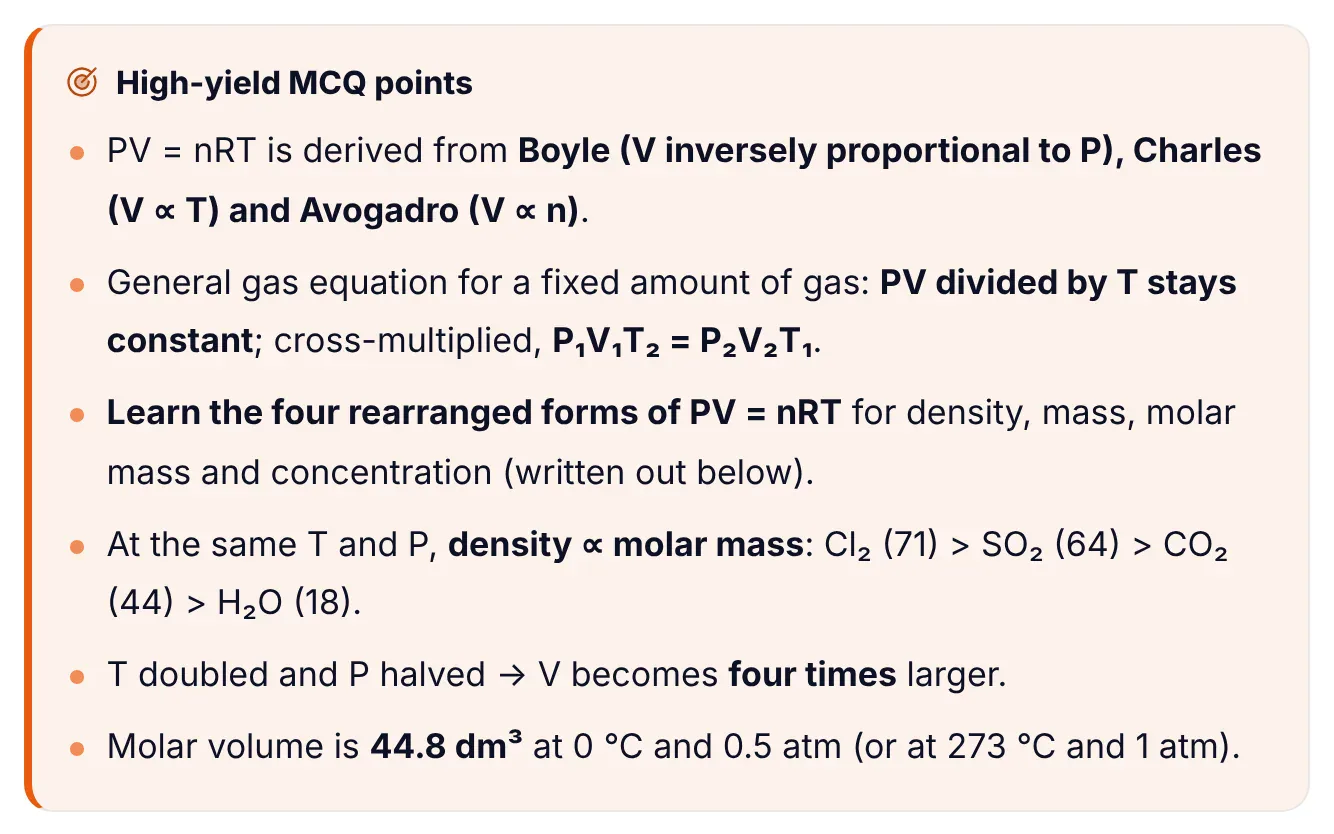
خلاصہ: gas کے ہر sum سے پہلے units ٹھیک کریں۔ °C میں 273 جمع کر کے K بنائیں، cm³ کو 1000 سے divide کر کے dm³، اور mm Hg کو 760 سے divide کر کے atm۔ atm اور dm³ ہوں تو R = 0.0821، اور Pa اور m³ ہوں تو R = 8.314۔ Boyle میں PV constant، Charles میں V/T constant، اور STP پر ایک mole کا volume 22.4 dm³ ہوتا ہے۔
The Gases chapter in ePrepare's MDCAT conceptual notes has separate lessons on Boyle's law, Charles's law, absolute zero, STP, the gas constant and the ideal gas equation, plus a cheat sheet, each with practice MCQs explained in English and easy Urdu. To see how Gases ranks among the chapters worth the most time, read MDCAT Chemistry high-yield chapters. The same arithmetic habits (cancel first, then multiply) are covered in MDCAT numericals without a calculator, and if you also want to see PV = nRT used in Physics, read first law of thermodynamics numericals. When you are ready, build a timed Gases quiz in the ePrepare Quiz Builder.
Frequently asked questions
Which value of R should I use in MDCAT gas numericals?
Match R to the units. With pressure in atm and volume in dm³ (litres), use 0.0821 dm³ atm K⁻¹ mol⁻¹. With pascals and m³, or kPa and dm³, use 8.314 J K⁻¹ mol⁻¹. With mm Hg (torr) and dm³, use 62.4.
Do I always need to convert °C to kelvin?
Yes, for every gas law and for PV = nRT. Volume and pressure are proportional to the absolute temperature, not the Celsius reading. The only exception is a temperature difference, which is the same in °C and K.
Do I need to convert units in Boyle's law?
Only if the two sides use different units. P1V1 = P2V2 works in any units as long as both pressures share one unit and both volumes share one unit. If one pressure is in atm and the other in mm Hg, convert one of them first.
Is the molar volume always 22.4 dm³?
No, only at STP (0 °C and 1 atm). At 0.5 atm and 0 °C, or at 273 °C and 1 atm, it is 44.8 dm³. At other conditions use PV = nRT.
What is the difference between STP and room temperature?
STP is 0 °C (273 K) and 1 atm. Room temperature is usually taken as 25 °C (298 K). A common wrong option gives STP as 25 °C.
Why does R have different values?
R is the same physical constant for every ideal gas; only its number changes with the units used for pressure, volume and energy. 0.0821 dm³ atm and 8.314 J are the same quantity written in different units.