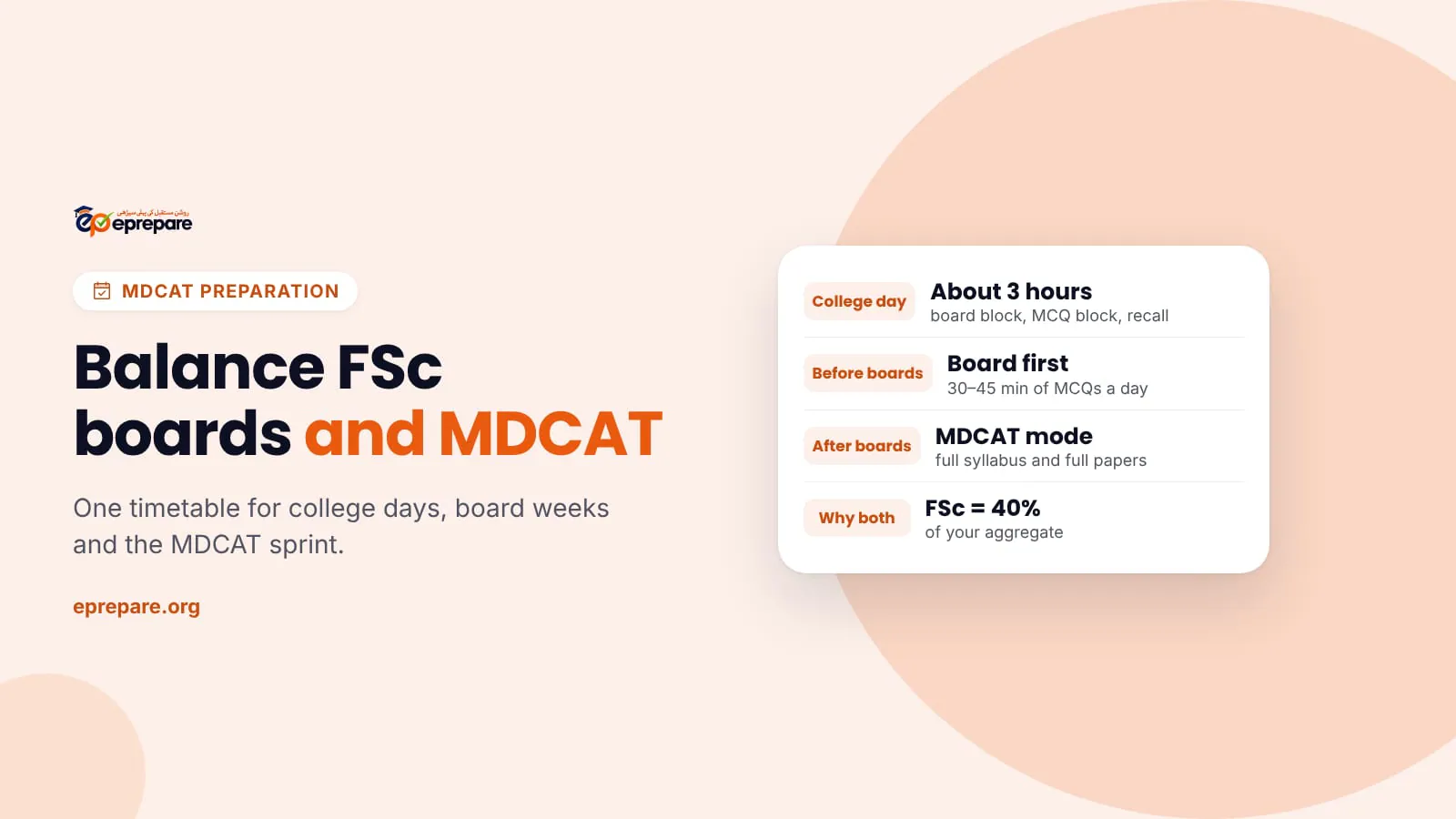
Second year of FSc Pre-Medical feels like two exams pulling you in two directions. Your college wants written answers, diagrams and practical notebooks for the board. MDCAT wants 180 fast, accurate MCQs. Many students pick one and let the other slide, then regret it when the aggregate is worked out. You do not have to choose. Both exams come from the same FSc books, so with the right timetable one hour of study can count twice.
The short answer: Study each chapter twice in the same week: once for the board (book reading, short and long questions) and once for MDCAT (MCQs on that chapter). On college days that means about three focused hours split into a board block, an MDCAT block and a short recall block. Put the board first in the last six to eight weeks before your papers, then switch fully to MDCAT after your last paper. Your FSc marks are 40% of your medical college aggregate, so neither exam can be dropped.
Why you cannot drop either exam
Admission to MBBS and BDS is decided by an aggregate, not by MDCAT alone. Under PM&DC's formula, MDCAT counts for 50%, FSc (HSSC) for 40% and Matric for 10%. PM&DC's 2026 regulations also ask for at least 60% in HSSC or equivalent before you can be admitted, and an admitting university can ask for more (KMU asks for 65% for KP public colleges).
Here is what that means in numbers:
- Every 1% of your FSc percentage is worth 0.4 aggregate points (because FSc carries 40%).
- Every MDCAT mark is worth about 0.278 aggregate points (50 ÷ 180).
- So losing 10 percentage points in FSc costs you 4 aggregate points. To win those back you would need about 14 extra MDCAT marks (4 ÷ 0.278 ≈ 14.4).
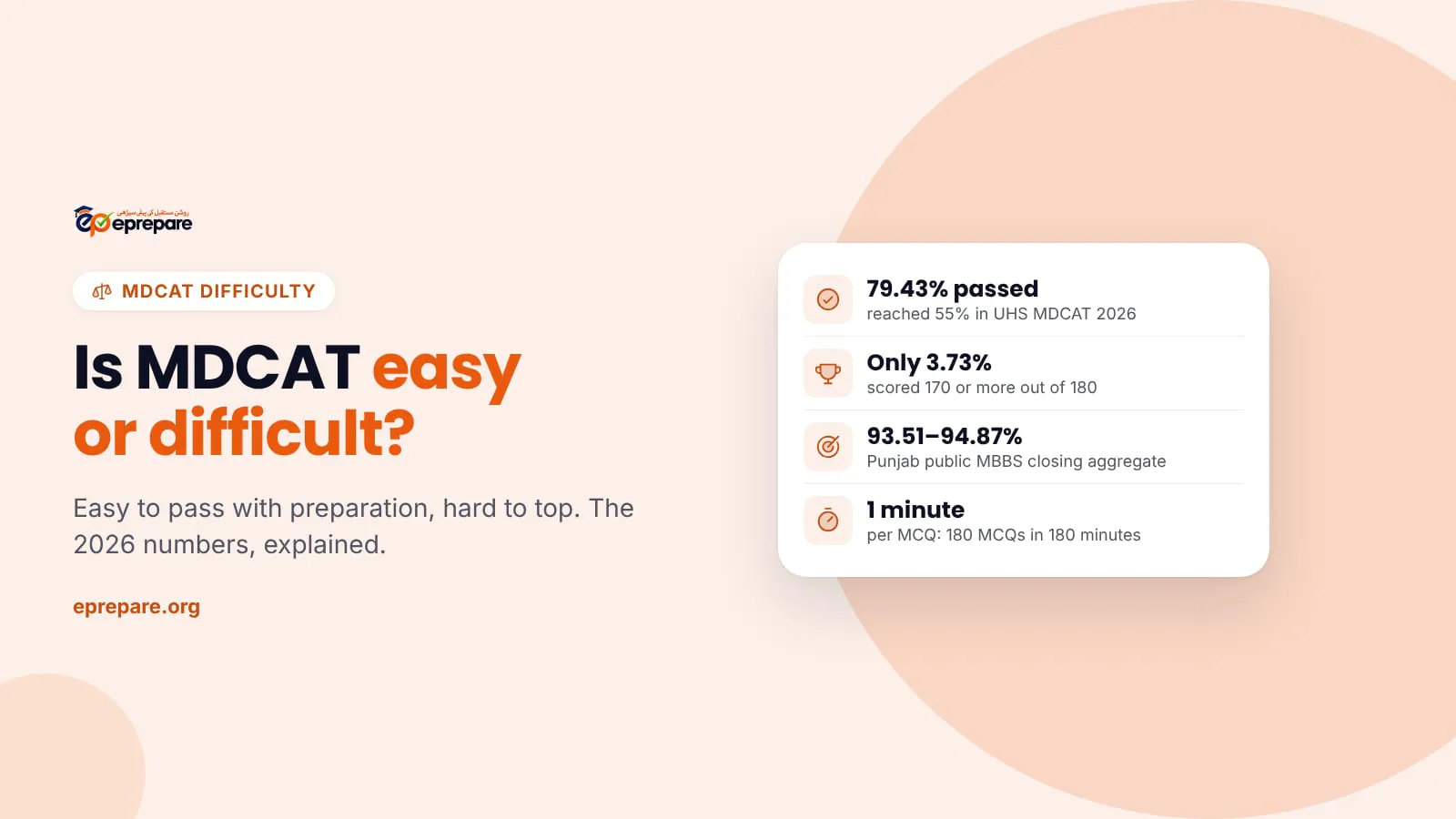
Now look at how tight merit is. In UHS's final open-merit list for 2025-26, the 17 public MBBS colleges in Punjab closed between 93.51% and 94.87% aggregate. A few aggregate points separate a public seat from no seat. Board marks are not a side issue. If you want to run your own numbers, use the ePrepare merit calculator or read how to calculate your MDCAT aggregate.
How much of the board syllabus is also MDCAT syllabus?
Most of it. PM&DC's MDCAT curriculum is built on FSc Biology, Chemistry and Physics, Part 1 and Part 2. When your college teaches Enzymes, Alkyl halides or Fluid dynamics for the board, it is teaching an MDCAT unit at the same time. That overlap is the whole reason a combined plan works.
There are three differences to keep in mind:
- Some book chapters are board-only. ePrepare's MDCAT syllabus page lists textbook topics that PM&DC's curriculum does not include, such as cell division, ecology, DNA replication and protein synthesis in Biology; measurements, gravitation, optics, Kirchhoff's laws and logic gates in Physics; and environmental and analytical chemistry, colligative properties and amines in Chemistry. You still need these for your board paper, so study them in board mode and do not spend MDCAT time on them.
- Two MDCAT sections are not board subjects in the same form. MDCAT has 9 English MCQs (grammar, vocabulary, reading) and 9 Logical Reasoning MCQs. Neither needs much daily time, but both need a small weekly slot from the start.
- The style of the questions is different. The board rewards complete written answers. MDCAT rewards quick recognition, exact facts and spotting traps.
| FSc board | MDCAT | |
|---|---|---|
| Format | Objective part plus short and long written questions, numericals with steps, diagrams, practicals | 180 MCQs in 3 hours, no negative marking |
| What earns marks | Complete definitions, derivations, labelled diagrams, neat working | The right option, quickly: exact facts, numbers, exceptions |
| How to practise | Write answers by hand; solve past board papers | Solve many MCQs; read the explanation of every wrong one |
| Speed needed | Enough to finish long answers | About one minute per MCQ |
| Extra sections | Practical exam and notebook | English (9 MCQs) and Logical Reasoning (9 MCQs) |
A weekday and weekend timetable that fits college hours
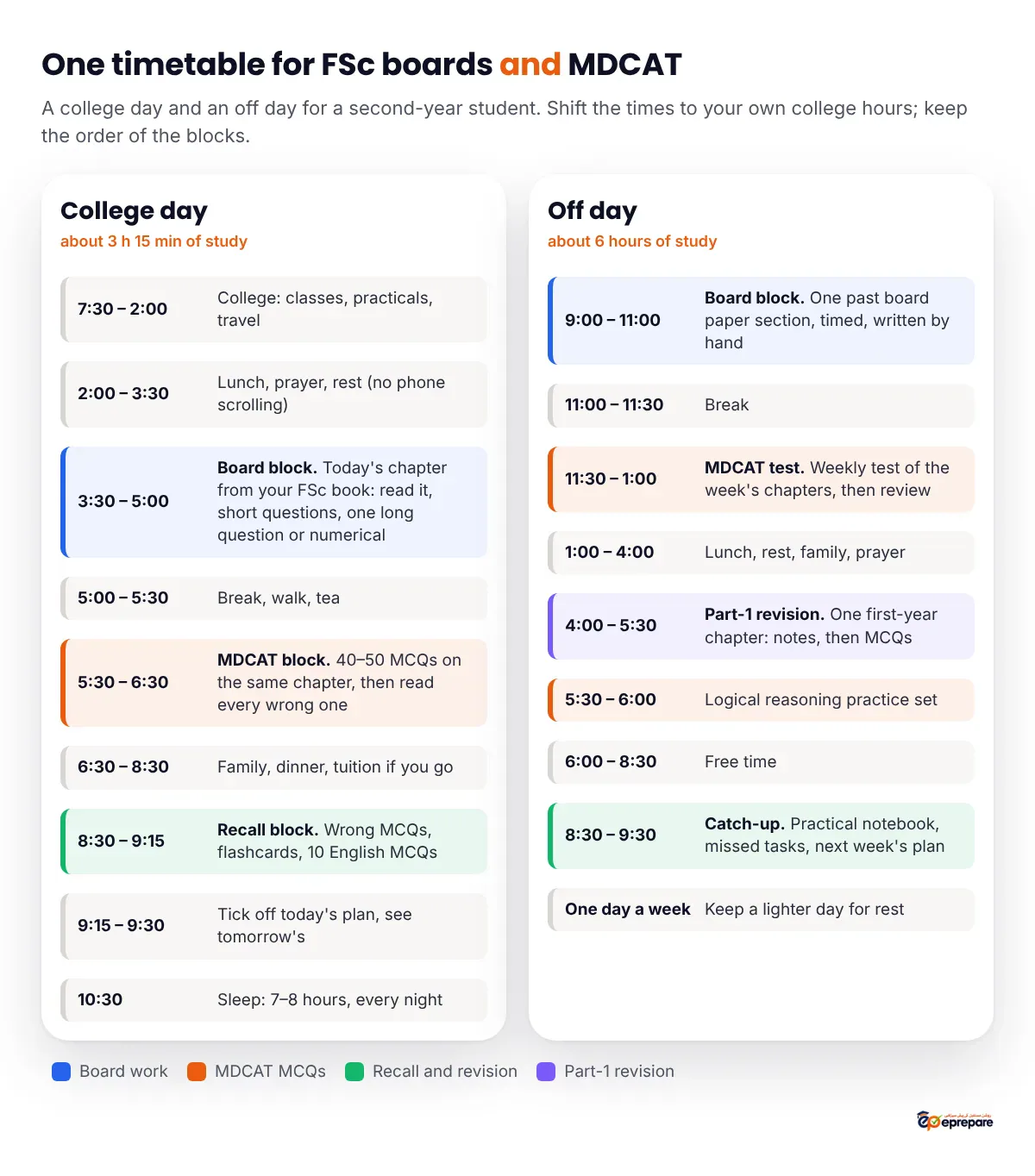
The timetable below assumes college from about 7:30 am to 2 pm, which is typical. If your college finishes later, slide every block later and keep the order. The order matters more than the clock.
Why the blocks are in this order
- Board block first (90 minutes). You have just heard the chapter in class, so you read it in your FSc book while it is fresh, then answer its short questions and one long question or numerical in writing. This is the "understand it" pass.
- MDCAT block second (60 minutes). Solve 40 to 50 MCQs on the same chapter. The MCQs test whether the reading actually stuck, and they show you the lines in the book that examiners like to twist. ePrepare's Bookline MCQs turn the KPK textbooks into MCQs line by line, exercise MCQs cover the KPK, Federal and Punjab books, and the question bank adds topic-wise MCQs with explanations.
- Recall block last (45 minutes). Before bed, revisit old mistakes and flashcards, and do about 10 English MCQs. Short, regular contact keeps older chapters from fading.
The off day
Use your off day for the things that need long, quiet time: a timed section of a past board paper written by hand, a weekly MDCAT test on the week's chapters, and one first-year chapter for revision. Part 1 is in MDCAT too, and if you leave all of it until after the boards you will run out of time. One Part-1 chapter every weekend from September covers most of it before the board season begins.
If you go to an academy or tuition
Count the academy class as your board block for that subject, and keep the MDCAT block and the recall block at home. If travel eats your evening, cut the recall block to 20 minutes rather than skipping it. Do not cut sleep. A tired brain reads the same page three times.
The month-by-month plan: September to boards to MDCAT
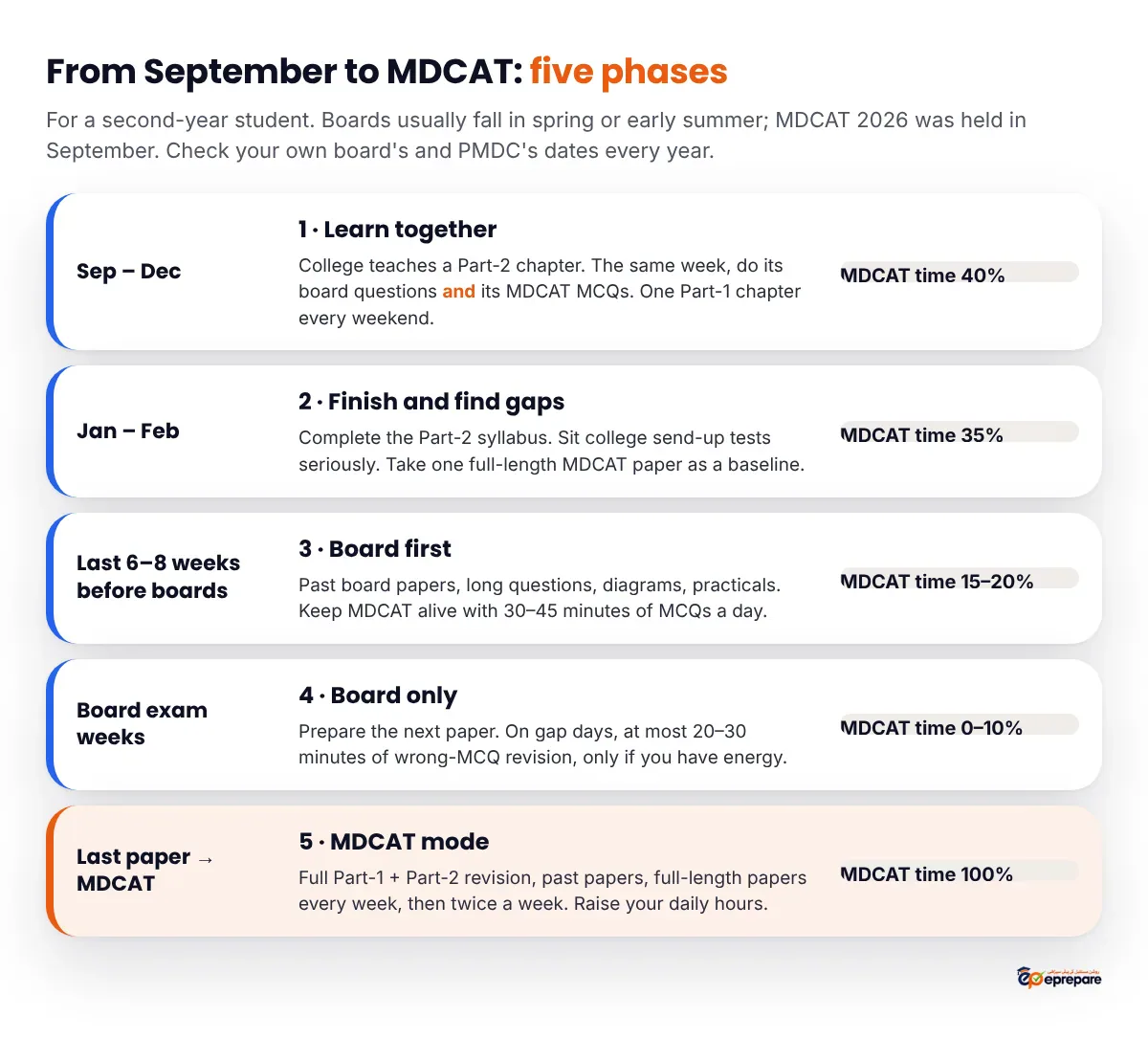
The weekly timetable stays roughly the same, but the balance between board and MDCAT changes through the year. Board exams usually fall in spring or early summer, and MDCAT 2026 was held in September, so plan in phases and check your own board's date sheet and PM&DC's announcement each year.
Phase 1 · September to December: learn together
This is where the combined method pays off. Follow your college's order of chapters. Every chapter gets its board pass and its MCQ pass in the same week. Weekends add one Part-1 chapter. Start 15 minutes of English and one Logical Reasoning set each week now, while the load is light.
Phase 2 · January and February: finish and find gaps
Colleges often finish the Part-2 course and hold send-up or pre-board tests around this time. Take them seriously; they are free board practice. This is also a good moment for your first full-length 180-MCQ paper. The score is not important. The list of weak chapters it gives you is.
Phase 3 · Last six to eight weeks before boards: board first
Now the board leads. Solve past board papers for each subject, rehearse long questions, draw your diagrams and finish the practical notebook. Keep MDCAT alive with 30 to 45 minutes of MCQs a day, mostly on chapters you are revising for the board anyway. Stopping MCQs completely for two months makes the restart much harder.
Phase 4 · Board exam weeks: board only
See the next section. In short: the next paper is your only job.
Phase 5 · After your last paper: MDCAT mode
The day after your last board paper, switch to full-time MDCAT. Revise Part 1 and Part 2 in MDCAT order, solve past papers, and sit a full-length paper every week, then twice a week near the end. How long this phase lasts depends on that year's dates. Pick the plan that matches the time you have: the 90-day MDCAT study plan, the 2-month plan, or a 30-day plan if time is short.
What to do during board exam months
Board weeks are not the time to prove anything about MDCAT. They are the time to collect every board mark you can, because each one feeds the 40%.
- Study only the next paper. If Chemistry is in four days, Chemistry gets those four days.
- Use the gap days well. First day: read the whole book chapter list and mark weak chapters. Middle days: weak chapters, past papers, long questions. Last evening: definitions, diagrams and formulas only, then sleep.
- Turn board revision into MDCAT revision for free. When you revise the Biology book for the board, you are revising most of MDCAT Biology. Underline lines with numbers, exceptions and examples as you go; these are the lines MDCAT asks about.
- Optional MCQs, only if you have energy. 20 to 30 minutes of old wrong MCQs on a gap day is enough. Never let MCQs cut into sleep before a paper.
- Do not judge yourself by mock scores now. Your MDCAT score will dip during board weeks. It comes back quickly once Phase 5 starts.
One chapter, two exams: a worked example
Take Enzymes, a Biology chapter that is both a board chapter and a full PM&DC unit. Here is how one week of it looks under the combined method.
| Board block (write it) | MDCAT block (spot it) |
|---|---|
| Define an enzyme and list its characteristics | Enzymes lower activation energy but do not change ΔG or the equilibrium |
| Explain the lock and key and induced fit models with diagrams | Lock and key: Fischer, 1890, rigid site. Induced fit: Koshland, 1959, flexible site |
| Describe the effect of temperature, pH and concentration, with graphs | Pepsin works best near pH 2, trypsin near pH 8; do not swap them |
| Differentiate competitive and non-competitive inhibition | Only competitive inhibition is reduced by adding more substrate |
| Explain the terms apoenzyme, cofactor and holoenzyme | Apoenzyme + cofactor = holoenzyme (the active form); a prosthetic group is firmly bound, a coenzyme loosely |
The board pass builds understanding. The MCQ pass sharpens the exact facts. Together they take about two and a half hours, and the chapter is ready for both exams.
Setting ePrepare's study plan for fewer daily hours
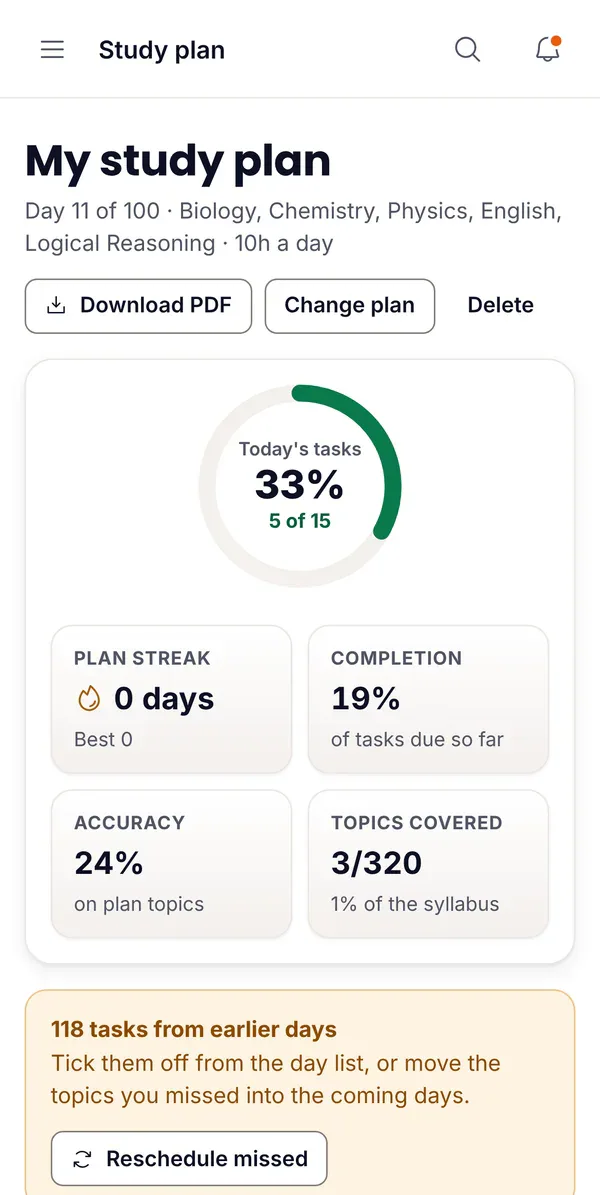
Most study plans assume you are free all day. A board student is not. ePrepare's study plan lets you choose how many hours you really have, so the daily task list fits around college instead of making you feel behind from day one.
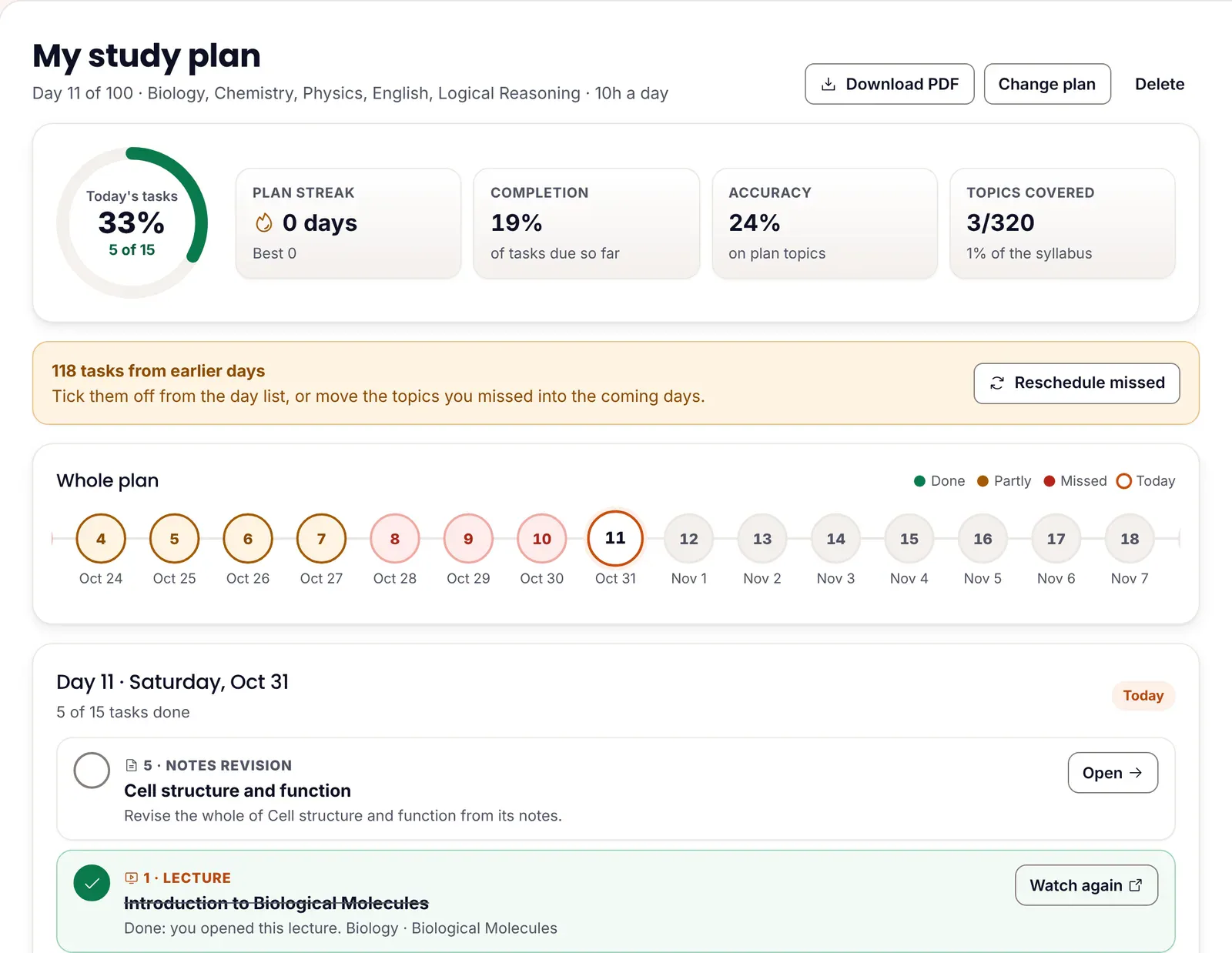
How to set it up during the board year:
- Pick your exam date or the number of days. A plan can run from 7 to 365 days.
- Choose your daily study time. The presets are 1, 2, 3, 4, 6 and 8 hours, or you can type your own from 30 minutes up to 16 hours. In Phases 1 and 2, 1 to 2 hours of MDCAT time is realistic on top of your board block.
- Mark rest days. Choose weekdays to keep free, for example a day you have practicals until late.
- Choose what goes in. You can leave out steps you are already covering. For example, if your college lectures already cover a subject, choose lectures only for the subjects you need them in.
- Let it reschedule. Missed a day because of a college test? The plan offers to move missed topics into the coming days.
- Change the plan when the phase changes. Before board weeks, lower the daily time; after your last paper, use "Change plan" to raise it to six or eight hours for MDCAT mode.
For a full walkthrough of planning, read how to make an MDCAT study plan. The study plan is one of the platform tools every ePrepare account gets, whatever the package; see packages and prices.
Common mistakes board students make
- "I will start MDCAT after the boards." Then a few months have to cover Part 1, Part 2, English, Logical Reasoning and full-length papers. Starting in September spreads that load over the year.
- Ignoring the board because "MDCAT is what matters". FSc is 40% of the aggregate, and you need at least 60% in HSSC to be admitted at all.
- Doing MCQs before reading. MCQs on a chapter you have not read feel like guessing and teach very little. Read first, then test.
- Skipping Part 1 all year. One Part-1 chapter per weekend from September is enough to stay in touch.
- Cutting sleep to fit everything in. A short, focused three hours beats a sleepy six.
آسان الفاظ میں: board اور MDCAT کی کتابیں ایک ہی ہیں، اس لیے ہر chapter ایک ہی ہفتے میں دو بار پڑھیں۔ پہلے board کے لیے کتاب پڑھیں اور سوال لکھیں، پھر اسی chapter کے MCQs حل کریں۔ College والے دن تقریباً تین گھنٹے کافی ہیں۔ Board کے آخری ڈیڑھ دو مہینے board کو ترجیح دیں، اور آخری paper کے اگلے دن سے پورا وقت MDCAT کو دیں۔ یاد رکھیں، FSc کے marks آپ کے aggregate کا 40% ہیں۔
Frequently asked questions
Can I prepare for MDCAT and FSc board exams at the same time?
Yes. Both use the same FSc Biology, Chemistry and Physics books, so study each chapter once for the board and once with MCQs in the same week. Leave extra board time for board-only chapters and a small weekly slot for MDCAT English and Logical Reasoning.
How many hours should a second-year student study for MDCAT during college?
About one to two hours of MDCAT work on college days, on top of your board study, is realistic for most students. On off days you can do more. After your last board paper, raise it to full-time MDCAT study.
Should I stop MDCAT preparation during board exams?
Mostly, yes. During board exam weeks, give your time to the next paper. A short revision of old wrong MCQs on a gap day is fine if you have energy, but board marks come first in those weeks.
How much do FSc marks matter for MBBS admission?
A lot. FSc is 40% of the aggregate (MDCAT 50%, Matric 10%), and PM&DC's 2026 regulations require at least 60% in HSSC or equivalent. Each 1% of FSc is worth 0.4 aggregate points, which is about 1.4 MDCAT marks.
Is the MDCAT syllabus the same as the FSc syllabus?
It is based on it, but not identical. PM&DC's curriculum covers most FSc chapters and leaves some out, such as cell division and ecology in Biology and optics and gravitation in Physics, and it adds English and Logical Reasoning. ePrepare's MDCAT syllabus page lists every unit and topic.
When should I start full-length MDCAT papers?
Take one in January or February as a baseline, then start them regularly once your board exams are over: weekly at first, then twice a week near MDCAT. Review every paper chapter by chapter, not just the score.