


"Sir, my base is weak. Can I still clear MDCAT?" We hear this every week, from students who scraped through FSc, students who took a gap year and forgot everything, and students who were never taught Physics properly in the first place. The honest answer is yes, but not by doing what everyone else does. A student with a weak base who jumps straight into MCQ books usually ends up memorising answers without understanding them, and the MDCAT punishes exactly that.
This guide is a plan built for a weak base: how to find out exactly where you stand, which gaps to fix first, how to study each subject, and how to turn the PMDC syllabus into marks one chapter at a time.
The short answer: Start with one timed diagnostic test and sort every chapter into red, amber or green. Spend your first six to eight weeks on foundations: the textbook, basic maths for Physics and the core Chemistry concepts, before heavy MCQ practice. Then cover the syllabus chapter by chapter from the textbook, giving most time to Biology (81 of 180 marks) and the high-weight chapters. Practise MCQs daily, keep a wrong-MCQ notebook, and move to full-length papers in the last six weeks. A weak base is a starting point, not a final score.
What "weak base" really means
"Weak base" means different things for different students, and the fix depends on which one is yours:
- Forgotten concepts: you studied FSc but crammed for board exams and remember very little now.
- Gaps from school: topics from Matric that FSc builds on, such as the mole, basic algebra or cell structure, were never clear.
- Weak maths: Physics numericals and Chemistry calculations stop you, even when you understand the idea.
- Low FSc marks: your aggregate starts behind, so your MDCAT score has to carry more.
- A long gap: you have been out of study for a year or more and have lost the habit of sitting with books.
Most students have two or three of these at once. That is normal. The plan below deals with all of them, in the right order.
Step 1: Diagnose before you plan
Do not start by buying more books. Start by finding out exactly what you know. Take one full timed test, or at least a mini mock, with no preparation: our free MDCAT online tests work for this. The score itself does not matter. What matters is the breakdown.
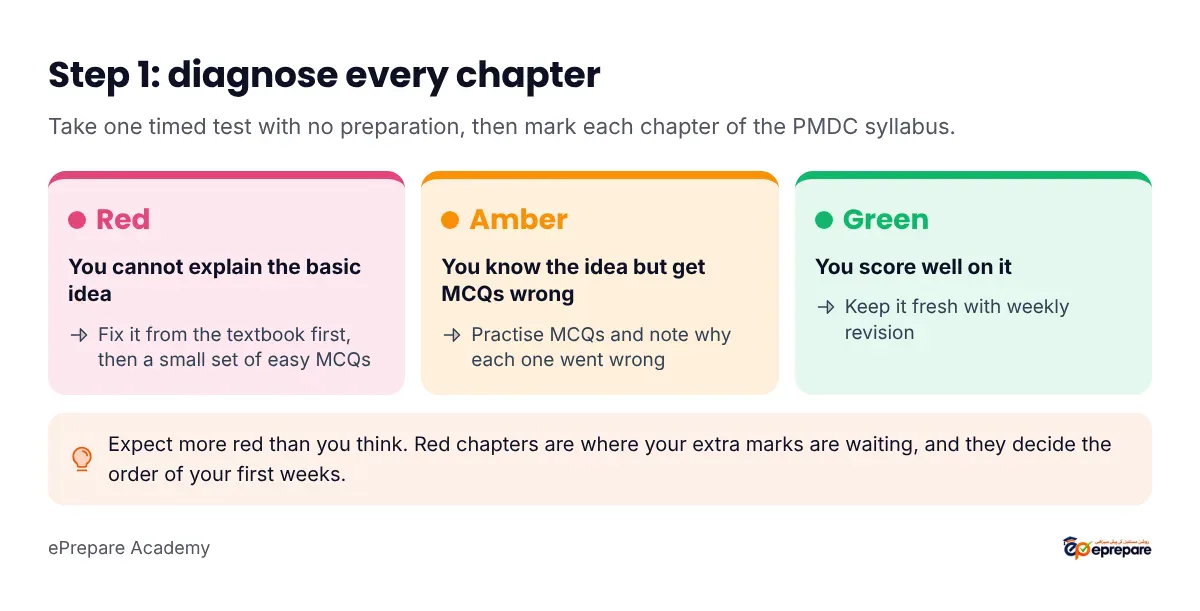
Go through the PMDC syllabus chapter by chapter and mark each one:
- Red: you cannot explain the basic idea in your own words. Fix it from the textbook first.
- Amber: you know the idea but keep getting MCQs wrong. Practise MCQs and learn from each mistake.
- Green: you score well. Keep it fresh with weekly revision.
Students with a weak base usually find more red than they expected. That is useful, not depressing: it tells you exactly where your marks are hiding. Our MDCAT syllabus guide lists every unit so nothing is missed.
Step 2: Know exactly what is tested
The MDCAT has 180 MCQs in 3 hours, one mark each, with no negative marking. The subject split never changes, and it should decide where your hours go:
| Subject | MCQs | Share of the paper |
|---|---|---|
| Biology | 81 | 45% |
| Chemistry | 45 | 25% |
| Physics | 36 | 20% |
| English | 9 | 5% |
| Logical Reasoning | 9 | 5% |
| Total | 180 | 100% |
Two facts matter most for a weak base. First, Biology is almost half the paper and is the most learnable subject: much of it rewards careful reading of the textbook rather than talent. Second, there is no negative marking, so every question you can narrow down is worth attempting. PMDC also says the paper is 15% easy, 70% moderate and 15% difficult, so most marks come from solid understanding, not tricks. Our paper pattern guide has the full breakdown.
Step 3: Follow a four-phase roadmap
A weak base needs a different order of work from a strong one. Do not do everything at once. Build in phases:
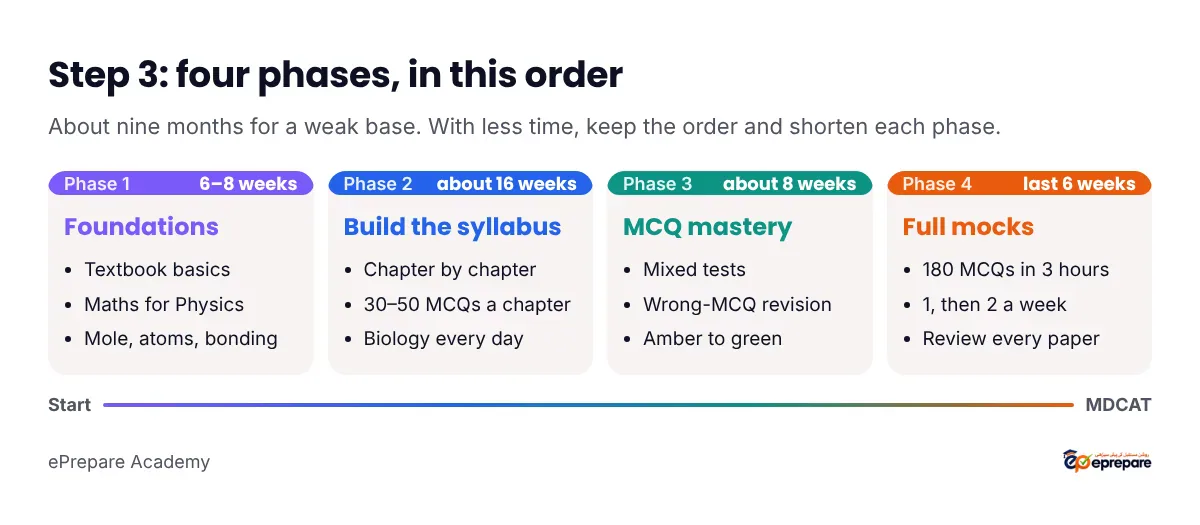
- Phase 1, foundations (6 to 8 weeks). Fix the red basics that everything else rests on: cell structure and biological molecules in Biology; the mole, atomic structure and chemical bonding in Chemistry; and the maths Physics needs (algebra, ratios, powers of ten, units and basic trigonometry). Read slowly from the textbook. Do only small sets of easy MCQs to check understanding.
- Phase 2, build the syllabus (about 16 weeks). Go chapter by chapter through the PMDC syllabus. For each chapter: read the textbook, make short notes, then solve 30 to 50 MCQs and review every wrong one. Do Biology every day, with Chemistry and Physics on alternate days.
- Phase 3, MCQ mastery and revision (about 8 weeks). Switch to mixed tests across chapters. Revise from your own notes and your wrong-MCQ list, not from new books. Turn amber chapters green.
- Phase 4, full-length mocks (last 6 weeks). Take full 180-MCQ papers in 3 hours, first once a week, then twice. After each one, spend as long reviewing as you spent writing it.
This assumes about nine months. If you have less time, keep the same order and shorten each phase; our day-by-day plans for 100 days, 60 days and 30 days do this for you. PMDC has not announced the MDCAT 2027 date yet, so plan for the earliest realistic date and treat any extra weeks as a bonus. Our date and registration guide tracks it.
Subject by subject: how to rebuild each one
Biology: your biggest chance
Biology carries 81 marks, and it rewards students who read carefully. Read your provincial textbook line by line, because MDCAT questions often test exact facts, terms and diagrams from it. After each topic, close the book and write down what you remember. Then solve MCQs on that topic only. Our Bookline MCQs follow the KPK textbooks line by line for exactly this reason.
Chemistry: fix the fundamentals before organic
Many weak-base students start Chemistry in the middle and get lost. Start with the fundamentals: the mole and formula calculations, atomic structure and chemical bonding. Physical chemistry (gases, equilibrium, kinetics, thermochemistry) depends on these. Organic chemistry is mostly patterns: learn the reactions of each functional group as a table, and give hydrocarbons extra time, because they are the largest Chemistry unit in the PMDC curriculum.
Physics: maths first, then concepts, then numericals
If Physics scares you, the problem is usually maths, not Physics. Spend the first weeks on the maths it needs: rearranging formulas, ratios, powers of ten, units and the values of sin, cos and tan at common angles. Calculators are not allowed, so practise simple arithmetic by hand. Then, for each chapter, understand the idea first, learn the few formulas that matter, and only then solve numericals, starting with easy ones. Our Physics high-yield guide has a formula sheet.
English and Logical Reasoning: 18 marks you can secure
Together these are 18 marks, as many as a large Biology unit, and they need less study time. Learn the common grammar rules and practise sentence correction for English; learn each question type for Logical Reasoning. Our guides to MDCAT English and Logical Reasoning question types cover both.
Where to spend your time first
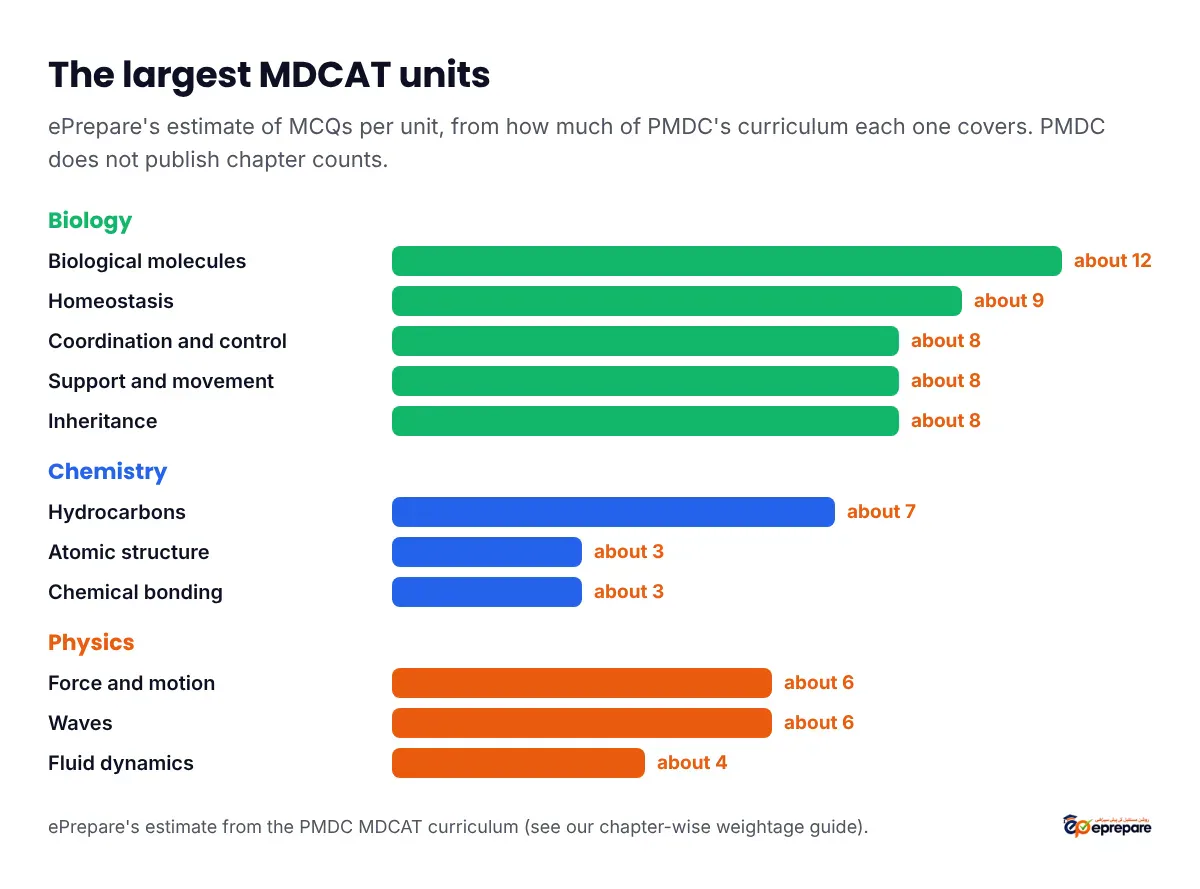
PMDC publishes how many MCQs come from each subject, but not from each chapter. The chart below shows ePrepare's estimate of the larger units, based on how much of PMDC's curriculum each one takes up. Use it to decide the order of your red chapters, not to skip anything.
| Subject | Largest units (estimated MCQs) |
|---|---|
| Biology | Biological molecules (about 12), homeostasis (about 9), coordination and control, support and movement, inheritance (about 8 each) |
| Chemistry | Hydrocarbons (about 7), then atomic structure, gases, chemical bonding, equilibrium, kinetics and thermochemistry (about 3 each) |
| Physics | Force and motion and waves (about 6 each), fluid dynamics (about 4), work and energy and electrostatics (about 3 each) |
Our chapter-wise weightage guide explains how these estimates are worked out, unit by unit.
A daily routine that works with a weak base
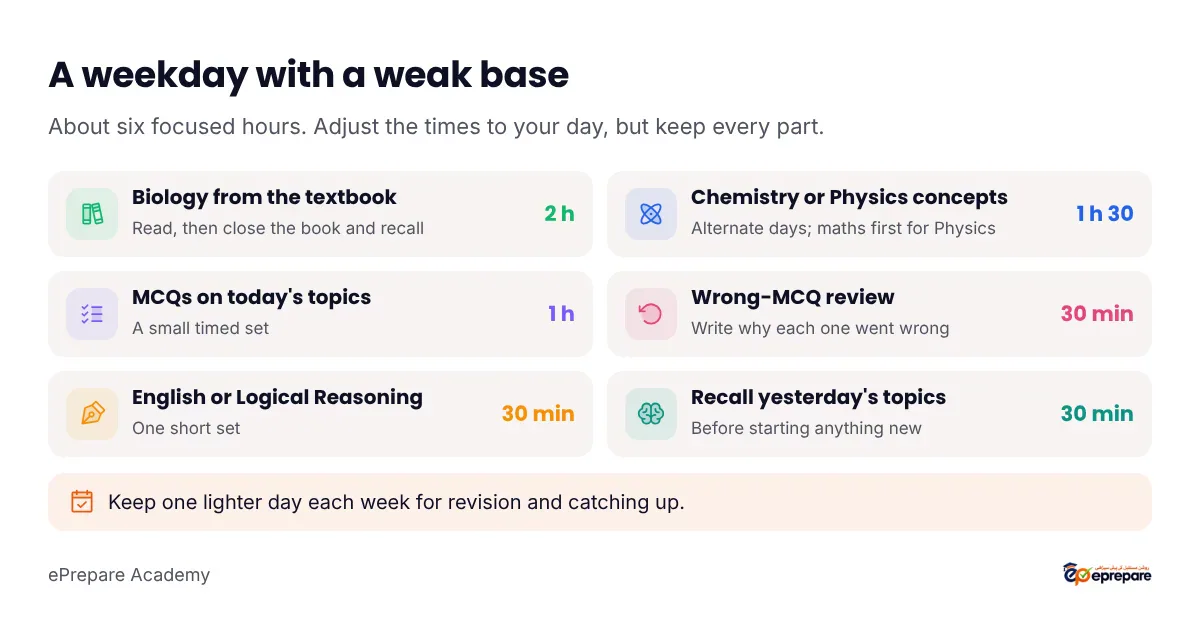
Hours matter less than what you do in them. A weak-base day should have these parts, in roughly this balance:
- Learn: Biology from the textbook every day, plus one of Chemistry or Physics.
- Test: MCQs on the topics you studied today, in a small timed set.
- Fix: go through every wrong MCQ and write the reason you got it wrong.
- Recall: spend a few minutes recalling yesterday's topics before you start new ones.
- Small wins: a short English or Logical Reasoning set.
Keep one day a week lighter for revision and catching up. A plan you can follow for months beats a heroic timetable you abandon in two weeks.
Keep a wrong-MCQ notebook. Every MCQ you get wrong shows you a gap. Write the question, the right answer and why you missed it. Revising this list weekly is the fastest way for a weak-base student to stop losing the same marks twice. ePrepare does this automatically: see Wrong MCQs and smart revision.
Set realistic targets, then raise them
PMDC's minimum to qualify is 55% (99 out of 180) for MBBS and 50% (90 out of 180) for BDS. Qualifying is the first line, not a seat. In KP, open-merit public seats need far more: our team's early estimate for the last public MBBS college in 2026-27 needs about 171 out of 180 with 95% in Matric and 93% in FSc. With lower FSc marks, the MDCAT score you need rises further. Our aggregate calculator shows exactly what you need with your own marks.
For a weak base, set a target for each stage instead of one big number. Track your score in every full mock, and aim to move steadily upward from your diagnostic score. If your mocks stop improving for a few weeks, go back to your wrong-MCQ list and your red chapters, not to new books. Our guide to passing marks explains the difference between passing and getting in, and our MBBS vs BDS guide helps if you are near the line.
Mistakes that keep a weak base weak
- Starting with MCQ books. MCQs test understanding; they do not build it. Read the topic first.
- Collecting too many sources. One textbook per subject, your own notes and one MCQ bank are enough.
- Avoiding the subject you fear. Physics avoided for months becomes impossible in the last weeks. Do a little every other day.
- Copying a topper's timetable. Their plan assumes their base. Build yours from your own red, amber and green list.
- Never testing under time. Untimed practice hides slow speed. Do timed sets from early on, and full papers at the end.
- Not revising. A chapter studied once and never revised is mostly forgotten by exam day. Schedule weekly revision.
How ePrepare helps a weak base
- A personal study plan that spreads the syllabus over your weeks: how to make your MDCAT study plan.
- Smart notes to read, highlight and revise each chapter: Smart Notes on ePrepare.
- Chapter-wise and Bookline MCQs with explanations, many in Urdu as well.
- A predicted score and "Fix next", which point you to the topics costing you the most marks: how it works.
- Full-length papers for the final phase: the FLP series.
Frequently asked questions
Can I clear MDCAT with a weak base?
Yes. Passing needs 99 out of 180 for MBBS and 90 for BDS, and every mark above that is earned chapter by chapter. A weak base means you need more time on foundations at the start, a clear plan and steady MCQ practice, not a different kind of brain.
How many months do I need with a weak base?
The more the better. Around nine months lets you spend six to eight weeks on foundations before covering the syllabus. With less time, keep the same order (foundations, syllabus, MCQs, mocks) and shorten each phase.
Should I study FSc textbooks or MDCAT books?
Start with your provincial textbooks. The MDCAT follows the PMDC syllabus, and many questions test facts and diagrams straight from the textbook. Use MCQ books and question banks after you have read each topic, not instead of reading it.
I am weak in maths. How do I handle Physics?
Fix the maths first: rearranging formulas, ratios, powers of ten, units and basic trigonometry values. Practise arithmetic by hand, since calculators are not allowed. Then learn each chapter's concepts before attempting numericals, starting with easy ones.
Which subject should I start with?
Biology, every day, because it carries 81 of the 180 marks and is the most learnable. Alongside it, fix the Chemistry fundamentals (the mole, atomic structure and bonding) and the maths for Physics.
How many hours a day should I study?
There is no magic number. A realistic plan for most students is about five to seven focused hours on weekdays, with one lighter day a week. Consistency over months matters far more than a few very long days.
Can I prepare for MDCAT at home?
Yes, if you follow a structured plan and test yourself regularly. Our guide on preparing for MDCAT at home covers the routine, resources and testing.
A weak base is where many successful doctors started. What made the difference was a plan that fixed the basics first and kept them practising every day. Start preparing with ePrepare, and take a free online test today to find your red chapters.
Sources: PMDC, MDCAT syllabus (the same syllabus applies to 2026 and 2027); PMDC's MDCAT curriculum and paper pattern, as summarised in our syllabus and paper pattern guides; PMDC's minimum qualifying marks, from our passing marks guide; chapter estimates from our chapter-wise weightage guide; KMU merit data and the 2026-27 estimate from our KMU closing merit trends.