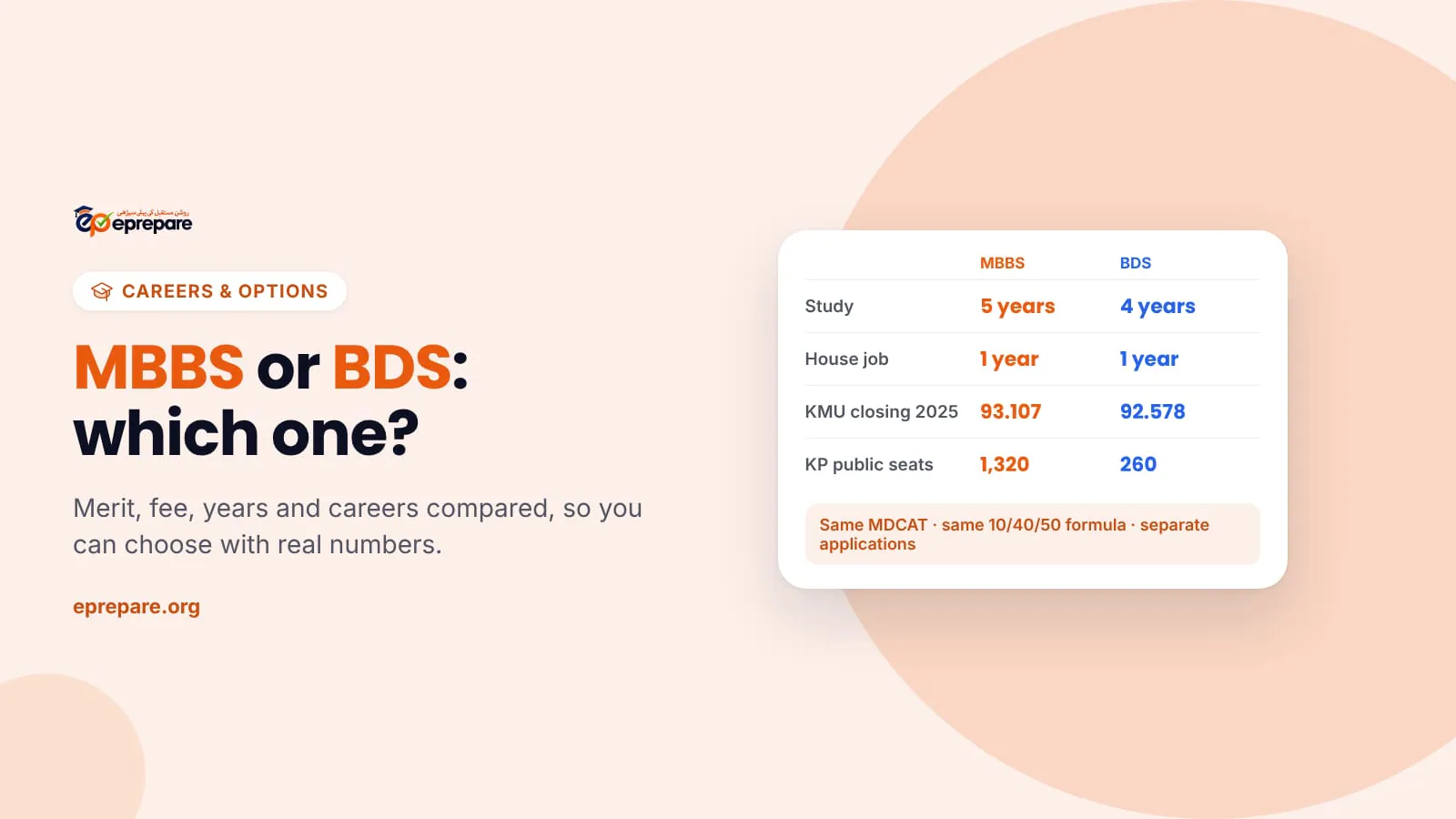
Every year, thousands of students finish the MDCAT with the same question: MBBS or BDS? Some families treat BDS as a "backup" for students who miss MBBS. The numbers say otherwise. In Khyber Pakhtunkhwa the last open-merit BDS seat closes only about half an aggregate point below the last MBBS seat, and there is only about one dental seat for every four to five medical seats. This guide compares the two degrees on what actually decides the choice: length, entry rules, merit, seats, fee, what you study and the careers that follow.
The short answer: MBBS takes 5 years and BDS takes 4 years, each followed by a one-year house job. Both need the same MDCAT, the same 60% in FSc and the same 10/40/50 merit formula, but they are separate applications. In KP, BDS closed at 92.578 against 93.107 for MBBS in 2025, a gap of 1.9 MDCAT marks. Public fees are almost the same; self-finance and private BDS cost less than MBBS. Choose MBBS if you want to treat the whole patient in hospitals and specialise widely; choose BDS if you like precise hands-on work and want a clinic-based career. If you would accept either, apply for both.
MBBS vs BDS at a glance
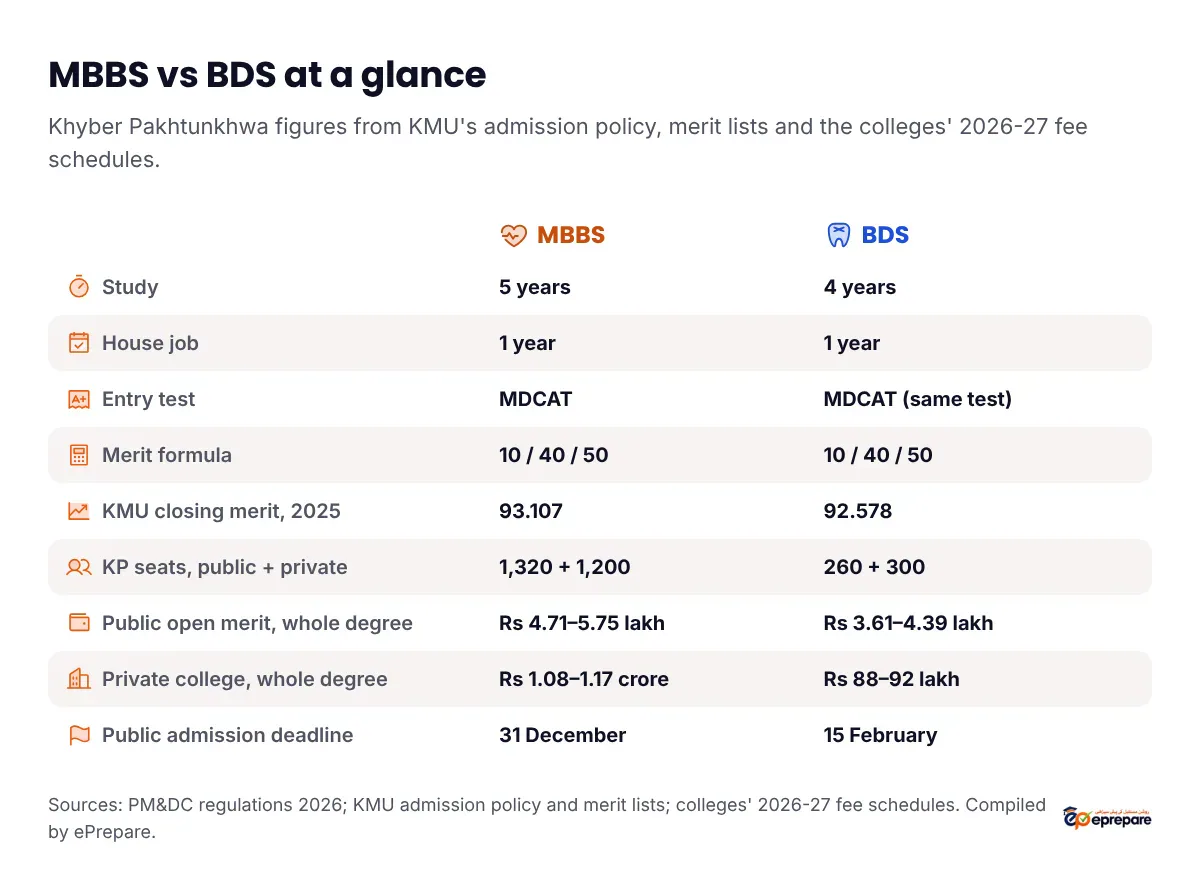
| MBBS | BDS | |
|---|---|---|
| Degree | Bachelor of Medicine, Bachelor of Surgery | Bachelor of Dental Surgery |
| Study | 5 years | 4 years |
| House job | 1 year | 1 year |
| Entry test | MDCAT | MDCAT (the same test) |
| Merit formula | Matric 10%, FSc 40%, MDCAT 50% | Matric 10%, FSc 40%, MDCAT 50% |
| KMU closing merit, 2025 | 93.107 | 92.578 |
| KP public seats (sanctioned) | 1,320 in 9 colleges | 260 in 4 colleges |
| KP private seats | 1,200 | 300 |
| Public open-merit fee, whole degree | Rs 4.71 to 5.75 lakh | Rs 3.61 to 4.39 lakh |
| Private college, whole degree | Rs 1.08 to 1.17 crore | Rs 88 to 92 lakh |
| Public admission deadline | 31 December | 15 February |
The merit, seat and fee figures are for Khyber Pakhtunkhwa, from KMU's admission policy and merit lists and the colleges' own 2026-27 fee schedules. Other provinces differ in the details, but the pattern is the same everywhere: BDS has far fewer seats and closes close to MBBS.
How many years: MBBS 5 + 1, BDS 4 + 1
MBBS is five years of study. BDS is four. After the final professional exam, both graduates do a one-year house job in a PM&DC-recognised teaching hospital. PM&DC's Registration Regulations 2023 require every MBBS and BDS graduate to complete one year of house job, and you must hold a valid provisional registration from PM&DC before the house job starts. Full registration comes after it.
So the total is six years for a doctor and five years for a dentist before you can practise independently, and specialist training comes on top of that for both.
Is BDS now 5 years? No. In July 2026 PM&DC approved a framework to make BDS five years of study. In September 2026 it withdrew that decision and told the Senate Standing Committee on National Health Services that BDS stays at four years of study followed by a one-year house job. The committee asked PM&DC to publish a public notice confirming this, so check pmdc.pk before you rely on any other figure.
Entry rules: the same test, but two separate applications
PM&DC's Admissions, Curriculum and Conduct Policy and Regulations 2026 set one set of rules for both degrees:
- MDCAT: you must pass it. There is no separate dental test.
- FSc: at least 60% in HSSC or an equivalent, with Biology and Chemistry plus Physics or Mathematics.
- Merit: Matric 10%, FSc 40% and MDCAT 50%, in public and private colleges alike. Our aggregate calculator works out the same number for both.
What is different is the application. In KP, KMU runs medical and dental admissions as two separate programmes, and its policy says a student who has not applied to a programme "shall not be entitled to admission to such program". Many students decide on BDS only after the MBBS lists come out, and by then it is too late. If you would accept BDS, apply for it in the same cycle. Our KMU BDS admission guide walks through the dental application.
The deadlines differ too. Under the 2026 regulations, admissions must be completed by 31 December for public medical colleges, 31 January for private medical colleges, 15 February for public dental colleges and 28 February for private dental colleges. Dental lists run later, so a student who misses MBBS in December can still be in the running for BDS.
Merit: BDS closes only a little below MBBS
Our team compiled the last open-merit seat in KP's public colleges from KMU's merit lists for six years. BDS has always closed below MBBS, but never far below.
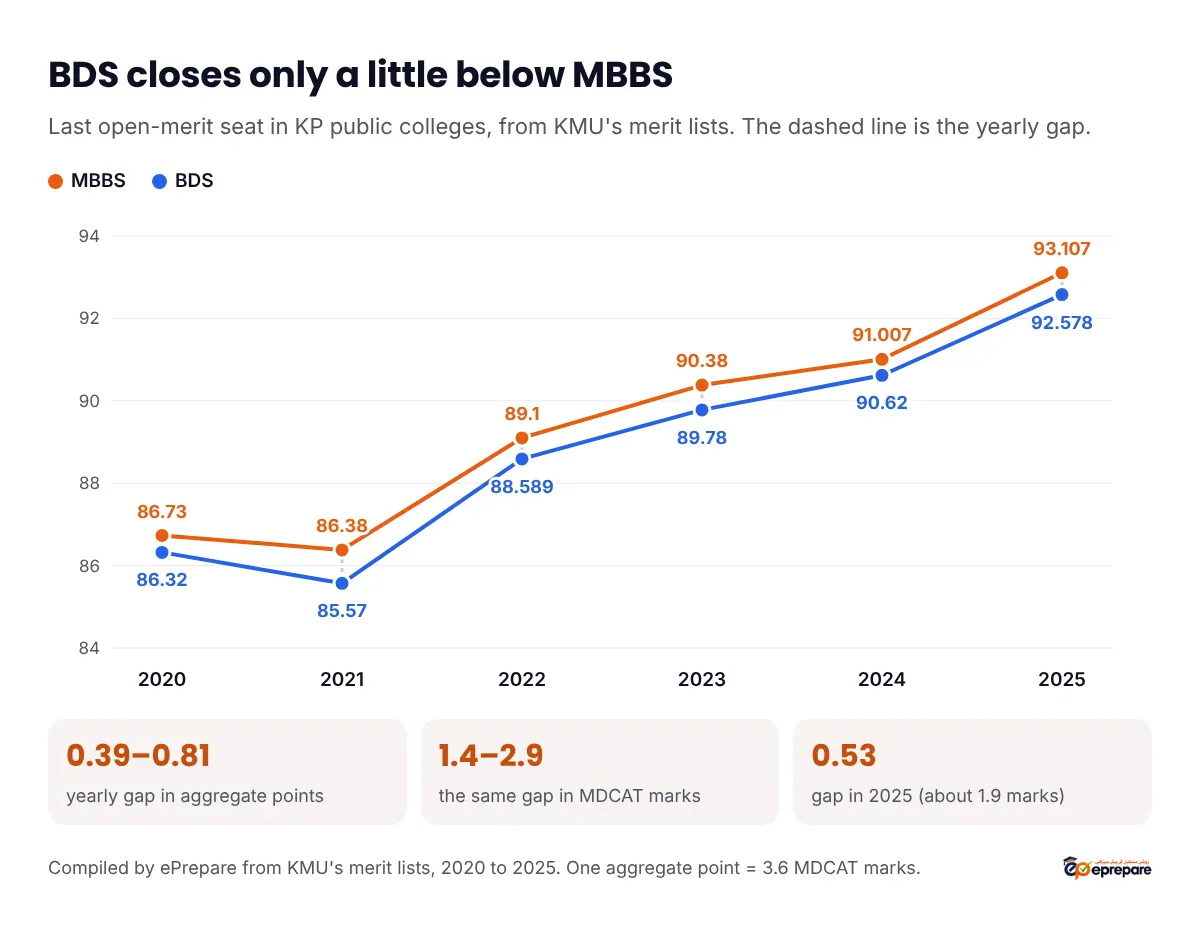
| Year | MBBS closing | BDS closing | Gap | In MDCAT marks |
|---|---|---|---|---|
| 2025 | 93.107 | 92.578 | 0.53 | about 1.9 |
| 2024 | 91.007 | 90.62 | 0.39 | about 1.4 |
| 2023 | 90.38 | 89.78 | 0.60 | about 2.2 |
| 2022 | 89.1 | 88.589 | 0.51 | about 1.8 |
| 2021 | 86.38 | 85.57 | 0.81 | about 2.9 |
| 2020 | 86.73 | 86.32 | 0.41 | about 1.5 |
How we turned the gap into MDCAT marks: MDCAT carries 50% of the aggregate and is out of 180, so one aggregate point equals 180 ÷ 50 = 3.6 MDCAT marks. A gap of 0.53 is 0.53 × 3.6 ≈ 1.9 marks.
Two things follow. First, BDS is not a low-merit option: in 2025 you needed 92.578 for the last public dental seat, which few students reach. Second, if you are within two or three MDCAT marks of the MBBS line, BDS is a realistic seat for you, so list it. See our KMU closing merit trends for college-wise figures, and check where your aggregate fits with the KP college predictor.
Seats: one dental seat for every four to five medical seats
PM&DC has sanctioned 1,320 MBBS seats in KMU's nine public medical colleges and 260 BDS seats in its four public dental colleges. KP's private sector adds 1,200 MBBS and 300 BDS seats across the 15 private colleges in KMU's 2026-27 admission notice. Put together, KP has about 2,520 MBBS seats and 560 BDS seats.
Fewer seats is the main reason BDS merit stays so high. Many strong students apply for both degrees, and the few dental seats fill quickly. Our college-wise seat guide breaks the numbers down by college and quota.
Fee: nearly the same in public colleges, lower for BDS elsewhere
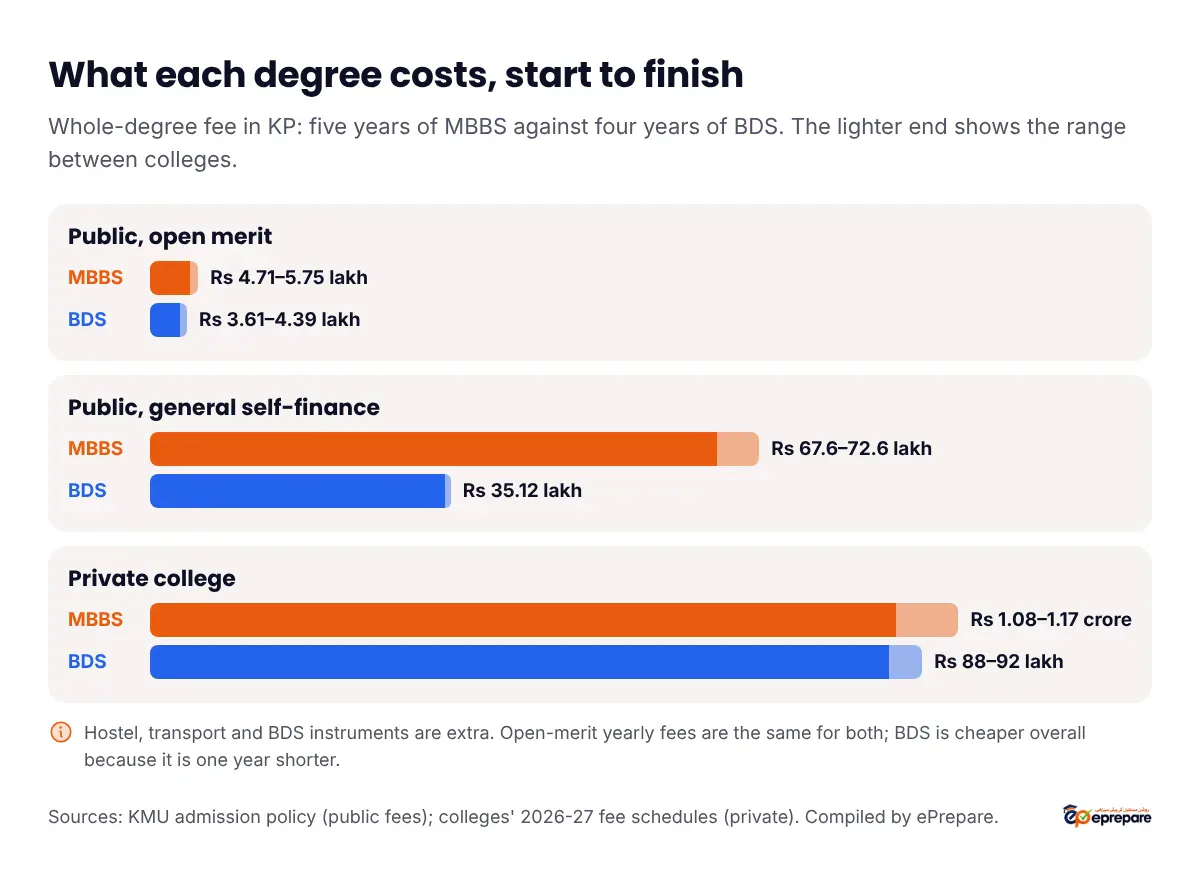
| Seat type (KP) | MBBS, first year | MBBS, whole degree | BDS, first year | BDS, whole degree |
|---|---|---|---|---|
| Public, open merit | Rs 87,000 to 102,000 | Rs 4.71 to 5.75 lakh | Rs 87,000 to 102,000 | Rs 3.61 to 4.39 lakh |
| Public, general self-finance | Rs 11.62 to 12.62 lakh | Rs 67.6 to 72.6 lakh | Rs 8.12 lakh | Rs 35.12 lakh |
| Private college | Rs 20.75 to 21.55 lakh | Rs 1.08 to 1.17 crore | about Rs 20.9 to 21.5 lakh | about Rs 88 to 92 lakh |
On an open-merit public seat the yearly fee is the same, and BDS costs less overall only because it is one year shorter. The real difference is on self-finance seats, where KMU charges BDS students about Rs 32 to 37 lakh less over the degree, and in private colleges, where BDS saves roughly Rs 20 to 25 lakh.
Two costs the tables leave out: hostel and transport, which are the same for both, and dental instruments and materials, which BDS students buy themselves from the early years. Ask seniors at the college for a realistic yearly figure before you decide. Full details are in our KMU fee guide and our private college fee guide.
What you study and what the work is like
Both degrees begin with the basic medical sciences: anatomy, physiology and biochemistry. After that they separate.
- MBBS covers the whole body and every branch of medicine: pathology, pharmacology, community medicine, then medicine, surgery, paediatrics, gynaecology and obstetrics, eye, ENT and more, with long clinical rotations in hospital wards.
- BDS turns to the mouth, teeth and jaws early: dental materials, oral biology, oral pathology, then operative dentistry, prosthodontics, orthodontics, periodontology and oral and maxillofacial surgery. Much of the training is fine hands-on work on models and then on patients.
The day-to-day work differs too. Hospital medicine means wards, emergencies and night duties, especially during the house job and specialist training. Most dental work is planned outpatient treatment in a clinic, with precise procedures done with your hands. Neither is "easier"; they suit different people.
Careers after MBBS and after BDS
| After MBBS | After BDS | |
|---|---|---|
| First step | House job, then PM&DC full registration | House job, then PM&DC full registration |
| Government job | Medical officer (BPS-17) | Dental surgeon (BPS-17) |
| Private work | Hospitals, clinics, general practice | Own dental clinic, private hospitals and dental practices |
| Specialising | FCPS from CPSP, or MS/MD from universities, in medicine, surgery and their branches | FCPS from CPSP, or MDS from universities, in dental specialties such as orthodontics, prosthodontics and oral surgery |
| Working abroad | The country's own licensing exam (for example PLAB in the UK) | The country's own dental exam (for example the ORE in the UK) |
MBBS opens far more specialties, from cardiology to psychiatry, and doctors are needed in every hospital and district. BDS leads to a narrower field, but a dentist can set up a private clinic soon after registration, and the work stays clinic-based with fewer night duties. In both cases, income depends far more on specialisation, city and years of experience than on the degree name, so be wary of anyone who quotes a single "salary" for either.
Which should you choose?
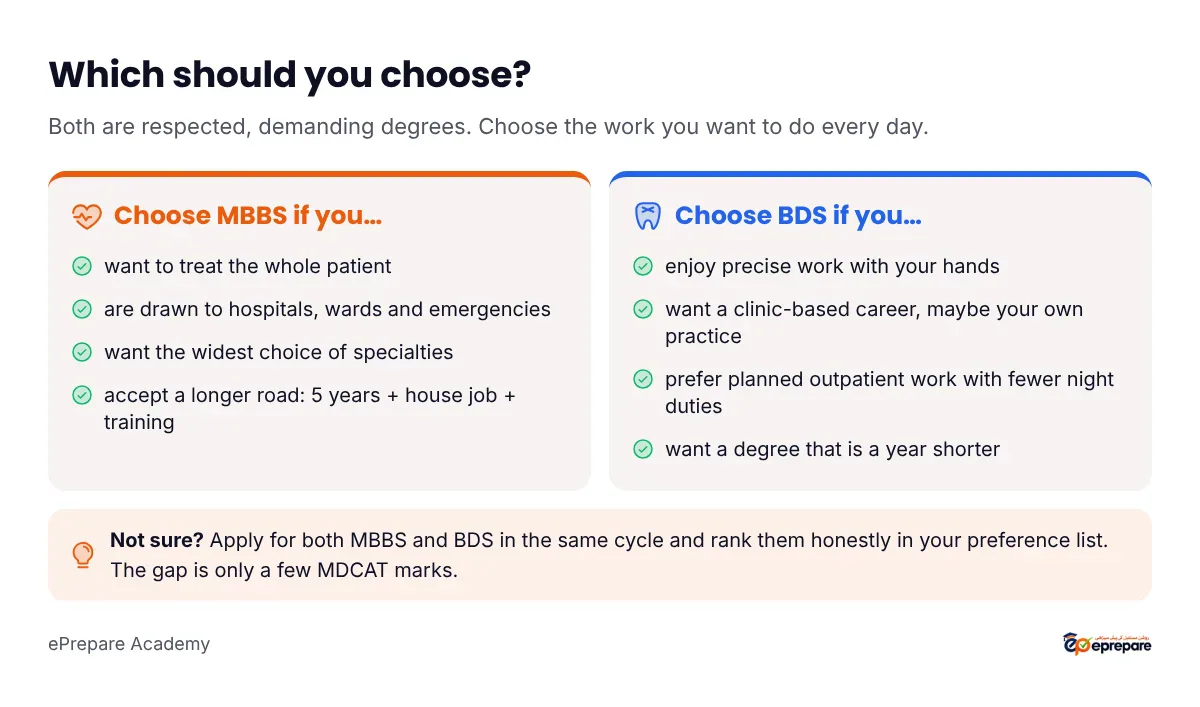
MBBS suits you if you want to treat the whole patient, are drawn to hospital work and emergencies, and want the widest choice of specialties later. Be ready for a longer road: five years, a house job and usually four to five more years of training.
BDS suits you if you enjoy detailed hand skills, want to run your own practice one day, and prefer planned clinic work. It is a year shorter and cheaper on self-finance and private seats.
If you are not sure, do these four things:
- Calculate your aggregate and compare it with last year's MBBS and BDS closings.
- Apply for both MBBS and BDS, and for self-finance if your family can afford it.
- Rank colleges honestly in your preference list. KMU gives seats on merit and your own choice, and upgrades in later lists follow that list. Our merit list and upgrade guide explains how.
- Talk to a house officer and a dentist about their actual week before you decide.
A common mistake: picking a self-finance MBBS seat over an open-merit BDS seat without doing the sums. In KP that choice can cost about Rs 63 to 69 lakh more over the degree. Our self-finance vs open merit guide helps you compare.
If you miss both, you still have options, from reattempting the MDCAT to allied health degrees. See what to do if you are not selected and which degrees need the MDCAT.
Frequently asked questions
Is BDS 4 years or 5 years in Pakistan?
Four years of study plus a one-year house job. PM&DC approved a five-year framework in July 2026 but withdrew it in September 2026, confirming four years of study and one year of house job.
Is BDS merit lower than MBBS merit?
Only slightly. In KP the last open-merit BDS seat closed between 0.39 and 0.81 aggregate points below MBBS from 2020 to 2025, which is about 1.4 to 2.9 MDCAT marks. In 2025 BDS closed at 92.578 and MBBS at 93.107.
Is the MDCAT the same for MBBS and BDS?
Yes. There is one MDCAT for both, with the same eligibility (at least 60% in FSc) and the same merit formula: Matric 10%, FSc 40% and MDCAT 50%.
Do I need a separate application for BDS?
Yes, in KP. KMU runs medical and dental admissions separately, and you cannot be offered a BDS seat if you did not apply for BDS. Check your own university's rules in other provinces.
Is BDS cheaper than MBBS?
On a public open-merit seat the yearly fee is the same, so BDS costs less only because it is one year shorter. On KMU's self-finance seats, BDS costs Rs 35.12 lakh against Rs 67.6 to 72.6 lakh for MBBS, and in KP's private colleges about Rs 88 to 92 lakh against Rs 1.08 to 1.17 crore.
Which has more seats, MBBS or BDS?
MBBS, by far. KP has 1,320 public and 1,200 private MBBS seats, against 260 public and 300 private BDS seats.
Can a BDS graduate get a government job?
Yes. After the house job and PM&DC registration, dentists can apply for dental surgeon posts (BPS-17) through the provincial public service commission and health department, alongside private practice.
Whichever degree you choose, it starts with your MDCAT score, and two or three marks can decide between them. ePrepare's question bank, full-length papers and study plan are built for exactly that. Start preparing with ePrepare, and use our aggregate calculator to see where you stand today.
Sources: PM&DC, Admissions, Curriculum and Conduct Policy and Regulations 2026, as reported by The Nation (APP), 27 October 2026; PM&DC Registration Regulations 2023; ARY News, PMDC rolls back five-year BDS programme, 15 September 2026; Dental Tribune Pakistan, 11 July 2026; KMU admission policy and merit lists on the KMU admission portal; KMU's private-sector admission notice on caspr.kmu.edu.pk; PM&DC's list of recognised private colleges; the colleges' own 2026-27 fee schedules, compiled in our linked guides.