

You have decided to prepare for MDCAT. You open your books, scroll through a few videos, and an hour later you are still not sure where to begin. That first-day confusion is normal, and it wastes more time than any hard chapter. This guide removes it. It tells you exactly what to do on day one, day two and every day of your first two weeks, step by step, using ePrepare's tools so you never have to wonder what comes next.
The short answer: on day one, understand the paper and read the official syllabus. On day two, take a short baseline test in each subject and build a day-by-day study plan to your exam date. From day three, study one chapter at a time in the same loop: lecture, then conceptual notes, then Bookline and topic MCQs, then your wrong MCQs. Take a timed test every seventh day, check your progress report every week, and start full-length papers as you finish each stage of the syllabus.
Before you start: what you need
- Your FSc textbooks (first and second year). MDCAT is built on the FSc syllabus.
- A phone or laptop with ePrepare, and a notebook for formulas and points you keep forgetting.
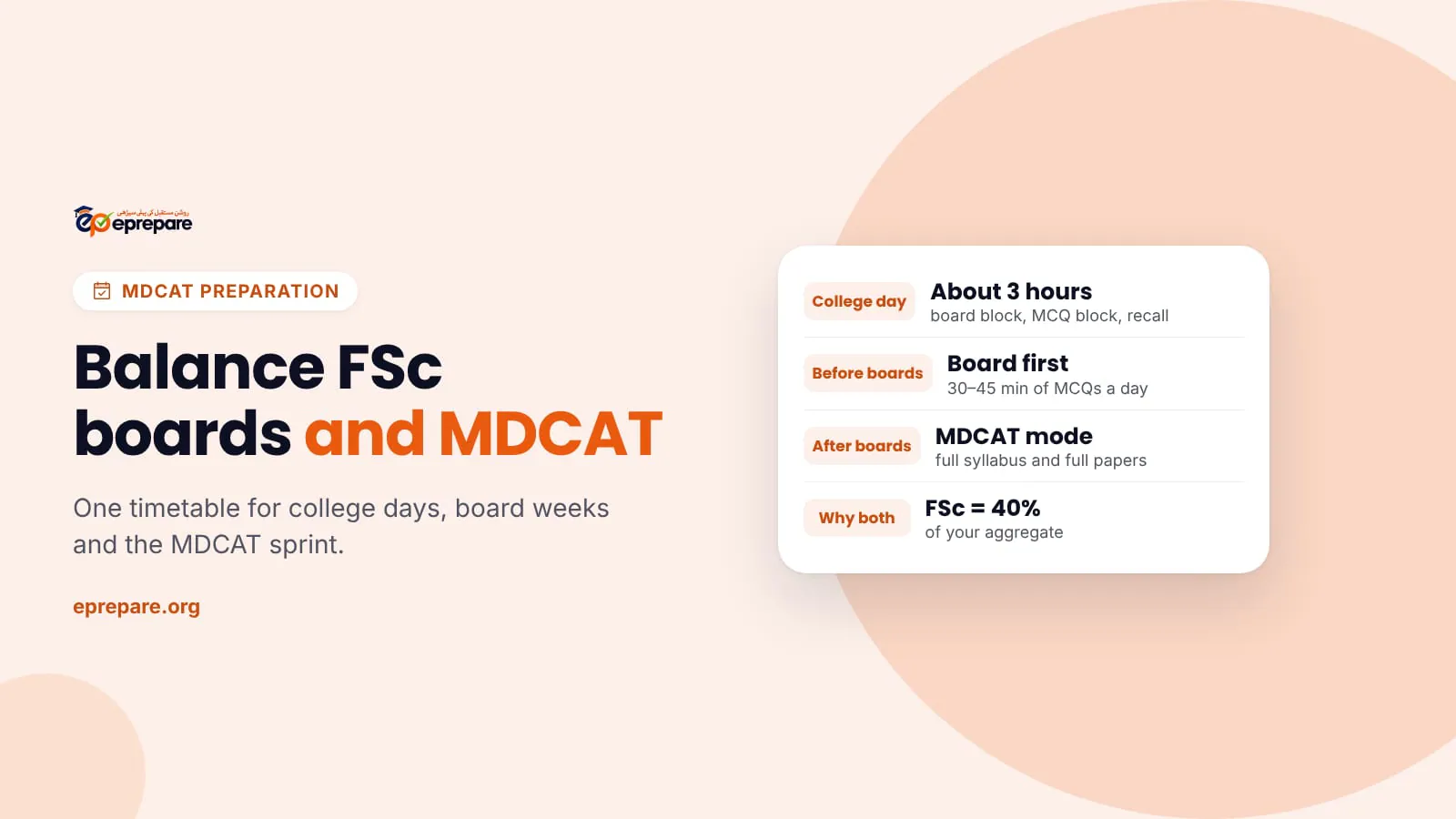
- A fixed daily slot. Decide your hours honestly: around 3–4 hours a day if you are still in college, more in a full-time year. Three real hours beat eight imaginary ones.
- A target score. Not "as high as possible", but a number. Put your Matric and FSc marks into the merit calculator to see what MDCAT score the college you want needs.
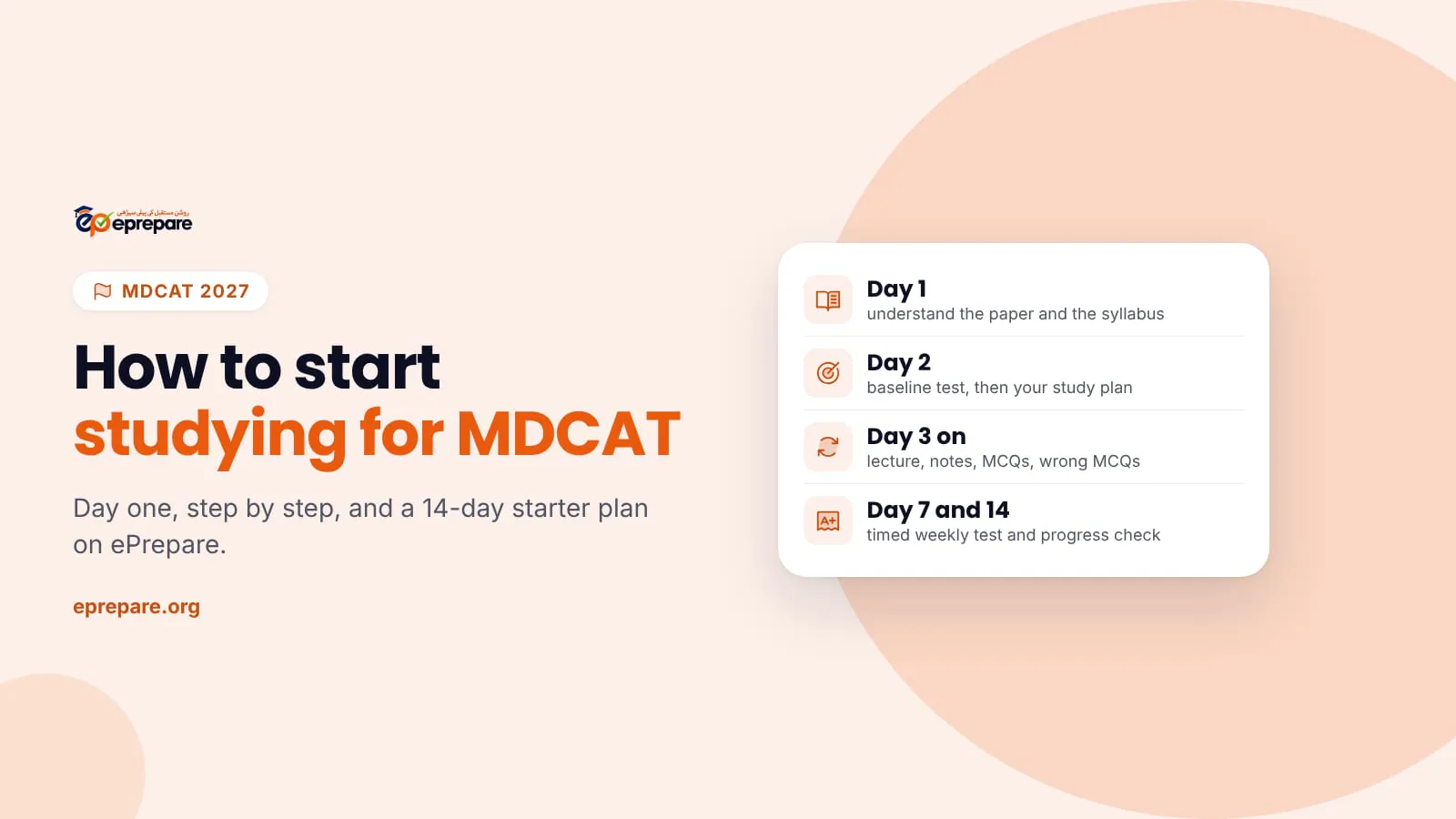
Your first 14 days at a glance
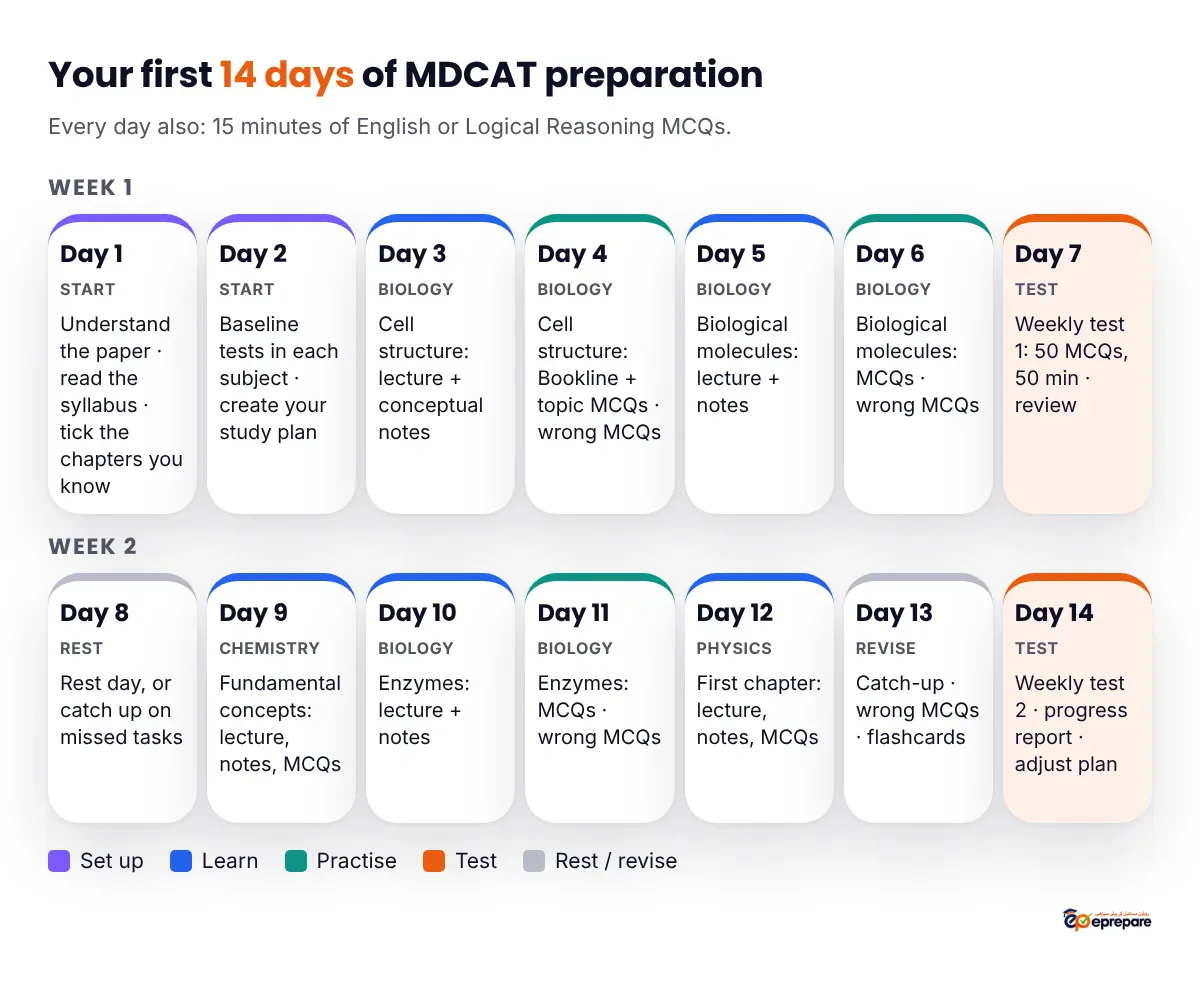
| Day | What you do | Where on ePrepare |
|---|---|---|
| 1 | Understand the paper; read the syllabus; tick chapters you already know | Syllabus page |
| 2 | Baseline tests in each subject; create your study plan | Question bank, Quiz Builder, Study plan |
| 3 | Biology, Cell structure and function: lecture and notes | Lectures, Conceptual notes |
| 4 | Cell structure: Bookline and topic MCQs; wrong MCQs | Bookline MCQs, Question bank, Wrong MCQs |
| 5 | Biology, Biological molecules: lecture and notes | Lectures, Conceptual notes |
| 6 | Biological molecules: MCQs; wrong MCQs | Bookline MCQs, Question bank, Wrong MCQs |
| 7 | Weekly test 1 (50 MCQs, 50 minutes) and review | Quiz Builder or chapter tests |
| 8 | Rest, or catch up on anything missed | Reschedule missed |
| 9 | Chemistry, Fundamental concepts: lecture, notes, MCQs | Lectures, Notes, Question bank |
| 10 | Biology, Enzymes: lecture and notes | Lectures, Conceptual notes |
| 11 | Enzymes: MCQs; wrong MCQs | Bookline MCQs, Question bank, Wrong MCQs |
| 12 | Physics, your first chapter: lecture, notes, MCQs | Lectures, Notes, Question bank |
| 13 | Catch-up; revise the fortnight's wrong MCQs and flashcards | Smart revision, Flashcards |
| 14 | Weekly test 2; progress review; adjust your plan | Quiz Builder, Progress report, Syllabus map |
Every day, add about 15 minutes of English or Logical Reasoning MCQs. They are only 9 questions each in the paper, but a little daily practice makes them easy marks. The steps below explain each part of this timetable.
Step 1 (day 1): Understand the paper
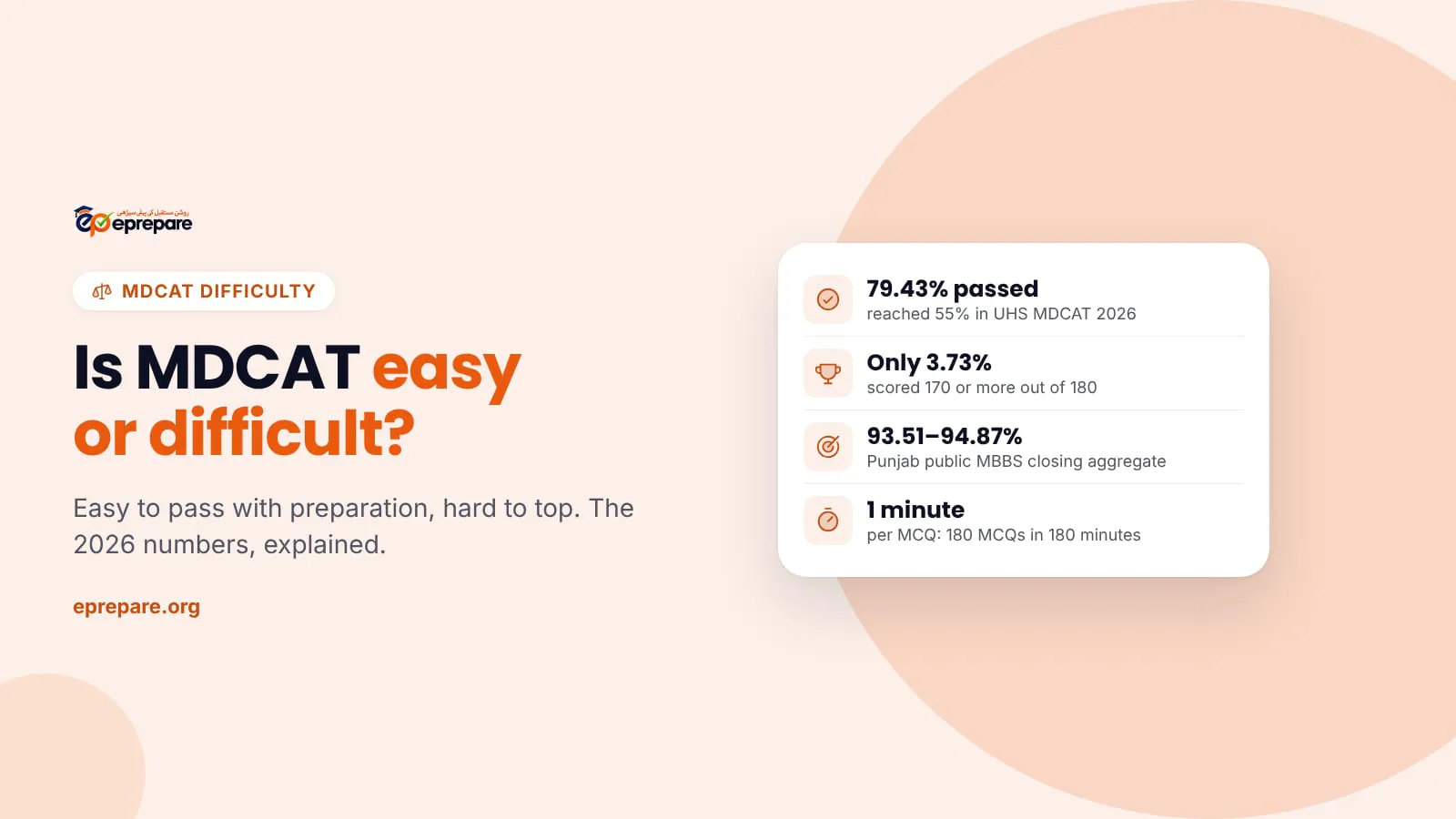
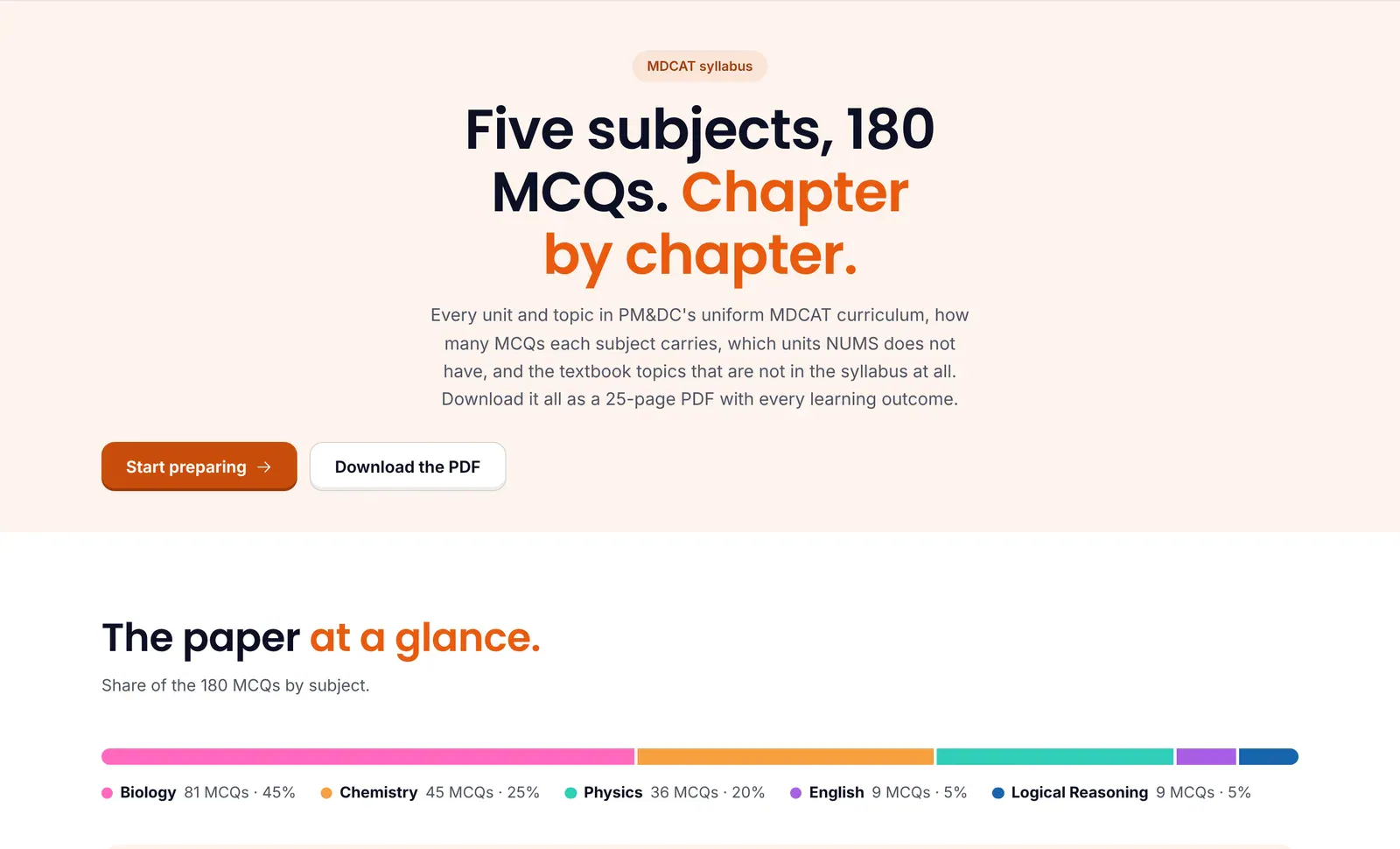
You cannot prepare well for a test you have not looked at. Spend the first hour of day one on the basics: 180 MCQs in 3 hours, no negative marking, Biology 81, Chemistry 45, Physics 36, English 9 and Logical Reasoning 9, with a pass mark of 99 for MBBS and 90 for BDS. That split tells you where your time should go: nearly half of it to Biology. Read what is MDCAT for the full picture, and is MDCAT easy or difficult for what different scores really mean.
Step 2 (day 1): Download and read the syllabus
Open the MDCAT syllabus page and download the PDF. It lists every unit, topic and learning outcome in PM&DC's uniform curriculum, and the textbook topics that are not in MDCAT at all, so you do not waste time on them. With a pen, tick the chapters you studied well in FSc and circle the ones you have never studied or found hard. This 30-minute exercise is the base of your plan.
Step 3 (day 2): Take a baseline test
Before you plan, find out where you stand. Take a short test in each subject on topics you have already covered in FSc: about 20 MCQs each in Biology, Chemistry and Physics, and 10 in English and Logical Reasoning. In ePrepare, open the question bank, choose a chapter for a chapter test (or tick a few topics for a custom test), or use the Quiz Builder to mix chapters in one timed test.
- Do not worry about the score. A low first score is normal, especially if you have not finished second year. The point is a starting line.
- Read every explanation for the MCQs you miss, in English or Urdu. Each wrong answer is saved automatically for later revision.
- Note your weakest subject. You will give it a fixed daily slot.
Your attempts also start your predicted MDCAT score, which gets more accurate as you practise. See how the predicted score works.
Step 4 (day 2): Make your study plan
Now build the plan you will follow every day. Open Study plan, choose "Until my exam" (or a length such as 100 or 150 days), set your daily hours, keep all five subjects on, and pick a study order: "Subject by subject" starts with Biology and finishes one subject before the next; "One subject a day" rotates subjects. Choose whether chapters start with lectures, keep MCQs, past papers, revision and weekly tests switched on, pick one rest day, check the summary and press Create my plan.
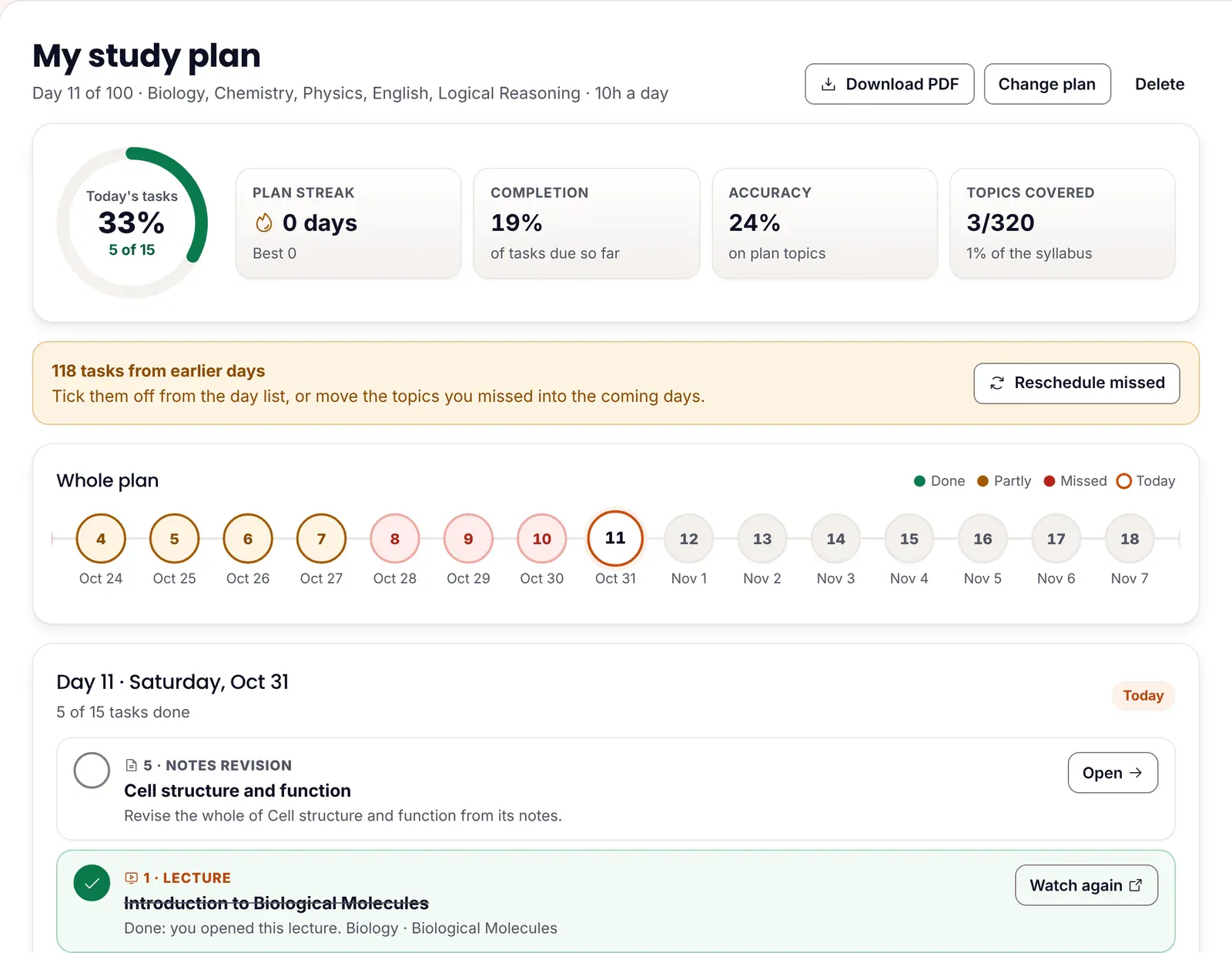
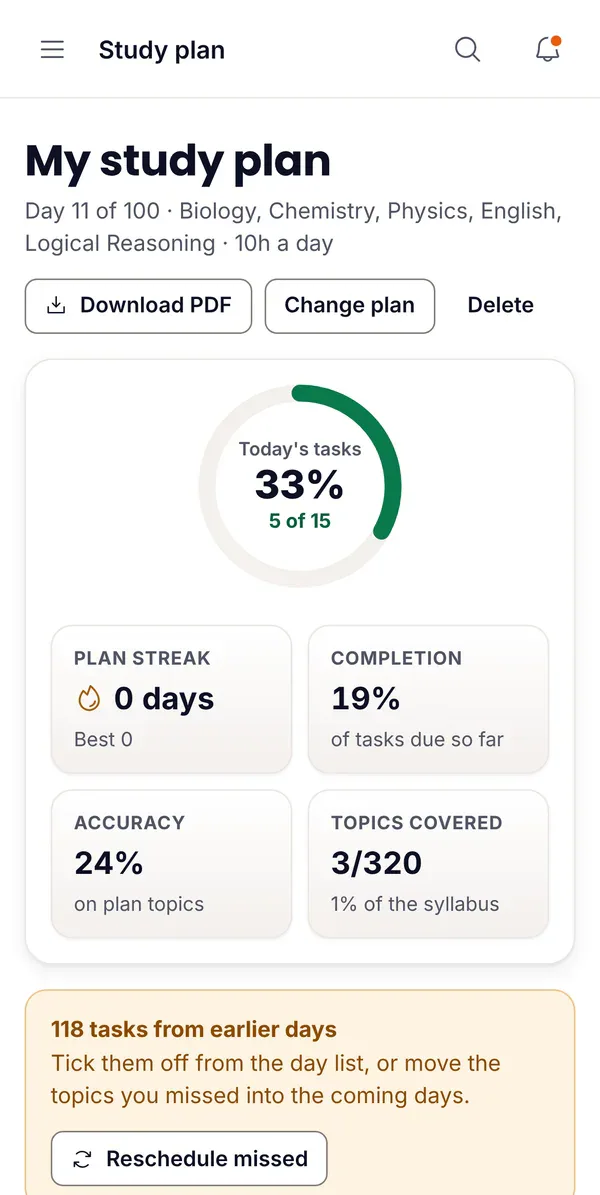
From now on, every morning starts the same way: open the plan and do the tasks under today's date. MCQ tasks tick themselves as you answer, and lectures tick when you open them. If you miss days, press Reschedule missed and the topics you skipped move into the coming days. The plan works the same on your phone. The full walkthrough is in how to make your MDCAT study plan on ePrepare.
Step 5 (day 3 onwards): Your first chapter, in four moves
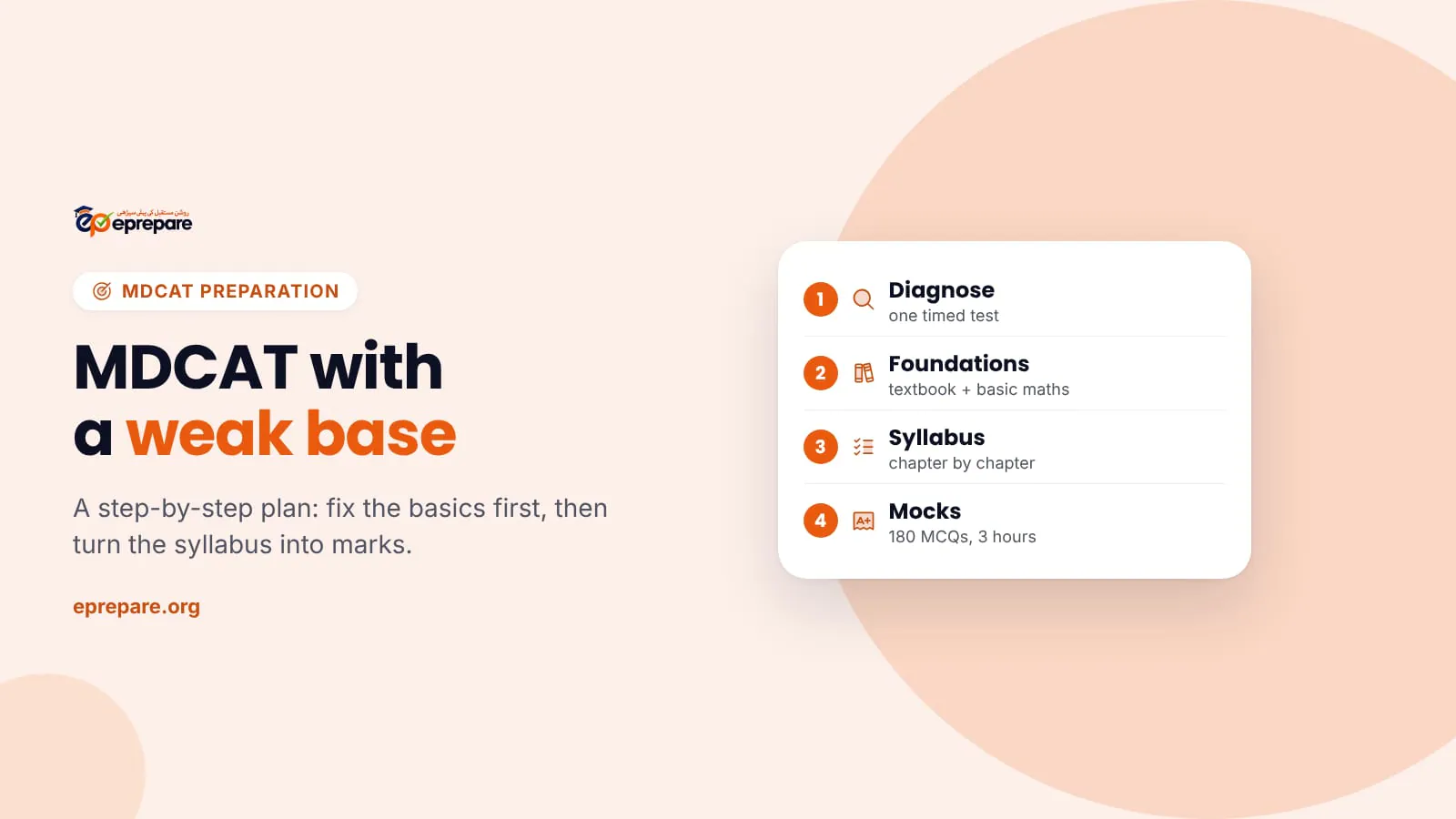
This is the routine you will repeat for every chapter until the syllabus is done. Most students begin with Biology's first chapter, Cell structure and function, because Biology carries the most marks and this chapter is the base for the rest. Here is the loop, with a rough split for a 4-hour day:
| Move | What you do | Time (4-hour day) |
|---|---|---|
| 1. Lecture | Watch the chapter's lectures once, without pausing every minute | 45–60 min |
| 2. Conceptual notes | Read the lesson, highlight key points, use the Urdu boxes where stuck | 30–45 min |
| 3. MCQs | Bookline MCQs, then topic MCQs from the question bank | 60–90 min |
| 4. Wrong MCQs | Read every explanation; retry the ones you missed | 20–30 min |
Move 1: Watch the lecture
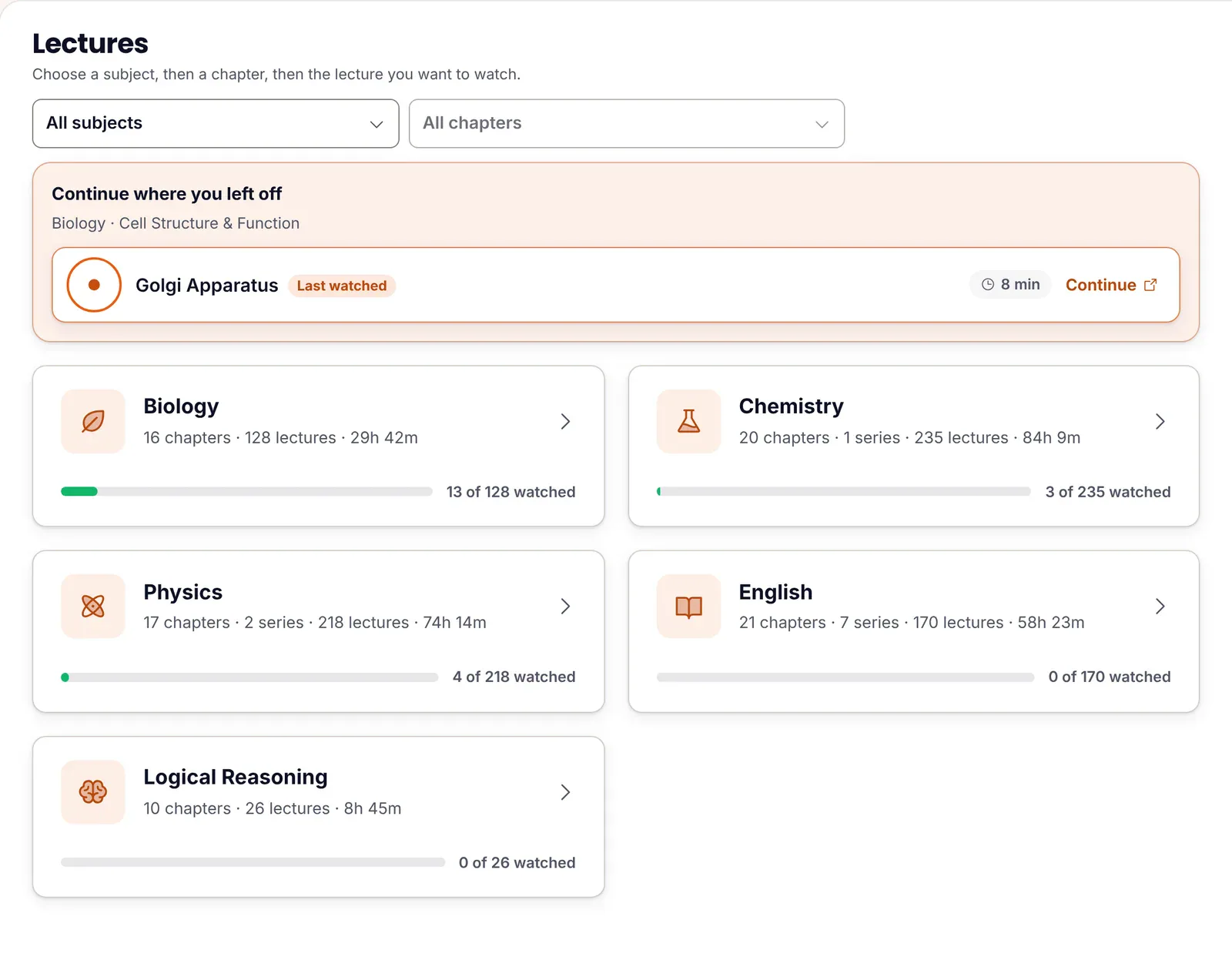
Open Lectures, choose Biology and the chapter. The library has 777 lectures across all five subjects, and it remembers where you stopped, so you can continue in one tap. Watch to understand, not to copy every word; your notes come next. (Lectures are in the Plus, Pro and Advance packages; on Basic, start each chapter by reading it from your textbook.)
Move 2: Read the conceptual notes
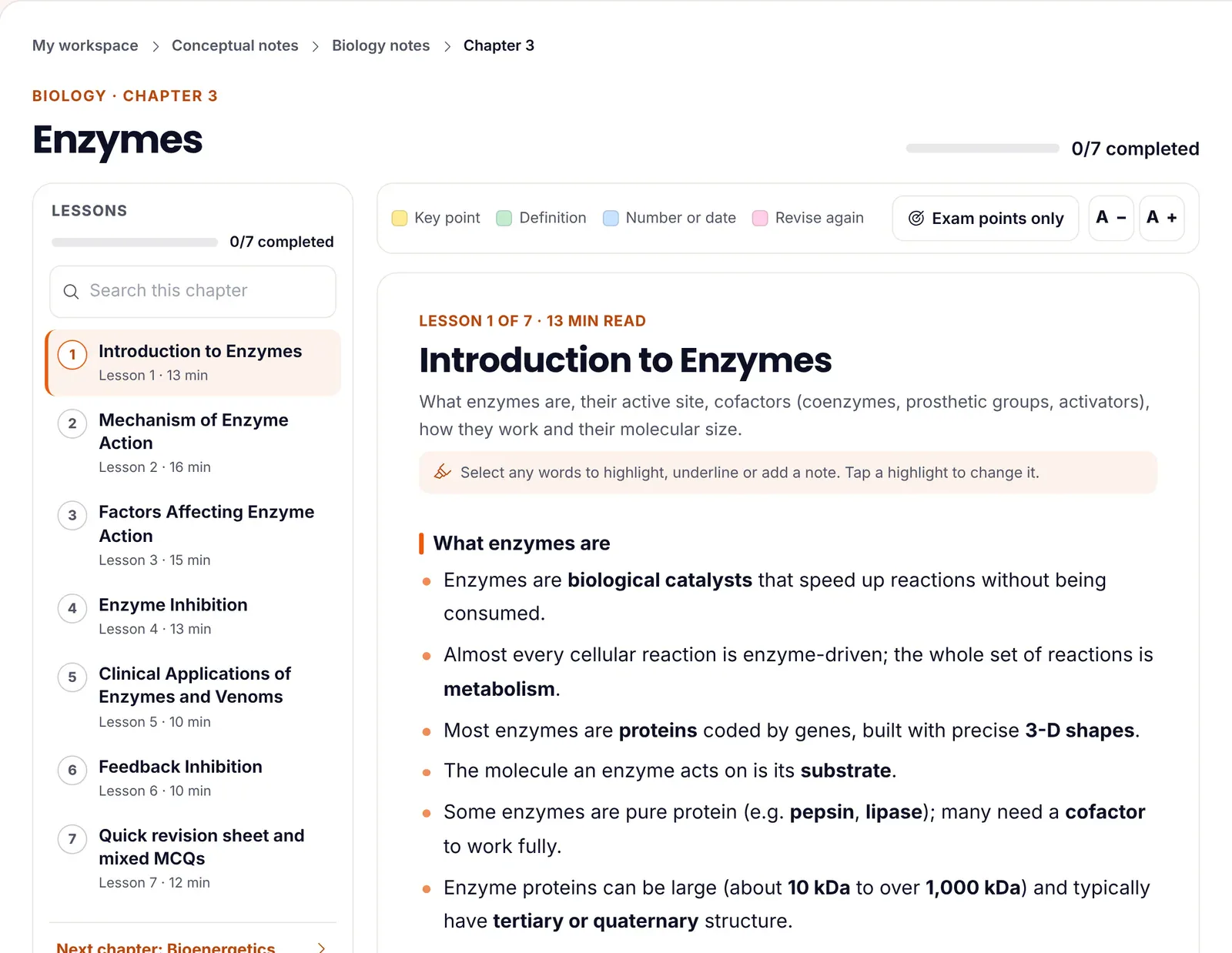
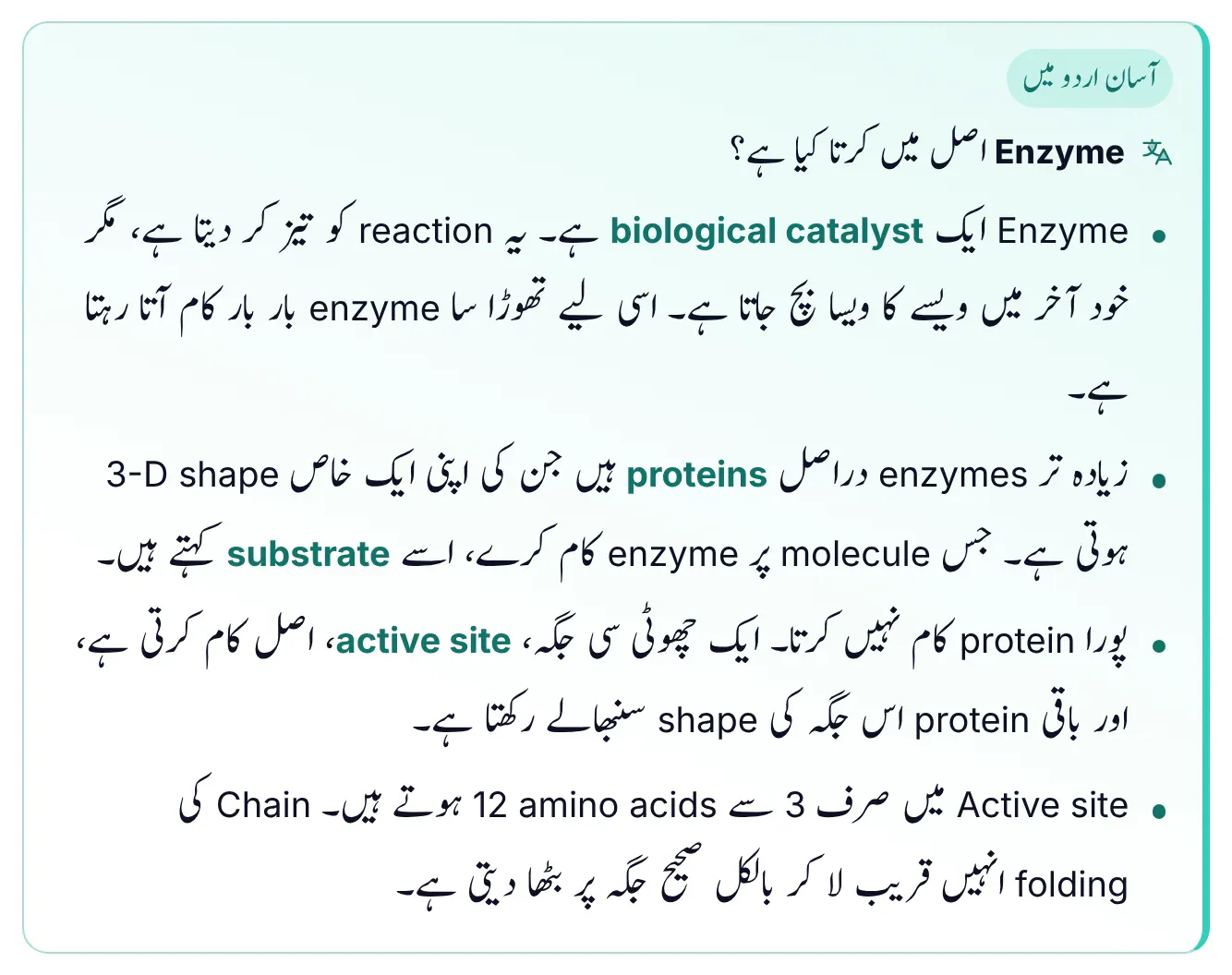
Next, open the same chapter in Conceptual notes. Each lesson shows how long it takes to read, and you can highlight words as a key point, definition, number or date, or "revise again". Where a concept does not click in English, read the easy-Urdu box beside it; the science terms stay in English, so you still learn the words the exam uses. When you revise later, the "Exam points only" switch shows just the high-yield lines.
Move 3: Practise Bookline and topic MCQs
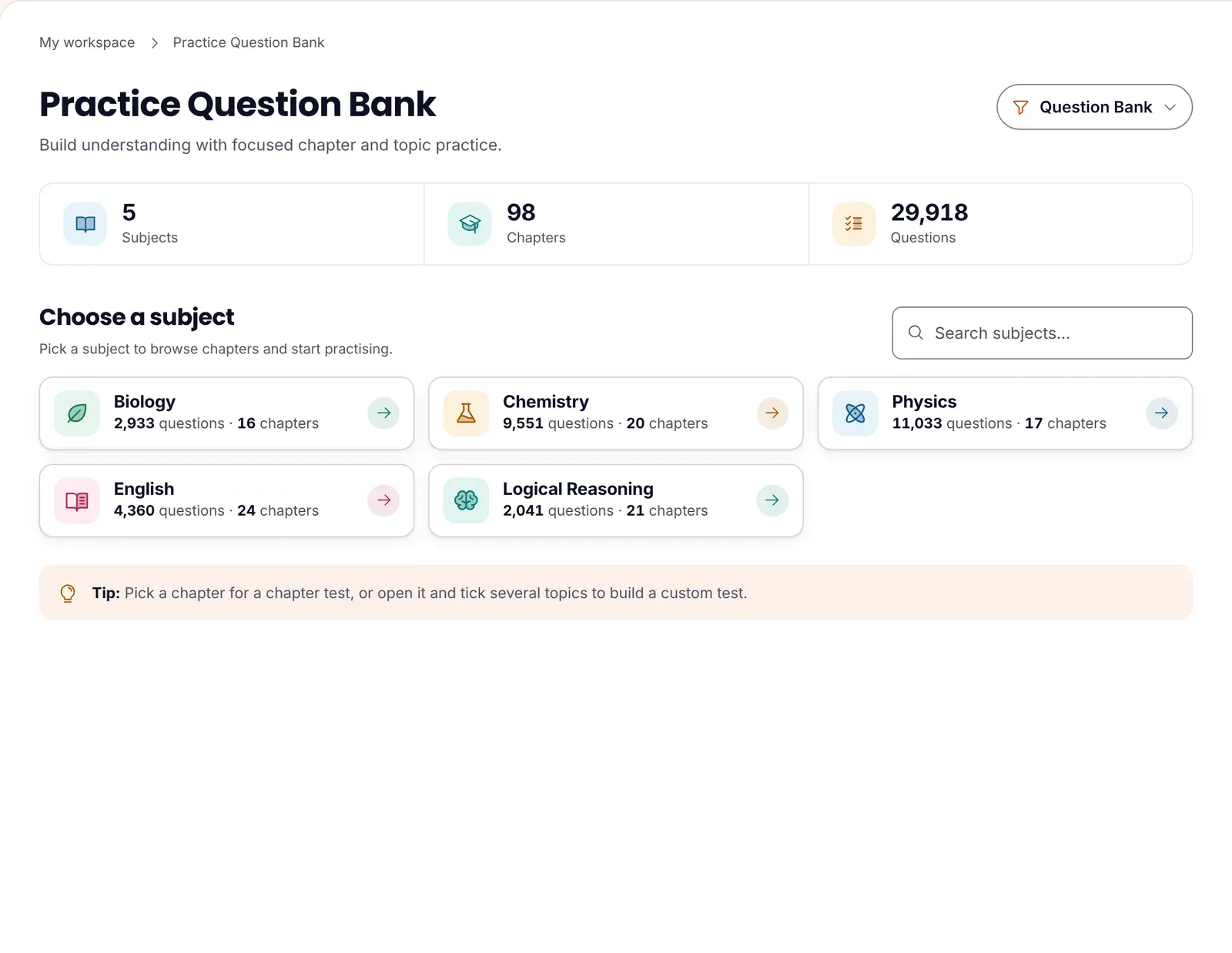
Now test what you learned, on the same day. Start with Bookline MCQs, which turn the textbook into MCQs line by line, so you catch every fact the paper can pick. Then take topic MCQs from the question bank (29,918 questions across 98 chapters), which test the concepts in different ways. Aim for roughly one minute per MCQ, the same pace as the real exam. Read how to use Bookline MCQs.
Move 4: Clear your wrong MCQs
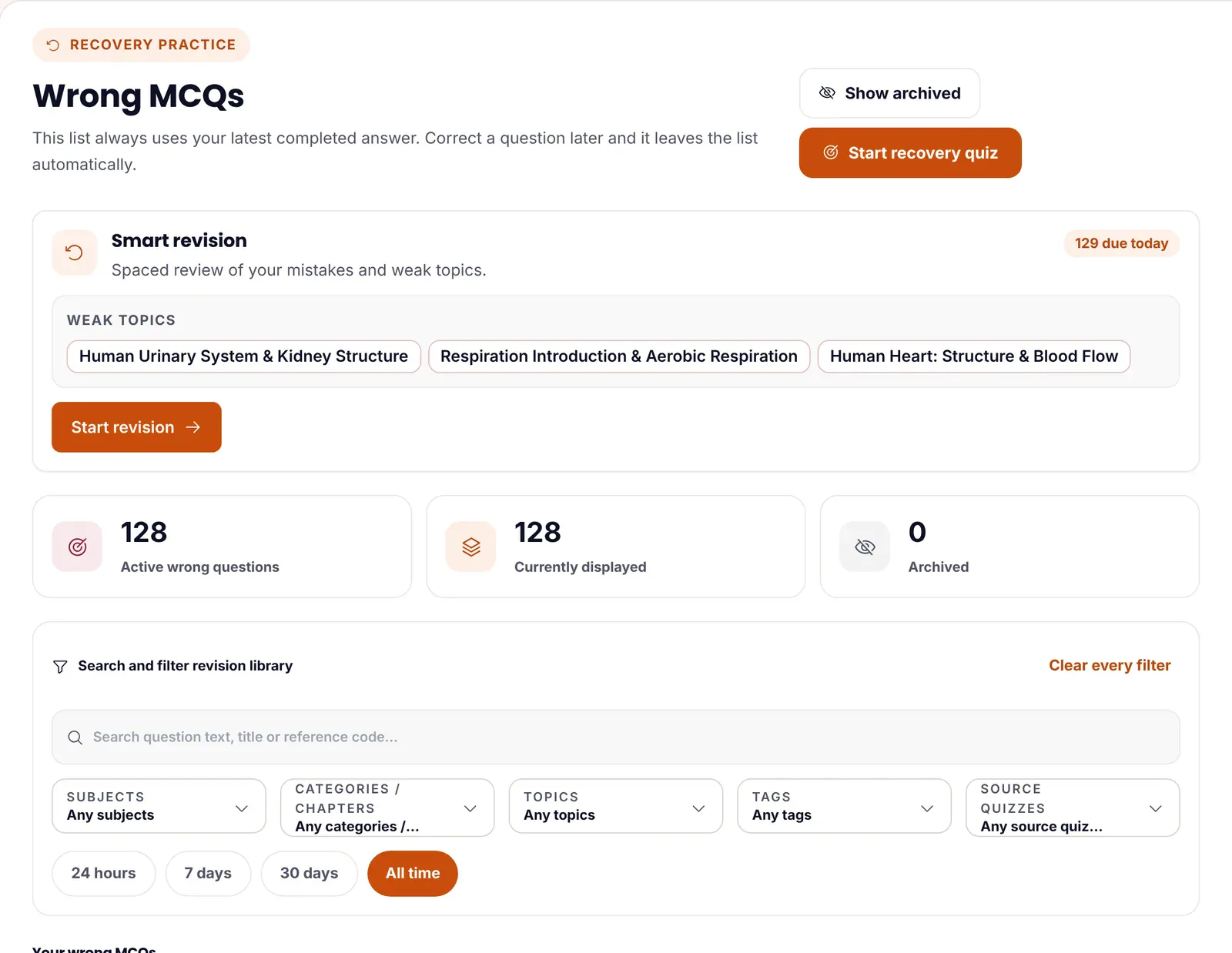
Finish the day in Wrong MCQs. Every question you missed is already there. Read each explanation, tag why you missed it (did not know it, misread it, or confused two terms), and retry. Smart revision brings your mistakes and weak topics back on a spaced schedule, and a question leaves the list once you answer it correctly.
Remember this: never end a study day on a lecture. A chapter is only "done" when you have practised its MCQs and cleared your wrong answers.
Step 6 (day 7 and day 14): Take a weekly test
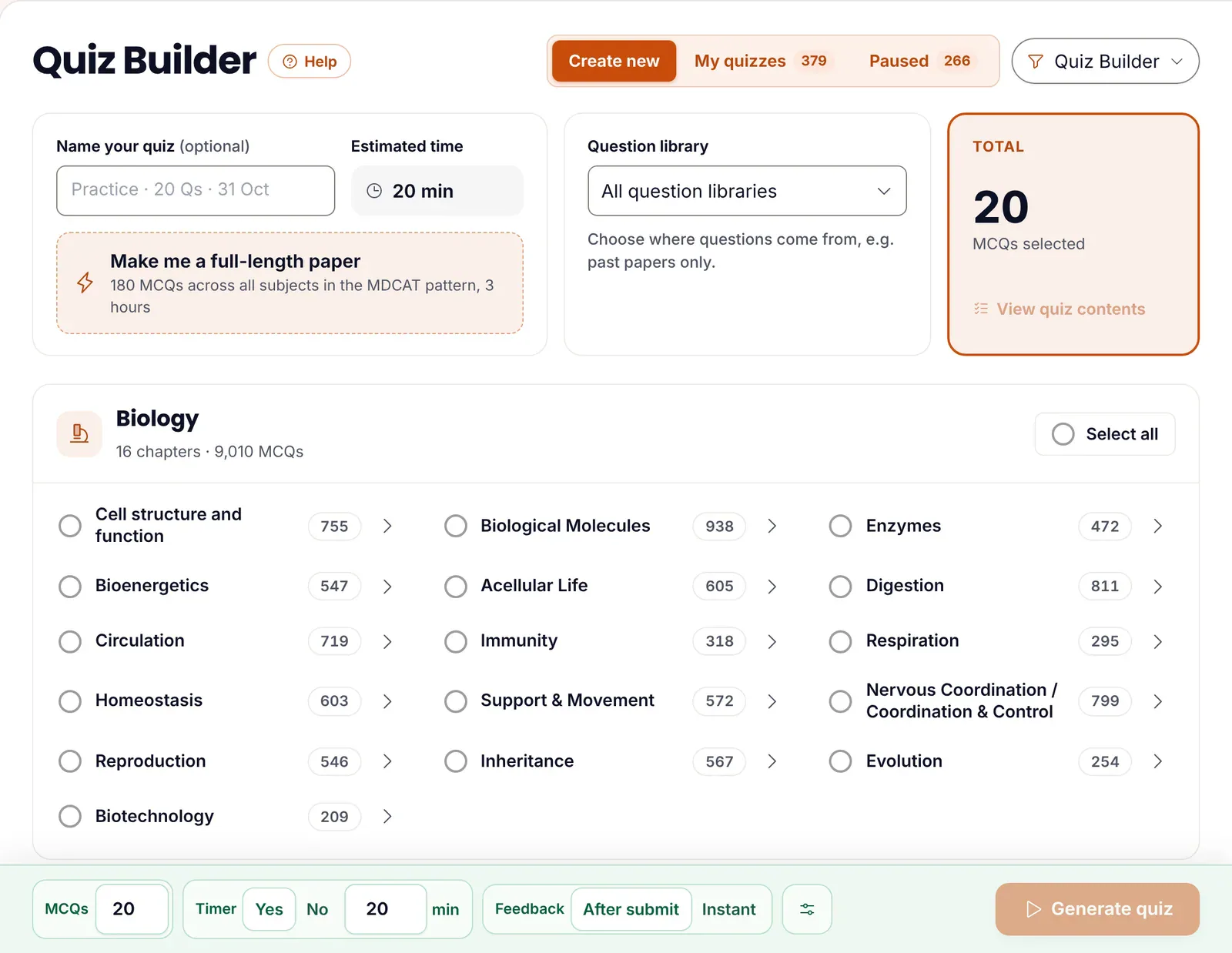
Every seventh study day, test the whole week together. Your study plan schedules a weekly test automatically. If you have the Quiz Builder (Pro and Advance), build one yourself: tick the chapters and topics you covered, set 50 MCQs with a 50-minute timer, choose feedback after submit, and attempt it in one sitting like the real exam. On other packages, take a chapter test from the question bank or past papers for each chapter you covered.
After the test, spend as long reviewing as you spent attempting. Which subject lost the most marks? Was it knowledge or time? That answer shapes next week.
Step 7 (every week): Track your progress
Once a week, after your test, open two pages:
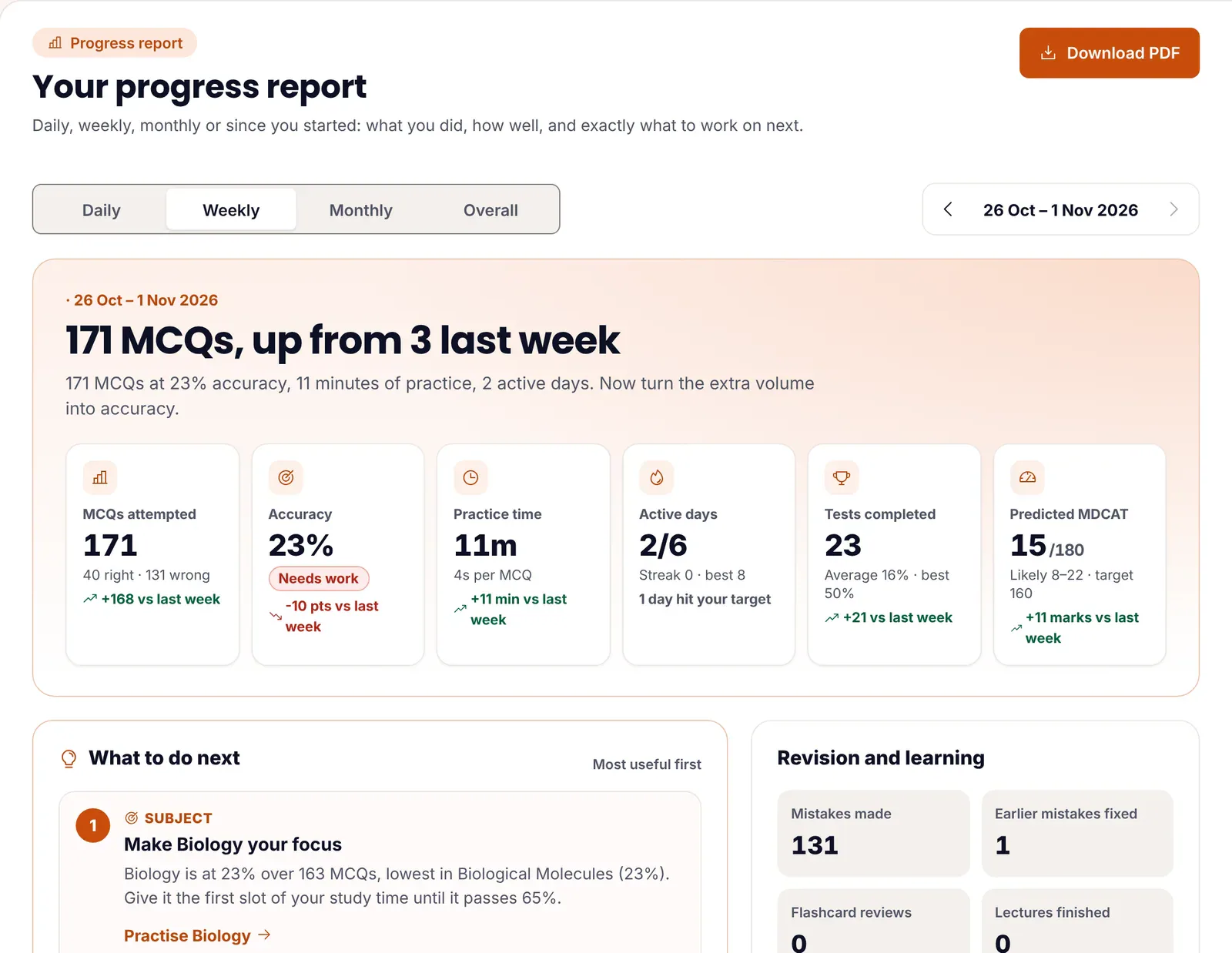
- Progress report. Switch to Weekly. It shows MCQs attempted, accuracy, practice time, active days, tests completed and your predicted MDCAT score, compared with last week, then a "What to do next" list in order of usefulness. You can download it as a PDF.
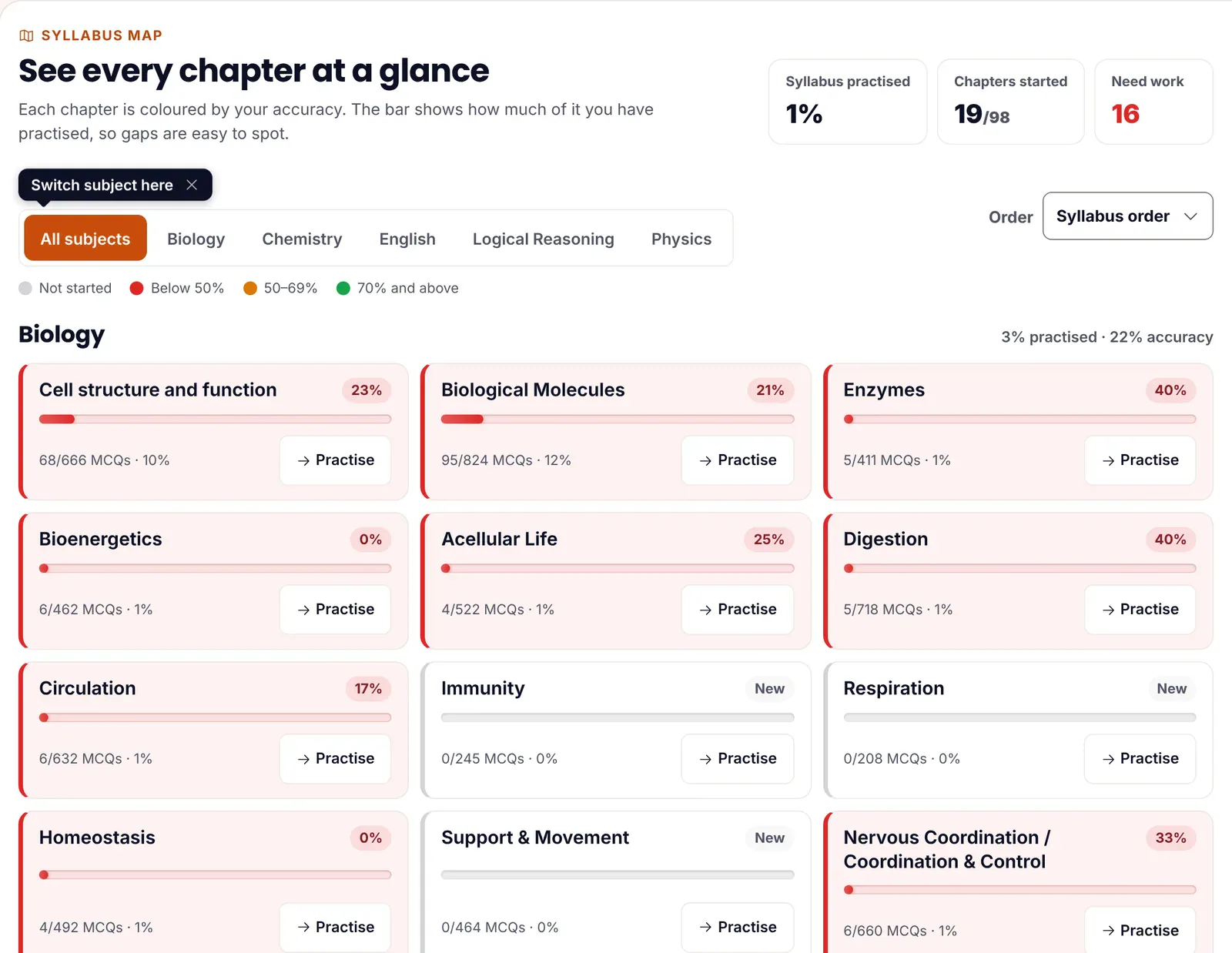
- Syllabus map. Every chapter is coloured by your accuracy: grey not started, red below 50%, amber 50–69%, green 70% and above. Your goal for the year is to turn the whole map green.
If you keep falling behind the plan, do not force it: press Change plan and give it more days or fewer daily hours. A plan you can keep beats a perfect plan you abandon.
Step 8: When to start full-length papers
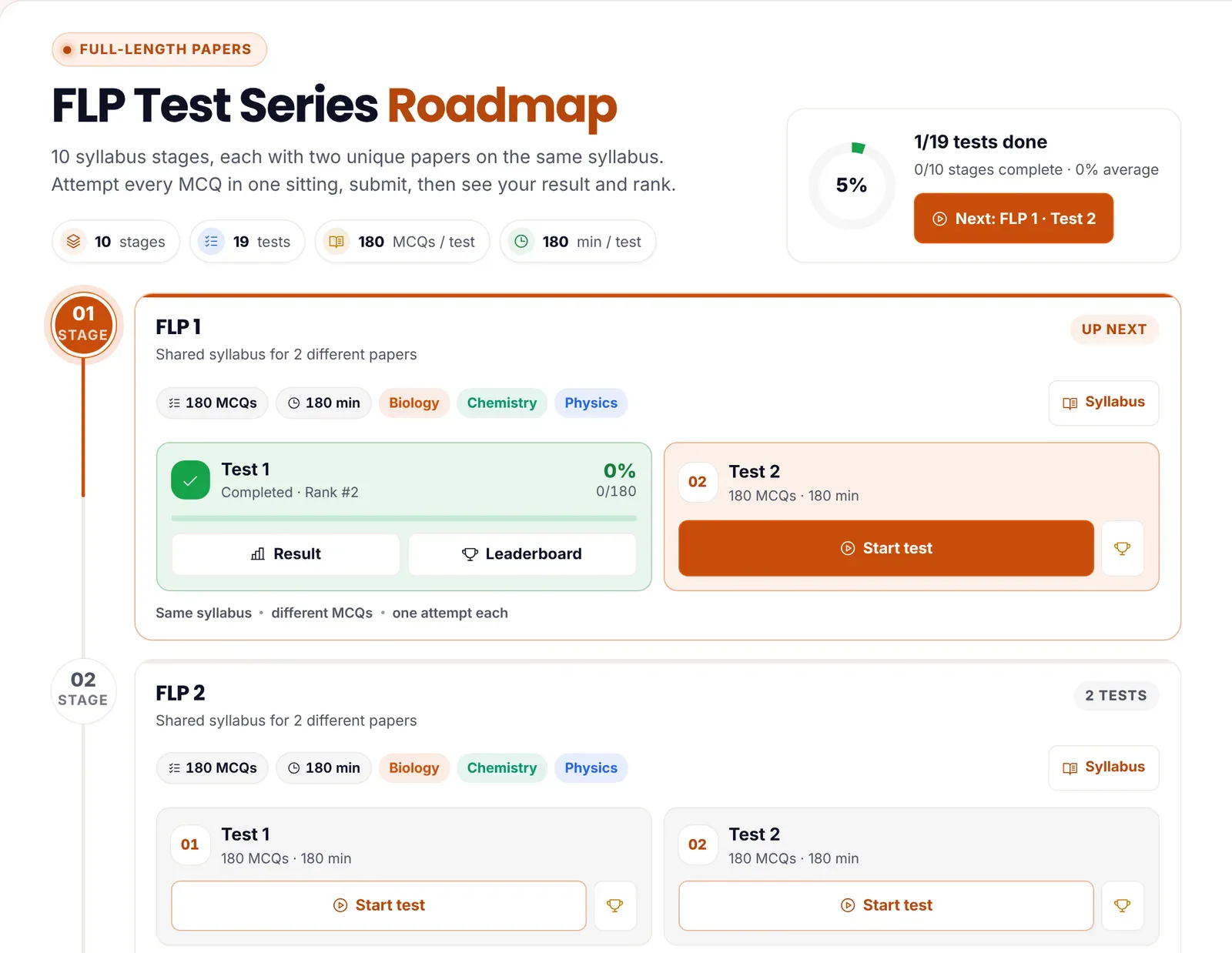
Not on day one, and not only at the end. ePrepare's FLP series (Advance package) is split into 10 syllabus stages, each with two different 180-MCQ, 180-minute papers on that stage's syllabus. Press Syllabus on a stage to see which chapters it covers, and sit its papers once you have finished those chapters. That way you practise the full three-hour paper early, on material you have actually studied. In the final months, move to complete-syllabus papers every week; your study plan keeps its last stretch of days for revision and full-length papers.
Five mistakes to avoid in your first two weeks
- Collecting material instead of studying. Ten books and five channels feel like progress. One complete platform and your textbooks are enough.
- Starting with your hardest chapter. Begin where the marks are and the base is laid: Biology's first chapters. Early wins keep you going.
- Watching lectures without MCQs. Understanding fades fast unless you test it the same day.
- Skipping the weekly test because you "are not ready". You never will feel ready. The test shows you what to fix.
- Restarting the plan after one bad day. Press Reschedule missed and carry on; one missed day changes nothing.
After the first two weeks
By day 14 you will have a plan, three or four chapters done properly, two weekly tests behind you and a clear picture of your weak spots. From here it is repetition: the same four-move loop for every chapter, a test every week, a progress check every Sunday, and full-length papers stage by stage. For the bigger picture by months left, read the MDCAT preparation guide; for studying without an academy, see how to prepare for MDCAT at home; and if you have about three months, the 90-day study plan. Need the tools? Compare the ePrepare packages and register; for a full tour of every feature, see the best online MDCAT preparation platform.
Frequently asked questions
What should I study first for MDCAT?
Start with the paper pattern and the syllabus on day one, then a baseline test. For chapters, most students start with Biology's first chapter, Cell structure and function, because Biology is 81 of the 180 MCQs and early chapters are the base for later ones.
How many hours a day should I study when I start?
Choose hours you can keep every day: around 3–4 hours alongside college, more in a full-time year. Increase them once the routine feels normal. Consistency matters more than long days.
How many MCQs should I solve per day at the beginning?
Start with a number you can finish with full attention, such as 50 to 75 a day, and read every explanation you get wrong. Raise it as your speed improves; in the final months, full 180-MCQ papers take over.
Should I finish my FSc books before starting MDCAT preparation?
No. MDCAT preparation is FSc study done the MDCAT way: learn a chapter, then practise its MCQs. Start with the chapters you have already covered in college and add the rest as you go.
When should I start my first full-length paper?
Once you finish the chapters of the first FLP stage. ePrepare's FLP series is split into syllabus stages, so you can sit full 180-MCQ papers early, on material you have studied, and then move to complete-syllabus papers in the final months.
Can I start MDCAT preparation in first year?
Yes. Starting early gives you time for every chapter, revision and full papers. Use a longer plan with fewer daily hours, and focus on the first-year chapters you are studying in college.