Magnetic force direction is one of those MDCAT topics where students know the formula but still lose the mark, because the question asks "which way?" and the options are up, down, into the page and out of the page. This guide shows you how to find the size of the force with F = qvB sin θ and, more importantly, how to find its direction every time, for protons and electrons, with dots and crosses, and for charges moving in a circle.
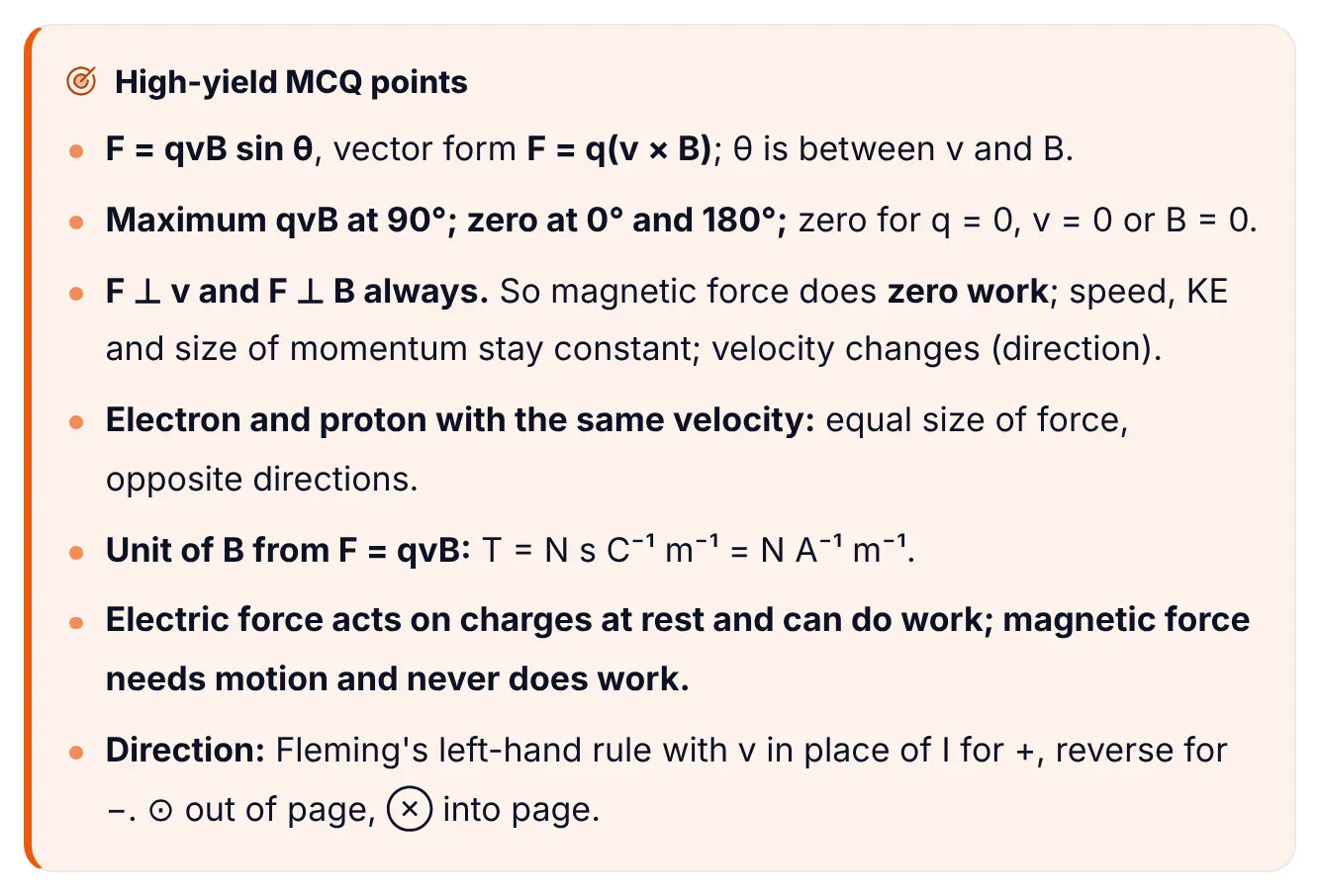
The short answer: The magnetic force on a moving charge is F = qvB sin θ, where θ is the angle between the velocity v and the field B. Its direction is always at 90° to both v and B: use Fleming's left-hand rule (first finger = field, second finger = velocity of a positive charge, thumb = force) or the cross product F = q(v × B). For an electron, find the direction for a positive charge and then reverse it. The force is zero when the charge moves along the field (θ = 0° or 180°) and largest, qvB, at 90°.
Why a magnetic field pushes a moving charge
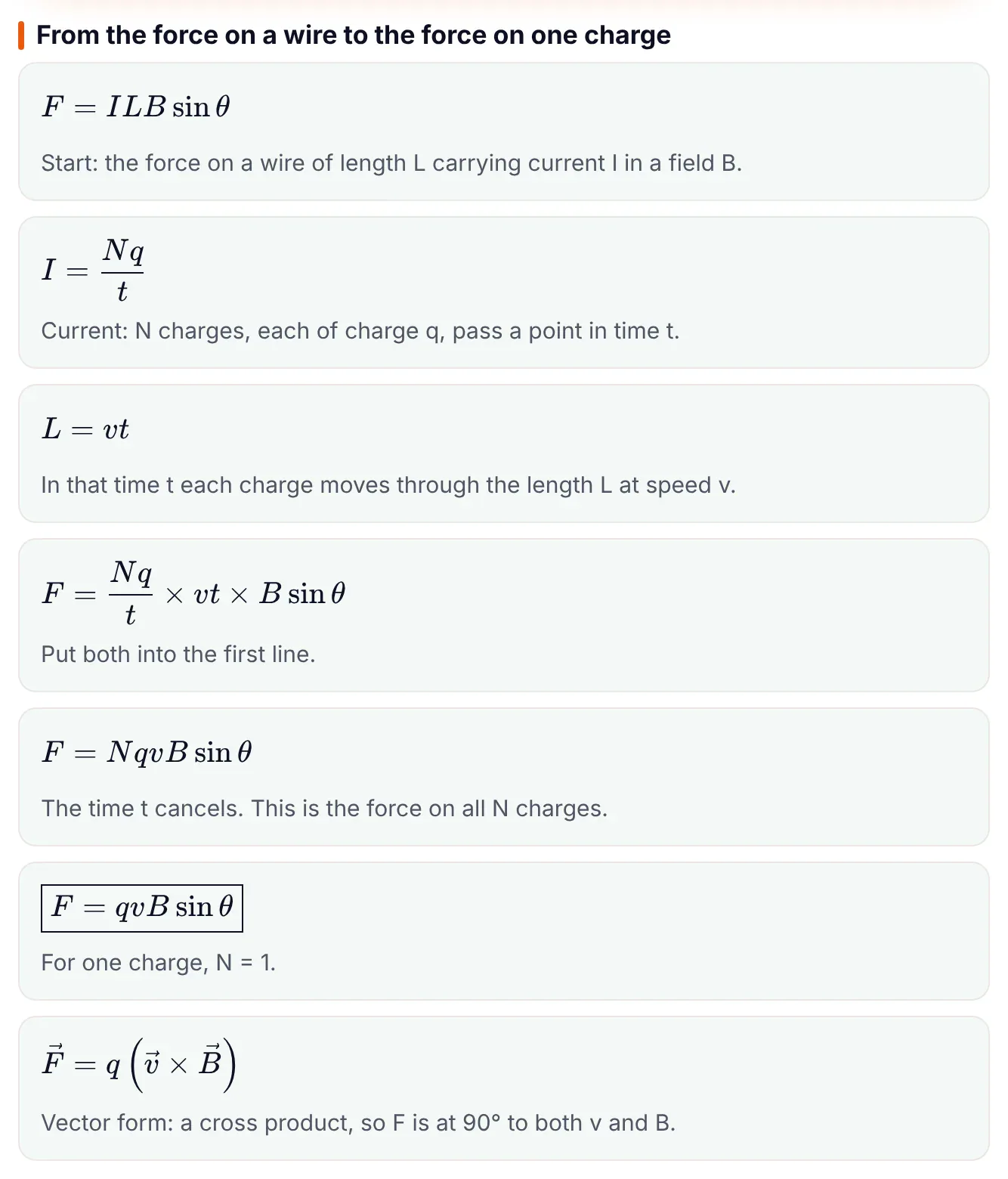
A current is simply charges moving along a wire. We already know a magnetic field pushes a current-carrying wire (F = ILB sin θ), so it must be pushing each moving charge inside it. You can see this without any wire: bring a magnet near the electron beam in a glass tube and the beam bends.
Two conditions must both be true for a magnetic force to act:
- The charge must be moving. A charge at rest in a magnetic field feels no magnetic force at all.
- Its velocity must have a part across the field lines. A charge moving exactly along (or exactly against) the field lines feels no force.
Formulas with symbols and units
| Formula | What it gives |
|---|---|
| F = qvB sin θ | Size of the magnetic force |
| F = q(v × B) | Vector form: F is perpendicular to both v and B |
| Fmax = qvB | Maximum force, when θ = 90° |
| r = mv/(qB) | Radius of the circle when v is at 90° to B |
| T = 2πm/(qB), f = qB/(2πm) | Time for one circle and its frequency (no v in them) |
- F: magnetic force in newtons (N)
- q: charge in coulombs (C). Proton q = +e, electron q = −e, with e = 1.6 × 10⁻¹⁹ C. Use the size of q for the size of F; the sign decides only the direction.
- v: speed in m s−1
- B: magnetic flux density in tesla (T). From B = F/(qv), 1 T = 1 N s C−1 m−1 = 1 N A−1 m−1.
- θ: angle between v and B (not between v and F; that angle is always 90°)
- m: mass in kg; r in m; T in s
Why sin θ? Only the part of the velocity across the field lines, v sin θ, is pushed. The part along the lines, v cos θ, feels nothing. So F = q(v sin θ)B.
How the angle changes the force
| Angle between v and B | sin θ | Force |
|---|---|---|
| 0° (along the field) | 0 | Zero |
| 30° | ½ | ½ qvB |
| 90° (straight across) | 1 | qvB (maximum) |
| 180° (against the field) | 0 | Zero |
The force is also zero when q = 0 (a neutron or a neutral atom), when v = 0 (charge at rest) or when B = 0. Any one zero factor makes the whole product zero.
How to find the magnetic force direction
The force points out of the plane that contains v and B, so a hand rule is needed to choose which side. First, the drawing convention:
- Dots (⊙) mean the field comes out of the page, towards you. Crosses (⊗ or ×) mean it goes into the page. Think of an arrow: you see its tip (dot) when it flies at you and its tail feathers (cross) when it flies away.
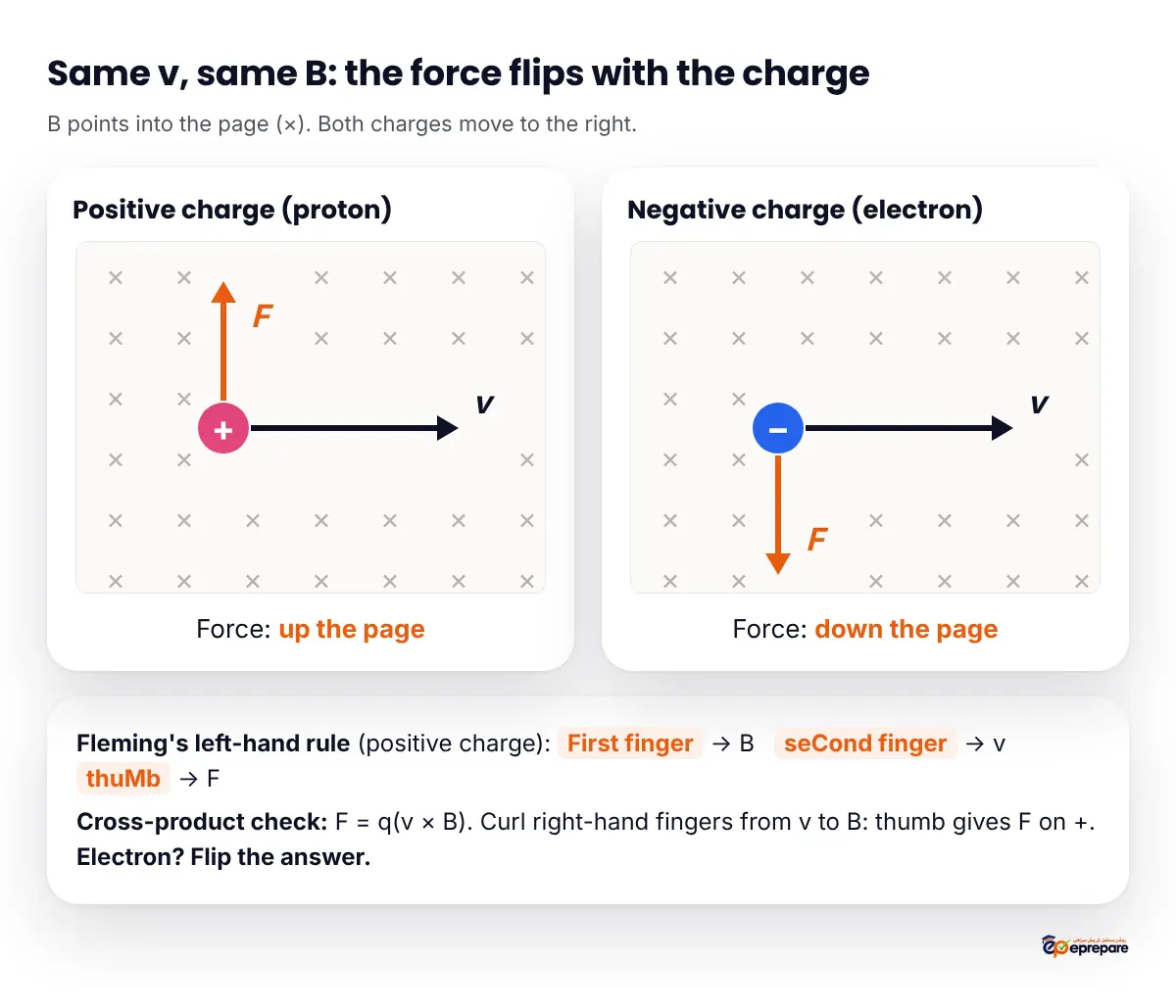
Method 1: Fleming's left-hand rule (the FSc and ePrepare method)
- Hold the thumb, first finger and second finger of your left hand at right angles to each other.
- Point the First finger along the Field B.
- Point the seCond finger along the velocity of a positive charge. A moving positive charge is a tiny current, so v takes the place of current.
- The thuMb gives the force (the direction of Motion).
- Negative charge? Its conventional current is opposite to its motion. Either point the second finger against v, or find the force for a positive charge and reverse it.
Method 2: the right-hand rule for F = q(v × B)
- Point the fingers of your right hand along v.
- Curl them towards B (through the smaller angle).
- The thumb gives the direction of v × B, which is the force on a positive charge.
- For a negative charge, q is negative, so the force is opposite to the thumb.
Both rules always give the same answer. Use the one your hand remembers best, and check with the other if you have time.
| Velocity of charge | Field B | Force on + | Force on − |
|---|---|---|---|
| Right | Into page ⊗ | Up the page | Down the page |
| Right | Out of page ⊙ | Down the page | Up the page |
| Up the page | Into page ⊗ | Left | Right |
| Up the page | Out of page ⊙ | Right | Left |
| Into page | Right | Down the page | Up the page |
| Right | Right | Zero (θ = 0°) | Zero (θ = 0°) |
Remember this: the magnetic force is always at 90° to v, so it does no work. Speed, kinetic energy and the size of momentum stay constant; only the direction of motion (and so the velocity) changes. A magnetic field is a steering wheel, never an accelerator.
When the force makes a circle
If a charge enters a uniform field at exactly 90°, the force is always sideways to its motion, with a constant size qvB. A constant sideways force is exactly what circular motion needs, so the charge moves in a circle. The magnetic force supplies the centripetal force:
- qvB = mv2/r, so r = mv/(qB): heavier or faster means a bigger circle; more charge or a stronger field means a tighter circle.
- T = 2πr/v = 2πm/(qB): the speed cancels. A faster particle runs a bigger circle in the same time.
- Sense of turning: in a field into the page, a positive charge goes round anticlockwise and an electron clockwise. (Check with the first row of the table: a + charge moving right is pushed up, so it curves to its left.)
- If v is at some other angle to B, the part along B carries the charge forward while the part across B makes it circle, so the path is a helix. At θ = 0° the path is a straight line.
Step-by-step method for any magnetic force question
- Is there a force at all? Check q ≠ 0, v ≠ 0 and θ ≠ 0° or 180°.
- Size: F = qvB sin θ. Convert μC to C (× 10−6) and mT to T (× 10−3). Multiply the plain numbers first, then add the powers of ten.
- Direction: apply Fleming's left-hand rule (or v × B) as if the charge were positive.
- Sign: if the charge is negative, reverse the direction.
- Check: your force must be perpendicular to both v and B. If it lies along either, you made a slip.
Worked examples (no calculator)
Example 1: proton, field into the page
A proton moves to the right across the page in a field directed into the page. Which way is the force?
- Left hand: first finger into the page (B), second finger to the right (v of a + charge).
- Thumb points up the page. That is the force.
Example 2: electron in the same field
An electron moves to the right in the same field (into the page).
- Answer for a + charge: up the page (Example 1).
- Reverse for the electron: down the page. The size of the force is the same as for the proton at the same speed, because both have charge of size e.
Example 3: electron moving up, field out of the page
- For a + charge moving up the page with B out of the page, the force is to the right (row 4 of the table).
- The electron is pushed to the left.
Example 4: working backwards to find B
A proton moving along +x is pushed along +y. Along which direction is the field?
- B must be perpendicular to both v and F, so it lies along +z or −z (out of or into the page, if x is right and y is up).
- Try into the page (−z): a + charge moving right is pushed up. That matches, so B is along −z (into the page).
Example 5: size of the force at 90°
A charge of 4 μC moves at 2 × 10⁵ m s−1 at right angles to a field of 0.5 T. Find the force.
- q = 4 × 10⁻⁶ C, sin 90° = 1
- F = 4 × 10−6 × 2 × 105 × 0.5
- Plain numbers: 4 × 2 × 0.5 = 4. Powers: 10−6 × 105 = 10−1
- F = 4 × 10−1 = 0.4 N
Example 6: an electron at 30°
An electron moves at 4 × 10⁶ m s−1 at 30° to a 0.5 T field. Find the size of the force (e = 1.6 × 10⁻¹⁹ C).
- F = 1.6 × 10−19 × 4 × 106 × 0.5 × sin 30°
- Small numbers first: 4 × 0.5 × 0.5 = 1
- F = 1.6 × 10⁻¹⁹ + 6 = 1.6 × 10⁻¹³ N, exactly half of what it would be at 90°.
Example 7: moving along the field
An electron moves at 107 m s−1 parallel to a 2 T field. Find the force.
- θ = 0°, sin 0° = 0, so F = 0. The numbers do not matter; the electron goes straight on without bending.
Example 8: radius of the circle
An ion of mass 6.4 × 10⁻²⁷ kg and charge 3.2 × 10⁻¹⁹ C enters a 0.2 T field at right angles with speed 106 m s−1. Find the radius of its path.
- r = mv/(qB) = (6.4 × 10−27 × 106)/(3.2 × 10−19 × 0.2)
- Top: 6.4 × 10⁻²¹. Bottom: 0.64 × 10−19 = 6.4 × 10⁻²⁰
- r = 10−21 + 20 = 10−1 m = 0.1 m (10 cm)
- If its speed were doubled, r would double to 20 cm, but the time for one circle would not change.
Common mistakes
- Using the right hand for Fleming's rule. Fleming's rule for force (motor effect) uses the left hand. The right hand is for the cross-product curl rule (or Fleming's right-hand rule for induced current, a different topic).
- Forgetting to flip for an electron. The single most common direction error. Do it as positive, then reverse.
- Taking θ as the angle between v and F. θ is between v and B. The angle between F and v is always 90°.
- Thinking 180° gives the biggest force. sin 180° = 0, so moving against the field gives zero force.
- Saying the magnetic force speeds the charge up. It does no work; speed and KE never change. Velocity changes only because its direction changes.
- Mixing up dots and crosses. Dot = out of the page (arrow tip), cross = into the page (arrow tail).
- Forgetting unit conversions. μC → × 10−6 C; mT → × 10−3 T; cm → × 10−2 m.
MDCAT-style practice MCQs
1. A positive charge moves to the right across a page in a magnetic field directed into the page. The force on it is:
A. Down the page B. Into the page C. To the left D. Up the page
Show answer
D. Up the page. Left hand: first finger into the page, second finger right, thumb up. Into the page and to the left lie along B and against v, but F must be perpendicular to both.
2. An electron moves to the right in a magnetic field directed out of the page. The force on it is:
A. Up the page B. Down the page C. To the left D. Zero
Show answer
A. Up the page. A positive charge would be pushed down the page; the electron is pushed the opposite way.
3. A proton moves parallel to the field lines of a uniform magnetic field. The magnetic force on it is:
A. qvB B. ½qvB C. Zero D. 2qvB
Show answer
C. Zero. θ = 0° and sin 0° = 0. qvB would need θ = 90°.
4. An electron moves into the page in a magnetic field that points to the right. The force on the electron is:
A. To the left B. To the right C. Up the page D. Down the page
Show answer
C. Up the page. For a positive charge moving into the page with B to the right, F is down the page; reverse it for the electron.
5. A proton moving along the +x axis experiences a magnetic force along the +y axis. The magnetic field is along:
A. +z B. −z C. +x D. −y
Show answer
B. −z. F = q(v × B): x̂ × (−ẑ) = +ŷ. B along x would give zero force, and B cannot lie along F.
6. A charged particle enters a uniform magnetic field at right angles to it. Its kinetic energy:
A. Increases B. Decreases C. Remains constant D. Becomes zero
Show answer
C. Remains constant. The force is always perpendicular to v, so it does no work; only the direction changes.
7. A charge moving at 90° to a field feels a force F. At the same speed, moving at 30° to the same field, it feels:
A. 2F B. F/2 C. 0.87F D. F
Show answer
B. F/2. F ∝ sin θ, and sin 30° = ½. 0.87F uses cos 30° by mistake.
8. A charged particle moves in a circle in a uniform magnetic field. If its speed is doubled, its radius and time period become:
A. Radius doubled, period unchanged B. Both doubled C. Radius halved, period doubled D. Both unchanged
Show answer
A. r = mv/(qB) is proportional to v; T = 2πm/(qB) does not contain v.
Quick revision table
| Point | Fact |
|---|---|
| Size | F = qvB sin θ (θ between v and B) |
| Vector form | F = q(v × B), perpendicular to v and B |
| Maximum / zero | qvB at 90°; zero at 0° and 180°, and for q, v or B = 0 |
| Direction (+) | Fleming's left hand: First finger B, seCond finger v, thuMb F |
| Direction (−) | Opposite to the + answer |
| Proton vs electron, same v | Equal size, opposite direction |
| Work done | Zero; speed and KE constant, velocity changes |
| Path at 90° | Circle, r = mv/(qB); at another angle a helix; at 0° a straight line |
| Time period | T = 2πm/(qB), independent of speed and radius |
| Unit of B | T = N A−1 m−1 = N s C−1 m−1 |
| Field into page, + charge | Circles anticlockwise (electron clockwise) |
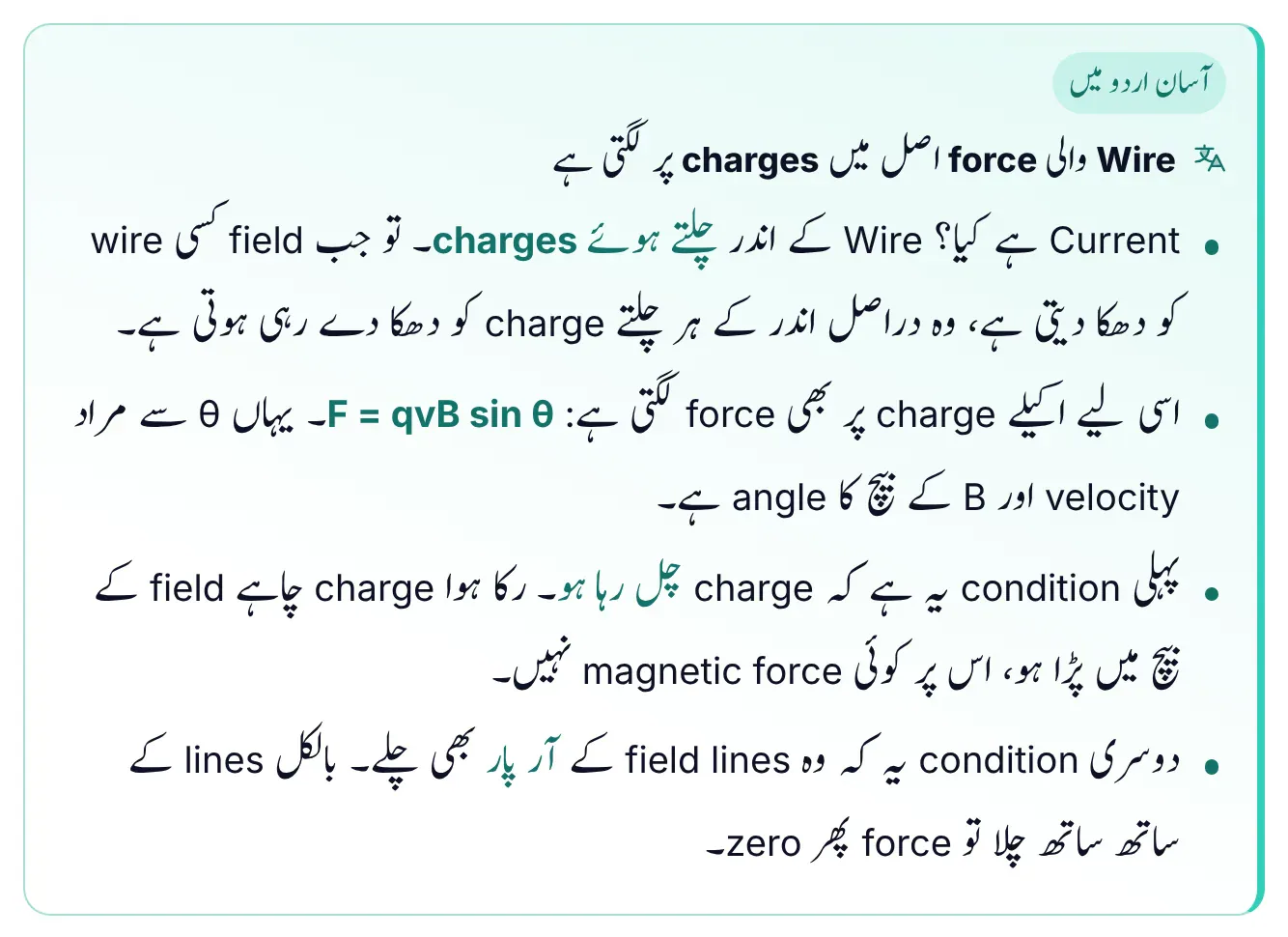
خلاصہ: magnetic force صرف چلتے ہوئے charge پر لگتی ہے، اور F = qvB sin θ ہے جس میں θ velocity اور B کے بیچ کا angle ہے۔ Direction کے لیے left hand لیں: پہلی انگلی field کی طرف، بیچ والی positive charge کی velocity کی طرف، انگوٹھا force بتائے گا۔ Electron ہو تو جواب الٹ دیں۔ Force ہمیشہ v سے 90° پر رہتی ہے، اس لیے work zero، اور speed اور KE نہیں بدلتیں۔
The complete lesson in the Electromagnetism chapter of ePrepare's MDCAT conceptual notes covers this topic in full: dots-and-crosses practice, electric vs magnetic force, the circular path lesson with electron, proton and alpha particle ratio questions, and practice MCQs with English and easy-Urdu explanations. To see how this chapter compares with the rest of the syllabus, read MDCAT Physics high-yield chapters, and for powers-of-ten tricks like the ones above, see MDCAT Physics numericals without a calculator. Then test yourself under time pressure with a chapter quiz in the ePrepare Quiz Builder.
Frequently asked questions
Which hand rule is used for magnetic force on a moving charge?
Fleming's left-hand rule: first finger along the field, second finger along the velocity of a positive charge, and the thumb gives the force. You can also use the right-hand rule for the cross product F = q(v × B). Both give the same direction.
Why is the force on an electron opposite to the force on a proton?
In F = q(v × B), the charge q of an electron is negative, so the force vector points the opposite way. The size is the same for the same speed, because both have a charge of size 1.6 × 10⁻¹⁹ C.
When is the magnetic force on a moving charge zero?
When the charge moves parallel or antiparallel to the field (θ = 0° or 180°), when it is at rest, when it has no charge (like a neutron), or when there is no field.
Does a magnetic field change the speed of a charged particle?
No. The magnetic force is always perpendicular to the velocity, so it does no work. The speed and kinetic energy stay the same; only the direction of motion changes.
Which way does a proton circle in a magnetic field into the page?
Anticlockwise. A proton moving right is pushed up the page, so it curves to its left, which traces an anticlockwise circle. An electron in the same field circles clockwise.
Is Fleming's left-hand rule the same as the rule for a current-carrying wire?
Yes. For a wire, the second finger points along the conventional current. For a single positive charge, it points along the velocity, because a moving positive charge is a tiny current in that direction.