Negative feedback is one of those ideas that turns up in several FSc chapters at once: homeostasis, the pancreas, the kidney, the brain and even enzymes. MDCAT examiners love it because one simple rule explains so many questions. Once you can draw the loop and name its parts, MCQs on insulin, ADH, body temperature and thyroxine become easy marks.
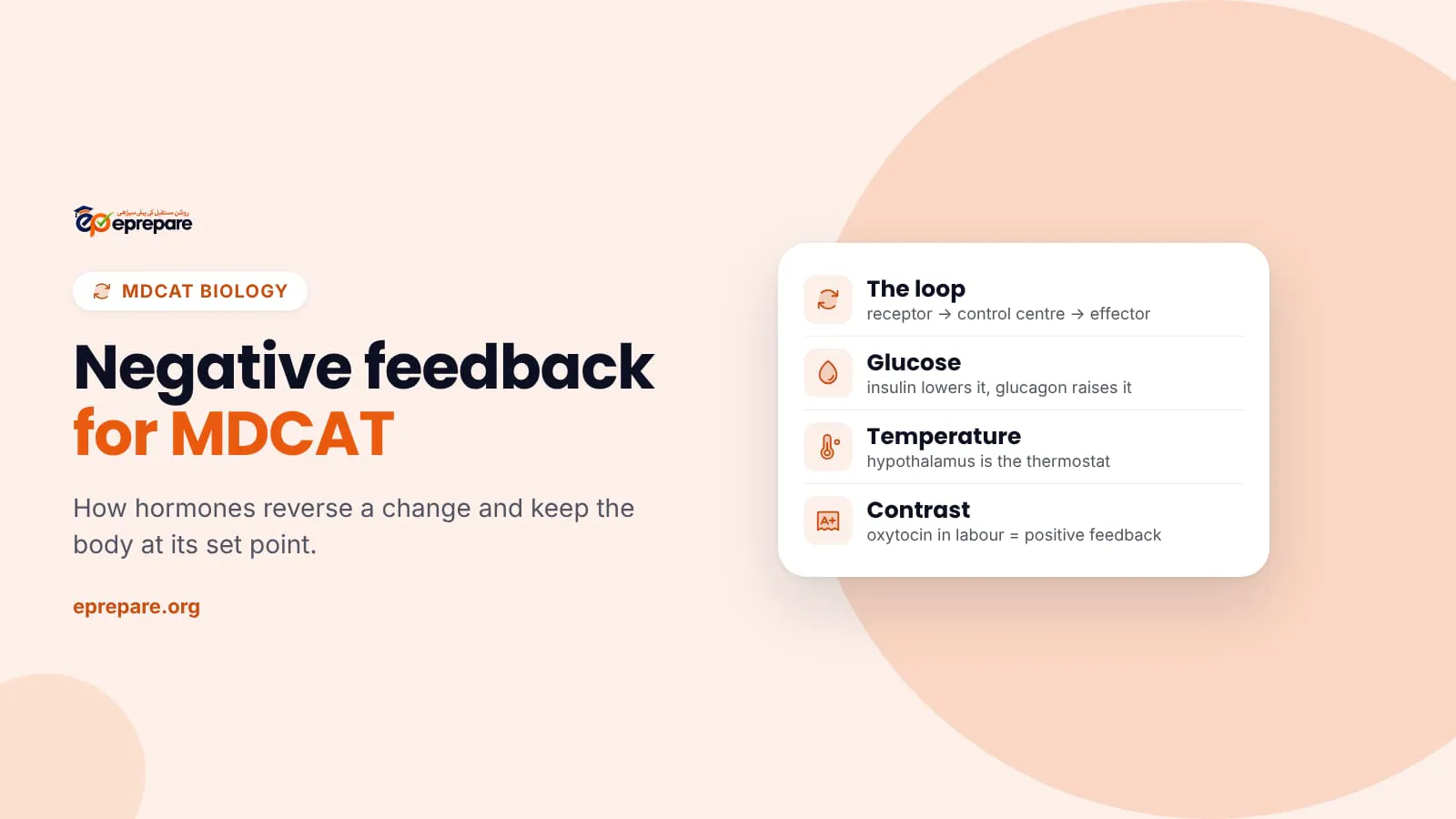
The short answer: negative feedback is a control mechanism in which the body's response reverses a change, bringing a value (such as blood glucose, body temperature or blood water content) back to its normal level, the set point. A receptor detects the change, a control centre compares it with the set point, and an effector corrects it. Once the value is normal again, the signal stops, so the loop switches itself off. Positive feedback is the opposite: the response makes the change bigger, as oxytocin does during labour.
What negative feedback means in biology
Homeostasis means keeping the internal environment of the body (the blood and the tissue fluid around the cells) nearly constant, even when conditions outside change. Water and salt levels, body temperature, blood glucose and pH all have to stay within narrow limits. The body does most of this by negative feedback.
"Negative" does not mean bad. It means the response works against the change. If a value rises, the body brings it down. If it falls, the body brings it up.
Think of an air-conditioned room. When the thermostat senses the room is too warm, the AC switches on. As soon as the room cools to the set temperature, the AC switches off. Your body runs ADH, sweating, insulin and many other responses in exactly this way.
The parts of every feedback loop
- Stimulus: a change from the normal value (blood glucose rises after a meal, for example).
- Receptor: detects the change (thermoreceptors, osmoreceptors, or the islet cells of the pancreas).
- Control centre: compares the value with the set point and decides what to do. In many loops this is the hypothalamus.
- Effector: a muscle or gland that acts (sweat glands, kidney tubules, liver cells, skeletal muscles).
- Response: the value returns to normal, and the receptor stops signalling.
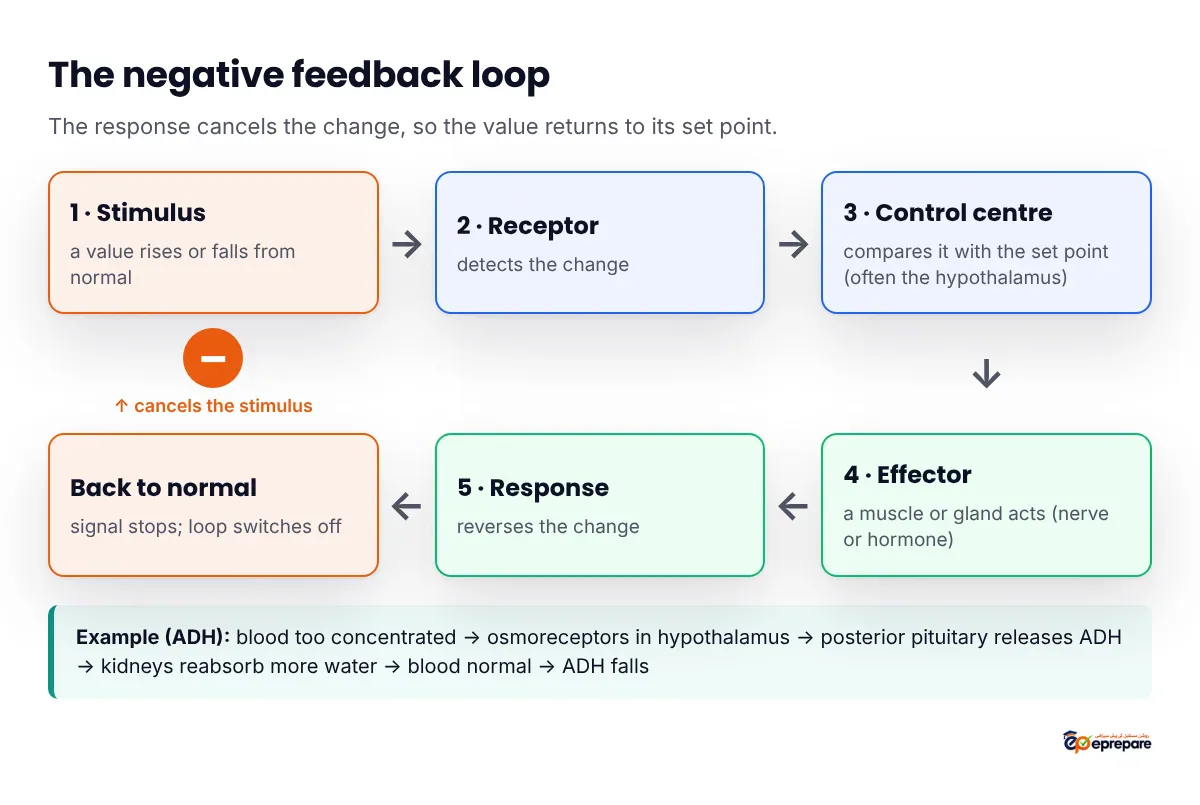
How negative feedback maintains homeostasis
The key feature is that the loop switches itself off. The response only runs while the value is away from the set point. This gives three advantages that MDCAT questions often test:
- Stability: values swing gently around the set point instead of running away in one direction.
- Two-way control: most values have one response to bring them down and another to bring them up. Blood glucose has insulin and glucagon; temperature has heat-loss and heat-gain responses.
- Economy: hormones are not released when they are not needed. Drinking a lot of water, for example, stops ADH release.
Hormones are a natural fit for this kind of control. The endocrine system works more slowly than the nervous system because hormones travel in the blood, but their effects last longer. The hypothalamus links the two systems: it is part of the brain and it also controls the pituitary gland.
Four examples of negative feedback MDCAT asks about
1. Blood glucose: insulin and glucagon
The endocrine part of the pancreas is the islets of Langerhans, about a million small clusters of cells that make up only around 2% of the gland. Beta cells secrete insulin; alpha cells secrete glucagon. Here the islet cells act as both receptor and control centre: they sense the glucose level of the blood directly.
| Situation | Hormone released | What the liver and cells do | Result |
|---|---|---|---|
| After a meal: glucose rises | Insulin (beta cells) | Cells take up glucose; the liver turns extra glucose into glycogen (glycogenesis) | Glucose falls back to normal; insulin release falls |
| Between meals: glucose falls | Glucagon (alpha cells) | The liver breaks glycogen into glucose (glycogenolysis); in starvation it makes new glucose (gluconeogenesis) | Glucose rises back to normal; glucagon release falls |
Insulin and glucagon are antagonistic hormones: they have opposite effects on the same value. ePrepare's memory trick: Insulin = glucose In (into storage); Glucagon = "glucose is gone", so stored glycogen is broken down.
2. Thermoregulation: the hypothalamus as thermostat
Human core temperature is kept at about 36.4 to 37.3 °C, mainly because temperature controls the rate of enzyme activity. The hypothalamus checks the temperature of the blood flowing through it and also receives signals from hot and cold thermoreceptors in the skin. It compares this with its set point and sends out corrections.
| Response | Body too hot | Body too cold |
|---|---|---|
| Skin arterioles | Vasodilation: more blood near the surface, more heat lost | Vasoconstriction: less blood near the surface, heat kept |
| Sweat glands | Active; evaporation of sweat removes heat | Inhibited |
| Skeletal muscles | No shivering | Shivering: up to five times basal heat production |
| Hair erector muscles | Relaxed | Hairs stand up to trap air (goose bumps) |
| Hormones and metabolism | Metabolism lowered | Thyroxin (long-term rise) and adrenaline (short-term rise) |
In both directions the response reverses the change and stops once the set point is reached. Fever is a useful twist: pyrogens (toxins from pathogens or chemicals from neutrophils) act on the hypothalamus and raise the set point. The feedback loop still works, but now it defends a higher temperature. Antipyretics such as aspirin and paracetamol lower the set point again.
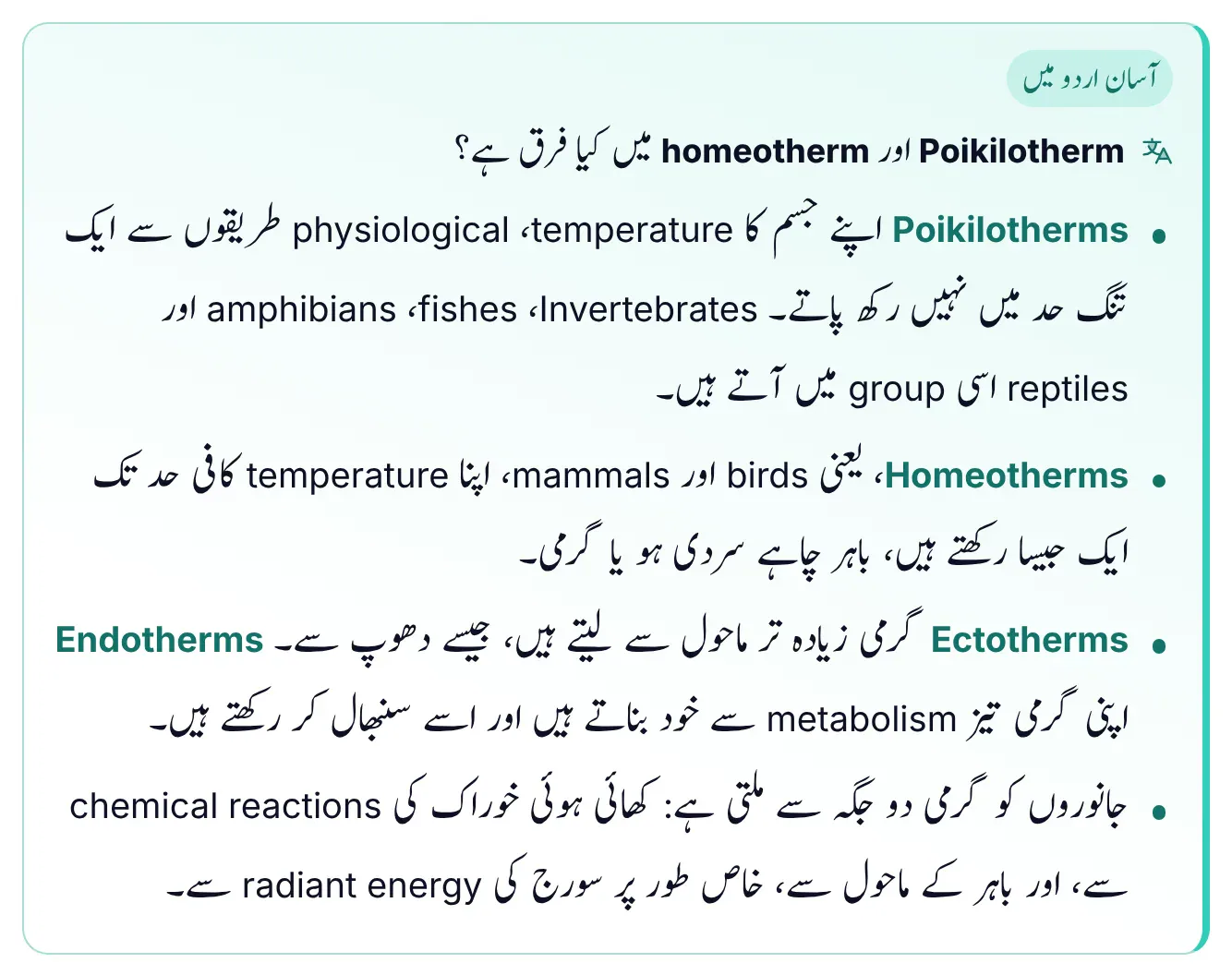
3. ADH and water balance (osmoregulation)
Antidiuretic hormone (ADH) is released from the posterior pituitary, under the control of the hypothalamus. It makes the distal convoluted tubule (DCT) and the collecting ducts of the nephron more permeable to water, so more water is reabsorbed into the blood.
- Blood too concentrated (after sweating, or not drinking): osmoreceptors in the hypothalamus detect it → the posterior pituitary releases more ADH → more water reabsorbed → a small amount of concentrated urine → blood returns to normal → ADH release falls.
- Blood too dilute (after drinking a lot of water): ADH release is inhibited → collecting ducts stay less permeable → a large amount of dilute urine → blood returns to normal.
Do not confuse ADH with aldosterone. Aldosterone comes from the adrenal cortex and makes the DCT reabsorb more sodium. ePrepare's trick: ADH Adds water back; aLdosterone saves sALt.
4. Thyroxine and TSH: a hormone that switches off its own trigger
This example comes from the FSc chemical coordination chapter. The chain runs from the brain to the thyroid:
- The hypothalamus releases a releasing hormone (TRH) that acts on the anterior pituitary.
- The anterior pituitary releases thyroid-stimulating hormone (TSH).
- TSH makes the thyroid gland release thyroxine, which raises the metabolic rate.
- When thyroxine in the blood is high, it inhibits the release of TSH (and TRH). Less TSH means less thyroxine.
- When thyroxine falls, the inhibition is lifted, TSH rises, and the thyroid releases more thyroxine.
Here the hormone at the end of the chain is the signal that turns the chain down. MDCAT likes the clinical link: in iodine deficiency, the thyroid cannot make enough thyroxine (iodine is part of the thyroxine molecule). Without thyroxine to inhibit it, TSH stays high and keeps stimulating the thyroid, which enlarges into a goitre.
Two more places you will meet the same idea
- Menstrual cycle: as oestrogen rises in the proliferative phase, it has a negative feedback on FSH, so FSH falls. (ePrepare's reproduction notes add that, for MDCAT, the falling FSH is taken as the signal for the LH surge.)
- Enzymes (feedback inhibition): inside a cell, the end product of a pathway binds the allosteric site of the first enzyme and slows it down once enough product is made. In the textbook example, excess threonine inhibits the first enzyme of the aspartate → threonine pathway. It is reversible and non-competitive: negative feedback at the molecular level.
Positive feedback: the contrast MDCAT tests
In positive feedback, the response increases the original change instead of cancelling it. The change grows and grows until some event ends the loop. Positive feedback is not used for keeping values steady; it is used when the body needs to finish something quickly.
The FSc example is oxytocin during labour (childbirth):
- The baby's head presses on the cervix and stretches it.
- Stretch signals reach the hypothalamus, and the posterior pituitary releases oxytocin.
- Oxytocin makes the smooth muscle of the uterine wall (the myometrium) contract more strongly.
- Stronger contractions push the baby harder against the cervix, which causes even more oxytocin release.
- The loop ends only when the baby is born and the stretching stops.
| Feature | Negative feedback | Positive feedback |
|---|---|---|
| Effect of the response | Reverses the change | Increases the change |
| Result | Value returns to the set point; stability | Value moves further from the start until an event ends it |
| How common | Most homeostatic control | Rare; for processes that must be completed |
| How it stops | Switches itself off at the set point | Stops when the end event happens (e.g. birth) |
| FSc examples | Insulin/glucagon, ADH, thermoregulation, thyroxine/TSH, end-product inhibition | Oxytocin in labour |
Hormones in feedback loops: one table to revise
| Hormone | Source | Released when | Main effect |
|---|---|---|---|
| Insulin | Beta cells, islets of Langerhans | Blood glucose high | Lowers blood glucose (glycogenesis) |
| Glucagon | Alpha cells, islets of Langerhans | Blood glucose low | Raises blood glucose (glycogenolysis) |
| ADH | Posterior pituitary (hypothalamus controls it) | Blood too concentrated | More water reabsorbed in DCT and collecting ducts |
| Aldosterone | Adrenal cortex | Sodium needs to be saved | More sodium reabsorbed in the DCT |
| TSH | Anterior pituitary | Thyroxine low | Stimulates the thyroid |
| Thyroxine | Thyroid gland | TSH present | Raises metabolic rate; long-term heat production; inhibits TSH |
| Oxytocin | Posterior pituitary | Cervix stretched in labour | Stronger uterine contractions (positive feedback) |
How MDCAT asks about feedback
- Name the part: "In a negative feedback loop, the part that compares a value with the set point is the…" (control centre).
- Predict the hormone change: "After drinking a lot of water, ADH…" (falls, so urine is dilute and plentiful).
- Pick the odd one out: "Which is an example of positive feedback?" (oxytocin in labour).
- Match hormone and gland: alpha cells and glucagon; posterior pituitary and ADH; adrenal cortex and aldosterone.
- Apply the loop to disease: iodine deficiency → low thyroxine → high TSH → goitre; pyrogens → raised set point → fever.
- Cold responses vs hot responses: "Which is NOT a response to cold?" (active sweat glands).
Common mistakes students make
- "Negative feedback means something harmful." Wrong. It only means the response reverses the change.
- "Glucagon stores glucose as glycogen." Wrong. Insulin does that; glucagon breaks glycogen down.
- "Insulin comes from alpha cells." Wrong. Beta cells make insulin; alpha cells make glucagon.
- "Drinking a lot of water raises ADH." Wrong. A high water intake inhibits ADH.
- "ADH comes from the anterior pituitary." Wrong. It is released from the posterior pituitary. TSH is the anterior pituitary hormone.
- "Vasodilation saves heat." Wrong. Vasodilation increases heat loss; vasoconstriction saves heat.
- "The skin is the control centre for temperature." Wrong. The skin has receptors and effectors; the hypothalamus is the control centre.
- "Thyroxin gives a short burst of heat." Wrong. Thyroxin gives a long-term rise; adrenaline gives the short-term rise.
MDCAT-style practice MCQs
1. In a negative feedback system, the response of the effector:
A. Increases the original change
B. Reverses the original change
C. Has no link with the change
D. Moves the set point upward
Show answer
B. The effector's response reverses the change and brings the value back to the set point; increasing the change would be positive feedback.
2. In a feedback loop, the part that compares a value with the set point is the:
A. Receptor
B. Effector
C. Control centre
D. Stimulus
Show answer
C. The control centre (often the hypothalamus) compares the value with the set point; the receptor only detects the change.
3. A student drinks two litres of water quickly. Which change is expected?
A. ADH rises; little concentrated urine
B. ADH falls; much dilute urine
C. ADH rises; much dilute urine
D. ADH falls; little concentrated urine
Show answer
B. High water intake inhibits ADH, so less water is reabsorbed and a large volume of dilute urine is passed.
4. Blood glucose falls between meals. The hormone released and its source are:
A. Insulin, beta cells
B. Glucagon, beta cells
C. Glucagon, alpha cells
D. Insulin, alpha cells
Show answer
C. Alpha cells release glucagon, which makes the liver break glycogen into glucose (glycogenolysis).
5. Which of the following is an example of positive feedback?
A. Release of insulin after a meal
B. Sweating on a hot day
C. Oxytocin release during labour
D. Inhibition of TSH by thyroxine
Show answer
C. Oxytocin strengthens uterine contractions, which cause more oxytocin release until birth; the other three reverse a change.
6. In iodine deficiency the thyroid gland enlarges because:
A. Thyroxine level rises and stimulates the thyroid
B. Low thyroxine fails to inhibit TSH, so TSH stays high
C. ADH stimulates the thyroid
D. TSH secretion stops completely
Show answer
B. Without enough thyroxine there is no negative feedback on TSH, and high TSH keeps stimulating the thyroid, causing a goitre.
7. Which response is NOT produced when body temperature falls below the set point?
A. Shivering of skeletal muscles
B. Release of thyroxin
C. Active sweat glands
D. Vasoconstriction in the skin
Show answer
C. Active sweat glands cause heat loss, which is a response to heat, not cold.
8. Feedback inhibition of an enzyme pathway is best described as:
A. Irreversible and competitive
B. Reversible and non-competitive
C. Irreversible and non-competitive
D. Reversible and competitive
Show answer
B. The end product binds an allosteric site on the first enzyme, not the active site, and leaves when product levels fall.
Learn it in ePrepare's conceptual notes
ePrepare's Biology conceptual notes cover this in the Homeostasis chapter (the thermoregulation, excretion and kidney lessons, each with its own feedback flow chart), the pancreas and liver lessons for insulin and glucagon, and the Enzymes chapter for feedback inhibition. Every lesson has easy-Urdu boxes with science terms kept in English, memory tricks, common mistakes, practice MCQs with explanations, and a high-yield MCQ points box like the one below.
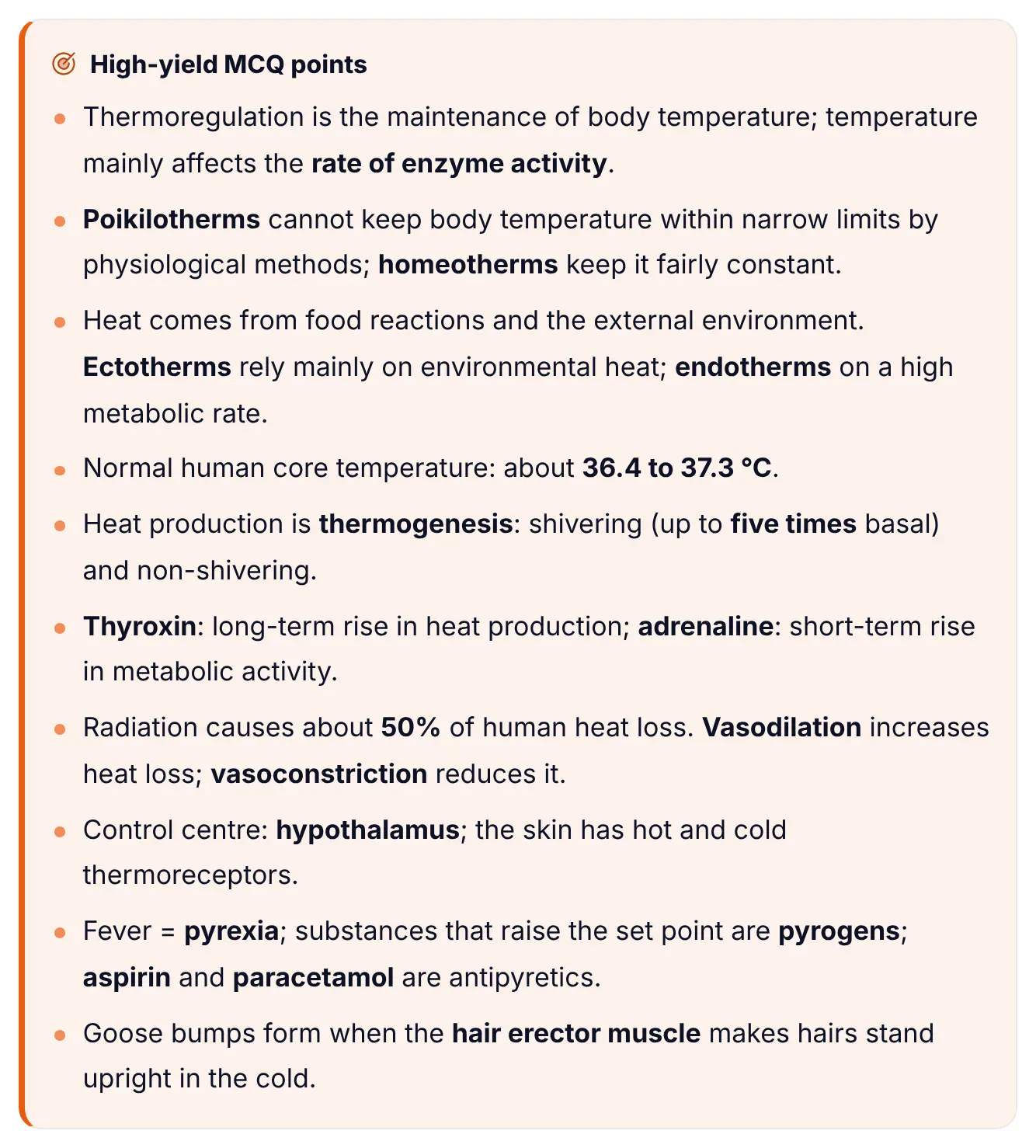
Read more about how the notes work in our guide to ePrepare's MDCAT conceptual notes. To see where Homeostasis sits among the chapters that carry the most Biology marks, read MDCAT Biology high-yield chapters. For more genetics and biochemistry practice, see sex-linked inheritance MCQs and levels of protein structure.
Quick revision table
| Point | Remember |
|---|---|
| Negative feedback | Response reverses the change; loop switches off at the set point |
| Loop order | Stimulus → receptor → control centre → effector → response |
| Main control centre | Hypothalamus (temperature, water balance; links nerves and hormones) |
| Glucose high | Insulin (beta cells) → glycogenesis |
| Glucose low | Glucagon (alpha cells) → glycogenolysis |
| Blood concentrated | Osmoreceptors → more ADH (posterior pituitary) → concentrated urine |
| Too hot / too cold | Vasodilation, sweating / vasoconstriction, shivering, thyroxin, adrenaline |
| Thyroxine high | Inhibits TSH (anterior pituitary); iodine lack → high TSH → goitre |
| Fever | Pyrogens raise the set point |
| Positive feedback | Response increases the change; oxytocin in labour |
آسان الفاظ میں: negative feedback میں جسم کا response ہمیشہ change کے الٹ ہوتا ہے۔ Blood glucose بڑھے تو insulin آتا ہے اور glucose کم ہو جاتا ہے، کم ہو تو glucagon اسے بڑھا دیتا ہے۔ پانی کم ہو تو ADH زیادہ نکلتا ہے، زیادہ پانی پی لیں تو ADH رک جاتا ہے۔ Thyroxine زیادہ ہو تو TSH کم ہو جاتا ہے۔ Value واپس set point پر آتے ہی loop خود بند ہو جاتا ہے۔ Positive feedback الٹا کام کرتا ہے، جیسے labour میں oxytocin، جو change کو اور بڑھاتا ہے یہاں تک کہ بچہ پیدا ہو جائے۔
Frequently asked questions
What is negative feedback in simple words?
It is a control system where the body's response undoes a change. If something rises above normal, the body brings it down; if it falls, the body brings it up. Once the value is normal, the response stops.
Why is it called "negative" feedback?
Because the response acts in the opposite (negative) direction to the change. It has nothing to do with being harmful. Negative feedback is what keeps you healthy.
What are the main examples of negative feedback for MDCAT?
Blood glucose control by insulin and glucagon, thermoregulation by the hypothalamus, water balance by ADH, and thyroxine inhibiting TSH. Feedback (end-product) inhibition of enzymes is the cellular version.
Is the hypothalamus the control centre for every feedback loop?
No. It is the control centre for temperature and water balance, and it controls the pituitary. But in blood glucose control, the islet cells of the pancreas sense glucose and release insulin or glucagon themselves.
What is the difference between negative and positive feedback?
Negative feedback reverses a change and keeps a value stable. Positive feedback increases a change until an end event, such as birth in the case of oxytocin during labour. Most homeostasis uses negative feedback.
Which chapter is negative feedback in for MDCAT?
It is taught mainly in Homeostasis (thermoregulation, kidney and ADH), with links to the pancreas and liver for glucose, coordination for the hypothalamus and pituitary, and Enzymes for feedback inhibition. Check the full list in the MDCAT syllabus.