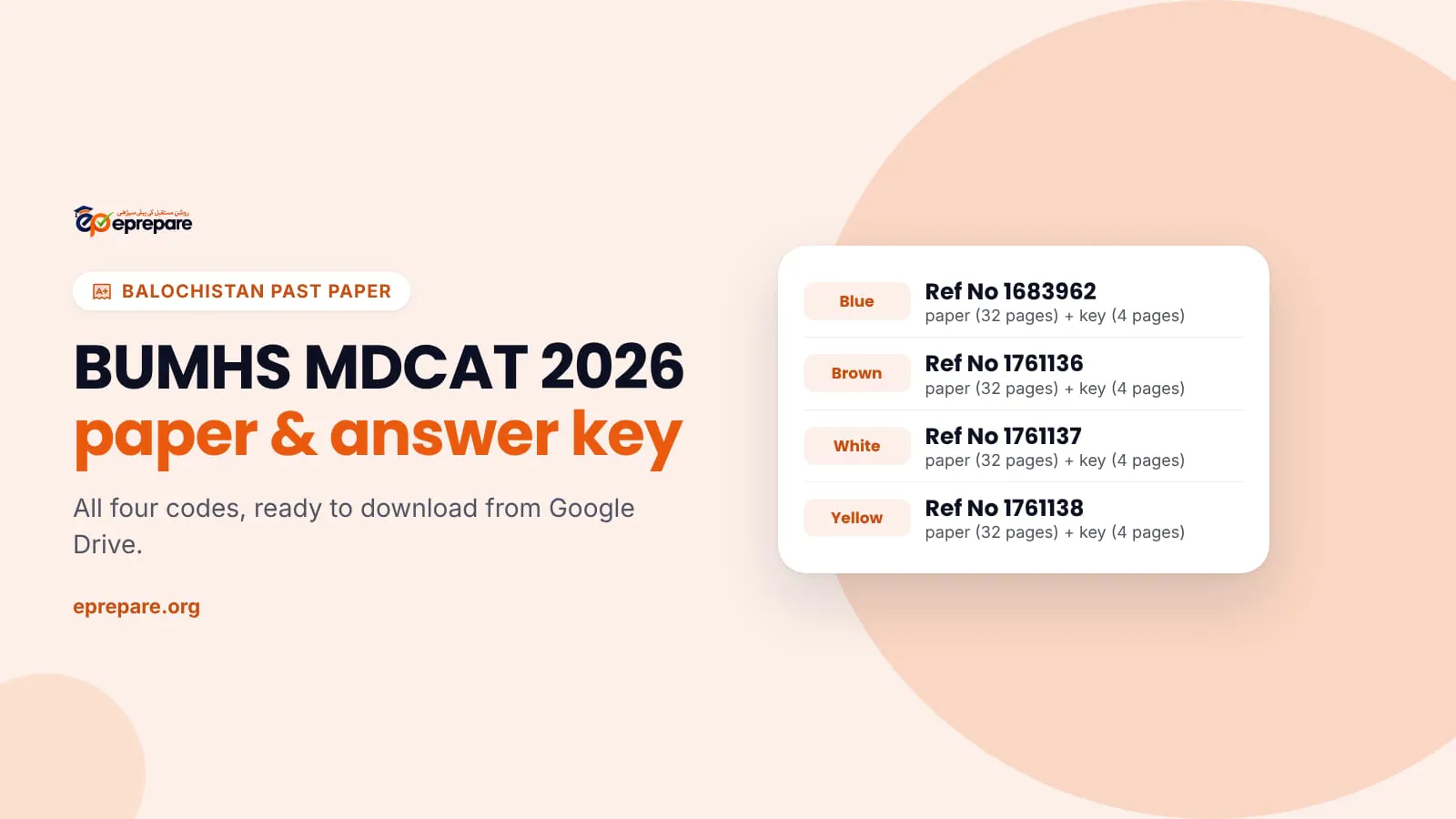
The BUMHS MDCAT 2026 paper came in four colour codes: Blue, Brown, White and Yellow. Below you will find the question paper and the answer key for each code. Every file downloads straight from Google Drive, so pick your colour, tap Download and the PDF is yours. You can also read any paper or key on this page without downloading it.
Quick way: check the colour printed at the top right of your paper, find that colour in the table, and download both the paper and its key. Use only your own colour's key: the questions are the same in every code, but their order is not.
All four codes at a glance
| Code | Ref No | Question paper (32 pages) | Answer key (4 pages) |
|---|---|---|---|
| Blue | 1683962 | Download · View | Download · View |
| Brown | 1761136 | Download · View | Download · View |
| White | 1761137 | Download · View | Download · View |
| Yellow | 1761138 | Download · View | Download · View |
BUMHS MDCAT 2026 in short
| Conducted by | Bolan University of Medical and Health Sciences (BUMHS), Quetta, for Balochistan |
|---|---|
| Test date | Sunday, 20 September 2026 (first set for 16 August, then postponed) |
| Centres | Quetta, plus an extra centre in Islamabad for candidates with Balochistan domicile |
| Paper | 180 MCQs, 180 marks, 180 minutes (shown on the paper as "Time: 180 mins, Marks: 180") |
| Negative marking | None: a wrong answer costs nothing |
| Codes | Blue, Brown, White and Yellow, each with its own answer key |
| Candidates | 9,923 registered; 9,596 are listed in the result |
| Highest score | 164 out of 180 (91%) |
| PMDC passing marks | 55% (99/180) for MBBS and 50% (90/180) for BDS |
How to find your paper code
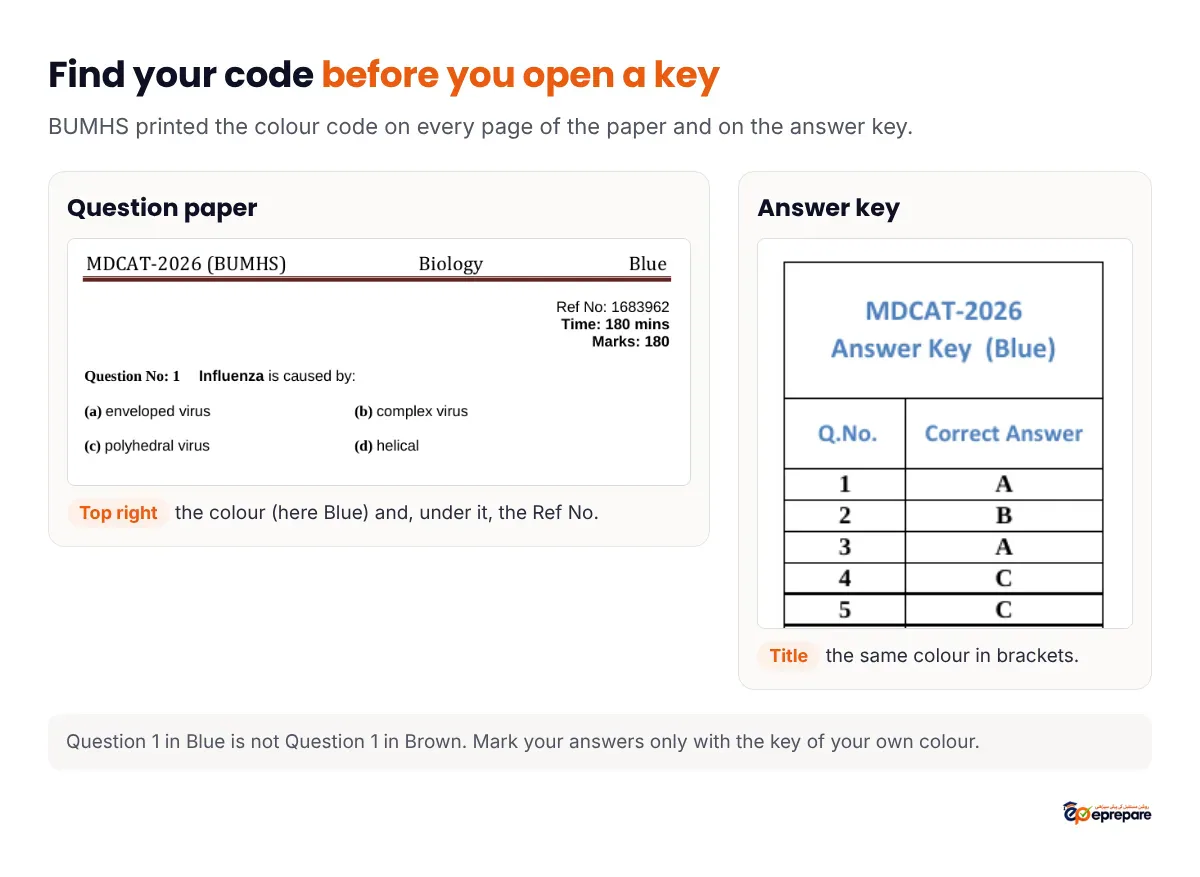
If you still have your question booklet, the colour is printed in the header of every page, next to "MDCAT-2026 (BUMHS)" and the subject name. The first page also shows a Ref No: 1683962 for Blue, 1761136 for Brown, 1761137 for White and 1761138 for Yellow. If you do not have the booklet, read the first question of each paper below and pick the one that matches what you remember: Blue starts with "Influenza is caused by".
Blue code: paper and answer key
The Blue booklet carries Ref No 1683962 under the colour name. It has 180 questions on 32 pages; its answer key is 4 pages.
Download Blue paper (PDF)Download Blue answer key (PDF)
Open Blue paper in Google DriveOpen Blue key in Google Drive
Read the Blue paper here (32 pages)
Read the Blue answer key here (4 pages)
Brown code: paper and answer key
The Brown booklet carries Ref No 1761136 under the colour name. It has 180 questions on 32 pages; its answer key is 4 pages.
Download Brown paper (PDF)Download Brown answer key (PDF)
Open Brown paper in Google DriveOpen Brown key in Google Drive
Read the Brown paper here (32 pages)
Read the Brown answer key here (4 pages)
White code: paper and answer key
The White booklet carries Ref No 1761137 under the colour name. It has 180 questions on 32 pages; its answer key is 4 pages.
Download White paper (PDF)Download White answer key (PDF)
Open White paper in Google DriveOpen White key in Google Drive
Read the White paper here (32 pages)
Read the White answer key here (4 pages)
Yellow code: paper and answer key
The Yellow booklet carries Ref No 1761138 under the colour name. It has 180 questions on 32 pages; its answer key is 4 pages.
Download Yellow paper (PDF)Download Yellow answer key (PDF)
Open Yellow paper in Google DriveOpen Yellow key in Google Drive
Read the Yellow paper here (32 pages)
Read the Yellow answer key here (4 pages)
BUMHS MDCAT 2026 paper pattern
All four codes follow PMDC's MDCAT pattern and keep each subject in one block, so Biology is always Questions 1 to 81, whatever your colour.
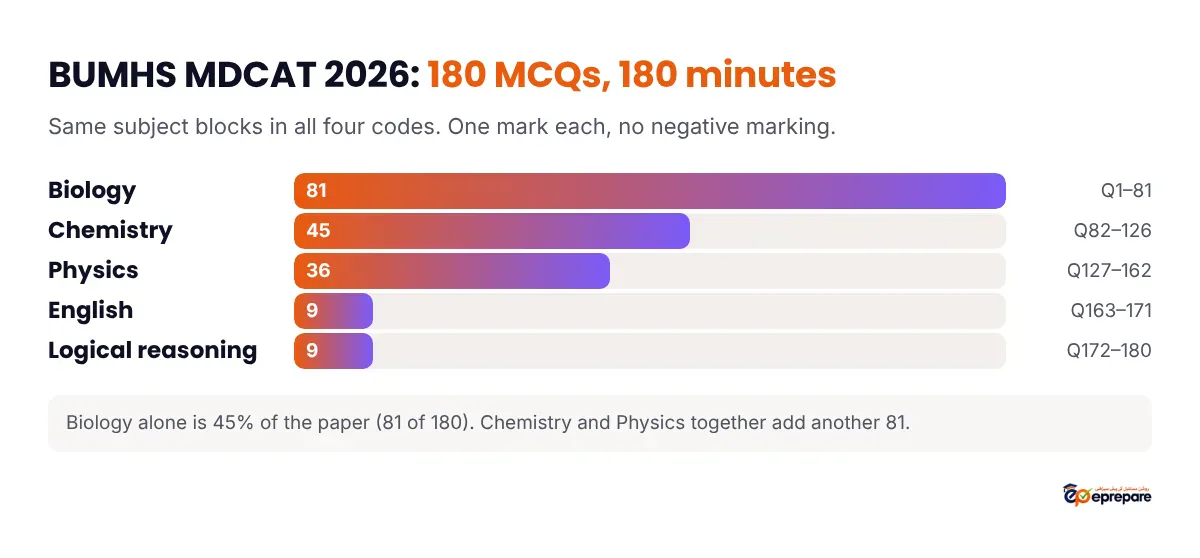
| Subject | MCQs | Question numbers | Share of paper |
|---|---|---|---|
| Biology | 81 | 1–81 | 45% |
| Chemistry | 45 | 82–126 | 25% |
| Physics | 36 | 127–162 | 20% |
| English | 9 | 163–171 | 5% |
| Logical reasoning | 9 | 172–180 | 5% |
| Total | 180 | 1–180 | 100% |
We compared the four papers line by line. They carry the same 180 questions, shuffled inside each subject, and the four keys give the same answer for every question. No colour was easier or harder than another. See the MDCAT paper pattern for how PMDC sets these numbers.
How to check your score with the key
- Download the answer key of your colour. Another colour's key will mark you wrong on most questions, because the order is different.
- Write your answers from your memory, your carbon copy or your notes next to the question numbers, 1 to 180.
- Compare each answer with the key and count the matches. Each correct answer is one mark; a wrong or blank answer is zero, because there was no negative marking.
- Your score out of 180 is the number of matches. Divide it by 1.8 for your percentage: 126 correct is 70%.
- Compare it with the passing marks: at least 99 for MBBS and 90 for BDS. Passing makes you eligible; admission then depends on your merit aggregate.
To see where that score could take you, use the MDCAT marks calculator and the merit calculator, and look at past closing merits. Our guide to MDCAT passing marks explains the 55% and 50% rules.
What came in each subject
Question numbers below are from the Blue code. The same questions are in the other three codes at different numbers.
Biology (81 MCQs)
- Viruses and HIV: influenza virus type (Q1), the structure every virus has (Q4), how HIV destroys T-lymphocytes (Q6) and the enzyme that joins viral DNA to the host genome (Q28).
- Evolution: three questions on Lamarckism (Q5, Q7, Q20) and one on antibiotic resistance (Q79).
- Inheritance: a test cross (Q2), haemophilia crosses and why it affects males (Q15, Q38, Q39, Q43), colour blindness genes on the X chromosome (Q70) and a 9:3:3:1 deviation (Q56).
- Human physiology: breathing movements and the diaphragm (Q3, Q31), the cardiac cycle and valves (Q19, Q23, Q41, Q54), digestion (Q9, Q32, Q45, Q63), kidneys and urea (Q35, Q44, Q50, Q61), the brain (Q25, Q34, Q73, Q76) and muscles and joints (Q47, Q74, Q78).
- Molecules and enzymes: acylglycerols, nucleotides and pyrimidines (Q8, Q22, Q27), the induced fit and lock and key models (Q14, Q48) and deamination (Q26, Q52).
- Immunity and biotechnology: anti-venom as artificial passive immunity (Q30), breast milk antibodies (Q58), interferons (Q68), gene therapy (Q40) and DNA probes (Q81).
Chemistry (45 MCQs)
- Organic chemistry was heavy: E2 reactions and leaving groups (Q83, Q87), anti-Markovnikov addition with peroxide (Q101), nitration of toluene (Q116), esters (Q103, Q104), dehydration of alcohols (Q120), benzene with chlorine in UV light (Q122) and an IUPAC name (Q126).
- Physical chemistry: molar volume at STP (Q89), kinetic molecular theory (Q96, Q114), rate laws and the rate constant (Q100, Q118) and an equilibrium constant from rate constants (Q124).
- Structure and periodicity: radius ratio (Q88), orbitals and quantum numbers (Q91, Q108), hybridisation of NH3 (Q123), sigma and pi bonds in ethene (Q125), Group 2 hydroxides (Q105) and an element from its configuration (Q111).
Physics (36 MCQs)
- Mechanics: vector components (Q137, Q155), projectile motion (Q145, Q146), circular motion (Q134, Q140), work done (Q143) and momentum in an explosion (Q162).
- Fluids and waves: the equation of continuity and flow rate (Q156, Q158), turbulent flow (Q150), longitudinal and standing waves (Q144, Q148) and a guitar string overtone (Q160).
- Electricity and magnetism: Coulomb's constant (Q127), maximum power transfer (Q128), capacitors with a dielectric (Q153), the weber (Q139), the cyclotron (Q142) and induced emf (Q147, Q161).
- Modern physics and electronics: photon energy (Q157), the Balmer series (Q151), nuclear radiation (Q136, Q152), n-type silicon (Q141) and Boolean algebra (Q159).
English and logical reasoning (9 + 9 MCQs)
English tested sentence structure, a word in context ("equivocal", Q164), prepositions, synonyms, fact and opinion, active and passive voice, present participles ("dancing daffodils", Q169), formal tone and the idiom "rock the boat" (Q171). Logical reasoning had a number series (Q172), a sequence rule (Q174), simple arithmetic (Q175, Q180), probability (Q176), a syllogism (Q177), an ordering puzzle (Q178) and a course-of-action question (Q179).
Solved MCQs from the paper
Try each one before you open the answer. Numbers are from the Blue code; the answers match the official key.
Q155. The x-component of a force at 60° to the x-axis is 100 N. What is the force?
Answer: (d) 200 N. Fx = F cos 60° = F × ½, so 100 = F × ½ and F = 200 N.
Q158. Cross-sectional area 2 cm², liquid speed 100 m/s. What is the flow rate?
Answer: (d) 0.02 m³/s. Change the area to m² first: 2 cm² = 2 × 10⁻⁴ m². Flow rate = Av = 2 × 10−4 × 100 = 0.02 m³/s.
Q160. A 50 cm guitar string vibrates in its first overtone; wave speed 350 m/s. Frequency?
Answer: (d) 700 Hz. The first overtone of a string is the second harmonic, with one full wavelength on the string: λ = L = 0.5 m. f = v/λ = 350/0.5 = 700 Hz.
Q124. Kc = 8 and kr = 0.25. What is kf?
Answer: (b) 2. Kc = kf/kr, so kf = 8 × 0.25 = 2.
Q125. How many sigma and pi bonds are in ethene?
Answer: (d) σ = 5, π = 1. Ethene (CH2=CH2) has four C–H sigma bonds and one C=C double bond, which is one sigma and one pi bond.
Q30. Anti-venom injected after a snake bite gives which type of immunity?
Answer: (d) Artificial passive immunity. The antibodies are made in another animal and injected ready-made, so the body does not make them itself (passive), and they arrive by injection, not naturally (artificial).
Q176. 4 blue, 3 black and 3 red pens. Probability that a random pen is blue?
Answer: (b) 2/5. 4 blue out of 10 pens = 4/10 = 2/5.
Practise for your next MDCAT
A past paper is most useful when you solve it timed and then study every wrong answer. On ePrepare you can do exactly that:
- Solve real papers by year and province in MDCAT past papers, or start a free timed paper in the MDCAT online test.
- Compare with other provinces: the KMU MDCAT paper and answer key and the NUMS paper and answer key.
- Practise subject by subject with Biology, Chemistry and Physics MCQs, each with explanations.
- Get full-length papers, a study plan and smart revision of your wrong MCQs with an ePrepare package.
Frequently asked questions
When was the BUMHS MDCAT 2026 held?
On Sunday, 20 September 2026. It was first scheduled for 16 August 2026 and then postponed. Candidates sat it in Quetta, and candidates with Balochistan domicile could also sit it at a centre in Islamabad.
Are the Blue, Brown, White and Yellow papers different?
They have the same 180 questions in a different order, and the four keys agree on every question. That is why you must use the key of your own colour: Question 1 in one code is a different question in another.
Was there negative marking in BUMHS MDCAT 2026?
No. Each correct answer is one mark and a wrong answer is zero, so your score is simply the number of correct answers out of 180. Read more in MDCAT negative marking.
What are the passing marks?
PMDC's passing marks are 55% for MBBS (99 out of 180) and 50% for BDS (90 out of 180). Passing makes you eligible to apply; your admission depends on the merit list.
How many candidates appeared, and what was the highest score?
9,923 candidates registered and 9,596 are listed in the BUMHS result. The highest score was 164 out of 180.
Can I use the KMU, UHS or Sindh answer key for my BUMHS paper?
No. Each province's university set its own paper, so only the BUMHS keys on this page match the Balochistan paper.
Why does the download open Google Drive?
The papers and keys are stored on Google Drive, and the download comes straight from there. On a phone, tap Download; if the PDF opens in a viewer instead, use your browser's download or share button to save it.