



The equation of continuity gives some of the quickest marks in MDCAT Physics. Most questions are one-line ratio numericals: the pipe gets narrower, so how much faster does the water move? The only trap is that area depends on the square of the diameter. This guide explains the idea, then works through the numericals MDCAT likes, from pipes and hose nozzles to arteries and capillaries, all without a calculator.
The short answer: The equation of continuity is A1v1 = A2v2 (Av = constant): for an incompressible fluid in steady flow, the volume passing every section per second is the same, so the speed is inversely proportional to the area. Because A = πr2, the speed is inversely proportional to d2: if the pipe diameter halves, the speed becomes 4 times. The equation comes from conservation of mass.
What the equation of continuity says
Think of water flowing steadily through a full pipe with no leaks and no extra inlets. Water cannot be squeezed, so whatever enters one end each second must leave the other end in the same second. Nothing piles up and nothing disappears. Where the pipe is narrow, the same amount of water has to get through a smaller opening, so it must move faster.
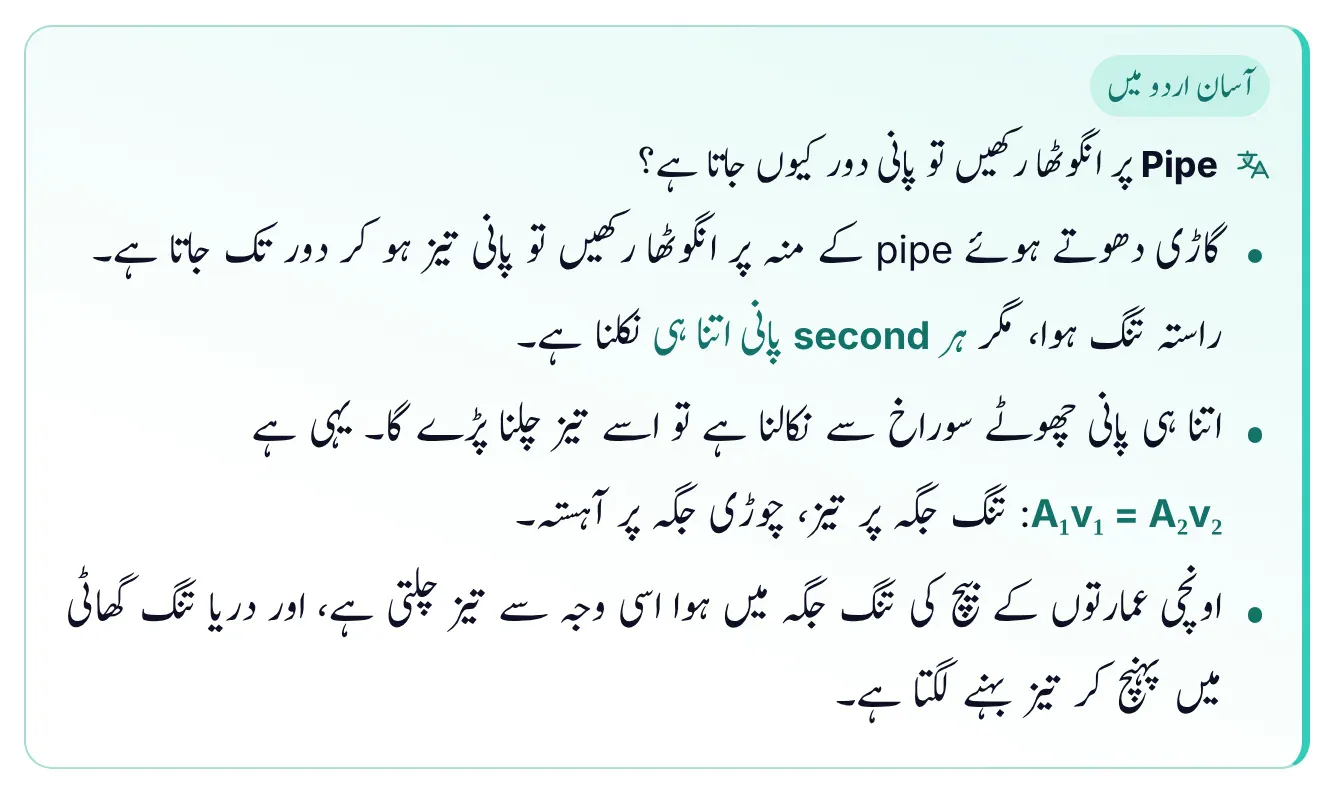
You have seen this many times: a thumb over a garden hose makes the jet go farther, a river runs fast through a narrow gorge and slowly where it is wide, and wind blows harder through a narrow gap between tall buildings.
The formula, every symbol and units
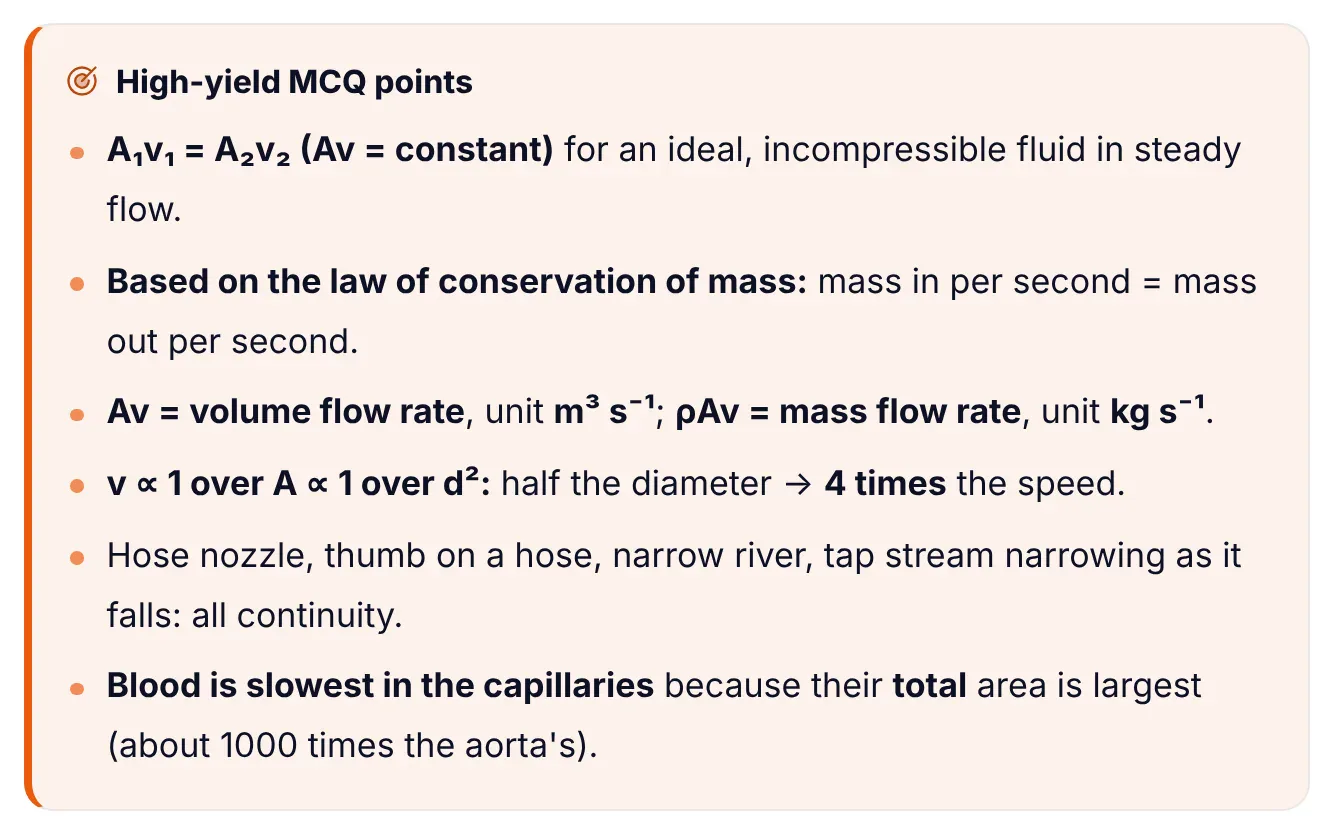
Equation of continuity: A1v1 = A2v2 or Av = constant
With radii or diameters: v2 = v1 × (r1/r2)2 = v1 × (d1/d2)2
General (mass) form: ρ1A1v1 = ρ2A2v2, used when the density changes, as in a gas.
| Symbol or quantity | Meaning | SI unit |
|---|---|---|
| A | Cross-sectional area of the pipe at that point (A = πr2 = πd2/4) | m2 |
| v | Flow speed at that point | m s−1 |
| ρ | Density of the fluid | kg m−3 |
| Q = Av | Volume flow rate (volume per second) | m3 s−1 |
| ρAv | Mass flow rate (mass per second) | kg s−1 |
Conversions you will need: 1 cm2 = 10−4 m2, 1 mm2 = 10−6 m2, 1 litre = 10−3 m3. In ratio questions the units cancel, so you can keep cm or mm. Convert only when the question asks for an actual flow rate or time.
Derivation idea: mass in = mass out
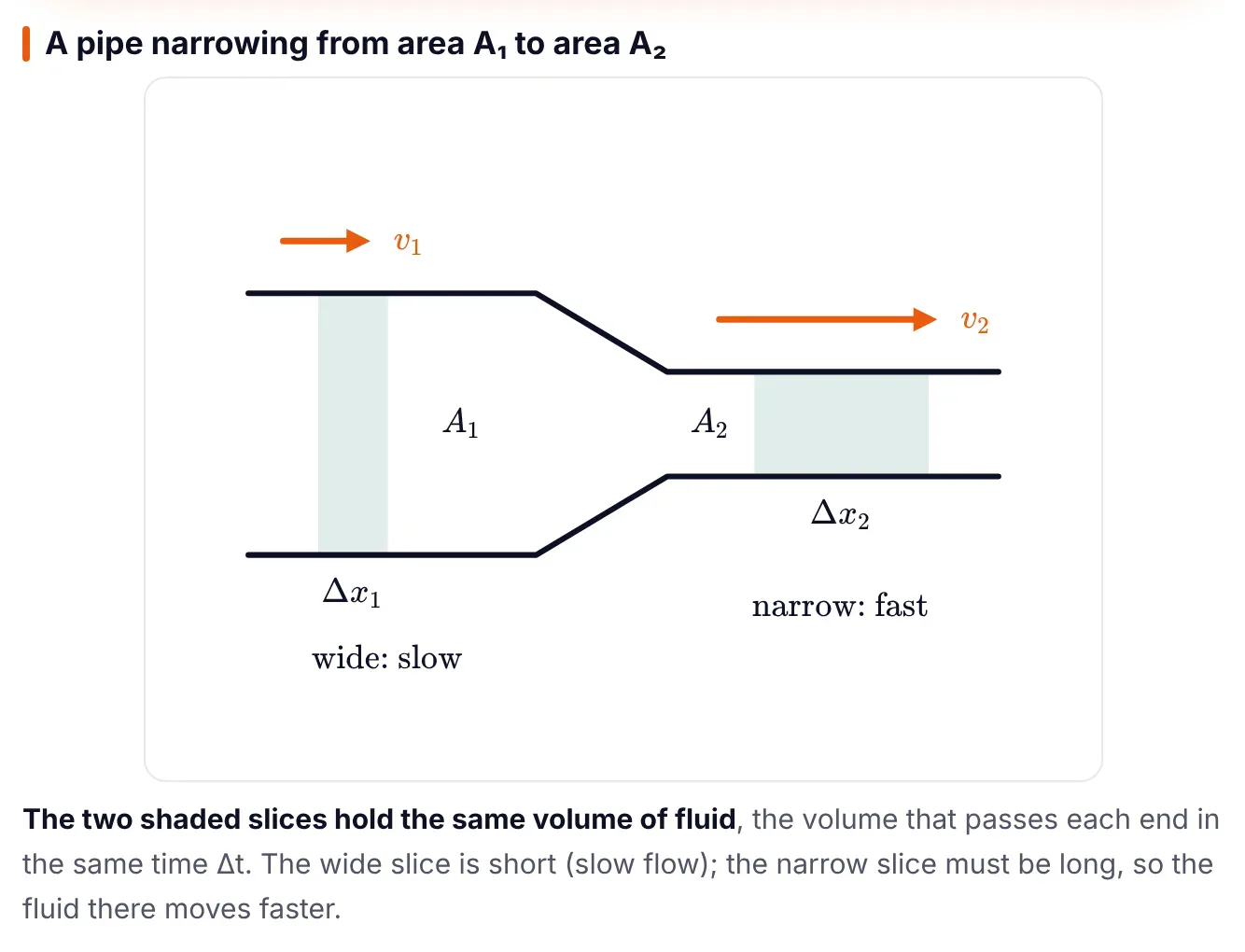
- In a short time Δt, fluid at the wide end moves a distance v1Δt, so the volume entering is A1v1Δt and the mass entering is ρA1v1Δt.
- In the same time, the mass leaving the narrow end is ρA2v2Δt.
- No leaks and no piling up, so mass in = mass out: ρA1v1Δt = ρA2v2Δt.
- The fluid is incompressible, so ρ is the same at both ends. Cancel ρ and Δt: A1v1 = A2v2.
So the equation of continuity is the law of conservation of mass for a flowing fluid. Its partner, Bernoulli's equation, is the law of conservation of energy. Continuity gives you the speed; Bernoulli then gives you the pressure.
The area ∝ d2 trick
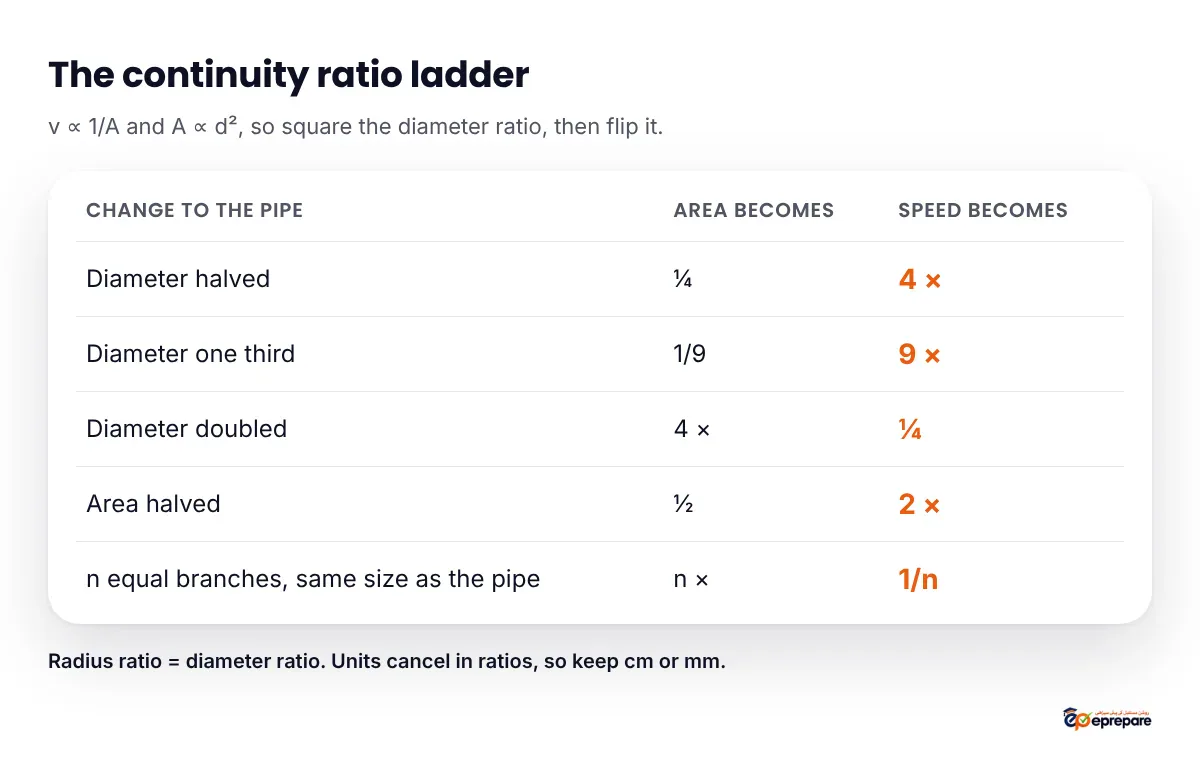
Pipes are round, so A = πr2. When you put this into A1v1 = A2v2, π cancels and you get r12v1 = r22v2. The ratio of radii and the ratio of diameters are the same number, so you can use either.
Equation of continuity numericals, solved
Each example is set up so the arithmetic is easy by hand. For more mental-maths shortcuts across the syllabus, see MDCAT Physics numericals without a calculator.
Example 1: the pipe diameter halves
Water flows at 3 m s−1 in a pipe. The pipe then narrows to half its diameter. Find the new speed.
- v2 = v1 × (d1/d2)2 = 3 × (2)2 = 3 × 4
- v2 = 12 m s−1. Half the diameter means a quarter of the area and four times the speed, not double.
Example 2: garden hose nozzle
A hose of inner diameter 2 cm carries water at 1.5 m s−1. The nozzle has an opening of diameter 0.5 cm. How fast does the water leave the nozzle?
- Diameter ratio = 2 ÷ 0.5 = 4. Square it: 16. (cm cancels.)
- v2 = 1.5 × 16 = 24 m s−1.
Example 3: volume flow rate, mass flow rate and filling a bucket
Water flows at 2.5 m s−1 through a pipe of cross-section 4 cm2. Find the volume flow rate, the mass flow rate, and the time to fill a 20 litre bucket.
- Convert: A = 4 cm2 = 4 × 10⁻⁴ m2.
- Q = Av = (4 × 10⁻⁴)(2.5) = 10 × 10−4 = 1 × 10⁻³ m3 s−1, which is 1 litre per second.
- Mass flow rate = ρQ = 1000 × 10−3 = 1 kg s−1.
- Time = volume ÷ Q = 20 L ÷ 1 L s−1 = 20 s.
Example 4: finding the diameter (working backwards)
Water moves at 2 m s−1 in a pipe of diameter 6 cm. What diameter should a narrower section have so that the water moves at 8 m s−1?
- The speed must become 4 times, so the area must become one quarter.
- Area ∝ d2, so one quarter of the area needs half the diameter: d2 = 3 cm.
- Trap: dividing the diameter by 4 (1.5 cm) would make the water 16 times faster.
Example 5: arteries, plaque and branching
(a) Blood flows at 0.5 m s−1 in an artery. Plaque reduces the open area to one third. Find the speed in the narrowed part.
- One third of the area means three times the speed: v = 1.5 m s−1. In the Bernoulli post we use this result to show that the pressure in the narrowed part drops by about 1060 Pa (about 8 mmHg).
(b) An artery of radius 0.4 cm carries blood at 20 cm s−1. It divides into 8 equal branches, each of radius 0.2 cm. Find the speed in each branch.
- When a pipe branches, use the total area of all the branches.
- Area of the artery ∝ (0.4)2 = 0.16. Total area of branches ∝ 8 × (0.2)2 = 8 × 0.04 = 0.32 (π cancels).
- The total area has doubled, so the speed halves: v = 10 cm s−1.
Example 6: why a tap stream gets thinner
Water leaves a tap at 1 m s−1 with a cross-section of 1 cm2. Find the cross-section of the stream 15 cm lower (take g = 10 m s−2).
- The water falls freely: v2 = u2 + 2gh = 1 + 2 × 10 × 0.15 = 1 + 3 = 4, so v = 2 m s−1.
- Av stays the same: the speed has doubled, so the area halves: A = 0.5 cm2.
- The stream narrows because gravity speeds the water up, not because the water is squeezed. Water is incompressible.
The blood-in-capillaries trap
This is the continuity question MDCAT students most often get wrong. Each capillary is extremely narrow, about as wide as a single red blood cell, so students guess that blood moves fastest there. It is the opposite.
- The aorta is one wide tube, about 2.5 cm2 in area. It branches into billions of capillaries whose total area is about 2500 cm2, roughly 1000 times larger (rough body values used in ePrepare's notes).
- Continuity uses the total area: (2.5)(30 cm s−1) = (2500) × vcap, so vcap = 75 ÷ 2500 = 0.03 cm s−1, about 1000 times slower.
- So blood is fastest in the aorta and slowest in the capillaries. The slow flow gives time for oxygen, food and waste to pass through the thin capillary walls.
Where continuity appears in MDCAT questions
- Thumb over a hose or a hose nozzle: smaller opening, faster jet.
- A river: fast in a narrow gorge, slow where it widens.
- A tap stream narrowing as it falls.
- Wind speeding up between tall buildings.
- Blood: aorta fastest, capillaries slowest (total area), and faster flow through a narrowed artery.
- The first step of a Bernoulli numerical: find v2 from continuity, then the pressure from Bernoulli.
Common mistakes
- "Half the diameter means double the speed." Wrong. Area ∝ d2, so the speed becomes 4 times.
- "Less water flows through the narrow part." Wrong. The same volume per second passes every section; it just moves faster.
- "Blood is fastest in the capillaries." Wrong. Their total area is the largest, so blood is slowest there.
- Forgetting branches: with n equal branches, the total area is n × the area of one branch.
- "Continuity comes from conservation of energy." Wrong. It is conservation of mass; Bernoulli is energy.
- Unit slips: forgetting that 1 cm2 = 10−4 m2 (not 10−2) when finding a flow rate.
MDCAT-style practice MCQs
1. The equation of continuity is a statement of the conservation of:
A) energy B) momentum C) mass D) charge
Show answer
C) mass. Mass entering per second equals mass leaving per second. Bernoulli's equation is the energy law.
2. The diameter of a pipe is reduced to half. The speed of water in the narrow part becomes:
A) half B) double C) four times D) one quarter
Show answer
C) four times. Area ∝ d2, so the area is one quarter and v = 4 × v1.
3. The radius of a pipe is reduced to one third. The flow speed becomes:
A) 3 times B) 6 times C) 9 times D) 1/9 times
Show answer
C) 9 times. (r1/r2)2 = 32 = 9.
4. The SI unit of the product Av is:
A) m2 s−1 B) m3 s−1 C) kg s−1 D) m s−2
Show answer
B) m3 s−1. Av is the volume flow rate; ρAv (in kg s−1) is the mass flow rate.
5. Water flows at 5 m s−1 through a pipe of cross-section 2 cm2. The time to fill a 30 litre tank is:
A) 3 s B) 15 s C) 30 s D) 300 s
Show answer
C) 30 s. Q = (2 × 10⁻⁴)(5) = 10−3 m3 s−1 = 1 L s−1, so 30 L takes 30 s.
6. Blood flows slowest in the:
A) aorta B) arteries C) capillaries D) pulmonary artery
Show answer
C) capillaries. Their total cross-sectional area is the largest, so v is the smallest.
7. A stream of water from a tap becomes narrower as it falls because:
A) water is compressed by air B) its speed increases and Av stays constant C) surface tension pulls it in D) its speed decreases
Show answer
B). Gravity speeds the water up; a bigger v needs a smaller A.
8. Water moves at 1 m s−1 in a pipe 8 cm in diameter. To make it leave at 16 m s−1, the nozzle diameter should be:
A) 0.5 cm B) 1 cm C) 2 cm D) 4 cm
Show answer
C) 2 cm. 16 times the speed needs 1/16 of the area, so 1/4 of the diameter: 8 ÷ 4 = 2 cm.
Quick revision table
| Point | What to remember |
|---|---|
| Equation | A1v1 = A2v2 (Av = constant) |
| Based on | Conservation of mass |
| Conditions | Incompressible fluid, steady flow, full pipe, no leaks |
| Speed and size | v ∝ 1/A ∝ 1/d2 |
| Diameter halves | Speed × 4 |
| Diameter one third | Speed × 9 |
| Volume flow rate | Q = Av, m3 s−1 |
| Mass flow rate | ρAv, kg s−1 |
| Branching | Use the total area of all branches |
| Blood speed | Aorta fastest, capillaries slowest |
The complete lesson, with easy-Urdu boxes, diagrams and practice MCQs with explanations, is part of ePrepare's MDCAT conceptual notes. For the wider picture of which Physics chapters deserve the most time, read MDCAT Physics high-yield chapters, and practise topic-wise papers with the Quiz Builder.
یاد رکھیں: pipe جتنا تنگ، پانی اتنا تیز، کیونکہ ہر second میں اتنا ہی پانی گزرنا ہے۔ A₁v₁ = A₂v₂ دراصل mass کی conservation ہے۔ Area کا تعلق diameter کے square سے ہے، اس لیے diameter آدھا ہو تو speed دو گنا نہیں بلکہ چار گنا ہو جاتی ہے۔ Capillaries میں blood سب سے آہستہ چلتا ہے، کیونکہ ان سب کا total area سب سے زیادہ ہے۔
Frequently asked questions
What is the equation of continuity in simple words?
For a fluid that cannot be squeezed, the same volume passes every section of a pipe each second. So A1v1 = A2v2: narrow part fast, wide part slow.
If the diameter of a pipe is halved, what happens to the speed?
The speed becomes 4 times. Area depends on the square of the diameter, so half the diameter gives a quarter of the area.
Is the equation of continuity based on conservation of mass or energy?
Mass. The mass entering per second equals the mass leaving per second. Bernoulli's equation is the one based on energy.
What is the difference between volume flow rate and mass flow rate?
Volume flow rate is Av, the volume passing per second, in m3 s−1. Mass flow rate is ρAv, the mass passing per second, in kg s−1.
Why is blood slowest in capillaries if they are the narrowest vessels?
Continuity uses the total area. There are so many capillaries that together their area is about 1000 times the aorta's, so the blood moves about 1000 times slower.
Does the equation of continuity work for gases?
The form A1v1 = A2v2 needs a constant density. If the density changes, use the mass form ρ1A1v1 = ρ2A2v2.