
Bernoulli's principle is one of the most reliable MCQs in the Fluid Dynamics chapter of MDCAT Physics. It is short to learn, but the questions come in many forms: a one-line concept, a pressure-difference numerical, or a "why does this happen?" application such as aeroplane lift, a perfume spray or a narrowed artery. This guide covers all of them in the order MDCAT asks them, with numericals you can solve without a calculator.
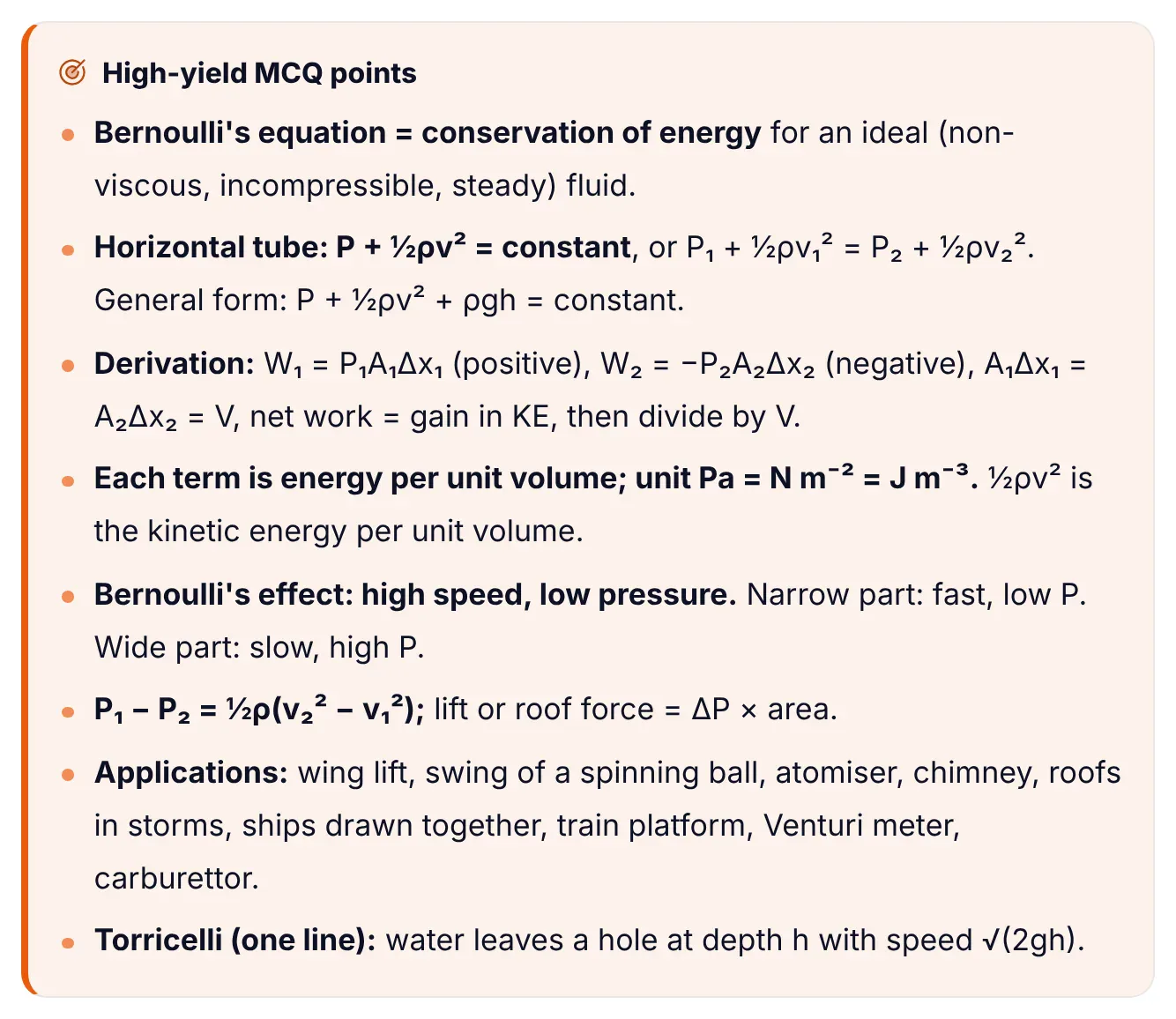
The short answer: Bernoulli's principle says that for an ideal fluid in steady flow, wherever the fluid moves faster its pressure is lower (at the same height). Bernoulli's equation is P + ½ρv2 + ρgh = constant, which is the law of conservation of energy for a moving fluid. In a horizontal pipe it becomes P + ½ρv2 = constant, so the narrow, fast part has the lowest pressure. For MDCAT, learn the equation, the units of each term, and the rule "speed up, pressure down".
What Bernoulli's principle means
A flowing fluid has three quantities that Bernoulli's equation links together: its pressure (P), its speed (v) and its height (h). Bernoulli's principle is the plain-language result: where the speed is high, the pressure is low, and where the speed is low, the pressure is high (for flow at the same level). ePrepare's notes call this Bernoulli's effect.
The equation is written for an ideal fluid, so MDCAT often asks for these conditions:
- Non-viscous: no fluid friction, so no energy is lost as heat.
- Incompressible: the density stays the same everywhere.
- Steady (streamline) flow: the velocity at any point does not change with time. Turbulent flow is not an assumption.
Keep the two laws of this chapter apart. The equation of continuity (A1v1 = A2v2) comes from conservation of mass and tells you the speed. Bernoulli's equation comes from conservation of energy and then tells you the pressure.
Bernoulli's equation: every symbol and unit
General form: P + ½ρv2 + ρgh = constant
Between two points: P1 + ½ρv12 + ρgh1 = P2 + ½ρv22 + ρgh2
Horizontal pipe (h1 = h2): P1 + ½ρv12 = P2 + ½ρv22, so P1 − P2 = ½ρ(v22 − v12)
| Symbol or term | Meaning | SI unit |
|---|---|---|
| P | Pressure of the fluid (pressure energy per unit volume) | Pa = N m−2 = J m−3 |
| ρ | Density of the fluid (water 1000, air about 1.2 to 1.3) | kg m−3 |
| v | Flow speed at that point | m s−1 |
| h | Height above a chosen reference level | m |
| g | Acceleration due to gravity (take 10 in MDCAT working) | m s−2 |
| ½ρv2 | Kinetic energy per unit volume | J m−3 = Pa |
| ρgh | Potential energy per unit volume | J m−3 = Pa |
Remember this: every term in Bernoulli's equation has the unit of pressure, Pa (N m−2 = J m−3), and the dimensions M L−1 T−2. That is why the terms can be added. An option in J or N for a pressure difference is always wrong.
One more result sits in the same family: Torricelli's result. Water leaving a small hole at depth h below the open surface of a tank has speed v = √(2gh), the same as a body falling freely through h. MDCAT needs only this one line.
The derivation idea (horizontal tube)
The FSc derivation is long on paper, but MDCAT asks only about its logic. Take a horizontal tube that is wide (area A1) on the left and narrow (area A2) on the right.
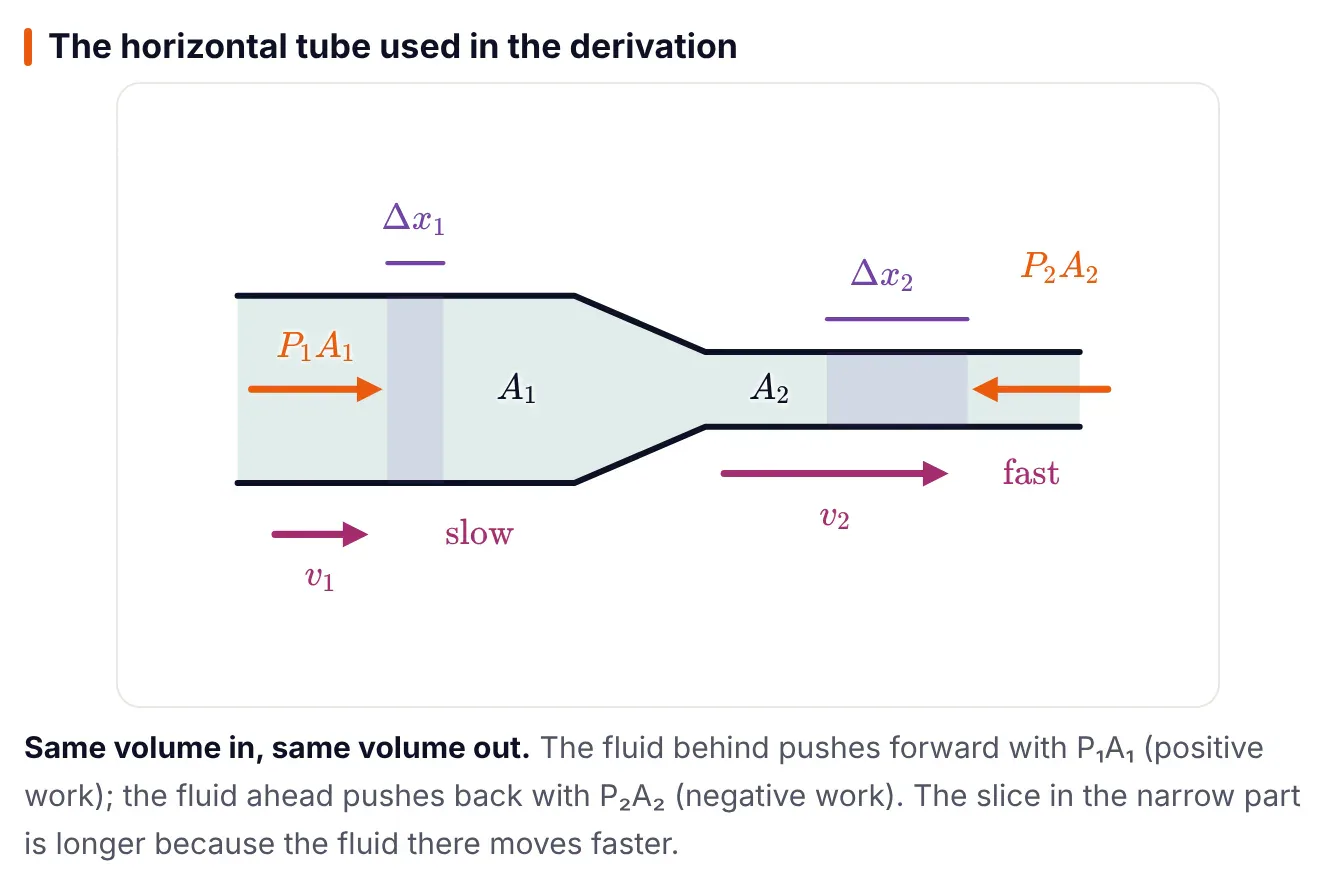
- Work on the left end: the fluid behind pushes forward with force P1A1 through Δx1, so W1 = P1A1Δx1 (positive).
- Work on the right end: the fluid ahead pushes back while our fluid moves forward (angle 180°), so W2 = −P2A2Δx2 (negative).
- Same volume: the fluid is incompressible, so A1Δx1 = A2Δx2 = V. Net work = (P1 − P2)V.
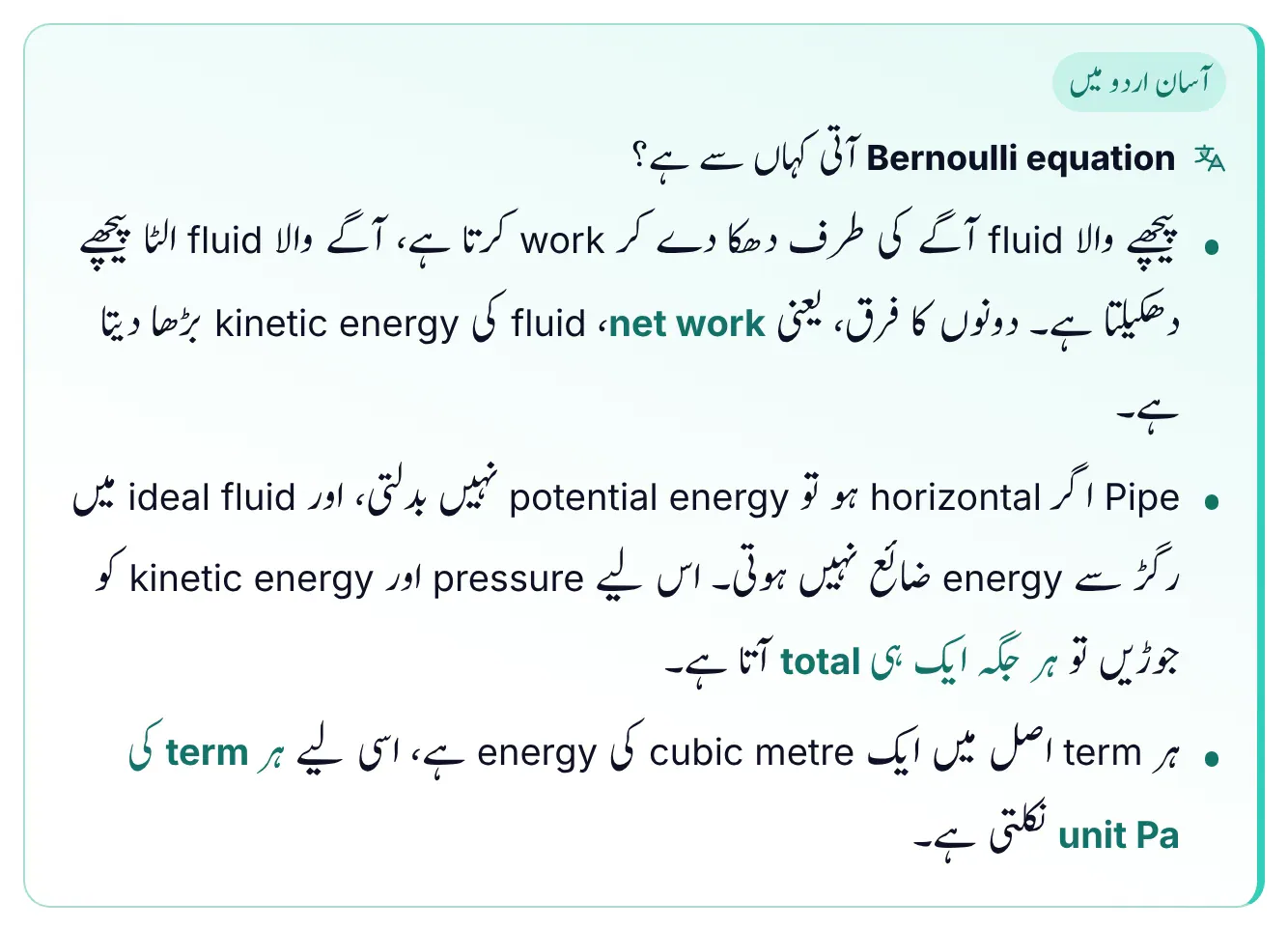
- Work-energy theorem: net work = gain in kinetic energy = ½ρV(v22 − v12), using m = ρV. The tube is level, so potential energy does not change; the fluid is ideal, so nothing is lost to friction.
- Cancel V and rearrange: P1 + ½ρv12 = P2 + ½ρv22, that is, P + ½ρv2 = constant.
Typical MDCAT questions from this: "Bernoulli's equation is based on the conservation of…" (energy), "Why is W2 negative?" (force opposite to motion), and "Which is not an assumption?" (turbulent flow).
Why fast fluid has low pressure
Most students expect fast water to push harder. Bernoulli says the opposite, and there are two simple reasons:
- Energy reason: P + ½ρv2 is fixed along a level flow. If the ½ρv2 part grows, the P part must shrink by the same amount.
- Force reason (the easiest): fluid going from a wide part into a narrow part speeds up. To speed up, it needs a net forward push, and that push can only come from a higher pressure behind it (wide part) than in front of it (narrow part).
A jet from a hose stings your hand because your hand stops the water (a change in momentum). Inside the moving jet, the pressure is still low. Pressure is the sideways push of the fluid on the walls, and faster fluid pushes the walls less.
| Quantity | Wide part | Narrow part |
|---|---|---|
| Area | Large | Small |
| Speed (from continuity) | Low | High |
| Streamlines | Far apart | Crowded together |
| Kinetic energy per m3 | Small | Large |
| Pressure (from Bernoulli) | High | Low |
Worked numericals (no calculator)
Two habits make every Bernoulli numerical easy. First, square each speed, then subtract: ½ρ(v22 − v12), never ½ρ(v2 − v1)2. Second, for water ½ρ = 500, and for air with ρ = 1.2, ½ρ = 0.6. More shortcuts like these are collected in our guide to MDCAT Physics numericals without a calculator.
Example 1: pressure difference from two speeds
Water flows through a horizontal pipe at 1 m s−1 at point 1 and 3 m s−1 at point 2. Find P1 − P2.
- P1 − P2 = ½ρ(v22 − v12) = 500 × (9 − 1) = 500 × 8
- P1 − P2 = 4000 Pa = 4 kPa, higher at point 1, where the water is slower.
- Trap: 500 × (3 − 1)2 = 2000 Pa is wrong.
Example 2: the pipe narrows to half its diameter
Water flows at 2 m s−1 in a horizontal pipe where the pressure is 150 kPa. The pipe narrows to half its diameter. Find the speed and pressure in the narrow part.
- Area depends on d2, so half the diameter means a quarter of the area. Continuity: v2 = 4 × 2 = 8 m s−1.
- Pressure drop = 500 × (64 − 4) = 500 × 60 = 30 000 Pa = 30 kPa.
- P2 = 150 − 30 = 120 kPa. Faster flow, lower pressure.
Example 3: a roof in a storm
A wind of 20 m s−1 blows over a flat roof of area 50 m2. The air inside the house is still. Take the density of air as 1.2 kg m−3. Find the force on the roof.
- Inside v = 0, so only the outside speed counts: ΔP = ½ρv2 = 0.6 × 400 = 240 Pa.
- F = ΔP × A = 240 × 50 = 12 000 N, upward. The higher pressure inside pushes the roof up.
Example 4: lift on an aeroplane wing
Air (ρ = 1.2 kg m−3) moves over the top of a wing at 60 m s−1 and under it at 50 m s−1. The wing area is 15 m2. Find the lift.
- ΔP = 0.6 × (3600 − 2500) = 0.6 × 1100 = 660 Pa.
- Lift = ΔP × A = 660 × 15 = 9900 N.
- Trap: (60 − 50)2 = 100 gives only 60 Pa and 900 N.
Example 5: water rising in a pipe of uniform width (using ρgh)
Water flows up a vertical pipe of uniform cross-section. Find the pressure difference between two points 2 m apart.
- Uniform area, so by continuity the speed is the same at both points and the ½ρv2 terms cancel.
- Pbottom − Ptop = ρgh = 1000 × 10 × 2 = 20 000 Pa. The pressure falls as the water rises, even though its speed does not change.
Example 6: Torricelli's result
A small hole is made 5 m below the water surface of a large open tank. Find the speed of the water leaving it.
- v = √(2gh) = √(2 × 10 × 5) = √100 = 10 m s−1.
Applications of Bernoulli's principle asked in MDCAT
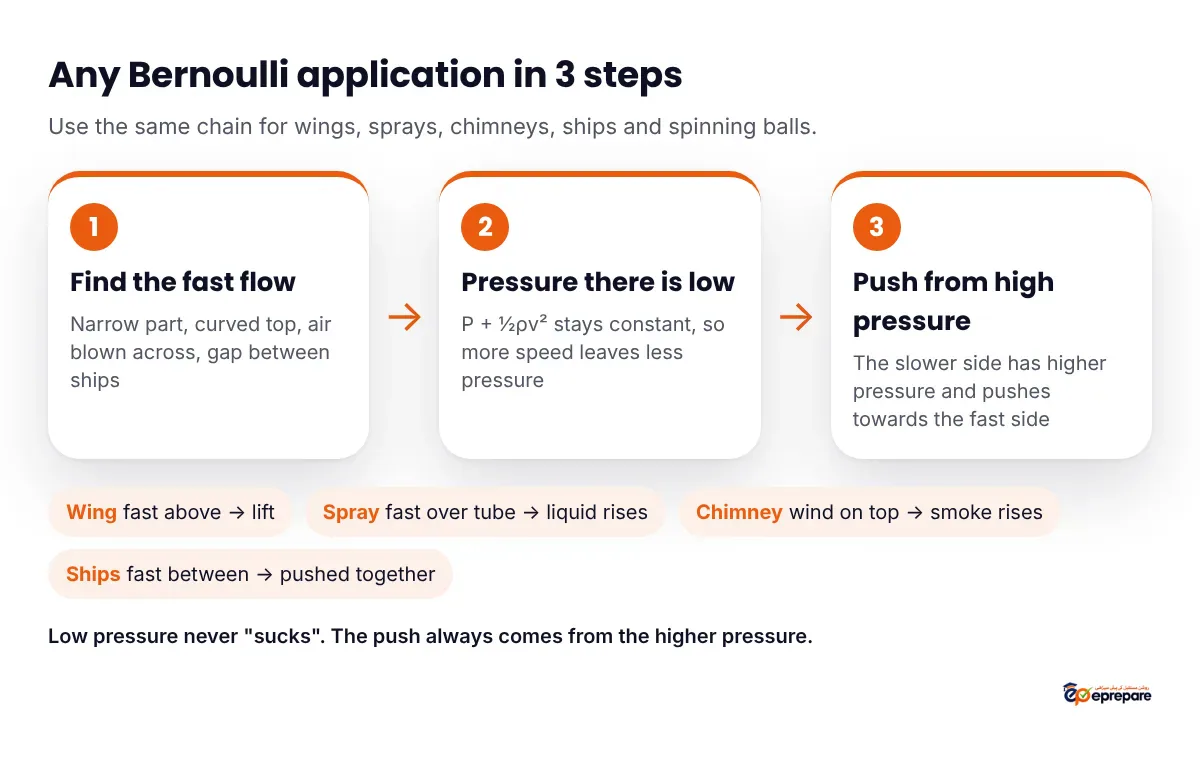
Every application follows the same three steps. Learn the method once and you can answer any new example in the exam hall.
Aeroplane lift
A wing (aerofoil) has a curved top and a nearly flat bottom. Air over the curved top travels faster, so the pressure above the wing is lower than below. The higher pressure under the wing pushes it up. This upward force is lift, and lift = ΔP × wing area.
Venturi meter
A Venturi meter is a pipe with a narrow throat. The fluid speeds up in the throat, so its pressure drops there. Two vertical tubes (or a manometer) show a taller column over the wide part and a shorter column over the throat. The measured pressure difference gives the flow speed through P1 − P2 = ½ρ(v22 − v12). When the speed in the wide part is small compared with the throat speed, this is close to P1 − P2 ≈ ½ρv22, a form some FSc books call the Venturi relation. The carburettor of an engine uses the same idea to draw in fuel.
Atomiser (perfume or paint spray)
Air is blown fast across the top of a thin tube dipped in the liquid. The pressure above the tube falls. The ordinary air pressure on the liquid surface in the bottle is now bigger, so it pushes the liquid up the tube, and the air stream breaks it into a fine spray.
Chimney on a windy day
Wind blowing across the top of a chimney is fast air, so the pressure at the top drops. The higher pressure of the air in the room pushes the smoke up faster. This is why a chimney draws better on a windy day.
Swing of a spinning ball
A spinning ball drags air round with it. On one side the ball's surface moves the same way as the air streaming past it, so the air there is faster and the pressure lower. On the other side the surface moves against the air and slows it. The ball swings towards the low-pressure (fast-air) side. ePrepare's notes give a quick rule: a ball swings the way its front surface is turning. This swing is also known as the Magnus effect.
Other examples in the same family
- Two ships or buses side by side: water or air squeezed between them moves faster, so they are pushed together.
- Fast train at a platform: a person standing too close is pushed towards the train. That is the reason for the safety line.
- Roof in a storm: the still air inside has higher pressure and can lift a light roof.
- Blowing over a strip of paper: the paper rises.
Blood flow and a narrowed artery
ePrepare's notes on blood physics apply the same two laws to an artery narrowed by fatty plaque (a stenosis). Learn the chain in order:
- Plaque makes the open area smaller.
- Continuity: the same volume of blood passes each second, so the blood speeds up in the narrowed part.
- Bernoulli: faster blood has lower pressure in the narrowed part.
- The pressure inside can fall below the pressure of the tissue outside, so the soft wall is pushed in and the artery partly closes.
- With the flow stopped, the pressure builds up again and forces it open. This repeated closing and opening is vascular flutter.
- The fast flow at the narrowing is turbulent, and turbulent flow makes a sound that a doctor hears with a stethoscope. Laminar flow is silent.
Watch for the two-pressure trap. The pressure inside the narrowed part is lower, but the pressure the heart must produce to keep the same flow is higher, which is why narrowed arteries go with high blood pressure.
Quick numerical: blood (ρ = 1060 kg m−3) flows at 0.5 m s−1; plaque reduces the area to one third. The speed becomes 3 × 0.5 = 1.5 m s−1. The pressure drop = 530 × (2.25 − 0.25) = 530 × 2 = 1060 Pa, about 8 mmHg (1 mmHg ≈ 133 Pa).
| Example | Where the flow is fast | Result |
|---|---|---|
| Aeroplane wing | Over the curved top | Lower pressure above: lift |
| Venturi meter, carburettor | In the narrow throat | Pressure drop gives the speed; draws in fuel |
| Atomiser, spray | Across the top of the tube | Liquid pushed up and sprayed |
| Chimney on a windy day | Across the top of the chimney | Smoke rises faster |
| Spinning ball | Side where the surface moves with the passing air | Ball swings towards that side |
| Ships or buses side by side | In the gap between them | Pushed together |
| Narrowed artery | In the narrowed part | Low pressure inside; wall pushed in; flutter |
Common mistakes
- "Faster fluid has higher pressure." Wrong. At the same height, faster fluid has lower pressure.
- "Low pressure sucks the liquid (or roof) up." Wrong. Low pressure cannot pull. The higher pressure on the other side pushes.
- "Bernoulli's equation is conservation of mass." Wrong. It is conservation of energy. Continuity is the mass law.
- Squaring the difference: ½ρ(v2 − v1)2 is wrong. Use ½ρ(v22 − v12).
- Forgetting the ½ in ½ρv2, or forgetting to multiply by area when the question asks for a force.
- "Two ships are pushed apart." Wrong. The fast water between them has low pressure, so they are pushed together.
- "The pressure rises in a narrowed artery." Wrong for the blood inside the narrowing. What rises is the pressure the heart must produce.
MDCAT-style practice MCQs
1. Bernoulli's equation is based on the law of conservation of:
A) mass B) energy C) momentum D) charge
Show answer
B) energy. The work done by pressure equals the gain in kinetic (and potential) energy of the fluid. Continuity is the mass law.
2. Water in a horizontal pipe flows from a wide section into a narrow section. In the narrow section:
A) speed rises, pressure falls B) speed rises, pressure rises C) speed falls, pressure rises D) both fall
Show answer
A). Continuity makes the water faster in the smaller area, and P + ½ρv2 = constant makes its pressure lower.
3. The term ½ρv2 has the same unit as:
A) energy, J B) force, N C) pressure, N m−2 D) power, W
Show answer
C). It is kinetic energy per unit volume: J m−3 = N m−2 = Pa.
4. Water (ρ = 1000 kg m−3) in a horizontal pipe flows at 1 m s−1 at point 1 and 3 m s−1 at point 2. P1 − P2 is:
A) 2000 Pa B) 4000 Pa C) 4500 Pa D) 8000 Pa
Show answer
B) 4000 Pa. 500 × (9 − 1) = 4000 Pa. 2000 Pa squares the difference; 8000 Pa forgets the ½.
5. A wind of 10 m s−1 blows over a roof of area 200 m2; the air inside is still (ρ of air = 1.2 kg m−3). The upward force on the roof is:
A) 1200 N B) 6000 N C) 12 000 N D) 24 000 N
Show answer
C) 12 000 N. ΔP = 0.6 × 100 = 60 Pa; F = 60 × 200 = 12 000 N. 24 000 N forgets the ½.
6. Two boats moving close together on parallel paths tend to:
A) move apart B) move towards each other C) stop D) stay exactly on course
Show answer
B). Water between them flows faster, so the pressure there is lower, and the higher outside pressure pushes them together.
7. In a perfume atomiser, the liquid rises up the tube because:
A) fast air raises the pressure above the tube B) fast air lowers the pressure above the tube C) gravity pulls it up D) the liquid is compressed
Show answer
B). The lower pressure above the tube lets the atmospheric pressure on the liquid surface push the liquid up.
8. In an artery narrowed by plaque, the blood in the narrowed part has:
A) lower speed and higher pressure B) higher speed and lower pressure C) higher speed and higher pressure D) the same speed and pressure
Show answer
B). Smaller area means higher speed (continuity), and higher speed means lower pressure (Bernoulli). The heart, however, must push harder.
Quick revision table
| Point | What to remember |
|---|---|
| Principle | Faster flow, lower pressure (same height) |
| Equation | P + ½ρv2 + ρgh = constant |
| Horizontal pipe | P1 − P2 = ½ρ(v22 − v12) |
| Based on | Conservation of energy (continuity is mass) |
| Assumptions | Non-viscous, incompressible, steady flow |
| Unit of each term | Pa = N m−2 = J m−3 |
| Force on wing or roof | ΔP × area |
| Torricelli | v = √(2gh) |
| Applications | Lift, Venturi meter, atomiser, chimney, spinning ball, ships, train platform, narrowed artery |
The full lesson, with the derivation, applications diagrams, easy-Urdu boxes and practice MCQs with explanations, is in ePrepare's MDCAT conceptual notes. To see where Fluid Dynamics sits among the other chapters, read MDCAT Physics high-yield chapters. Then practise Fluid Dynamics MCQs topic by topic with the Quiz Builder, and keep the ones you miss coming back with Wrong MCQs smart revision.
آسان الفاظ میں: جہاں fluid کی speed زیادہ ہو، وہاں pressure کم ہوتا ہے۔ Bernoulli equation یعنی P + ½ρv² + ρgh = constant، دراصل energy کی conservation ہے۔ Pressure کا فرق نکالتے وقت ہر speed کا الگ square کریں، پھر subtract کریں۔ Wing، spray، chimney یا ships، ہر سوال میں یہی دیکھیں کہ ہوا یا پانی کہاں تیز ہے، وہاں pressure کم ہوگا اور زیادہ pressure والی طرف سے دھکا لگے گا۔
Frequently asked questions
What is Bernoulli's principle in simple words?
Where a fluid moves faster, its pressure is lower, as long as the flow is at the same height and the fluid is ideal. It follows from Bernoulli's equation, P + ½ρv2 + ρgh = constant.
Is Bernoulli's equation based on conservation of mass or energy?
Energy. The equation of continuity, A1v1 = A2v2, is based on conservation of mass. This pairing is a favourite one-mark MDCAT question.
Do I need to memorise the full derivation for MDCAT?
No. Learn its logic: positive work at the inlet, negative work at the outlet, the same volume V at both ends, and net work equal to the gain in kinetic energy. MCQs test these steps, not the full write-up.
Why does an aeroplane wing get lift?
Air over the curved top moves faster than air underneath, so the pressure above is lower. The higher pressure below pushes the wing up. Lift = pressure difference × wing area.
How does Bernoulli's principle apply to blood flow?
In an artery narrowed by plaque, the blood speeds up (continuity) and its pressure in the narrowed part falls (Bernoulli). The outside tissue can then push the soft wall in, causing vascular flutter, and the turbulent flow makes a sound heard with a stethoscope.
What is the unit of each term in Bernoulli's equation?
Every term has the unit of pressure, the pascal: Pa = N m−2 = J m−3. Each term is an energy per unit volume.