Equivalent resistance numericals look easy in FSc Physics, then turn into a trap in MDCAT when five resistors are drawn in a strange shape and you have about a minute and no calculator. The good news: every one of these questions uses just two rules, a couple of shortcuts and a fixed order of steps. This guide teaches all of it with clean numbers, so you can solve series, parallel and mixed networks in your head.
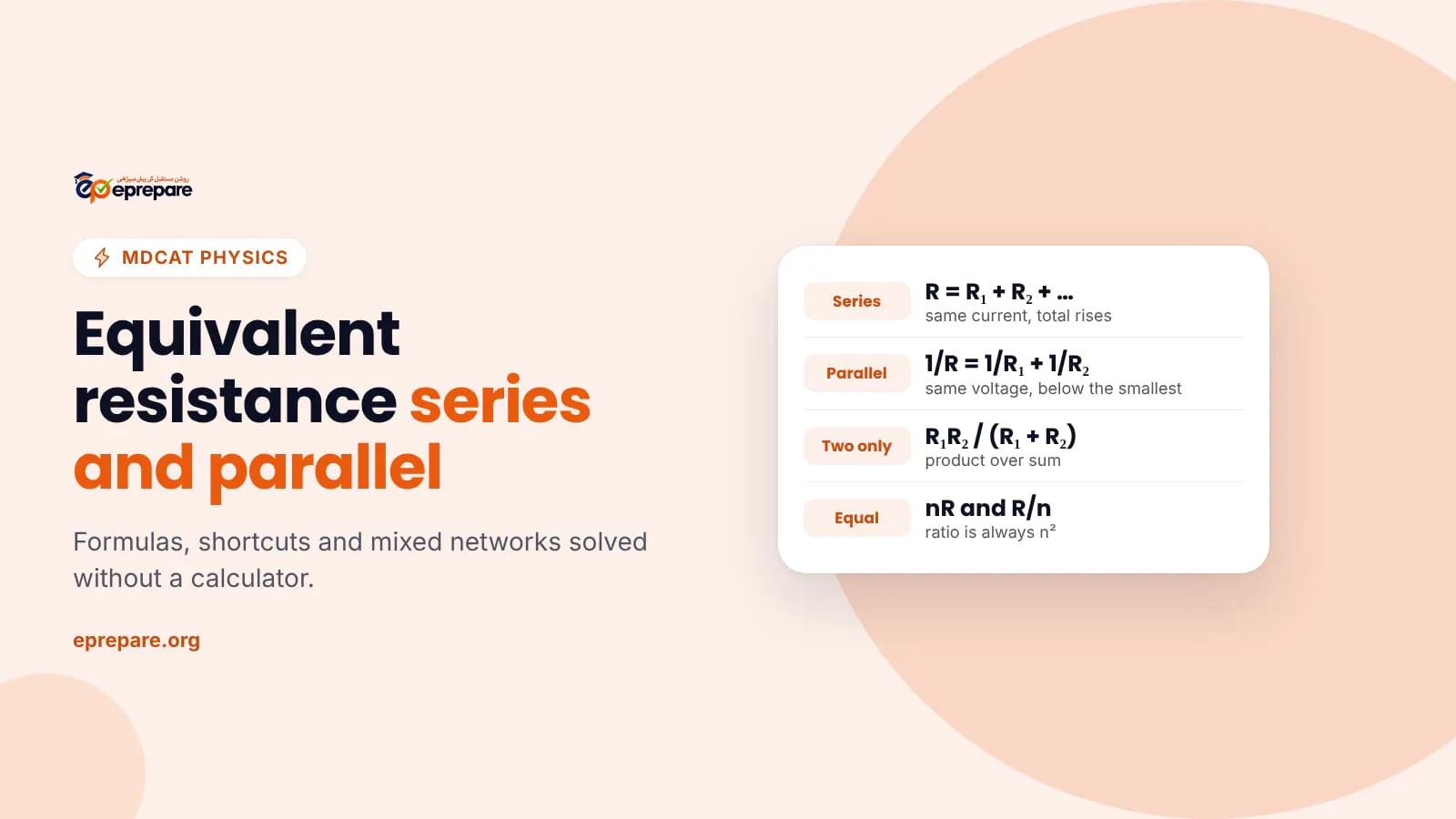
The short answer: In series, resistances add: R = R1 + R2 + R3 + … and the same current flows through each. In parallel, reciprocals add: 1/R = 1/R1 + 1/R2 + … and each resistor has the same voltage. For two resistors in parallel use product over sum, R1R2/(R1 + R2); for n equal resistors use nR (series) and R/n (parallel). A parallel total is always smaller than the smallest resistor.
Series and parallel: the idea behind the formulas
Equivalent resistance is the single resistor that could replace a whole group and draw the same current from the same supply. To find it, you only need to know which quantity is shared and which is the same.
- Series (one after another, a single path): the same current flows through every resistor. The supply voltage is shared, and the bigger resistor takes the bigger share. Adding resistors in series makes the path longer, so the total goes up and is bigger than the biggest one.
- Parallel (side by side, joined at both ends): every resistor has the same voltage across it. The current splits, and the smaller resistor takes the bigger share. Each new branch is an extra path, so the total goes down and is less than the smallest one.
This is exactly how ePrepare's conceptual notes for Current Electricity put it: in series "the same current flows through each resistor", in parallel "each resistor has the same voltage across it", and homes are wired in parallel so every appliance gets the full mains voltage and has its own switch.
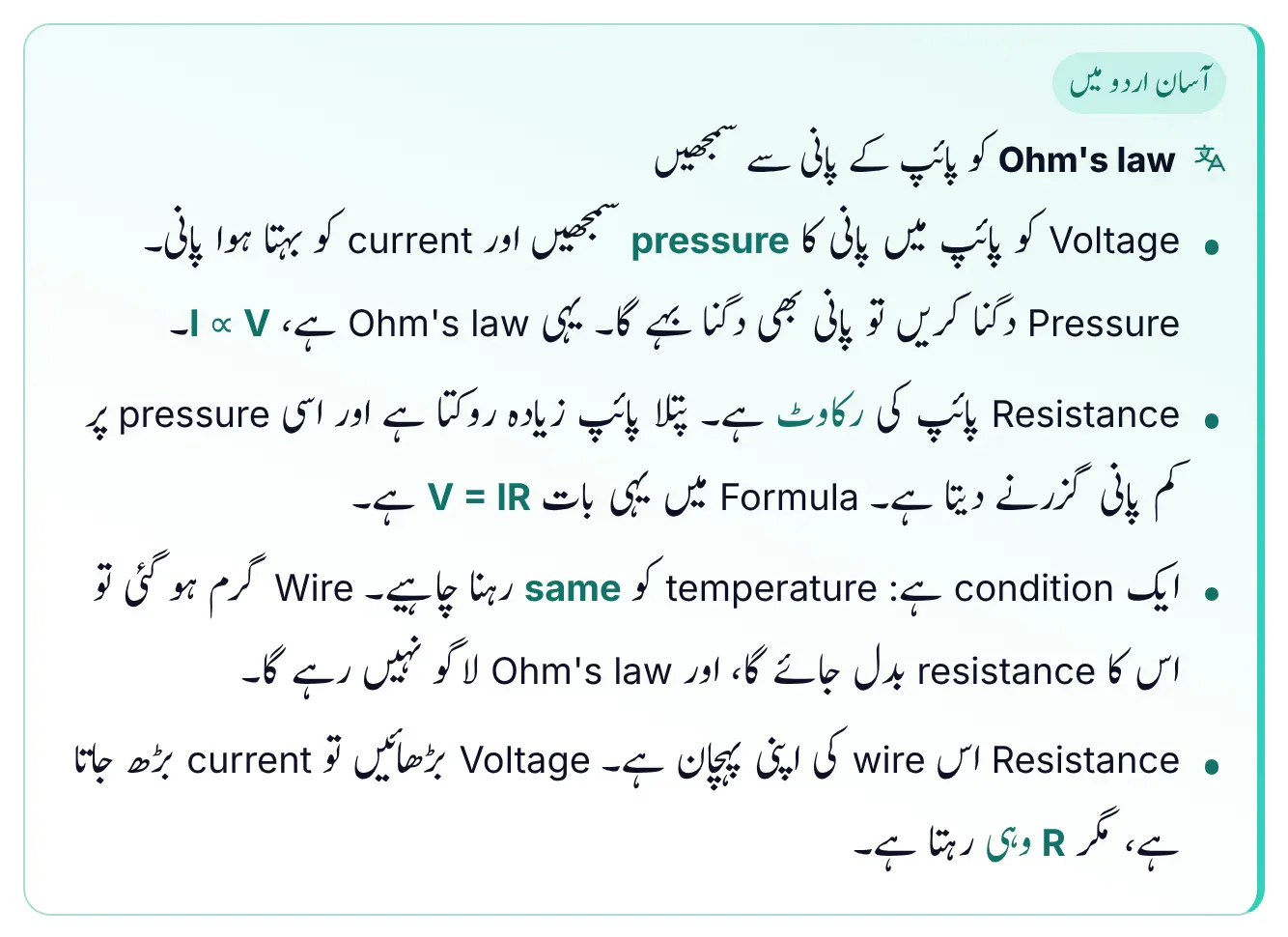
The pipe picture also explains parallel resistors. Two pipes side by side carry more water than either pipe alone, so two resistors in parallel let more current through than either alone: a smaller equivalent resistance.
Formulas with symbols and units
| Case | Formula | What stays the same |
|---|---|---|
| Series | Rs = R1 + R2 + R3 + … | Current I |
| Parallel | 1/Rp = 1/R1 + 1/R2 + 1/R3 + … | Voltage V |
| Two in parallel | Rp = R1R2 / (R1 + R2) | Voltage V |
| n equal resistors, series | Rs = nR | Current I |
| n equal resistors, parallel | Rp = R/n | Voltage V |
| Voltage divider (two in series) | V1 = V × R1 / (R1 + R2) | Current I |
| Current divider (two in parallel) | I1 = I × R2 / (R1 + R2) | Voltage V |
Symbols and units: R is resistance in ohms (Ω), where 1 Ω = 1 V A−1. V is potential difference in volts (V). I is current in amperes (A). n is a plain number (how many equal resistors). Conductance G = 1/R is measured in siemens (S), so in parallel the conductances simply add: G = G1 + G2.
Where do the formulas come from? In series, V = V1 + V2, so IR = IR1 + IR2; cancel I to get R = R1 + R2. In parallel, I = I1 + I2, so V/R = V/R1 + V/R2; cancel V to get the reciprocal rule.
Remember this: in the current divider, the current in R1 has the other resistor (R2) on top. Less resistance, more current. In the voltage divider, V1 has its own resistor on top. More resistance, more voltage.
Shortcuts that save time in MDCAT
- Product over sum works only for two resistors at a time. For three in parallel, combine two, then combine the answer with the third, or use the reciprocal rule.
- Equal resistors: n in series = nR, n in parallel = R/n. So the series value is always n² times the parallel value (four equal resistors: ratio 16).
- Two equal in parallel = half. 10 Ω ∥ 10 Ω = 5 Ω.
- Ratio 1 : 2 in parallel gives two-thirds of the smaller one: 3 ∥ 6 = 2 Ω, 4 ∥ 8 = 8/3 Ω, 6 ∥ 12 = 4 Ω.
- Ratio 1 : 3 in parallel gives three-quarters of the smaller one: 4 ∥ 12 = 3 Ω, 2 ∥ 6 = 1.5 Ω.
- Common-denominator trick: for 2, 3 and 6 Ω in parallel, write 1/2 + 1/3 + 1/6 as 3/6 + 2/6 + 1/6 = 6/6, so R = 1 Ω.
- Very big in parallel with very small: the total is just below the small one. 1 Ω ∥ 1000 Ω is a little less than 1 Ω.
- Anything in parallel with a plain wire (zero resistance) gives zero: it is short-circuited and carries no current.
- Wire cut into n equal parts and joined in parallel: each part is R/n, and n of them in parallel give R/n².
Step-by-step method for mixed networks
Mixed (series-parallel) networks are where marks are won or lost. Follow the same order every time:
- Mark the two end points (where the battery or the question's terminals connect).
- Find the innermost simple group: resistors that are clearly in series (one after another with no junction between them) or clearly in parallel (joined at the same two points).
- Replace that group with one resistor and redraw (even a rough sketch in the margin of your question paper helps).
- Repeat until one resistor is left. That is the equivalent resistance.
- Work backwards for currents and voltages: total current I = V/Req, then use the same current through series parts and the same voltage across parallel parts.
- Sanity check: a parallel group must come out smaller than its smallest member; currents into a junction must add up to the current out.
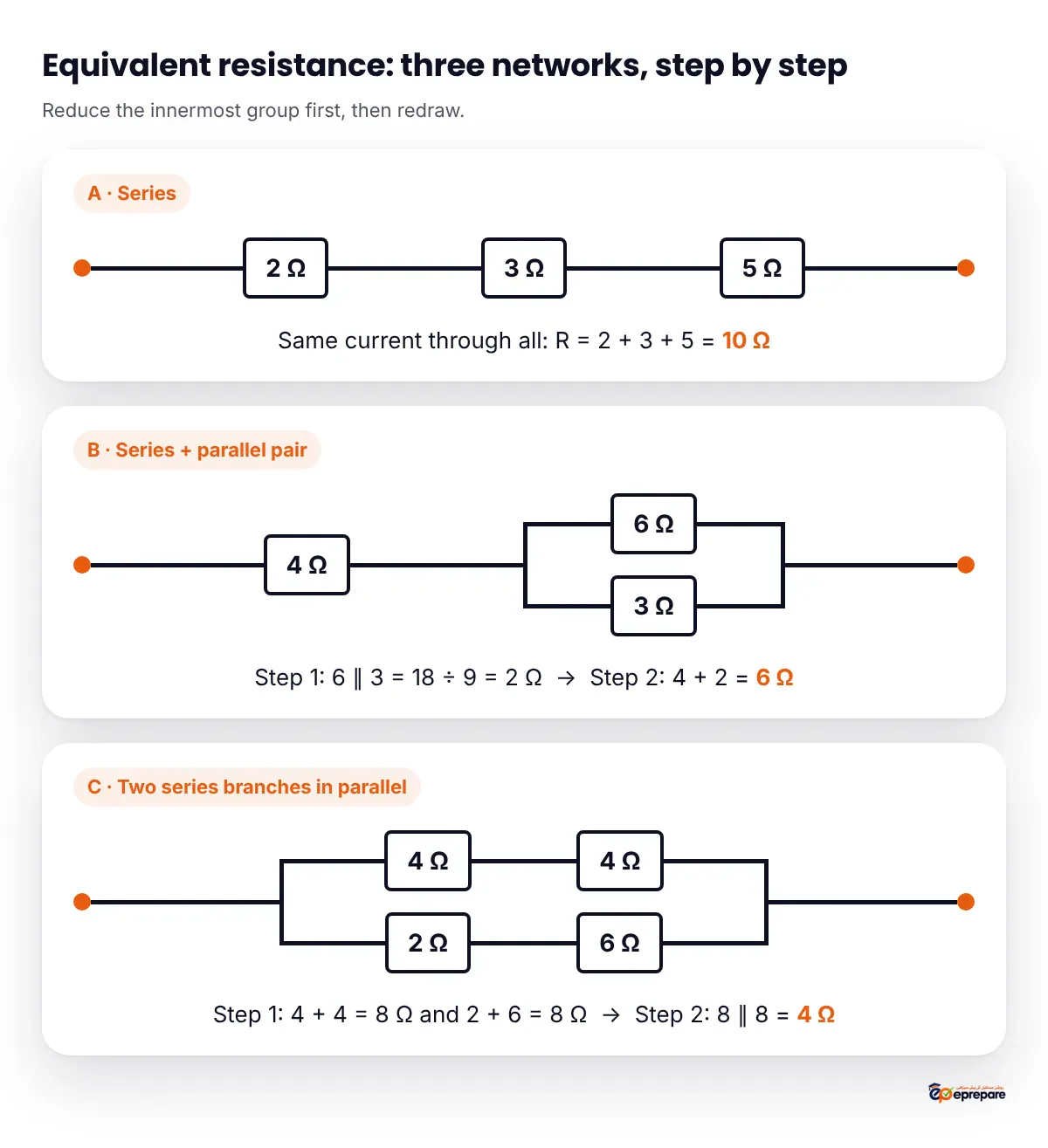
The figure below shows three networks of the kind MDCAT likes, reduced with exactly this method.
Worked numericals (no calculator)
Example 1: three resistors in series
Resistors of 2 Ω, 3 Ω and 5 Ω are joined in series to a 20 V battery. Find the equivalent resistance, the current and the voltage across each.
- Rs = 2 + 3 + 5 = 10 Ω
- I = V/R = 20/10 = 2 A (the same in every resistor)
- V2Ω = 2 × 2 = 4 V, V3Ω = 2 × 3 = 6 V, V5Ω = 2 × 5 = 10 V
- Check: 4 + 6 + 10 = 20 V. The biggest resistor takes the biggest share.
Example 2: two resistors in parallel, with currents
A 4 Ω and a 12 Ω resistor are connected in parallel across a 6 V battery. Find the equivalent resistance and the current in each.
- Rp = (4 × 12)/(4 + 12) = 48/16 = 3 Ω (less than 4 Ω, as it must be)
- Total current I = 6/3 = 2 A
- Each has the full 6 V: I4Ω = 6/4 = 1.5 A, I12Ω = 6/12 = 0.5 A
- Check: 1.5 + 0.5 = 2 A. The smaller resistor takes three times the current, because 12 is three times 4.
Example 3: three unequal resistors in parallel
Find the equivalent resistance of 2 Ω, 3 Ω and 6 Ω in parallel.
- 1/R = 1/2 + 1/3 + 1/6
- Common denominator 6: 3/6 + 2/6 + 1/6 = 6/6 = 1
- R = 1 Ω. Do not forget to turn 1/R upside down at the end (here it happens to be 1 either way, but for 1/R = 1/2 the answer is 2 Ω, not 0.5 Ω).
Example 4: n identical resistors
Five 10 Ω resistors are joined first in series, then in parallel. Find both values and their ratio.
- Series: nR = 5 × 10 = 50 Ω
- Parallel: R/n = 10/5 = 2 Ω
- Ratio Rs : Rp = 50 : 2 = 25 : 1 = n². The n² rule lets you answer "how many resistors?" questions instantly.
Example 5: series plus a parallel pair (network B)
A 4 Ω resistor is in series with a parallel pair of 6 Ω and 3 Ω. A 12 V battery is connected across the whole network. Find Req, the battery current and the current in the 6 Ω resistor.
- Innermost group first: 6 ∥ 3 = 18/9 = 2 Ω
- Now 4 Ω and 2 Ω are in series: Req = 4 + 2 = 6 Ω
- Battery current I = 12/6 = 2 A; all of it passes through the 4 Ω resistor
- Voltage across the parallel pair = I × 2 Ω = 4 V (and 2 × 4 = 8 V across the 4 Ω; 8 + 4 = 12 V)
- I6Ω = 4/6 = 2/3 A, I3Ω = 4/3 A. Check: 2/3 + 4/3 = 2 A.
Example 6: two series branches in parallel (network C)
One branch has 4 Ω and 4 Ω in series; the other has 2 Ω and 6 Ω in series. The two branches are joined in parallel. Find Req.
- Branch 1: 4 + 4 = 8 Ω. Branch 2: 2 + 6 = 8 Ω
- Two equal resistances in parallel: 8/2 = 4 Ω
- A common slip is to put all four resistors "in parallel". Resistors inside a branch are in series; only the two complete branches are in parallel.
Example 7: current division
A current of 10 A enters a junction and splits between a 2 Ω and an 8 Ω resistor in parallel. Find the current in each.
- I2Ω = 10 × 8/(2 + 8) = 10 × 0.8 = 8 A
- I8Ω = 10 × 2/(2 + 8) = 2 A
- Check: currents are in the inverse ratio of the resistances, 8 : 2 = 4 : 1, while the resistances are 1 : 4.
Example 8: what happens when you add a resistor in parallel?
A 6 Ω resistor is connected to a 12 V battery of negligible internal resistance. A second 6 Ω resistor is then connected in parallel with it. What happens to the total resistance, the battery current and the current in the first resistor?
- Before: R = 6 Ω, I = 12/6 = 2 A
- After: R = 6/2 = 3 Ω (it falls), battery current = 12/3 = 4 A (it doubles)
- The first resistor still has 12 V across it, so it still carries 12/6 = 2 A. The extra 2 A goes through the new branch.
- With a real cell (some internal resistance r), the larger current makes the terminal voltage drop a little, which is why lamps in parallel dim slightly when more are switched on.
Example 9: cutting a wire
A uniform wire of resistance 16 Ω is cut into four equal pieces, which are then joined in parallel. Find the new resistance.
- Each piece has a quarter of the length, so a quarter of the resistance: 16/4 = 4 Ω
- Four 4 Ω pieces in parallel: 4/4 = 1 Ω
- Shortcut: R/n² = 16/16 = 1 Ω.
Linking it to the I–V graph
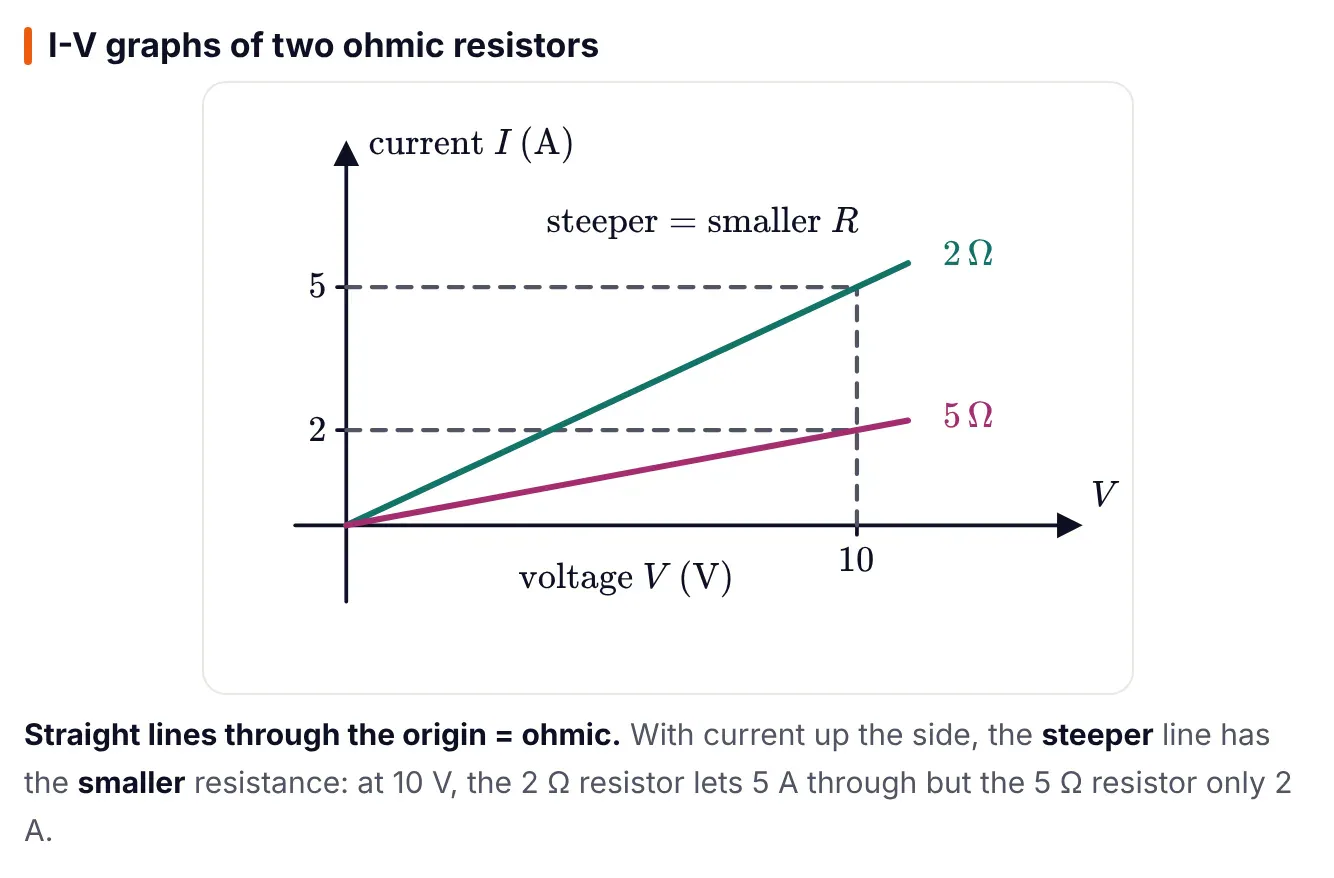
This graph is a favourite MCQ setting. Put the two resistors in parallel and, at 10 V, the currents add: 5 + 2 = 7 A, so the combination's line is steeper than both (R = 10/7 Ω, smaller than 2 Ω). Put them in series and R = 7 Ω, so its line is flatter than both. Always read the axes first: if voltage is on the y-axis, the slope is R itself and steeper means bigger resistance.
Common mistakes
- Forgetting to flip 1/R. If 1/R = 1/2 + 1/4 = 3/4, then R = 4/3 Ω, not 3/4 Ω.
- Using product over sum for three resistors. (2 × 3 × 6)/(2 + 3 + 6) = 36/11 Ω is wrong; the correct answer is 1 Ω.
- Calling any two neighbouring resistors "parallel". Parallel means joined at the same two points. If there is a junction between them, check again.
- A parallel answer bigger than the smallest resistor. If 3 ∥ 6 comes out as 4.5 Ω, you averaged instead of combining. It must be below 3 Ω (it is 2 Ω).
- Thinking that adding a resistor always increases resistance. True only in series. Adding any resistor in parallel lowers the total, even a huge one.
- Swapping the current-divider formula. The current in R1 is I × R2/(R1 + R2), with the other resistor on top.
- Splitting voltage in parallel. Parallel resistors do not share the voltage; each gets the full voltage of that pair.
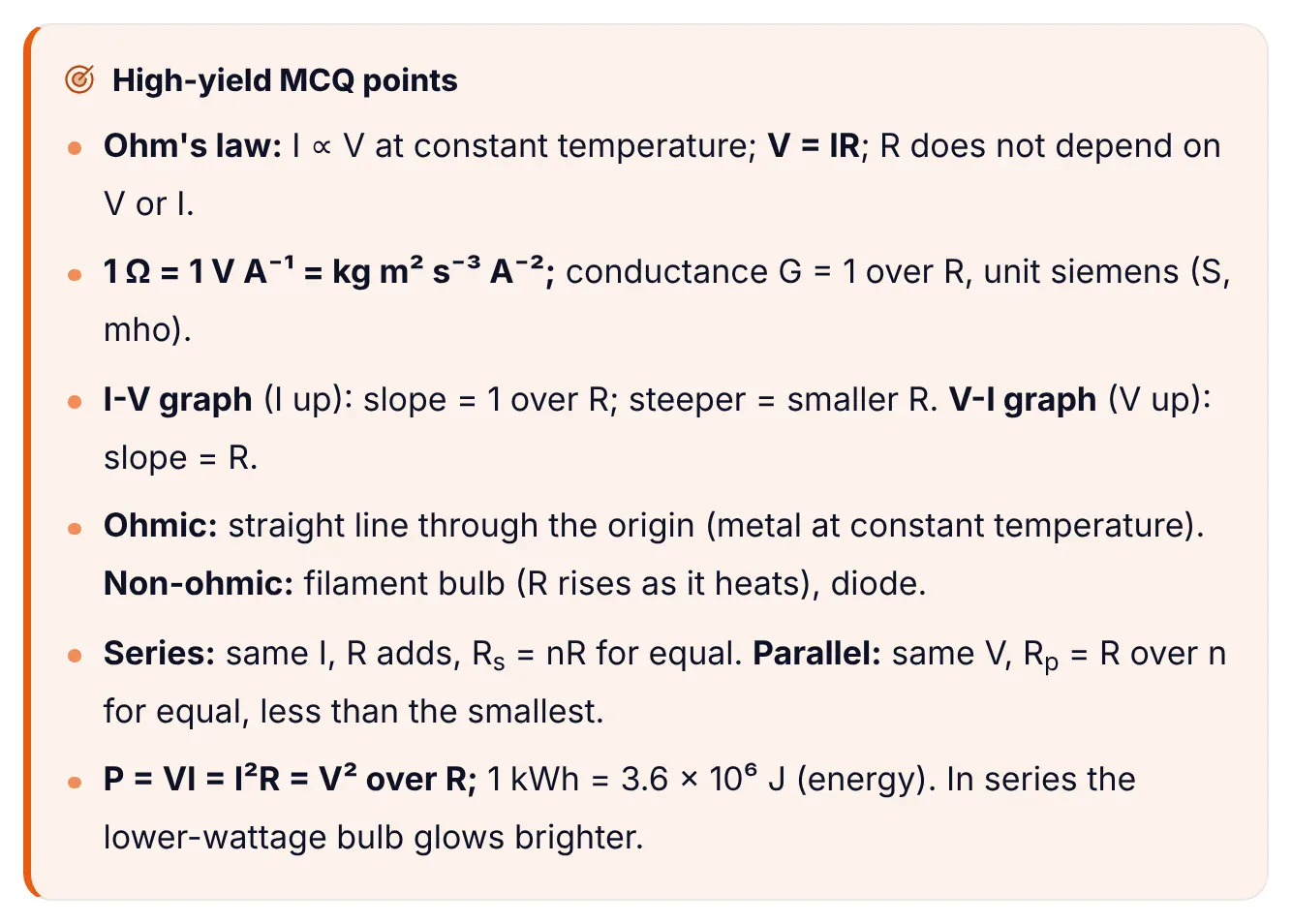
MDCAT-style practice MCQs
1. Resistors of 4 Ω and 12 Ω are connected in parallel. The equivalent resistance is:
A. 16 Ω B. 8 Ω C. 3 Ω D. 0.33 Ω
Show answer
C. 3 Ω. Product over sum: 48/16 = 3 Ω. 16 Ω is the series value; 0.33 Ω is 1/R not turned upside down.
2. Three resistors of 6 Ω each are connected in parallel. The equivalent resistance is:
A. 2 Ω B. 18 Ω C. 3 Ω D. 6 Ω
Show answer
A. 2 Ω. n equal resistors in parallel give R/n = 6/3 = 2 Ω.
3. Some identical resistors give 50 Ω in series and 2 Ω in parallel. How many resistors are there?
A. 25 B. 10 C. 4 D. 5
Show answer
D. 5. Rs/Rp = n² = 50/2 = 25, so n = 5. Choosing 25 forgets to take the square root.
4. Three 3 Ω resistors are all used together. Which equivalent resistance is NOT possible?
A. 9 Ω B. 6 Ω C. 4.5 Ω D. 2 Ω
Show answer
B. 6 Ω. The four arrangements give 9 Ω (all series), 1 Ω (all parallel), 4.5 Ω (two in parallel, then the third in series: 1.5 + 3) and 2 Ω (two in series, then in parallel with the third: 6 ∥ 3). 6 Ω needs only two resistors.
5. A wire of resistance 9 Ω is cut into three equal parts, which are joined in parallel. The new resistance is:
A. 3 Ω B. 1 Ω C. 27 Ω D. 9 Ω
Show answer
B. 1 Ω. Each part is 3 Ω; three in parallel give 3/3 = 1 Ω (shortcut R/n² = 9/9).
6. A third resistor is connected in parallel with two resistors already in parallel across an ideal battery. Which statement is correct?
A. Total resistance increases and battery current decreases
B. Total resistance decreases and battery current increases
C. Total resistance and battery current both stay the same
D. Total resistance decreases and the current in each old resistor decreases
Show answer
B. An extra branch is an extra path, so R falls and the battery supplies more current. Each old resistor still has the same voltage, so its own current does not change (rules out D).
7. A current of 12 A divides between 3 Ω and 6 Ω resistors in parallel. The current in the 6 Ω resistor is:
A. 8 A B. 6 A C. 4 A D. 2 A
Show answer
C. 4 A. I6Ω = 12 × 3/(3 + 6) = 4 A. 8 A is the current in the 3 Ω resistor.
8. A 2 Ω resistor is in series with two 4 Ω resistors that are in parallel with each other. The network is connected to an 8 V battery. The current drawn from the battery is:
A. 2 A B. 0.8 A C. 1 A D. 4 A
Show answer
A. 2 A. 4 ∥ 4 = 2 Ω; plus 2 Ω in series gives 4 Ω; I = 8/4 = 2 A. 0.8 A comes from adding all three as if in series (10 Ω).
Quick revision table
| Point | Series | Parallel |
|---|---|---|
| Same in each resistor | Current | Voltage |
| Shared between resistors | Voltage (bigger R, bigger share) | Current (smaller R, bigger share) |
| Total resistance | R1 + R2 + … | 1/R = 1/R1 + 1/R2 + … |
| Compared with members | Bigger than the biggest | Smaller than the smallest |
| n equal resistors | nR | R/n |
| Two resistors | R1 + R2 | R1R2/(R1 + R2) |
| Adding one more resistor | Total rises | Total falls |
| One component fails (open) | Whole circuit stops | Others keep working |
| Power formula to use | P = I2R (bigger R, more power) | P = V2/R (smaller R, more power) |
خلاصہ: series میں current ہر resistor میں same رہتا ہے اور resistances سیدھی add ہوتی ہیں۔ Parallel میں voltage same رہتا ہے، 1/R add ہوتے ہیں، اور جواب ہمیشہ سب سے چھوٹے resistor سے بھی کم آتا ہے۔ دو resistors ہوں تو product over sum لگائیں، اور برابر resistors ہوں تو series میں nR اور parallel میں R/n۔ Mixed circuit میں ہمیشہ اندر والے group سے شروع کریں۔
For the full lesson, with the series and parallel diagram, more worked examples on power and the kWh, and practice MCQs with explanations in English and easy Urdu, open the Current Electricity chapter in ePrepare's MDCAT conceptual notes. To see where this chapter sits among the topics that score most, read MDCAT Physics high-yield chapters, and for more calculator-free tricks across the syllabus, see how to solve MDCAT Physics numericals without a calculator. When you are ready to test yourself, build a timed Current Electricity test with the ePrepare Quiz Builder, and let Wrong MCQs smart revision bring back the ones you miss.
Frequently asked questions
What is the formula for equivalent resistance in parallel?
1/R = 1/R1 + 1/R2 + 1/R3 + … Add the reciprocals, then turn the answer upside down. For only two resistors, the faster form is R1R2/(R1 + R2).
Why is the equivalent resistance in parallel less than the smallest resistor?
Each branch is an extra path for current. With the same voltage across the group, more paths let more total current flow, and more current for the same voltage means less resistance. Even adding a very large resistor in parallel lowers the total slightly.
Can I use product over sum for three resistors?
No. Product over sum is only for two resistors. For three, combine any two with product over sum, then combine that answer with the third, or use the full reciprocal formula.
How do I know if resistors are in series or parallel in a complicated diagram?
Resistors are in series if the same current must pass through both, with no junction between them. They are in parallel if both ends of each are connected to the same two points. Mark the junctions with letters; two resistors between the same pair of letters are in parallel.
What happens to the current when a resistor is added in parallel?
The total resistance falls, so the current from the supply rises. With an ideal battery, the current in the resistors already there does not change, because their voltage is the same. With a real cell, the terminal voltage drops a little because of internal resistance.
How many marks can Current Electricity bring in MDCAT?
Physics carries 36 of the 180 MCQs in the PM&DC MDCAT. Current Electricity is part of the Physics syllabus, and equivalent resistance is one of the most common numericals in that chapter. Check the chapter-wise weightage guide to plan your time.