If you study under the Federal Board (FBISE), you have probably heard a friend say "MDCAT comes from the Punjab book" or "KPK students have an advantage". It is an understandable worry: chapter numbers and the order of topics differ from board to board, and MDCAT is one paper for everyone. The good news is that MDCAT does not follow any one board's book. It follows PM&DC's syllabus. Once you learn to map your own textbook onto that syllabus, the board you study under matters much less.
The short answer: There is no single "MDCAT textbook". MDCAT is set from PM&DC's uniform MDCAT curriculum, which lists every unit, topic and learning outcome. FBISE students should keep their own FSc books as the main textbook, map each PMDC topic to the chapter and page where it sits in their book, and fill any gaps from notes that follow the PMDC units. Then practise MCQs written from more than one book's wording.
Which book does MDCAT follow?
None of them, strictly. PM&DC publishes a uniform MDCAT curriculum. It divides each subject into units, each unit into topics, and each topic into numbered learning outcomes. Biology has 16 units, Chemistry 20 and Physics 16; English has three themes and Logical Reasoning six. The paper pattern is the same for every candidate: 180 MCQs in 3 hours, with 81 Biology, 45 Chemistry, 36 Physics, 9 English and 9 Logical Reasoning MCQs, and no negative marking.
Questions are written to test those outcomes. A topic such as "Mode of Enzyme Action" (Biology outcome 6.2, "Explain mechanism of action of enzymes") is examinable whether your book explains it in two pages or in five. That is why the syllabus, not the book, should be your checklist.
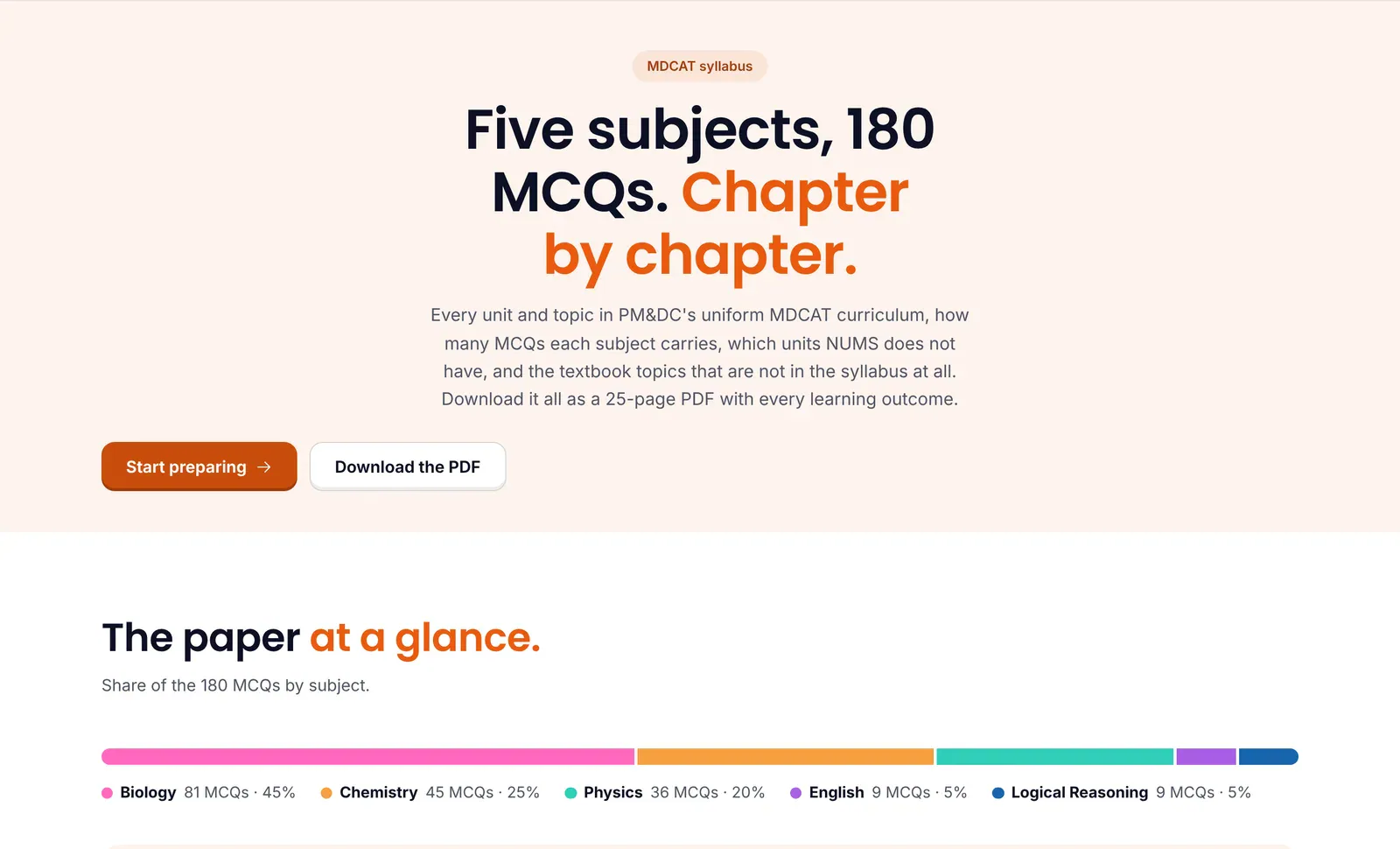
You can read the whole curriculum, unit by unit, on the MDCAT syllabus page, and a plain-language summary in the MDCAT syllabus guide.
What actually differs between board textbooks
Every board's FSc books teach the same sciences, so most PMDC topics are in every book. What changes is the packaging:
- Chapter numbers and order. "Chapter 5" in one book is not "Chapter 5" in another. Never plan with chapter numbers from someone else's book.
- Part 1 or Part 2. A topic can sit in the first-year book for one board and the second-year book for another, and one PMDC unit can be spread across more than one chapter.
- Depth and wording. One book may give a topic a full section with a diagram; another may give it a paragraph. MCQ writers often lift exact facts, numbers and examples, so thin coverage is a real risk.
- Extra topics. Every book has chapters that PMDC does not examine. You still need them for your board exam.
None of this means a Federal student is behind. It means every student, from any board, should check their book against the syllabus rather than trusting it blindly.
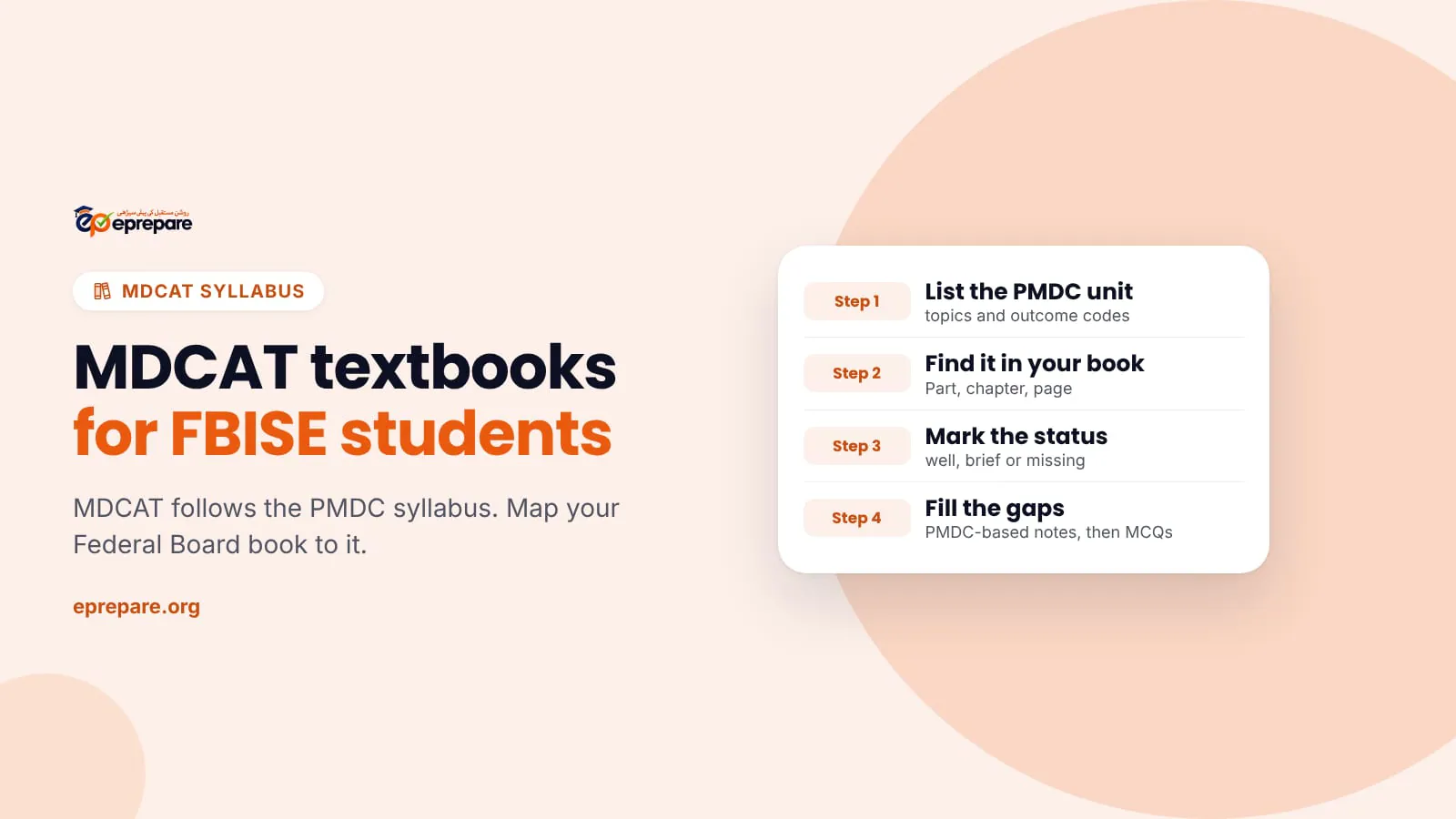
The mapping method, step by step
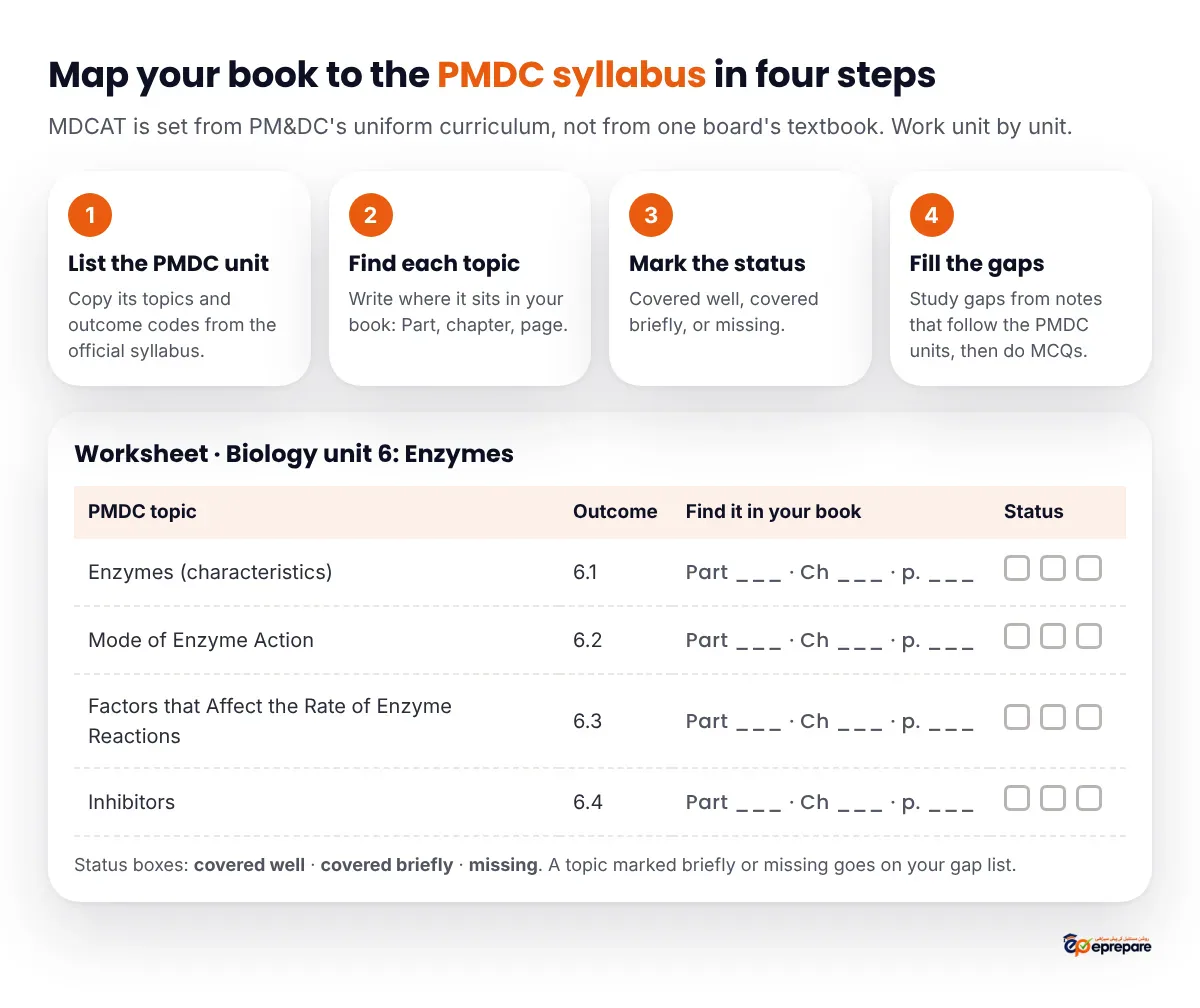
- List the PMDC unit. Open the syllabus and copy one unit's topics and outcome codes into a notebook or spreadsheet. Do one unit at a time.
- Find each topic in your book. Use the contents page and index of your FBISE textbook. Write Part (1 or 2), chapter and page next to each topic. Do not copy chapter numbers from friends who study other boards' books.
- Mark the status. Read the outcome, then the section in your book. Tick one box: covered well (you could answer an MCQ on it from the book alone), covered briefly (a mention, but no detail or diagram), or missing.
- Fill the gaps. For anything brief or missing, study the topic from notes that follow the PMDC units, then solve MCQs on it straight away so you know it stuck.
A whole subject takes a few evenings. After that, your gap list is short and specific, which is far better than a vague fear that "my book is different".
Ready-to-fill templates for four units
Here are templates for four units across the three sciences. The PMDC topic names and outcome codes are copied from PM&DC's curriculum. The book column is deliberately blank: fill it from your FBISE textbook, because only your copy of the book can tell you where each topic sits.
| PMDC topic | Outcomes | Find it in your book | Status |
|---|---|---|---|
| Mendel's laws of Inheritance | 10.1, 10.2 (independent assortment with an example) | Part ___, chapter ___, page ___ | well / brief / missing |
| Gene linkage and crossing over | 10.3, 10.4 (how linkage counters independent assortment) | Part ___, chapter ___, page ___ | well / brief / missing |
| X-linked recessive inheritance | 10.5 to 10.7 (sex-linkage, sex-linked traits, hemophilia) | Part ___, chapter ___, page ___ | well / brief / missing |
| PMDC topic | Outcomes | Find it in your book | Status |
|---|---|---|---|
| Urinary system and kidney | 15.1 (organs, kidney structure and function) | Part ___, chapter ___, page ___ | well / brief / missing |
| Homeostasis (kidney specifically) | 15.2 to 15.6 (filtration, reabsorption, secretion, kidney stones, kidney failure) | Part ___, chapter ___, page ___ | well / brief / missing |
| Thermoregulation | 15.7 | Part ___, chapter ___, page ___ | well / brief / missing |
| Excretion | 15.8 (nitrogenous compounds excreted) | Part ___, chapter ___, page ___ | well / brief / missing |
| PMDC topic | Outcomes | Find it in your book | Status |
|---|---|---|---|
| Nomenclature, structure and reactivity | 15.1 (IUPAC names), 15.2 (structure and reactivity of RX) | Part ___, chapter ___, page ___ | well / brief / missing |
| Substitution vs elimination | 15.3 (nucleophilic substitution: mechanism and types), 15.4 (elimination: mechanism and types) | Part ___, chapter ___, page ___ | well / brief / missing |
| PMDC topic | Outcomes | Find it in your book | Status |
|---|---|---|---|
| Terminal velocity | 5.1 | Part ___, chapter ___, page ___ | well / brief / missing |
| Fluid drag | 5.2 | Part ___, chapter ___, page ___ | well / brief / missing |
| Fluid flow | 5.3 to 5.5 (steady, incompressible, non-viscous flow; laminar to turbulent) | Part ___, chapter ___, page ___ | well / brief / missing |
| Equation of continuity | 5.6, 5.7 (Av = constant; conservation of mass) | Part ___, chapter ___, page ___ | well / brief / missing |
| Bernoulli's equation | 5.8 to 5.10 (blood physics, derivation for a horizontal tube, Bernoulli's effect) | Part ___, chapter ___, page ___ | well / brief / missing |
Remember this: plan with PMDC unit names, not chapter numbers. "Fluid dynamics" means the same thing to every MDCAT candidate; "Chapter 6" does not.
What to do with each status
| Status | What it means | What to do |
|---|---|---|
| Covered well | Your book explains it fully | Study from your book, then solve MCQs on the topic |
| Covered briefly | A mention, without detail, numbers or a diagram | Read the book first, then the PMDC-based notes for the missing detail, then MCQs |
| Missing | Not in your book (or not where you looked) | Check the index once more, then learn it from PMDC-based notes and MCQs |
| In your book, not in PMDC | Board-only content | Study it for your board exam; give it no MDCAT time |
For the last row, ePrepare's syllabus page lists textbook topics that neither PM&DC's curriculum nor the NUMS 2026 syllabus includes: in Biology, cell division (mitosis and meiosis), ecology and ecosystems, and DNA replication and protein synthesis; in Physics, measurements, gravitation, deformation of solids, optics, the second law of thermodynamics, Kirchhoff's laws, transistors and logic gates, the photoelectric effect, X-rays, and fission and fusion; in Chemistry, environmental and analytical chemistry, colligative properties and amines. Keep these for the board, and always confirm against PM&DC's notice for your exam year.
Which resources to use alongside your FBISE book
1. Your own FBISE textbooks (main book)
They are what your board exam is set from, and your FSc marks are 40% of your aggregate. Keep them as the base for both exams. If you are juggling both, see how to balance FSc board exams and MDCAT.
2. Notes that follow the PMDC units
ePrepare's conceptual notes are organised by the PMDC units themselves: 16 Biology chapters, 20 Chemistry chapters and 16 Physics chapters, matching the 16, 20 and 16 PMDC units, plus 11 English chapters. That makes them a natural place to fill the gaps on your worksheet, because each chapter is already arranged the way the syllabus is.
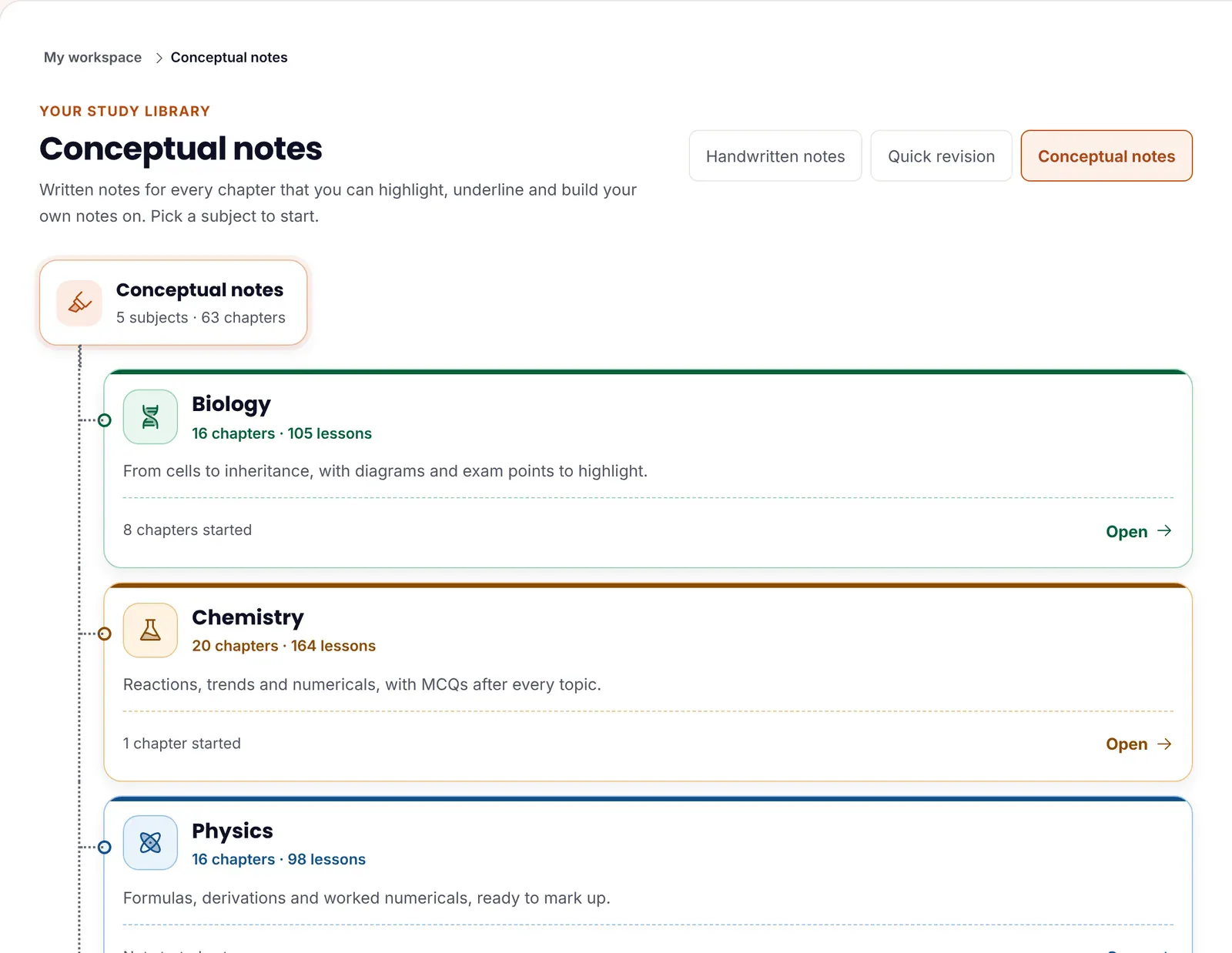
Each lesson has easy-Urdu explanation boxes (science terms kept in English), diagrams, memory tricks, common mistakes, practice MCQs with explanations, and an "Exam points only" switch for fast revision. More in ePrepare's conceptual notes for MDCAT.
3. MCQs written from more than one book
Reading one book and testing yourself with MCQs from the same book can hide gaps. ePrepare's exercise MCQs cover the KPK, Federal and Punjab books, so you can practise your own book's exercises and meet other books' wording too. Bookline MCQs turn every line of the KPK textbooks into MCQs; for a Federal student they work as extra practice in a second book's wording, not as a replacement for your own book.
4. Past papers
Past MDCAT papers show how PMDC-style questions are actually worded. ePrepare files past paper MCQs by province; see the MDCAT past papers guide.
Should an FBISE student buy another board's book?
Usually not. Reading a second full set of FSc books costs weeks and mostly repeats what you already know. The mapping method finds the few topics that need extra material, and you can fill those from PMDC-based notes. If a teacher recommends another book for one specific chapter, use it for that chapter only, as a reference.
English and Logical Reasoning are not tied to any book
The 9 English MCQs test reading, grammar and vocabulary, and the 9 Logical Reasoning MCQs test reasoning skills. No FSc textbook covers them in MDCAT style, for any board. Give each a short weekly slot from the start. See MDCAT English grammar topics and MDCAT logical reasoning questions.
Common mistakes
- Switching books in panic. Changing to another board's books halfway through the year usually costs more than it gains.
- Using chapter numbers from friends. A friend's "Chapter 9" may not be your "Chapter 9". Use PMDC unit names.
- Skipping the "briefly covered" topics. These are where MCQs on exact facts catch you.
- Spending MDCAT time on board-only chapters. Study them for the board, but do not let them eat MDCAT revision time.
- Treating the book as the syllabus. The syllabus is PM&DC's document. The book is how you learn it.
آسان الفاظ میں: MDCAT کسی ایک board کی کتاب سے نہیں بلکہ PMDC کے syllabus سے آتا ہے۔ Federal Board والے طلبہ اپنی ہی کتاب کو بنیاد بنائیں۔ PMDC کے ہر unit کا ہر topic لکھیں، پھر اپنی کتاب میں ڈھونڈ کر Part، chapter اور page لکھیں۔ جو topic کم یا بالکل نہ ملے، اسے ایسے notes سے پڑھیں جو PMDC کے units کے مطابق ہوں، اور فوراً MCQs حل کریں۔ دوسروں کے chapter numbers پر بھروسہ نہ کریں، unit کے نام سے plan بنائیں۔
Frequently asked questions
Is MDCAT based on the Punjab or KPK textbook?
No. MDCAT is set from PM&DC's uniform MDCAT curriculum, which lists units, topics and learning outcomes. Every board's FSc books cover most of it, but none of them is "the" MDCAT book.
Is the FBISE syllabus enough for MDCAT?
Your FBISE books cover most of the PMDC syllabus, like every board's books. Map them against the PMDC syllabus to find any topics that are thin or missing, and fill those from PMDC-based notes and MCQs.
Do Federal Board students need KPK or Punjab books for MDCAT?
Not as a second set of textbooks. It helps to practise MCQs written from other books' wording, which ePrepare's exercise MCQs (KPK, Federal and Punjab books) and Bookline MCQs (KPK books) give you, but your own book plus the gap list is enough as reading material.
Where can I download the PMDC MDCAT syllabus?
ePrepare's MDCAT syllabus page lists every unit and topic and offers the full curriculum, with every learning outcome, as a 25-page PDF. Always confirm against PM&DC's notice for your exam year.
Which university conducts MDCAT for Islamabad students?
In 2026, SZABMU Islamabad conducted MDCAT for Islamabad, AJK, GB and Riyadh. UHS Lahore conducted it for Punjab, Sukkur IBA University for Sindh, KMU Peshawar for KP and BUMHS Quetta for Balochistan. The syllabus and paper pattern were PM&DC's for all of them. Check the current year's announcement, as conducting universities can change.
Which chapters can an FBISE student skip for MDCAT?
Only chapters that are not in PM&DC's syllabus, such as cell division and ecology in Biology or optics and gravitation in Physics, and only for MDCAT. You still need them for your board exam.